Over the last half century, I have conducted anthropological fieldwork in the state of Gujarat, situated on the west coast of India. My first round in the early 1960s, when as a young student I was charged with collecting data for writing another village study, focused on the fading away of a system of agrarian bondage as it had been practiced from generation to generation. I analyzed the relationship under which agricultural laborers, with their wives and children, were attached to the households of the big landowners in the localities of my research in terms of patronage and exploitation. I followed up my fieldwork findings by going back to the archives, in India as well as in Britain, to learn about the historical antecedents of bondage: the social, political, and economic context in which the system of bondage, known as halipratha, operated and the reasons why it started to disintegrate in the late-colonial era.Footnote 1 More recently, I published a study in which I described in greater detail how bondage under the ancien regime came about, how colonial policy makers reacted to this institution of unfreedom, and which parties were at work during the struggle for national independence to try to dissolve the state of attachment in which agricultural laborers were forced to live.Footnote 2 Below, I will summarize some of my findings.
While my basic argument is that the type of bondage that used to exist has disappeared, in my ongoing field-based investigations in West India in subsequent decades I have often found practices at the bottom of both the rural and urban informal-sector economies that restrict labor's freedom of movement. Indebtedness is invariably what causes laborers to comply with a condition of employment that keeps them entrapped at the worksite. Employers use the payment of advance wages (“earnest money”) as a mechanism of attachment: The recipient has to repay the provider in labor if and when desired, for a price lower than the going market rate. The account that follows does not refer to sources other than my own writings, but the relationships I describe are, of course, also reported in many other publications that discuss ongoing practices of unfree labor in South Asia at large.Footnote 3
Employers who recruit migrant workers for an entire season are an important source for binding labor in a relationship of indebtedness. A wide variety of economic activities that take place in the open air make use of such “footloose labor” tied down in a cycle of production that begins at the start of the dry season and ends before the first rainfall. The seasonal migration of labor has been a worldwide phenomenon for quite some time. The transition to a capitalist mode of production put a premium on mobility, resulting in an increase in both the scale of migration and the distances covered. However, as the transformation of Western economies progressed in the late nineteenth century, the circulation of labor declined. On the one hand, increased and more regular employment reduced the pressure to migrate temporarily to work elsewhere, while on the other hand, industrialization made it possible for rural migrants to settle down in towns and cities. The mobility of labor in India, both rural-to-urban and intra-rural, started to gather momentum in the second half of the twentieth century. But the annual trek from village to distant worksite and back has not resulted in permanent settlement. The circulation of labor is going on, with no end in sight, as described in two case studies relating to the villages of my recurrent fieldwork in south Gujarat.
The Annual Trek to the Brick Kilns
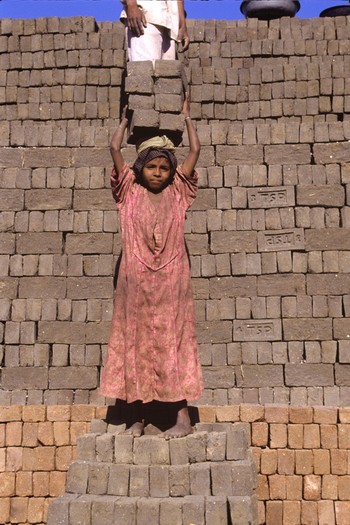
In the vicinity of Chikhligam, labor from far away is mobilized for a variety of activities, including the sugarcane harvest, road building, sand digging, and working in stone quarries. But large groups of laborers from south Gujarat go in search of work elsewhere, mostly in brick kilns. For many years, middlemen acting on behalf of brick manufacturers have recruited members of the land-poor and landless castes from Chikhligam. I have defined the modality of employment to which they are recruited as neo-bondage. Let me first explain why I see this arrangement as a form of labor bondage. During the monsoon, when the subsistence deficit in the landless neighborhoods is at its most urgent because of lack of work and income, the recruiting agent arrives to hand out earnest money that commits the recipient to leave the village two or three months later to go work in the brick fields. When the migrants arrive at the worksite, the jobber or labor recruiter (mukadam) becomes the foreman of the gang he has contracted. The manner of recruitment is the same as that of the earlier hali, who was not forced to become a farm servant but offered his services “voluntarily” to a master who was prepared to pay him an advance, usually to enable him to marry. The bondage relationship usually started with a debt, which is also true of the laborer nowadays, who surrenders his freedom of movement at the moment he accepts an advance from the jobber. Just like the hali—the bonded farm servant who had to work for his master until the debt was paid off—the seasonal worker cannot leave the brick kiln until he has worked off the advance payment. Once the debt has been cleared, he should be free to leave, but his wage is then held back after a deduction of a weekly amount to cover his daily requirements, and paid in a lump sum when he returns home at the end of the season. If he leaves the kiln prematurely, he loses the net balance of seven months' work. He can ask for a new advance in the meantime, but if he does, too often he may have very little left at the end, perhaps just enough to pay for the journey home. Sometimes the migrant may even leave the kiln with a debt if he has received a large advance from the owner or the mukadam—for example, to arrange for his own wedding or that of another family member—an advance that cannot be paid off with one season's work.
I refer to this situation of indebtedness as neo-bondage because despite its resemblance to the previous practice of halipratha, there are significant differences. Both situations lead to loss of freedom of movement, but in the case of the seasonal migrants, the advance they receive binds them only for the season. The agreement is not, as with the halis, the start of a relationship that often lasts for life or is even kept intact from generation to generation. Secondly, it applies only to the laborer, whereas when a hali was employed, his wife and children were usually in the master's service, too. That is not necessarily the case for the brick makers. The jobber pays earnest money for the wives and children, depending on their productive capacity. Sometimes members of the same family even hire themselves out to different mukadams so that they can obtain a higher advance payment. Lastly, seasonal migrants are hired purely on the basis of a labor contract. The noneconomic aspects of patronage that were so characteristic of halipratha, the halis' function as an indicator of their masters' power and prestige, play no part in the kiln owners' decision to hire labor. They are not feudal patrons who surround themselves with clients but capitalist entrepreneurs who satisfy their time-bound demand for labor by recruiting workers in the rural hinterland. They do this with the aid of jobbers and in such a way that the army of migrant men, women, and children is immobilized as long as their presence is needed and sent back when the season is over. If they lose their productive capacity, they are a burden to the employer. Their temporary employment entitles them to no additional benefits. While the halis' masters were willing to provide support in cases of illness or old age, the kiln owners resolutely refuse to provide any guarantee of survival for their employees.
The more bricks this young girl can carry, the higher her weekly advance will be. Photograph by Ravi Agarwal, from Down and Out: Labouring under Global Capitalism (Oxford, 2000).

It is certainly not my intention to exaggerate the extent to which halis could solicit support and protection under the old system of patronage, but the seasonal migrants are not better off under a labor regime in which they are treated as commodities. Being unable to work affects not only those suffering from illness, but also the other members of the team because the work is based on the active participation of men, women, and children in the production process. One evening, I was taken to a brick kiln that had been opened in Chikhligam—which, of course, used labor from elsewhere—to see a young girl of about fifteen who had symptoms of malaria. I found her lying on the ground under a couple of jute sacks, shivering with fever. Her younger sister came now and again and shook her gently, trying to get her to go to work because she was unable to carry all the bricks away from the base plate by herself. The labor power of her sick sister was needed to eliminate the backlog. When she had done this, she could lie down again, although for no longer than ten minutes.Footnote 4
The relationship between the jobbers and the laborers is contractual, but they are relatively close to each other. There is no great difference in social identity, such as that between the dhaniyamo (master) and the halis (servants). The labor contractors come from the same background as the migrants. They are part of the footloose army for many years until the kiln owner asks them to act as intermediaries and gives them a sum of money to recruit labor. To be eligible for the position of jobber, they must have experience with the work, possess the qualities required to act as an intermediary, and have a certain amount of property that can be used as security in the event that the agreed number of migrants do not show up. These criteria explain why outsiders cannot be middlemen. How completely wrong things can go is shown by the case of D., an Anavil Brahmin and former village head of Chikhligam, who saw labor contracting as an attractive source of additional income. For many years he had witnessed the departure of seasonal migrants to the brickworks, whose owners regularly visited the village to gain information from him about the reputation of recruiters and workers. D. reckoned that he was better qualified than anybody else to streamline this demand for temporary labor according to the requirements of modern times. After all, members of the low castes in the village trusted him, and a man of his social background would find it easy to convince distant employers of his integrity and intelligence. D. took up matters in a big way and, according to him, entered into contracts to supply some thousands of workers to the brick-making industry of Bombay and south Gujarat from Chikhligam and adjacent villages. He even accompanied the first contingent of some hundreds to Bombay. However, the factory owners there, who had indeed provided him in good faith with a large amount of credit, were dissatisfied with the poor quality of the workers with whom he arrived. When these bosses continued to refuse payment of the commission he had been promised on deliverance of the gangs, D. loaded all his workers into lorries one night and took them to other brick yards in Surat. My landless informants burst out in laughter as they told me about this adventure.Footnote 5
Nearly all jobbers are Dhodhias, a tribal caste of land-poor peasants, who have first worked in the kilns themselves. They are therefore thoroughly familiar with the situation in the kilns, know what work to give to whom, and how to make sure it gets done properly. They are appointed as middlemen because of their good service record and their willingness in preceding years to act as an agent in the village for their own jobber. They give him information on suitable candidates, who will come with their wives and children, for recruitment and act as witnesses when the earnest money is paid out. In this way, they show their suitability to act as jobbers themselves and are eventually promoted. The Dhodhias have the advantage of owning some property—land and cattle—that they can offer as security against the debt the seasonal migrants have entered into. That is why very few jobbers are Halpatis, a tribal caste of agricultural laborers. In Chikhligam, L. succeeded in being promoted to the position of jobber, but he was unable to sustain it. At the time I noted the following:
L. is again working as brick-maker having acted as jobber and gang boss for two years. He was ruined by a couple of migrants who had agreed to go with him at the start of the second season but failed to show up at the time of departure. At that late date, he was unable to find replacements, according to him due to lack of solidarity of Dhodhia mukadams in the village. They are prepared to help one another, but they spread a rumour about L. that the brickworks' owner had no faith in his ability as a gang boss. The patron was angry when L. arrived with fewer workers than he had promised and deducted the advances given in the monsoon to the missing workers from his commission. But this was not all the damage. Two members of his gang returned home early due to illness with the result that the output of the others was reduced. The upshot was that at the end of the second year he was indebted to the owner of the brickworks. According to the calculations of the latter at least, with the result he had to return to the village without a penny in his pocket.Footnote 6
Jobbers are the guardians of the routes leading from the village to the outside world. They know how to deal with employers and to make sure the members of their gang do the work they have agreed to do, to pay out the weekly living allowance, to keep production going until the end of the season, and to mete out punishment in the knowledge that they will be backed up by their principals. The debt the migrants enter into commits them to obedience and a show of deference in the same way that the halis had to respect their dhaniyamo. The migrant workers, however, have much more opportunity to escape the grips of the jobber/gang boss, and this is perhaps the greatest difference between traditional bondage and neo-bondage. Often they are cheated by one or the other. They are not able to check the balance of pay they take home with them at the end of the season. Protesting against maltreatment or underpayment when they leave is ineffective. All they can do is choose a different jobber the next season and go to work at a different kiln.
The reserve army of underpaid and underemployed labor has to stand by in the hinterland until the time comes to leave, but this does not mean these workers behave as a docile and helpless mass who, having received their advance, have no other choice than to accept their bondage from the moment they leave the village to the day they are sent home again at the end of the season. The jobbers have to keep a constant eye on them to ensure that they actually stick to the agreement to leave when the time comes. Some laborers accept earnest money from more than one jobber. The jobbers protect themselves against such deceit or disloyalty by keeping in contact with each other and drawing up a blacklist of clients who do not honor their contracts. When I came back to Chikhli in 1986, I was foolish enough to accept a ride in a jeep. Vehicles rarely enter the isolated landless neighborhood, and when the inhabitants saw the dust cloud announcing my arrival they fled into the fields, thinking that it was the mukadam who had come, together with the brick owner, to pick up those who had not turned up when the migrants left for the kiln a couple of weeks earlier. Complaints of ill health are not accepted as a good excuse for not turning up. The least these no-show cases could expect was a beating, and if they still refused to go, they would have to find a replacement. There is no point in demanding repayment of the advance, since the landless have hardly any property that can be confiscated in place of payment. What is often presented as deceit on the part of the migrants, however, can be fraud by the jobber, who has kept back some of the credit for himself rather than paying it out as an advance. The employers are aware of such practices and replace the mukadam if the scale of “bad debts” becomes too high. The jobber is a necessary evil but needs to be kept under close surveillance, according to a kiln owner with whom I have remained in contact for many years.
An example is a jobber I had known for some time, whom I met again during the 1986 monsoon when he was staying with the owner of a petrol pump sited on the main road from Chikhli to Valsad. Here he meets the migrants recruited for him by a new gang boss. In exchange for placing their thumbprint on a paper, they are given the first installment of the promised cash advance. But the patron has armed himself against the deceit by which he had formerly been victimized. He takes a photo of each contracted worker. The flash that accompanies the making of the portrait is not really necessary, but its use dramatically stresses the importance of the proceedings. In a loud voice he then says that this evidence will be a great help to the police if the workers try to defraud him. In an aside, he tells me that he turns down anyone who refuses to follow his order to look straight into the camera when he is taking the photograph.Footnote 7
But the seasonal migrants do not allow themselves to be intimidated by these threats. Both parties are fully aware that trying to get compensation from them for failing to keep their part of the agreement is doomed in advance. The workers toe the line as long as it is in their own interests but do not hesitate to back out if that suits them better. Nor do they let their indebtedness stand in the way.
Harvesting Sugarcane in Neo-bondage
For many years, the Bardoli sugar cooperative recruited the majority of its cane cutters from Khandesh in the neighboring state of Maharasthra. During the monsoon, a staff member of the cooperative management was stationed in Dhulia town to recruit cutting teams from the surrounding villages. He did that by taking on jobbers, who each received a sum of money for putting together a gang of work teams and contracting them by giving them an advance. This earnest money was paid in several installments and came at a time when the village economy offered little work or income for the majority of land-poor farmers and landless laborers. This desperate situation was even worse in years when there was insufficient rainfall and going into debt was the only way that these households were able to survive. The jobbers had to sign written contracts that they had to follow to the letter: to leave when they were told to, to be at the designated locations with their gangs from the beginning to the end of the harvest campaign, and to supervise the work and ensure that it went as instructed. There were two kinds of teams. The gadavalas took an ox cart with them to transport the cane to the factory themselves. Four or five workers were needed for each cart: two to take the fully laden cart to the factory, while the other members made sure there was a new load of cane ready to load when the cart came back. Much more numerous were the koytavalas.Footnote 8 These were minimal cutting teams consisting of two members, usually a husband and wife. Children from the age of eight would also often take part in the work. These gangs did not transport the cane themselves but loaded it onto tractors and lorries sent by the factory. The gadavalas received higher advances than the koytavalas, but both groups were forced to sell their labor in advance to enable them to survive the slack season.
The army of harvesters increased in size from the 1960s onward, when the expansion of irrigated land allowed the agro industry to spread on the central plain. New cooperatives were set up in neighboring subdistricts. They built their own factories and modeled their activities on the formula that had proved so successful in Bardoli. They, too, chose not to employ local landless labor and recruited work gangs from the far-off hinterland, using the routes that the pioneers from Bardoli had opened up. The intermediaries who form the link between the cooperatives and the migrants are crucial to the recruitment process. They come from the same background as the cane cutters, have worked as cutters themselves for many years, and therefore know what is expected of them as a jobber: They must be sufficiently creditworthy; know when, how, and whom to recruit; direct the work during the campaign; and settle wages with their gang. Being too accommodating to either side can get the mukadams into trouble, but being unwilling to take risks or refusing to pay out more earnest money than the factory agent is willing to supply can also be costly. The labor brokers are in competition with one another and often have to take out high-interest loans from private moneylenders to make sure their teams are complete. But this does not mean that they have no sanctions at their disposal to make sure the seasonal migrants do as they say. These are applied with customary brutality when making up a gang of cutting teams. It is found wholly in order even by their victims that the mukadams should demand and eventually force their rights. The factories discharge the recruitment risks onto the labor brokers, who consequently shift these further down onto the actual workers. The cane cutters have no means of defending themselves against unjust or unreasonable claims and resign themselves to their fate or are at least not in a position to come out in open protest against it.Footnote 9
Upon arrival on the central plain, the army of thousands of cane cutters is immediately divided up among the various zones demarcated by the cooperative, an area within a radius of twenty to thirty kilometers of the factory. The gadavalas teams are sent to locations up to a distance of ten kilometers, while the koytavalas work in the fields further away. For their tentlike shelters, the migrants are issued a few bamboo poles and three mats or sheets of blue canvas. They erect these less than a yard from each other, leaving no room for the cutters to retreat in a niche of their own or to sleep in the intimacy of their family. After the evening meal they sit together around the fire on which the food is prepared. In the winter months they warm themselves against the cold evening air. These compact colonies, ranging from a few dozen to several hundred men, women, and children, are set up in open spaces on the roadside or at the edges of villages. They are temporary settlements, which take no more than a couple of hours to erect and can just as quickly be dismantled when all the fields in the immediate vicinity have been harvested. The removal to a new location takes place as quickly as possible, so that the cutters do not lose a working day. There are usually several gangs in each camp. The teams are clustered around their mukadam for protection and to ensure that they are always at his disposal. They lack even the most basic facilities, such as a latrine, and often have no drinking water. The migrants have to wash themselves and their clothes in the irrigation channels, which are badly polluted as a result of the excessive use of fertilizers and pesticides. The impossibility of observing even the most elementary rules of hygiene means that diseases are widespread, especially dysentery, diarrhea, malaria, and all kinds of infections. The camps are a filthy habitat that leaves no room for human dignity. From a short but continuous stay in two camps—of ten days and a week, respectively—it was chiefly the tiredness and dreariness of the khandeshis' existence that impressed me most strongly. People live packed very close to one another in extremely primitive conditions, often outside the regular family attachments and with an overrepresentation of young men and women. All sorts of social conventions and control mechanisms that apply back in their own village lose their significance and efficacy in this alien and harsh milieu. The mood in the camp is often tetchy, and small and unimportant differences of opinion easily blow up into fierce fights. The inhuman treatment that the cane cutters meet is unloosened between them in rancor and aggression.Footnote 10
The working day starts early and the men leave the camp first. The women come a little later, as they first have to prepare the food they take to the fields. The gang boss assigns each cutting team several rows of cane, which the men have to cut off close to the ground. The women follow on behind, cutting the cane stalks into smaller pieces and removing the leaves on the sides. If there is a child in the team, he or she makes the cut cane into bundles, tying it together with leaves. The work is heavy and has to be done quickly, with no protection for the feet against the stubble and no covering on arms and hands to prevent cuts from the sharp leaves. The midday break is short, just long enough to eat the meal. Water is fetched from an irrigation channel to drink and to wash the sweat off. The average daily yield is between 600 and 800 kilograms of cane, the equivalent of a ten-hour working day. Some teams finish before others, depending on their experience or the number of helpers for each cutter. The faster teams will sometimes help the slower ones, but if they are not closely related, they will come to some compensatory arrangement. At the end of the day, the gang members return to the camp. They walk back in a long, straggling procession, all arriving by the time darkness has fallen. My daily presence in both the camps and the fields made me realize the burden that the women have to bear. I quote from my field notes:
Although the cutting-knife is wielded mostly by the men, their helpers, usually the women, sometimes take over so that the men may rest. The cleaning, breaking and bundling of the canestalks, all very demanding tasks, are handled by the women. While the men drink some water or lie down exhausted during the short break, the women have to attend to infants they may have brought to the fields with them, the youngest not yet weaned. On returning to the camp at the end of the day, it is the women again who carry a bundle of wood for the cooking fire on their head, and back in the camp they have many chores to attend to.Footnote 11
The working day continues through the night. Milling the cane is an industrial process that continues without interruption, and the same applies to the transport of the cane cut during the day. The transport has to be spread out so that the roads to the factory and the site itself do not become congested with lorries, tractors, and ox carts unable to unload their cargo. The daily processing of large quantities of cane is a logistical operation that is worked out in great detail far in advance. The planning starts with the planting of the seed and goes through to the end of the growth cycles, fourteen to eighteen months later. On the phased harvest timetable, the fields in which the cane is ripe for cutting are grouped in clusters. The members of the cooperative therefore know when the cutters will be working on their land. Until that time, they have to follow the instructions of management to the letter. The cut cane has to be milled within eight hours or the sugar content will fall. This means that the koytavalas are picked up during the evening or at night to be taken by tractor or lorry from the camp to the field in which they were working during the day. The men never know when this is going to be, but they have to be ready to leave immediately to drag the bundles of cane to the roadside and load them onto the vehicles. That takes an hour to an hour and a half, after which they return to the camp, only to start the new working day a few hours later. The gadavalas are no better off. They take the cane to the factory themselves but have to wait their turn when they get there. Tractors and lorries have priority, and the ox carts have to wait for hours before they are unloaded. They form a buffer the factory can use to compensate for the uneven rhythm of the motorized vehicles, which may experience delays as the result of problems with loading or holdups en route. The frenzy not only continues throughout the day and night, but also there is no weekly free day, not even for religious festivals.
The mukadam tolerates absence only in the event of illness. Leave to return home for a short time is only granted on very rare occasions, for example the death of a close relative. If the cane cutters do not turn up for work, they do not get paid, and that is the last thing they can afford. On the other hand, the cutters are not paid if production comes to a standstill because a machine at the mill needs to be repaired for the fortnightly cleaning operation. And if the factory compound is too congested to continue unloading, or if a lorry has broken down on the road, this is radioed to the supervisors in the fields, and cutting is suspended for a few hours. Sometimes teams are instructed to cut more cane and to keep working for longer hours. In such cases, the factory management is not prepared to accept responsibility for any risk whatsoever, or to pay the extra costs. I concluded from all this that the army of cutters is entirely at the mercy of the sugar factory for around seven months, without even a minimum of labor rights. This means that the workers have no set times for eating, sleeping, or resting. These and other activities can only be managed if they are not on duty. But they are always expected to be so. For work, everything else must give way. Even several basic social habits in their way of life—for instance, that women eat after their husbands, that baths are taken or at least the mouth is rinsed early in the morning on rising—cannot be followed. For the duration of the harvest, everything turns on keeping the factory constantly supplied; yet this does not imply that there is any fixed rhythm. Every change that occurs—stoppage of the cutting, changes in the transport schedule, sudden orders (also) to cut double the quantity—has to be endured by the workers. The working day is long, knows no specific hours, and, moreover, is in part not paid for.Footnote 12
Labor is a factor of production without human value. That became clear to me when I tried to calculate how many workers were involved in the cutting, how long they worked, and what they earned. My questions remained unanswered by the factory administration. Only the mukadam knew how many members each gang contained and how the work was divided up among them. His job was to make sure the migrants did what they had been contracted to do: cut enough cane and make sure it got to the factory on time. I summarized this complete subordination of the army of harvesters to the labor regime in the title I gave to my report: “The Crushing of Cane and of Labour by the Co-operative Sugar Industry of Bardoli.”Footnote 13
What wages do the cane cutters receive, and when are they paid out? Each cutting team consisting of at least two members is required to harvest around a ton of cane a day, but the average throughout the campaign is around two-thirds to three-quarters of that, from 600 to 750 kilograms per day. One indicator of the level of productivity is that the size of the army of harvesters is thirty percent to forty percent larger than the volume of cane produced by the factory in tons per day. Wages are fixed on the basis of piecework. The rate of pay per ton is set every year, but the cutters are only told what it is at the end of the campaign and not beforehand. The factory management wants to know first what price it can get for the sugar. The financial administration draws up an account twice a month of how much cane each gang has cut on the basis of the slips written out by the slip-boys for each load of cane transported from the field. On arrival at the mill, the load is weighed and the exact quantity recorded. The mukadam comes to the mill every fortnight but does not receive the full pay his gang has earned. First, the advance he paid to the teams when they were recruited is deducted. Until the debt is paid off, the gang members receive only a grain allowance to meet their basic needs. The sacks of millet are delivered to the camp every fortnight. In addition to the allowance, the mukadam gives the head of each team a small amount of money to buy vegetables, dried fish, red pepper, and salt. Most of the men, however, use this pocket money to play dice or to buy tobacco and drink. Alongside the formal accounts, the mukadam keeps his own accounts to keep track of the money he has paid to the cutters, both the earnest money paid out at the start and anything else he has given them before departure or during the campaign. Once the cutters have worked off their debt, the mill still does not start to pay their full wages. Payment is postponed until the end of the campaign on the pretext that this is in the best interest of the workers themselves. On the last payday, the factory cashiers give the mukadams the balance of what their teams have earned. How the money is then distributed in the camps is no longer the responsibility of the mill management. And, of course, these intermediaries between the cooperative and the cutters find all kinds of ways to cheat the migrants. The latter have neither the knowledge nor the power to claim the amount they are actually due. The only weapon they have against fraudulent practices is to go and work for another mukadam the following season. But that is no guarantee that they will not be cheated again.
I have used the term neo-bondage to describe this labor contract, which commits the cane cutters to the regime imposed by the sugar factory from the start to the end of the harvest campaign. By accepting the advance, the migrants commit themselves to work to pay off the debt. But the state of bondage continues after the debt has been paid off because they only receive the wages they are due after they have harvested all the fields. In this way, the factory makes sure the migrants do not just pack up and go home. Their bondage is therefore founded not only in the fact that they receive a payment in advance, but also by the holding back of their wages until the work has been completed. This “custom,” as the employers call it, is an effective means of preempting opposition to the abominable working conditions. The workers withhold protest against the long working days, the pace of the work, the great distance to the fields, the continual moving from place to place, the low grain ration, and so on, for fear of incurring the displeasure of the employer.
I was actually staying in a koytavala camp on an important Maratha feast day that normally would have been celebrated. However, the order came down from the field manager that work had to go on as usual. Nevertheless, some of the gangs in a nearby camp did not turn up that day. The grain allowance to the cutters involved was immediately stopped for a week as punishment, and a work ban was put on them for the same period. The mukadams of the gangs concerned hurried to the factory to apologize—initially in vain. A day or two later they presented the managing director with a written statement in his office. In the most abject manner and words, they again acknowledged their disobedience, requested forgiveness, and promised never again to transgress the regulations. With ill grace and many stern words, the manager finally relented. He made a great show of filing their petition, gave permission for the ration of grain to be handed out, and rescinded the work ban.Footnote 14
In addition, the combination of advanced and postponed payment means that the laborers are at the mercy of the untrustworthy practices of the intermediaries, who provide credit at an exorbitant rate of interest. It would be incorrect to calculate the wages the laborers actually receive on the basis of the mill records. Although these show how little the cane cutters are paid for the heavy work they perform—much less than the minimum wage—the real extent to which they are underpaid is concealed by the machinations of the mukadam.
The nature of the seasonal migrants' bondage is different from that between hali and master. Firstly, the cane cutters only commit themselves for a limited period of time, which in theory does not exceed the duration of the harvest campaign. It also lacks any of the elements of patronage that committed master and servant to an all-embracing relationship with each other and that was automatically passed down from generation to generation. The mukadam stakes a claim to the labor power of the members of his gang and pays them a wage in return. The agreement is more specific by nature, is purely economic, and has nothing to do with the acquisition of power and status as an aim in itself. The middleman is after all a broker who works on commission and at his own risk and expense. He acts as an agent in finding workers, setting them to work, and paying them off at the end of the campaign. In theory, the migrants are free to offer their services to a different gang boss every year. In reality, however, they have learned that it often pays to stay with the same one. His gang consists of a fixed core of workers who remain loyal to him and who can rely on a wide range of favors. And they can ask him for credit for exceptional expenses, like a wedding or paying for a house. Such loans often take longer than one campaign to repay, which means that the contract is automatically extended for the following year. Jobbers with a bad name find it more difficult to recruit enough workers, but it also happens that they refuse to employ candidates who cannot work to full capacity or who have a reputation for being difficult. The gang boss supervises the daily work and is an indispensable link between the management and the workers. The company's office and field staff have no direct contact with the cane cutters, and the cutters fall completely under the authority of the gang boss. His word is law in the camp. He takes charge of setting up and dismantling the tents, collects the fortnightly ration from the factory and divides it up among the teams (they all receive the same amount, irrespective of the number of members in each team, and with deductions for days they have not worked through illness or for other reasons), and settles arguments between or even within teams. There is a small shop in the camp where the migrants can buy small items for their daily use. This is often run by the gang boss's wife or another family member, and customers can buy on credit, but up to a limit set by the gang boss. The far-reaching authority of the jobber-cum-gang-boss-cum-camp-leader becomes apparent when he is absent. Outsiders who speak directly to the cane cutters receive no answers to their questions but are referred to the mukadam. His authority expresses itself in his resolute treatment of those who are dependent on him, while his attitude to his superiors is typified by a moderated servitude and an ability to interact with them. Mukadams normally have little trouble in disciplining their workers, and even when this is done with the use of some force, they know that they can depend on the covert or even overt support of factory management. Intimidation can give rise to heated reaction, however, particularly when physical rather than verbal force is used. It would be quite inaccurate to picture the cane-cutting army as a docile mass of people whose spirit has been broken. Mukadams who handle their workers too drastically are likely to encounter some who are not afraid to show forcible resistance.Footnote 15
The low profile that the cane cutters adopt is not founded on a natural docility but on their awareness that they are in an alien environment and the fear of getting into trouble through ignorance of the appropriate code of conduct. The migrants rarely or never have contact with the local people in the area in which they spend more than half the year. This marginality is only part of the story. Their tendency to hide behind the mukadam for protection and their dependence on him reinforces the impression that the large army of harvest workers do not live in freedom. The final clause of the contract that the mukadam is made to sign with the mill commits him to leave the region with his gang as soon as the campaign is over.
The case studies reported above are based on practices I found in earlier rounds of my fieldwork. Is neo-bondage a phenomenon of the past that does not exist any longer or at least has gone down in magnitude? No. At the bottom of the informalized economy of India, neo-bondage is indeed rampant because the workforce suffers from lack of sufficient employment. Workers are hired and fired according to the need of the moment and receive for their labor power wages that are too low to live on. Consequently, the members of this huge reserve army have no alternative but to sell their labor power in advance and are thus entrapped in a state of indebtedness that takes away their freedom of movement. In a recent report, the International Labor Organization identified debt bondage as a form of unfree labor to which poor peasants and indigenous peoples in Asia and Latin America fall victim. In an edited volume, Isabelle Guerin, Aseem Prakash, and I have highlighted the linkage between past and present forms of labor bondage in the Indian subcontinent.Footnote 16