Introduction
Moving from a behavioral-based to a biological-based classification of mental disorders is a crucial step toward a precision-medicine approach in psychiatry. In this view, almost 10 years ago, Tomas Insel at the National Institute of Mental Health launched the Research Domain Criteria (RDoC) project.Reference Insel, Cuthbert and Garvey1, Reference Insel2 The aim of the RDoC is to move from categorial diagnosis based on clusters of behaviors to the identification of neural networks and biomarkers, in order to predict and improve response to treatments.Reference Insel, Cuthbert and Garvey1, Reference Insel2 In the last decade, a big effort has been made in order to stratify genetic, immunological, neurobiological, cognitive, and clinical profiles of patients. Making the case of obsessive–compulsive disorder (OCD), a lot have been made in this direction. Indeed, while the DSM diagnosis of OCD aimed to delineate a homogeneous group of patients, it is now clear that OCD is instead an heterogeneous disorders. For instance, different symptom dimensions are related to different neural networks, some forms of OCD are probably related to specific immunological dysfunctions, comorbidity patterns seem to delineate different OCD trajectory, genetics data are probably specific for different patients and the clinical presentation of patients could depends on the clinical staging.3-6 Also, a convergent amount of literature in the last years, indicated that OCD patients with an early age at onset seem to have a specific clinical and biological profile, suggesting it as a neurodevelopmental disorder.Reference Burchi and Pallanti7 Indeed, large epidemiological studies showed that OCD has two peak of onset. One around 19 years and one around 11 years (early-onset, EO).Reference Ruscio, Stein and Chiu8 The two landmark studies available up to date on the natural history of OCD, highlighted the relevance of the recognition of early-onset OCD. These studies demonstrated that OCD patients with an early onset tend to have a worse outcome, and that the amount of OCD-burdened years are predictor of a worse outcome.Reference Skoog and Skoog9, Reference Fineberg, Hengartner and Bergbaum10
Therefore, the aim of the present paper is to resume the available genetic, immunological, neurobiological, cognitive, and clinical data in favor of a more precise subtype of OCD: the so called “early-onset OCD” (EO-OCD). In the last section we will briefly resume current available recommendations for the treatment of this population.
Methods
In this short review, we aimed to include the most recent researches in the field of OCD patients with an early onset of the disease. We included papers directly assessing the age at onset in their methodology and we focused on the most recent researches on the genetic, neurobiological, cognitive, immunological, and clinical phenotypes of EO-OCD. For this purpose, a pubmed search was performed using a combination of the following terms: “early onset,” “late onset,” “OCD,” “pediatric OCD,” “inflammation,” “autoimmunity,” “pediatric autoimmune neuropsychiatric disorder associated with group A beta-hemolytic streptococcus (PANDAS)/pediatric acute neuropsychiatric syndrome (PANS),” “gut microbiota,” “genetic,” “neuropsychology,” “cognition,” “comorbidity.” In each section we briefly present the most recent and relevant data on EO-OCD, while in the last section we discuss limitations and criticisms of the current literature.
The Genetic Phenotype
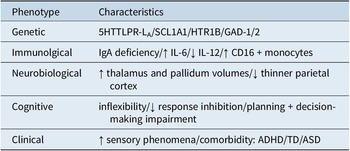
According to twin studies the heritability for OCD is much higher in children (0.45 to 0.65) than in adults (0.27 to 0.47).Reference van Grootheest, Cath and Beekman11 Also, early-onset OCD has been associated with higher prevalence of OCD in first-degree relatives, suggesting higher familiarity in this group.12–14 Due to their involvement in OCD pathophysiology, serotonin, dopamine, and glutamate system genes have been extensively investigates, but results are mixed somehow.Reference Walitza, Wendland and Gruenblatt14, Reference Walitza, Marinova and Grünblatt15 However, the restriction of the analyses according to the age at onset led to interesting results. One example is the 5HTTLPR polymorphism of the serotonin transporter gene (SLC6A4). This region of the gene exists in two alleles: the long (L) allele (conferring high-expression function) and the short (S) allele (conferring low-expression function). Also, the L allele exists in two subforms: the LA and the LG subtype (that is functionally equivalent to the S form). The LA-type polymorphism has been inconsistently associated to OCD when looking to both adults and kids, but a recent research found a significant association of this polymorphism when looking to only pediatric OCD patients.Reference Walitza, Marinova and Grünblatt15 Also, the polymorphisms of the glutamate transporter gene (SLC1A1) has been investigated in OCD groups with inconsistent results.Reference Wu, Wang and Xiao16 However, in a case control study comparing early-onset and late-onset (LO) OCD patients, a polymorphism of the SLC1A1 gene was significantly correlated to EO-OCD but not to LO-OCD patients.Reference Wu, Wang and Xiao16 Finally, a recent study replicated previous findings showing the association between a serotonergic gene (HTR1B gene, coding for the serotonin receptor 1B) and two GABAergic genes (GAD1/GAD2, coding for the glutamate decarboxylase isoenzyme) with early-onset OCDReference Boloc, Mas and Rodriguez17 (see Table 1 for a summary).
EO-OCD: Biological and Clinical Phenotype (Summary)

Abbreviations: ADHD, attention deficit hyperactivity disorder; ASD, autism spectrum disorders; GAD-1/2, genes encoding for Glutamate decarboxylases; HTR1B, gene encoding the 5-hydroxytryptamine receptor 1B; IL-6, interlukin-6; IL-12, interleukin-12; SCL1A1, gene encoding excitatory amino acid transporter 3, EAAT3; TD, tic disorders; 5HTTLPR, serotonin-transporter-linked polymorphic region.
All together, these findings support the hypothesis of a specific genetic phenotype of EO-OCD that probably could explain its higher heritability respect to later-onset patients. However, studies on the genetics of OCD are still ongoing and future results will corroborate or elucidate these preliminary findings.
The Immunological Phenotype
The involvement of the immune system (autoimmunity/inflammation) in brain diseases is already a matter of fact for several psychiatric disorders and OCD is no exception.Reference Leboyer, Berk and Yolken18 For instance, a recent large epidemiological study showed a risk up to 43% of any autoimmune disease in OCD and their relatives.Reference Mataix-Cols, Frans and Pérez-Vigil19 However, the first evidence of autoimmunity/inflammation in OCD came out in pediatric patients, almost 20 years ago, with the description of the “PANDAS” than renamed “PANS.”Reference Swedo, Leonard and Garvey20, Reference Swedo, Leckman and Rose21 What is supposed to be peculiar of PANDAS/PANS is that OC symptoms show an abrupt onset, often following an infection-trigger, and are related to the develop of anti-neural antibodies (mainly anti-basal ganglia antibodies), as is the case of Sydhenam’s chorea after streptococcal infection.Reference Wilbur, Bitnun and Kronenberg22 Despite the true existence of PANDAS/PANS is still debated, subsequent studies and a recent meta-analysis showed that OCD patients, not only the pediatric ones, show a fivefold increase in serum anti-basal ganglia antibodies respect to controls.Reference Pearlman, Vora and Marquis23 Also, the presence of neuroinflammation in the OCD neurocircuitry (expressed by the increase of a marker of microglial activation) has been recently demonstrated in adults with OCD.Reference Attwells, Setiawan and Wilson24 Thus, the presence of neuroinflammation is probably not a peculiar aspect of early-onset pediatric patients, but a more general aspect of OCD pathophysiology. However, recent data investigating peripheral immunity (cytokines, monocytes, and mucosal immunoglobulins) and directly comparing early-onset and late-onset OCD patients start to highlight some intriguing differences between these two populations. A recent study investigating IgA deficiency in OCD, found that EO-OCD patients have a four-fold higher deficiency of IgA respect to adult-onset OCD patients.Reference Williams, Shorser-Gentile and Sarvode Mothi25 In the EO-OCD group as a whole, IgA deficiency was similar to that observed in other neurodevelopmental disorders (attention-deficit hyperactivity disorders [ADHD] and tic disorders [TD]), but when looking specifically to the male EO-OCD group the IgA deficiency was significantly higher than for all other disorders except for celiac disease.Reference Williams, Shorser-Gentile and Sarvode Mothi25 Also, while a recent meta-analysis failed to confirm a clear alteration of cytokines patterns in OCD as a whole group, recent data on early-onset patients showed increased levels of IL-6, reduced levels of IL-12, and increased prevalence of CD16+ monocytes.26–28
Brain inflammation could be also linked to the gut microbiota through the so called “microbiota-gut-brain axis” (the set of hormonal, immunological, and neural connections between the brain and the gut-microbiota).Reference Grassi and Pallanti29 A putative role of the microbiota-gut-brain axis have been already suggested for several psychiatric disorders (including other neurodevelopmental disorders such as ADHD and autism spectrum disorders [ASD]).Reference Grassi and Pallanti29 Despite this field of research is still in its infancy in the OCD research world, an Italian group in 2018 showed that kids with the PANDAS/PANS showed an altered bacterial community structure, in particular showing the presence of a strong increase in Bacteroidetes (a species involved in inflammatory diseases such as obesity and diabetes).Reference Quagliariello, Del Chierico and Russo30 Interestingly, a recent Canadian study was the first to show that also adult OCD patients have an altered gut microbiota composition respect to controls. However, differently to kids with PANDAS/PANS, adult OCD patients showed a deficit in three anti-inflammatory species (namely Oscillospira, Odoribacter, and Anaerostipes)Reference Turna, Grosman Kaplan and Anglin31 (see Table 1 for a summary). Therefore, future studies should replicate the microbiota alterations in OCD and also clarify specific alterations in early and late-onset OCD patients.
The Neurobiological Phenotype
A large amount of studies in the last 20 years investigated the neurocircuitries implicated in OCD and found structural and functional abnormalities in the parallel cortico-striato-thalamo-conrtical circuits and other related brain networks, involving front-parietal, fronto-limbic, and cerebellar regions.Reference Boedhoe, Schmaal and Abe32 In the last few years, relevant data on structural brain differences between early and late-onset and between pediatric and adult OCD patients came from the OCD working group of the The Enhancing NeuroImaging Genetics through Meta-Analysis (ENIGMA) consortium. The ENIGMA-OCD group conducted the largest study to date of brain structure in adult and paediatric OCD, employing both meta- and mega-analysis on almost 1900 OCD patients (and relative controls) across 35 cohorts worldwide.Reference Boedhoe, Schmaal and Abe32 The analysis of subcortical abnormalities showed differences between pediatric and adult OCD: adult patients showed larger pallidum and smaller hippocampus volumes (this latter result was partially driven by depression comorbidity and late-onset of illness) respect to healthy adults while pediatric patients showed larger thalamus volume respect to healthy pediatric controls. Moreover, adult patients with early-onset OCD showed a more pronounced pallidum volume respect to late-onset adults, indicating that both pediatric and EO-adult OCD patients may display a specific pattern of subcortical abnormalities.Reference Boedhoe, Schmaal and Abe32 A subsequent analysis on structural cortical abnormalities showed again differences between pediatric and adult OCD: adult patients showed thinner inferior parietal cortex and lower surface are of the transverse temporal cortex respect to adult controls while pediatric patients showed thinner inferior and superior parietal cortex but not reduction of any surface area (with the exception of medicated patients that showed surface deficits in frontal areas) respect to pediatric controls (see Table 1 for a summary).Reference Boedhoe, Schmaal and Abe33
The Cognitive Phenotype
There is a paucity of studies directly comparing early and late onset patients on their cognitive profiles. Neuropsychological investigations on pediatric OCD patients showed inconsistent results across studies while studies on adults showed several executive, memory, and attentional deficits (with small to moderate effect sizes).34-36 Studies directly assessing cognitive functions in EO-OCD patients found cognitive inflexibility (expressed as set-shifting deficits), response inhibition deficits, planning, and decision-making impairments.Reference Zhang, Yang and Yang37 These impairments have been also showed in mixed samples of early and late onset patients and have been proposed as cognitive endophenotypes.Reference Chamberlain, Fineberg and Menzies38, Reference Grassi, Pallanti and Righi39 Thus, further studies directly comparing pediatric and/or EO-OCD and LO-OCD are needed to elucidate the cognitive phenotype of these sub-populations.
The Clinical Phenotype
The clinical presentation of EO patients is highly characterized by its peculiar comorbidity pattern and to a lesser degree by a specific pattern of OC-related symptoms.Reference Grover, Sarkar and Gupta40, Reference Ferrão, Shavitt and Prado41
Symptoms patterns
Clinical studies investigating symptoms dimensions in EO patients inconsistently showed some difference respect to LO patients (higher prevalence of symmetry/ordering and hoarding symptoms).Reference Grover, Sarkar and Gupta40 On the other hand, several studies showed a higher prevalence of sensory phenomena in EO patients respect to LO patients.Reference Ferrão, Shavitt and Prado41 Sensory phenomena (SP) are defined as uncomfortable, distressing subjective experiences that precede repetitive behaviors. This term include a variety of subjective experiences: “physical sensations” (tactile or muscle-joint uncomfortable sensations), “just right” (desire for things to feel just right), “not-just right/incompleteness” (“just right” perceptions triggered by internal feelings of incompleteness and not just right feeling), “energy release” (sensations of inner tension or energy that builds up and needs to be released), and “urge” (just an urge to perform a repetitive behavior).Reference Ferrão, Shavitt and Prado41 A large OCD cohort study found a prevalence of 65% of sensory phenomena in OCD patients and revealed a significant association with EO-OCD.Reference Ferrão, Shavitt and Prado41 Also, for 15% of those patients, SP are more distressing than obsessions. Finally, the authors found a higher prevalence of TD comorbidity in OCD patients with sensory phenomena.Reference Ferrão, Shavitt and Prado41 Since it is often difficult to draw the line between complex tics and compulsions, this latter result highlights the importance of distinguishing also between tic-related and OCD-related SP in patients with both OCD and tics.
Comorbidity patterns
Comorbidity in OCD is the rule rather than the exception. According to the National Comorbidity Survey Replication study, and in agreement with several subsequent studies, almost 90% of OCD patients have at least one lifetime comorbidity.Reference Ruscio, Stein and Chiu8 Based on this high presence of comorbidity some authors also proposed a comorbidity-based sub-classification of OCD.Reference Nestadt, Di and Riddle42 Moreover, the onset of the comorbid disorder seems to impact the OCD course and trajectory.Reference de Mathis, Diniz and Hounie4
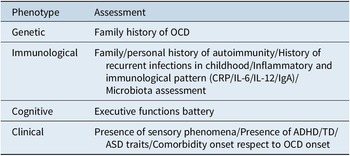
When looking to the OCD population as a whole, mood and anxiety disorders represent the most common comorbidities.Reference Ruscio, Stein and Chiu8 However, the EO-OCD population is highly comorbid with three others neurodevelopmental disorders: TD, ADHD, and ASD.Reference Geller, Biederman and Faraone43, Reference Boedhoe, van Rooij and Hoogman44 Moreover, these comorbidity patterns seem to affect the clinical presentation of EO-OCD patients and require a specific assessment and treatment management (see Table 2 for a summary).
Clinical Assessment of EO-OCD

Abbreviations: ADHD, attention deficit hyperactivity disorder; ASD, autism spectrum disorders; CRP, C-reactive protein; IgA, immunoglobulin A; IL-6, interlukin-6; IL-12, interleukin-12; OCD, obsessive–compulsive disorder; TD, tic disorders.
OCD–ADHD comorbidity
ADHD and OCD share clinical and cognitive features such as impulsivity, attentional problems, and executive dysfunctions.Reference Grassi, Pallanti and Righi39, Reference Cabarkapa, King and Dowling45 Also, on a neurobiological level, they show both disorder-shared and disorder-specific dysfunctions.Reference Boedhoe, van Rooij and Hoogman44, Reference Norman, Carlisi and Lukito46 Some authors debated the true existing of a comorbidity between ADHD and OCD suggesting that OCD patients often present ADHD-like symptoms (such inattention) that are linked to the presence of obsessions or that ADHD patients may display some OC symptoms as a coping strategy.Reference Abramovitch, Dar and Hermesh47, Reference Abramovitch, Dar and Mittelman48 However, studies on pediatric samples clearly suggested that ADHD and OCD may co-exist and represents a true comorbidity.Reference Geller, Biederman and Faraone49, Reference Geller, Biederman and Faraone50 Several studies reported high rate of ADHD comorbidity in OCD and viceversa.45–47 This comorbidity seems to be more pronounced in the early neurodevelopment phases. Indeed, ADHD prevalence in early onset OCD patients reach up to 11.8%.Reference Sheppard, Chavira and Azzam51 These data have been replicated by a recent study showing a lifetime prevalence of ADHD in adult OCD patients of 13.7% and a clear correlation with EO-OCD.Reference Blanco-Vieira, Santos and Ferrão52
Early-onset patients with ADHD+OCD seem to show a specific clinical presentation. Several studies showed that they display higher impulsivity, higher prevalence of symmetry obsessions, and hoarding compulsions, higher frequencies of sensory phenomena and comorbidity with tic disorders, more frequently a history of rheumatic fever, poorer executive functioning, higher family, and academic impairment.52–56 Also, and importantly, they tend to have a more severe and treatment-resistant OCD with an increased risk of suicide attempts.Reference Blanco-Vieira, Santos and Ferrão52, Reference Farrell, Lavell and Baras54, Reference Walitza, Zellmann and Irblich57 Finally, the temporal relation between OCD and ADHD onset seems to have an impact on OCD course. Indeed, patients that initially present with ADHD and then OCD have higher lifetime frequencies of substance abuse and dependence and worsening OCD course.Reference de Mathis, Diniz and Hounie4
OCD–TD comorbidity
Tic disorders (TD) are highly prevalent in OCD patients to the point that the DSM-5 introduced the tic-related specifier to the OCD diagnosis.58 However, data on OCD + TD comorbidity vary greatly across different studies. According to clinical samples tic disorders comorbidity range from 2% to 28%, while in community-based samples this comorbidity range between 5% and 9%.Reference Kloft, Steinel and Kathmann59 Interestingly, things get clearer when looking to EO-OCD patients. In this population, the prevalence rates of TD rise to 18% to 46% and meta-analysis showed a clear correlation between TD and early onset of OCD.Reference Kloft, Steinel and Kathmann59 Also, a recent nation-wide study in Sweden, showed that the risk of OCD in relatives of individuals with tic-related OCD is considerably greater than the risk of OCD in relatives of individuals with non-tic-related OCD, suggesting that tic-related OCD is a particularly familial subtype of OCD.Reference Brander, Kuja-Halkola and Rosenqvist60
The clinical picture of OCD + TD is characterized by the male gender, higher rates of symmetry/ordering symptoms, and sensory phenomena, and higher rates of ADHD and ASD traits.Reference Kloft, Steinel and Kathmann59, Reference Vries, Cath and Hoogendoorn61 Importantly, according to a recent multi-center Italian study, OCD + TD patients showed higher rates of suicidal attempts and tend to be more treatment-resistant respect to OCD without tics.Reference Benatti, Ferrari and Grancini62
Finally, as is the case for ADHD+OCD, the temporal relation between OCD and TD onset seems to have an impact on OCD course: patients that initially present with TD and then OCD have higher lifetime frequencies of OCD spectrum disorders (trichotillomania, skin picking, and body dysmorphic disorder).Reference de Mathis, Diniz and Hounie4
OCD–ASD comorbidity
OCD patients display a four-fold risk of comorbid ASD.Reference Meier, Petersen and Schendel63 The prevalence of autistic traits in OCD range between 34% and 47% and that of a full ASD between 17% and 28%.63-65 According to a recent UK study this comorbidity is highly correlated to EO-OCD.Reference Wikramanayake, Mandy and Shahper65 On a clinical level, OCD + ASD patients showed a more severe OCD picture and tend to have a lower insight in their OC symptoms.63–65 Thus, identifying the presence of ASD in OCD patients represent a relevant issue. However, distinguishing between repetitive behaviors in ASD and compulsions in OCD is not always an easy task. Respect to compulsions in OCD, repetitive behaviors in ASD are not obsession-related, they are often simple behaviors and they tend to be egosyntonic since they often represent a learnt strategy for managing the distress generated by environmental contingencies.Reference Wikramanayake, Mandy and Shahper65 However, ASD patients often display true compulsions (such as hoarding and symmetry arranging compulsions) that are difficult to distinguish from an OC symptom.Reference Wikramanayake, Mandy and Shahper65
Treatment Implications
The first important issue in early-onset OCD is a timely early-intervention. It is now clear the duration of untreated illness and the number of OCD-burned years are correlated to a worse outcome.Reference Fineberg, Hengartner and Bergbaum10, Reference Fineberg, Dell’Osso and Albert66, Reference Albert, Barbaro and Bramante67 Also, there is growing evidence that treating pediatric OCD patients with an appropriate approach (Cognitive Behavioral Therapy (CBT), Selective Serotonin Reuptake Inhibitor (SSRIs), augmentations with antidopaminergic agents) result in a better outcome respect to what can be achieved in adults with OCD.Reference Fineberg, Dell’Osso and Albert66, Reference Melin, Skarphedinsson and Skärsäter68 However, since early-onset patients often present high levels of family accommodation, family interventions should also be considered in the initial management of these patients.Reference Albert, Baffa and Maina69, Reference Wu, McGuire and Martino70 Recently, a consensus statement on early-intervention strategies for OCD has been published by an international pool of experts.Reference Fineberg, Dell’Osso and Albert66
As we have seen, the clinical phenotype of EO-OCD and their response to first-line treatments is highly affected by neurodevelopmental disorders comorbidities (mainly ADHD, tics and ASD). Tailoring treatment approaches according to comorbidity patterns is not a specific approach for EO patients but is rather a general principle in the treatment of OCD. Thus, after a comprehensive assessment for the presence comorbidities, the treatment decision-making should take into-account the specific comorbidity pattern.
For OCD + TD patients there is substantial evidence that while they respond similarly to non-comorbid patients to CBT, they tend to have a lower response to SSRIs and a better response to augmentation strategies with antidopaminergic medications.Reference Kloft, Steinel and Kathmann59 On the other hand, how to manage ADHD and OCD comorbidity is still an unsolved topic. While studies demonstrated that serotonergic agents are less effective in OCD + ADHD patients respect to OCD alone patients,Reference Masi, Millepiedi and Perugi71 current literature presents case reports showing both improvement and worsening of OCD symptoms following stimulant administration.Reference King, Dowling and Leow72, Reference Jhanda, Singla and Grover73 However, a few years ago a double-blind controlled study showed 50% of responder rates on adult OCD patients following d-amphetamine treatment.Reference Koran, Aboujaoude and Gamel74 Finally, there are still no clear indications for the management of comorbid OCD and ASD. While CBT seems to work less on these patients, there are some preliminary positive data modified forms of CBTReference Krebs, Murray and Jassi75 and some trials on glutamatergic agents are ongoing.Reference Häge, Banaschewski and Buitelaar76
Finally, when treating a patient presenting with early-onset OCD, clinicians should consider an assessment of inflammatory and immunological aspects, such as infective history, OCD symptoms course, inflammatory markers, familial history of autoimmunity, and the gut-microbiota. Early recognition of inflammatory and immunological factors in early and acute-onset OCD patients may represent a crucial starting point for appropriate intervention in this population and could potentially advance the field toward a putative etiological treatment of OCD.Reference Fineberg, Dell’Osso and Albert66 In this field, while there a still no clear evidence for the suspected PANDAS/PANS cases, some evidence in favor of anti-inflammatory agents for OCD is coming out and researches on the use of probiotics are ongoing.Reference Grassi and Pallanti29 Of note, SSRIs are also known to have also an anti-inflammatory effect that seems to be specific for each different agent.Reference Gobin, Van Steendam and Denys77 Therefore, we can imagine in the next future a treatment approach in which the choice of the SSRI will be based on the patient’s inflammatory and cytokines profile.
Limitations and Open Issues
Both the DSM-5 and the ICD-11 OCD working groups discussed about including the early-onset specifier in the OCD diagnosis. This specifier was not included in those manuals because of the lack of compelling evidence and several criticisms at the time of publication.78–80 Several of these criticisms are still not solved. For example, it is still debated whether exists or not a clear cut between early and late onset of OCD. Big epidemiological studies proposed the pre-puberal age as an early-onset cut-off while other studies proposed the age of twenty.Reference Anholt, Aderka and Balkom81 Thus, it is still not clear if the age at onset of OCD should be considered dimensionally (eg, it differently affects the phenotype according to the stage of neurodevelopment) or categorically (eg, it affects the phenotype independently by the stage of neurodevelopment). Also, some studies suggested that the age at onset of symptoms or of the full syndrome could differently impact the clinical phenotypes.Reference Albert, Manchia and Tortorella82 While the data presented in this paper are in favor of a specific phenotype of EO-OCD patients, they also deserve several limitations that should be noted. First of all, current literature is still lacking of large-sample studies directly comparing early and late-onset patients. Most of the cited studies are cross-sectional and/or retrospective and many of them are small sample sized. Also, the presence of several confounders (eg, comorbidities) could affect the phenotypical results. Finally, the current literature is relatively lacking of studies directly comparing EO and LO-OCD patients on duration of untreated illness. Therefore, it is still not clear how the duration of untreated illness could differently impact on the phenotype trajectory of EO respect to LO patients. In order to answer to these open questions and to consider early-onset as an OCD diagnosis specifier in the future, large longitudinal studies are needed.
Conclusions
Several lines of genetic, neurobiological, immunological, and clinical evidence suggest that early-onset OCD could be a biologically and clinically specific subtype of OCD. The strongest evidence for this hypothesis, come from genetic, neurobiological, and immunological studies while the cognitive and clinical characterization of early-onset patients will benefit from larger longitudinal studies in the future. There are still many open questions about this putative subtype of OCD. However, it is important for clinicians to keep in mind the current knowledge about early-onset patients. In fact, these patients tend to have a worse outcome and early-intervention should be a primary goal in order to modify the disabling trajectory of OCD. For this purpose, the clinical decision-making process should take into-account the comorbidity profile of patients. Also, a closer look to immunological factors and to the immunological history of patients should be included in the initial assessment. Future studies should clearly separate early and later onset OCD patients in order to increase our understanding of these phenotypes and improve the outcome of current treatment approaches.
Funding
No funding has been received for this paper.
Disclosure
Giacomo Grassi, Chiara Cecchelli, Gloria Mazzocato, and Luisa Vignozzi, have nothing to disclose.