Contemporary theories of romantic involvement describe developmental changes in terms of a series of “soft” stages (see Connolly & McIsaac, Reference Connolly, McIsaac, Lerner and Steinberg2009; Furman & Collins, 2008; Furman & Rose, in press). Evidence exists of a sequence from no relationship to one casual relationship to multiple casual relationships to one steady relationship (Davies & Windle, Reference Davies and Windle2000; Meier & Allen, Reference Meier and Allen2009). The proportion of individuals who are cohabiting peaks in the 20s, and the proportion who are married increases throughout the 20s (Copen, Daniels, Vespa, & Mosher, Reference Copen, Daniels, Vespa and Mosher2012). This is not to suggest that everyone progresses through these stages in a perfectly order manner or even that everyone follows this sequence, reaching a final stage of having a committed relationship. Nevertheless, what is clear from these patterns is that what is normative or characteristic of an age changes developmentally.
Developmental changes occur in romantic involvement, and youth vary in when they initiate romantic experiences and how intensely involved they are in romantic relationships. For example, some may be involved in a serious relationship at an early age, whereas others may only date infrequently as young adults. Such variation in romantic involvement may be linked to psychosocial adjustment.
In particular, social timetable theories of adjustment emphasize the importance of considering when experiences occur (Elder, 1975). That is, social norms exist regarding the approximate age when social roles, activities, or life events are expected to occur (Neugarten, Reference Neugarten1979). Those who experience an event, such as having a romantic relationship or getting married, at the normative (or typical) time their peers experience that event would be said to be on-time; those who experience events earlier or later than the norm would be off-time. Similarly, we conceptualized those whose level of romantic involvement was normative of their agemates to be on time; those whose level of romantic involvement was greater than the norm for their agemates or lesser than the norm of their agemates would be considered to be off time.
Atypical timing of experiences may be associated with adverse outcomes or problems in adjustment for a number of reasons (Rook, Catalano, & Dooley, Reference Rook, Catalano and Dooley1989). When events are off time, negative social sanctions may be imposed for deviating from the normative pattern (Elder, 1975). Such individuals may also have fewer social resources because fewer of their peers are experiencing the same events (Neugarten, Reference Neugarten1979). Finally, individuals who have difficulties in adjustment may be more likely to deviate from social norms, either intentionally or unintentionally. With regard to the timing of romantic experiences in particular, romantic relationships may be premature in early adolescence as one's identity has not been established (Erikson, 1968).
Consistent with these ideas, the timing of romantic experiences is linked to adjustment. In particular, early romantic experiences are associated with externalizing and internalizing problems, especially for girls (see review by Connolly & McIsaac, Reference Connolly, McIsaac, Lerner and Steinberg2009). Early starters may not have had the time to acquire the skills necessary for managing such relationships successfully. Early relationships may also be particularly intense (Thornton, Reference Thornton1990) or prone to dissolution.
On the other hand, Erikson (1968) hypothesized that having a committed relationship in young adulthood would be associated with positive adjustment. Consistent with this idea, greater levels of commitment are associated with greater subjective well-being in young adulthood, even controlling for differences in relationship happiness (Kamp Dush & Amato, Reference Kamp Dush and Amato2005). Relatively little is known about individuals who do not establish romantic relationships until a later age than is typical. Older adolescents who have not had a romantic relationship, however, are anxious (La Greca & Harrison, Reference La Greca and Harrison2005).
Although much of the literature is consistent with the social timetable theory, some studies find that having a romantic relationship is predictive of increases in depression throughout adolescence, even when having such a relationship is normative or characteristic of that age group (Joyner & Udry, Reference Joyner and Udry2000). Most of the literature has only examined one age group; thus, differences in the patterns of association across studies could reflect differences in cohorts or samples. To the best of our knowledge, no longitudinal study has demonstrated that the association between romantic involvement and adjustment changes with development. Studies have shown that adolescents who are more involved in romantic relationships than their peers are not as well adjusted, but we do not know if adolescents who are less involved in romantic relationships than their peers are not as well adjusted. In a similar vein, it is questionable whether adults who are in more committed relationships than their peers are actually less well adjusted, as a social timetable model would predict. Kamp Dush and Amato (Reference Kamp Dush and Amato2005) found that married adults were the highest in well-being, although the normative level of involvement in their sample was steady dating. Thus, the literature is not fully consistent with a social timetable theory, and several key predictions have not been tested.
A developmental task theory provides a somewhat different set of expectations regarding the timing of romantic involvement and adjustment. This theory posits that romantic involvement is an emerging developmental task in adolescence, such that premature involvement at that age could undermine development and adaptation (Roisman, Booth-LaForce, Cauffman, Spieker, & The NICHD Early Child Care Research Network, Reference Roisman, Booth-LaForce, Cauffman and Spieker2009; Roisman, Masten, Coatsworth, & Tellegen, Reference Roisman, Masten, Coatsworth and Tellegen2004). Romantic involvement eventually becomes a salient developmental task in adulthood, and as it does, such involvement becomes linked to adaptation and ultimately subsequent adaptation. This theory may account for some of the literature which is inconsistent with the social timetable theory; it suggests that greater romantic involvement in adolescence is linked to adverse outcomes because romantic involvement is not yet a salient developmental task, not because it is nonnormative. Therefore, findings indicating links between having a romantic relationship and poor psychosocial adjustment in middle adolescence, when having a romantic relationship is normative, fit nicely with the developmental task theory's predictions (Davila, Reference Davila, Fincham and Cui2011; Joyner & Udry, Reference Joyner and Udry2000). In addition, the fact that commitment in adulthood is associated with positive outcomes, even when that commitment is nonnormative, is predicted by the theory (Kamp Dush & Amato Reference Kamp Dush and Amato2005). That is, once having a committed romantic relationship becomes a salient developmental task, having such a relationship should be associated with adjustment even if it is not completely normative yet. In sum, a developmental task theory provides an alternative to the social timetable theory; it hypothesizes that greater levels of romantic involvement would be associated with difficulties with adjustment in adolescence but with positive adjustment in young adulthood.
The purpose of the present study was to examine the pattern of associations between romantic involvement and adjustment over a 10-year period from middle adolescence to young adulthood (15–25 years of age). We compared the social timetable theory, which predicts that deviation from what is normative is associated with less adjustment, with the developmental task theory, which predicts that more romantic involvement in adolescence is associated with poorer adjustment but becomes associated with better adjustment in adulthood. We examined both model fit and parameters to determine which theory accurately predicted the developmental pattern of associations of romantic involvement with three indices of adjustment: substance use, externalizing symptoms, and internalizing symptoms. These three variables were examined as they are the ones that have been primarily examined in past work on both adolescence and young adulthood. Once we determined the appropriate theoretical approach, we focused on that theory's pattern of associations with both romantic involvement and the simple presence or absence of a current relationship. We then examined whether the associations varied as a function of gender, as some work has found stronger links between adjustment and romantic involvement for women than for men (Joyner & Udry, Reference Joyner and Udry2000; Simon & Barrett, Reference Simon and Barrett2010).
Method
Participants
The participants were part of a longitudinal study investigating the role of relationships with parents, peers, and romantic partners on psychosocial adjustment. Two hundred 10th-grade high school students (100 boys, 100 girls; M age = 15 years, 10.44 months, SD = 0.49), were recruited from a diverse range of neighborhoods and schools in a large Western metropolitan area. We distributed brochures and sent letters to families residing in various zip codes and to students enrolled in various schools in ethnically diverse neighborhoods. We were unable to determine the ascertainment rate because we used brochures and because the letters were sent to many families who did not have 10th-grade students. To insure maximal response, we paid families $25 to hear a description of the project in their home. Of the families that heard the description, 85.5% expressed interest and carried through with the Wave 1 assessment.
Participants were selected so that the sample was representative of the ethnic and racial composition of the United States; thus, the sample consisted of 11.5% African Americans, 12.5% Hispanics, 1.5% Native Americans, 1% Asian American, 4% biracial, and 69.5% White, non-Hispanics. The sample was of average intelligence and comparable to national norms on multiple measures of substance use and internalizing and externalizing symptomatology (see Furman, Ho, & Low, Reference Furman, Low and Ho2009).
Procedure
Adolescents participated in a series of laboratory sessions in which they were interviewed about romantic relationships and completed questionnaires. The mother and a close friend nominated by the participant also completed questionnaires about the participant's psychosocial competence and risky/problem behaviors (mothers: N = 169, friends: N = 145).
For the purposes of the current study, we used the first through seventh waves of data collection, beginning when the participants were in the 10th grade and ending approximately 5.5 years after graduation from high school. Data were collected on a yearly basis in Waves 1–4 and then 1.5 years later for Waves 5–7. Participant retention was excellent (Waves 1 and 2: N = 200; Wave 3: N = 199; Wave 4: N = 196; Wave 5: N = 192; Wave 6: N = 186; Wave 7: N = 178).
Romantic relationship status regarding whether the participant was currently or had been in a romantic relationship lasting a month or longer in the previous year was assessed by self-report in each wave. With regard to sexual orientation, 89.3% said they were heterosexual in Wave 7; the remaining 10.7% said they were bisexual, gay, lesbian, or questioning. We chose to retain the sexual minorities in the sample to be inclusive.
The study was approved by the local institutional review board. The confidentiality of participants' data was protected by a Certificate of Confidentiality issued by the US Department of Health and Human Services.
Measures
Romantic involvement/commitment
Participants indicated their current relationship status as part of the Dating History Questionnaire (Furman & Wehner, Reference Furman and Wehner1992). Consistent with prior work showing that romantic involvement and commitment can be conceptualized as a continuum (Kamp Dush & Amato, Reference Kamp Dush and Amato2005; Ross, Reference Ross1995), we derived a 7-point scale (1 = not dating/rarely dating, 2 = dating or seeing one person casually, 3 = dating or seeing more than one person, 4 = having an exclusive boy/girlfriend or having a serious relationship, 5 = engaged or living with someone, 6 = engaged and living with someone, 7 = married). Although the scale points differ in terms of both involvement and commitment, we use the term romantic involvement for the sake of brevity.
A question on the Network of Relationships Inventory: Behavioral Systems Version (Furman & Buhrmester, Reference Furman and Buhrmester2009) asked whether they were currently involved in a romantic relationship of at least 1 month's duration. This variable is referred to as current relationship presence.
Youth/adult self-report
Participants completed Achenbach's (Reference Achenbach1991) Youth Self-Report in Waves 1–3 and Achenbach's (Reference Achenbach1997) Adult Self-Report in Waves 4–7. Internalizing and externalizing scores were derived from the 20 and 26 items that were comparable on the two versions (M αs = 0.81 and 0.87, respectively).
Child/adult behavior checklist
Friends and mothers reported on participants' externalizing symptoms by completing the externalizing items of the Child Behavior Checklist in Waves 1–3, and the externalizing items on the Adult Behavior Checklist in Waves 4–7 (Achenbach, Reference Achenbach1991, Reference Achenbach1997). Friend and mother reports of externalizing scores were derived from the 19 items that were comparable on the two versions (M α = 0.84 and 0.89, respectively).
Beck Depression Inventory (BDI)
Participants completed the BDI to assess depressive symptoms (M α = 0.86; Beck, Rush, Shaw, & Emery, Reference Beck, Rush, Shaw and Emery1979).
State-Trait Anxiety Inventory (STAI)
Participants completed the trait scale of Spielberger's (Reference Spielberger1983) STAI to assess anxious symptoms (M α = 0.92)
Drug Involvement Scale for Adolescence
Participants completed the Drug Involvement Scale for Adolescence (Eggert, Herting, & Thompson, Reference Eggert, Herting and Thompson1996). We examined use of alcohol and other drugs (marijuana, cocaine, opiates, depressants, tranquilizers, hallucinogens, inhalants, stimulants, over-the-counter drugs, and club drugs) over the previous 30 days. Frequency of each substance use was scored on a 7-point scale ranging from never to every day. Participants also completed a 16-item measure assessing adverse consequences arising from substance use (M α = 0.94), and an 8-item measure assessing difficulties in controlling substance use (M α = 0.91). The questionnaire on substance use was administered by computer-assisted self-interviewing techniques to increase the candor of responses.
Friends report of substance use
As part of their version of the Adolescent Self-Perception Profile (Harter, Reference Harter1988), friends were asked four questions about the participant's use of alcohol and drugs and problems related to the use of those substances. The four items were averaged to derive the friend report of the participant's substance use and problems (M α = 0.82).
Derivation of composites
The different adjustment measures had different numbers of points on their scales and had different numbers of items. To make the scales comparable so that we could derive composites, we first standardized scores on each adjustment variable across the waves. In other words, we derived the grand mean of scores over time and the grand standard deviation of scores over time and used them to transform the scores for each wave. This procedure of standardizing variables over waves is recommended by statisticians (Little, Reference Little2013): it retains differences in means and variance among waves, it does not change the shape of the distribution, and it does not change the patterns of associations among the variables.
Once the scores were standardized, the participants', friends', and mothers' reports of externalizing symptoms at each wave were averaged to derive indices of externalizing symptoms for each wave. The standardized BDI depression scores, STAI anxiety scores, and internalizing symptom scores at each wave were averaged to derive indices of internalizing symptoms. Each wave of the standardized participants' reports of beer/wine drinking and their reports of drinking liquor were averaged to derive a measure of alcohol use for each wave. Similarly, the standardized participants' reports of marijuana use and their reports of other drug use were averaged at each wave to derive measures of drug use. The standardized participants' reports of problems and their reports of control problems were averaged at each wave to derive measures of problem usage. Then the alcohol, drug, and problem usage and the standardized friends' reports of substance use at each wave were averaged to derive measures of substance use.
Results
Preliminary and descriptive analyses
All variables were examined to insure that they had acceptable levels of skew and kurtosis (Behrens, Reference Behrens1997). Outliers were Winsorized to fall 1.5 times the interquartile range below the 25th percentile or above the 75th percentile.
In Wave 1, 17.1% of participants reported having a current romantic partner; in Wave 2, 29.4% reported having a current romantic partner; in Wave 3, 33.2% reported having a current romantic partner; in Wave 4, 38.5% reported having a current romantic partner; in Wave 5, 45.4% reported having a current romantic partner; in Wave 6, 53.8% reported having a current romantic partner; and in Wave 7, 55.9% reported having a current romantic partner. A univariate growth curve model revealed that degree of romantic involvement significantly increased over time (β = 0.17, p < .001). Additional descriptive statistics can be found in Table 1; correlations are available upon request from the corresponding author.
Mean (standard deviation) romantic involvement and adjustment outcomes

Comparison of social timetable and development task theory
First, we aimed to determine which theoretical approach (the social timetable theory or the developmental task theory) was more appropriate. To test these two theories, we used a series of multilevel models using the statistical program Hierarchical Linear Modeling Version 6.0 (Raudenbush, Bryk, Cheong, & Congdon, Reference Raudenbush, Bryk, Cheong and Congdon2001). To determine how normative a person's level of romantic involvement was at each wave, we created a deviation from normative romantic involvement, which was the absolute value of the difference between the participant's level of involvement and the median level of romantic involvement in that wave of assessment. We used wave rather than age in the theory comparison analyses so that we could create this deviation from normative romantic involvement scores. An interaction term between wave of assessment and the deviation from the normative level variable and an interaction term between wave of assessment and the romantic involvement variable were derived by centering and multiplying the relevant terms. The social timetable theory would be supported if the deviation score was predictive of problems in adjustment, such that higher deviation scores were related to higher scores on the adjustment problem indices (substance use, externalizing symptoms, and internalizing symptoms). The developmental task theory would be supported by significant interactions between wave and romantic involvement, such that higher levels of involvement in earlier waves were related to lower levels of adjustment but higher levels of adjustment in the later waves of the study. To determine which theory more accurately predicted the pattern of associations with adjustment across time, we included both the romantic involvement variable and the deviation from normative level variable as predictors. Similarly, we included both the Wave × Romantic Involvement and Wave × Deviation from normative level interactions in a second step of the model to examine the interaction effects independently from the main effects and avoid concerns of conditionality (Little, Reference Little2013). Thus, each complete model had the following form:
Level 1:
 $$\eqalign{Y_{i} &= {\rm \beta}_{0} + {\rm \beta}_{1} \, \lpar \hbox{Wave}\rpar + {\rm \beta}_{2}\, \lpar \hbox{Romantic Involvement}\rpar \cr &\quad + {\rm \beta}_{3}\, \lpar \hbox{Deviation from Normative}\rpar\cr &\qquad\qquad\qquad\qquad\qquad\quad\qquad\ \hbox{ Romantic Involvement} \cr &\quad +{\rm \beta}_{4}\, \lpar \hbox{Wave} \times \hbox{Romantic Involvement}\rpar \cr &\quad +{\rm \beta}_{5}\, \lpar \hbox{Wave} \times \hbox{Deviation from Normative} \cr &\qquad\qquad\qquad\qquad\qquad\quad \ \hbox{Romantic Involvement}\rpar + r_{i}.}$$
Level 2:
 $$\eqalign{{\rm \beta}_{0} &= {\rm \gamma}_{00}+{\rm \gamma}_{01} \lpar \hbox{gender}\rpar +u_{0}\comma \; \cr {\rm \beta}_{1} &= {\rm \gamma}_{10}\comma \; \cr {\rm \beta}_{2} &= {\rm \gamma}_{20}\comma \; \cr {\rm \beta}_{3}&={\rm \gamma}_{30}.}$$
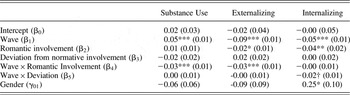
Table 2 reports the results of these analyses. Although the main effects and interaction effects are presented together in Table 2, the unstandardized regression coefficients and standard errors are the values at the step in which the terms were first entered in the model.
Multilevel models comparing social timetable and developmental task theory

Note: The primary numbers in the table are the unstandardized coefficients for the fixed effects.
Standard errors are in parentheses.
†p < .10. *p < .05. **p < .01. ***p < .001.
In terms of substance use, neither the main effect of romantic involvement nor the deviation from normative romantic involvement was significant. The interaction between wave and romantic involvement was significant, whereas the interaction between wave and deviation from normative romantic involvement was not.
In terms of externalizing behavior, romantic involvement significantly predicted lower levels of symptoms. In addition, wave interacted with romantic involvement to predict externalizing symptoms. In contrast, neither the deviation from normative romantic variable nor the interaction between the deviation variable and wave were significant predictors. Finally, in terms of internalizing behavior, romantic involvement significantly predicted lower levels of symptoms. In contrast, the deviation from normative involvement variable did not significantly predict internalizing symptoms. No interaction effects with wave were found.
Thus, consistent with a developmental task theory, the degree of romantic involvement or the interaction between wave and romantic involvement was related to all three indices of adjustment, even taking into account the degree of deviation from normative level of romantic involvement. In contrast, neither the deviation from normative level of involvement nor the interaction between wave and deviation was a significant predictor.
We also conducted model fit statistics to assess the two theoretical models: We first examined whether the inclusion of the romantic involvement and Wave × Romantic Involvement interaction variables as predictors improved the fit of a model that contained the deviation from normative level, wave, and the Wave × Deviation from normative level variables. Consistent with the developmental task theory, the addition of the romantic involvement variable and the Wave × Romantic Involvement variable significantly improved model fit for substance use, Δχ2 (2) = 39.92, p < .001, externalizing symptoms, Δχ2 (2) = 24.22, p < .001, and internalizing symptoms, Δχ2 (2) = 10.17, p = .006.
In contrast, when we added the deviation from normative level and the Wave × Deviation from normative level as predictors to a model with romantic involvement, wave, and Wave × Romantic Involvement as predictors, the addition did not improve the fit for either externalizing, Δχ2 (2) = 1.27, p = .53, or internalizing symptoms, Δχ2 (2) = 3.55, p = .17. The addition of the deviation and Wave × Deviation predictors did significantly improve the model fit for substance use, Δχ2 (2) = 22.94, p < .001. However, the degree of improvement in fit appeared to be less than the improvement in fit that the addition of romantic involvement and Wave × Romantic Involvement provided to the model with the deviation terms, Δχ2 (2) = 22.94 versus Δχ2 (2) = 39.92.
Thus, both the findings concerning which variables were significant predictors and the findings concerning model fit are more consistent with the developmental task theory than the social timetable theory. Therefore, subsequent analyses focused on examining the developmental task theory in more detail.
Developmental task theory analyses
Having tested the social timetable theory and the developmental task theory, we then aimed to examine the pattern of associations between degree of romantic involvement and adjustment. We used the following model:
Level 1:
 $$\eqalign{Y_{i} &= {\rm \beta}_{0} + {\rm \beta}_{1}\lpar \hbox{Age}\rpar + {\rm \beta}_{2} \lpar \hbox{Romantic Involvement}\rpar \cr &\quad + {\rm \beta}_{3} \lpar \hbox{Age} \times \hbox{Romantic Involvement}\rpar + r_{i}\comma \; }$$
Level 2:
 $$\eqalign{{\rm \beta}_{0} &= {\rm \gamma}_{00} + {\rm \gamma}_{01} \lpar \hbox{gender}\rpar + u_{0}\comma \; \cr {\rm \beta}_{1} &= {\rm \gamma}_{10}\comma \; \cr {\rm \beta}_{2} &= {\rm \gamma}_{20}\comma \; \cr {\rm \beta}_{3} &= {\rm \gamma}_{30}.}$$
In these models, we used age instead of wave because age offers a more precise measurement of timing. In supplementary analyses, however, we used wave and obtained the same results. Again, the interaction effects were examined in a second step after the main effects to avoid concerns of conditionality (Little, Reference Little2013).
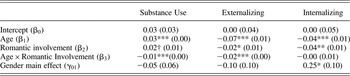
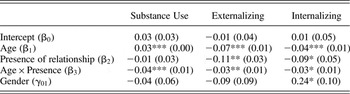
Table 3 reports the results of these analyses. Though the main effects and interaction effects are presented together, the unstandardized regression coefficients and standard errors are the values at the step in which these terms were first entered in the model as described previously.
Multilevel models testing the associations between romantic involvement and adjustment

Notes. The primary numbers in the table are the unstandardized coefficients for the fixed effects.
Standard errors are in parentheses.
†p < .10. *p < .05. **p < .01. ***p < .001.
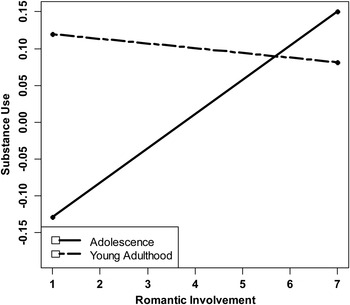
Regarding substance use, a main effect of age was found, but it was qualified by a significant interaction between age and romantic involvement on substance use (see Figure 1). To further interpret the interaction, we used Preacher, Curran, and Bauer's (Reference Preacher, Curran and Bauer2006) computational tools to plot the estimated association between romantic involvement and substance use for two values of age: 1 SD above the mean age across all seven waves (16.66 years) and 1 SD below the mean age across all seven waves (21.92 years). Greater romantic involvement was associated with more substance use at the younger age, β = 0.05, t (1288) = 3.56, p < .001. The degree of romantic involvement was not related to substance use at the older age, but computations with the equation's parameters in Table 3 indicate that greater romantic involvement becomes increasingly associated with less substance use as youth go through young adulthood. We also conducted all these analyses with only the adverse consequences arising from substance use component of the substance use measure and found the same pattern.
Interaction between romantic involvement and age on substance use. The two lines depict the association between romantic involvement and substance use at 1 SD below the mean age (16.66 years, labeled adolescence), and 1 SD above the mean age (21.92 years, labeled young adulthood). Romantic involvement is plotted uncentered for interpretation. Substance use scores are standardized across waves.

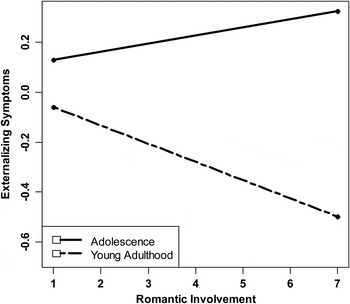
Regarding externalizing symptoms, main effects of age and romantic involvement were observed. These were qualified, however, by a significant interaction between age and romantic involvement on externalizing symptoms. Greater romantic involvement was associated with higher levels of externalizing symptoms at the younger age, which was labeled adolescence in Figure 2. In contrast, a higher degree of romantic involvement was associated with lower levels of externalizing symptoms at the older age, which was labeled early adulthood in Figure 2, β < 0.03, t (1288) = 2.51, p = .01; β = −0.07, t (1288) = −5.58, p < .001, respectively.
Interaction between romantic involvement and age on externalizing symptoms. The two lines depict the association between romantic involvement and externalizing symptoms at 1 SD below the mean age (16.66 years, labeled adolescence), and 1 SD above the mean age (21.92 years, labeled young adulthood). Romantic involvement is plotted uncentered for interpretation. Externalizing symptoms scores are standardized.

For internalizing symptoms, main effects of age and romantic involvement were found such that greater age and greater involvement both predicted lower levels of symptoms. The interaction between age and romantic involvement on internalizing symptoms was not significant.
Regarding gender, no significant main effects of gender were found for substance use or externalizing symptoms, but females were higher on internalizing symptoms. We examined three-way interactions with gender and found that none was significant.
Current relationship presence
In the present study, we conceptualized romantic involvement as a continuum. This conceptualization is consistent with research showing that individuals follow a sequence of soft stages from no relationship to one casual relationship to multiple casual relationships to one steady relationship (Davies & Windle, Reference Davies and Windle2000; Meier & Allen, Reference Meier and Allen2009). Engagement and marriage typically follow these steps.
Such an approach provides a more theoretically sound and sensitive means of testing the social timetable and developmental task theories and has appealing statistical properties (MacCallum, Zhang, Preacher, & Rucker, Reference MacCallum, Zhang, Preacher and Rucker2002). Moreover, the use of a single continuous variable accounts for as much variance in well-being as a set of categories (Kamp Dush & Amato, Reference Kamp Dush and Amato2005).
Research with young adults has commonly used such a continuous variable (e.g., Dhariwal, Connolly, Paciello, & Caprara, Reference Dhariwal, Connolly, Paciello and Caprara2009; Kamp Dush & Amato, Reference Kamp Dush and Amato2005; Soons, Liefbroer, & Kalmijn, Reference Soons, Liefbroer and Kalmijn2009), but virtually all of the existing research on adolescents has examined whether the youth did or did not have a romantic relationship rather than the degree of romantic involvement (see Davila, Reference Davila2008). Accordingly, we conducted analyses of the association between whether a participant had a current romantic relationship and adjustment. To test the associations between the presence of a current relationship and adjustment, we used the following model:
Level 1:
 $$\fleqalignno{Y_{i}& = {\rm \beta}_{0} + {\rm \beta}_{1}\lpar \hbox{Age}\rpar \cr & \quad+ {\rm \beta}_{2} \lpar \hbox{Dichotomous Romantic} \hbox{Involvement}\rpar \cr &\quad+ {\rm \beta}_{3}\lpar \hbox{Age} \times \hbox{Dichotomous Romantic} \hbox{Involvement}\rpar \cr &\quad+ r_{i}\comma}$$
Level 2:
 $$\eqalign{{\rm \beta}_{0} &= {\rm \gamma}_{00} + {\rm \gamma}_{01} \lpar \hbox{gender}\rpar + u_{0}\comma \; \cr {\rm \beta}_{1} &= {\rm \gamma}_{10}\comma \; \cr {\rm \beta}_{2} &= {\rm \gamma}_{20}\comma \; \cr {\rm \beta}_{3} &= {\rm \gamma}_{30}.}$$
Table 4 reports the results of these analyses. Though the main effects and interaction effects are presented together, the unstandardized coefficients and standard errors are the values for the steps in which they were entered as described previously.
Multilevel models testing the associations between presence of a romantic relationship and adjustment

Notes. The primary numbers in the table are the unstandardized coefficients for the fixed effects.
Standard errors are in parentheses.
*p < .05. **p < .01. ***p < .001.
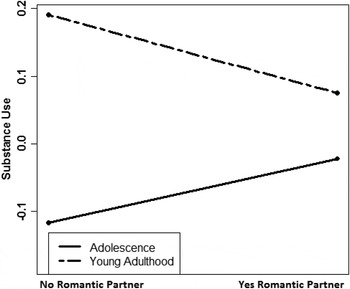
For substance use, a main effect of age occurred that was qualified by a significant interaction between age and having a romantic relationship. To interpret significant interactions, we used Preacher, Curran, and Bauer's (Reference Preacher, Curran and Bauer2006) computational tools to plot the estimated association between romantic involvement and substance use for two values of age: 1 SD above the mean age across all seven waves (16.66 years) and 1 SD below the mean age across all seven waves (21.92 years). The plot of substance use is presented in Figure 3. In adolescence, substance use was greater for those with a romantic relationship, β = 0.10, t (1285) = 2.39, p = .02. In young adulthood, substance use was lower for those with a romantic relationship, β = −0.12, t (1285) = −2.89, p = .003.
Interaction between age and whether the participant has a romantic relationship on substance use. The two lines depict the association between romantic involvement and substance use at 1 SD below the mean age (16.66 years, labeled adolescence), and 1 SD above the mean age (21.92 years, labeled young adulthood). Substance use scores are standardized.

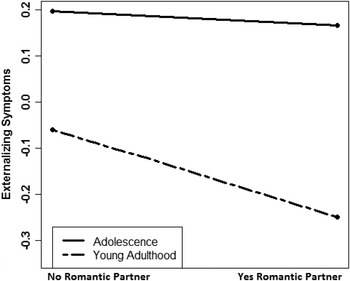
Regarding externalizing symptoms, main effects of age and romantic involvement occurred, which once again were qualified by a significant interaction between having a relationship and age. As shown in Figure 4, having a romantic partner was associated with fewer externalizing symptoms at the older age, β = −0.19, t (1289) = −4.74, p < .001. Whether one did or did not have a romantic partner was unrelated to externalizing symptoms at the younger age, β = −0.03, t (1289) = −0.78, p > .05, but computations with the equation's parameters in Table 4 indicate that having a romantic relationship was associated with more externalizing symptoms earlier in adolescence.
Interaction between age and whether the participant has a romantic relationship and age on externalizing symptoms. The two lines depict the association between romantic involvement and externalizing symptoms at 1 SD below the mean age (16.66 years, labeled adolescence), and 1 SD above the mean age (21.92 years, labeled young adulthood). Externalizing symptoms scores are standardized.

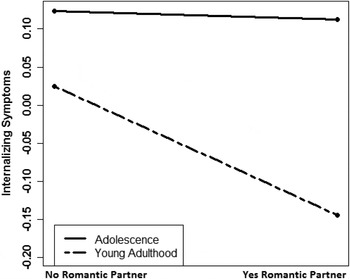
Main effects of age and romantic involvement on internalizing symptoms were found, but these were qualified by a significant interaction between having a relationship and age. Having a romantic relationship was associated with lower internalizing symptoms at the older age labeled early adulthood in Figure 5, β = −0.17, t (1293) = −2.99, p = .003. Having or not having a romantic relationship was unrelated to internalizing symptoms at the younger age in Figure 5, β –0.01, t (1293) = −0.19, p > .05, but computations with the equation's parameters in Table 4 indicate that having a romantic relationship was associated with more internalizing symptoms earlier in adolescence.
Interaction between age and whether the participant has a romantic relationship on internalizing symptoms. The two lines depict the association between romantic involvement and internalizing symptoms at 1 SD below the mean age (16.66 years, labeled adolescence), and 1 SD above the mean age (21.92 years, labeled young adulthood). Internalizing symptoms are standardized.

Regarding gender, once again females were higher on internalizing symptoms. There were no main effects of gender on externalizing symptoms or substance use. We examined three-way interactions with gender and found none.
Discussion
The present study compared two theories of the association between romantic involvement and adjustment: a social timetable theory and a developmental task theory. A social timetable theory hypothesizes that nonnormative or atypical timing of experiences is associated with adverse outcomes or problems in adjustment. Little support was found for this theory. The degree to which one's romantic involvement was nonnormative was not associated with the degree of substance use, externalizing symptoms or internalizing symptoms when we simultaneously examined the associations with the simple degree of romantic involvement and the degree to which the romantic involvement was nonnormative.
The association between romantic involvement and adjustment did vary as a function of age, but the pattern was not such that a deviation from the normative was associated with adjustment. Rather, the specific pattern of results was more consistent with a developmental task theory, which predicts that more romantic involvement in adolescence is associated with poorer adjustment but becomes associated with better adjustment in adulthood. Such a pattern was observed for both substance use and externalizing symptoms. Similar interactions between having a current relationship and age were found for all three measures of psychosocial adjustment. In effect, the developmental task theory received relatively consistent support.
Substance use
The significant interactions between age and romantic involvement or presence of a current relationship are consistent with prior work showing substance use to be associated with dating and greater romantic involvement in adolescence (Davies & Windle, Reference Davies and Windle2000; Joyner & Udry, Reference Joyner and Udry2000; Miller et al., Reference Miller, Lansford, Costanzo, Malone, Golonka and Killeya-Jones2009) but inversely related to romantic involvement in adulthood (Fischer & Wiersma, Reference Fischer and Wiersma2012). The developmental changes in the association between romantic involvement and substance use have important implications for understanding the nature of this association. One explanation for the change is that processes underlying the association result in different effects at different ages. Consistent with developmental task theory, the processes associated with romantic involvement in adolescence could undermine adjustment, but the processes associated with romantic involvement in young adulthood should promote adjustment (Roisman et al., Reference Roisman, Booth-LaForce, Cauffman and Spieker2009). In adolescence, greater romantic involvement may lead to social activities where substance use is common. In adulthood, greater romantic involvement may make one less likely to engage in social activities where substance use is prevalent. “Partying” may be more common when one does not have a romantic partner. It is important that this explanation is not interpreted as simply saying that romantic involvement increases with age and, as a consequence, substance use decreases. Developmental increases were observed in the degree of romantic involvement, but if the changes in substance use simply reflected the developmental change in involvement, only main effects of romantic involvement would have been found. Instead, interactions between age and involvement were found as well, such that the association between involvement and age changes in direction.
Another possible explanation for the association between romantic involvement and substance use is the reverse of the prior explanation, such that substance use leads to romantic involvement rather than that romantic involvement leads to substance use. In adolescence, those who engage in more substance use may be more likely to become more romantically involved than are those who engage in less substance use. On the other hand, in adulthood, those who engage in more substance use may be less likely to become more romantically involved. High levels of substance use could make someone less interested in more serious romantic involvement, make someone a less attractive partner, or make someone less able to maintain a romantic relationship (White & Jackson, Reference White and Jackson2004).
Although unlikely, it is possible that third variables may account for the association. For example, those who are more popular in adolescence may be more likely to date (Franzoi, Davis, & Vasquez-Suson, Reference Franzoi, Davis and Vasquez-Suson1994) and drink (Balsa, Homer, French, & Norton, Reference Balsa, Homer, French and Norton2011). If such individual differences in popularity were to account for the interaction between romantic involvement and age, it would mean that young adults who are popular are less romantically involved and engage in less substance use. Although we were not able to locate any empirical literature on this issue, this idea does not seem very plausible in our opinion. It is possible that popularity may account for the association in adolescence, and some other variable may account for the reverse association in young adulthood. Such an account, however, would need to explain why the association with popularity only occurs in adolescence, and why the other variable is not associated with romantic involvement and substance use until young adulthood. In general, it is our impression that many third variables, especially stable ones, face challenges in accounting for the interactions between involvement and age for substance use. Similar challenges apply for potential third variable explanations of the other adjustment outcomes.
Externalizing symptoms
Greater romantic involvement was associated with more externalizing behaviors in middle adolescence but by late adolescence began to be associated with fewer externalizing symptoms. These results are consistent with prior work showing greater romantic involvement associated with more externalizing behavior in adolescence (Davies & Windle, Reference Davies and Windle2000; Joyner & Udry, Reference Joyner and Udry2000; Miller et al., Reference Miller, Lansford, Costanzo, Malone, Golonka and Killeya-Jones2009). Similarly, they are consistent with research indicating that young adults who are married engage in less criminal behavior (Farrington, Reference Farrington1995; Sampson, Laub, & Wimer, Reference Sampson, Laub and Wimer2006). One explanation that has been given for this finding is that the decrease in criminal behavior occurs as a result of the attachment or social bond that forms as a result of the relationship (see Sampson et al., Reference Sampson, Laub and Wimer2006). Although this explanation may account for the inverse association between romantic involvement and externalizing behavior in adulthood, it is not clear how it would account for the positive association between involvement and externalizing behavior in adolescence.
The effects of greater involvement on well-being in adults can be partially attributed to the increase in social and emotional resources (Soons & Liefbroer, Reference Soons and Liefbroer2008). If changes in social resources underlie the association between involvement and adjustment in adolescence, it would mean that increasing involvement in adolescence is associated with less social and emotional resources. Although this explanation may initially seem counterintuitive, it is consistent with a stress and coping model, which theorizes that romantic involvement in adolescence may be taxing, stressful, and difficult to cope with, which could reduce one's resources and lead to problems of adjustment (Davila, Reference Davila2008). As adolescents enter young adulthood and develop more coping skills to deal with these new stressors, they may be better able to benefit from the social and emotional resources that romantic partners can provide.
Another explanation that has been given is that criminal behavior decreases as a consequence of the changes in daily routines and patterns of associations with others that come with a committed relationship (Sampson et al., Reference Sampson, Laub and Wimer2006). For example, those in committed relationships may have fewer opportunities to spend time with same-sex peers who engage in criminal activities. Although the specific nature of the changes would differ in adolescence and adulthood, such an explanation could account for the association in adolescence, as romantic involvement may lead to greater integration into the peer group, which may be more accepting and approving of at least mild levels of problem behavior (Allen, Porter, McFarland, Marsh, & McElhaney, Reference Allen, Porter, McFarland, Marsh and McElhaney2005). At the same time, engaging in these problem behaviors may be a means of acting older, obtaining status in the peer group, and becoming a more attractive romantic partner (Moffitt, Reference Moffitt1993).
Internalizing symptoms
Greater romantic involvement was associated with fewer internalizing symptoms. These results are consistent with the literature showing that marriage is associated with lower levels of depression and greater mental health (Waite & Gallagher, Reference Waite and Gallagher2000; Williams, Frech, & Carlson, Reference Williams, Frech, Carlson, Scheid and Brown2010). The findings are consistent with research showing greater levels of involvement in young adulthood associated with greater subjective well-being (Kamp Dush & Amato, Reference Kamp Dush and Amato2005; Soons et al., Reference Soons, Liefbroer and Kalmijn2009). In contrast, adolescents who have had a romantic relationship are more likely to be depressed (see Davila, Reference Davila2008), which on first examination seems inconsistent with the current findings. However, virtually all of the existing adolescent research examined whether the youth had a romantic relationship rather than the degree of romantic involvement. Our analyses of the more commonly used variable of whether the participant had a relationship found a significant interaction between age and having a romantic relationship, such that earlier in adolescence, those with a romantic relationship would be expected to be more depressed.
Several explanations have been provided for the associations between internalizing symptoms and having a romantic relationship in adolescence (see Davila, Reference Davila2008). We have already described a number of these potential explanations, including the social timetable model, a stress and coping model, and an individual differences model (e.g., differences in popularity are responsible for the associations). The social timetable model, as we've discussed, is not supported by the current findings. Furthermore, the individual differences model, which is a third variable model, does not appear to provide an account for the manner in which the associations change developmentally. The stress and coping model, as described previously, could account for the developmental changes in the association if young adults become increasingly able to cope with the stress of romantic relationships and ultimately find such relationships to be more of a source of social and emotional resources than a cause of stress. One potential explanation for the findings that we have yet to discuss is an attention impairment model, wherein romantic involvement takes time or attention away from other important areas of life, which causes difficulties and leads to problems in adjustment. If such a model were to account for the developmental shift in the direction of association between romantic involvement and internalizing symptoms, it would imply that having a romantic relationship or being more romantically involved in young adulthood takes less time or attention away from other aspects of life than does not having one.
Limitations and future directions
In the present study, we tested the social timetable model by calculating the degree to which participants' romantic involvement was normative for the whole sample's romantic involvement at each wave of data collection. What is normative, however, varies as a function of race, ethnicity, or other demographic characteristics (Giordano, Manning, & Longmore, Reference Giordano, Manning and Longmore2005). Although the sample was representative of the ethnic and racial composition of the United States, we did not have a sufficient number of each ethnic and racial minority to derive estimates of what was normative for each group. We did, however, limit the sample to White, non-Hispanics, reran the analyses testing the social timetable model, and obtained the same results. An argument could be made that what is normative may vary by gender. Thus, we conducted analyses in which we used gender-specific norms of romantic involvement and again obtained the same results (all supplemental analyses available from the corresponding author). Nevertheless, it would be important for subsequent work to see if the degree to which romantic involvement was normative in terms of particular subgroups is predictive of adjustment. In a related vein, the sample seems representative in terms of sexual orientation. Nevertheless, the sample primarily consisted of heterosexual youth. Future research should examine whether the present results apply to specific subgroups of adolescent and young adults.
As we only examined the concurrent associations between involvement and adjustment, the findings could stem from the effects of adjustment on relationship involvement (selection), involvement on adjustment (socialization), or a third factor. We reviewed a number of potential explanations for the associations and argued that some models, especially third-variable models, seemed less plausible because of the changes in the developmental direction of associations. Nevertheless, it would be important to further examine the various selection, socialization, and third-variable explanations by conducting longitudinal studies to determine whether changes in relationship involvement are associated with changes in adjustment (see Fleming, White, Oesterle, Haggerty, & Catalano, Reference Fleming, White, Oesterle, Haggerty and Catalano2010; Kamp Dush & Amato, Reference Kamp Dush and Amato2005). When prior adjustment has been controlled for, the magnitude of the associations between involvement and adjustment are at least as great, if not greater (Fleming, White, & Catalano, Reference Fleming, White and Catalano2010).
Although the present study suggests that the degree of romantic involvement may be an important correlate and perhaps determinant of psychosocial adjustment, other dimensions of romantic relationships also are important. For example, the qualities of romantic relationships are linked to adjustment in adolescence and adulthood (Davila, Reference Davila, Fincham and Cui2011). Partner characteristics also play a key role (Rhule-Louie & McMahon, Reference Rhule-Louie and McMahon2007). Research that simultaneously examines romantic involvement, relationship quality, and partner characteristics is needed (e.g., Fleming, White, & Catalano, Reference Fleming, White and Catalano2010). Examining the dissolution of romantic relationships also would be important as such break-ups can lead to problems in adjustment (Joiner & Udry, 2000; Rhoades, Kamp Dush, Atkins, Stanley, & Markman, Reference Rhoades, Kamp Dush, Atkins, Stanley and Markman2011).
It is possible that the observed associations with romantic involvements could stem from differences in relationship quality variables associated with romantic involvement. For example, developmental differences in the typical quality of particular kinds of relationships at different ages may underlie the changing associations. Relationships are more supportive and enjoyable and less stressful and problematic in early adulthood than in adolescence (see Furman & Winkles, Reference Furman, Winkles, Laursen and Collins2011). Thus, the more supportive relationship that is characteristic of young adulthood may be more likely to lead to or stem from better adjustment than does the less supportive one of adolescence. At the same time, some work suggests that the level of relationship involvement is linked to adjustment, even when controlling for differences in relationship quality (Kamp Dush & Amato, Reference Kamp Dush and Amato2005). Thus, future work should examine the characteristics of romantic relationships at different ages and not just the level of romantic involvement.
Research also is needed on other variables that may mediate the relation between romantic involvement and adjustment. For example, the association between adults' substance use and romantic involvement is partially mediated by greater exposure to substance use for those not in a relationship (Fleming, White, Oesterle, et al., Reference Fleming, White, Oesterle, Haggerty and Catalano2010). Such mediational work will prove to be particularly interesting because of the changes in the direction of association between romantic involvement and adjustment. Thus, if exposure to substance-using peers underlies the link between romantic involvement and adjustment in adolescence as well as in adulthood, that would mean that those who are more romantically involved in adolescence are more exposed to substance-using peers than are those adolescents who are less romantically involved.
These limitations notwithstanding, the present study contributes to the literature by examining the pattern of association over an 8-year period. The longitudinal nature of this study eliminates the problem of comparing different cross-sectional studies that vary in their measures and samples. Moreover, the study documents the changing nature of the association between romantic involvement and psychosocial adjustment longitudinally. The changing nature of the association challenges a number of current theories but may ultimately lead to a better understanding of the processes underlying the links between romantic involvement and adjustment.