Introduction
Lamotrigine was first approved by the U.S. Food and Drug Administration in 1994 for treatment of epilepsy. It is indicated in children for partial-onset seizures; primary generalized tonic-clonic seizures, and generalized seizures of Lennox-Gastaut syndrome, and as conversion monotherapy in adults. 1 Lamotrigine is also approved for use in the maintenance treatment of bipolar I disorder to delay the time to recurrence of mood episodes in patients treated with standard therapy.Reference Yatham, Kennedy and Parikh 2 The off-label indications for its use include the acute treatment of bipolar depression and as an augmenting agent in the management of major depressive disorder (MDD), schizophrenia, and obsessive-compulsive disorder (OCD).Reference Reid, Gitlin and Altshuler 3
Randomized controlled trials have indicated the effectiveness of lamotrigine in patients with treatment-resistant OCD and as adjunctive treatment for patients with OCDReference Bruno, Mico and Pandolfo 4 , Reference Khalkhali, Aram, Zarrabi, Kafie and Heidarzadeh 5 and comorbid mood and psychotic disorders including schizophrenia and schizoaffective disorder.Reference Poyurovsky, Glick and Koran 6 A meta-analysis also demonstrated its effectiveness in treatment of bipolar disorder.Reference Geddes, Calabrese and Goodwin 7 However, there is also literature suggesting that lamotrigine can cause obsessions and compulsions. Kemp et al Reference Kemp, Gilmer, Fleck and Dago 8 reported 5 patients with bipolar II disorder who experienced the onset of intrusive, repetitive phrases coinciding with lamotrigine treatment. The symptoms abated following the dose reduction or discontinuation of lamotrigine but recurred upon dose escalation or re-challenge of lamotrigine. Unlike symptoms of OCD, the intrusive phrases were not associated with anxiety nor did they appear to neutralize the obsessive thoughts.Reference Kemp, Gilmer, Fleck and Dago 8 Kuloglu et al Reference Kuloglu, Caykoylu, Ekinci and Yilmaz 9 reported a case of bipolar II disorder where the patient developed OCD following the addition of lamotrigine to olanzapine and citalopram but had symptom abatement 3 days after the discontinuation of lamotrigine.
Case reports in children have noted emergence of tics or Tourette syndrome with lamotrigine.Reference Lombroso 10 – Reference Zaatreh, Tennison, D’Cruz and Beach 12 One child also developed OCD along with tics.Reference Lombroso 10 Lamotrigine has also been linked to OCD in patients with schizophrenia or schizoaffective disorder,Reference Szmulewics, Valerio and Smith 13 mood disorders,Reference Alkın, Onur and Özerdem 14 and epilepsy.Reference Lee, Lee and Heo 15 In one study, lamotrigine was an independent predictor of OCD diagnosis after adjusting for age and clozapine dosage in patients with schizophrenia or schizoaffective disorder. Among patients treated with lamotrigine, 29.2% had obsessive-compulsive symptoms and 13.8% had OCD.Reference Szmulewics, Valerio and Smith 13
In this article we describe 8 patients with bipolar disorder who developed OCD for the first time following treatment with lamotrigine. To our knowledge, this is the first case series to report on the association of lamotrigine with OCD diagnosed as per Diagnostic and Statistical Manual of Mental Disorders, Fifth Edition (DSM-5).
Methods
Eight patients who reported first onset of obsessions and compulsions following the initiation of lamotrigine are included in this case series. The patients were assessed by the first author at a specialized mood disorders program in a provincial psychiatric hospital during the period July 2006–May 2017. Prior to the onset of OCD, they had been seen in follow-up by the same psychiatrist for 2–11 years for management of bipolar disorder and comorbid psychiatric disorders.
The patients met the DSM-5 criteria for medication-induced OCD (ie, development of symptoms of OCD after exposure to a medication capable of producing these symptoms), and improvement or remission of symptoms within 4 weeks of discontinuation of the medication. DSM-5 criteria were also applied to confirm a diagnosis of bipolar disorder, or any other comorbid psychiatric disorder.
Charts were reviewed to gather demographic and pertinent clinical information about the patients. Detailed history of medications (both psychotropic and nonpsychotropic) prescribed at our clinic as well as other facilities was obtained. In order to avoid response bias, patients were not informed of the possible association of lamotrigine with OCD at the time lamotrigine was discontinued.
The Naranjo Adverse Drug Reaction Probability Scale was used to ascertain the likelihood of whether the adverse drug reaction (obsessions and compulsions) was actually due to lamotrigine rather than the result of other factors. The scale has 10 questions that are answered as either “Yes,” “No,” or “Do not know.” The total scores range from –4 to + 13. Probability is assigned as definite (a score of ≥ 9), probable (a score of 5 to 8), possible (a score 1 to 4), or doubtful (0 or less).Reference Naranjo, Busto and Sellers 16 Patients provided informed consent to participate in the case series. Approval for the case series was granted by the Health Science Research Ethics Board at Western University.
Results
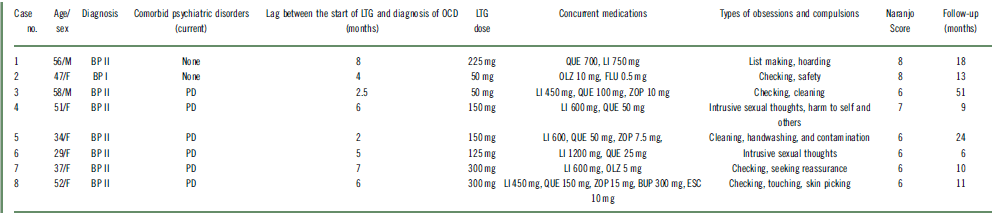
Demographic and clinical characteristics of patients are shown in Table 1. The patients were mostly women (n = 6), with ages ranging between 29 and 58 years (M = 45.5, SD = 10.81). All patients met the DSM-5 diagnostic criteria for bipolar disorder: 7 patients had bipolar II disorder, and 1 patient met the criteria for bipolar I disorder. Panic disorder was concurrently present in 5 cases. Only 1 patient (Case 8) had a family history of OCD in a first degree relative. Case 1 had obsessions and compulsions in the past but met the diagnostic criteria of OCD only after the introduction of lamotrigine. The patients were not using any substances (such as cocaine or psychostimulants) or suffering from any medical condition that could account for OCD symptoms. The lamotrigine dose ranged between 50 mg and 300 mg (M = 168.75, SD = 98.88). The OCD symptoms appeared 2–8 months after patients were first put on lamotrigine.
Clinical and treatment summary
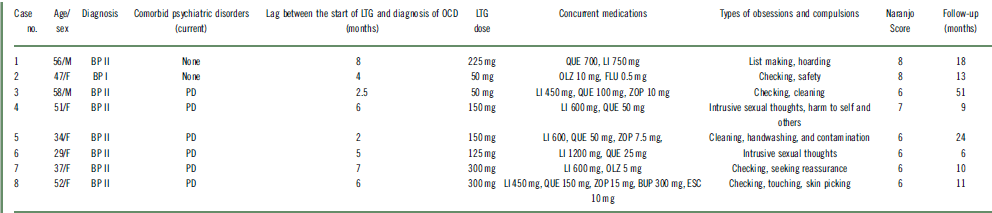
Abbreviations: BP I = bipolar I disorder, BP II = bipolar II disorder, BUP = bupropion, ESC = escitalopram, FLU = flupenthixol, LI = lithium, LTG = lamotrigine, OCD = obsessive compulsive disorder, OLZ = olanzapine, PD = panic disorder, QUE = quetiapine, ZOP = zopiclone.
Scores on the Naranjo scale indicated lamotrigine was a probable cause of OCD. The lag period between initiation of lamotrigine and patients reaching the diagnostic threshold of OCD ranged from 2 to 8 months. Two cases (Case 1 and Case 2) developed OCD when challenged again with lamotrigine. Case 1 first disclosed the OCD symptoms 8 months after being put on lamotrigine; however, upon a rechallenge of lamotrigine the OCD symptoms appeared within 1 month. Similarly, in Case 2 OCD reemerged after only 3 weeks upon a rechallenge of lamotrigine. Interestingly, Case 4 had reemergence of OCD symptoms following the substitution of lamotrigine with carbamazepine 400 mg daily.
In all cases except one, OCD symptoms fully remitted within 1 month of discontinuation of lamotrigine. None of the patients had a recurrence of OCD symptoms during follow-up periods spanning 6 months to 51 months (M = 17.75, SD = 14.58). The only exception was Case 8, who had a family history of OCD and experienced only abatement of OCD symptoms.
Vignettes of the representative cases are described below.
Case Vignettes
Case 1
Case 1 had had obsessions and compulsions in the past, but these symptoms never interfered with his level of functioning or caused any emotional distress. Following the initiation of lamotrigine, he started making copious notes on a daily basis about actors in television shows he planned to watch that day. The notes included a detailed biography of each actor and information about the television show. He would spend at least 8 hours a day gathering the material online and writing it up.
He also developed a compulsion to write the license plate numbers of all the commercial vehicles he would encounter during the time spent outside his home. He became highly anxious due to his inability to jot down the license plates of all the vehicles and decided to restrict his outdoor activities, resulting in him becoming housebound. During a regular follow-up appointment, he broke down and disclosed the full extent of OCD symptoms, including their “paralyzing” effect on his daily functioning.
Since lamotrigine was the last drug added to the regimen, we decided to taper it off. Within 1 month of lamotrigine discontinuation, he was completely free of OCD symptoms but developed severe depression. We decided to increase his quetiapine dose to 550 mg, but he developed frequent falls. Due to the persistence of depression and concerns regarding his safety, he agreed to retry lamotrigine, albeit in a low dose. Within 1 week of taking lamotrigine 75 mg a day, he had a return of OCD symptoms similar to the ones he had experienced earlier. The symptoms disappeared 3 days after lamotrigine was discontinued and he has remained free of OCD symptoms for 18 months. He is currently taking lithium 750 mg and quetiapine 700 mg daily.
Case 3
Case 3 developed a compulsive need to floss his teeth after lamotrigine was added to lithium 450 mg, quetiapine 100 mg, and zopiclone 10 mg daily. He would floss his teeth at least 20 times a day, spending several minutes each time. This was a major change from before, as he used to floss his teeth every couple of weeks. The frequent and prolonged periods of flossing caused a great deal of distress for him. He would excuse himself several times when sharing meals with his family to go to the washroom to floss his teeth. In between the flossing, he would repeatedly check his teeth to ensure there was no debris. He recognized the senseless nature of his behavior but felt compelled to carry out these activities. The symptoms disappeared within 2 weeks of discontinuation of lamotrigine, and he has not had any symptoms of OCD during the 51-month follow-up.
Discussion
Despite research suggesting lamotrigine as being effective in the treatment of OCD,Reference Bruno, Mico and Pandolfo 4 – Reference Poyurovsky, Glick and Koran 6 this case series suggests that lamotrigine may trigger OCD in patients with bipolar disorder. Since OCD is a common comorbidity in the context of bipolar disorder, it can be argued that these patients had spontaneous occurrences of OCD rather than having lamotrigine-induced OCD. Similarly, atypical neuroleptics such as risperidone, olanzapine, and quetiapine have been implicated in the causation of OCD.Reference Lykouras, Alevizos, Michalopoulou and Rabavilas 17 – Reference Tranulis, Potvin, Gourge, Leblanc, Mancici-Marie and Stip 19 All of our patients were on atypical neuroleptics—2 were on olanzapine and the rest took quetiapine—concurrent to use of lamotrigine. Thus it is possible that atypical neuroleptics may have contributed to the development of OCD symptoms. However, this is highly unlikely because these patients did not have any recurrences of OCD in spite of the continued use of these drugs. OCD can occur any time throughout the lifespan; however, most adults with the disorder report onset in childhood or adolescence.Reference Brakoulias, Starcevic and Belloch 20 , Reference Ruscio, Stein, Chiu and Kessler 21 None of our patients had onset of symptoms in childhood or adolescence.
Several factors including a close temporal relationship between lamotrigine use and symptom onset, disappearance of symptoms within 1 month of drug discontinuation, re-emergence of symptoms upon rechallenge of the drug, and absence of recurrence of OCD during the follow-up are suggestive of a causative role of lamotrigine. Absence of personal and family history of OCD in all except 1 patient suggests that these patients were not particularly prone to OCD and likely experienced these symptoms after the use of lamotrigine.
Some of our findings are not in accordance with previous reports. Patients in our series met the DSM-5 diagnostic criteria for medication-induced OCD, unlike patients in another case seriesReference Bruno, Mico and Pandolfo 4 who were thought to have symptoms distinct from OCD. Notably, the repetitive phrases were not accompanied by anxiety, as is the case with obsessions and compulsions. Kemp et al Reference Kemp, Gilmer, Fleck and Dago 8 reported onset of OCD symptoms only after lamotrigine was escalated to 200 mg or higher. Only 3 of our patients received doses higher than 200 mg.
It is difficult to comment on the prevalence of lamotrigine-induced OCD in bipolar disorder. Since bipolar disorder is the focus of care in a large number of patients taking lamotrigine, patients (especially those with no prior history of OCD) are rarely asked about obsessions and compulsions. Also, patients with depression may not be sensitized to the symptoms of OCD due to deficits in attention and reasoning,Reference Zaninotto, Solmi and Veronese 22 thus delaying the recognition and reporting of obsessions and compulsions. Another important issue is that patients may be reluctant to report these symptoms spontaneously due to feelings of shame and guilt.Reference Fergus, Valentiner, McGrath and Jencuis 23
Our findings suggest that patients with bipolar disorder should be monitored for emergence of obsessions and compulsions during treatment with lamotrigine. In cases where lamotrigine is thought to have induced OCD, clinicians should consider reducing the lamotrigine dose and monitoring for symptoms of OCD. If there is symptomatic improvement, lamotrigine should be tapered off. Management of bipolar depression comorbid with OCD is particularly challenging and often involves the use of more than one psychotropic drug.Reference Amerio, Stubbs, Odone, Tonna, Marchesi and Ghaemi 24 Clinicians who are unaware of lamotrigine inducing OCD might be tempted to add drugs to manage OCD rather than discontinue lamotrigine.
The etiology of lamotrigine-induced OCD is unclear. Individuals with OCD have lower glutamate levels in the lower anterior cingulate cortex (ACC),Reference Rosenberg, Mirza and Russell 25 , Reference Yücel, Wood and Wellard 26 and animal models suggest an increase of glutamate within the striatum.Reference Wu, Hanna, Rosenberg and Arnold 27 It is hypothesized that tonic-phase dysregulation of glutamate in the ACC results in phasic overactivation of the striatum, the outcome of which is OCD symptoms.Reference Ruscio, Stein, Chiu and Kessler 21 Lamotrigine acts by inhibiting glutamate by blocking N-methyl-D-aspartate (NMDA) receptors and inhibiting sodium-gated channels.Reference Cheung, Kamp and Harris 28 , Reference Ostadhadi, Ahangari and Nikoui 29 Kemp et al Reference Kemp, Gilmer, Fleck and Dago 8 hypothesized that lamotrigine may disrupt the glutamate balance within the cortico-striato-thalamic-cortical network resulting in the development of OCD. It is also unclear as to why lamotrigine induces OCD in some patients while it ameliorates these symptoms in others. There are examples of this paradoxical effect with other drugs such as atypical antipsychotics, including risperidone, olanzapine, and quetiapineReference Lykouras, Alevizos, Michalopoulou and Rabavilas 17 – Reference Tranulis, Potvin, Gourge, Leblanc, Mancici-Marie and Stip 19 ; other anticonvulsants such as levetiracetam and topiramateReference Çökmüş, Aşçıbaşı, Öztekin and Demet 30 , Reference Ozkara, Ozmen, Erdogan and Yalug 31 ; and antidepressants where chronic use can cause tardive dysphoriaReference El-Mallakh, Gao and Jeannie Roberts 32 and treatment resistanceReference Sharma 33 in some cases.
Limitations
Selection bias likely played a role in the observed occurrence of lamotrigine-induced OCD in patients with bipolar disorder because there are occasional reports of lamotrigine inducing obsessions and compulsions in patients with other psychiatric disorders. The small number of cases reported and lack of use of a scale to quantify the symptoms are other limitations. Caution should be exercised about generalizing our findings to patients seen in non-tertiary care facilities. Controlled studies exploring lamotrigine-induced OCD might provide useful insights into the etiology of OCD as well as its treatment in patients with comorbid bipolar disorder. Studies are also needed to assess whether patients with lamotrigine-treated epilepsy are at a higher risk of having OCD compared with similar patients on other antiepileptic drugs.
Conclusions
Lamotrigine is a commonly used drug in the treatment of bipolar depression, and there are occasional reports of its use in the management of OCD. Our case series suggests that lamotrigine use may be associated with first-onset of OCD in some patients with bipolar disorder. Although similar in symptomatology to primary OCD, lamotrigine-induced OCD appears to carry a better prognosis. Hopefully, future studies will shed light on the paradoxical effect of lamotrigine on OCD in individuals with bipolar disorder.
Disclosures
Dr. Sharma has received grant support from, participated on scientific advisory boards for, or served on speakers bureaus of Assurex, Genome Canada, Neurocrine Biosciences, Sage Therapeutics, Stanley Medical Research Institute, and Sunovion Pharmaceuticals. Ms. Doobay has no conflicts of interest to disclose.