INTRODUCTION
Approximately 15–20% of U.S. Service Members who served in Operation Enduring Freedom (OEF), Operation Iraqi Freedom (OIF), and Operation New Dawn (OND) have sustained one or more traumatic brain injuries (TBIs), most of which resulted from blast exposure and were mild in severity (Hoge et al., Reference Hoge, McGurk, Thomas, Cox, Engel and Castro2008; Terrio et al., Reference Terrio, Brenner, Ivins, Cho, Helmick, Schwab and Warden2009). In contrast with findings from the civilian literature that a single mild TBI (mTBI) is typically associated with a rapid return to baseline levels of cognitive function (Tator et al., Reference Tator, Davis, Dufort, Tartaglia, Davis, Ebraheem and Hiploylee2016), many OEF/OIF/OND Veterans continue to have significant cognitive complaints months, and even years, after sustaining one or more mTBI (Lange, Brickell, Ivins, Vanderploeg, & French, Reference Lange, Brickell, Ivins, Vanderploeg and French2013). These cognitive complaints are often associated with impairments in day-to-day functioning and increased use of healthcare resources (Cooper et al., Reference Cooper, Kennedy, Cullen, Critchfield, Amador and Bowles2011; Stroupe, Smith, Hogan, & St Andre, Reference Stroupe, Smith, Hogan and St Andre2013; Taylor et al., Reference Taylor, Hagel, Carlson, Cifu, Cutting, Bidelspach and Sayer2012).
Despite the prevalence of self-reported cognitive difficulties among OEF/OIF/OND Veterans with a history of mTBI, a clear understanding of the nature and etiology of these complaints remains elusive. This can present a clinical challenge as Veterans are frequently referred for evaluation and treatment of mTBI-related cognitive problems, which are distressing on subjective report but difficult to identify on standard neuropsychological measures (Drag, Spencer, Walker, Panglinan, & Bieliauskas, Reference Burgess, Alderman, Forbes, Costello, Coates, Dawson and Channon2012; O’Neil et al., Reference O’Neil, Carlson, Storzbach, Brenner, Freeman, Quinones and Kansagara2014). This discrepancy is also seen in the civilian mTBI literature (Belanger, Curtiss, Demery, Lebowitz, & Vanderploeg, Reference Belanger, Curtiss, Demery, Lebowitz and Vanderploeg2005; Belanger & Vanderploeg, Reference Belanger and Vanderploeg2005; Rohling et al., Reference Rohling, Binder, Demakis, Larrabee, Ploetz and Langhinrichsen-Rohling2011), and is often thought to be related to non-mTBI related factors, including comorbid psychiatric conditions (Belanger et al., Reference Belanger, Curtiss, Demery, Lebowitz and Vanderploeg2005). Similar interpretations are common within the literature on military-related mTBI, with persistent cognitive difficulties often attributed to unresolved PTSD (Hoge et al., Reference Hoge, McGurk, Thomas, Cox, Engel and Castro2008; Pietrzak et al., Reference Pietrzak, Goldstein, Malley, Rivers, Johnson and Southwick2010). This interpretation is not unexpected given the high prevalence of co-occurring mTBI and PTSD in this population, and the known cognitive symptoms associated with PTSD (Vasterling & Brailey, Reference Vasterling and Brailey2005). One study found that of over 300,000 OEF/OIF Veterans receiving care at the VA, 73% of Veterans diagnosed with TBI were also diagnosed with PTSD (Taylor et al., Reference Taylor, Hagel, Carlson, Cifu, Cutting, Bidelspach and Sayer2012).
Although non-mTBI related factors may certainly account for some of the day-to-day cognitive difficulties reported by OEF/OIF/OND Veterans, this cohort of Veterans may also be at increased risk of persisting cognitive impairment because many have sustained multiple mTBIs over the course of one or more deployments, often with insufficient time for recovery between injuries (Galarneau, Woodruff, Dye, Mohrle, & Wade, Reference Galarneau, Woodruff, Dye, Mohrle and Wade2008; Terrio et al., Reference Terrio, Brenner, Ivins, Cho, Helmick, Schwab and Warden2009). The deleterious cumulative effect of multiple mTBIs on cognitive functioning is well documented in studies of athletes (Belanger, Spiegel, & Vanderploeg, Reference Belanger, Spiegel and Vanderploeg2010; Guskiewicz et al., Reference Guskiewicz, McCrea, Marshall, Cantu, Randolph, Barr and Kelly2003; Zhang et al., Reference Zhang, Heier, Zimmerman, Jordan and Ulug2006). For instance, frequency of exposure to concussive and/or subconcussive head impacts (e.g., number of bouts and length of career in boxers; frequency of heading in soccer players) has been associated with reduced executive functioning and memory (Belanger et al., Reference Belanger, Spiegel and Vanderploeg2010). Furthermore, there is emerging neuroimaging evidence of chronic structural and functional brain abnormalities in Veterans with a history of blast-related mTBI (Hayes, Miller, Lafleche, Salat, & Verfaellie, Reference Hayes, Miller, Lafleche, Salat and Verfaellie2015; Jorge et al., Reference Jorge, Acion, White, Tordesillas-Gutierrez, Pierson, Crespo-Facorro and Magnotta2012 Newsome et al., Reference Newsome, Durgerian, Mourany, Scheibel, Lowe, Beall and Rao2015, Reference Newsome, Mayer, Lin, Troyanskaya, Jackson, Scheibel and Levin2016; Petrie et al., Reference Petrie, Cross, Yarnykh, Richards, Martin, Pagulayan and Peskind2014).
Despite this potentially increased risk, studies evaluating neuropsychological outcome following blast-related mTBI have consistently failed to find evidence of objective cognitive impairment (Belanger, Kretzmer, Yoash-Gantz, Pickett, & Tupler, Reference Belanger, Kretzmer, Yoash-Gantz, Pickett and Tupler2009; Levin et al., Reference Levin, Wilde, Troyanskaya, Petersen, Scheibel, Newsome and Li2010; Nelson et al., Reference Nelson, Hoelzle, Doane, McGuire, Ferrier-Auerbach, Charlesworth and Sponheim2012; Newsome et al., Reference Newsome, Durgerian, Mourany, Scheibel, Lowe, Beall and Rao2015; Spencer, Drag, Walker, & Bieliauskas, Reference Spencer, Drag, Walker and Bieliauskas2010; Verfaellie, Lafleche, Spiro, & Bousquet, Reference Verfaellie, Lafleche, Spiro and Bousquet2014). Multiple factors may contribute to this, including the use of neuropsychological measures that may not adequately assess the Veterans’ subjective complaints. Many commonly used neuropsychological measures were developed with the aim of detecting and localizing neuropathology (Johnstone & Frank, Reference Johnstone and Frank1995), rather than identifying the subtle cognitive inefficiencies that may emerge in some individuals following mTBI.
Furthermore, the highly structured nature of standardized neuropsychological tests and the distraction-free environment in which they are administered may mask cognitive inefficiencies that emerge in daily life when competing demands and distractions are present (Parsons, Reference Parsons2015). Of interest, some studies have noted lowered executive functioning (Burgess et al., Reference Burgess, Alderman, Forbes, Costello, Coates, Dawson and Channon2006; Dawson et al., Reference Dawson, Anderson, Burgess, Cooper, Krpan and Stuss2009) and multi-tasking (Scott et al., Reference Scott, Woods, Vigil, Heaton, Schweinsburg, Ellis and San Diego2011) performances on ecologically valid tasks despite normal performance on more traditional measures of these same functions. These findings support the use of more ecologically valid measurement, especially for the assessment of cognitive inefficiencies that may be more sensitive to environmental demands.
This study proposes to fill some gaps in the literature by evaluating a broader range of memory abilities in Veterans with a history of mTBI with a measure that has a higher level of ecological validity. Reduced memory is the most common cognitive problem endorsed by civilians with a history of mTBI (McCrea, Reference McCrea2008) and is also frequently reported by OEF/OIF/OND Veterans who have sustained a mTBI (Hoge et al., Reference Hoge, McGurk, Thomas, Cox, Engel and Castro2008). Past studies typically evaluated the ability to learn and recall word lists, stories, or line drawings. For the purpose of this study, we refer to this ability as retrospective memory (RM), a term that encapsulates multiple types of long-term memory processes (e.g., episodic memory, semantic memory).
Less frequently evaluated is the ability to remember future intentions, a dimension referred to as prospective memory (PM). Evaluation of PM may provide valuable insights into the nature of the cognitive difficulties frequently reported by Veterans with a history of blast-related mTBI, as PM is a high-level cognitive ability that is critical to the completion of many day-to-day tasks, such as remembering to schedule appointments or take medications (Vedhara et al., Reference Vedhara, Wadsworth, Norman, Searle, Mitchell, Macrae and Memel2004). Furthermore, objective assessments of PM performance have demonstrated significant associations with day-to-day memory complaints (Paxton & Chiaravalloti, Reference Paxton and Chiaravalloti2014; Raskin, Buckheit, & Waxman, Reference Raskin, Buckheit and Waxman2012; Tay, Ang, Lau, Meyyappan, & Collinson, Reference Tay, Ang, Lau, Meyyappan and Collinson2010) and may help improve our current understanding of reported memory problems. Research has shown that reduced PM may persist for an extended period following TBI, even after controlling for psychiatric symptoms (Tay et al., Reference Tay, Ang, Lau, Meyyappan and Collinson2010). However, PM has not yet been evaluated in Veterans with a history of blast-related mTBI.
The purpose of this study was to assess PM and RM in Veterans with a self-reported history of blast-related mTBI compared to a control group of Veterans with no history of TBI. Based on the frequency of memory complaints in this Veteran population, as well as previous findings of PM impairments in other individuals with a history of mTBI, we hypothesized that Veterans with a self-reported history of blast-related mTBI would have reduced PM, but not RM, performance relative to the control group. Because of reported associations between cognitive difficulties and psychiatric symptoms (Belanger et al., Reference Belanger, Curtiss, Demery, Lebowitz and Vanderploeg2005; Hoge et al., Reference Hoge, McGurk, Thomas, Cox, Engel and Castro2008; Pietrzak et al., Reference Pietrzak, Goldstein, Malley, Rivers, Johnson and Southwick2010) and the significant comorbidity between mTBI and PTSD in this Veteran population, we also evaluated the contribution of PTSD to task performance.
METHOD
Participants
The data were collected as part of a longitudinal study of outcomes in OEF/OIF/OND Veterans who reported a history of blast-related mTBIs. Participants were recruited from VA Puget Sound and affiliated clinics, as well as through outreach to Veteran organizations and National Guard and Reserve units. Sixty-one Veterans participated in the study, including 42 OEF/OIF/OND Veterans with a self-reported history of blast-related mTBI and 19 OEF/OIF/OND era Veterans with no history of blast exposures or TBI and no current PTSD (15 who had been deployed to Iraq and/or Afghanistan and four who had not been deployed). Data from two additional participants in the mTBI group were excluded from the analysis because of questionable performance validity. All participants were male and fluent in English. Exclusion criteria for the study included the presence of another neurological disorder (including moderate or severe TBI); lifetime DSM-IV diagnoses of schizophrenia, other psychotic disorder, or bipolar disorder; and a diagnosis of substance abuse or dependence within the past 3 months.
Procedures
This study was reviewed by the institutional review boards at the VA Puget Sound. All participants provided written informed consent before study enrollment and participation in study procedures.
Assessment of Blast-Related mTBI
Detailed information regarding blast and mTBI history was obtained using a previously described (Petrie et al., Reference Petrie, Cross, Yarnykh, Richards, Martin, Pagulayan and Peskind2014) comprehensive semi-structured interview that yields information about number and injury characteristics of lifetime mTBIs. Interviews were conducted by physicians and/or physician assistants who are trained in mTBI and PTSD. Two clinicians were present for this evaluation whenever possible so that diagnostic consensus could be reached at the time of the evaluation. During this semi-structured interview, participants were asked to report the number of blast exposures they experienced that were associated with at least one of the following symptoms: feeling dazed, confused, disoriented, time slowed, felt unreal, bell rung, blurry vision, blinded, hearing loss, ringing ears, blood from ears, dizzy, vertigo, unsteady on feet, nausea/vomiting, eyes sensitive to light, and/or headache. These were considered symptomatic blast exposures.
The semi-structured interview then guided the collection of details regarding the five Veteran-defined most severe blast exposures. Data collected included dates, locations (identified on maps), types of explosive devices, distance from blast, body position with respect to the blast, presence or absence of protective gear, whether their head hit a hard surface or was hit by significant debris, any injury to others, any loss of consciousness and/or posttraumatic amnesia, acute postconcussive symptoms, medical care received, and any change in duty status following the injury. This information was used to determine if any of the blast exposures met American Congress of Rehabilitation Medicine (ACRM) (Kay, Reference Kay1993) diagnostic criteria for mTBI (i.e., one or more of the following was present: (a) loss of consciousness (LOC) up to 30 min, (b) loss of memory for events surrounding the blast for up to 24 hr, or (c) any alteration in mental state).
Assessment of Psychiatric Symptoms
The Clinician-Administered PTSD Scale for DSM-IV (CAPS) (Blake et al., Reference Blake, Weathers, Nagy, Kaloupek, Gusman, Charney and Keane1995) was administered to determine whether Veterans met diagnostic criteria for PTSD. Criteria outlined by Blake et al. (Reference Blake, Weathers, Nagy, Kaloupek, Klauminzer, Charney and Keane1990) were used to determine current PTSD diagnosis. The PTSD Checklist-Military Version (PCL-M) (Forbes, Creamer, & Biddle, Reference Forbes, Creamer and Biddle2001; Weathers, Litz, Herman, Huska, & Keane, Reference Weathers, Litz, Herman, Huska and Keane1993) was used to assess PTSD symptom severity. The Patient Health Questionnaire-9 (PHQ-9) (Kroenke, Spitzer, & Williams, Reference Kroenke, Spitzer and Williams2001) was used to assess severity of current depression symptoms (total score), as well as to determine whether Veterans likely met DSM-IV diagnostic criteria for major depressive disorder (MDD) (Spitzer, Kroenke, & Williams, Reference Spitzer, Kroenke and Williams1999).
Neuropsychological Assessment
All participants were administered the Wechsler Test of Adult Reading (WTAR) (Wechsler, Reference Wechsler2001) to estimate premorbid intellectual functioning. Single word reading recognition ability is generally resilient to the effects of neurological injury or illness, including TBI (Green et al., Reference Green, Melo, Christensen, Ngo, Monette and Bradbury2008).
PM was assessed with the Memory for Intentions Test (MIST) (Raskin, Buckheit, & Sherrod, Reference Raskin, Buckheit and Sherrod2010). This measure consists of 8 PM tasks that are completed within a 25-min period. The tasks vary according to (a) the length of time delay before the required recall (2 or 15 min), (b) the nature of the cue provided (event-based or time-based), and (c) nature of response type (verbal or action). In contrast to event-based tasks, which provide an external cue to prompt performance (e.g., “When I do X, you do Y.”), time-based tasks are inherently more challenging as they require participants to perform an activity at a specified time in the future without any external cues or prompts.
Participants are provided with a clock to monitor time, but are not permitted to write down times or task instructions. Between PM tasks, the participant is engaged in a distractor task. The primary outcome for this measure was the MIST Total PM Score; four of the six subscale scores (2-min Delay, 15-min Delay, Event Cue, and Time Cue) were used as secondary outcomes. Scores on the MIST Total PM score range from 0 to 48, and scores on each subscale range from 0 to 8. This measure was developed with ecological validity in mind, and the tasks completed are consistent with the types of demands an individual might encounter in their day to day life (Raskin, Reference Raskin2009; Raskin et al., Reference Raskin, Buckheit and Sherrod2010). This measure has been shown to have high internal consistency and inter-rater reliability, adequate test–retest reliability, and construct validity (Kamat et al., Reference Kamat, Weinborn, Kellogg, Bucks, Velnoweth and Woods2014; Raskin et al., Reference Raskin, Buckheit and Sherrod2010; Woods, Moran, Dawson, Carey, & Grant, Reference Woods, Moran, Dawson, Carey and Grant2008).
Verbal RM was assessed with the California Verbal Learning Test-II (CVLT-II) (Delis & Kramer, Reference Delis and Kramer2000), and nonverbal RM was assessed with the Brief Visuospatial Memory Test-Revised (BVMT-R) (Benedict, Reference Benedict1997). For each of these domains, the primary outcome was Delayed Free Recall Total Score, and secondary outcomes were Single Trial Learning as defined by the score on Trial 1 of the Immediate Recall trials, and Total Immediate Recall across all of the learning trials.
Assessment of Performance Validity
Participants were administered Trials 1 and 2 of the Test of Memory Malingering (TOMM) (Tombaugh, Reference Tombaugh1996) to evaluate performance validity. All participants included in the analysis scored above the cutoffs for valid performance defined in the test manual (Tombaugh, Reference Tombaugh1996). On Trial 1, the mean score was 48.42 (SD=1.64) for the control group and 46.93 (SD=2.79) for the mTBI group. On Trial 2, the mean score was 49.95 (SD=0.23) for the control group and 49.83 (SD=0.44 ) for the mTBI group.
Statistical Analysis
Group differences on demographic variables and psychiatric symptoms were tested using Student’s t test for continuous variables and the chi-squared test for categorical variables. For categorical variables, confidence intervals (CIs) for the difference between two percentages were based on inverting the score statistic (Newcombe, Reference Newcombe1998). Pearson correlations were used to examine the relationship between age and neuropsychological test performance. Differences between groups on the primary and secondary outcomes were tested using analysis of covariance (ANCOVA) with age as a covariate, since the effect of age on neuropsychological test performance is well-documented, and including it as a covariate can reduce the variability of estimated means. Tests for interaction between age and group were performed to validate the homogeneity of coefficients assumption of ANCOVA. Reported means and standard errors (SEs) are based on an age of 35 years, close to the average age for all groups combined. Results for the 11 endpoints were adjusted for multiple comparisons using the method of Holm (Reference Holm1979).
We first compared the mTBI and control groups on each of the measures. Then, to evaluate the possible contribution of PTSD, participants with a history of self-reported mTBI were divided into those with (mTBI/PTSD+) and without (mTBI/PTSD-) co-occurring PTSD. For endpoints for which the ANCOVA remained significant after adjusting for multiple comparisons, we performed post hoc pairwise comparisons based on Fisher’s least significant difference (Levin, Serlin, & Seaman, Reference Levin, Serlin and Seaman1994). Effect size for a pairwise difference was computed by dividing the difference by the estimated population standard deviation (SD) based on the residuals from the fitted model (Cohen, Reference Cohen1988).
To explore possible differences in number of blast exposures between the mTBI/PTSD- and mTBI/PTSD+ groups, the Wilcoxon rank sum test was used to allow for a skewed distribution of number of blast exposures. All analyses were performed using R version 3.3.3 (R Core Team, 2017), the EnvStats package (Millard, Reference Millard2013), and the multcomp package (Hothorn, Bretz, & Westfall, Reference Hothorn, Bretz and Westfall2008).
RESULTS
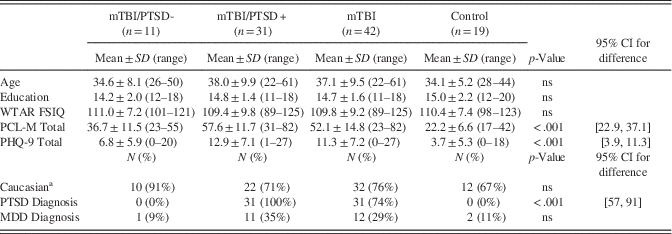
Demographic characteristics are presented in Table 1 for the entire mTBI group, the control group, and the mTBI subgroups (with and without PTSD). Mean estimated premorbid IQ was in the average range for both mTBI and control groups. There were no group differences in age, years of education, race, or estimated premorbid IQ. Compared to the control group, participants in the mTBI group had a significantly higher rates of PTSD diagnosis, PTSD symptoms and depression symptoms; the groups did not differ with respect to rates of MDD diagnosis.
Demographic and clinical characteristics of the sample

Note. For continuous variables, p-values and 95% CIs are based on the two-sample t-test (mTBI – control). For categorical variables, p-values are based on the chi-squared test and CIs are based on inverting the score statistic.
a One missing value for controls.
Participants in the mTBI group reported a wide range of symptomatic blast exposures (range=2 to >100; median=11.5; mean=38.4; SD=79.6). Eighty-one percent of the Veterans in the mTBI group reported at least one instance of hitting their head on a hard surface or their head being hit by significant debris in the context of a blast exposure. A subset of the blast exposures were determined to meet ACRM criteria for mTBI; 40 participants in the mTBI group (95%) sustained more than one mTBI, including 18 participants (43%) who reported 5 or more mTBIs. Sixty percent of the Veterans in the mTBI group reported having sustained a loss of consciousness (LOC) or post-traumatic amnesia; the average number of LOCs across this group was less than one. Average time since most recent blast exposure was 6.4 years (SD=2.4), with a range of 1 to 11 years.
As expected, age was significantly negatively correlated with all three primary outcomes (range: r=−0.47 to −0.31; one-sided p=.0001 to .007), and five of the eight secondary outcomes (range: r=−0.26 to −0.48; one-sided p=.0001 to .02). The exceptions were the MIST 15-min Delay r=−0.19; one-sided p=0.07), MIST Event Cue (r=−0.18; one-sided p=.08), and CVLT-II immediate recall on Trial 1 (r=−0.15; one-sided p=.12). No significant interaction between age and group was detected for any of the outcomes.
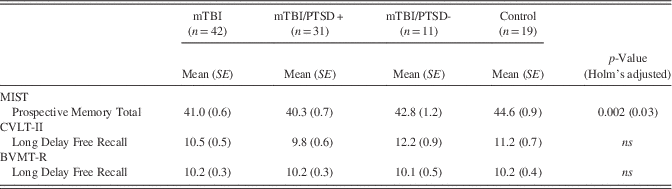
The mTBI group as a whole performed significantly worse than the control group on the MIST Prospective Memory Total Score (p=.002; Holm-corrected p=.02), but no group differences emerged on the CVLT-II or BVMT-R Long Delay Free Recall Scores. Additional analyses were conducted to compare Veterans in the mTBI/PTSD+, mTBI/PTSD-, and control groups. Age-adjusted mean scores and the results of the ANCOVAs for the primary neuropsychological outcome measures are presented in Table 2. Group differences were again present for the MIST PM Total Score, but not for the delayed recall scores for either RM task.
Performance on retrospective and prospective memory tasks: Primary outcomes

Notes. Means and SEs for mTBI are based on linear regression models with group (mTBI vs. control) as an explanatory variable and age as a covariate, with age set to 35 years old. Means and SEs for mTBI/PTSD+, mTBI/PTSD-, and control are based on linear regression models with group (mTBI/PTSD+ vs. mTBI/PTSD- vs. control) as an explanatory variable and age as a covariate, with age set to 35 years old. p-Values are based on comparing the three groups mTBI/PTSD+ vs. mTBI/PTSD- vs. control. Holm’s adjusted p-values are based on adjusting for 11 outcomes.
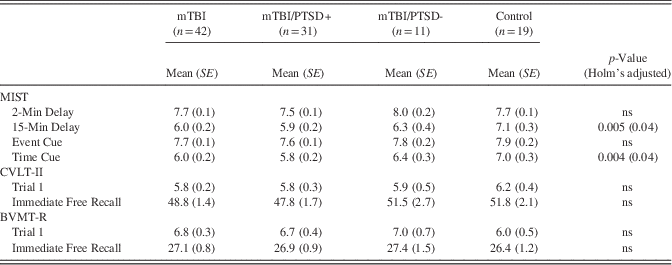
Similar analyses were conducted for the secondary outcomes. Veterans in the mTBI group as a whole demonstrated reduced performance on the MIST 15-min Delay (p=.002; Holm-corrected p=.02) and Time Cue (p=.003; Holm-corrected p=.04) subscales. No group differences were present on the MIST 2-min Delay or Event Cue subscales, as both groups demonstrated a high level of accuracy on these subscales (2-min Delay subscale: 79% of the controls and 74% of the mTBI group had 100% accuracy; Event Cue subscale: 95% of controls and 83% of mTBI group demonstrated 100% accuracy).
Finally, no group differences were present on the single trial learning or total immediate recall scales of the RM measures. Additional analyses were conducted comparing the mTBI/PTSD+, mTBI/PTSD-, and control groups on the secondary outcomes. These results are presented in Table 3, and again revealed group differences on the MIST 15-min Delay and Time Cue subscales, but not on the other secondary measures.
Performance on retrospective and prospective Memory Tasks: Secondary Outcomes

Note. Means and SEs for mTBI are based on linear regression models with group (mTBI vs. control) as an explanatory variable and age as a covariate, with age set to 35 years old. Means and SEs for mTBI/PTSD+, mTBI/PTSD-, and control are based on linear regression models with group (mTBI/PTSD+ vs. mTBI/PTSD- vs. control) as an explanatory variable and age as a covariate, with age set to 35 years old. p-Values are based on comparing the three groups mTBI/PTSD+ vs. mTBI/PTSD- vs. control. Holm’s adjusted p-values are based on adjusting for 11 outcomes.
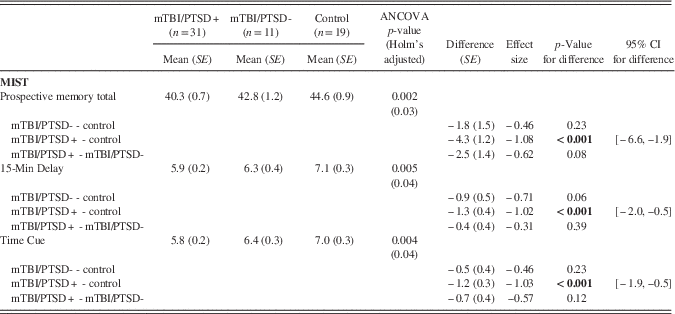
Post hoc analyses for the MIST Total score and the 15-min Delay and Time Cue subscale scores are presented in Table 4. These analyses show that participants in the mTBI/PTSD+ group performed significantly worse than participants in the control group on all three of these MIST scales. In addition, the mean for mTBI/PTSD- participants was in-between the mean for controls and the mean for mTBI/PTSD+ participants on all three scales; however, the means for the mTBI/PTSD- group were not significantly different from either of these other two groups. There was no difference in number of blast exposures between the mTBI/PTSD- and mTBI/PTSD+ groups (Wilcoxon rank sum p=.10). Finally, within the mTBI group, there was no difference in performance on the primary and secondary outcome measures according to history of loss of consciousness and/or post-traumatic amnesia.
Performance on prospective memory tasks for which the ANCOVA three-group difference remained significant after adjusting for multiple comparisons (i.e., 11 outcomes)

Note. Results are based on linear regression models with group (mTBI/PTSD+ vs. mTBI/PTSD- vs. control) as an explanatory variable and age as a covariate. Displayed Means and SEs are based on age set to 35 years old.
DISCUSSION
Previous studies of OEF/OIF/OND Veterans with a history of blast-related mTBI have not consistently demonstrated reduced abilities on neuropsychological memory measures (Nelson et al., Reference Nelson, Hoelzle, Doane, McGuire, Ferrier-Auerbach, Charlesworth and Sponheim2012; Verfaellie et al., Reference Verfaellie, Lafleche, Spiro and Bousquet2014), despite self-reported cognitive difficulties. This study evaluated RM and PM in an attempt to further characterize and quantify these reported day-to-day memory difficulties. Our results revealed reduced PM performance (MIST PM Total Score) in Veterans in the mTBI/PTSD+ group relative to a Veteran control group with no self-reported history of TBI and no current PTSD. Examination of the MIST subscales indicated that Veterans in the mTBI/PTSD+ group also had significantly worse performance than the control group on the MIST 15-min Delay and Time Cue subscales.
These differences were associated with large effect sizes (Cohen, Reference Cohen1988), supporting the clinical significance of this finding. Importantly, these findings also suggest a pattern of dissociation within PM, with difficulties limited to more challenging aspects of the task, such as maintaining prospective memory cues for 15 minutes and remembering to complete tasks at a specified time without prompts. In contrast, participants in all three groups demonstrated high levels of accuracy on tasks involving the shorter delay (2 min), regardless of cue type (event or time).
Similarly, when responses were prompted by an Event Cue, regardless of length of delay, the groups performed comparably well. This PM performance pattern is consistent with the civilian TBI literature (Mathias & Mansfield, Reference Mathias and Mansfield2005; Raskin et al., Reference Raskin, Buckheit and Waxman2012; Tay et al., Reference Tay, Ang, Lau, Meyyappan and Collinson2010) and advances our current understanding of the specific types of memory difficulties experienced by these OEF/OIF/OND Veterans. This finding is especially important from a functional perspective, given that PM performance has been shown to be highly correlated with “real world” functioning including medication adherence, compliance with health care directions, and employment status (Contardo, Black, Beauvais, Dieckhaus, & Rosen, Reference Contardo, Black, Beauvais, Dieckhaus and Rosen2009; Poquette et al., Reference Poquette, Moore, Gouaux, Morgan, Grant and Woods2013; Woods, Weber, Weisz, Twamley, & Grant, Reference Woods, Weber, Weisz, Twamley and Grant2011; Zogg et al., Reference Zogg, Woods, Weber, Iudicello, Dawson and Grant2010).
Also, consistent with previous investigations, OEF/OIF/OND Veterans with a self-reported history of blast-related mTBI did not differ from the control group on measures of RM (Belanger et al., Reference Belanger, Kretzmer, Yoash-Gantz, Pickett and Tupler2009; Levin et al., Reference Levin, Wilde, Troyanskaya, Petersen, Scheibel, Newsome and Li2010; Nelson et al., Reference Nelson, Hoelzle, Doane, McGuire, Ferrier-Auerbach, Charlesworth and Sponheim2012; O’Neil et al., Reference O’Neil, Carlson, Storzbach, Brenner, Freeman, Quinones and Kansagara2014; Spencer et al., Reference Spencer, Drag, Walker and Bieliauskas2010; Verfaellie et al., Reference Verfaellie, Lafleche, Spiro and Bousquet2014). This finding was true regardless of whether comorbid PTSD was present. Although RM is typically assessed as part of neuropsychological evaluations, these results suggest that it may not be as sensitive as PM to cognitive difficulties in Veterans with self-reported mTBI and PTSD. As such, neuropsychological evaluations may need to incorporate assessment of PM to fully characterize the cognitive inefficiencies experienced by this population.
Characteristics that differentiate RM and PM may help to explain this finding. For instance, RM tasks, including those used in this study, typically involve a prompt to remember information (e.g., tell me all of the words from the list that you can remember). This study showed that the participants had particular difficulty on the PM task when the expected response was uncued. This characteristic of PM, often referred to as “remembering to remember”, is a cognitively complex process that involves the formation, retention, initiation, and execution of a response at the desired time (Kliegel, Martin, McDaniel, & Einstein, Reference Kliegel, Martin, McDaniel and Einstein2002). Successful completion of this task requires RM as well as executive functioning abilities (Carey, Woods, Rippeth, Heaton, & Grant, Reference Carey, Woods, Rippeth, Heaton and Grant2006; Kliegel, Altgassen, Hering, & Rose, Reference Kliegel, Altgassen, Hering and Rose2011; Kliegel, McDaniel, & Einstein, Reference Kliegel, McDaniel and Einstein2008; McDaniel & Einstein, Reference McDaniel and Einstein2000; Tay et al., Reference Tay, Ang, Lau, Meyyappan and Collinson2010).
Furthermore, on the MIST, these tasks have to be completed while multi-tasking (i.e., working on distractor task) and managing frequent distractions (i.e., examiner prompts), which increases the cognitive load and task challenge. This also increases the ecological validity of the measure, as day-to-day cognitive functioning often involves similar management of multiple competing cognitive demands. The multi-faceted nature of time-based PM is supported by imaging studies that implicate brain regions associated with both executive functioning and memory, including the dorsolateral prefrontal cortex, cuneus/precuneus, inferior parietal lobule, superior temporal gyrus, and the cerebellum (Gonneaud et al., Reference Gonneaud, Rauchs, Groussard, Landeau, Mezenge, de La Sayette and Desgranges2014).
One important question relates to the etiology of reduced PM in OEF/OIF/OND Veterans with a self-reported history of blast-related mTBI. Prior research has found reduced PM in civilians with mTBI not reported to have PTSD or depression (Tay et al., Reference Tay, Ang, Lau, Meyyappan and Collinson2010) as well as among Veterans with PTSD (Scott et al., Reference Scott, Woods, Wrocklage, Schweinsburg, Southwick and Krystal2016). In the current study, PM performance in the mTBI/PTSD+ group was significantly lower than the control group on the three MIST measures, with scores for the mTBI/PTSD- group intermediate between Veterans with no self-reported history of TBI and Veterans in the mTBI/PTSD+ group.
Although the differences between Veterans in the mTBI/PTSD- group and the other two groups were not statistically significant, it is not possible to determine from these results whether this is because of a Type II error due to the small sample size of the mTBI/PTSD- group or if there truly are not group differences on these measures. One possible mechanism for the pattern of significantly lower performance in the mTBI/PTSD+ group (relative to controls) is the alterations in the prefrontal cortex functioning that can be associated with both mTBI and PTSD. For example, PTSD is associated with a disruption of the frontally-mediated attention system (Etkin, Gyurak, & O’Hara, Reference Etkin, Gyurak and O’Hara2013; Eysenck, Derakshan, Santos, & Calvo, Reference Eysenck, Derakshan, Santos and Calvo2007). Similarly, blast-related mTBI has been shown to affect prefrontal cortex functional connectivity (Sponheim et al., Reference Sponheim, McGuire, Kang, Davenport, Aviyente, Bernat and Lim2011), which could be related to decreased white matter integrity in frontal (Lipton et al., Reference Lipton, Gulko, Zimmerman, Friedman, Kim, Gellella and Branch2009; Niogi & Mukherjee, Reference Niogi and Mukherjee2010) and more diffuse brain regions (Davenport, Lim, Armstrong, & Sponheim, Reference Davenport, Lim, Armstrong and Sponheim2012) observed in individuals with a history of mTBI. Furthermore, our prior research (Meabon et al., Reference Meabon, Huber, Cross, Richards, Minoshima, Pagulayan and Cook2016; Petrie et al., Reference Petrie, Cross, Yarnykh, Richards, Martin, Pagulayan and Peskind2014) suggests that the cerebellum, a core component of the working memory network (Kirschen, Chen, Schraedley-Desmond, & Desmond, Reference Kirschen, Chen, Schraedley-Desmond and Desmond2005) and a brain region that is active during time-based prospective memory tasks (Gonneaud et al., Reference Gonneaud, Rauchs, Groussard, Landeau, Mezenge, de La Sayette and Desgranges2014), may be particularly vulnerable to blast-related mTBI. Disruption of this neural network may contribute to difficulty maintaining intentions, and when combined with PTSD symptoms, may be sufficient to cause reduced PM performance. However, it is important to note the majority of neuroimaging studies of individuals with blast-related mTBI, like studies of neuropsychological functioning in this population, are accompanied by the major limitation of retrospective self-report of TBI history, which limits our conclusions at this time.
It is also possible that other factors not evaluated in this study are contributing to these findings. For example, mTBI and PTSD frequently co-occur with chronic pain (Lew et al., Reference Lew, Otis, Tun, Kerns, Clark and Cifu2009), and PM deficits have been reported in patients with chronic pain (Ling, Campbell, Heffernan, & Greenough, Reference Ling, Campbell, Heffernan and Greenough2007). Similarly, disrupted sleep, depression, and substance misuse occur at high rates in this population, and all have been associated with reduced PM (Altgassen, Kliegel, & Martin, Reference Altgassen, Kliegel and Martin2009; Grundgeiger, Bayen, & Horn, Reference Grundgeiger, Bayen and Horn2014; Marshall, Heffernan, & Hamilton, Reference Marshall, Heffernan and Hamilton2016). As such, ongoing investigation is needed to fully understand all of the factors that may be contributing to the reduced PM seen in this study.
Identification of PM difficulties in Veterans with a self-reported history of blast-related mTBI and comorbid PTSD has potential treatment implications. Several studies have demonstrated clinical benefit of PM-focused cognitive rehabilitation interventions (e.g., Fleming, Shum, Strong, & Lightbody, Reference Fleming, Shum, Strong and Lightbody2005; McDonald et al., Reference McDonald, Haslam, Yates, Gurr, Leeder and Sayers2011; Raskin & Sohlberg, Reference Raskin and Sohlberg2009; Shum, Fleming, Gill, Gullo, & Strong, Reference Shum, Fleming, Gill, Gullo and Strong2011). These studies, which typically use mental rehearsal strategies or compensatory aids, such as diaries or electronic prompts, to serve as external reminders, are largely preliminary studies involving small clinical samples.
A more recent randomized controlled trial of group-based compensatory cognitive training (CCT) with 119 OEF/OIF/OND Veterans with a history of mTBI was found to significantly reduce self-reported PM problems (Storzbach et al., Reference Storzbach, Twamley, Roost, Golshan, Williams, O’Neil and Huckans2017). In this intervention, PM difficulties and associated compensatory strategies were only addressed in two of the ten treatment sessions. The results of the current study, which found that Veterans with self-reported history of blast-related mTBI and PTSD had the lowest performance on PM measures compared to the control group and Veterans with a history of mTBI but no current PTSD, suggests that a hybrid intervention designed to treat PM and psychiatric symptoms simultaneously might be clinically beneficial.
This dual-treatment approach could simultaneously teach cognitive compensatory strategies and treat the underlying PTSD symptoms that may be contributing to the PM difficulties. In addition, evaluation of possible change in PM following evidence-based psychotherapy interventions for PTSD such as Prolonged Exposure (Foa, Hembree, & Rothbaum, Reference Foa, Hembree and Rothbaum2007) or Cognitive Processing Therapy (Resick, Monson & Chard, Reference Resick, Monson and Chard2008) would significantly further our understanding of the contribution of PTSD symptoms to PM difficulties.
There are several limitations to this study. First, we enrolled a convenience sample (i.e., Veterans recruited from VA Puget Sound and affiliated clinics) consisting entirely of male volunteers. As such, our findings may not be representative of all OEF/OIF/OND Veterans with a self-reported history of blast-related mTBI and cannot be generalized to female Veterans. However, because this sample is likely representative of the majority of OEF/OIF/OND Veterans who are seeking care in the VA system, the findings may have potential for identifying and ultimately treating specific cognitive difficulties in this population.
There are also limitations related to the diagnosis of mTBI. Medical records from the time of injury were not available for review (as is the case for many OEF/OIF/OND Veterans with a history of mTBI), so a semi-structured clinical interview was used to gather information about injury characteristics and guide the determination of the presence or absence of mTBI. Although the retrospective diagnosis of mTBI is imperfect, it is often presumed that semistructured interviews increase diagnostic accuracy and this diagnostic approach is consistent with most research on this clinical population (e.g., Donnelly et al., Reference Donnelly, Donnelly, Dunnam, Warner, Kittleson, Constance and Alt2011; Nelson et al., Reference Nelson, Hoelzle, McGuire, Ferrier-Auerbach, Charlesworth and Sponheim2011; Terrio et al., Reference Terrio, Brenner, Ivins, Cho, Helmick, Schwab and Warden2009; Vanderploeg, Groer, & Belanger, Reference Vanderploeg, Groer and Belanger2012; Walker et al., Reference Walker, Cifu, Hudak, Goldberg, Kunz and Sima2015).
Another limitation is that the majority of the participants in the mTBI group had co-occurring PTSD (n=31), with fewer Veterans meeting criteria for only mTBI (n=11). These small sample sizes, and the lack of participants in the control group who had PTSD, limited our analyses and conclusions that could be drawn about the impact of PTSD alone and self-reported mTBI alone on PM functioning. Future studies using a larger sample size would have increased power for detecting possible group differences on PM. Finally, although the TOMM was included for the evaluation of performance validity, symptom validity [i.e., validity scales from measures such as the Minnesota Multiphasic Personality Inventory-2 (Butcher, Graham, Tellegen, & Kaemmer, Reference Butcher, Graham, Tellegen and Kaemmer1989) or Personality Assessment Inventory (Morey, Reference Morey2007)] was not formally evaluated.
Taken together, these results hold significant promise for helping to understand the persisting cognitive difficulties reported by OEF/OIF/OND Veterans with a self-reported history of blast-related mTBI and current PTSD. PM is rarely formally assessed clinically, but is essential for many everyday activities. Further research in individuals with a history of mTBI is needed to understand the relationship between PM and both self-reported cognitive difficulties and other domains of cognitive functioning, as well as the contribution of other common comorbid conditions, including pain, sleep, and depression, to PM performance. An appreciation of the complex heterogeneity underlying both mTBI and PTSD could reveal important mechanisms and risk factors associated with reduced PM and inform individually tailored treatments. Finally, the results suggest that a shift in neuropsychological assessment approaches toward including more sensitive and ecologically valid measures (Parsons, Reference Parsons2015) may be necessary to fully characterize the cognitive inefficiencies that may be present among OEF/OEF/OND Veterans with a self-reported history of blast-related mTBI.
ACKNOWLEDGMENTS
Conflicts of Interest and Source of Funding: This material is based on work supported by the Department of Veterans Affairs VA Clinical Science Research and Development (R&D) Career Development Award IK2 CX000516 (K.F.P.) and Award CX001508-02 (S.S.); Rehabilitation R&D Service Merit Review Award B77421 (E.R.P.); VA Northwest Network MIRECC (E.R.P., B.R.H., M.A.R., K.F.P., H.R., E.C.P., C.M., J.S.M., B.R.H.); Office of Academic Affiliations, Advanced Fellowship Program in Mental Illness Research and Treatment, Department of Veterans Affairs (B.R.H.), National Institute of Health T32 AG000258 (J.S.M.); Department of Veterans Affairs Office of R&D Medical Research Service (D.G.C., E.R.P.); and an anonymous foundation. The authors have no conflicts of interest to report.