1 Introduction
Lexical exceptions, patterns in which a restricted set of morphemes unexpectedly undergoes or fails to undergo a phonological process, can shed light on key properties of the phonological grammar. This paper discusses apparent exceptional prosodification effects, in which exceptional lexical items appear to follow a regular pattern that is found in a different prosodic context. I focus on several such cases in the distribution of nasal vowels in Standard French. In brief, the language places restrictions on the types of segments that can follow nasal vowels, i.e. possible ṼX sequences (where X = any segment). This distribution is generally sensitive to morphosyntactic constituency: the larger the juncture between Ṽ and X, the more types of segments X are permitted. However, several exceptional items show stronger than expected restrictions on ṼX sequences at junctures; in each case the pattern resembles a regular one that applies within a smaller domain.
Exceptional prosodification effects have generally been accounted for in terms of prosodic prespecification (also known as ‘prosodic subcategorisation’); some lexical items subcategorise for a non-default prosodic representation (Inkelas Reference Inkelas1989, Poser Reference Poser, Inkelas and Zec1990, Zec Reference Zec2005, Paster Reference Paster2006, Bennett et al. Reference Bennett, Harizanov and Henderson2018, Tyler Reference Tyler2019). This paper proposes that prespecification approaches should be re-evaluated in light of recent advances in phonological theory. It builds on several arguments advanced in favour of Harmonic Grammar, a constraint-based grammar in which constraints are numerically weighted rather than ranked (Legendre et al. Reference Legendre, Miyata and Smolensky1990, Smolensky & Legendre Reference Smolensky and Legendre2006). In particular, a weighted constraint system can generate many phonological patterns using a smaller constraint set that better predicts attested typologies (Farris-Trimble Reference Farris-Trimble2008, Potts et al. Reference Potts, Pater, Jesney, Bhatt and Becker2010, Jesney Reference Jesney2011, Pater Reference Pater, Borowsky, Kawahara, Shinya and Sugahara2012, Reference Pater, McCarthy and Pater2016), and correctly predicts that optimal outputs can be determined by the interaction of constraints that refer to independent dimensions of structure (Zuraw & Hayes Reference Zuraw and Hayes2017). In addition, I consider recent claims that lexical variability and exceptionality should be accounted for in terms of contrasts in the gradient activity values of underlying representations (Rosen Reference Rosen2016, Smolensky & Goldrick Reference Smolensky and Goldrick2016, Zimmermann Reference Zimmermann2018).
I demonstrate that apparent exceptional prosodification effects are predicted to arise in such a framework, a Gradient Harmonic Grammar (Smolensky et al. Reference Smolensky, Goldrick and Mathis2014, Smolensky & Goldrick Reference Smolensky and Goldrick2016), without lexically specific variability in the mappings from syntactic to prosodic constituent structure. Instead, these patterns emerge from the interaction of two independently proposed constraint penalty adjustments: (i) scaling of constraint penalties according to the prosodic environments in which they occur (Hsu & Jesney Reference Hsu and Jesney2016, Inkelas & Wilbanks Reference Inkelas, Wilbanks, Gallagher, Gouskova and Yin2018), and (ii) contrastive specification of featural and segmental activity values (Rosen Reference Rosen2016, Smolensky & Goldrick Reference Smolensky and Goldrick2016, Zimmermann Reference Zimmermann2018). Because both factors contribute to the harmony values of output candidates, changes to the underlying values of otherwise identical input structures can replicate the effects of scaling based on prosodic context.
Anticipating the analysis, I propose that positional markedness constraints against ṼX sequences are scaled according to the size of the smallest prosodic constituent that contains such sequences, such that ṼX sequences contained in smaller domains incur higher markedness penalties. All nasal vowels in French are derived from an underlying form /Ṽn/, but lexical items vary in the underlying activity value of the vowel's [nasal] feature and of /n/’s root node. These contrasts in underlying activity alter the penalties of faithfulness constraints. Because all constraint violations contribute to total harmony, changes to underlying activity values can in some instances have the same effect as constraint scaling on the relative harmony of output forms. This approach is able to generate the French pattern from a uniform set of underlying segments for lexical items with a nasal vowel allomorph, without prosodic prespecification, desiderata that have eluded previous analyses.
The proposal has several implications. First, it suggests that contrasts in gradient activity among lexical items can provide a unified analysis for exceptional patterns more generally, both in exceptional prosodification effects and in patterns that do not involve prosodic structure (Rosen Reference Rosen2016, Zimmermann Reference Zimmermann2018). As this reduces the number of structural prespecifications proposed for underlying forms, it results in a more parsimonious explanation for lexical exceptionality. In addition, this approach to exceptional prosodification effects allows morpheme-specific constraints on syntax–prosody alignment to be dispensed with, in line with recent research that proposes reduced variability in the possible mappings from syntactic to prosodic domains (Selkirk Reference Selkirk, Goldsmith, Riggle and Yu2011, Elfner Reference Elfner2012, Tyler Reference Tyler2019).
The remainder of the paper is structured as follows. §2 presents the distribution of nasal vowels in French and the apparent exceptional prosodification effects in the language. §3 presents an analysis of regular sensitivity to prosodic structure using scalar markedness constraints, and §4 shows how the apparent exceptional prosodification effects arise from the interaction of scalar markedness constraints and contrastive activity values. §5 argues against approaches which employ prosodic prespecification and lexical constraint indexation, and §6 concludes the paper.
2 Effects of prosodic structure on nasal vowels and liaison
This section presents the distribution of the nasal vowels ([ε̃ ɔ̃ ɑ̃]) in Standard French, with a focus on the types of segments that can follow nasal vowels. Generally, the larger the boundary between Ṽ and X, the more types of segment X are permitted, such that relatively sonorous segments are dispreferred. This is observed both in static phonotactic generalisations and in alternations observed at morphosyntactic junctures. I then present the exceptional cases, where individual lexical items show stronger than expected restrictions on ṼX sequences. Crucially, I show that there are only three regular patterns, and that all exceptional lexical items pattern in a way that resembles a regular pattern that applies across a smaller juncture.
2.1 Stem-internal ṼX
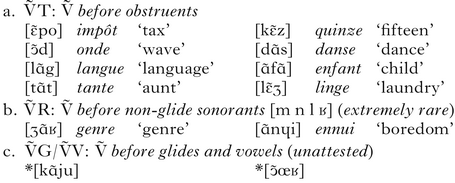
With very few exceptions, when both segments ṼX are contained within a stem, the only sounds that follow nasal vowels are obstruents. Some examples are given in (1a). Nasal vowels followed by non-glide sonorants are extremely rare, and are restricted to a handful of forms, like [ʒɑ̃ʁ] and [ɑ̃nɥi] in (1b). Lastly, nasal vowels are not found before glides or vowels (Dell Reference Dell1970), as shown by the absence of forms like those in (1c). Note that the restriction against nasal vowels preceding other vowels is stronger than the general dispreference for vowel hiatus, as hiatus is attested for adjacent oral vowels (VV; e.g. [naif] naïf ‘naive’) and for an oral vowel followed by a nasal vowel (VṼ; e.g. [kameleɔ̃] caméléon ‘chameleon’), but not for a nasal vowel followed by an oral vowel (*ṼV) or for a sequence of nasal vowels (*ṼṼ).Footnote 1 The absence of nasal vowels before glides results to some extent from the restricted distribution of non-initial glides; neither [w] nor [ɥ] is permitted as a singleton onset in non-stem-initial syllables (Tranel Reference Tranel1987). Nonetheless, [j] is permitted in these contexts, and is unattested following nasal vowels.
(1)

2.2 ṼX across prefix boundaries
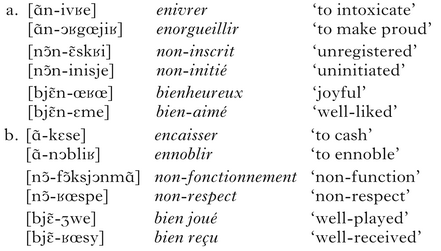
Restrictions on nasal vowels preceding morpheme boundaries can be observed on prefixes that have an allomorph that ends with a nasal vowel. The general pattern is illustrated in the alternations of [ɑ̃(n)] en- ‘to make X’, [nɔ̃(n)] non- ‘non-’, [bjε̃(n)] bien- ‘well-’ (Tranel Reference Tranel1981, Hannahs Reference Hannahs1995). Before a vowel-initial stem, each prefix ends in a nasal vowel and coronal nasal, as shown in (2a). Before a consonant-initial stem, it ends in a nasal vowel, regardless of the following consonant's sonority, as in (2b). In contrast to stem-internal nasal vowels, nasal vowels in prefixes are permitted before sonorant consonants.
(2)
As described by Tranel (Reference Tranel1976), the negative prefix in- has a pattern of allomorphy which is distinct from other prefixes, in that it is sensitive to the sonority of stem-initial consonants. In- surfaces as [in] before vowel-initial and glide-initial stems (3a), as [i] before other sonorant-initial stems (b) and as [ε̃] before obstruent-initial stems (c).Footnote 2
(3)
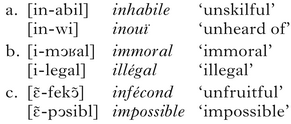
The key observation here is that this pattern of allomorph selection shows the same distribution as for stem-internal ṼX sequences, where nasal vowels can precede obstruents, but not sonorant consonants or vowels.
2.3 ṼX across word boundaries
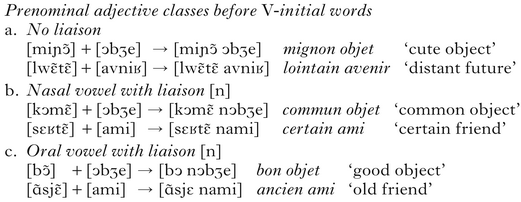
The patterning of ṼX sequences separated by a morphological word boundary shows the greatest degree of variation across lexical items. The analysis of this variability, as well as identifying which patterns should be treated as exceptional, has been the subject of many analyses in generative phonology (see Tranel Reference Tranel1981, Reference Tranel1995 for detailed overviews). Here, I focus on prenominal adjectives ending in a nasal vowel when pronounced in isolation, and how they surface when they precede a vowel-initial word. Three patterns emerge in this context (Sampson Reference Sampson2001). First, certain prenominal adjectives end in a nasal vowel, with no change from their pronunciation in isolation, as in (4a). The second class of adjectives, in (b), retains the final nasal vowel, but surfaces with a linking (liaison) consonant [n]. The third class also surfaces with linking [n], but with an oral vowel in place of the nasal vowel that would appear in isolation, as in (c). The observed patterns are conditioned by the prenominal adjective, rather than the following word (cf. Zymet Reference Zymet2018 for discussion of effects of the first word in liaison with consonants other than [n]).
(4)
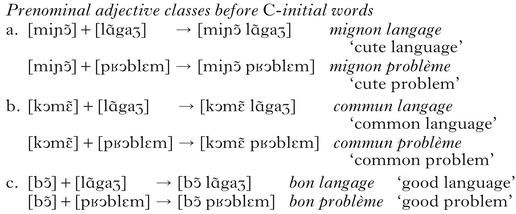
This distinction is observed only before vowel-initial words. When followed by a consonant-initial word, all of the adjectives above surface with a final nasal vowel before both sonorant and obstruent consonants, as in (5).
(5)
Although there is some correlation between the properties of these adjectives and their patterning before vowel-initial words, none are fully predictable or without exceptions. For instance, while adjectives that trigger liaison with an oral vowel (4c) commonly end in [ε̃] (orthographic -ien, -ain, -ein), this vowel-quality generalisation does not extend to bon ([bɔ̃]/[bɔn]). Furthermore, the liaison forms of these prenominal adjectives frequently resemble their feminine allomorphs (-enne, -aine, -eine [εn]), suggesting an analysis of these forms in terms of gender suppletion (Tranel Reference Tranel1981, Reference Tranel, Hirschbühler and Koerner1992, Steriade Reference Steriade, Authier, Bullock and Reed1999, but cf. Bermúdez-Otero Reference Bermúdez-Otero2018). Nonetheless, many prenominal adjectives that end in [ε̃] in isolation and have a feminine allomorph ending in [εn] either do not trigger liaison for most speakers (Encrevé Reference Encrevé1986, Sampson Reference Sampson2001), e.g. [lwε̃tε̃ avniʁ], or surface with final [ε̃n], e.g. [sεʁtε̃ nami] (Steriade Reference Steriade, Authier, Bullock and Reed1999).
The liaison with nasal vowel pattern (4b) also applies in the standard dialect to non-adjectival prenominal items like the masculine indefinite article un and the possessive pronouns mon, ton and son. However, some speakers apply liaison with an oral vowel to indefinite articles and possessive pronouns (Tranel Reference Tranel1981). More generally, there is interspeaker and interdialectal variability in the patterning of certain adjectives; some adjectives, e.g. ancien and lointain, have been described as following each of the three patterns for different sets of speakers (Tranel Reference Tranel1981, Encrevé Reference Encrevé1988, Sampson Reference Sampson2001).
While there are difficulties in eliciting production studies with novel adjective + noun sequences, given the preference for most adjectives to appear postnominally, Sampson (Reference Sampson2001) shows that the no liaison pattern is to a large extent the productive one applied by speakers to novel sequences, and that it is possible to treat the two classes of liaison-triggering items as being finite. Similarly, Durand & Lyche (Reference Durand and Lyche2008) find liaison with prenominal adjectives to be rare in the Phonologie du Français Contemporain corpus, which includes scripted, semi-directed and informal speech. On the criterion of productivity, no liaison is the regular pattern for prenominal adjectives preceding vowel-initial words, while the liaison with [n] patterns are exceptional. I will adopt this perspective in the remainder of this work.
The crucial generalisation here is that each pattern in which a linking consonant surfaces replicates a regular phonotactic generalisation that is attested word-internally. Commun-class adjectives (4b), which trigger liaison with a preserved nasal vowel, replicate the regular pattern found at prefix boundaries; nasal vowels surface before obstruents and sonorant [n], but not vowels. Bon-class adjectives (4c), which trigger liaison with an oral vowel, replicate the stem-internal pattern; nasal vowels do not surface before either vowels or sonorant consonants. Aspects of this generalisation have been noted in previous work. Bybee (Reference Bybee, Bybee and Hopper2001: 347) observes that liaison (including with consonants other than [n]) is ‘very similar to morphologically and lexically conditioned alternations that occur word-internally’. Sampson (Reference Sampson2001: 255) characterises the patterning of bon-class adjectives as a type of partial lexicalisation in which adjective + noun sequences are ‘treated effectively as phonological words’. The similarity between the commun objet pattern of liaison with a nasal vowel and the allomorphic patterning of prefixes like en-, non- and bien- is also noted by Tranel (Reference Tranel1981) and Prunet (Reference Prunet1986).
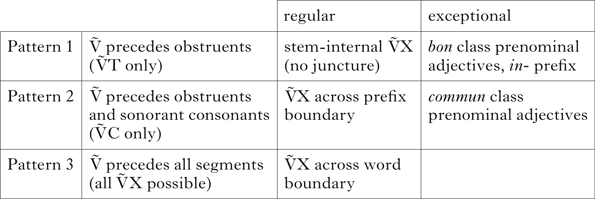
In summary, there are three basic patterns in the distribution of permissible ṼX sequences in Standard French. Each pattern applies regularly at some level of constituent structure. In the regular case, the larger the boundary between Ṽ and X, the more types of segment X are permitted. The behaviour of all exceptional items resembles a pattern that regularly applies across a smaller boundary. This distribution is summarised in Table I.
Summary of regular and exceptional distributions of ṼX sequences.

3 Scalar constraint analysis of restrictions on ṼX
3.1 Restrictions on ṼX sequences and prosodic structure
I first turn to developing an analysis of the regular sensitivity of restrictions on ṼX sequences to morphosyntactic contexts. Following standard claims in Prosodic Phonology, I assume that the domains of segmental restrictions are defined in terms of prosodic constituents (Selkirk Reference Selkirk, Aronoff and Kean1980, Nespor & Vogel Reference Nespor and Vogel1986, Flack Reference Flack2009, Ito & Mester Reference Ito and Mester2013, among others), which are themselves defined in relation to, though they are not always isomorphic with, syntactic constituents (e.g. Selkirk Reference Selkirk and Fretheim1981, Reference Selkirk, Goldsmith, Riggle and Yu2011, Nespor & Vogel Reference Nespor and Vogel1986).Footnote 3 In addition, prosodic constituency can be recursive; any prosodic category can dominate an instance of the same category (Elfner Reference Elfner2012, Ito & Mester Reference Ito and Mester2013, Myrberg Reference Myrberg2013). Domain-sensitive phonological processes can target specific subcategories of a recursive structure (Ito & Mester Reference Ito and Mester2013), such as a maximal projection (a prosodic category not dominated by a category of the same type) or a minimal projection (a prosodic category that does not dominate a category of the same type).
Given the focus in this paper on the patterning of nasal vowels within morphological words and nominal phrases, I restrict my attention to two prosodic constituents: the prosodic word (ω) and the phonological phrase (φ). The syntax–prosody mapping that I assume is given in (6).
(6)
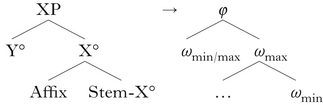
Syntactic phrases (XPs) are mapped to φ’s (Selkirk Reference Selkirk2009, Reference Selkirk, Goldsmith, Riggle and Yu2011, Elfner Reference Elfner2012). At the word level, both the stem and the complete morphological word are mapped to ω nodes. In affixed words, the stem corresponds to a minimal prosodic word (ω min) because it does not itself dominate a ω, while the full morphological word corresponds to a maximal prosodic word (ω max) because it is not itself dominated by a ω. An unaffixed stem (here Y°) is mapped to a prosodic word that is both minimal and maximal, and thus subject to restrictions that apply to both constituent types. This structure predicts that all stems are subject to restrictions that apply to ω max and ω min, while affixes are not subject to restrictions that apply to ω min.Footnote 4 Because the recursive ω structure is the most faithful mapping from syntactic to prosodic constituency, as previously argued for φ-level structure, I assume that it holds for Standard French.
I now turn to the predicted prosodic representations that correspond to the morphosyntactic contexts discussed in the previous section. The crucial observation is that all restrictions on possible ṼX sequences can be stated in terms of the size of the smallest prosodic constituent domain that contains the relevant sequence. Consider first the status of ṼX sequences that are fully contained within stems. Regardless of whether other affixes are present, all stem material is contained within a ω min. This is shown in (7a) for an unaffixed stem, dominated by a single ω node that is simultaneously maximal and minimal. In this context, only obstruents can follow nasal vowels.
(7)
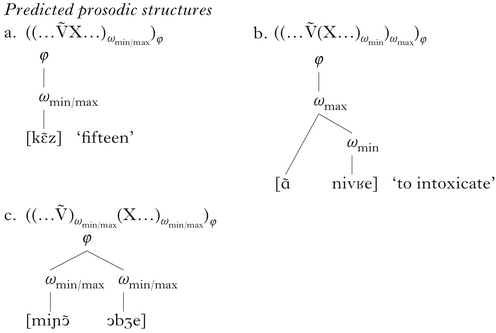
Prefixes are syllables dominated directly by ω max, but are not contained within the ω min that contains the stem. I assume that [n] associated with prefixes like en-, non- and bien- before a vowel-initial root is dominated by ω min, since it is syllabified as an onset with the stem-initial vowel, as in (7b). However, an alternative representation in which [n] is dominated by ω max but not ω min is equally compatible with the proposed analysis. As long as the prefix nasal vowel is not dominated by ω min, the Ṽn sequence in either structure is fully contained within the ω max that dominates the full morphological word, but not the ω min that dominates the stem.Footnote 5
Prenominal adjectives constitute morphological words that are independent from the nouns that they modify, but are contained within the same nominal phrase. In terms of the prosodic representation predicted by an isomorphic mapping, prenominal adjectives and their following nouns are dominated by distinct ω max nodes. The ṼX sequence in a form like [miɲɔ̃ ɔbʒe] in (7c) is fully contained only within a φ.
In summary, restrictions on possible ṼX sequences depend on the types of prosodic constituents that contain them. ṼX sequences that are fully contained in smaller prosodic constituents are subject to more restrictions on X.
3.2 Scalar domain-span constraints
We now turn to the formalisation of the restrictions discussed in §3.1 in a weighted constraint grammar. Previous work has shown that many influences on phonological patterns can be successfully modelled by scalar constraints, whose penalties are adjusted on the basis of some contextual property. Constraint scaling can account for a range of phonological patterns that depend on a scale or hierarchy, including continuous phonetic values (Flemming Reference Flemming2001, Cho Reference Cho2011, McAllister Byun Reference McAllister Byun2011, Ryan Reference Ryan2011), perceptual distance (McCollum Reference McCollum2018), the sonority scale (Pater Reference Pater, Borowsky, Kawahara, Shinya and Sugahara2012, Reference Pater, McCarthy and Pater2016, Jesney Reference Jesney2015), trigger and target strength in vowel harmony (Kimper Reference Kimper2011), morphological locality in vowel harmony (McPherson & Hayes Reference McPherson and Hayes2016), prosodic boundary strength (Hsu & Jesney Reference Hsu and Jesney2016), distance from prosodic boundaries (Inkelas & Wilbanks Reference Inkelas, Wilbanks, Gallagher, Gouskova and Yin2018), lexical category and frequency (Coetzee & Kawahara Reference Coetzee and Kawahara2013, Linzen et al. 2013) and degree of nativisation (Hsu & Jesney Reference Hsu and Jesney2017, Reference Hsu, Jesney, Gallagher, Gouskova and Yin2018).
The present type of scalar pattern, in which a phonological process or restriction applies only up to a cut-off point on a hierarchy, has often been analysed in ranked constraint grammars using sets of stringently related constraints (de Lacy Reference de Lacy2002) or fixed constraint rankings. However, there is empirical support in favour of applying weighted scalar constraints to these cases. Hsu & Jesney (Reference Hsu and Jesney2016, Reference Hsu and Jesney2017) show that in instances where more than one type of constraint is indexed to the same hierarchy, both fixed rankings and stringently related constraints generate unattested ‘level-skipping’ patterns, in which a process applies at non-adjacent points on the hierarchy, whereas scalar constraints avoid this overgeneration problem. Constraint scaling also has the advantage of theoretical parsimony. It accounts for scalar phenomena in different empirical domains using a single grammatical mechanism: numerical adjustment of constraint violations.
I will employ a scaling system in which scaling involves the addition of a penalty to the basic weight w of a constraint (Hsu & Jesney Reference Hsu and Jesney2016, Shih & Inkelas Reference Shih, Inkelas, Hansson, Farris-Trimble, McMullin and Pulleyblank2016). This amount is determined by a constraint-specific scaling factor s, whose value is multiplied by a numerical value d, which is determined by the corresponding point on the hierarchy of the constraint violation. The contribution to total harmony of a single violation of a scalar constraint is calculated as in (8).Footnote 6
(8)

For any scalar constraint, I assume that values of w and s are language-specific, and acquired by the learner. However, the type of scaling factor s associated with a given constraint is plausibly universally predetermined, based on the type of structure penalised by the constraint and the contextual influences that can adjust its contribution to harmony.
Here, I propose that markedness constraint violations are scaled according to the size of the smallest prosodic constituent type that fully contains the marked structure. Schematically, a constraint against a marked sequence M is defined in such a way that its total penalty is adjusted on the basis of the size of the smallest prosodic category that contains all segments in M. The restriction to full containment within a prosodic constituent resembles that of Selkirk's (Reference Selkirk, Aronoff and Kean1980) domain-span rules, which apply only to segments that are dominated by a specified prosodic category. The analysis makes use of two scalar markedness constraints.Footnote 7 The first scalar constraint *ṼR, in (9a), penalises sequences of nasal vowels followed by sonorant consonants. A penalty of the basic weight w is incurred by any nasal vowel followed by a sonorant, regardless of where it occurs in the prosodic structure. In this analysis, I will use the scale (φ = 0, ω max = 1, ω min = 2).Footnote 8
(9)
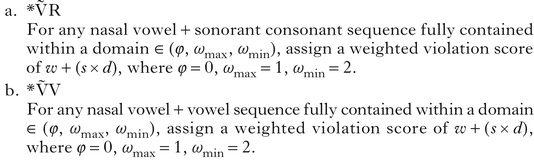
The second scalar constraint, *ṼV, in (9b), penalises a sequence of a nasal vowel followed by another vowel. A non-scalar version of this constraint is used to motivate the appearance of linking [n] in Smith's (Reference Smith2015) analysis. While both constraints in (9) have constraint-specific values for their base weights w and scaling factors s, they refer to the same scale.
Sample penalty calculations associated with *ṼR violations in the three relevant prosodic contexts are given in (10), assuming a base weight of 1 and a scaling factor of 2.
(10)
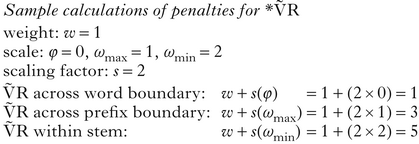
We can now address the weighting and scaling conditions that generate the distribution of French nasal vowels. For illustrative purposes, I assume that vowels are nasalised underlyingly, and that linking [n] in an output is epenthesised. A different representation will be proposed for the final analysis, as the adoption of gradient activity allows different input structures to be considered. In this example, the scalar markedness constraints in (9) interact with two faithfulness constraints: Max[nas], violated by output segments that differ from their input correspondent in not having a [nasal] feature, and Dep, violated by output segments with no input correspondent (McCarthy & Prince Reference McCarthy, Prince, Beckman, Dickey and Urbanczyk1995).Footnote 9
One set of weights and scaling factors that generates the regular pattern is shown in the tableaux in (11). The input for each tableau contains an underlying ṼV sequence. For ease of presentation, I only consider output candidates that resemble one of the three attested surface patterns found in this context: (a) faithful surfacing of ṼV, (b) insertion of [n] following Ṽ and (c) insertion of [n] and change from a nasal to oral vowel. Each tableau reflects a different prosodic representation, illustrated by a regular prenominal adjective (11a), a regular prefix (b) and a stem (c). Although each set of output candidates violates the same constraints, scaling applied to the markedness constraints alters the relative harmony in each context. Penalty calculations for the scalar markedness constraints are shown in each relevant cell. By convention, each constraint violation is represented by a negative integer. The optimal candidate in each tableau is the one whose harmony score is closest to zero.
Consider (11a), in which the prenominal adjective and noun surface in separate ω max constituents. The optimal, faithful candidate, (i), violates only *ṼV; because the smallest prosodic constituent that contains the ṼV sequence is a φ, the constraint's scaling factor s is multiplied by the corresponding value of the scale (φ = 0). This results in a total *ṼV penalty of w + s(φ) = 3 + (6 × 0) = 3. Candidate (ii), which maintains vowel nasalisation and epenthesises a nasal consonant, violates both Dep (incurring a penalty w = 4) and *ṼR (incurring a penalty w + s(φ) = 1 + (3 × 0) = 1). Candidate (iii), which removes vowel nasalisation and epenthesises a nasal consonant, violates only the faithfulness constraints Dep (w = 4) and Max[nas] (w = 6).
(11)
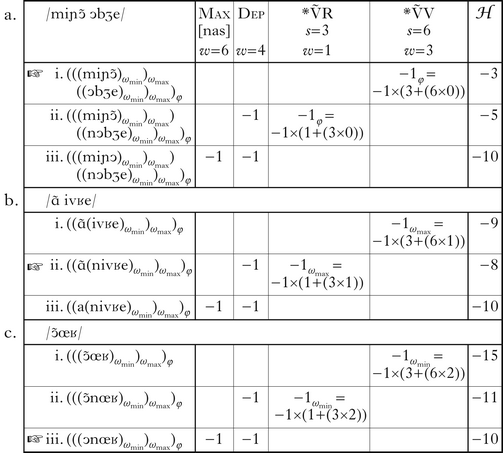
Compare this with tableau (11b), in which the nasal vowel is associated with a prefix, and is contained in the same ω max as the stem. Because the ṼV sequence in the faithful candidate, (i), is contained within a ω max, its violation of *ṼV is scaled to the next value on the scale (ω max = 1), resulting in a total penalty of w + s(ω max) = 3 + (6 × 1) = 9. Candidate (ii)’s violation of *ṼR is adjusted to the same value on the scale, incurring a penalty of w + s(ω max) = 1 + (3 × 1) = 4. Although both candidates now incur greater total penalties, (i) has a relatively larger increase, which is sufficient to make (ii) optimal. Finally, (11c) compares output candidates for a hypothetical input stem /ɔ̃œʁ/. Because all segments in the output candidates are contained within a ω min, the first two candidates’ violations of *ṼV and *ṼR are scaled to the highest value on the scale (ω min = 2). The increased penalty of *ṼR results in another change in relative harmony, such that (iii) is optimal.
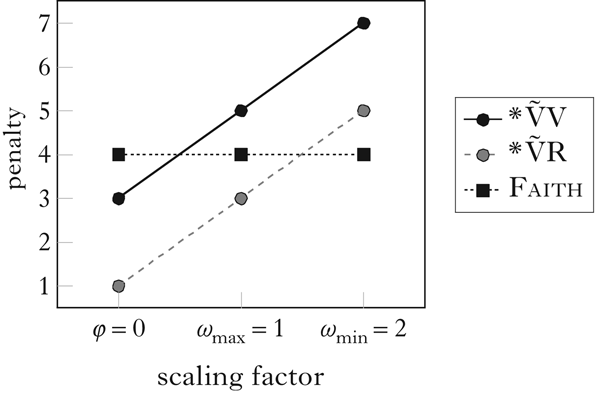
Figure 1 shows a more abstract representation of these effects of markedness scaling on relative harmony, using different weights and scaling factors as an expository simplification. The total penalties incurred by various constraint violations are shown on the y-axis, while the x-axis represents values on the scale. For illustration, non-faithful candidates are assumed to violate a single Faith constraint, and both markedness constraints have the same scaling factor s = 2. In this example, the base weight of Faith, w = 4, exceeds that of *ṼR, w = 1, and *ṼV, w = 3. When the smallest prosodic constituent that fully contains the ṼX sequence is φ, these weights are unaffected by the scaling factor, as φ corresponds to 0 on the scale. Nasal vowel + oral vowel sequences and nasal vowel + sonorant consonant sequences surface faithfully. If the ṼX sequence is contained within a ω max, the scaled penalty of *ṼV, 3 + (2 × 1) = 5, now exceeds the penalty for Faith, predicting that nasal vowel + oral vowel sequences will be repaired. Because the penalty for Faith still exceeds the scaled penalty for *ṼR, 1 + (2 × 1) = 3, nasal vowels remain permitted before sonorant consonants. Finally, for ṼX sequences contained in a ω min, the scaled penalties for *ṼV, 3 + (2 × 2) = 7, and *ṼR, 1 + (2 × 2) = 5, both exceed the penalty for Faith, predicting that both marked sequences will be repaired.
Prosodic context sensitivity generated by scalar markedness constraints.

4 Interaction of scalar constraints and gradient activity
4.1 Gradient Harmonic Grammar
Smolensky et al. (Reference Smolensky, Goldrick and Mathis2014) and Smolensky & Goldrick (Reference Smolensky and Goldrick2016) propose that individual discrete symbols manipulated by grammars have a degree of presence in their input representation, and that the degree of presence of a symbol, its activity, can take continuously gradient values. These gradient activity values are directly relevant to grammatical computation in a weighted constraint system like Harmonic Grammar. The penalty of a constraint violation is proportional to the activity of the structure that incurs the violation. In the present analysis, I assume that gradient activity is a property of both segments and features.
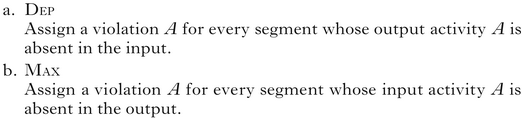
Given that grammatical outputs are determined by comparing the harmony scores of competing output candidates, a key consequence of this proposal is that changes to the underlying activity value of otherwise identical segments can lead to different optimal outputs, while a uniform set of constraints and constraint weights is maintained. Following Smolensky et al. (Reference Smolensky, Goldrick and Mathis2014) and Smolensky & Goldrick (Reference Smolensky and Goldrick2016), I assume that input structures can have continuous activity values between 0 and 1, while all structures in output candidates, being discrete segments, have an activity value of 1 (cf. Zimmermann Reference Zimmermann2018 for arguments for gradient activity in outputs). Because markedness constraints refer only to output structures, which must be fully active, their evaluation is not dependent on the underlying activity value of the relevant structure. However, differences in gradient activity affect the penalties of faithfulness constraint violations, which are proportional to the activity value of the non-correspondent structure. For example, I use the definitions in (12) for the faithfulness constraints Dep and Max (based on Zimmermann Reference Zimmermann2018).
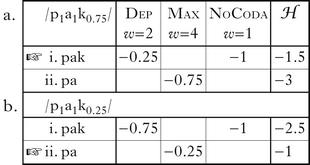
(12)
The basic interaction is illustrated in the simplified example in (13). Both tableaux contain the same input /pak/, but differ in the activity value of /k/, 0.75 in (13a) and 0.25 in (b). Because markedness constraints refer only to output structures, the candidate [pak] incurs the same penalty in both tableaux for violation of NoCoda, regardless of the underlying activity value of /k/. However, the violation of the faithfulness constraint Dep is proportional to the amount of activity that needs to be added to bring a segment's activity to 1. Thus Dep’s contribution to the total harmony of (13a.i), which realises [k] in the output, is the weight of the constraint (2) multiplied by 1 minus its underlying activity, i.e. 2 × (1 − 0.75) = 0.5. Likewise, the violation of Max is proportional to the underlying activity value of a segment that is deleted in the output. Max’s contribution to the total harmony of (13a.ii), in which /k/ is deleted, is the weight of the constraint (4) multiplied by its underlying activity, 4 × 0.75 = 3. Compare this interaction with the one in tableau (13b), in which /k/ has an activity value of 0.25. This alters the harmony scores of both candidates, such that the coda-deletion candidate now has the highest total harmony.
(13)
From this example, we see that a contrast in the gradient activity values of two otherwise identical input structures can change the relative harmony values of competing output candidates by affecting the evaluation of faithfulness constraints. In the previous section, it was shown that the scaling of positional markedness constraints similarly alters the relative harmony of segmentally identical output candidates in different prosodic contexts. Because both gradient activity and constraint scaling contribute to total harmony values in Gradient Harmonic Grammar, we expect to find patterns in which contrasts in gradient activity values of otherwise identical inputs replicate the effects of scaling based on prosodic context. In the remainder of the section, I show that this predicted type of interaction successfully accounts for the distribution of nasal vowels in French, in both regular and exceptional patterns. I now turn to the representation of nasal vowels, and how the interaction between contrasts in gradient activity and prosodic constraint scaling can be applied to the analysis of ṼX sequences with a full constraint set.
4.2 Gradient symbols analysis of the regular pattern
Smolensky & Goldrick (Reference Smolensky and Goldrick2016) show that the greater representational power of Gradient Harmonic Grammar allows new analytical solutions to recalcitrant problems in formal grammars. Specifically, certain patterns where discrete symbolic approaches find conflicting evidence for representations A and B can be generated from representations that contain both gradiently active A and gradiently active B. There is a parallel to this general line of analysis in the problem of nasal vowels and linking [n], as many underlying representations have been proposed for nasal vowels in Standard French, each on the basis of a different set of generalisations. For example, nasal vowels have been claimed to have the underlying form /Vn/ (Schane Reference Schane1968, Dell Reference Dell1970), /Ṽ/ (Tranel Reference Tranel1981), /Ṽn/ or /Vn/, depending on lexical item (Selkirk Reference Selkirk1972), or /V/ followed by a floating nasal segment unassociated with a timing slot (Prunet Reference Prunet1986). Note that this range of proposed representations essentially reflects the variety of surface forms associated with lexical items that surface with a nasal vowel in some environment.
The main generalisation to be captured is that lexical items that end with nasal vowels in isolation can in some environments vary in their propensity to maintain vowel nasalisation and to surface with linking [n]. I propose that this can be captured in Gradient Harmonic Grammar by positing a unique underlying representation /Ṽn/ for nasal vowels in the language.Footnote 10 However, lexical items can vary in two ways: the underlying activity value of the vowel's [nasal] feature, and the underlying activity value of the nasal consonant's root node.Footnote 11
Variation in these two dimensions of activity in part determines whether the vowel maintains its [nasal] feature and whether the nasal consonant is deleted in the optimal output. The analysis will thus consider two relevant faithfulness constraints: Max, violated by deleted root-node activity, and Max[nas] in (14), violated by loss of underlying nasalisation.
(14)

The penalty for Max[nas] depends on the input activity value of the deleted [nasal] feature, while the penalty for Max depends on the input activity value of the deleted segment. These faithfulness constraints will interact with the scalar markedness constraints *ṼR and *ṼV.
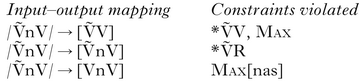
Given this constraint set, we first establish the weighting and scaling conditions necessary to generate the regular pattern of sensitivity to prosodic embedding. The grammar compares the relative harmony of three relevant output candidates: one that deletes /n/ while maintaining vowel nasalisation, [Ṽ], one that realises vowel nasalisation and /n/ faithfully, [Ṽn], and one that realises /n/ but not vowel nasalisation, [Vn]. For an input that contains the sequence /ṼnV/, the constraint violations in (15) are associated with each mapping.
(15)
The weighting conditions can be stated as in (16). In this notation, the name of each constraint stands for the total penalty incurred by a single violation of that constraint, taking into account both scaling and gradient activity. Parentheses following markedness constraints indicate the step on the scale used to assess the constraint penalty. For example, *ṼR(φ) stands for ‘the penalty incurred by a *ṼR violation contained within a φ’. Parentheses following faithfulness constraints indicate the activity value of the non-correspondent structure. Here, the activity value for non-exceptional lexical items is shown as the variable α. For example, Max(α) stands for ‘the penalty incurred by a Max violation for a structure with activity value α’. Note that the actual activity values of /n/ and the vowel's [nasal] feature need not be identical, as we will see below. Finally, the plus sign indicates the summed penalties of two constraints, while the comma indicates that the inequality statements apply individually to two items (e.g. ‘C1, C2 > C3 + C4’ indicates that the individual penalties of C1 and C2 both exceed the summed penalties of C3 and C4).
(16)
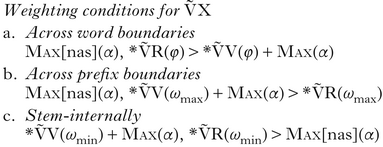
For structures in which output ṼX sequences would span a word boundary, (a), the lowest level of scaling (φ) applies to the markedness constraints. Here, the penalties for Max[nas](α), violated by the input–output mapping /ṼnV/ → [VnV], and for *ṼR(φ), violated by /ṼnV/ → [ṼnV], both exceed the combined penalties for *ṼV(φ) + Max(α), violated by the optimal mapping /ṼnV/ → [ṼV]. At the next level of scaling (ω max), (b), the combined penalty for *ṼV(ω max) + Max(α) must now exceed that of *ṼR(ω max), making /ṼnV/ →[ṼnV] the optimal mapping. This indicates that *ṼV needs to have a greater scaling factor than that of *ṼR. Finally, (c), the highest level of scaling (ω min) must cause the penalties of *ṼR(ω min) and the combined penalties of *ṼV(ω min) + Max(α) to exceed that of Max[nas](α).
One set of activity values, constraint weights and scaling factors that satisfies these conditions is shown in (17). Each of the three prosodic contexts is illustrated using a regular prenominal adjective (a), a regular prefix (b) and a stem (c). Just as before, the output candidates in each tableau differ in the prosodic context in which ṼX sequences surface, resulting in different penalties for the scalar markedness constraints. In each case, the input structure /Ṽn/ has the same underlying activity value: the [nasal] feature of /Ṽ/ has 0.75 activity, and /n/ 0.25. In all tableaux, deletion of /n/ incurs a penalty for Max of its base weight, 4, multiplied by the segment's underlying activity, 4 × 0.25 = 1, while loss of [nasal] incurs an Max[nas] penalty of 15 × 0.75 = 11.25.
(17)
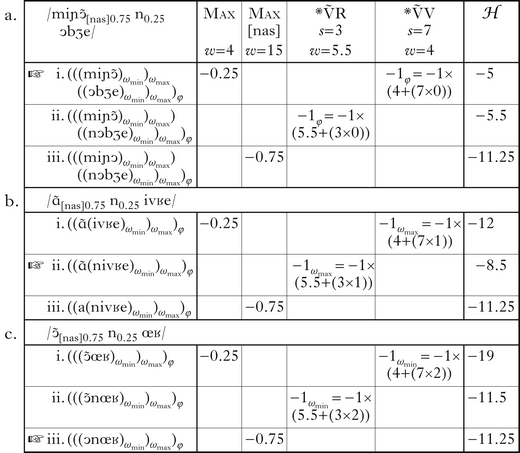
As a segue to the analysis of exceptionality below, I consider the patterns that could arise from inputs associated with different underlying activity values, given the principle of Richness of the Base (Prince & Smolensky Reference Prince and Smolensky1993). I begin by noting that there is no set of input activity values that allows a *ṼV sequence to surface within a ω max or ω min, i.e. candidates (17b.i) and (c.i) are never optimal, consistent with the observation that word-internal ṼV sequences are unattested in French. This is because the scaled penalty of *ṼV exceeds that of *ṼR in these contexts, and because any candidate that deletes underlying /n/ also incurs a Max violation.
We can also observe that changes to the input activities of /n/ and the [nasal] feature of /Ṽ/ result in outputs that resemble various exceptional patterns. First, consider hypothetical inputs with varying activities of [nasal] on /Ṽ/. For all increased activity values that cause the penalty of Max[nas] to exceed *ṼR(ω min), in this example any value greater than 0.766, stem-internal nasal vowels will not denasalise before sonorant consonants. While this is not the regular pattern, such inputs would generate the very limited but attested forms like [ʒɑ̃ʁ] and [ɑ̃nɥi] (cf. (1b)). Reductions in the activity value of [nasal] will cause underlying nasal vowels to denasalise before sonorants across larger prosodic boundaries. For example, if the Max[nas] penalty falls below the *ṼR(ω max) penalty (at values lower than 0.566), denasalisation will occur on prefix nasal vowels preceding sonorant-initial words, as observed for the exceptional prefix in-. If the Max[nas] penalty falls below the *ṼR(φ) penalty (values lower than 0.366), denasalisation before sonorants will take place across word boundaries, as observed for prenominal adjectives like bon. A final possible pattern arises from increases in the activity value of /n/. For any activity value that causes the combined Max and *ṼV(φ) penalties to exceed that of *ṼR(φ), for instance /n/ = 0.5, the realisation of [n] becomes obligatory, in order to prevent ṼV sequences from surfacing across word boundaries. This resembles the patterning of both exceptional classes of prenominal adjectives. In the remainder of this section, I show that the overall French pattern is generated by such systematic differences in activity values between regular and exceptional items.
4.3 Prenominal adjectives and exceptionality
We can now demonstrate how the exceptions to the regular pattern can be generated from differences in underlying activity. Recall that the three classes of prenominal adjectives differ in whether they surface with linking [n] before vowel-initial words, and that the items that surface with [n] further vary in whether or not vowel nasalisation is maintained. This translates straightforwardly into a gradient symbolic analysis in terms of variation in the input activity values of the vowel's [nasal] feature and the nasal consonant's root node.
Again, we first consider in the abstract the conditions on weighting, scaling and activity that generate the exceptional prenominal adjective patterns. The weighting conditions that generate the regular pattern, discussed in §4.2, are repeated in (18a). The activity values of lexical items that generate the commun objet pattern (linking [n] with a nasal vowel) are represented by the variable β in (b). The activity values of items that generate the bon objet pattern (linking [n] with a oral vowel) are represented by the variable γ in (c).
(18)
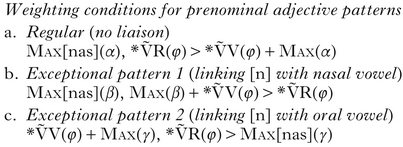
The crucial observation is that changes in activity values, which affect the penalties of faithfulness constraints, can alter the relative harmony scores of different types of output candidates. Taking the regular pattern's weights and activity values as a starting point of comparison, exceptional pattern 1 is obtained by an increase in the underlying activity value of /n/, where the increased Max penalty is sufficient to reverse the relative penalties of *ṼR(φ) and Max(β) + *ṼV(φ). Again taking the regular pattern as the starting point, exceptional pattern 2 is obtained by a decrease in the activity value of the vowel's [nasal] feature, where the proportional decrease in the Max[nas] penalty is sufficient to make it lower than the penalties of both *ṼR(φ) and *ṼV(φ) + Max(γ).
Retaining the constraint weights and scaling factors from §4.2, the exceptional prenominal adjective patterns are generated by the activity values in the three tableaux in (19). All output candidates in each tableau have the prosodic representation in (7c); all violations of *ṼR and *ṼV incur the same penalties. Tableau (17a) above, showing the regular mignon objet pattern with no linking [n], is repeated as (19a). Exceptional pattern 1 in (19b) is generated by an increase in the activity value of /n/ from 0.25 to 0.5; the resulting increase in the penalty for Max from 4 × 0.25 = 1 to 4 × 0.5 = 2 alters the harmony of the candidate that deletes underlying /n/ relative to the one that realises it in the output. Exceptional pattern 2 in (c) is generated by a decrease in the activity value of [nasal] from 0.75 to 0.3, proportionally reducing the penalty of Max[nas]. It is important to note that the exact activity values chosen here are not crucial; there is a range of values that can be used to generate each of the three weighting conditions.
(19)
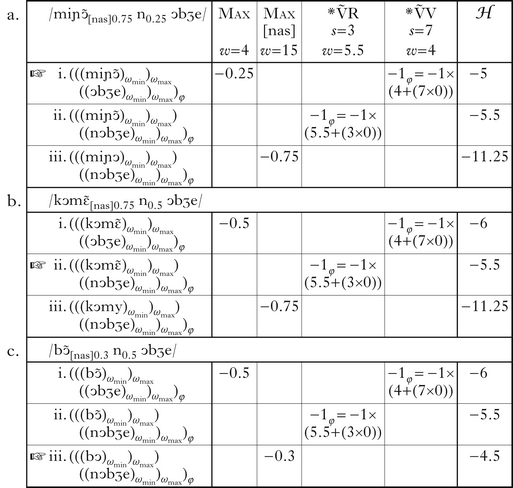
In summary, we see that allowing lexical items to vary in the activity values assigned to underlying /Ṽn/ allows us to predict the three patterns observed with prenominal adjectives before vowel-initial words. In the remainder of this section, I first extend the analysis to the regular and exceptional patterns of prefix allomorphy, before returning to the patterning of prenominal adjectives before consonant-initial words and in phrase-final position.
4.4 Prefix allomorphy and exceptionality
We return to the analysis of prefix allomorphy, first discussing the general patterning of prefixes with nasal vowels before turning to exceptional in-. In §4.2, I presented a set of weights, scaling factors and regular activity values to account for the surfacing of both input segments of prefix /Ṽn/ before vowel-initial stems, as in [bjε̃n-εme]. However, (20) shows that they incorrectly predict the same output form to be optimal before sonorant-initial stems like [ʁœspe] respect ‘respect’. This is because *ṼR is violated by the two candidates that retain a nasal vowel (regardless of whether /n/ is deleted), but deletion of /n/ incurs an additional Max violation.
(20)
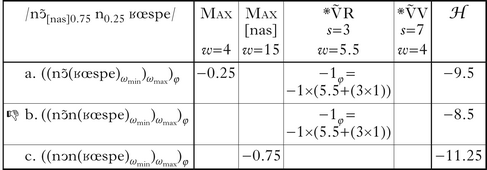
This can be resolved by including a constraint against sequences of nasal consonants followed by another consonant, *NC, which independently accounts for the underattestation of NC sequences in Standard French (Schane Reference Schane1968, Dell Reference Dell1970). While in principle we may expect this constraint to be scaled like the other markedness constraints, there are no patterns that require a scalar constraint for this analysis.
(21)
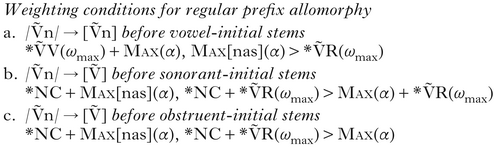
Given the existing weights, scaling factors and activity values, the inclusion of *NC with a weight of 3.5 ensures that /n/ is not realised before a sonorant consonant. As shown in (22), this correctly generates the patterning of regular prefixes before vowel-initial, sonorant-initial and obstruent-initial stems. The inclusion of *NC will again be necessary in selecting the correct output forms of the exceptional prefix in- and prenominal adjectives before sonorant-initial stems (see §4.5).
(22)
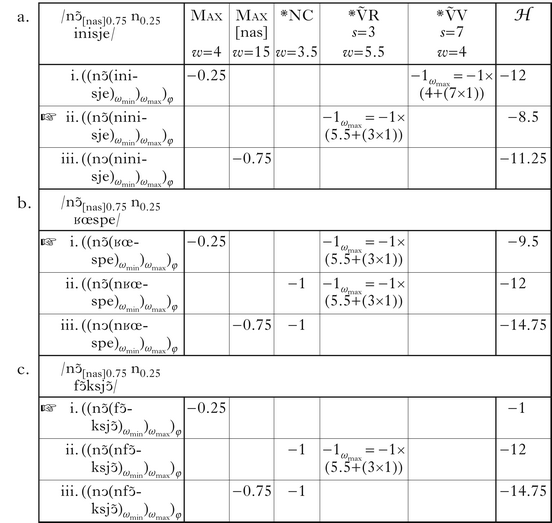
Again, we can see that changes to the underlying activity value of /Ṽn/ can result in the selection of different output candidates. This can be illustrated with attested dialectal variation involving the prefix non-, which is produced by some speakers with an oral vowel before vowel-initial words (Hannahs Reference Hannahs1995), e.g. [nɔ̃-ʁœspe] non-respect ‘non-respect’, [nɔ̃-fɔ̃ksjɔ̃] non-fonction ‘non-function’, [nɔn-inisje] non-initié ‘non-initiated’. Maintaining the same set of weights, this dialect is generated by a lower activity value of [nasal] for non-. For example, this pattern arises by lowering the activity value of [nasal] to 0.5.
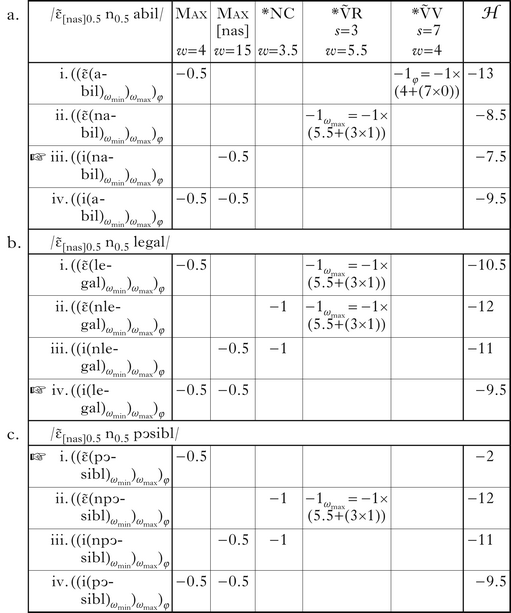
We now turn to the exceptional patterning of in-, which surfaces as [in] before vowel-initial and glide-initial stems, [i] before other sonorant-initial stems and [ε̃] before obstruent-initial stems. This pattern is unique, in that it is the only prefix that has an output form that deletes both /n/ and the vowel's [nasal] feature. I thus consider four possible output mappings of /Ṽn/, given in (23): one that removes the nasal consonant, [Ṽ], one that realises both segments, [Ṽn], one that removes nasality on the vowel, [Vn], and one that removes both the consonant and vowel nasality, [V]. In addition, I give the markedness constraints violated depending on whether /Ṽn/ precedes a vowel (a), a sonorant consonant (b) or an obstruent (c). I will have to leave aside the question of why the oral vowel + /n/-deletion candidate /Ṽn/ → [V] only surfaces with in-, but not with prenominal adjectives.
(23)
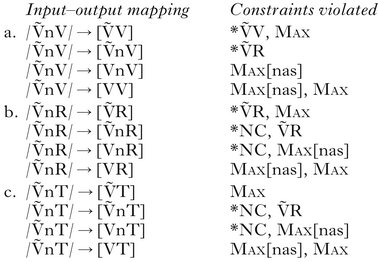
From this, we can establish the weighting conditions that generate the in- pattern, with the three allomorphs [in], [i] and [ε̃]. The activity values needed to generate this pattern are represented by the variable δ in the weighting conditions given in (24).
(24)
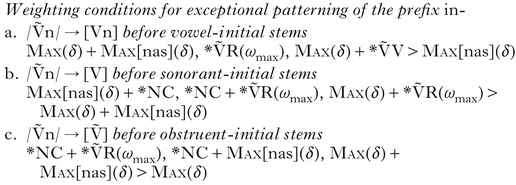
With the previously used constraint weights and scaling factors, one concrete set of activity values that generates this pattern is 0.5 for the vowel's [nasal] feature and 0.5 for /n/, as shown in (25).Footnote 12
(25)
4.5 Contexts without lexical exceptionality
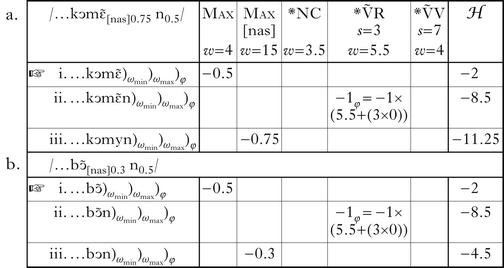
Finally, the proposed grammar should account for the fact that adjectives with final Ṽ and final ṼN or VN alternants (e.g. [bɔ̃] ~ [bɔn], [kɔmε̃] ~ [kɔmε̃n]) always surface with final Ṽ in φ-final position or when they precede consonant-initial words. Turning first to φ-final prenominal adjectives, the most important difference between this case and those we have seen before is that it is not possible for the /Ṽn/ → [Ṽ] mapping to violate *ṼV in phrase-final position. The necessary weighting condition here is that the penalty for Max needs to be lower than that for Max[nas](φ) and *ṼR(φ), for both the regular and exceptional activity patterns, as shown in (26).
(26)

The activity values previously proposed are consistent with these conditions, as shown in (27) for phrase-final commun and bon.
(27)
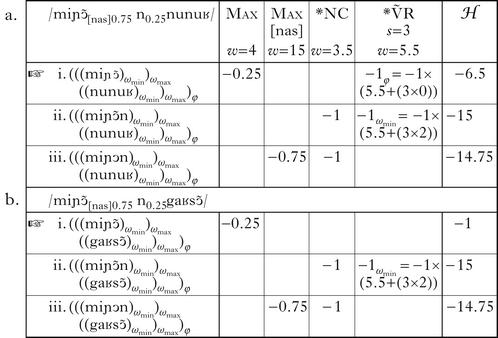
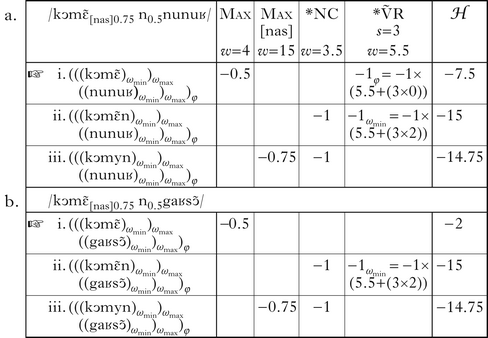
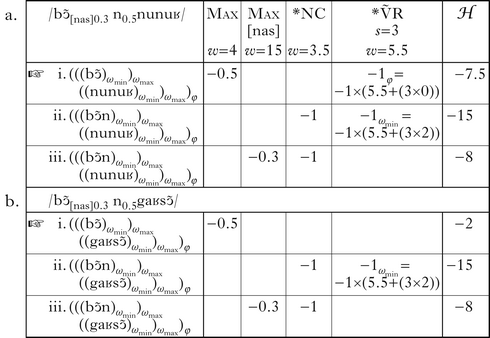
Finally, the analysis must ensure that all of these prenominal adjectives surface with final Ṽ before all consonant-initial words, regardless of the sonority of the initial consonant. The tableaux in (28)–(30) examine the predicted patterning of each class of adjective before a sonorant-initial word [nunuʁ] nounours ‘teddy bear’ and obstruent-initial [gaʁsɔ̃] garçon ‘boy’, and show that the /Ṽn/ → [Ṽ] mapping is optimal in these contexts, given the weights, scaling factors and activity values already established. ṼV is not violated in the tableaux in this subsection, and is omitted for reasons of space.
(28)
(29)
(30)
4.6 Summary
In this section, I have shown that the complex distribution of nasal vowels in Standard French, which is sensitive to both prosodic organisation and lexical exceptionality, can be generated in Gradient Harmonic Grammar with a uniform underlying form, /Ṽn/, for lexical items with a nasal vowel allomorph, and without lexical exceptionality in prosodic organisation. Regular and exceptional items differ only in the activity values associated with underlying nasal vowels. Proportional changes to faithfulness constraint penalties mimic the effects of scalar markedness constraints on total harmony, creating exceptional prosodification effects.
It is important to emphasise that although constraint scaling and gradient activity influence the calculation of harmony in similar ways, the functions of the two mechanisms in the grammar should not be conflated. On the assumption that outputs contain only quantised (discrete) structures with full activity, differences in input gradient activity do not affect the evaluation of markedness constraints. The relative ill-formedness of output structures that vary in their context within a hierarchy can only be accounted for by markedness scaling, which imposes relative harmony thresholds for the surfacing of marked structures in different contexts. While changes in input activity can result in the exceptional surfacing of marked forms, they cannot alter the relative thresholds determined by scalar markedness constraints.
5 Alternative approaches
5.1 Prosodic prespecification
Broadly speaking, early work in generative phonology takes two basic approaches to the analysis of lexical exceptionality involving nasal vowels and nasal liaison (for more detailed overviews, see Tranel Reference Tranel1981, Reference Tranel, Hirschbühler and Koerner1992 and Prunet Reference Prunet1986). The different rules approach posits that the exceptional items are subject to either distinct rules or rule orderings. For instance, Schane (Reference Schane1968, Reference Schane, Kachru, Lees, Malkiel, Pietrangeli and Saporta1973) proposes an underlying /Vn/ form for both the bon and commun classes of preverbal adjectives, but marks forms like commun as exceptions to a requirement that vowels are not nasalised before NV sequences. Dell (Reference Dell1970, Reference Dell1973) similarly maintains underlying /Vn/ for both classes, but proposes that they are subject to different orderings of vowel nasalisation and resyllabification rules. Tranel (Reference Tranel1981) posits a /Ṽ/ underlying form for both classes; only the bon class undergoes a minor rule of vowel denasalisation before NV sequences. Alternatively, the different underlying segments approach claims that exceptional items have distinct underlying segments. For example, Selkirk (Reference Selkirk1972) maintains a single set of rules, but posits that commun-type items with non-alternating vowel quality have /Ṽn/ underlying forms, in contrast to /Vn/ for the bon class.
The crucial drawback to both of these analyses is that the resemblance of each exceptional pattern to a regular pattern that applies in a smaller domain is purely accidental. Hsu (Reference Hsu, Kingston, Moore-Cantwell, Pater and Staubs2014, Reference Hsu2015) presents a prosodic prespecification analysis that directly accounts for the relationship between the regular and exceptional patterns. In this approach, prenominal adjectives have three possible prosodic representations. Regular prenominal adjectives bear no prespecification, and are mapped to their own maximal prosodic word nodes in accordance with the default syntax–prosody mapping, as in (31a) (cf. (7c) above).
(31)
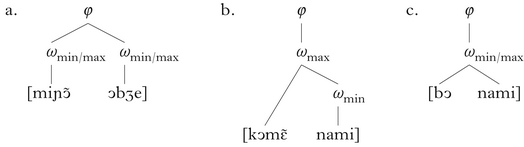
The first class of exceptions, prenominal adjectives that trigger the commun ami pattern of liaison with a retained nasal vowel, are prespecified as being dominated by the ω max node of the following word, as in (31b). Note that this is the default prosodic organisation of prefixes. The second class of exceptions, those that trigger the bon ami pattern of liaison with an oral vowel, are prespecified as being contained within the ω min node that dominates the following word, as in (c). These items are in essence phrased as if they are part of the same stem as the following word.
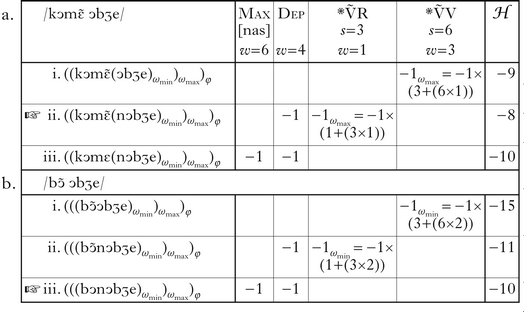
An advantage of this approach is that all three classes of prenominal adjectives have a uniform segmental underlying form in final position. For instance, the representation proposed for the final segment of mignon, /Ṽ/, can also be used for the commun- and bon-class exceptions, as in (32). The difference in their optimal output forms is generated by the regular pattern of constraint interaction that applies at the prespecified level of prosodic constituency.
(32)
The exceptional allomorphy of the prefix in- is accounted for with the same prosodic prespecification of bon-class adjectives: in- is prespecified as being contained in the ω min node of what it attaches to, as in (33).
(33)
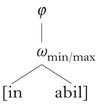
The allomorphic pattern of in- is sensitive to the sonority of the following consonant simply because the constraint against nasal vowels followed by sonorants is enforced within ω min; cf. (34).
(34)
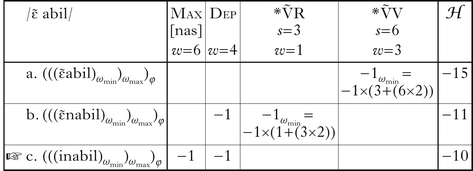
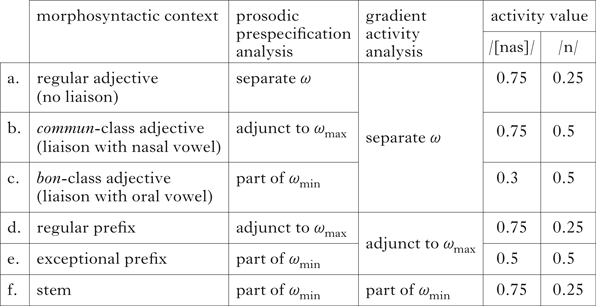
In summary, the prosodic prespecification analysis and the Gradient Harmonic Grammar proposal differ in the locus of variation between regular and exceptional lexical items. The two approaches are compared in Table II. The prespecification analysis posits a uniform structure for all nasal vowels, but requires exceptional items (b), (c) and (e) to surface in an exceptional prosodic structure. In contrast, the gradient activity analysis assumes no item-specific variation in syntax–prosody mapping, but posits that lexical items can vary in the activity values associated with underlying final nasal vowels. All the regular patterns, (a), (d) and (f), can be generated by the same set of activity values, /[nasal]0.75/ and /n0.25/, while each exceptional pattern is associated with different activity values. It is worth repeating here that the exact values are not crucial, as long as they fall within ranges that satisfy the correct weighting conditions.Footnote 13
Comparison of prosodic prespecification and gradient activity analyses.

Like the gradient activity analysis, prosodic prespecification captures the generalisation that each exceptional pattern resembles the regular pattern at a different level of prosodic constituency. However, it introduces additional complexity to the phonological grammar. First, it requires underlying representations to contain information about surface prosodic structure. This is unexpected, given the absence of evidence for prespecification of surface syllable structure, generally considered to be the lowest level of prosodic constituency (Hayes Reference Hayes1989).Footnote 14 Second, in order to enforce morpheme-specific syntax–prosody mismatches in a constraint-based theory, the grammar must include constraints that enforce morpheme-specific prespecifications. While these claims may ultimately receive independent justification from other phonological patterns, the analysis proposed in this paper obviates the need for these additions to the theory.
The prosodic prespecification analysis also faces an empirical difficulty, in that in- displays a mix of prefix-like and stem-like phonological properties. Tranel (Reference Tranel1976) notes that for some speakers in- preceding a sonorant-initial stem is optionally realised with a geminate version of the stem-initial segment (e.g. [illegal], [immɔʁal]). Tranel shows that the optional degemination pattern is a general characteristic of Standard French prefixes, such as those in (35). Although some speakers permit stem-internal geminates in forms like [gʁammεʁ] grammaire ‘grammar’, optional degemination seems to be a property specific to prefixes.
(35)

If the optional degemination process reflects the basic prosodic organisation of prefixes, the prespecification analysis leads to a paradox, as in- is predicted to obey all prosody-sensitive generalisations that apply to stems but not to regular prefixes. Although I cannot pursue an analysis of the optional degemination pattern here, we can note that the gradient activity analysis allows for patterns in which exceptional activity causes a morpheme to behave exceptionally with respect to one prosody-sensitive restriction but not to another.
Finally, it is important to note that the gradient activity analysis resembles both the prosodic prespecification and different underlying segments approaches in that the difference between regular and exceptional patterns arises from the underlying representations associated with each class. However, the gradient activity analysis is superior on the following criteria. First, it allows a reduction in the types of structures that a learner needs to posit for underlying forms; the learner needs to posit only the structures that are necessary for the regular pattern, and acquire item- or class-specific differences in activity values. Second, systematic differences in activity values across lexical items can be plausibly grounded in quantifiable substantive factors that are known to influence lexical exceptionality, such as morpheme frequency, perceptual cue strength and informativity (Inkelas Reference Inkelas, Hsiao and Wee2015, Smolensky & Goldrick Reference Smolensky and Goldrick2016). On the other hand, it is difficult to envision how these factors should determine the different segmental representations or prespecified prosodic structures that have been used to account for lexical exceptions.
5.2 Lexical constraint indexation
In constraint-based grammars, morpheme-specific phonological patterns can also be captured by positing lexically indexed constraints (Pater Reference Pater2000, Reference Pater and Parker2009) that apply only to exceptional morphemes that possess a relevant index. For instance, the exceptional patterning of commun- and bon-class prenominal adjectives can be accounted for in a grammar with ranked constraints by including lexically indexed versions of *ṼV and *ṼR that outrank the constraints that prevent denasalisation and [n]-insertion with regular adjectives. While such an approach could generate the distribution of nasal vowels in French, the resemblance of exceptional patterns to regular patterns applying in smaller domains would again be entirely coincidental, as with the different rules and different underlying segments analyses.
It is worth noting that gradient activity analyses of exceptionality can generate both exceptional blocking and exceptional triggering patterns (cf. Pater Reference Pater and Parker2009 on indexed constraints). Exceptional blocking arises in conditions where a markedness penalty exceeds a faithfulness penalty when the input contains items with regular activity, while exceptional items incur a greater faithfulness penalty that exceeds the markedness penalty. Exceptional triggering occurs if the faithfulness penalty at the regular activity value exceeds the markedness penalty, while exceptional items incur a faithfulness penalty less than the markedness penalty.
To the best of my knowledge, any exceptional pattern that arises through a difference in gradient activity can also be generated in an indexed constraint analysis. Although the issue requires further study, we can note several ways in which the approaches differ in their restrictiveness. In the Gradient Harmonic Grammar proposal, each change in the underlying gradient activity value of a segment or feature affects the violations of all and only the faithfulness constraints that refer to that structure. On the other hand, in the indexed constraint analysis there is in principle no necessary connection between the indices assigned to a morpheme, that morpheme's phonological properties and the inventory of indexed constraints (see Smith Reference Smith2018 for similar discussion). This leads to distinct predictions. The gradient activity analysis of exceptionality readily predicts the existence of patterns in which morphemes pattern exceptionally with respect to multiple processes or constraints referring to the same structure (see Zimmermann Reference Zimmermann2018 for one such case), while such clustering of exceptional processes can only be accidental in an indexed constraint approach. A conclusive evaluation of these broader predictions awaits further investigation.
6 Conclusion
This paper has shown that the adoption of scalar constraints and gradient symbolic structures in a weighted constraint grammar can provide novel analyses and explanations for challenging cases of lexical exceptionality. In Gradient Harmonic Grammar, apparent exceptional prosodification effects arise from the fact that contrasts in activity across lexical items can produce the same effects on output selection as constraint scaling. The existence of this type of interaction across apparently separate dimensions of structure is a key prediction of a weighted constraint grammar in which all constraint violations contribute to total harmony.
The proposal predicts other possible interactions between contrasts in gradient activity and prosodic constraint scaling. In the Standard French case, the activity values associated with exceptional lexical items have the same effect on total harmony as an increase in the prosodic scaling factor. As a result, exceptional items pattern as if they are contained within more prosodic categories than expected from the default syntax–prosody mapping. This approach also predicts the existence of patterns where exceptional items behave as if they are contained within fewer prosodic categories than expected. This type of pattern is described by Poser (Reference Poser, Inkelas and Zec1990) for Aoyagi prefixes in Standard Japanese, i.e. morphological prefixes whose tonal patterns suggest that they introduce a φ boundary within morphological words. While Poser analyses these apparent cases of ‘word-internal phrase boundary’ as the result of prosodic prespecification, the proposal in this paper suggests that an alternative analysis without prespecification is possible. More broadly, it predicts similar interactions between lexical exceptionality and other patterns of context-sensitivity that can be modelled through constraint scaling, such as lexical category (Smith Reference Smith, van Oostendorp, Ewen, Hume and Rice2011) or degree of nativisation (Hsu & Jesney Reference Hsu and Jesney2017, Reference Hsu, Jesney, Gallagher, Gouskova and Yin2018).
This paper, like analyses by Smolensky & Goldrick (Reference Smolensky and Goldrick2016), Rosen (Reference Rosen2016) and Zimmermann (Reference Zimmermann2018), has shown that contrastive gradient activity can account for important cases of lexical exceptionality in phonology. Taken together, the results of these proposals allow for a more restrictive theory of possible phonological representations. Contrasts in the gradient activity value of segmentally identical underlying forms obviate the need to propose additional structures or prespecifications for each individual exceptional pattern.
Finally, the proposal invites a broader reconsideration of current approaches to syntax–prosody mapping parameters. For instance, the observation that the exponents of functional heads and phrases are often exempt from phonological generalisations that hold for exponents of lexical ones has been taken to indicate that functional heads and projections are ignored by syntax–prosody mapping constraints (Selkirk Reference Selkirk, Morgan and Demuth1996, Truckenbrodt Reference Truckenbrodt1999). The present study suggests that some of these patterns can be explained in a syntax–prosody mapping that does not distinguish between lexical and functional projections, if the exponents of functional items differ systematically in their activity from the exponents of lexical ones, as potentially expected if activity values are grounded in factors like frequency or informativity. This follows recent work that similarly questions the need for mapping parameters to distinguish between lexical and functional categories (Elfner Reference Elfner2012, Tyler Reference Tyler2019), permitting a more restrictive theory of syntax–prosody correspondence.