This research note augments the typology of gender indexicality as presented in Fleming (Reference Fleming2012). One of the goals of that work was to suggest that something analogous to semantic features for the domain of social pragmatics is needed to accurately capture the description of categorical (as opposed to performative) gender indexicality. I used the term interactional schemata on analogy to Agha's (Reference Agha1996) denotational schemata to refer to these proposed feature types. For ease, here I simply use the term pragmatic feature. A semantic gender feature assigns sex-based semantic gender to nouns that refer to entities normatively characterized as male or female (Corbett Reference Corbett1991). We define a pragmatic gender feature as a categorical presupposition concerning the social gender of individuals inhabiting the interactional role(s) indexed by a nonreferential indexical—that is, as a categorical gender presupposition on the focus of an index.
A distinction between nonreferential indexicals that index only one interactional role and those that index more than one role simultaneously was already recognized in Haas (Reference Haas1944), the first rigorous comparative treatment of categorical gender indexicality. In Agha's (Reference Agha2007) framework for the analysis of linguistic registers the interactional role(s) picked out by an index are called the ‘indexical focus' of an index. (We may think about indexical focus as the analog, for the domain of nonreferential indexicality, to ‘referent’ for referential indexicality.) In Levinson's (Reference Levinson1983) framework for social deixis, Haas' distinction between one-place and two-place indexicals was labeled a distinction between ‘absolute’ and ‘relational’ indexicals. These are terminological innovations that I adopt here.
Although Haas' classification appreciated the distinction between what we would now call absolute and relational indexical focus types, it drew only on the interactional roles of speaker and addressee (see Haas Reference Haas1944:148). Accordingly, she documented only three types of categorical gender indexicality:
Type I: absolute speaker focal indexicality
Type II: absolute addressee focal indexicality
Type III: relational speaker-addressee focal indexicality
From the perspective of the typological treatment of grammaticalized nonreferential indexicality the interactional role that is notably missing here is that of referent. Relational speaker-referent focal indexicality is commonly found, for instance, in honorific registers (Agha Reference Agha2007). We might expect three other types of gender indexicality:
Type IV: absolute referent focal indexicality
Type V: relational speaker-referent focal indexicality
Type VI: relational addressee-referent focal indexicality
Fleming (Reference Fleming2012) argued that none of these types is attested in the sample of languages that exhibit categorical gender indexicality. My arguments were, I think, cogent for excluding even the possibility of absolute referent-focal gender indexicality (see Fleming Reference Fleming2012:302–303). Basically, this kind of gender indexicality would be functionally equivalent to a system of ‘rational’ semantic gender (see Fleming Reference Fleming2012:n. 4, and discussion below). Unfortunately, I did not make explicit the reasons for excluding the relational referent focal cases (i.e. V and VI), leaving the reader to fall back on the contention that because ‘social gender is a relatively stable characteristic of participants' there is a ‘strong motivation for … gender to be indexed absolutely, rather than relationally’ (Fleming Reference Fleming2012:301). My exclusion of a would-be Type V, in particular, was an all the more glaring omission given the fact that relational gender indexing of the speaker-addressee dyad (i.e. Type III) is clearly present in Kurux and Yana (Sapir Reference Sapir and Mandelbaum1929/1963; Ekka Reference Ekka1972). In a cruel irony, it would seem that my exclusion of speaker-referent focused gender indexicality reflected some of the very same semanticist biases that my article sought to critique. The crucial error was to tacitly assume that gender when presupposed of a referent is always semantic in character.
The important cases for recognizing the error are those in which pragmatic gender interacts with—or at least seems to interact with—semantic gender. Chiquitano, an isolate spoken in Bolivia, is a case in point. In Chiquitano, gender indexicality is found in morphology employed by male speakers to refer to referents normatively evaluated as being of masculine social gender. Fleming (Reference Fleming2012) characterizes Chiquitano as an absolute speaker-focal indexical system that manifests in the denotation of masculine semantic gender (i.e. as being of Type I).
In Chiquitano, variant semantic gender markers used in determiners, possessive morphology, and on human nouns index speaker gender (Adam & Henry Reference Adam and Henry1880; Galeote Reference Galeote Tormo1993). Masculine gender is only marked in men's speech while no sex-based gender distinction is made in women's. (Fleming Reference Fleming2012:309)
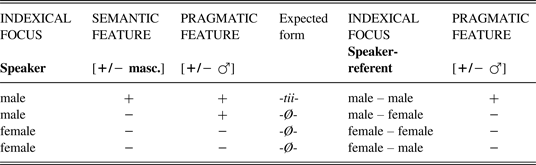
A more parsimonious explanation of Chiquitano gender indexicality is to stipulate a pragmatic feature [+/− ♂] with a relational speaker-referent focus. (Use of gender symbols indicates pragmatic, as opposed to semantic, gender features.) The morphological element in question, -tii-, is employed where speaker and referent are both of masculine gender. A purely pragmatic explanation is better because it does not require us to split the baby by stipulating two features, one semantic and one pragmatic. On this account there is no semantic gender in Chiquitano.
In Table 1 these two possible explanations of Chiquitano gender indexicality are contrasted with one another. The account on the left requires both a semantic feature and a pragmatic feature while the more parsimonious account on the right requires just a pragmatic feature. Simply by changing the indexical focus of the pragmatic feature [+/− ♂] from an absolute speaker focus to a relational speaker-referent focus, the need for a semantic masculine gender feature is eliminated. Note that though masculine gender in Chiquitano is indexed by a purely pragmatic feature, the characterization of referent-gender within men's speech is functionally equivalent to a sex-based semantic feature.
Two analyses of the morpheme -tii- in Chiquitano.

The Chiquitano case suggests that Haas' typology is incomplete; we need to add a novel type of gender indexicality—Type V, the relational speaker-referent focused type. Although this revised analysis of Chiquitano requires positing a new type of gender indexicality, the application of a pragmatic gender feature to a relational indexical focus is already well-established for speaker-addressee focused gender indexicality (i.e. Type III). The most well-known study of a system of this type—it is not an exaggeration to say that it was foundational for the study of categorical gender indexicality in general—is Sapir's essay on ‘Male and female forms of speech in Yana’, a nomination that he immediately qualified:
The terms ‘male’ and ‘female’ are not entirely adequate, for the male forms are used only by males in speaking to males, while the female forms are used by females in speaking to males or females and by males in speaking to females. … There is apparently no question of the male forms being tabooed to the females, for a female uses the male forms without hesitation when she quotes the words of a male speaking to a male, as in relating a myth in which one male character speaks to another. (Sapir Reference Sapir and Mandelbaum1929/1963:206–7)
Gender indexicality in Yana, an indigenous language of northern California, was relational. Speech differences presupposed the social gender of speaker and addressee. These interactional roles are in focus even where indexical values are recentered, as in reported-speech constructions. That is, gender indexicality does not presuppose the gender of the actual animator-recipient dyad but of the represented speaker-addressee. The pragmatic feature that is differentially marked is, as in the case of Chiquitano, masculine social gender; use of the men's register presupposes that all members of the set of individuals occupying the roles of speaker and addressee are of masculine social gender.
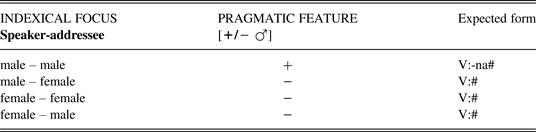
There were a number of morphophonological rules that distinguished presupposed gender of speech participant dyads in Yana. One particularly salient formal distinction was made in words that ended in a long vowel (i.e. V:#). In masculine interactional frameworks the semantically vacuous morpheme -na was suffixed to the long vowel. Using this form contrast by way of illustration, Table 2 offers a feature analysis of Yana gender indexicality. Note that except for the type of relational focus involved, Yana and Chiquitano gender indexicality are organized in precisely the same manner. Both presuppose that all individuals inhabiting the interactional roles specified by the focus of the index are of masculine social gender. The pragmatic gender feature is universally quantified over the interactional roles, taken as a set, which are the focus of the index.
Feature analysis of relational speaker-addressee focused gender indexicality in Yana.
Another language that is profitably analyzed as involving speaker-referent gender indexicality is Yanyuwa, an Aboriginal Australian language spoken in the Northern Territories. Like Chiquitano, Fleming (Reference Fleming2012) characterizes the gender indexicality found in Yanyuwa nominal classification as an absolute speaker-focal index. Although, as we see below, this turns out to be an accurate representation of the synchronic character of Yanyuwa gender indexing, it fails to capture its historical development or why gender indexicality in the language manifests in nominal classification.
Yanyuwa has an exceptionally rich set of noun classes. Kirton (Reference Kirton1971) distinguishes as many as fifteen. For the sake of our discussion we can leave aside the numerous subdivisions of inalienable noun classes (e.g. kin terms, body part terms, personal and place names) and the three morphologically distinct semantic classes for arboreal, vegetal, and abstract nouns. The only noun classes that are necessary for understanding gender indexicality in Yanyuwa are the two sex-based semantic gender classes and the two corresponding classes used to classify nonhuman nouns.
In Table 3 these four noun classes are represented following Corbett's method for distinguishing controller and target genders (Corbett Reference Corbett1991:ch. 6). The diagram illustrates that in this subdomain of the Yanyuwa gender system there are four controller genders mapped onto three target genders in the singular and two target genders in the plural. The difference between singular and plural reflects the fact that only human nouns can take a plural marker. Thus Classes I and II contain only human nouns, while III and IV contain only nonhuman nouns.
Yanyuwa singular and plural nominal prefixes by noun class (women's speech).

Kirton uses the following labels for these four classes: I is ‘male’, II is ‘female’, III is ‘feminine’, and IV is ‘masculine’. This last label (i.e. ‘masculine’ for IV) is potentially misleading as it partly reflects the very processes of gender indexicality we are about to discuss. It is better to think of Class IV as the unmarked gender class, the one that houses the largest number of nouns not semantically categorized into other classes (i.e. the ‘semantic residue’ in the sense of Corbett Reference Corbett1991). Not only is this prefixless class formally unmarked, it also contains the semantically most diverse set of nouns and is the largest noun class (Bradley & Kirton Reference Bradley and Kirton1992:55). To review, Class I consists of masculine human nouns, Class II of feminine human nouns, Class III of sex-differentiable feminine animates plus a large semantic residue, and Class IV of sex-differentiable masculine animates plus an even larger semantic residue.
Importantly, the noun-class distinctions that we have just been discussing only occur in women's speech. In men's speech, Class I and Class IV are collapsed (see Table 4). The only difference is that Class I continues to take the human plural marker while Class IV does not. This means that in men's speech, Class I and Class IV (i.e. ‘masculine’ nouns) are treated in parallel fashion to the treatment of Class II and Class III (i.e. ‘feminine’ nouns) in everyone's speech. In the singular, I and IV are formally indistinguishable, though the human versus nonhuman distinction is still maintained in the plural.
Yanyuwa singular and plural nominal prefixes by noun class (men's speech).

Formally there are diverse ways in which this collapsed target gender found in men's speech is morphologically marked. In Yanyuwa, nouns and adjectives are obligatorily prefixed with noun-class markers (e.g. nya-yabi nya-arrkula class.i-good class.i-one ‘one good man/boy’ (women's speech); Bradley & Kirton Reference Bradley and Kirton1992:85). In men's speech these noun-class markers take zero marking. That is, the zero-form used in women's speech only for Class IV is also used to mark human masculine nouns (Class I) in men's speech. Moving beyond the nonportmanteau nominal and adjectival noun-class prefixes, some of the forms used in men's speech are not shared with any variants employed in women's speech. For instance, the Class I/IV prefix (ki-) employed on nouns that take oblique postpositional suffixes is unique to men's speech (cf. women's speech Class I nyu- and Class IV ji-). However, for the vast majority of agreement targets that have portmanteau functions (e.g. case-markers, verbal cross-referencing morphology, demonstratives, etc.), the forms that are used in women's speech for Class I are extended to mark nonhuman Class IV nouns in men's speech.
It is, therefore, not only Class I agreement targets but also Class IV markers that differentially index masculine social gender of speaker. Although Class I is semantically restricted to masculine human nouns, Class IV contains a semantically diverse set of nouns (e.g. arlku ‘fish’, yurdu ‘dust’, ararr ‘sky’, wuka ‘language’, yilirri ‘blood’). Thus gender indexical variants are not only employed in reference to a socially or semantically delimited category of human referents, as in Chiquitano. On the contrary, sociopragmatic variants occur in reference to all Class I and Class IV nominals. From a synchronic perspective, therefore, Yanyuwa is an absolute speaker-focal gender indexical system. Nevertheless, the morphological distribution suggests that Yanyuwa gender indexicality began as a speaker-referent focused system that specified a relational masculine pragmatic feature.
Notably it is only morphemes whose sole function is to mark noun-class membership of nominal controller that take zero-marking. It may have been by means of such zero-marking of masculine human nouns that Yanyuwa gender indexicality historically emerged.Footnote 1 Zero-marking is not only found on Class IV nouns and men's speech Class I nouns, it also occurs in what Bradley & Kirton (Reference Bradley and Kirton1992:64) label ‘familiar’ kinship terms. Although ‘formal’ kinship terms take appropriate human class markers (i.e. nya- or rra-), familiar kinship terms typically omit them. This distinction between familiar and formal kin terms correlates with kin classes associated with interactional freedom and reserve, respectively. Familiar kin terms denote classes of close consanguineal kin (e.g. parents, children, nephews and nieces, same-sex grandparents, etc.) while formal kin terms typically denote members of the class of affinal kin. In Aboriginal Australia, where in-law avoidance is pronounced, this pragmatic distinction between formal and familiar kin reference is perhaps expectable.
Importantly, the omission of human noun-class prefixes on kin terms as a speaker-referent focal index of ‘familiarity’ is employed in both men's and women's speech. One possible reconstruction, therefore, is that historically male speakers extended prefix deletion as a resource for speaker-referent indexicality beyond the domain of kinship, perhaps to tropically index a certain homosocial solidarity and familiarity. Further supporting evidence for this claim comes from the acquisition and onset of men's speech in Yanyuwa.
In early adolescence boys were, and still are, initiated through a series of rituals which culminated in circumcision, after which they were considered men and from which time onwards they were expected to speak the men's dialect. However, it was no smooth transition. For at least 10 years the boys had been speaking a predominantly female form of Yanyuwa and only passively hearing the men's dialect. As a consequence, for a short while after initiation they spoke a form of Yanyuwa which was a mixture of both men's and women's dialects. This was a situation which the older Yanyuwa apparently did not tolerate and the young men were disciplined for speaking incorrectly. (Bradley Reference Bradley1988:129)
Acquisition and production of the male register by young boys is understood as part-and-parcel of his transformation in status into an adult male. Use of unmarked Class I nouns by male initiates indexes not only a common gender but a shared social essence. In its speaker-referent function, Yanyuwa men's speech indexed an adult masculinity that had been exposed to and thus baptized in the sacra of male initiation.
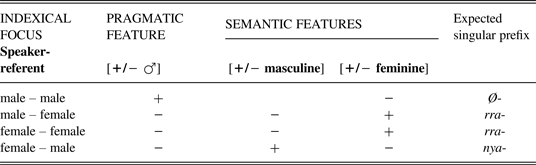
A reconstruction like this one, which sees Yanyuwa gender indexicality as emerging out of speaker-referent focused indexing, offers a principled explanation for why gender indexicality manifests in noun-class marking. To vulgarize, historically, Yanyuwa men indexed masculine ‘solidarity’ by suppressing semantic marking of masculine gender when referring to other men. Masculine gender in Yanyuwa was shifted from being a semantic feature to a pragmatic feature in men's speech. That is, gender indexicality involved the transposition, in men's speech, of the semantic feature [+/- masculine] for singular targets into the pragmatic feature [+/- ♂]. We might say, using the language of Kiparsky (Reference Kiparsky, Bach and Harms1968), that pragmatic indexing of gender ‘bleeds' semantic denotation of gender in Yanyuwa men's speech. This filtering relationship can be seen in Table 5. Thus, where there is a positive specification for the pragmatic feature [+/− ♂] there is no application of the semantic feature [+/− masculine]. But where the pragmatic feature is unmarked the semantic feature applies.
Feature analysis of relational speaker-referent focused gender indexicality in classification of human nouns in Yanyuwa.
Both the Chiquitano and Yanyuwa data illustrate the dynamic manner in which speaker-referent gender indexicality interacts with nominal classification. The key point here is that the presupposition of referent gender is functionally equivalent whether specified by a semantic feature or by a speaker-referent focused pragmatic feature. There is, thus, a possibility for pragmatic features to be re-analyzed as semantic ones (e.g. Chiquitano) and, given the right circumstances, for semantic features to be re-fashioned as pragmatic ones (e.g. Yanyuwa). In a number of other languages from our sample, gender indexicality interacts with morphological categories employed in the marking of person, number, and gender distinctions (see Fleming Reference Fleming2012:300). The possibility of relational speaker-referent indexicality should also be pursued for those cases, whether as a transitional diachronic stage or as a synchronic description. Another case, in particular, where a speaker-referent focused analysis seems appropriate is the ‘noun class' system of Yuchi (Linn Reference Linn1997). Not just gender, but also age-based and ethnicity based features of the Yuchi nominal system can be given parsimonious treatment with speaker-referent pragmatic features. Given considerations of space, that is a topic best left for another occasion.
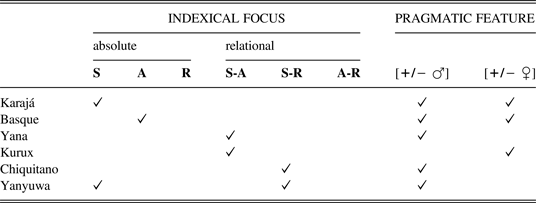
In conclusion, with the attested cases of speaker-referent gender indexicality presented here it may be observed that cases of categorical gender indexicality span nearly the full range of possible indexical focus types (see Table 6). The only relational type that is not documented at this point is a relational addressee-referent type. The only absolute type that is lacking is a referent-focal type. As I argued in Fleming (Reference Fleming2012), the absence of this type is expectable since such a type is functionally equivalent to a system of sex-based semantic gender. With this observation in mind we can note that indexical focus potentially offers a framework that can encompass both referential and nonreferential indexicality. Pure referent focal types (i.e. absolute referent focus and relational referent-referent focus) would account for semantic features as they occur in deictic categories (e.g. gender deixis in Afroasiatic pronouns or relative-generation sensitive dual pronouns in Aboriginal Australian languages, respectively), while all other indexical focus types are found in ‘social deictic’ contrasts like those analyzed here.
Comparative survey of gender indexicality subcategorized by indexical focus type and pragmatic feature (S = speaker; A = addressee; R = referent).
The expanded treatment of nonreferential gender indexicality presented here brings the topic more in line with that better studied domain of ‘social deixis'—honorifics. Speaker-referent focus is, if anything, the unmarked focus type in honorific registers, with honorifics indexing deference entitlements to discourse referents (Agha Reference Agha2007:315–22). As with gender indexicals, both speaker-addressee and speaker-referent focused honorific patterns are attested (cf. the distinction between krama (speaker-addressee focus) and krama inggil (speaker-referent focus) in Javanese; Errington Reference Errington1988). Indeed, we should be attentive to the possible dependencies between the speaker-referent indexical focus type and other focus types. Speakers tend to rationalize sociopragmatic functions in terms of referential functions, so it is common for referent focused pragmatic forms to develop speaker and/or addressee focal values (see Silverstein Reference Silverstein, Clyne, Hanks and Hofbauer1979 for the general argument concerning the mediating role of reference in the relationship between language structure and language ideology; see Silverstein Reference Silverstein, Mertz and Parmentier1985 on the centrality of reference for speakers of European languages in their rationalizations of how stereotypes of social gender are reflected and reproduced in language structure and use). As in other nonreferential indexical systems, speaker-referent gender indexicality may be an important diachronic source for other indexical focus configurations.