1. Introduction
We consider the following ruin problem of the classical Cramér-Lundberg model in risk theory; see, e.g., [Reference Asmussen and Albrecher4]. Let  $\{{{X}_{1}},{{X}_{2}},\dots\}$
be a sequence of independent and identically distributed (i.i.d.) positive random variables representing successive claim sizes that arrive according to a homogeneous Poisson process
 ${N(t)}$
,
 $t \geqslant 0$
, with rate
 ${\lambda}$
. Premiums are received continuously at a constant rate
 ${p} > {\lambda} \mathbb{E}( {{X}})$
. We assume that there is also a reinsurance agreement in place, where
 ${R(t)}$
is the reinsured amount at time t. More precisely, if
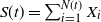 ${S(t)} = \sum_{i=1}^{{N(t)}} {{X_{i}}}$
is the aggregate claim amount at time t and
 ${p_{\text D}}$
is the remaining premium for the insurer after reinsurance has been purchased, then the aggregate loss minus premiums at time t for the insurer is equal to
 ${S(t)} - {p_{\text D}} t - {R(t)}$
. If
 ${u} \geqslant 0$
is the initial capital, then the probability of ruin before time T is defined as
 \begin{equation} {\psi({u},T)} = {\mathbb{P}} \bigg( \sup_{0 \leqslant t \leqslant T} \{ {S(t)} - {p_{\text D}} t - {R(t)} \} > {u} \bigg).\end{equation}
We will restrict our attention to two forms of large-claim reinsurance, namely LCR and ECOMOR. In an LCR (largest claim reinsurance) contract (see, e.g., [Reference Ammeter3] for an early reference), the reinsurer agrees to cover the largest  ${r}$
claims, where
 ${r} \geqslant 1$
is a fixed number, while in an ECOMOR (excédent du coût moyen relatif) contract [Reference Thépaut19], the reinsurer covers the excess of the
 ${r}$
largest claims over the
 $({r}+1)$
st largest claim; see [Reference Albrecher, Teugels and Beirlant2] for more details on this type of reinsurance contract.
We assume that the distribution of the claim sizes belongs to a class of distributions with a regularly varying tail, which is valid for many applications [Reference Embrechts, Klüppelberg and Mikosch11]. It is well known that the principle of one big jump holds in the heavy-tailed claim setting, i.e. ruin is typically caused by a single large claim. However, under the presence of large-claim reinsurance contracts, ruin probabilities are typically harder to analyze because the largest claims are covered by the reinsurer and thus multiple claims may be responsible for the event of ruin.
Several papers have studied properties of large-claim reinsurance contracts. For example, when claim sizes are light tailed, the asymptotic tail behavior of the reinsured amounts is considered in [Reference Hashorva and Li12,Reference Jiang and Tang13] and their joint tail behavior in [Reference Peng17]. For asymptotic properties of the reinsured amounts when the claim size distribution is heavy tailed, see [Reference Albrecher, Robert and Teugels1,Reference Ladoucette and Teugels15]. For dependence between claim sizes and interarrival times in this context, see [Reference Li16]. An interesting recent link between large-claim treaties and risk measures is given in [Reference Castaño-Martìnez, Pigueiras and Sordo8]. However, none of these contributions deal with the ruin probability, which is considered here.
In this paper we suggest leveraging recent new tools developed in the context of sample-path large deviations for heavy-tailed stochastic processes for the study of ruin problems under LCR and ECOMOR treaties. Concretely, for a centered Lévy process  ${Y(t)}$
,
 $t \geqslant 0$
, with regularly varying Lévy measure
 ${\nu}$
, sample-path large deviations were developed in [Reference Rhee18]. Consider the process
 ${\bar{Y}_{n}} = \{ {\bar{Y}_{n}(t)},\, t \in [0,1] \}$
, where
 ${\bar{Y}_{n}(t)} = {Y(n t)}/n$
,
 $t \geqslant 0$
. Then, asymptotic estimates of
 ${\mathbb{P}} ( {\bar{Y}_{n}} \in {A} )$
for a large collection of sets
 ${A}$
were derived. For Lévy processes with only positive jumps that are regularly varying with index
 $-{\alpha}$
,
 ${\alpha} >1$
, these results take the form
 \begin{equation} { C_{{\mathcal{J}(A) }} ({{A}^\circ}) } \leqslant \liminf_{n \to \infty} \frac{{\mathbb{P}} ( {\bar{Y}_{n}} \in {A} )}{ ( n\cdot {\nu}[n,\infty))^{{\mathcal{J}(A) }}} \leqslant \limsup_{n \to \infty} \frac{{\mathbb{P}} ( {\bar{Y}_{n}} \in {A} )}{ ( n\cdot {\nu}[n,\infty) )^{{\mathcal{J}(A) }}} \leqslant { C_{{\mathcal{J}(A) }} ({\bar{A}}) },\end{equation}
where  ${{A}^\circ}$
and
 ${\bar{A}}$
are the interior and closure of
 ${A}$
,
 ${\mathcal{J}(A) }$
is interpreted as the minimum number of jumps in the Lévy process that are needed to cause the event
 ${A}$
, and
 ${ C_{j} }$
is a measure. We will show how the reinsurance problem fits in the above framework. For this, we resolve several technical challenges such as showing how ruin probabilities in the reinsurance setting can be written as continuous maps of the input process in a suitable Skorokhod space.
Apart from the fact that reinsurance contracts are an interesting object of study in their own right, the present application seems to be the first example for which it is possible to compute the pre-factors in the asymptotics (2) explicitly. More precisely, we show for both the LCR and ECOMOR treaty that  ${ C_{{\mathcal{J}(A) }} ({{A}^\circ}) } = { C_{{\mathcal{J}(A) }} ({\bar{A}}) }$
, and we provide an explicit expression for this value.
The rest of the paper is organized as follows. In Section 2 we provide some preliminary results and introduce the necessary notation. Section 3 develops the main result, i.e. the tail asymptotics for finite-time ruin probabilities. For this, we are required to write (1) in terms of (2). This leads to the need to show continuity of certain mappings, as well as several additional technical requirements. In Section 4 we validate our asymptotic results with numerical experiments.
2. Model description and preliminaries
Following the notation and terminology used in Section 1, let  ${F}$
denote the distribution function of the claim sizes and
 $\mathbb{E} ( {{X}})$
be their expectation. We assume that
 ${F}$
is regularly varying with index
 $-{\alpha}$
, i.e. there exists a slowly varying function
 ${L(x)}$
such that
 ${\bar{{F}}(x)} : = 1- {{F}(x)} = {L(x)} x^{-{\alpha}}$
, with
 ${\alpha} >1$
. Also, let
 ${{X}^\star_{1,{N(t)}}} \geqslant {{X}^\star_{2,{N(t)}}} \geqslant \cdots \geqslant {{X}^\star_{N(t),{N(t)}}}$
denote the order statistics of
 ${{X}_{1}},{{X}_{2}},\dots , {{X}_{{N(t)}}}$
.
In an LCR treaty, the reinsured amount  ${R(t)}$
is equal to
 \begin{equation} {L_{{r}}(t)} \coloneqq \sum_{i=1}^{r} {{X}^\star_{i,{N(t)}}},\end{equation}
i.e. the  ${r}$
largest claims are paid by the reinsurer. On the other hand, the reinsured amount
 ${R(t)}$
in an ECOMOR treaty takes the form
 \begin{equation} {E_{{r}}(t)}\coloneqq \sum_{i=1}^{r} {{X}^\star_{i,{N(t)}}} - {r} {{X}^\star_{{r}+1,{N(t)}}} = \sum_{i=1}^{{N(t)}} \big( {{X}_{i}} - {{X}^\star_{{r}+1,{N(t)}}} \big)_+.\end{equation}
That is, the ECOMOR constitutes an excess-of-loss treaty with a random retention, and the latter is the  $({r}+1)$
st largest claim. For more details and background on such reinsurance contracts, see [Reference Albrecher, Teugels and Beirlant2]. In either treaty, the number of reinsured claims is equal to
 ${r}$
.
Assumption 1. If  ${N(t)} \leqslant {r}$
, we set
 ${{X}^\star_{i,{N(t)}}}=0$
for
 $i= {N(t)}+1,\dots,{r} +1$
. This means that in the case that there are less than
 ${r}+1$
claims, the reinsurer pays all the claims in the ECOMOR treaty.
Another modeling assumption is concerned with the way the reinsurance is affecting the capital position of the insurance company under consideration.
Assumption 2. We assume that at each time t, the currently applicable reinsured amount  ${R(t)}$
is considered in the determination of the available surplus. In particular, this means that before the arrival of the
 $({r}+1)$
st claim, the random retention in the ECOMOR treaty is considered to be zero. As a consequence, in the ECOMOR treaty the arrival of a new claim can lead to a modification of
 ${R(t)}$
of either sign, as the excess over the
 $({r}+1)$
st claim may also decrease.
Note also that the setup we study here is that the duration of the reinsurance contract is T, and the implied premium for the reinsurance contract over the period [0, T] is uniformly spread over this time interval. We will study the asymptotic behavior of the finite-time ruin probabilities (1) utilizing (2). Therefore, we formulate in the next section the large-deviation problem that arises in our reinsurance context.
2.1. Large deviations in reinsurance
In [Reference Rhee18], the large deviations results (2) were derived in the Skorokhod  ${J_1}$
topology. Correspondingly, we let
 ${\mathds{D}}= {\mathds{D}} ([0,1],{\mathds{R}})$
be a Skorokhod space, i.e. a space of real-valued càdlàg (right continuous with left limits) functions on [0, 1], equipped with the
 ${J_1}$
metric defined by
 \begin{equation*} {d({\xi},{\zeta})} = \inf_{{h} \in {\Lambda}} \{ { \| {h} - {id} \| } \vee { \| {\xi} - {\zeta} \circ {h} \| } \}, \qquad ({\xi},{\zeta}) \in {\mathds{D}^{2}},\end{equation*}
where  ${\Lambda}$
denotes the set of all strictly increasing continuous bijections from [0, 1] to itself,
 ${id}$
denotes the identity mapping, and
 ${ \| \cdot \| }$
denotes the uniform (sup) norm on [0, 1]. Thus,
 ${A}$
and
 ${ C_{j} }$
in (2) are a measurable set and a measure on
 ${\mathds{D}}$
, respectively. Furthermore, if
 ${\phi}\, :\, {\mathds{D}} \to {\mathds{R}}$
is a continuous functional on
 ${\mathds{D}}$
and
 ${ B } \in { { \mathcal{B} }({\mathds{R}}) }$
is a Borel set such that
 ${A} = {\phi}^{-1}({ B })$
, where
 ${\phi}^{-1}$
stands for the inverse of
 ${\phi}$
, we have
 \begin{equation*} {\mathbb{P}} ( {\phi} ({\bar{Y}_{n}}) \in { B }) ={\mathbb{P}} ( {\bar{Y}_{n}} \in {\phi}^{-1}({ B }) ) ={\mathbb{P}} ( {\bar{Y}_{n}} \in {A} ).\end{equation*}
The above relation portrays how it is possible to use the result (2) to study continuous functionals of  ${\bar{Y}_{n}}$
. To connect this to our ruin problem, we define
 $ {\bar{S}_{n}}\coloneqq \{ {\bar{S}_{n}(t)},\, t \in [0,1] \}$
as the centered and scaled process
 \begin{equation*} {\bar{S}_{n}(t)} = \frac1n {S(nt)} - {\lambda} \mathbb{E} ( {{X}}) t= \frac1n \sum_{i=1}^{{N(nt)}} {{X}_{i}} - {\lambda} \mathbb{E} ( {{X}}) t, \qquad t \geqslant 0.\end{equation*}
Moreover, we assume that the capital  ${u}$
increases linearly in n, i.e. there exists an
 ${a}>0$
such that
 ${u} = n {a}$
. We now formulate the large deviations problem to estimate the probabilities
 \begin{align*} {\mathbb{P}} \bigg( \sup_{t\in[0,1]}& \{ {S(nt)} - {p_{\text D}} nt - {R(nt)} \} \geqslant n {a} \bigg) \notag \\
&= {\mathbb{P}} \bigg( \sup_{t\in[0,1]} \{ {S(nt)} - {\lambda} \mathbb{E} ( {{X}}) nt- ({p_{\text D}} - {\lambda} \mathbb{E}( {{X}})) nt - {R(nt)} \} \geqslant n {a} \bigg) \notag \\
&= {\mathbb{P}} \bigg( \sup_{t\in[0,1]} \{ n {\bar{S}_{n}(t)} - {c} nt - {R(nt)} \} \geqslant n{a} \bigg) \notag \\
&= {\mathbb{P}} \bigg( \sup_{t\in[0,1]} \{ {\bar{S}_{n}(t)} - {c} t - \frac1n {R(nt)} \} \geqslant {a} \bigg),\end{align*}
where  ${c} = {p_{\text D}} - {\lambda} \mathbb{E}( {{X}})$
. As a next step, we must identify a continuous functional
 ${\phi}$
such that
 \begin{equation} \sup_{t\in[0,1]} \Big\{ {\bar{S}_{n}(t)} - {c} t - \frac1n {R(nt)} \Big\} = {\phi} ({\bar{S}_{n}}),\end{equation}
so that we can write
 \begin{equation}{\mathbb{P}} \bigg( \sup_{t\in[0,1]} \Big\{ {\bar{S}_{n}(t)} - {c} t - \frac1n {R(nt)} \Big\} \geqslant {a} \bigg)= {\mathbb{P}} ( {\phi} ({\bar{S}_{n}}) \geqslant {a} )= {\mathbb{P}} ( {\bar{S}_{n}} \in {\phi}^{-1}( [{a}, \infty)) ).\end{equation}
However, it is not immediately obvious from (5) what the functional  ${\phi}$
looks like because
 ${R(nt)}$
is not expressed in terms of
 ${\bar{S}_{n}}$
. We focus first on the LCR treaty and observe that
 \begin{equation*} \frac1n {R(nt)} =\frac1n {L_{{r}}(nt)} =\frac1n \sum_{i=1}^{r} {{X}^\star_{i,{N(nt)}}} =\max_{\substack{ (s_1,\dots,s_{r})\in[0,t]^{r}\\s_i\neq s_j,\forall i\neq j}} \sum_{i=1}^{r} ( {\bar{S}_{n}(s_i)}-{\bar{S}_{n}(s_i^-)} ), \quad t \in [0,1],\end{equation*}
i.e.  ${L_{{r}}(nt)}/n$
can be expressed as the sum of the
 ${r}$
biggest jumps of the process
 ${\bar{S}_{n}(t)}$
. For every
 ${\xi} \in {\mathds{D}}$
and
 $m \in {\mathds{N}}$
, we define, for
 $t\in(0,1]$
,
 \begin{equation} {{\mathfrak J}^{m}_{{\xi}}(t)} = \sup_{\substack{ (s_1,\dots,s_m)\in[0,t]^m\\s_i\neq s_j,\forall i\neq j}} \sum_{i=1}^m ( {{\xi}(s_i)}-{{\xi}(s_i^-)} ) = \max_{\substack{ (s_1,\dots,s_m)\in[0,t]^m\\s_i\neq s_j,\forall i\neq j}} \sum_{i=1}^m ( {{\xi}(s_i)}-{{\xi}(s_i^-)} ) \end{equation}
as the supremum of the sum of the m largest jumps of the function  ${\xi}$
. Naturally,
 ${{\mathfrak J}^{m}_{{\xi}}(0)} =0$
. Consequently, the functional
 ${\phi}$
we are looking for is a mapping
 ${\phi_{r}}\,:\,{\mathds{D}} \to {\mathds{R}}$
defined for every
 ${\xi} \in {\mathds{D}}$
as
 \begin{equation} {{\phi_{r}}(\xi)} = \sup_{t \in [0,1]} \big\{ {{\xi}(t)} - {c} t - {{\mathfrak J}^{{r}}_{{\xi}}(t)}\big\}.\end{equation}
Moreover, we denote the pre-image of  $[{a},\infty)$
under
 ${\phi_{r}}$
as
 ${{A}^{r}_{{c},{a}}} = {\phi_{r}}^{-1}\big( [{a},\infty) \big)$
, where
 \begin{equation} {{A}^{r}_{{c},{a}}} = \bigg\{ {\xi} \in {\mathds{D}}\,: \sup_{t \in [0,1]} \Big\{ {{\xi}(t)} - {c} t - {{\mathfrak J}^{{r}}_{{\xi}}(t)}\Big\} \geqslant {a} \bigg\}.\end{equation}
By comparing (3) and (4), we observe that the relation between the reinsured amounts of the two treaties is
 \begin{equation*} {E_{{r}}(t)} = {L_{{r}}(t)} - {r} {{X}^\star_{{r}+1,{N(t)}}} = ({r} + 1){L_{{r}}(t)} - {r} ( {L_{{r}}(t)} + {{X}^\star_{{r}+1,{N(t)}}} ) = ({r} + 1){L_{{r}}(t)} - {r} {L_{{r}+1}(t)}.\end{equation*}
Thus, in the ECOMOR treaty, the functional  ${\phi}$
in (6) is the mapping
 ${\varphi_{r}}\,:\,{\mathds{D}} \to {\mathds{R}}$
defined for every
 ${\xi} \in {\mathds{D}}$
as
 \begin{equation} {{\varphi_{r}}(\xi)} = \sup_{t \in [0,1]} \Big\{ {{\xi}(t)} - {c} t - ({r} + 1){{\mathfrak J}^{{r}}_{{\xi}}(t)} + {r} {{\mathfrak J}^{{r}+1}_{{\xi}}(t)} \Big\},\end{equation}
while the pre-image of  $[{a},\infty)$
under
 ${\varphi_{r}}$
, i.e.
 ${{\mathcal{A}}^{r}_{{c},{a}}} = {\varphi^{-1}_{r}}( [{a},\infty) )$
, is defined as
 \begin{equation} {{\mathcal{A}}^{r}_{{c},{a}}} = \bigg\{ {\xi} \in {\mathds{D}}: \sup_{t \in [0,1]} \Big\{ {{\xi}(t)} - {c} t - ({r} + 1){{\mathfrak J}^{{r}}_{{\xi}}(t)} + {r} {{\mathfrak J}^{{r}+1}_{{\xi}}(t)} \Big\} \geqslant {a} \bigg\}.\end{equation}
2.2. Preliminaries on the Skorokhod topology and notation
Consider the complete metric space  $({\mathds{D}},{d(,)})$
. The functional
 ${{\mathfrak J}^{m}_{{\xi}}(t)}$
defined in (7) will play a significant role in the forthcoming analysis. Thus, it is important to confirm that it is well defined. For this reason, let
 ${\mathcal{D}({\xi})}$
be the set of discontinuities of
 ${\xi} \in {\mathds{D}}$
, i.e.
 \begin{equation*} {\mathcal{D}({\xi})} = \{ t \in [0,1]\,:\,{{\xi}(t^-)} \neq {{\xi}(t)}\},\end{equation*}
and let  ${\mathcal{D}({\xi},\varepsilon)}$
be the set of discontinuities of magnitude at least
 $\varepsilon$
, i.e.
 \begin{equation} {\mathcal{D}({\xi},\varepsilon)} = \{ t \in [0,1]\,:\,{\left| {{{{\xi}(t^-)} - {{\xi}(t)}}} \right|} \geqslant \varepsilon\}.\end{equation}
The following result is standard.
Lemma 1. (Theorem 12.2.1 and Corollary 12.2.1 of [Reference Whitt20].) For any  ${\xi} \in {\mathds{D}}$
and
 $\varepsilon>0$
,
 ${\mathcal{D}({\xi},\varepsilon)}$
is a finite subset of [0, 1]. In particular,
 ${\mathcal{D}({\xi})}$
is either finite or countably infinite.
Consequently, the supremum in (7) is attained because only finitely many jumps can exceed a given positive number. As a result,  ${{\mathfrak J}^{m}_{{\xi}}(t)}$
is well defined.
Some important subspaces of  ${\mathds{D}}$
for our analysis are those restricted to step functions. We let
 $\smash{{\mathds{D}^{\uparrow}_{\mathcal{S}}}}$
be the set of all non-decreasing step functions vanishing at the origin. Furthermore,
 ${ {\mathds{D}}_{j}}$
is the subspace of
 ${\mathds{D}}$
consisting of non-decreasing step functions, vanishing at the origin, with exactly j steps, and similarly,
 ${ {\mathds{D}}_{ \leqslant j}} = \bigcup_{0 \leqslant i \leqslant j} { {\mathds{D}}_{i}}$
consists of non-decreasing step functions, vanishing at the origin, with at most j steps. Finally, if
 ${\mathcal{D}_+({\xi})}$
denotes the number of discontinuities of
 ${\xi} \in {\mathds{D}}$
, we can then formally define the integer-valued set function
 ${\mathcal{J}(A) }$
appearing in (2) by
 \begin{equation} {\mathcal{J}(A) } = \inf_{{\xi} \in {A} \cap {\mathds{D}^{\uparrow}_{\mathcal{S}}}} {\mathcal{D}_+({\xi})},\end{equation}
which we call the rate function. Observe that every  ${\xi} \in { {\mathds{D}}_{j}}$
is determined by the pair of jump sizes and jump times
 $({\textbf{\textit{x}}},{\textbf{\textit{u}}}) \in {\mathds{R}}^{j}_+ \times [0,1]^{\,j}$
, i.e.
 ${{\xi}(t)} = \sum_{i = 1}^{j} {{x} _{i}} {\textbf{1}_{\{{{u} _{i}} ,1\}}}(t)$
, where
 ${\textbf{1}_{{ B }}}$
is the indicator function on the set
 ${ B }$
. For
 $ {\textbf{\textit{x}}}= ({{x} _{1}} ,\dots,{{x} _{j}} )$
and
 $ {\textbf{\textit{u}}} = ({{u} _{1}} ,\dots,{{u} _{j}} )$
, we define the sets
 \begin{align*} { {\mathds{R}}^{j\downarrow}_+ } &= \big\{ {\textbf{\textit{x}}} \in {\mathds{R}}^{j}_+ \,:\, {{x} _{1}} \geqslant {{x} _{2}} \geqslant \dots \geqslant {{x} _{j}} >0\big\} \intertext{and} { S_{j}} &= \big\{ ({\textbf{\textit{x}}}, {\textbf{\textit{u}}}) \in { {\mathds{R}}^{j\downarrow}_+ } \times (0,1)^{\,j}\,:\, {{u} _{1}} ,\dots,{{u} _{j}} \text{ are all distinct} \big\},\end{align*}
where the  ${{u} _{j}} $
do not follow the ordering of the
 ${{x} _{j}} $
, i.e.
 ${{x} _{k}} \geqslant {{x} _{l}} \not \Rightarrow {{u} _{k}} \geqslant {{u} _{l}} $
. Thus, we can formally define the mapping
 ${T_{j}}\,:\, { S_{j}} \to { {\mathds{D}}_{j}}$
by
 ${{T_{j}}({\textbf{\textit{x}}}, {\textbf{\textit{u}}})} = \sum_{i = 1}^{j} {{x} _{i}} {\textbf{1}_{\{{{u} _{i}} ,1\}}}$
.
Furthermore, let  ${{\nu}_{\alpha}}(x,\infty) = x^{-{\alpha}}$
(i.e. the pure power decay part of the regularly varying claim sizes), and let
 ${{\nu}^{j}_{\alpha}}$
denote the restriction to
 ${ {\mathds{R}}^{j\downarrow}_+ }$
of the j-fold product measure of
 ${{\nu}_{\alpha}}$
. We define, for each
 $j \geqslant 1$
, the measure
 ${ C_{j} }$
concentrated on
 ${ {\mathds{D}}_{j}}$
as
 \begin{equation} { C_{j} }(\bullet) = \mathbb{E} \Bigg[ {{\nu}^{j}_{\alpha}} \Bigg\{{\textbf{\textit{y}}} \in {\mathds{R}}^{j}_+ : \sum_{i=1}^j y_i {\textbf{1}_{\{{U_{i,}1}\}}} \in \bullet \Bigg\} \Bigg],\end{equation}
where the random variables  ${U_{i}}$
,
 $i=1,\dots,j$
, are i.i.d. uniform on [0, 1].
Finally, we say that a set  ${A} \subseteq {\mathds{D}}$
is bounded away from another set
 ${ B } \subseteq {\mathds{D}}$
if
 $\inf_{x \in {A}, y \in { B }} {d(x,y)}>0$
. Additionally, we let
 $_{\delta}{{A}} = \{ {\xi} \in {\mathds{D}}: {d({\xi},{A})} \leqslant {\delta} \}$
for any
 ${\delta}>0$
. We conclude this section with a large deviations result from [Reference Rhee18]. Let
 ${Y(t)}$
,
 $t \geqslant 0$
, be a centered Lévy process with a Lévy measure
 ${\nu}$
that is concentrated on
 $(0,\infty)$
and satisfies
 ${\nu}(x,\infty) = x^{-\alpha} {L(x)}$
for some
 $\alpha>1$
(in our case,
 $\nu$
is the claim arrival rate times the measure of the claim size). Moreover, let
 ${\bar{Y}_{n}} = \{ {\bar{Y}_{n}(t)},\, t \in [0,1] \}$
, where
 ${\bar{Y}_{n}(t)} = {Y(n t)}/n$
,
 $t \geqslant 0$
.
Theorem 1. (Theorem 3.2 of [Reference Rhee18].) Suppose that A is a measurable set. If  ${\mathcal{J}(A) }$
as in (13) equals
 $j^*$
and
 ${d( A,{{ {\mathds{D}}_{ \leqslant j^*-1}}} )} > 0$
, then
 \begin{equation*}{ C_{j^*} }({{A}^\circ})\leqslant \varliminf_{n\to\infty} \frac{{\mathbb{P}} ( {\bar{Y}_{n}} \in A ) }{(n{\nu}[n,\infty))^{\,j^*}}\leqslant \varlimsup_{n\to\infty} \frac{{\mathbb{P}} ( {\bar{Y}_{n}} \in A ) }{(n{\nu}[n,\infty))^{\,j^*}}\leqslant { C_{j^*} }({\bar{A}}),\end{equation*}
where  ${ C_{j} }$
is defined in (14).
3. Main result
Note that the parameter  ${c} = {p_{\text D}} - {\lambda} \mathbb{E} ( {{X}})$
introduced in Subsection 2.1 can be either positive or negative. However, for
 ${a} \leqslant -{c} $
, the rare event probability in (6) converges to 1 by the functional law of large numbers. For this reason, we focus only on the case
 ${c}+{a}>0$
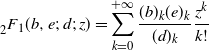
. Letting
 $\displaystyle \prescript{}{2}{F}_1(b,e;\,d;\,z) = \sum_{k=0}^{+\infty} \frac{(b)_k (e)_k}{ (d)_k} \frac{z^k}{k!}$
be the hypergeometric function, with
 $(b)_k = b (b+1) \cdots (b+k-1)$
denoting the Pochhammer symbol, we have the following theorem.
Theorem 2. For  ${a}>0$
,
 ${c}+{a}>0$
, and
 ${r} \in {\mathds{N}}$
, we have
 \begin{equation}{\psi(na,n)}\sim{ \mathcal{C}_{{r}+1}} ({\lambda} {L(n)} )^{{r}+1} n^{-({r}+1)({\alpha}-1)}, \qquad n \to \infty,\end{equation}
where
 \begin{gather*} { \mathcal{C}_{{r}+1}} = \big[ {a}^{-({r} + 1) {\alpha}} \prescript{}{2}{F}_1[{r}+1, ({r} + 1) {\alpha};\, {r} + 2; -{c}/{a}] \cdot {\textbf{1}_{\{c>0\}}} + ({a} + {c})^{-({r}+1){\alpha}} \cdot {\textbf{1}_{\{c<0\}}} \big] \\[4pt]
\times \frac{1}{({r}+1)!} \times \begin{cases} 1, & {if }\, {R(t)} = L_{{r}}(t)\, \textit{(LCR)}, \\[4pt] ({r}+1)^{({r}+1){\alpha}}, & {if }\, {R(t)} = {E_{{r}}(t)}\, \textit{(ECOMOR)}. \end{cases}\end{gather*}
The result in the literature that comes closest to Theorem 2 is the reinsurance contract analyzed in Section 4 of [Reference Chen, Blanchet, Rhee and Zwart9]. In that case, all claims in excess of size bn are reinsured. In that setting, the tail index is  $\lceil a/b \rceil (\alpha-1)$
, and the constant in front of the regularly varying function is a multidimensional integral without an explicit expression.
The proof of Theorem 2 is based on sample-path large deviations results developed in [Reference Rhee18]. Specifically, Theorems 3.1 and 3.2 in [Reference Rhee18] provide the conditions under which the result (2) holds, and in addition the  $\liminf$
and
 $\limsup$
are equal. Thus, to achieve our goal, we must verify that these conditions are satisfied for
 ${\bar{Y}_{n}} = {\bar{S}_{n}}$
and
 ${A} = {{A}^{r}_{{c},{a}}}$
(LCR) or
 ${A} = {{\mathcal{A}}^{r}_{{c},{a}}}$
(ECOMOR) defined in (9) and (11), respectively. However, their verification is rather involved. Hence, to make the proof of Theorem 2 more accessible, we split it into various steps after the aforementioned conditions and we provide additional explanations for each step.
Note that all of the forthcoming results are similar for the two treaties, with possible deviations in small details. Therefore, we will first prove them for the LCR treaty and then show briefly how they can be extended to the ECOMOR treaty.
3.1. Proof of Theorem 2
The first step is to show that both mappings  ${\phi_{r}}, {\varphi_{r}}\,:\, {\mathds{D}} \to {\mathds{R}}$
from (8) and (10), respectively, are Lipschitz continuous. Due to their continuity, (6) will hold and, consequently, we will be able to write
 ${\mathbb{P}} ( {\phi_{r}} ({\bar{S}_{n}}) \geqslant {a} )= {\mathbb{P}} ( {\bar{S}_{n}} \in {{A}^{r}_{{c},{a}}} )$
and
 ${\mathbb{P}} ( {\varphi_{r}} ({\bar{S}_{n}}) \geqslant {a} )= \allowbreak {\mathbb{P}} ( {\bar{S}_{n}} \in {{\mathcal{A}}^{r}_{{c},{a}}} )$
. For this, we need the following intermediate result.
Lemma 2. For every  $({\xi}, {\zeta}) \in {\mathds{D}^{2}}$
,
 $m \in {\mathds{N}}$
, and
 ${h} \in {\Lambda}$
, we have
 \begin{equation*} {\left| {{{{\mathfrak J}^{m}_{{\zeta} \circ {h}}(t)} - {{\mathfrak J}^{m}_{{\xi}}(t)} }} \right|} \leqslant 2 m { \| {\xi} - {\zeta} \circ {h} \| }, \qquad {for\ all}\ t \in [0,1].\end{equation*}
Proof. By the definition of  ${{\mathfrak J}^{m}_{{\zeta} \circ {h}}(t)}$
, there exists
 $(\sigma_1,\dots,\sigma_m) \in [0,t]^m$
, with
 $\sigma_i \neq \sigma_j$
for all
 $i \neq j$
, such that
 \begin{equation} {{\mathfrak J}^{m}_{{\zeta} \circ {h}}(t)} = \sum_{i=1}^m ( {\zeta} \circ {h}(\sigma_i)-{\zeta} \circ {h}(\sigma_i^-) ).\end{equation}
In addition, we have that
 \begin{equation} {{\mathfrak J}^{m}_{{\xi}}(t)} = \max_{\substack{ (s_1,\dots,s_m)\in[0,t]^m\\s_i\neq s_j,\forall i\neq j}} \sum_{i=1}^m ( {{\xi}(s_i)}-{{\xi}(s_i^-)}) \geqslant \sum_{i=1}^m ( {{\xi}(\sigma_i)}-{{\xi}(\sigma_i^-)} ).\end{equation}
Subtracting (16) and (17), we obtain
 \begin{align*} {{\mathfrak J}^{m}_{{\zeta} \circ {h}}(t)} - {{\mathfrak J}^{m}_{{\xi}}(t)} &\leqslant \sum_{i=1}^m ( {\zeta} \circ {h}(\sigma_i)-{\zeta} \circ {h}(\sigma_i^-) - {{\xi}(\sigma_i)}+{{\xi}(\sigma_i^-)} )\\ &\leqslant \sum_{i=1}^m \big( {\left| {{{\zeta} \circ {h}(\sigma_i) - {{\xi}(\sigma_i)}}} \right|} + {\left| {{{\zeta} \circ {h}(\sigma_i^-) - {{\xi}(\sigma_i^-)}}} \right|} \big)\\ &\leqslant 2 m { \| {\xi} - {\zeta} \circ {h} \| }.\end{align*}
Following similar arguments, we can also show that  ${{\mathfrak J}^{m}_{{\xi}}(t)} - {{\mathfrak J}^{m}_{{\zeta} \circ {h}}(t)} \leqslant 2 m { \| {\xi} - {\zeta} \circ {h} \| }$
, which completes the proof. □
We are now ready to establish the desired continuity.
Lemma 3. (Lipschitz continuity of the mapping.) The mappings  ${\phi_{r}}, {\varphi_{r}}\,:\, {\mathds{D}} \to {\mathds{R}}$
defined by (8) and (10), respectively, are Lipschitz continuous with respect to
 ${J_1}$
. More precisely, there exist
 ${K} \in [0,{\left| {{c}} \right|} + 2 {r} + 1]$
and
 ${L} \in [0,{\left| {{c}} \right|} + 4 {r}^2 + 4 {r} + 1]$
such that
 ${\left| {{{{\phi_{r}}(\xi)} - {{\phi_{r}}({\zeta})}}} \right|} \leqslant {K} {d({\xi},{\zeta})}$
and
 ${\left| {{{{\varphi_{r}}(\xi)} - {{\varphi_{r}}({\zeta})}}} \right|} \leqslant {L} {d({\xi},{\zeta})}$
for all
 $({\xi}, {\zeta}) \in {\mathds{D}^{2}}$
.
Proof. Without loss of generality, we assume that  ${{\phi_{r}}(\xi)} \geqslant {{\phi_{r}}({\zeta})}$
, otherwise we switch the roles of
 ${\xi}$
and
 ${\zeta}$
. For every
 $\varepsilon>0$
, there exists
 $t_* \in [0,1]$
such that
 \begin{equation} {{\xi}(t_*)} - {c} t_* - {{\mathfrak J}^{{r}}_{{\xi}}(t_*)} > {{\phi_{r}}(\xi)} - \varepsilon.\end{equation}
On the other hand, by the definition of  ${J_1}$
, there exists
 ${h} = {h}({\xi},{\zeta},\varepsilon) \in {\Lambda}$
so that
 \begin{equation} {d({\xi},{\zeta})} + \varepsilon = { \| {h} - {id} \| } \vee { \| {\xi} - {\zeta} \circ {h} \| } \geqslant ({h}(t_*) - t_* ) \vee ( {{\xi}(t_*)} - {\zeta} \circ {h}(t_*) ).\end{equation}
Furthermore, using the fact that  ${h}$
is a homeomorphism on [0, 1], we obtain
 \begin{align} {\zeta} \circ {h}(t_*) - & {c} {h}(t_*) - {{\mathfrak J}^{{r}}_{{\zeta} \circ {h}}(t_*)} \notag \\[3pt]
&= {\zeta} \circ {h}(t_*) - {c} {h}(t_*) - \max_{\substack{ (s_1,\dots,s_{r})\in[0,t_*]^{r}\\
s_i\neq s_j,\forall i\neq j}} \sum_{i=1}^{r} ( {\zeta} \circ {h}(s_i)- {\zeta} \circ {h}(s_i^-) ) \notag \\
&= {\zeta} ( {h}(t_*)) - {c} {h}(t_*) - \max_{\substack{ (s_1,\dots,s_{r})\in[0,{h}(t_*)]^{r}\\s_i\neq s_j,\forall i\neq j}} \sum_{i=1}^{r} ( {\zeta}(s_i)- {\zeta}(s_i^-) ) \notag \\ &= {\zeta} \big( {h}(t_*) \big) - {c} {h}(t_*) - {{\mathfrak J}^{{r}}_{{\zeta}}({h}(t_*))} \leqslant {{\phi_{r}}({\zeta})}.\end{align}
Subtracting (20) from (18) yields
 \begin{align*} {{\phi_{r}}(\xi)} - {{\phi_{r}}({\zeta})} &< \varepsilon + ( {{\xi}(t_*)} - {\zeta} \circ {h}(t_*) ) + {c} ({h}(t_*) - t_* ) + ( {{\mathfrak J}^{{r}}_{{\zeta} \circ {h}}(t_*)} - {{\mathfrak J}^{{r}}_{{\xi}}(t_*)} ) \notag \\ &
< \varepsilon + ( {d({\xi},{\zeta})} + \varepsilon ) + {\left| {{c}} \right|} ( {d({\xi},{\zeta})} + \varepsilon ) + 2 {r} ( {d({\xi},{\zeta})} + \varepsilon ) \notag \\ &= (2 + {\left| {{c}} \right|} + 2 {r}) \varepsilon + (1 + {\left| {{c}} \right|} + 2 {r}) {d({\xi},{\zeta})},\end{align*}
where we have also used (19) and  ${{\mathfrak J}^{{r}}_{{\zeta} \circ {h}}(t_*)}- {{\mathfrak J}^{{r}}_{{\xi}}(t_*)} \leqslant 2 {r} { \| {\xi} - {\zeta} \circ {h} \| }$
by applying Lemma 2 with
 $t=t_*$
and
 $m={r}$
. Letting
 $\varepsilon \to 0$
, we conclude that
 ${{\phi_{r}}(\xi)} - {{\phi_{r}}({\zeta})} \leqslant (1 + {\left| {{c}} \right|} + 2 {r}) {d({\xi},{\zeta})}$
, i.e.
 ${\phi_{r}}$
is Lipschitz continuous. The Lipschitz continuity for the
 ${\varphi_{r}}$
mapping can be shown in an analogous manner. More precisely, for every
 $\varepsilon>0$
, there exists
 $t_* \in [0,1]$
such that
 \begin{equation} {{\xi}(t_*)} - {c} t_* - ({r}+1) {{\mathfrak J}^{{r}}_{{\xi}}(t_*)} + {r} {{\mathfrak J}^{{r}+1}_{{\xi}}(t_*)} > {{\varphi_{r}}(\xi)} - \varepsilon.\end{equation}
For a homeomorphism  ${h}$
on [0, 1] satisfying (19), we have
 \begin{align} & {\zeta} \circ {h}(t_*) - {c} {h}(t_*) - ({r}+1) {{\mathfrak J}^{{r}}_{{\zeta} \circ {h}}(t_*)} + {r} {{\mathfrak J}^{{r}+1}_{{\zeta} \circ {h}}(t_*)}\nonumber\\
& \quad = {\zeta} ( {h}(t_*) ) - {c} {h}(t_*) - ({r}+1) {{\mathfrak J}^{{r}}_{{\zeta}}({h}(t_*))} + {r} {{\mathfrak J}^{{r}+1}_{{\zeta}}({h}(t_*))} \leqslant {{\varphi_{r}}({\zeta})}.\end{align}
We assume now, without loss of generality, that  ${{\varphi_{r}}(\xi)} \geqslant {{\varphi_{r}}({\zeta})}$
and we subtract (22) from (21) to attain
 \begin{align*} {{\varphi_{r}}(\xi)} - {{\varphi_{r}}({\zeta})} <& \ \varepsilon + ( {{\xi}(t_*)} - {\zeta} \circ {h}(t_*) ) + {c} ({h}(t_*) - t_* ) + ({r} +1) ( {{\mathfrak J}^{{r}}_{{\zeta} \circ {h}}(t_*)} - {{\mathfrak J}^{{r}}_{{\xi}}(t_*)} ) \\
&+ {r} ( {{\mathfrak J}^{{r}+1}_{{\xi}}(t_*)} - {{\mathfrak J}^{{r}+1}_{{\zeta} \circ {h}}(t_*)}) \notag \\
<& ( 2 + {\left| {{c}} \right|} + 4 {r} ({r} +1) ) \varepsilon + ( 1 + {\left| {{c}} \right|} + 4 {r} ({r} +1) ) {d({\xi},{\zeta})},\end{align*}
where we have also used (19) and twice Lemma 2 with  $m={r},{r}+1$
and
 $t=t_*$
. Letting
 $\varepsilon \to 0$
, the result is immediate. □
As a next step, we calculate the rate functions  ${\mathcal{J}({{A}^{r}_{{c},{a}}}) }$
and
 ${\mathcal{J}({{\mathcal{A}}^{r}_{{c},{a}}}) }$
that appear in (2) and are formally defined in (13). For simplicity, we set
 ${c}_+=\max \{0,{c}\}$
and
 ${c}_-=\max \{0,-{c}\}$
.
Lemma 4. (Evaluation of the rate function.) The rate function defined by (13) is equal to  ${r} +1$
in both treaties, i.e.
 \begin{equation*} {\mathcal{J}({{A}^{r}_{{c},{a}}}) } = {\mathcal{J}({{\mathcal{A}}^{r}_{{c},{a}}}) } = {r} +1.\end{equation*}
Proof. We first need to show that  ${\mathcal{J}({{A}^{r}_{{c},{a}}}) }$
cannot take any value smaller than or equal to
 ${r}$
. Let us assume, on the contrary, that
 $\smash{{\xi} \in {{A}^{r}_{{c},{a}}} \cap {\mathds{D}^{\uparrow}_{\mathcal{S}}}}$
such that
 ${\mathcal{D}_+({\xi})} =k \leqslant {r}$
. This means that
 ${\xi} = \sum_{i \leqslant k} {{x} _{i}} {\textbf{1}_{\{{{u} _{i}} ,1\}}}$
, with
 ${{x} _{1}} \geqslant {{x} _{2}} \geqslant \cdots \geqslant {{x} _{k}} >0$
and
 $\{ 0,{{u} _{1}} ,{{u} _{2}} ,\dots,{{u} _{k}} ,1 \}$
all distinct. By taking into account Assumptions 1 and 2, we calculate
 \begin{align*} {{\phi_{r}}(\xi)} &= \sup_{t \in [0,1]} \big\{ {{\xi}(t)} - {c} t - {{\mathfrak J}^{{r}}_{{\xi}}(t)}\big\} = \sup_{t \in [0,1]} \Bigg\{ \cancel{{\sum_{i=1}^k {{x} _{i}} {\textbf{1}_{\{{{u} _{i}} ,1\}}}(t)}} - {c} t - \cancel{{\sum_{i=1}^k {{x} _{i}} {\textbf{1}_{\{{{u} _{i}} ,1\}}}(t)}} \Bigg\}\\
& = {c}_-,\end{align*}
which states that  ${\xi} \not\in {{A}^{r}_{{c},{a}}}$
because
 ${{\phi_{r}}(\xi)} = {c}_- \not \geqslant {a}$
. As a result,
 ${\mathcal{J}({{A}^{r}_{{c},{a}}}) } \not = k$
,
 $k \leqslant r$
.
Let us assume now that  ${\xi} \in {{A}^{r}_{{c},{a}}} \cap {\mathds{D}^{\uparrow}_{\mathcal{S}}}$
such that
 ${\mathcal{D}_+({\xi})} = {r}+1$
, i.e.
 ${\xi} = \sum_{i = 1}^{{r}+1} {{x} _{i}} {\textbf{1}_{\{{{u} _{i}} ,1\}}}$
, with
 ${{x} _{1}} \geqslant {{x} _{2}} \geqslant \cdots \geqslant {{x} _{{r}+1}} >0$
and
 $\{ 0,{{u} _{1}} ,{{u} _{2}} ,\dots,{{u} _{{r}+1}} ,1 \}$
all distinct. To calculate
 ${{\phi_{r}}(\xi)}$
, observe first that
 \begin{equation} {{\xi}(t)} - {{\mathfrak J}^{{r}}_{{\xi}}(t)} = \sum_{i=1}^{{r}+1} {{x} _{i}} {\textbf{1}_{\{{{u} _{i}} ,1\}}}(t) - {{\mathfrak J}^{{r}}_{{\xi}}(t)} = \begin{cases} 0, & t
< \max \{ {{u} _{1}} ,\dots,{{u} _{{r}+1}} \} , \\[4pt] {{x} _{{r}+1}} , & t \geqslant \max \{ {{u} _{1}} ,\dots,{{u} _{{r}+1}} \} , \end{cases} \end{equation}
because all the claims are ‘absorbed’ according to Assumption 2 before the arrival of the ( ${r}+1$
)st claim, which happens at time
 $t^* = \max \{ {{u} _{1}} ,\dots,{{u} _{{r}+1}} \}$
. Thus, we can write
 \begin{align*} {{\phi_{r}}(\xi)} &= \sup_{t \in [0,1]} \big\{ {{\xi}(t)} - {c} t - {{\mathfrak J}^{{r}}_{{\xi}}(t)} \big\} = \sup_{t \in [0,1]} \Bigg\{ {{x} _{{r}+1}} \prod_{i=1}^{{r}+1} {\textbf{1}_{\{{{u} _{i}} ,1\}}}(t) - {c} t \Bigg\}\\ &= {{x} _{{r}+1}} - {c}_+ \max\{ {{u} _{1}} ,\dots,{{u} _{{r}+1}} \} +{c}_- ,\end{align*}
since  ${{x} _{{r}+1}} \prod_{i=1}^{{r}+1} {\textbf{1}_{\{{{u} _{i}} ,1\}}}(t)$
remains fixed at the value
 ${{x} _{{r}+1}} $
from
 $t^*= \max\{ {{u} _{1}} ,\dots,{{u} _{{r}+1}} \}$
onward, while
 $-{c} t$
decreases or increases depending on the value of
 ${c}$
. Due to the fact that
 ${\xi} \in {{A}^{r}_{{c},{a}}}$
, we get
 \begin{equation*}{{\phi_{r}}(\xi)} \geqslant {a} \Rightarrow {{x} _{{r}+1}} \geqslant a + {c}_+ \max\{ {{u} _{1}} ,\dots,{{u} _{{r}+1}} \} - {c}_- \geqslant a - {c}_- > 0,\end{equation*}
i.e.  ${{A}^{r}_{{c},{a}}} \cap {\mathds{D}^{\uparrow}_{\mathcal{S}}} \not = \emptyset$
but contains all step functions with
 ${r}+1$
steps such that the (
 ${r}+1$
)st largest step satisfies
 ${{x} _{{r}+1}} \geqslant a + {c}_+ \max\{ {{u} _{1}} ,\dots,{{u} _{{r}+1}} \} - {c}_-$
. Thus,
 ${\mathcal{J}({{A}^{r}_{{c},{a}}}) } = {r} +1$
.
The proof for  ${\mathcal{J}({{\mathcal{A}}^{r}_{{c},{a}}}) } = {r} +1$
in the ECOMOR treaty is similar. More precisely, it can easily be shown that there is no
 $\smash{{\xi} \in {{\mathcal{A}}^{r}_{{c},{a}}} \cap {\mathds{D}^{\uparrow}_{\mathcal{S}}}}$
with
 ${\mathcal{D}_+({\xi})} =k \leqslant {r}$
. Consequently,
 ${\mathcal{J}({{\mathcal{A}}^{r}_{{c},{a}}}) } \not = k$
,
 $k \leqslant r$
. Let us assume next that
 ${\xi} \in {{\mathcal{A}}^{r}_{{c},{a}}} \cap {\mathds{D}^{\uparrow}_{\mathcal{S}}}$
such that
 ${\mathcal{D}_+({\xi})} = {r}+1$
, i.e.
 ${\xi} = \sum_{i = 1}^{{r}+1} {{x} _{i}} {\textbf{1}_{\{{{u} _{i}} ,1\}}}$
, with
 ${{x} _{1}} \geqslant {{x} _{2}} \geqslant \cdots \geqslant {{x} _{{r}+1}} >0$
and
 $\{ 0,{{u} _{1}} ,{{u} _{2}} ,\dots,{{u} _{{r}+1}} ,1 \}$
all distinct. We have
 \begin{equation} {r} {{\mathfrak J}^{{r}+1}_{{\xi}}(t)} - ({r} + 1){{\mathfrak J}^{{r}}_{{\xi}}(t)} = -{{\mathfrak J}^{{r}}_{{\xi}}(t)} + \begin{cases} 0, & t
< \max \{ {{u} _{1}} ,\dots,{{u} _{{r}+1}} \} , \\[4pt] {r} {{x} _{{r}+1}} , & t \geqslant \max \{ {{u} _{1}} ,\dots,{{u} _{{r}+1}} \} , \end{cases} \end{equation}
due to Assumption 1. By combining (23) and (24), we calculate
 \begin{align*} {{\varphi_{r}}(\xi)} &= \sup_{t \in [0,1]} \big\{ {{\xi}(t)} - {c} t - ({r} + 1){{\mathfrak J}^{{r}}_{{\xi}}(t)} + {r} {{\mathfrak J}^{{r}+1}_{{\xi}}(t)} \big\} \\
&= \sup_{t \in [0,1]} \Bigg\{ ({r}+1){{x} _{{r}+1}} \prod_{i=1}^{{r}+1} {\textbf{1}_{\{{{u} _{i}} ,1\}}}(t) - {c} t \Bigg\}\\[4pt]
&=({r}+1){{x} _{{r}+1}} - {c}_+ \max\{ {{u} _{1}} ,\dots,{{u} _{{r}+1}} \} +{c}_- .\end{align*}
Since  ${\xi} \in {{\mathcal{A}}^{r}_{{c},{a}}}$
, we get
 ${{\varphi_{r}}(\xi)} \geqslant {a} \Rightarrow ({r} +1){{x} _{{r}+1}} \geqslant {a} + {c}_+ \max\{ {{u} _{1}} ,\dots,{{u} _{{r}+1}} \} - {c}_-$
, i.e.
 ${{\mathcal{A}}^{r}_{{c},{a}}} \cap \smash{{\mathds{D}^{\uparrow}_{\mathcal{S}}} \not = \emptyset}$
but contains all step functions with
 ${r}+1$
steps such that the (
 ${r}+1$
)st largest step satisfies
 ${{x} _{{r}+1}} \geqslant ( {a} + {c}_+ \max\{ {{u} _{1}} ,\dots,{{u} _{{r}+1}} \} - {c}_- )/({r}+1) $
. Thus,
 ${\mathcal{J}({{\mathcal{A}}^{r}_{{c},{a}}}) } = {r} +1$
, and the proof is complete. □
Remark 1. The above lemma not only gives the value of the rate function, it also provides the form of the minimal  ${\xi}$
that belongs to the sets
 ${{A}^{r}_{{c},{a}}}$
and
 ${{\mathcal{A}}^{r}_{{c},{a}}}$
, i.e. all step functions with
 ${r}+1$
steps such that their (
 ${r}+1$
)st greatest step is greater than or equal to the value
 ${a} + {c}_+ \max\{ {{u} _{1}} ,\dots,{{u} _{{r}+1}} \} - {c}_- $
in the LCR treaty and the value
 $({a} + {c}_+ \max\{ {{u} _{1}} ,\dots,{{u} _{{r}+1}} \} - {c}_- )/({r}+1)$
in the ECOMOR treaty.
An essential condition of Theorem 3.2 in [Reference Rhee18] is that the sets  $_{\delta}{{{A}^{r}_{{c},{a}}}} \cap { {\mathds{D}}_{ \leqslant {{\mathcal{J}({{A}^{r}_{{c},{a}}}) }}}}$
and
 $_{\delta}{{{\mathcal{A}}^{r}_{{c},{a}}}} \cap { {\mathds{D}}_{ \leqslant {{\mathcal{J}({{\mathcal{A}}^{r}_{{c},{a}}}) }}}}$
are bounded away from
 ${ {\mathds{D}}_{ \leqslant {{\mathcal{J}({{A}^{r}_{{c},{a}}}) } - 1}}}$
and
 ${ {\mathds{D}}_{ \leqslant {{\mathcal{J}({{\mathcal{A}}^{r}_{{c},{a}}}) } - 1}}}$
, respectively. Verifying this condition allows us then to derive the result (2) for both treaties. We can directly use the value of the rate function in the following result due to Lemma 4.
Lemma 5. (Bounded away property.) The sets  $_{\delta}{{{A}^{r}_{{c},{a}}}} \cap { {\mathds{D}}_{ \leqslant {r}+1}}$
and
 $_{\delta}{{{\mathcal{A}}^{r}_{{c},{a}}}} \cap { {\mathds{D}}_{ \leqslant {r}+1}}$
are bounded away from
 ${ {\mathds{D}}_{ \leqslant {r}}}$
for some
 ${\delta}>0$
.
Proof. To simplify the notation in the proof, we write  ${A}$
instead of
 ${{A}^{r}_{{c},{a}}}$
and
 ${\mathcal{A}}$
instead of
 ${{\mathcal{A}}^{r}_{{c},{a}}}$
; the notation
 $_{\delta}{{A}}$
,
 $_{\delta}{{\mathcal{A}}}$
follows naturally.
We start by showing that  $_{\delta}{{A}} \cap { {\mathds{D}}_{ \leqslant {r}+1}}$
is bounded away from
 ${ {\mathds{D}}_{ \leqslant {r}}}$
for some
 ${\delta}>0$
. Thanks to Lemma 2, we have that
 $_{\delta}{{A}} \subset {A}({\delta})$
, where
 ${A}({\delta}) = {\phi_{r}}^{-1}( [{a} - ({\left| {{c}} \right|} + 2 {r} + 1){\delta} ,\infty) )$
. Hence, it suffices to show that
 ${A}({\delta}) \cap { {\mathds{D}}_{ \leqslant {r}+1}}$
is bounded away from
 ${ {\mathds{D}}_{ \leqslant {r}}}$
. Let
 ${\xi} \in {A}({\delta}) \cap { {\mathds{D}}_{ \leqslant {r}+1}}$
. Since
 ${\xi} \in { {\mathds{D}}_{ \leqslant {r}+1}}$
, we can write
 ${\xi} = \sum_{i = 1}^{{r}+1} {{x} _{i}} {\textbf{1}_{\{{{u} _{i}} ,1\}}}$
with
 ${{x} _{1}} \geqslant {{x} _{2}} \geqslant \dots \geqslant {{x} _{{r}+1}} \geqslant 0$
, for which we have
 ${{\phi_{r}}(\xi)} \leqslant {{x} _{{r}+1}} - {c}_+ \max\{ {{u} _{1}} ,\dots,{{u} _{{r}+1}} \}+{c}_- \leqslant {{x} _{{r}+1}} + {c}_-$
according to the proof of Lemma 4. Furthermore,
 ${\xi} \in {A}({\delta}) \Leftrightarrow {{\phi_{r}}(\xi)} \geqslant {a} - ({\left| {{c}} \right|} + 2 {r} + 1){\delta}$
. Combining the two inequalities, we obtain that
 ${{x} _{{r}+1}} \geqslant ({a} - {c}_-) - ({\left| {{c}} \right|} + 2 {r} + 1){\delta} \geqslant ({a}-{c}_-)/2$
for
 ${\delta} \leqslant ({a}-{c}_-)/2 ({\left| {{c}} \right|} + 2 {r} + 1)$
. In other words, for
 ${\delta} \leqslant ({a}-{c}_-)/2 ({\left| {{c}} \right|} + 2 {r} + 1)$
,
 ${\xi} \in {A}({\delta}) \cap { {\mathds{D}}_{{r}+1}} \subset {A}({\delta}) \cap { {\mathds{D}}_{ \leqslant {r}+1}}$
with jump sizes bounded from below by
 $({a}-{c}_-)/2$
, which implies that
 ${A}({\delta}) \cap { {\mathds{D}}_{ \leqslant {r}+1}}$
is bounded away from
 ${ {\mathds{D}}_{ \leqslant {r}}}$
.
In a similar manner, it suffices to show that  ${\mathcal{A}}({\delta}) \cap { {\mathds{D}}_{ \leqslant {r}+1}}$
is bounded away from
 ${ {\mathds{D}}_{ \leqslant {r}}}$
, where
 ${\mathcal{A}}({\delta}) = {\varphi_{r}}^{-1}( [{a} - ({\left| {{c}} \right|} + 4 {r}^2 + 4 {r} + 1){\delta} ,\infty) )$
. Let
 ${\xi} \in {\mathcal{A}}({\delta}) \cap { {\mathds{D}}_{ \leqslant {r}+1}}$
. Since
 ${\xi} \in { {\mathds{D}}_{ \leqslant {r}+1}}$
, we can write
 ${\xi} = \sum_{i = 1}^{{r}+1} {{x} _{i}} {\textbf{1}_{\{{{u} _{i}} ,1\}}}$
with
 ${{x} _{1}} \geqslant {{x} _{2}} \geqslant \dots \geqslant {{x} _{{r}+1}} \geqslant 0$
, for which it holds that
 ${{\varphi_{r}}(\xi)} \leqslant ({r}+1){{x} _{{r}+1}} - {c}_+ \max\{ {{u} _{1}} ,\dots,{{u} _{{r}+1}} \} + {c}_- \leqslant ({r}+1){{x} _{{r}+1}} + {c}_-$
. Furthermore,
 ${\xi} \in {\mathcal{A}}({\delta}) \Leftrightarrow {{\varphi_{r}}(\xi)} \geqslant {a} - ({\left| {{c}} \right|} + 4 {r}^2 + 4 {r} + 1){\delta}$
. Combining the two inequalities, we obtain that
 $({r}+1){{x} _{{r}+1}} \geqslant ({a}-{c}_-) - ({\left| {{c}} \right|} + 4 {r}^2 + 4 {r} + 1){\delta} \geqslant ({a}-{c}_-)/2$
for
 ${\delta} \leqslant ({a}-{c}_-)/2 ({\left| {{c}} \right|} + 4 {r}^2 + 4 {r} + 1)$
. In other words, the jump sizes of
 ${\xi}$
are bounded from below by
 $({a}-{c}_-)/2({r}+1)$
, which implies that
 ${\mathcal{A}}({\delta}) \cap { {\mathds{D}}_{ \leqslant {r}+1}}$
is bounded away from
 ${ {\mathds{D}}_{ \leqslant {r}}}$
for
 ${\delta} \leqslant ({a}-{c}_-)/2 ({\left| {{c}} \right|} + 4 {r}^2 + 4 {r} + 1)$
, and the proof is complete. □
Let  ${ \mathcal{C}_{{r}+1}^{\text L} }\coloneqq { C_{{r}+1} ({{A}^{r}_{{c},{a}}}) }$
and
 ${ \mathcal{C}_{{r}+1}^{\text E} }\coloneqq { C_{{r}+1} ({{\mathcal{A}}^{r}_{{c},{a}}}) }$
. According to Section 3.1 in [Reference Rhee18], the
 $\liminf$
and
 $\limsup$
in (2) yield the same result when
 \begin{equation*} { C_{{\mathcal{J}(A) }} ({{A}^\circ}) } = { C_{{\mathcal{J}(A) }} (A) }= { C_{{\mathcal{J}(A) }} ({\bar{A}}) }.\end{equation*}
However, the above equality holds when the set  ${A}$
is
 ${ C_{{\mathcal{J}(A) }} }$
-continuous, i.e.
 ${ C_{{\mathcal{J}(A) }} }({\partial{A}})=0$
, where the boundary
 ${\partial{A}} = {\bar{A}} \setminus {{A}^\circ}$
of a set
 ${A}$
is the closure of
 ${A}$
without its interior. We prove in the next lemma that the sets
 ${{A}^{r}_{{c},{a}}}$
and
 ${{\mathcal{A}}^{r}_{{c},{a}}}$
are both
 ${ C_{{r}+1} }$
-continuous.
Lemma 6. (Equality of the limits.) The sets  ${{A}^{r}_{{c},{a}}}$
and
 ${{\mathcal{A}}^{r}_{{c},{a}}}$
are
 ${ C_{{r}+1} }$
-continuous, i.e.
 ${ C_{{r}+1} ({{\partial{A}}{^{r}_{{c},{a}}}}) } = { C_{{r}+1} ({{\partial{\mathcal{A}}}{^{r}_{{c},{a}}}}) } = 0$
.
Proof. To simplify the notation in the proof, we again write  ${A}$
instead of
 ${{A}^{r}_{{c},{a}}}$
and
 ${\mathcal{A}}$
instead of
 ${{\mathcal{A}}^{r}_{{c},{a}}}$
; the notation
 ${{{A}}^\circ}$
,
 ${{{\mathcal{A}}}^\circ}$
,
 ${\bar{A}}$
,
 ${\bar{A}}$
follows naturally.
We start by showing the  ${ C_{{r}+1} }$
-continuity of
 ${A}$
. In compliance with the notation introduced in Subsection 2.2, we consider the function
 ${T^{-1}_{{r}+1}}\,:\, { {\mathds{D}}_{r+1}} \to { S_{r+1}}$
such that
 \begin{align*} {{T^{-1}_{{r}+1}}({{{A}}^\circ})} &= {{T^{-1}_{{r}+1}}({\phi_{r}}^{-1}( ({a},\infty) ))} \\[4pt]
&= \big\{ ({\textbf{\textit{x}}}, {\textbf{\textit{u}}}) \in { S_{r+1}}\, :\, {{x} _{{r}+1}} > {a} + {c}_+ \max \{ {{u} _{1}} ,\dots,{{u} _{{r}+1}} \} - {c}_- \big\}, \\[4pt]
{{T^{-1}_{{r}+1}}({\bar{A}})} &= {{T^{-1}_{{r}+1}}({\phi_{r}}^{-1}( [{a},\infty) ))}\\[4pt]
&= \big\{ ({\textbf{\textit{x}}}, {\textbf{\textit{u}}}) \in { S_{r+1}}\, :\, {{x} _{{r}+1}} \geqslant {a} + {c}_+ \max \{ {{u} _{1}} ,\dots,{{u} _{{r}+1}} \} - {c}_- \big\}.\end{align*}
Obviously, the set  ${{T^{-1}_{{r}+1}}({\bar{A}})} \setminus {{T^{-1}_{{r}+1}}\left({{{A}}^\circ}\right)}$
has zero Lebesgue measure. Combining this with
 ${{{A}}^\circ} \subseteq {A} \subseteq {\bar{A}}$
and
 ${\phi_{r}}$
being a continuous function, we conclude that
 ${ C_{{r}+1} ({{\partial{A}}}) } = 0$
, i.e.
 ${A}$
is
 ${ C_{{r}+1} }$
-continuous. To prove the
 ${ C_{{r}+1} }$
-continuity of
 ${\mathcal{A}}$
, it suffices to observe that the set
 ${{T^{-1}_{{r}+1}}({\bar{\mathcal{A}}})} \setminus {{T^{-1}_{{r}+1}}\left({{{\mathcal{A}}}^\circ}\right)}$
has zero Lebesgue measure, where
 \begin{align*} {{T^{-1}_{{r}+1}}({{{\mathcal{A}}}^\circ})} &= {{T^{-1}_{{r}+1}}({\varphi_{r}}^{-1}( ({a},\infty) ))}\\
&= \big\{ ({\textbf{\textit{x}}}, {\textbf{\textit{u}}}) \in { S_{r+1}}\, :\, {{x} _{{r}+1}} > ({a} + {c}_+ \max\{ {{u} _{1}} ,\dots,{{u} _{{r}+1}} \} - {c}_- )/({r}+1) \big\}, \\
{{T^{-1}_{{r}+1}}({\bar{\mathcal{A}}})} &= {{T^{-1}_{{r}+1}}({\varphi_{r}}^{-1}( [{a},\infty)))}\\
&= \big\{ ({\textbf{\textit{x}}}, {\textbf{\textit{u}}}) \in { S_{r+1}}\, :\, {{x} _{{r}+1}} \geqslant ({a} + {c}_+ \max\{ {{u} _{1}} ,\dots,{{u} _{{r}+1}} \} - {c}_- )/({r}+1) \big\},\end{align*}
which follows by the same reasoning. □
We now calculate the pre-constants  ${ C_{{\mathcal{J}({{A}^{r}_{{c},{a}}}) }}}({{A}^{r}_{{c},{a}}})$
and
 ${ C_{{\mathcal{J} }({{\mathcal{A}}^{r}_{{c},{a}}})} }({{\mathcal{A}}^{r}_{{c},{a}}})$
.
Lemma 7. (Calculation of the pre-constant.) The constants  ${ \mathcal{C}_{{r}+1}^{\text L} }$
and
 ${ \mathcal{C}_{{r}+1}^{\text E} }$
are given by
 \begin{alignat*}{2} { \mathcal{C}_{{r}+1}^{\text L} } =& \quad \frac{1}{({r}+1)!} &&\times \begin{cases} {a}^{-({r} + 1) {\alpha}} \cdot \prescript{}{2}{F}_1[{r}+1, ({r} + 1) {\alpha};\ {r} + 2; -{c}/{a}], & {c}>0, \\[3pt]
({a}+{c})^{-({r}+1){\alpha}}, & {c}<0 ; \end{cases} \\[5pt]
{ \mathcal{C}_{{r}+1}^{\text E} } =& \frac{({r}+1)^{({r}+1){\alpha}}}{({r}+1)!} &&\times \begin{cases} {a}^{-({r} + 1) {\alpha}} \cdot \prescript{}{2}{F}_1[{r}+1, ({r} + 1) {\alpha};\ {r} + 2; -{c}/{a}], & {c}>0, \\[3pt]
({a}+{c})^{-({r}+1){\alpha}}, & {c}<0. \end{cases}\end{alignat*}
Proof. Recall that  ${ \mathcal{C}_{{r}+1}^{\text L} }\coloneqq { C_{{r}+1} ({{A}^{r}_{{c},{a}}}) }$
and
 ${ \mathcal{C}_{{r}+1}^{\text E} }\coloneqq { C_{{r}+1} ({{\mathcal{A}}^{r}_{{c},{a}}}) }$
. To calculate these constants, we use the definition of the measure
 ${ C_{{r}+1} (\bullet) }$
in (14). We start with
 ${ \mathcal{C}_{{r}+1}^{\text L} }$
. It is known that for
 ${U_{1}},\dots,{U_{{r}+1}} \sim {\mathcal{U}}(0,1)$
, the distribution of the random variable
 $\max \{ {U_{1}},\dots,{U_{{r}+1}} \}$
is given by the formula
 ${\mathbb{P}}(\max \{ {U_{1}},\dots,{U_{{r}+1}} \leqslant t) = t^{{r}+1}$
. Furthermore, by using that
 $\int_b^{+\infty} {\alpha} y^{-n {\alpha} - 1} \, {\text d} y = b^{-n {\alpha}}/n$
with
 $b>0$
, we calculate recursively the following multiple integrals for
 $n \in {\mathds{N}}$
and positive
 $y_i$
:
 \begin{align*} {\mathcal{I}_{n}} &= \int\limits_{y_1 \geqslant \dots \geqslant y_{n+1}} \prod_{i=1}^n {\alpha} y_i^{-{\alpha}-1} \, {\text d} y_1 \cdots {\text d} y_n \\
&= \int\limits_{y_n = y_{n+1}}^{+\infty} \int\limits_{y_{n-1} = y_n}^{+\infty} \dots \int\limits_{y_2 = y_3}^{+\infty} \prod_{i=2}^{n} {\alpha} y_i^{-{\alpha}-1} \underbrace{\left(\;\int\limits_{y_1 = y_2}^{+\infty} {\alpha} y_1^{-{\alpha}-1} \, {\text d} y_1 \;\right)}_{= y_2^{-{\alpha}}} \, {\text d} y_2 \cdots {\text d} y_n \\ &= \int\limits_{y_n = y_{n+1}}^{+\infty} \dots \int\limits_{y_3 = y_4}^{+\infty} \prod_{i=3}^{n} {\alpha} y_i^{-{\alpha}-1} \underbrace{\left(\; \int\limits_{y_2 = y_3}^{+\infty} {\alpha} y_2^{-2{\alpha}-1} \, {\text d} y_2\;\right)}_{= y_3^{-2 {\alpha}}/2} \, {\text d} y_3 \cdots {\text d} y_n = \dots \\ &= \frac{1}{n!}(y_{n+1})^{- n {\alpha}}.\end{align*}
Consequently, in the case  ${c}>0$
, we obtain, by virtue of Remark 1,

 \begin{align*} { \mathcal{C}_{{r}+1}^{\text L} } &= \mathbb{E} \Bigg[ {{\nu}^{{r}+1}_{\alpha}} \Bigg\{ {\textbf{\textit{y}}} \in {\mathds{R}}^{{r}+1}_+ : \sum_{i=1}^{{r}+1} y_i {\textbf{1}_{\{{U_{i}},1\}}} \in {{A}^{r}_{{c},{a}}} \Bigg\} \Bigg] \\
&= \mathbb{E} \left[ \int\limits_{y_1 \geqslant \dots \geqslant y_{{r}+1}>0} \prod_{i=1}^{{r}+1} {\alpha} y_i^{-{\alpha}-1} {\textbf{1}_{{ \{ y_{{r}+1} \geqslant {a} + {c} \max \{ {U_{1}},\dots,{U_{{r}+1}}\} \} }}}\, {\text d} y_1 \cdots {\text d} y_{{r}+1} \right] \\
&= \int\limits_{t \in [0,1]} \int\limits_{y_1 \geqslant \dots \geqslant y_{{r}+1}>0} \prod_{i=1}^{{r}+1} {\alpha} y_i^{-{\alpha}-1} {\textbf{1}_{\{y_{{r}+1} \geqslant {a} + {c} t \}\}}} ({r}+1) t^{r} \, {\text d} y_1 \cdots {\text d} y_{{r}+1} {\text d} t\\
&= \int\limits_{t \in [0,1]} \int\limits_{ y_{{r}+1}>0} {\mathcal{I}_{{r}}} {\alpha} y_{{r}+1}^{-{\alpha}-1} {\textbf{1}_{\{y_{{r}+1} \geqslant {a} + {c} t \} \}}} ({r}+1) t^{r} \, {\text d} y_{{r}+1} {\text d} t\displaybreak\\
&= \int\limits_{t \in [0,1]} \int\limits_{ y_{{r}+1}={a} + {c} t }^{+\infty} \frac{1}{{r}!}(y_{{r}+1})^{- {r} {\alpha}} {\alpha} y_{{r}+1}^{-{\alpha}-1} ({r}+1) t^{r} \, {\text d} y_{{r}+1} {\text d} t\\[3pt]
&= \frac{{r}+1}{{r}!} \int\limits_0^1 t^{r} \left(\; \int\limits_{{a} + {c} t }^{+\infty} {\alpha} (y_{{r}+1})^{-({r}+1){\alpha}-1} \, {\text d} y_{{r}+1} \;\right) {\text d} t = \frac{1}{{r}!} \int\limits_0^1 t^{r} ({a} + {c} t)^{-({r}+1){\alpha}} \, {\text d} t\\[3pt]
&=\frac{{a}^{-({r} + 1) {\alpha}}}{({r}+1)!} \cdot \prescript{}{2}{F}_1[{r}+1, ({r} + 1) {\alpha};\ {r} + 2; -{c}/{a}].\end{align*}
Analogously, we find
 \begin{align*} { \mathcal{C}_{{r}+1}^{\text E} } &= \mathbb{E} \Bigg[{{\nu}^{{r}+1}_{\alpha}} \Bigg\{ {\textbf{\textit{y}}} \in {\mathds{R}}^{{r}+1}_+ : \sum_{i=1}^{{r}+1} y_i {\textbf{1}_{\{{U_{i}},1\}}} \in {{\mathcal{A}}^{r}_{{c},{a}}} \Bigg\} \Bigg] \\
&=\int\limits_{y_1 \geqslant \dots \geqslant y_{{r}+1}>0} \prod_{i=1}^{{r}+1} {\alpha} y_i^{-{\alpha}-1} {\textbf{1}_{{ \{y_{{r}+1} \geqslant ({a} + {c} \max \{ {U_{1}},\dots,{U_{{r}+1}}\} )/({r}+1) \} }}}\, {\text d} y_1 \cdots {\text d} y_{{r}+1} \\[3pt]
&= \int\limits_{t \in [0,1]} \int\limits_{ y_{{r}+1}>0} {\mathcal{I}_{{r}}} {\alpha} y_{{r}+1}^{-{\alpha}-1} {\textbf{1}_{\{y_{{r}+1} \geqslant ({a} + {c} t)/({r}+1) \} \}}} ({r}+1) t^{r} \, {\text d} y_{{r}+1} {\text d} t\\[3pt]
&= \frac{1}{{r}!} \int\limits_0^1 t^{r} \left( \frac{{a} + {c} t}{{r}+1} \right)^{-({r}+1){\alpha}} \, {\text d} t = ({r}+1)^{({r}+1){\alpha}} \frac{1}{{r}!} \int\limits_0^1 t^{r} ( {a} + {c} t )^{-({r}+1){\alpha}} \, {\text d} t\\
&= ({r}+1)^{({r}+1){\alpha}} \frac{{a}^{-({r} + 1) {\alpha}}}{({r}+1)!} \cdot \prescript{}{2}{F}_1[{r}+1, ({r} + 1) {\alpha};\ {r} + 2; -{c}/{a}].\end{align*}
In the case  ${c}<0$
, the coefficients simplify to
 \begin{align*} \hspace*{15pt} { \mathcal{C}_{{r}+1}^{\text L} } &= \mathbb{E} \left[ \int\limits_{y_1 \geqslant \dots \geqslant y_{{r}+1}>0} \prod_{i=1}^{{r}+1} {\alpha} y_i^{-{\alpha}-1} {\textbf{1}_{\{y_{{r}+1} \geqslant {a} + {c} \}}}\, {\text d} y_1 \cdots {\text d} y_{{r}+1} \right] = \int\limits_{ {a} + {c}}^{+\infty} {\mathcal{I}_{{r}}} {\alpha} y_{{r}+1}^{-{\alpha}-1} \, {\text d} y_{{r}+1}\\[4pt]
&= \cdots = \frac{1}{({r}+1)!} ({a}+{c})^{-({r}+1){\alpha}}, \quad \text{and}\\[4pt]
{ \mathcal{C}_{{r}+1}^{\text E} } &= ({r}+1)^{({r}+1){\alpha}} \frac{1}{({r}+1)!} ({a}+{c})^{-({r}+1){\alpha}}.\hspace*{175pt}\Box\end{align*}
Remark 2. When  ${c}>0$
, the coefficients
 ${ \mathcal{C}_{{r}+1}^{\text L} }$
and
 ${ \mathcal{C}_{{r}+1}^{\text E} }$
can be equivalently expressed in terms of finite sums involving the Gamma function. More precisely, by applying integration by parts
 ${r}$
times, we calculate for
 $k>{r}+1$
that
 \begin{align*} \frac{1}{{r}!} \int t^{r} ({a} + {c} t)^{-k} \, {\text d} t =& \sum_{m=1}^{{r}+1} \frac{(-1)^{m+1} t^{{r}+1-m}}{({r}+1-m)!} \frac{({a} + {c} t)^{m-k}}{{c}^m \prod_{j=1}^m(j-k)}\\
=& \sum_{m=1}^{{r}+1} \frac{(-1)^{m+1} t^{{r}+1-m}}{({r}+1-m)!} \frac{({a} + {c} t)^{m-k}}{{c}^m (1-k)_m}\end{align*}
 \begin{align*} =& -\sum_{m=1}^{{r}+1} \frac{ t^{{r}+1-m}}{({r}+1-m)!} \frac{({a} + {c} t)^{m-k}}{{c}^m (k-m)_m} \Rightarrow \\
\frac{1}{{r}!} \int\limits_0^1 t^{r} ({a} + {c} t)^{-k} \, {\text d} t =& \frac{ {a}^{{r}+1-k} }{{c}^{{r}+1} (k-{r}-1)_{{r}+1}} -\sum_{m=1}^{{r}+1} \frac{({a} + {c})^{m-k}}{({r}+1-m)! {c}^m (k-m)_m},\end{align*}
where  $(b)_k = \Gamma(b+k)/\Gamma(b)$
is again the Pochhammer symbol. Thus,
 \begin{align*} { \mathcal{C}_{{r}+1}^{\text L} } =& \frac{ {a}^{-({r}+1)({\alpha}-1)} \Gamma ( ({r}+1) {\alpha} ) }{{c}^{{r}+1} \Gamma ( ({r}+1)({\alpha}-1) )} -\sum_{m=1}^{{r}+1} \frac{({a} + {c})^{m-({r}+1){\alpha}} \Gamma ( ({r}+1) {\alpha} ) }{({r}+1-m)! {c}^m \Gamma ( ( {r}+1){\alpha} - m )}, \\[3pt]
{ \mathcal{C}_{{r}+1}^{\text E} } =& ({r}+1)^{({r}+1){\alpha}} \\[3pt]
&\times \left( \frac{ {a}^{-({r}+1)({\alpha}-1)} \Gamma ( ({r}+1) {\alpha} ) }{{c}^{{r}+1} \Gamma ( ({r}+1)({\alpha}-1) )} -\sum_{m=1}^{{r}+1} \frac{({a} + {c})^{m-({r}+1){\alpha}} \Gamma ( ({r}+1) {\alpha} ) }{({r}+1-m)! {c}^m \Gamma ( ( {r}+1){\alpha} - m )} \right).\end{align*}
Remark 3. In the absence of reinsurance ( ${r} = 0$
), the pre-constant simplifies to
 \begin{equation*} \frac{{a}^{-{\alpha} +1} - ({a} + {c})^{-{\alpha} +1}}{{c} ({\alpha} - 1)},\end{equation*}
which can also be derived from existing results; see, e.g., [Reference Asmussen and Klüppelberg6,Reference Embrechts, Goldie and Veraverbeke10].
Finally, we know from [Reference Kyprianou14] that the compound Poisson aggregate claim process  ${S(t)} = \sum_{i=1}^{{N(t)}} {{X}_{i}}$
is a special Lévy process with Lévy measure
 ${\nu}({\text d} x) = {\lambda} {{F}({\text d} x)}$
, which means that
 $n \cdot {\nu}[n,\infty) = {\lambda} n {\bar{{F}}(n)} = {\lambda} {L(n)} n^{-{\alpha}+1}$
,
 $n \in {\mathds{N}}$
. We conclude the proof by combining this result with Lemma 7 to obtain the expression (15).
4. Numerical implementations
Our primary goal in this section is to verify our asymptotic approximations in Theorem 2 via numerical illustration. For this purpose, we employ an importance sampling scheme that was developed in [Reference Chen, Blanchet, Rhee and Zwart9], and it is proved to be strongly efficient in the current setting. We provide a short description of this scheme in Appendix A.
We use a shifted Pareto distribution for the claim sizes, i.e.  ${\bar{{F}}(x)} = (x+1)^{-{\alpha}}$
,
 $x\geqslant 0$
, and
 $\mathbb{E} ( {{X}}) = 1/({\alpha}-1)$
. In addition, we calculate the net premiums
 $p^{\text L}_{\text D} = {p} - p^{\text L}_{\text R}$
and
 $p^{\text E}_{\text D} = {p} - p^{\text E}_{\text R}$
of the insurer after purchasing an LCR or ECOMOR reinsurance for a premium
 $p^{\text L}_{\text R}$
or
 $p^{\text E}_{\text R}$
, respectively.
We assume here that the reinsurance premiums are determined according to an expected value principle (see, e.g., [Reference Albrecher, Teugels and Beirlant2]). Hence, we need to determine  $\mathbb{E}( {R(t)})$
. As the Pareto claims arrive according to a Poisson process with rate
 ${\lambda}$
, we follow [Reference Berliner7] to obtain
 \begin{align*} \mathbb{E} ( {L_{{r}}(t)}) &= ({\lambda} t)^{1/{\alpha}} \sum_{i=1}^{r} \frac{\gamma(i-1/{\alpha},{\lambda} t)}{\Gamma(i)} - \sum_{i=1}^{r} \frac{\gamma(i,{\lambda} t)}{\Gamma(i)},\\ \mathbb{E} ( {E_{{r}}(t)}) &= ({\lambda} t)^{1/{\alpha}} \Bigg( \sum_{i=1}^{r} \frac{\gamma(i-1/{\alpha},{\lambda} t)}{\Gamma(i)} - {r} \frac{\gamma({r}+1-1/{\alpha},{\lambda} t)}{\Gamma({r}+1)} \Bigg) \\ & \quad - \Bigg( \sum_{i=1}^{r} \frac{\gamma(i,{\lambda} t)}{\Gamma(i)} - {r} \frac{\gamma({r}+1,{\lambda} t)}{\Gamma({r}+1)} \Bigg),\end{align*}
where  $\displaystyle \gamma(k,s) = \int_0^s {\text e}^{-u} u^{k-1} \, {\text d} u$
is the lower incomplete gamma function. Thus, if
 ${\theta}, {\eta}>0$
are the relative safety loadings imposed by the insurer and reinsurer, respectively, we calculate the annual retained premium
 ${p_{\text D}}$
over a period of n years via the formula
 ${p_{\text D}} = (1+{\theta}) \mathbb{E} ( {S(1)}) - (1 + {\eta}) \mathbb{E} ( {R(n)})/n$
. Correspondingly,
 \begin{align*} p^{\text L}_{\text D} &= (1+{\theta}) \frac{{\lambda}}{{\alpha}-1} - (1+{\eta}) \Bigg( ({\lambda} n)^{1/{\alpha}} \sum_{i=1}^{r} \frac{\gamma(i-1/{\alpha},{\lambda} n)}{\Gamma(i)} - \sum_{i=1}^{r} \frac{\gamma(i,{\lambda} n)}{\Gamma(i)} \Bigg) \Biggm/ n,\\[4pt]
p^{\text E}_{\text D} &= (1+{\theta}) \frac{{\lambda}}{{\alpha}-1} - (1+{\eta}) ({\lambda} n)^{1/{\alpha}} \Bigg( \sum_{i=1}^{r} \frac{\gamma(i-1/{\alpha},{\lambda} n)}{\Gamma(i)} - {r} \frac{\gamma({r}+1-1/{\alpha},{\lambda} n)}{\Gamma({r}+1)} \Bigg) \Bigg/ n \\[4pt]
& \quad + (1+{\eta})\Bigg( \sum_{i=1}^{r} \frac{\gamma(i,{\lambda} n)}{\Gamma(i)} - {r} \frac{\gamma({r}+1,{\lambda} n)}{\Gamma({r}+1)} \Bigg) \Bigg/ n.\end{align*}
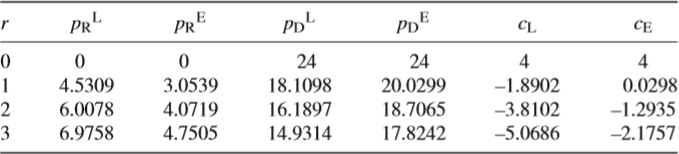
We now fix  $n=20$
,
 ${\alpha} = 1.5$
,
 ${\lambda} = 10$
,
 ${\theta}=0.2$
,
 ${\eta}=0.3$
(safety loadings for reinsurance are typically larger than for primary insurance, see [Reference Albrecher, Teugels and Beirlant2]) to obtain the figures shown in Table 1.
Finally, we choose the values of  ${a}$
such that the asymptotic approximations for LCR and ECOMOR are simultaneously defined. In other words, we should have
 ${a} > \max \{ -{c}_{\text L}, -{c}_{\text E}, 0 \}$
, where
 ${c}_i = {p_{\text D}}^i - {\lambda}/({\alpha}-1)$
,
 $i \in \{ {\text L},{\text E} \}$
. It is clear from Table 1 that
 ${c}_{\text L} < {c}_{\text E}$
. Therefore, both approximations are simultaneously valid for
 ${a} >\max \{ -{c}_{\text L}, 0 \}$
.
Premiums for LCR and ECOMOR treaties for varying  ${r}$
for
 $n = 20$
,
 ${\lambda}=10$
,
 ${\alpha} = 1.5$
,
 ${\theta}=0.2$
, and
 ${\eta}=0.3$
.

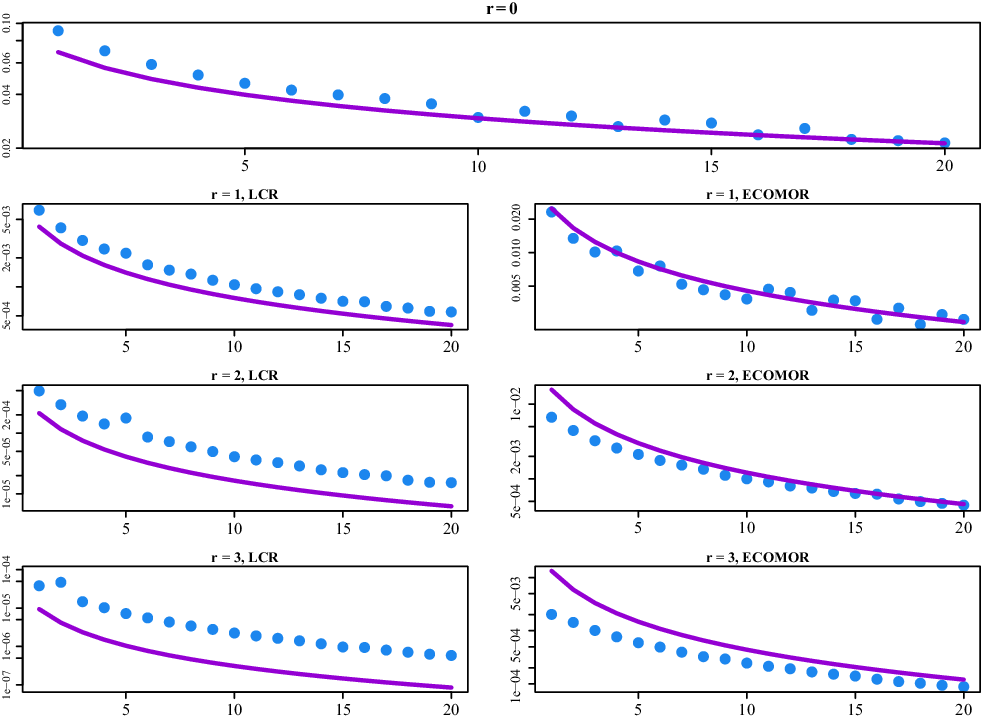
Numerical results for both LCR and ECOMOR treaties, for  ${a}=20$
.

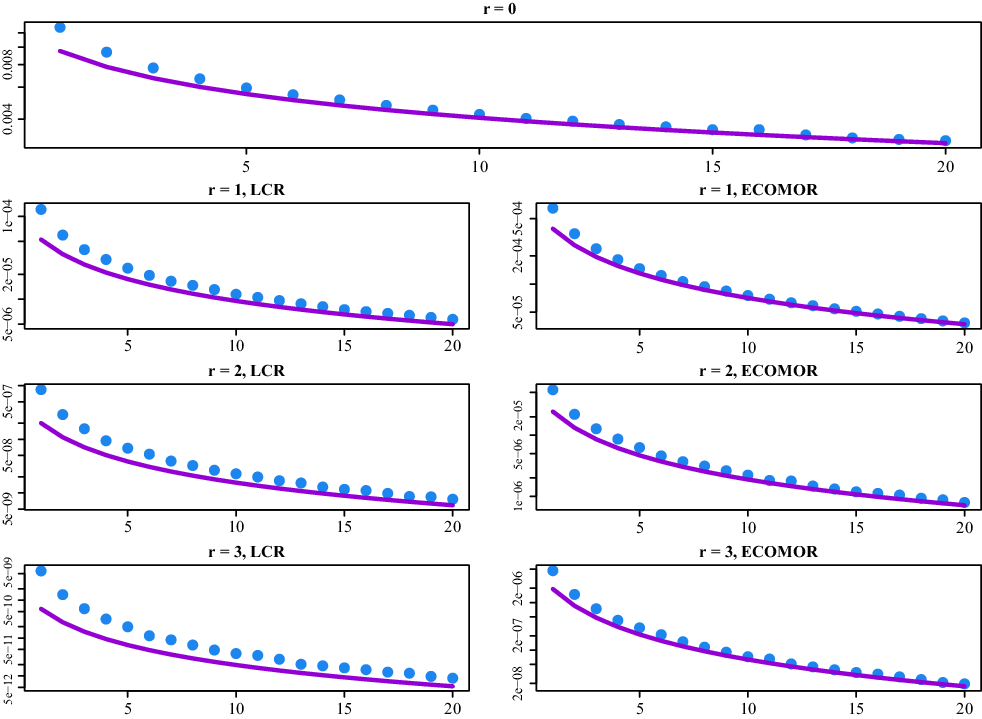
Numerical results for both LCR and ECOMOR treaties, for  ${a}=80$
.

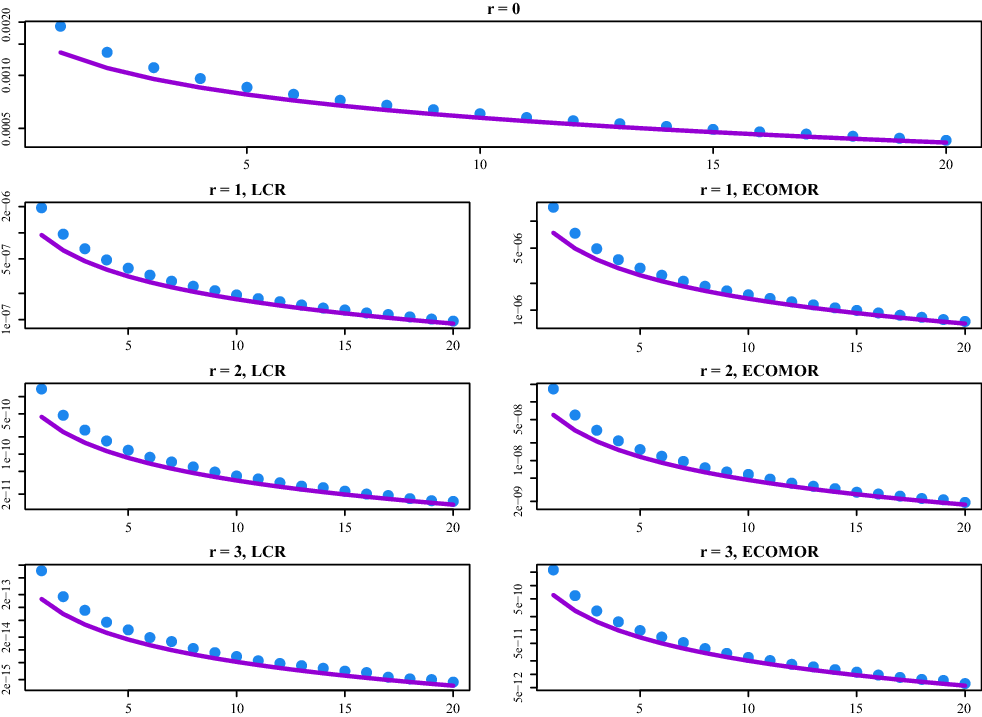
Numerical results for both LCR and ECOMOR treaties, for  ${a}=300$
.

The results under both LCR and ECOMOR treaties for different combinations of  ${r}$
and
 ${a}$
are presented in Figures 1–3. We plot the simulation estimates (circles) together with the large-deviation approximation (line) of the rare-event probabilities as a function of n. Note that the results for
 $r=0$
can be considered as a sanity check for our simulation study.
We observe that the large-deviation results become accurate as n grows, in line with Theorem 2. It is quite remarkable that in most cases the resulting approximation is already excellent for  $n=20$
. This corresponds to a time horizon of 20 years for the present insurance application. For fixed n, the quality of the asymptotic approximation improves as
 ${a}$
increases. Finally, we recognize that LCR always leads to lower ruin probabilities than ECOMOR, which is intuitively expected. However, the explicit expression given in Theorem 2 allows us for the first time to quantitatively assess the effects of the model parameters on the resulting ruin probabilities.
Appendix A. Short description of the simulation technique
Our simulation estimator is based on an importance sampling strategy; see, e.g., Chapter V of [Reference Asmussen and Glynn5]. To be precise, for  ${\delta}>0$
, we define the auxiliary set
 \begin{equation*} B_{\delta} = \{ {\xi}\in{\mathds{D}} \colon {\mathcal{D}({\xi},{\delta})} \geqslant {r}+1 \},\end{equation*}
where  ${\mathcal{D}({\xi},{\delta})}$
is given in (12). We propose an importance distribution
 $\textrm{Q}_{{\delta},w}$
that is determined by
 \begin{equation*} \textrm{Q}_{{\delta},w} (\,\bullet\,) = w{\mathbb{P}} (\,\bullet\,) + (1-w)\textrm{Q}_{{\delta}} (\,\bullet\,),\end{equation*}
where  $w\in(0,1)$
and
 $\textrm{Q}_{{\delta}} (\,\bullet\,) = {\mathbb{P}} (\,\bullet\, |\, {\bar{S}_{n}} \in B_{\delta} )$
. Note that
 $\textrm{Q}_{{\delta}} (\,\bullet\,)$
is the conditional distribution given that the event
 ${\bar{S}_{n}}$
has at least
 ${r}+1$
discontinuities of magnitude
 ${\delta}$
. The proposed importance distribution has the following interpretation. We flip a coin at the beginning of each simulation. We generate with probability w the sample path of
 ${\bar{S}_{n}}$
under the original measure and, with probability
 $1-w$
, we sample
 ${\bar{S}_{n}}$
under the measure
 $\textrm{Q}_{{\delta}} (\,\bullet\,)$
. To compensate for the bias introduced by the importance distribution, a likelihood ratio (the Radon-Nikodym derivative between
 ${\mathbb{P}}$
and
 $\textrm{Q}_{{\delta},w}$
) must be included in the estimator. In our case, the estimator
 $Z_n$
for
 ${\mathbb{P}}({\bar{S}_{n}} \in {A} )$
is then given by
 \begin{equation*}Z_n={\textbf{1}_{\{{\bar{S}_{n}} \in {A} \}}} \frac{\textrm{d}{\mathbb{P}}}{\textrm{d}\textrm{Q}_{{\delta},w}}={\textbf{1}_{\{{\bar{S}_{n}} \in {A} \}}}\left( w+\frac{1-w}{{\mathbb{P}}({\bar{S}_{n}}\in B_{\delta})}{\textbf{1}_{\{{\bar{S}_{n}}\in B_{\delta}\}}} \right)^{-1}.\end{equation*}
The output analysis is performed similarly to the Monte Carlo method, i.e. we generate M i.i.d. replicates of  $Z_n$
from
 $\textrm{Q}_{{\delta},w}$
and we estimate
 ${\mathbb{P}}({\bar{S}_{n}}\in {A} )$
as the arithmentic mean of the replicates. From Theorem 1 in [Reference Chen, Blanchet, Rhee and Zwart9], there exists
 ${\delta}$
such that the simulation estimator has a bounded relative error. Hence, the number of simulation runs required to achieve a given accuracy is bounded as n goes to infinity. For more details of the estimator, we refer readers to [Reference Chen, Blanchet, Rhee and Zwart9].
Acknowledgements
H.A. and E.V. acknowledge financial support from the Swiss National Science Foundation Project 200021_168993. B.C. and B.Z. are supported by NWO VICI grant # 639.033.413 of the Dutch Science Foundation.