The developmental trajectories of internalizing and externalizing problem behavior have consistently been found to be associated (Masten et al., Reference Masten, Roisman, Long, Burt, Obradović and Riley2005; Overbeek, Vollebergh, Meeus, Engels, & Luijpers, Reference Overbeek, Vollebergh, Meeus, Engels and Luijpers2001), and the co-occurrence of internalizing and externalizing tendencies has recently been found to increase over time (Denissen, Asendorpf, & Van Aken, Reference Denissen, Asendorpf and van Aken2008). This increase in co-occurrence suggests the existence of so-called spill-over or cascade effects in which functioning in one developmental domain spills over to influence functioning in other developmental domains (Burt, Obradović, Long, & Masten, Reference Burt, Obradović, Long and Masten2008; Masten et al., Reference Masten, Roisman, Long, Burt, Obradović and Riley2005). It is important to study the longitudinal relationship between both types of problem behavior as they limit daily functioning and can be a precursor of later psychopathology (Ferdinand, Stijnen, Verhulst, & Van der Reijden, Reference Ferdinand, Stijnen, Verhulst and Van der Reijden1999). Personality disorders have been associated with both internalizing and externalizing tendencies. For example, antisocial personality disorder appears to be characterized by externalizing behavior (aggressiveness), whereas avoidant personality disorder is characterized by internalizing tendencies (e.g., social withdrawal; American Psychiatric Association, 2000). In addition, borderline personality disorder has been found to be associated with both internalizing and externalizing problem behavior (James & Taylor, Reference James and Taylor2008).
Natural variation in temperamental reactivity and self-regulation may underlie both personality and personality disorders. That is, it has been suggested that personality disorders are extreme variants of normal development rather than distinct personality structures (Posner et al., Reference Posner, Rothbart, Vizueta, Thomas, Levy and Fossella2003). According to the developmental psychopathology perspective, knowledge of normal development and variations in normal development is required to understand deviations from normal development (Cicchetti, Reference Cicchetti1993; Cicchetti & Toth, Reference Cicchetti and Toth2009; Rutter & Sroufe, Reference Rutter and Sroufe2000). Investigating normal pathways of development offers the opportunity to disentangle the processes and mechanisms underlying deviations from these pathways (Cicchetti, Reference Cicchetti1993). By investigating the longitudinal associations between the development of an internalizing tendency (shyness) and an externalizing tendency (aggressiveness) and individual differences in these associations, the present study aims to give insight into how normal variations in development and the association between two developmental domains might result in maladaptive development. It will be investigated whether there are cascade effects linking the longitudinal trajectories of shyness and aggressiveness between age 4 and 23 and whether there are individual differences in this longitudinal relationship. Investigating the longitudinal association between an internalizing and an externalizing tendency may have implications for prevention and intervention of the comorbidity of both types of problem behavior.
Longitudinal Association Between Internalizing and Externalizing Tendencies
Internalizing and externalizing behavior have consistently been found to be related, both within and across time (Angold, Costello, & Erkanli, Reference Angold, Costello and Erkanli1999; Keiley, Bates, Dodge, & Pettit, Reference Keiley, Bates, Dodge and Pettit2000). Literature linking the longitudinal trajectories of internalizing and externalizing behavior presents a complex picture in that some studies have found internalizing and externalizing tendencies to be negatively related (e.g., Kerr, Tremblay, Pagani, & Vitaro, Reference Kerr, Tremblay, Pagani and Vitaro1997), whereas others have found both dimensions to be positively related (e.g., Capaldi, Reference Capaldi1992). It has been suggested that this relationship is developmentally specific, and that internalizing and externalizing problems show differential relations across time (Burt et al., Reference Burt, Obradović, Long and Masten2008).
With regard to the negative relation between internalizing and externalizing behavior over time, evidence points out that internalizing tendencies might protect children from developing externalizing problems. For example, Kerr et al. (Reference Kerr, Tremblay, Pagani and Vitaro1997) found that behavioral inhibition, but not behavioral withdrawal, protected boys at risk from developing delinquent behavior. Inhibited 10- to 12-year-old boys were less likely to become delinquent at ages 13 to 15. In addition, Masten and colleagues (2005) revealed that internalizing symptoms in adolescence predict a decline in externalizing problems into emerging adulthood and suggest that internalizing symptoms counteract increase in externalizing problems.
Other studies have found positive relationships between internalizing and externalizing problems. Delinquency and depression have been found to longitudinally co-occur during adolescence (Akse, Hale, Engels, Raaijmakers, & Meeus, Reference Akse, Hale, Engels, Raaijmakers and Meeus2007; Overbeek et al., Reference Overbeek, Vollebergh, Meeus, Engels and Luijpers2001) and conduct problems and depressive symptoms have been found to co-occur in early adolescence (Capaldi, Reference Capaldi1992). As stated above, the co-occurrence of internalizing and externalizing tendencies have recently been found to increase from early adolescence into adulthood (Denissen et al., Reference Denissen, Asendorpf and van Aken2008).
The co-occurrence of internalizing and externalizing tendencies results in worse developmental outcomes than the occurrence of only one type of problem behavior (Beyers & Loeber, Reference Beyers and Loeber2003; Keiley, Lofthouse, Bates, Dodge, & Pettit, Reference Keiley, Lofthouse, Bates, Dodge and Pettit2003). For example, early adolescents with co-occurring conduct problems and depressed mood show poorer parent and peer relationships and lower self-esteem than adolescents with conduct problems or depressed mood only (Capaldi, Reference Capaldi1992).
Underlying Processes
Several ideas have been developed to explain the longitudinal association between internalizing and externalizing behavior. The negative association between internalizing and externalizing tendencies might be explained by the influence of internalizing tendencies on risk-taking behavior and involvement with deviant peers (Burt et al., Reference Burt, Obradović, Long and Masten2008; Farrington, Reference Farrington1995; Kerr et al., Reference Kerr, Tremblay, Pagani and Vitaro1997). That is, internalizing tendencies such as behavioral inhibition are thought to result in less risk-taking behavior or involvement with deviant peers and as a result might protect individuals from developing externalizing behavior.
Two theories that may explain the positive spillover effects between both types of problem behavior over time are the failure theory and the acting out theory. According to the failure theory, externalizing problems precede and predict internalizing behavior (Overbeek et al., Reference Overbeek, Vollebergh, Meeus, Engels and Luijpers2001). Externalizing behavior is thought to result in failure experiences in social interactions in the form of rejection by and conflict with others, leading to an increased vulnerability to develop internalizing behavior (Akse et al., Reference Akse, Hale, Engels, Raaijmakers and Meeus2007; Burke, Loeber, Lahey, & Rathouz, Reference Burke, Loeber, Lahey and Rathouz2005; Capaldi, Reference Capaldi1991, Reference Capaldi1992; Overbeek et al., Reference Overbeek, Vollebergh, Meeus, Engels and Luijpers2001). In contrast, the acting out theory holds that internalizing feelings are “acted out” by showing externalizing behavior (Akse et al., Reference Akse, Hale, Engels, Raaijmakers and Meeus2007; Overbeek et al., Reference Overbeek, Vollebergh, Meeus, Engels and Luijpers2001).
Despite the complex longitudinal relationships between internalizing and externalizing tendencies found in the literature, theories explaining the association between both have focused either on negative or on positive associations. Although the link between internalizing and externalizing behavior has been suggested to be developmentally specific (Burt et al., Reference Burt, Obradović, Long and Masten2008), the development of this association over time and the possible changes in the direction of the relation between both remain unstudied.
Individual Differences
In order to understand and make generalizations about principles and mechanisms underlying developmental processes, it is crucial to investigate in what respect individuals are the same and in what respect they differ in their developmental processes (Bergman, Magnusson, & El-Khouri, Reference Bergman, Magnusson and El-Khouri2003). As not all individuals function and develop in the same way, there might be developmental heterogeneity in the association between internalizing and externalizing tendencies. Developing organisms continually interact with their environment (Rutter & Sroufe, Reference Rutter and Sroufe2000); as a result, individual differences might be situated not only in intrinsic characteristics but also in the differential interaction between the individual and the environment. Therefore, the longitudinal association between shyness and aggressiveness might vary between individuals with different environmental backgrounds.
Both internalizing and externalizing tendencies have been found to be related to the quality of social relationships (e.g., Barrera, Chassin, & Rogosch, Reference Barrera, Chassin and Rogosch1993; Helsen, Vollebergh, & Meeus, Reference Helsen, Vollebergh and Meeus2000). For example, support from parents has been found to be negatively related to adolescent substance abuse and externalizing behavior, and conflict with parents has been found to be positively related to externalizing behavior (Barrera et al., Reference Barrera, Chassin and Rogosch1993). In addition, low levels of parental support have been shown to be associated with high levels of emotional problems during adolescence (Helsen et al., Reference Helsen, Vollebergh and Meeus2000). It has been suggested that shy adolescents experience problems in psychological well-being and adaptive functioning when they are not receiving adequate support (Mounts, Valentiner, Anderson, & Boswel, 2006). Based on these findings, the longitudinal association between internalizing and externalizing tendencies might vary for individuals who differ in the quality of their social relationships.
In the present study, the development of the association between shyness and aggressiveness from childhood into emerging adulthood will be investigated. Emerging adulthood is the developmental period between age 18 and 25 that is characterized by change and exploration (Arnett, Reference Arnett2000). During this period, individuals are thought to adopt adult roles that are indicated by demographic transitions, subjective sense of having reached adulthood, and identity exploration. There are no clear norms with regard to the timing and sequence of these processes (Arnett, Reference Arnett2000). For example, a large amount of interindividual variation in demographic transitions are characteristic of this period in that individuals have been found to vary in the timing and the way in which they make demographical transitions such as leaving the parental home. Adopting responsibility in social roles has been found to be related to development in other domains. Denissen and colleagues (2008) have found part-time work to be related to the development of aggressiveness in that participants who started to work part-time earlier became less aggressive over time compared to participants who made this transition later. Based on these findings it can be suggested that the associations between shyness and aggressiveness might differ for people who vary in their timing of demographic transitions during this developmental period.
The Present Study
In the present study, developmental cascade models will be used to investigate the link between the developmental trajectories of shyness (internalizing behavior) and aggressiveness (externalizing behavior) and the possible changes in this association over time. As the co-occurrence of shyness and aggressiveness has been found to increase over time (Denissen et al., Reference Denissen, Asendorpf and van Aken2008) it is hypothesized that there will be cascade effects from high overall levels of shyness to increasing levels of aggressiveness over time (in accordance with the acting out theory) and from high overall levels of aggressiveness to increasing levels of shyness over time (conform the failure theory). In addition the cascade effects between shyness and aggressiveness are expected to differ between individuals. That is, the longitudinal association between shyness and aggressiveness is expected to vary depending on differences in the quality of social relations (i.e., social support and conflict) and demographic transitions during emerging adulthood.
By using a multiwave longitudinal design, the present study allows to investigate spillover effects between the longitudinal pathways of shyness and aggressiveness and to investigate individual differences in this association. As this longitudinal design covers the developmental period between age 4 and 23, it offers the opportunity to study the changing dynamics in the relationship between shyness and aggressiveness from childhood into emerging adulthood.
Method
Procedure
Participants were part of the Munich Longitudinal Study on the Genesis of Individual Competencies (LOGIC; Scheider & Bullock, Reference Schneider and Bullock2009). The sample was recruited from 20 selected preschools in the Munich area in Germany. Only children who started to attend preschool in the fall of 1984 were included. More than 90% of the selected parents permitted their child to participate in the study. There were 11 waves of data collection: the children were assessed annually from age 4 until age 12 and reassessed twice at ages 17 and 23. Participants visited the Max Planck Institute in Munich at each assessment.
Sample
The original LOGIC sample consisted of 230 children (111 girls, 119 boys) born in 1980–1981. In the sample used in the present study, self-report data up to age 23 were available for 149 participants (71 girls, 78 boys) and parent-ratings up to age 23 were available for 120 participants (61 girls, 59 boys). Of the 120 parent reports, 95 cases (79.2%) provided both father and mother ratings, 22 (18.3%) only mother ratings and 3 (2.5%) only father ratings. All participants had German as their first language and the sample had a representative distribution of people with low (28.1%), moderate (62.5%), and high (9.4%) socioeconomic status (Weinert & Schneider, Reference Weinert and Schneider1999).
Attrition analyses
Attrition was studied by comparing the dropouts with the remaining participants for each wave. Percentages of attrition varied from wave to wave, ranging from 5.3% (from age 6 to 7) to 29.7% (from age 17 to 23). No attrition effects were found with regard to parental ratings of shyness and aggressiveness and support of parents over all waves. From age 17 to 23, dropouts were more often male, χ 2 (1, N = 148) = 4.57, p = .03, φ = .18, significantly lower on socioeconomic status, F (1, 141) = 4.26, p = .04, η 2 = .03, and lower on the percentage of time spent in part-time work, F (1, 123) = 6.19, p = .01, η 2 = .05, than remaining participants. Because the effect sizes of the attrition effects were relatively small (Cohen, Reference Cohen1988) they were not expected to influence further analyses.
Measures
Parental scales on shyness and aggressiveness
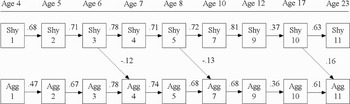
The main caregiver completed a parent questionnaire including a Shyness and Aggressiveness Scale (Asendorpf & van Aken, Reference Asendorpf and van Aken1999) when the child was age 4, 5, 6, 7, 8, 10, and 12. At ages 17 and 23, the questionnaire was filled out by both the father and the mother. In the assessments between age 4 and 10, the Shyness Scale contained eight items and the Aggressiveness Scale four items. At ages 12, 17, and 23 the Shyness Scale consisted of four items. The four shyness items were asked separately for shyness toward adults and shyness toward children (resulting in an eight-item scale) until age 12, whereas only two of these items were asked for shyness toward adults and another two for shyness toward children between age 12 and 23 because all items were highly correlated in previous assessments (Asendorpf & van Aken, Reference Asendorpf and van Aken1999). The items measured the extent of aggressiveness with peers (is aggressive to peers, starts arguing with peers, easily flies into a rage, makes peers angry) and shyness and inhibition with strangers (shy, inhibited, slow to warm up, uneasy approach) on a scale from 1 (never) to 7 (always).Footnote 1 The average reliability across waves was .90 for shyness (Cronbach αs = .83–.95) and .84 for aggressiveness (Cronbach αs = .75–.88). Father and mother judgments of shyness and aggressiveness at ages 17 and 23 correlated moderately to highly (rs = .49–.70), and were therefore collapsed into one mean score. Parental ratings of shyness and aggressiveness remained stable across waves (see Figure 1).
The cross-lagged model of stability and cascade effects between shyness and aggressiveness from age 4 to 23. All displayed paths are significant at p < .05.

Quality of social relationships
Quality of social relationships was assessed at age 17 using the German adaptation of the Network of Relationships Inventory (Furman & Buhrmester, Reference Furman and Buhrmester1985). The participants were asked to mention the important persons in their social network that were coded into eight categories: mothers, fathers, grandparents, other adults, siblings, classmates, nonschool friends, and younger children. Subsequently, the participants rated these persons on seven social dimensions of which six scales were directly translated from Furman and Buhrmester's Network of Relationships Inventory (instrumental aid, conflict, satisfaction, intimacy, esteem enhancement, companionships) and a seventh scale was added (reliability of the network member). The subscales instrumental aid, intimacy, esteem enhancement, and reliability were averaged into a composite scale of perceived support. Items were answered on a 5-point scale from 1 (never) to 5 (always). For the current analyses, only the support and conflict scales were used. Internal consistency of the Social Network Inventory was acceptable with a mean Cronbach α of .69.
Life history calendar
Demographic transitions were assessed at age 23 using the Life History Calendar (Caspi et al., Reference Caspi, Moffitt, Thornton, Freedman, Amell and Harrington1996). During a 45-min lasting interview, various aspects of the participants' lives between age 18 and 23 were documented on a month-by-month horizontal time line. By proceeding successively from one life domain to another, additional life history information was linked to key biographical events (e.g., “Did you get your new job before or after you broke up with your girlfriend?”), a procedure that has been found to lead to more accurate responses (Caspi et al., Reference Caspi, Moffitt, Thornton, Freedman, Amell and Harrington1996). The version of the interview used in the current study contained the life domains living situation, romantic relationships, education, work, and delinquency. From this information, variables were created with regard to latency to leaving the parental home, latency to first romantic relationship, latency to first part-time job, and latency to first full-time job; percentage of time spent in various living arrangements (e.g., in parental home, alone, with partner, with peers), in education, and in part-time and full-time jobs; highest educational level reached; and criminal charges for delinquency. Latency to an event was set to 0 if the event had occurred before the 18th birthday.
Analyses
The cascade effects between the longitudinal trajectories of shyness and aggressiveness and moderation effects were analyzed using (multiple group) cross-lagged modeling in Mplus version 4.0 (Muthén & Muthén, 1998–Reference Muthén and Muthén2006).
To test whether high levels of aggressiveness spilled over to increasing levels of shyness it was examined as to whether cross-lagged effects existed from aggressiveness to adjacent measurement points of shyness. To test whether high levels of shyness spilled over to increasing levels of aggressiveness it was examined as to whether cross-lagged effects existed from shyness to adjacent measurement points of aggressiveness. As cross-lagged modeling could only reveal cascade effects between specific measurement points and not the overall longitudinal relationship between shyness and aggressiveness, hierarchical linear modeling (HLM) was used to investigate the overall relationship between shyness and aggressiveness over time. In the HLM analyses measurement points were nested within individuals, allowing the total effects over all waves to be investigated.
To investigate differences in the cascade effects between shyness and aggressiveness between groups differing in the quality of social relationships and demographic transitions, multiple group cross-lagged modeling was used. The model fit of a model in which the cross-lagged paths were fixed to be equal across groups was compared to a model in which the cross-lagged paths were allowed to differ between the groups by investigating the change in chi square.
Results
Descriptive statistics
The means and standard deviations of shyness and aggressiveness across all waves are presented in Table 1.
Means (standard deviations) of shyness and aggressiveness from age 4 to age 23 (N = 120)

Cascade model
Model fit
To investigate whether cascade effects existed between shyness and aggressiveness over time, cross-lagged modeling in Mplus was used. The cascade model (Figure 1) fitted the data reasonably well, χ 2 (119, N = 202) = 241.52, p < .001; χ 2/df ratio = 2.03, comparative fit index = .89, Tucker–Lewis index = .86, root mean square error of approximation = .07.
Longitudinal stability
Both shyness and aggressiveness appeared to be stable over time from age 4 to age 23. All within domain stability paths between adjacent time points were positive and statistically significant (Figure 1). Stability coefficients ranged from .37 to .81 for shyness and from .36 to .78 for aggressiveness (ps < .001). The stability of shyness and aggressiveness was lower between age 12 and 17 than between other time points.
Cascade effects
Shyness significantly predicted successive measures of aggressiveness at three moments in time and the dynamics of these relationships appeared to change over time (Figure 1). Shyness at age 6 negatively predicted aggressiveness at age 7 (B = −.12, SE = .06, β = −.14, p = .04). That is, children who were shy at age 6 became less aggressive at age 7. The same relationship was found between age 8 and age 10: children who were judged by their parents as shy at age 8 were judged as becoming less aggressive at age 10 (B = −.13, SE = .06, β = −.14, p = .04). Between age 17 and 23 the direction of the relationship changed and shyness positively predicted aggressiveness (B = .16, SE = .07, β = .18, p = .03). Shy adolescents at age 17 became increasingly aggressive 5 years later. Contrary to the expectations, aggressiveness did never predict successive measures of shyness. The cascade model including stability paths explained a reasonable amount of variance in shyness (R 2 = .20–.65) and aggressiveness (R 2 = .29–.58) over waves.
HLM was used to investigate the overall stability of shyness and aggressiveness and the overall cross-lagged effects from shyness to aggressiveness and from aggressiveness to shyness over time. In these analyses measurement points were nested within individuals, allowing the total effects over all waves to be investigated. Overall stability coefficients of shyness and aggressiveness over time indicted that both shyness (B = .49, SE = .03, p < .001) and aggressiveness (B = .49, SE = .03, p < .001) were stable across waves. There were no overall cross-lagged effects, that is, overall shyness over time did not predict overall aggressiveness (B = −.04, SE = .02, p = .08) and vice versa (B = .03, SE = .03, p = .34). The existence of cross-lagged effects from shyness to aggressiveness between specific waves (e.g., between shyness at age 17 and aggressiveness at age 23) that were found using cross-lagged modeling and the lack of an overall effect in the HLM analyses indicates that the relation between shyness and aggressiveness should be interpreted from a developmental perspective. That is, although overall shyness and aggressiveness were not related between childhood and young adulthood, these concepts were related during specific developmental periods. Moreover, the direction of this relationship depended on the developmental period and changed over time.
Moderation model
To investigate whether the positive cascade effect between shyness at age 17 and aggressiveness at age 23 differed between groups, moderation analyses were conducted. All support and conflict scales of the Social Network Interview and all Life History Calendar variables were investigated as possible moderators. All variables were dichotomized on the basis of the mean, resulting in groups low and high on the specific variables. Multiple group cross-lagged modeling in Mplus revealed that the cascade effect from shyness at age 17 to aggressiveness at age 23 was significantly moderated by support from parents at age 17 and by the percentage of time in part-time work. In the following, the significant moderation effects are reported.
Support from parents
The model in which the cascade-effect between shyness at age 17 and aggressiveness at age 23 was allowed to differ between adolescents low and high on support from parents fitted the data significantly better than the model in which this cascade effect was fixed to be equal across groups (Table 2). Shyness at age 17 positively predicted aggressiveness at age 23 for adolescents low on support from parents (B = .35, SE = .10, β = .37, p < .001), but not for adolescents high on support from parents (B = −.02, SE = .09, β = −.02, p = .83). That is, shy adolescents receiving low levels of support from their parents at age 17 became increasingly aggressive 5 years later, whereas this was not the case for adolescents receiving high levels of parental support.
Fit indices for nested models: Moderation of support from parents

Note: CFI, comparative fit index; TLI, Tucker–Lewis index; RMSEA, root mean square error of approximation. The fixed model represents the model in which the cross-lagged path from shyness at age 17 to aggressiveness at age 23 was fixed to be equal across groups. The free model represents the model in which the cross-lagged path from shyness at age 17 to aggressiveness at age 23 was allowed to differ between the groups.
**p < .01. ***p < .001.
Part-time work
The percentage of time in part-time work significantly moderated the cascade effect between shyness at age 17 and aggressiveness at age 23 as there was a significant interaction between shyness at age 17 and percentage of time in part-time work (B = −.31, SE = .12, β = −.21, p = .01). Multiple group cross-lagged modeling with percentage of time in part-time work dichotomized into a group low and a group high on time spent in part-time work revealed that the groups differed on the cascade effect between age 17 and 23. Shyness at age 17 positively predicted aggressiveness at age 23 for adolescents spending less time working part-time (B = .25, SE = .10, β = .29, p < .01), whereas this effect did not occur for adolescents spending more time working part-time (B = .05, SE = .11, β = .07, p = .44). Stated otherwise, only shy adolescents spending little time working part-time at age 17 became increasingly aggressive at age 23.
Discussion
The present study investigated cascade effects linking the longitudinal trajectories of shyness and aggressiveness and interindividual differences in these cascade effects. The aim was to give insight into how normal variations in development and the association between two developmental domains might result into maladaptive functioning. It was tested whether cascade effects existed from shyness to increasing levels of aggressiveness over time and vice versa. In addition, it was investigated whether the cascade effects differed for individuals with regard to the quality of social relationships and demographic transitions. In the following, the findings will be described in more detail.
Cascade effects
Results of this study demonstrated that there were cascade effects from shyness to adjacent time points of aggressiveness. Shyness predicted successive measures of aggressiveness at three moments in time and the dynamics of these relationships changed over time. Children who were shy at age 6 became less aggressive at age 7 and the same effect was found between age 8 and age 10. From adolescence to early adulthood, the direction of the relationship changed and shy adolescents at age 17 became increasingly aggressive 5 years later. This positive cascade effect from shyness at age 17 to aggressiveness at age 23 supports the acting out theory in that shyness in adolescence seems to be acted out by showing aggressiveness in early adulthood. However, the negative cascade effects from shyness to aggressiveness between age 6 and 7 and between age 8 and 10 do not support this theory.
As also suggested by Masten and colleagues (2005), internalizing tendencies may be adaptive in some circumstances or for some outcomes, whereas they may promote risk under other conditions or for other outcomes. That is, shyness may be adaptive early in life for avoiding potential dangers (Caspi, Elder, & Bern, Reference Caspi, Elder and Bern1988), and it can protect children from developing externalizing behavior (Kerr et al., Reference Kerr, Tremblay, Pagani and Vitaro1997). However, from late childhood onward this behavioral style may become maladaptive in that it prevents children from developing social knowledge and social skills (Caspi et al., Reference Caspi, Elder and Bern1988). The cumulative consequences of these difficulties in social knowledge and skills might lead to frustration and develop into aggressiveness in early adulthood. However, the positive cascade effect from shyness at age 17 to aggressiveness at age 23 may alternatively be explained by a generalized negative image parents might have of their children as only parent ratings of shyness and aggressiveness were used in the present study. The amount of time that parents and their children spent together decreases from adolescence to early adulthood (Laursen, Coy, & Collins, Reference Laursen, Coy and Collins1998). As a result, parents might be less able to distinguish between different types of problem behavior and develop a generalized negative image of their adolescent children in which they judge them as both shy and aggressive.
The changing dynamics in the relationship between shyness and aggressiveness found in the present study might explain the inconsistency in findings from previous studies, where some studies find negative relationships between internalizing and externalizing tendencies (e.g., Kerr et al., Reference Kerr, Tremblay, Pagani and Vitaro1997), whereas others find positive relationships (e.g., Capaldi, Reference Capaldi1992). Our results show that the direction of the relationship between shyness and aggressiveness depends on the developmental period. HLM revealed that overall shyness and aggressiveness were not related between childhood and early adulthood, whereas cross-lagged effects from shyness to aggressiveness were found between specific ages (e.g., between shyness at age 17 and aggressiveness at age 23). This implies that the relationship between shyness and aggressiveness should be interpreted from a developmental perspective.
Contrary to the expectations, no cascade effects were found from aggressiveness to shyness. Our findings do not support the failure theory, which holds that externalizing behavior results in failure experiences in social interactions in the form of rejection by and conflict with others, leading to an increased vulnerability to develop internalizing behavior (Capaldi, Reference Capaldi1991, Reference Capaldi1992). Previous studies finding support for the failure theory (e.g., Capaldi, Reference Capaldi1992) have investigated internalizing tendencies such as depression and anxiety. The absence of spillover effects from aggressiveness to shyness over time in the present study might be explained by the use of shyness as an internalizing tendency. Failure experience resulting from aggressive behavior might lead to internalizing tendencies as depression, but not to internalizing tendencies related to social interactions, such as shyness.
Individual differences
The positive cascade effect between shyness at age 17 and aggressiveness at age 23 was found to be moderated by support from parents at age 17 and by the percentage of time in part-time work. These results were in line with the expectations that there are interindividual differences in the longitudinal associations between shyness and aggressiveness. Person–environment interaction appears to play a crucial role in that shyness only leads to increasing aggressiveness for adolescents with low levels of parental support and little time spent in part-time work.
Findings revealed that shy adolescents receiving low levels of support from their parents at age 17 became increasingly aggressive 5 years later, whereas this was not the case for adolescents receiving high levels of parental support. This can be explained by the suggestion that shy adolescents experience problems in psychological well-being and adaptive functioning when they do not receive adequate support (Mounts et al., Reference Mounts, Valentiner, Anderson and Boswell2006). Stated otherwise, shy adolescents might be in special need of parental support as they already experience difficulties in social interactions with others such as peers. As a result, parental support may buffer the relationship between shyness and aggressiveness by protecting shy adolescents from developing aggressiveness.
With regard to the percentage of time in part-time work, we found that only shy adolescents spending little time working part-time at age 17 became increasingly aggressive at age 23. The cascade effect of shyness at age 17 to increasing levels of aggressiveness 5 years later was not found for adolescents spending more time in part-time work. This finding is consistent with the literature finding that part-time work in adolescence promotes resilience and psychological well-being in early adulthood (Denissen et al., Reference Denissen, Asendorpf and van Aken2008; Mortimer & Staff, Reference Mortimer and Staff2004). Part-time work in adolescence might equip shy adolescents with, for example, social skills, and in that way act as a buffer for developing increasing levels of aggressiveness.
Limitations and Future Research
Interindividual differences could only be investigated for the cascade effect between shyness at age 17 and aggressiveness at age 23 as the quality of social relations and demographical transitions were only assessed in the last measurement occasions. As a result, it remains unknown whether developmental heterogeneity in the association between shyness and aggressiveness exists earlier in development. In addition, the relatively large attrition rates resulted in low power to detect effects. Although several cross-lagged effects were found between shyness and aggressiveness, there might be associations during other developmental periods that could not be detected in the current study. Finally, no causal conclusion can be drawn from this study. Although shyness precedes the development of aggressiveness in time, it cannot be concluded that shyness causes aggressiveness as the cross-lagged effect of shyness on aggressiveness might be caused by a third variable.
Our findings suggest continuity between normal and abnormal development in that normal variations in shyness and aggressiveness were found to develop into increasing levels of co-occurrence between both. Future research could elaborate on this by including personality measures to investigate whether personality disorders are extreme manifestations of normal personality. In addition, future studies could include a clinical as well as a normal sample to examine whether the association between shyness and aggressiveness differs between people with and without psychopathology. This would provide the opportunity to investigate whether the same personality structure underlies both normal and psychopathological personality and what causes some individuals to develop personality disorders, whereas others with the same personality structure develop normal personality. Individuals with personality disorders have been found to differ in their brain functioning from normal controls (Mensebach et al., Reference Mensebach, Beblo, Driessen, Wingefeld, Mertens and Rullkoetter2009; Völlm et al., Reference Völlm, Richardson, Stirling, Elliott, Dolan and Chaudhry2004). By using functional magnetic resonance imaging future research may provide hard evidence as to whether there is continuity in abnormal and normal personality development and whether the same personality structure underlies both.
Implications
The normal variations found in the longitudinal associations of shyness and aggressiveness have several implications to understand more extreme manifestations of development in the form of personality disorders. First, our study emphasizes the importance of examining problem behavior and the association between problem behaviors from a developmental perspective. Our finding that shyness protects individuals from developing aggressiveness early in life but develops into a risk factor for developing aggressiveness between adolescence and emerging adulthood implicates that what defines a risk or protective factor depends on the developmental period.
Second, our findings bear out the continuity between normal and abnormal development. Normal variations in shyness and aggressiveness might approach abnormal development, as shyness in adolescence was found to result in the co-occurrence of shyness and aggressiveness during early adulthood. The configuration of internalizing and externalizing tendencies can also be found in personality disorders, as is the case with borderline personality disorder (James & Taylor, Reference James and Taylor2008). The same processes underlying the increase in co-occurrence of normal levels of shyness and aggressiveness found in the present study might underlie more extreme forms of the configuration of internalizing and externalizing tendencies in borderline personality disorder.
Third, the interindividual differences found in the longitudinal associations between shyness and aggressiveness stress the importance of studying person–environment interactions. The fact that spillover effects from shyness to aggressiveness between adolescence and emerging adulthood were only found for adolescents receiving low levels of parental support and for adolescents spending little time in part-time jobs implicates that certain developmental manifestations only occur under specific environmental circumstances. The same may hold for the development of more extreme forms of problematic personality. It has been suggested that personality disorders are an extreme variant of normal personality, and that the same personality structure might underlie both (Posner et al., Reference Posner, Rothbart, Vizueta, Thomas, Levy and Fossella2003). In this line of reasoning, only people with specific environmental circumstances might develop personality disorders, whereas others with the same personality structure but a different environment might function in an adaptive way.
Fourth and finally, the developmental specificity of the associations between shyness and aggressiveness found in the present study indicates the importance of adapting prevention and intervention strategies to the developmental period. That is, the fact that shyness might act as a protective factor for developing aggressiveness early in life whereas it acts as a risk factor later in life suggests that the timing and content of prevention and intervention should be adapted to the developmental period.