


1. Introduction
More than 25 years ago, I was teaching English at a branch of an American university in Japan. One day my colleague from the U.S. stopped by my office. He told me that a student came up to him after class and said, “This is my homework. You check my English and give it back to me tomorrow.” What she said was perfectly grammatical with no lexical errors, but my colleague was stunned about the way she communicated her request. This is pragmatics. Knowing how to speak appropriately in a situation requires more than grammar and vocabulary knowledge. It extends to the knowledge of social conventions and norms of language use – what to say or not to say in a given context and how to convey intentions appropriately. Because linguistic means to express social concepts like politeness or formality are not salient and are often culture-specific, second language (L2) learners, even at an advanced proficiency level, often struggle with finding an appropriate connection between linguistic forms, function, and context of use. Yet, knowledge of form–function–context relationships is critical for L2 learning because it has great interpersonal consequence, like the case of my colleague. Hence, pragmatics should be part of regular classroom instruction and curriculum. Instruction is likely to be most effective when using authentic or semi-authentic materials that promote meaningful, contextualized language use. Technology applications can help create such materials. In this lecture, I will first present a brief overview of technology-enhanced pragmatics learning. Then, I will share findings from my recent research using a digital game for teaching pragmatics. We created a game application called A Day on Campus to teach how to make a request appropriately in a variety of situations. Using the game app, we conducted three separate studies, each involving unique foci and research questions. I will summarize key findings from the studies and conclude my talk with future directions.
2. Technology-enhanced pragmatics learning
With my colleague SooJung Youn, I recently published a chapter on research methods in instructed pragmatics (Taguchi & Youn, Reference Taguchi, Youn, Gurzynski-Weiss and Kim2022). In preparation for this chapter, we did a literature search to locate empirical studies assessing effects of instruction on pragmatics learning. Using several databases and search terms, we found 77 studies published from 1989 to 2021. While those studies were skewed in terms of the target language (55 out of 77 studies on English), target pragmatic features (52 studies on speech acts), and instructional method (58 studies on explicit and/or implicit instruction), we found great diversity in the types of technology applications featured in the studies. Some studies drew on computer-mediated communication (CMC) in a variety of settings like social networking sites (e.g., Facebook), video conferencing, and text/voice chat apps (e.g., Skype, WeChat) (Li, Reference Li2019). Other studies developed a range of custom-made platforms using synthetic immersive environments, mobile games, and virtual reality (Sykes, Reference Sykes, Taguchi and Sykes2013; Holden & Sykes, Reference Holden, Sykes, Taguchi and Sykes2013). A growing diversity in applications has also become evident recently with two special issues that came out from technology-focused journals. Carl Blyth and Julie Sykes published a volume, ‘Technology-enhanced L2 instructional pragmatics’ with Language Learning & Technology (Reference Blyth and Sykes2020). In the same year, another special issue came out from CALICO, titled ‘Exploring the interface of interlanguage (L2) pragmatics and digital spaces’ (Reference Blyth and Sykes2020), edited by Julie Sykes and Marta González-Lloret.
I am excited about these trends because, in my view, technology is imperative to pragmatics instruction. To become pragmatically competent, L2 learners need a range of linguistic and non-linguistic resources, together with the ability to evaluate contextual cues, select appropriate resources for the context, and use them efficiently in real-time interactions. As such, several key ingredients must come together when teaching pragmatics – language, context, and interaction. These ingredients can be best promoted via technology. In the following, I highlight three benefits of using technology for pragmatics instruction.
(1) Contextualization of instructional materials
Context is fundamental when learning pragmatics. Yet, this critical element is often limited in the current practice. In many of the 77 instructional studies we reviewed, context is often introduced through a brief situational scenario or a dialogue. Learners must read a short description of a scene and enrich its contextual information by themselves using their imagination. Many studies have incorporated interaction practice using role-plays, but again, learners must read a scenario and take up an imaginary role, rather than their actual role. Several studies have used videos with audio-visual input, but learners usually view those videos from the third-person angle (not the first-person view) and observe someone else's interaction rather than their own. Technology can compensate for these limitations. Rich multimodal input, simulations with interpersonal consequences, and real-time interactions all contribute to the development of meaningful, contextualized materials.
(2) Direct interaction with target language speakers across distance
Technology can facilitate immediate, convenient access to communicative practices directed to individuals’ needs. Those practices are often goal-oriented and collaborative, allowing learners to develop a sense of community while participating in shared activities. Critically, learners do not have to travel abroad to gain access to the target language community. Access is a click away. For example, learners can exchange compliments and feedback while posting on social networking sites. They can also log on to a virtual game and simulate a range of roles with built-in avatars in diverse social contexts. All these can be done anywhere, anytime.
(3) Self-directed, experiential, and autonomous learning
Technology can promote learner agency and autonomy in pragmatics learning. A variety of communicative options are made available via technology – posting and commenting on social media, playing online games, and participating in virtual events. Learners can decide which practice to participate in for how long and with whom. They can also decide which language to use and navigate their course of practice at their own pace. Pragmatics learning occurs as a by-product of their participation.
To illustrate these benefits, in the following section I will discuss the use of digital games as an exemplary application of technology-enhanced pragmatics learning.
3. Digital games for teaching pragmatics
Owing to the rising internet connectivity and increasing use of smartphones, the gaming industry reached a market value of 198 billion in 2021 (Modor Intelligence, 2021). Corresponding to this trend, game types and genres have expanded. We can find role-play games, action games, adventure games, and strategy games, to name a few. One type, education games, has attracted much interest among practitioners as a resource to help players learn something about a particular subject. On the subject of L2 learning, Sykes and Reinhardt (Reference Sykes and Reinhardt2012) coined the term game-based language learning as a way of creating a game for pedagogical purposes to elicit specific L2 behavior as learning objectives.
Game-based language learning has several benefits. First, various game mechanics (e.g., dialogue trees, gameful feedback) can promote learner motivation and engagement in learning. As Cornillie (Reference Cornillie, Thorne and May2017) claims, “playful interface mechanics may lead to more meaningful engagement with the L2 [and inspire] more communicative engagement” (p. 365). Another benefit is playful repetition and practice presented in games. Since games are typically designed to be played multiple times, repeated exposures can provide learners ample time and opportunities to process and internalize target linguistic forms.
What design principles of commercial games can be applied to language learning games? Prensky (Reference Prensky2007) presents six defining principles of a digital game. The first principle is goals. All games have ultimate goals to achieve. Reaching goals motivates players to engage in a series of problem-solving tasks or quests. Players have to follow rules to progress toward a goal, and they receive feedback constantly as a form of progress check. Interaction is another element of a game. Interaction can be at an individual level between a player and game mechanics, or at an interpersonal level when several players work together to complete quests. The last principle is representation, a story or narrative that contextualizes gameplay.
These six principles – goals, problem-solving, rules, feedback, interaction, and representation – were applied to create a digital learning application called A Day on Campus. I determined learning objectives and tasks, and my former research assistant, Daniel Dixon (currently Assistant Professor at Georgia State University), programmed the tasks using Python (Van Rossum & Drake, Reference Van Rossum and Drake2009). To be clear, A Day on Campus does not have all the elements that perfectly resemble those of a commercial game. Tasks are sequenced in a linear manner via repetition of a problem-solving and feedback cycle, and interaction between the player and game mechanics is limited to selecting and clicking an object. The game did not have different “levels” like many other games do (e.g., reaching goals to unlock the next level). Clearly, our game app does not compare to those in the game industry created with multimillion dollar budgets. However, our app was designed with several game mechanics drawn from commercial games, albeit to a lesser degree. It involves goal-oriented, problem-solving activities, feedback signaling a(n) (un)successful attempt, and scores showing the player's progress. These mechanics were combined with other game-specific features – multimodal input, lifelike simulations, and dialogue trees – to create contextualized, interactive, and meaningful pragmatics practice.
To be sure, A Day on Campus was not the first game app ever created to teach pragmatics. There are some precedents in this attempt. For example, Sykes (Reference Sykes, Taguchi and Sykes2013) created Croquelandia where L2 Spanish learners interacted with built-in characters in a study abroad setting (e.g., host family members, shop clerks) while producing speech acts (request and apology). Built-in characters responded to the learners in a certain manner (e.g., calm, upset) according to the speech act expressions they selected. The learners showed a moderate gain in their speech act knowledge after playing the game.
Holden and Sykes (Reference Holden, Sykes, Taguchi and Sykes2013) developed a mobile game Mentira. In the game situated in New Mexico, L2 Spanish learners collaborated with each other and solved a murder mystery by gathering clues from built-in characters. They received useful clues only when their way of speaking matched with the characters’ preferred interaction style (e.g., direct or indirect). Interview data revealed learners’ engagement in pragmatic analysis and reflection while playing the game.
Tang and Taguchi (Reference Tang and Taguchi2020, Reference Tang and Taguchi2021) developed Questaurant to teach formulaic expressions in Chinese. In the game, learners interacted with pre-programmed animated characters using target formulaic expressions. The learners received explicit text-based feedback on their choice of expressions, together with implicit feedback through the characters’ facial expressions (e.g., happy, upset). The learners increased their knowledge of formulaic expressions after just one session of gameplay, although the gains were no different from those found in a comparison method (i.e., structured instruction via computer-assisted language learning (CALL)). The learners perceived explicit feedback to be useful, while they largely ignored implicit feedback.
A comparison between explicit and implicit feedback was made in Cornillie et al. (Reference Cornillie, Clarebout and Desmet2012), who designed a game by adding instructional content (polite language use) to a commercial avatar-based role-play game. Learners completed quests by interacting with built-in characters while receiving explicit written feedback (direct metapragmatic explanation) and implicit feedback (built-in characters’ gestures). Survey and interview data showed that learners perceived explicit corrective feedback as more useful than implicit feedback, although implicit feedback made the game fun and engaging.
While only a handful of studies are available to date, existing findings indicate great potential of digital game-based pragmatics instruction. As Sykes and Dubreil (Reference Sykes, Dubreil and Taguchi2019) claim, digital games allow learners to simulate different roles in diverse social contexts and experience consequences of their pragmatic behaviors through individualized feedback. Our game A Day on Campus was another attempt to assess this claim. The next section presents an overview of this game (including feedback mechanism) and learning objectives.
4. Digital game: A Day on Campus
The goal of the game A Day on Campus was to navigate a variety of communicative situations taking place at a fictional university in the U.S. (ten request-making situations and eight filler situations) without offending anyone. Making everybody happy at the end of the day was the ultimate goal of the game. Participants were able to see their outcomes with game scores and the number of smiley faces they collected during the game.
4.1. Feedback mechanism
Digital games provide feedback in a variety of forms (e.g., fail states, game over). While feedback is given to signal players’ progress, when applied to L2 learning, feedback can prompt noticing and processing of target linguistic features and promote learning of the features (Gass et al., Reference Gass, Behney and Plonsky2020). Feedback can provide positive or negative evidence of target language use. Positive evidence tells learners that a particular target language form is possible, while negative evidence indicates that a certain form is “deviant with regard to the norms of the language being learned” (Gass et al., Reference Gass, Behney and Plonsky2020, p. 161). Existing studies have assessed the efficacy of various feedback types, ranging from explicit (metalinguistic explanation) to implicit (e.g., recast, repetition), demonstrating that feedback is generally beneficial for L2 learning. For example, Plonsky and Zhuang (Reference Plonsky, Zhuang and Taguchi2019) found a greater effect size for pragmatics instruction involving feedback (d = 1.81) than instruction without feedback (d = 1.28).
Our game has adopted the pragmatics concept of Perlocutionary Effect, or a consequence of one's linguistic behavior, to design in-game feedback. Speech act theory (Austin, Reference Austin1962; Searle, Reference Searle1969) conceptualizes a communicative act involving three components – locution, illocution, and perlocution. Locution refers to what is said by the speaker (utterance), while illocution is what the speaker means by saying the utterance (speaker intention). Perlocution is the effect of the utterance on the listener (listener response). For example, on a cold day a strong wind is blowing into the room. The speaker says, “It's cold in here.” This is locution. The illocution behind this utterance is a request to close the window. Perlocution is the listener's reaction to the utterance (e.g., closing the window).
Using this perlocutionary effect as a feedback mechanism, we investigated whether L2 learners can learn request-making forms by observing their interlocutor's reaction to their request. When learners produce a request, their interlocutor may respond by performing the requested action or rejecting the request. Facial expressions and gestures that accompany their action are also part of the perlocutionary effect (e.g., the interlocutor accepting the request happily or refusing the request completely). By observing these reactions, learners may understand whether their request was successful or unsuccessful. Our game was designed so that learners can systematically experience a perlocutionary effect of their linguistic choice. Learners’ choice of a particular request-making form was followed by their interlocutor's immediate reaction. We assessed the degree of learning coming from this implicit feedback, a perlocutionary effect.
4.2. Learning objectives
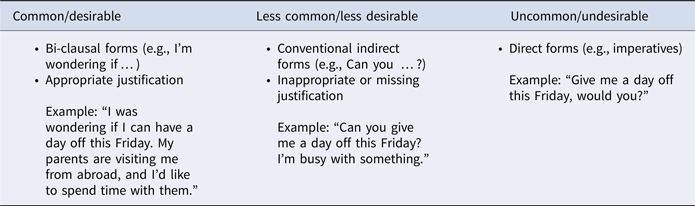
The game was designed to teach appropriate request-making forms in high-stake situations (making a high-imposition request to someone in higher power and larger social distance, e.g., asking a boss for a day off). Based on data collected from native English speakers and advanced learners of English (Taguchi, Reference Taguchi2012, Reference Taguchi2022), we identified expressions in three categories: common (and thus desirable), less common (less desirable), and uncommon (undesirable) (see below). The common/desirable forms were set as learning objectives of the game.
4.3. Game design
A Day on Campus involves ten request-making scenarios (along with eight filler scenarios) depicting common encounters with teachers, professors, employers, and friends in a university setting. Each scenario involves four phases:Footnote 1
-
Phase 1 – Scenario text: Each scenario starts with a short text describing the person, the situation, and the target request. A countdown timer appears on the screen, indicating 15 seconds for players to read the scenario.
-
Phase 2 – Scenario video: When the timer runs out, a video depicting the scenario automatically plays, setting up the encounter with the interlocutor at a specific location.
-
Phase 3 – Response choices: When the video ends, the screen presents four response options (request forms directed to the interlocutor in the video). Players are asked to choose the response option that they think is most desirable given the scenario. The most desirable option involves a bi-clausal request form and an appropriate justification for the request. There are two less desirable options, one involving a bi-clausal request form with no justification and the other involving a conventional indirect form (e.g., Can I … ?) with an inappropriate justification. The least desirable option involves a direct form (e.g., an imperative) with an appropriate justification.
-
Phase 4 – Feedback: After selecting a response option, players see their interlocutor's reaction in the video. When the player selects the most desirable option, the interlocutor accepts the request happily. When either of the two less desirable options is selected, the interlocutor reluctantly accepts the request. When the least desirable option is selected, the interlocutor appears upset and declines the request.
5. Digital game-based learning of request-making
Using A Day on Campus, we conducted three studies consecutively. The first study (Study 1) was exploratory in nature: it simply examined whether the perlocutionary effect (the interlocutor's reaction to the request form selected) as implicit feedback is effective, leading to improved knowledge of request-making. Building on this study, the second study (Study 2) was conducted to compare two feedback conditions for learning outcomes. The last study (Study 3) investigated the transfer of learning from the instructed speech act (request-making) to the uninstructed speech act (advice-giving) after playing the game. All studies were conducted in a university in China with L2 learners of English. In the following, I will present findings from these studies.Footnote 2
5.1. Study 1: Effectiveness of the perlocutionary effect as feedback
The first study addressed whether L2 learners of English gain their knowledge of request-making by experiencing perlocutionary effects of their linguistic choices in game-based instruction. Participants were 60 undergraduate students (native speakers of Mandarin Chinese) learning English at a university in China with the mean age of 18. There were 15 male and 40 female students (five students indicating non-binary gender identity). They each had about ten years of formal English study. Data were collected individually in a computer lab on campus over two days. On Day 1, participants filled out a background survey, completed the pretest, played the game, and completed the immediate posttest (all within one class session of 100 minutes). Two weeks later (Day 2), participants completed the delayed posttest, which took about 25 minutes.
Production and recognition tests were used for pre-post assessment of learning outcomes. Three parallel versions were created for pre, immediate post, and delayed posttest. The production test had seven open response items, of which four were target items eliciting a request and three were filler items eliciting other speech acts (e.g., apology, refusal). Each item presented a written scenario followed by a box in which participants typed in their speech acts. We used two scoring rubrics to evaluate responses, one for request forms and the other for request justification. For the request form, if participants produced a bi-clausal form (e.g., I wonder if you could … ), they received a full score of 3, while if they used a mono-clausal indirect form (e.g., Can you … ?), they received 2 points. If they produced a mono-clausal direct form (e.g., imperatives), they received 1 point. They received no points if their request form was incomprehensible owing to excessive grammatical and lexical errors. In terms of the justification, if they provided a sound reason to support their request, they received 2 points; a vague or inappropriate reason led to 1 point; an incomprehensible reason led to no points. Scores for the request form and justification were combined to yield a composite score (5 points max) (score range: 0–20 for four request-making items).
The recognition test had 16 multiple-choice items, of which eight were target request-making items. Each item had a written scenario and four answer options (e.g., desirable, less desirable, undesirable) from which participants selected the most appropriate response. The correct (most appropriate) response received 3 points, while the less and the least appropriate responses received 2 points and 1 point, respectively (score range: 8–24 for eight request-making items).
A repeated-measures ANOVA revealed a significant gain from the pre- to immediate posttest in both modalities (production and recognition), but the gain was not retained at delayed posttest. The findings indicate that the perlocutionary effect as a feedback mechanism worked well. After one session of gameplay, participants were able to improve their knowledge of request-making in both modalities. While completing in-game tasks, the learners received input, but they never produced output. Still, they improved their production of the target forms immediately after the game. However, their gained knowledge diminished at the delayed posttest two weeks later.
5.2. Study 2: Comparison of feedback conditions
Lack of lasting effect of instruction in Study 1 motivated the design of Study 2. We manipulated the feedback condition with a goal of producing a sustained effect. In the condition in Study 1, participants had only one chance to select a response (appropriate request-making forms) and view the interlocutor's reaction. We wondered whether the condition where participants can explore different response options and view different consequences may produce more robust knowledge, leading to long-lasting knowledge. In the latter condition, participants can see the contrast between desirable and undesirable options as well as different consequences of selecting one form over the other, which may result in better learning outcomes.
Study 2 tested this hypothesis. Two versions of the game were developed that differed only by one designed game mechanic. Version A allowed learners to see one single reaction from interlocutors after selecting one option from a set of request forms. In contrast, in Version B, learners were told to click different options and see the full range of interlocutor reactions. Learning outcomes between the two game versions were compared by using pre, post, and delayed posttest items (recognition and production tests), and scoring procedures were adopted from Study 1.
Contrary to our expectation, Version B did not bear greater learning outcomes. A repeated measures ANOVA revealed a significant effect of test session on both production and recognition test scores. Similar to Study 1, learners improved their knowledge immediately after playing the game, but they did not maintain their gains at the delayed posttest. Most importantly, there was no interaction effect between test session and game version. Essentially, both game versions had positive effects on learners’ knowledge of request-making. Learning outcomes were the same for those who had only one opportunity to select a response as those who were allowed to try out multiple options and view multiple reaction videos.
While the findings were surprising, we found some clues as to why the results turned out the way they did. We analyzed how often participants who played Version B actually clicked other options and viewed multiple reaction videos. We found that on average only 39% of the participants actually did so. After all, not all participants actually took advantage of the increased feedback opportunities in Version B. Instead, a majority of them moved quickly to the next scenario once they received positive or negative feedback and confirmed their chosen response. Perhaps those who played Version B did not find it engaging or meaningful to explore all the options and reaction videos. They might have become bored with the simple “click and watch” mechanic, particularly under the time pressure of 90 seconds in a laboratory setting. These results indicate further challenges of developing an engaging and motivating game for lasting effects.
5.3. Study 3: Metapragmatic knowledge and transfer of learning
The final study in this series stepped aside from the focus of digital game-based learning and explored under-studied topics in L2 pragmatics research – transfer of learning and the role of metapragmatic knowledge supporting the transfer. We examined whether learners develop metapragmatic knowledge of request-making via implicit feedback given in A Day on Campus and whether that knowledge relates to their performance of the instructed speech act (request-making) and a novel, uninstructed speech act (advice-giving).
Transfer of learned pragmatic knowledge is a forgotten topic. In our review of 77 instructional studies (Taguchi & Youn, Reference Taguchi, Ying and Qin2022), no studies have addressed whether learning one pragmatic feature can facilitate learning of another pragmatic feature. Yet, this question has great pedagogical value. If learning one pragmatic feature can help learn another pragmatic feature for free, instructors can use their class time efficiently. They can see connections among seemingly separate pragmatic features and teach pragmatics in a more comprehensive program.
Transfer of learning can be facilitated via metapragmatic knowledge. Metapragmatic knowledge is part of metapragmatic awareness, which refers to reflective awareness of pragmatic features and their meanings in context (Silverstein, Reference Silverstein and Lucy1993; Verschueren, Reference Verschueren2000; Lucy, Reference Lucy2004). Learners are considered to have metapragmatic awareness if they can articulate generalizable rules behind a pragmatic phenomenon (explaining what kind of forms are used in certain contexts and why). Metapragmatic awareness (or metapragmatic knowledge) may serve as the foundation that facilitates transfer of learning from one pragmatic feature to another. To test this hypothesis, Study 3 examined whether metapragmatic knowledge established in game-based instruction is related to learners’ knowledge of a targeted/instructed speech act (request-making) and a novel/uninstructed speech act (advice-giving).
We selected the speech act of advice-giving as the speech act for transfer because it is structurally similar to request-making. The bi-clausal structure in request-making (“I was wondering if you could … ”) also appears in advice-giving (“It'd be good if you could … ”) to mitigate the imposition of request or advice on the hearer (Martínez-Flor, Reference Martínez-Flor2006). In both speech acts, the speaker typically presents a solid justification supporting their request or advice so they can convince the listener that their request or advice is reasonable.
Participants involved 105 learners of English recruited from the same institution in Study 1 and 2 (mean age of 19; 38 males and 67 females). They had studied English for 11 years on average. Like Study 1 and 2, data were collected individually in a computer lab on campus. On Day 1, participants filled out a background survey and completed the pretest. On Day 2, they completed half of the game A Day on Campus. On Day 3, they completed the remaining half and then completed the metapragmatic knowledge survey, followed by the immediate posttest. Two weeks later (Day 4), they completed the delayed posttest.
There were two assessment measures, one for learning outcomes and the other for metapragmatic knowledge. Learning outcomes were assessed with a production and a recognition test. The test format was the same as those from Study 1 and 2, but this time, items were divided into request-making and advice-giving. Metapragmatic knowledge was assessed using an open-ended survey question. Participants were asked to write down what they thought they learned while playing the game in the language of their choice (Chinese or English). Their responses were scored using a six-point rubric on three areas: (1) form (whether they mentioned the importance of using bi-clausal forms when making a request), (2) justification (whether they mentioned the importance of providing a sound reason supporting their request), and (3) context (whether they mentioned specific contextual factors such as interlocutors’ relationship and social distance). Two Chinese-English bilinguals scored all responses. The composite score of all three areas was used for the final analysis.
While no gains were found in the recognition test scores (possibly owing to the ceiling effect), participants made significant gains in their productive knowledge of both speech acts immediately after playing the game. They were able to retain the knowledge of request-making two weeks later, but not the knowledge of advice-giving, as shown in the significant decrease of production test scores from immediate to delayed posttest. Finally, the participants’ metapragmatic knowledge significantly correlated with their test performance for both speech acts. These findings show that transfer of learning from instructed to uninstructed speech act did occur after game-based instruction. The findings also support the idea that metapragmatic knowledge established during instruction was related to the transfer (knowledge of advice-giving).
6. Conclusion
Among diverse options available in technology-enhanced language learning, digital games have gained growing interest for their potential to engage learners in contextualized, meaningful language practice (Reinhardt, Reference Reinhardt2019). In this lecture, I presented how game-based learning can be applied to pragmatics learning. I demonstrated the structure and design of A Day on Campus and showcased three studies that examined the effectiveness of the game for teaching pragmatics. While the studies were limited to one target language (English), one participant population (Chinese learners of English), and one pragmatic feature (the speech act of request), they revealed important findings and implications for future research.
1. Simulations of real-life feedback (perlocutionary effects, or the listener's reaction to the speaker's linguistic choice) embedded in the digital game had a positive effect on learning. The effect was strong enough to reveal cross-skill transfer of learned knowledge (input-based in-game practice leading to output of target pragmatic forms). Multimodal, just-in-time feedback probably made the input salient for learners, drawing their attention to the interlocutor's (non)verbal cues and prompting them to use those cues to re-evaluate the appropriateness of the forms they selected. Repetition of this process seemed to have led to positive learning outcomes. The findings are supported by one of the benefits of game-based learning. As Reinhardt (Reference Reinhardt2019) argues, games are designed to be played multiple times; repeated exposures allow more time for processing vocabulary and grammatical forms, leading to learning. The studies presented here proved it true in pragmatics learning.
However, the studies also showed that the effect of multiple exposures was short-lived. To produce a long-term effect, game design needs to be improved to enhance learner engagement. Although A Day on Campus incorporated several gamification features (e.g., point system, time pressure, multimodal feedback), these were probably not engaging or motivating enough for participants to devote their attention and time to game playing. Future research can add more gaming features to explore the connection between gamification and learner engagement. To do so, it is critical to collect data on learner perceptions of the game and incorporate their input into game design.
2. The feedback condition did not make a difference. More opportunities to explore different request expressions and view different reactions did not lead to greater learning. These findings need to be interpreted in light of the fact that only about 40% of the participants actually took advantage of the opportunities for more feedback. As stated above, future research is in order to explore what makes a feedback condition more playful and engaging. Such research can also address the lack of long-term effect of instruction found in these studies. Critics often say that educational games do not have much motivational appeal because fun and engaging mechanics in entertainment games are replaced by repetitive exercise-type mechanics (like the “click-and-watch” mechanic in our game) (Dixon et al., Reference Dixon, Dixon and Jordan2022; Loewen et al., Reference Loewen, Crowther, Isbell, Kim, Maloney, Miller and Rawal2019). How can we create an educational game that can achieve the same level of playfulness as their entertainment counterparts? To answer this question, researchers can explore different game mechanics and features to identify the feedback condition that can yield the most robust, long-lasting knowledge gains. For example, to encourage participants to review and explore alternative feedback more often, a playful gamification feature can be added (e.g., earning extra points upon reviewing different options).
3. Another important finding is the transfer of learning across different speech acts. Participants were exposed to request-making forms while playing the game. After the game, however, they not only improved on request-making forms but also on advice-giving forms that were never presented in the game. Also, metapragmatic knowledge of request-making established during the game positively correlated with the knowledge of both speech acts. These findings present two implications for future game-based learning. First, while learning objectives might be kept covert in educational games for entertainment purposes, researchers can encourage learners to reflect on what they learned during gameplay so games are played with learning outcomes in mind. Since a reflection could potentially lead to more robust, long-lasting knowledge, as suggested in Study 3's findings, it can be part of game design (e.g., receiving a reward upon appropriate reflection). Second, input, tasks, and specific behaviors occurring in a game need to be analyzed carefully to capture learning outcomes from a broader perspective. Educational games are often designed with narrowly defined learning objectives, but actual learning outcomes may transcend what was originally targeted. Creating a game is extremely resource-consuming both in terms of time and money. Future research can explore how to maximize learning opportunities in a single game.
To conclude, a growing number of studies have exploited benefits of digital games (e.g., multimodal input, rich contextual cues, simulations of real-life interactions in diverse social settings), delivering instructional materials through gamified environments. While the effectiveness and utility of games for pragmatics learning found to date are promising, challenges for future research remain. Echoing Tang (Reference Tang, Taguchi and Kadarin press), future researchers need to ask a critical question to push the current practice forward: What game design features and mechanics are engaging and motivating, and at the same time are conductive for pragmatics learning? The answer to this question remains in future collaborations among game developers, educators, and language learners.
Acknowledgement
I am grateful for Daniel Dixon, Ying Chen, and Yuqing Qin for their collaboration on the studies presented in this paper. My thanks also go to Lizzy Hanks for proof-reading this paper carefully. All the errors that may remain are mine.
Naoko Taguchi is Professor in the English Department at Northern Arizona University. Her research interests include second language pragmatics, technology-enhanced language learning, intercultural competence, and English-medium instruction. She is currently co-editing the Encyclopedia of Applied Linguistics, Area: Pragmatics. She is the co-editor of Applied Pragmatics.



