Introduction
A significant hole exists in our understanding of ancient Mesopotamian history and cultural development. Texts reveal that from approximately 1740–1460(?) b.c.e.,Footnote 2 the Sealand Dynasty (alternatively, the Second Dynasty of Babylon) ruled an unknown extent of southern Mesopotamia. However, a century and a half of archaeological exploration and excavation did not yield significant evidence for Sealand-era residence in any Mesopotamian city south of Nippur (Gasche Reference Gasche1989; Stone Reference Stone, Cuyler Young and Levine1977; Ur Reference Ur and Potts2012). Data suggested that major residential districts in the area's most prominent cities were largely abandoned (Stone Reference Stone, Cuyler Young and Levine1977: 285, although see Dalley Reference Dalley2009: 89). Early second-millennium b.c.e. housing areas at Ur, once the capital of southern Mesopotamia, were essentially vacated.Footnote 3
Southern Mesopotamia appears to have undergone a great ruralization in the second half of the eighteenth century b.c.e., probably due to changes in the flow of the great rivers that enabled urban life (Stone Reference Stone, Cuyler Young and Levine1977; Ur Reference Ur and Potts2012: 549). Perhaps as a result, Sealand deposits have proven extraordinarily rare. Until recently the dynasty itself has been known almost entirely from a limited number of texts: the Babylonian King Lists A and B, a Late Assyrian version of a Synchronistic King List, and 506 unprovenienced texts published by Stephanie Dalley in 2009. These latter texts record palace administrative and economic interactions, and do not allow scholars to pinpoint the dynasty's capital city (if any), its geographical extent, or its precise chronology.
In 2013, researchers at Tell Khaiber began to provide the first archaeological data from a substantial Sealand Dynasty settlement (Campbell, et al., Reference Campbell, Moon, Killick, Calderbank, Robson, Shepperson and Slater2017). Excavations in 2013–2017 focused on an immense public building, partially eroded but rich in finds including ceramics, animal bones, and one hundred and fifty tablets and tablet fragments (Campbell, et al. Reference Campbell, Moon, Killick, Calderbank, Robson, Shepperson and Slater2017; E. Robson 2017 pers. comm.). Additional work at three private houses recovered metal, ceramic and ground stone tools as well as assorted sheep, fish, and bird bones; intramural burials yielded metal jewellery (Campbell, et al., Reference Campbell, Moon, Killick, Calderbank, Robson, Shepperson and Slater2017).
These finds constitute the first published data about Sealand Dynasty cultural activities and economic practices not recorded in centralized administrative documentation. Their value is tremendous—but much, of course, remains to be learned. A single site cannot testify to life across southern Mesopotamia, and a preponderance of the Tell Khaiber evidence derives from an administrative context (Campbell, et al., Reference Campbell, Moon, Killick, Calderbank, Robson, Shepperson and Slater2017). Extraordinarily little remains known about Sealand Dynasty social and ecological practices (Dalley Reference Dalley2009; Koppen Reference Koppen2010; Lambert Reference Lambert1974; Roaf Reference Roaf1990:123). Ceremonial activities are likewise poorly understood.
In December to January 2011–2012, Drs. Elizabeth Stone and Paul Zimansky led a five-week field season at the low mound of Tell Sakhariya in southern Iraq, recovering ceramics that date most of the site's occupation to the Sealand period.Footnote 4 The data recovered from Sakhariya provide new archaeological insight into the mysterious dynasty in its homeland of southern Mesopotamia, and Sakhariya's faunal remains provide as-yet unique insight into key aspects of Sealand life.
Of particular interest are the ritual activities reflected in Sakhariya's faunal assemblage, as the site appears initially to have been a religious pilgrimage destination, and later perhaps a campsite for marsh nomads seeking dry ground during the flood season. The animal bone evidence derives almost entirely from the site's later, “campsite” occupation(s). It nonetheless suggests multiple forms of ritual activity at Sakhariya, and perhaps dog symbolism akin to that seen in contemporary and later southern Mesopotamian dynasties.
Sakhariya
Sakhariya is situated in the hot and arid lower Mesopotamian plain. At the time of its occupation, Sakhariya lay relatively near the marshes of southern Iraq. These marshes, which once constituted the largest wetland ecosystem in western Eurasia, advance and retreat seasonally as huge quantities of meltwater flow down the Euphrates river system from the Anatolian highlands (UNEP Partow Reference Partow2001). Sakhariya thus probably lay in a broadly mosaic environment, variably close throughout the year to deserts, marshlands, and croplands irrigated with canals bordered by groves of date palms. The site's animal remains are consistent with this inference, indicating that the people who came to Sakhariya consumed animals occupying marshes or canal edges (e.g., pigs/boars) as well as species resident in the steppes or deserts (e.g., gazelles).
Sakhariya was excavated because Zimansky and Stone wanted to investigate a small site and assess its relationship with a nearby urban centre, as a dearth of Mesopotamian small-site excavations is incongruent with the abundance of villages reported in Mesopotamian texts.Footnote 5 They selected Ur as their urban centre on the basis of its extensively excavated habitation areas dating to the early second millennium b.c.e., a time period with a relatively rich textual corpus. They used high-resolution satellite imagery to identify a promising small settlement seven kilometres away from Ur. After ground-truthing revealed that the site postdated their desired time period, they selected a different low mound, also seven kilometres to the northeast of Ur. Kassite and Old Babylonian ceramics littered this site's surface and satellite imagery suggested the buried remains of a square building. This site, which Wright called Tell Abu Ba'arura Shimal, they renamed Tell Sakhariya (Wright Reference Wright and Adams1981: 339, Zimansky and Stone Reference Zimansky, Stone, Kaelin and Mathys2016).
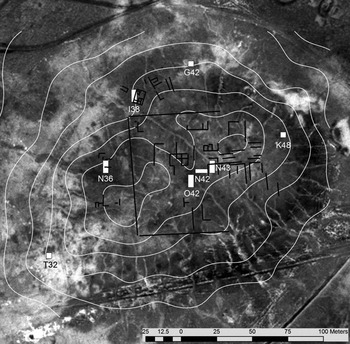
Stone and Zimansky's survey and excavation team arrived on site in December 2011. Once there, they were surprised that no sub-surface domestic architecture was revealed in their surface and magnetic gradiometry surveys. In the absence of buildings around which to focus excavation, the Sakhariya team excavated a series of dispersed 5 × 10 metre trenches across the low mound (Fig. 1). A skim of topsoil and burials containing Late Kassite remains lay across the top of the site; below that the occupation proved broadly divisible into two periods.
Plan of Tell Sakhariya excavations. Black lines represent ancient walls visible in satellite imagery. White lines are 50 cm contour intervals. White rectangles are excavation areas. G42, T32, and K48 on the sides of the mound yielded mostly slope wash; their assemblages are not discussed here. Image courtesy of Elizabeth Stone and Paul Zimansky

Just below the topsoil and its Late Kassite sherds were Sealand Dynasty deposits reflecting repeated brief occupations by transient, probably marsh-dwelling populations. These groups left behind ashy pits containing ceramic, lithic, metal, floral and faunal remains, but no substantial architecture.
The second, earlier occupation also lacked associated domestic architecture, but it featured at least one huge, high, hard mud or clay platform. (The material of the platform was recovered at precisely the same elevation in two trenches located fifty-five metres apart; the intervening area was not dug.) Part of this platform, which was constructed of sterile clay, overlay a small, square, baked brick pavement. Possibly contemporary with the clay platform was a broad area of clean silt with a brick drain or channel at its base. Stone and Zimansky speculate that it might represent the remnants of a constructed carp pond, perhaps in a garden.Footnote 6 Perhaps significantly, an inscription on a brick of Ur-Namma (c. 2112–2095 b.c.e.), found out of context in a separate excavation trench, describes the construction of a garden and a pedestal.
This inscribed brick proved to be one of several pre-Sealand royal inscriptions recovered during the five-week excavation season. The team also found four other fragments of brick inscriptions; three clay cones (one from Rim-Sin, another from the preceding Ur III period, and a third as yet undated); and two Sumerian tablets, one of which can be dated to year 28 of Shulgi's reign (c. 2022 b.c.e.). This multiplicity of inscriptions is remarkable for such a tiny site. Their presence, as well as that of one or perhaps more clay platforms, indicate that Sakhariya was an important place in the preceding Ur III to Isin-Larsa periods.
Stone and Zimansky believe Sakhariya to have been a ceremonial site called Ga'eš, where the kings of nearby Ur celebrated the great autumn and spring Akiti festivals (Sallaberger Reference Sallaberger1993: 170–171; Zimansky and Stone Reference Zimansky, Stone, Kaelin and Mathys2016). Sakhariya's location accords with previous scholars’ textual inferences regarding Ga'eš’s location; Sakhariya lacks standard southern Mesopotamian architectural evidence of domestic life; Sakhariya's platform is a plausible support for a house or temple akin to that recorded for the Akiti festivals; and the inferred garden at Sakhariya may be associable with the pleasure gardens of the textually known en-priestess of Nanna's palace. The pre-Sealand-era inscriptions on clay bricks and nails—none of which was found in a primary context—derive from lost structures whose materials became redeposited around the site during the Sealand occupation (Zimansky and Stone Reference Zimansky, Stone, Kaelin and Mathys2016). This interpretation accords well with textual evidence for royal building activity at Ga'eš from the Ur III to the early Old Babylonian, after which Ga'eš disappears from the written record (Zimansky and Stone Reference Zimansky, Stone, Kaelin and Mathys2016).
Assuming that Sakhariya was Ga'eš, at the peak of its use the site would have been populated for perhaps a week or so twice a year, at the spring and autumn equinoxes. Only the en-priestess, perhaps the king, and their attendants might have stayed longer. Ceramics indicate that the Sealand-era occupations excavated in 2011–12 postdate Sakhariya's Ur III and Old Babylonian heyday as a pilgrimage destination. They do not clarify whether the Sealanders who camped at the site valued it primarily for its religious significance or were simply marsh-dwellers seeking high ground during annual inundations. I sought, therefore, to evaluate what if any ritual activities are reflected in the Sakhariya/Ga'eš faunal assemblage. I paid particular attention to, first, evidence for ceremonial performances such as sacrifices or animal burials. Such activities are potentially reflected in a predominance of taxa associated in the texts with ritual activities, and/or in body part distributions and/or taphonomic patterns reflecting interments or animal sacrifice (Russell Reference Russell2012: 66–67, 73–79, 88–127). I also examined evidence for ritualized group activities such as mass commensality (feasting). Such activities are potentially reflected in body part distributions and/or taphonomic patterns (Twiss Reference Twiss2008: table 1).
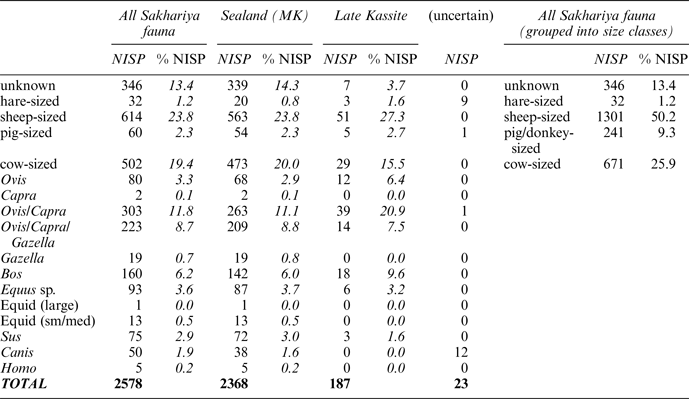
Taxonomic proportions at Tell Sakhariya

The size classes listed in the columns on the right incorporate all sizeable remains, including speciated ones: e.g., “sheep-sized” includes elements speciated to Ovis, Gazella, etc. Homo is not included in the size class groupings. The ratio of equid remains identified during analysis as Large Equid (i.e., horse-sized) to those identified as Small-Medium Equid (i.e., donkey-sized) is 1:13; the 93 equid specimens that were not directly identifiable to size class are here allotted into the Cow-sized and Pig-sized categories following that ratio.
The Sakhariya/Ga'eš faunal assemblage: an overview
Sakhariya's recorded mammalian assemblage comprises 2,578 fragments: 2,368 Sealand specimens, 187 Late Kassite specimens, and 23 that cannot be assigned to either period ( table 1).
These specimens were almost entirely handpicked. To their dismay, Sakhariya's excavators found that a sieve they had had constructed in the local village could not be emptied once filled, and the security situation in southern Iraq that winter precluded them from going into town to explain to the local metalsmith what they needed. Flotation samples generally appear to have been handpicked prior to floating as well, so they cannot be used to estimate original taxonomic proportions in the handpicked bags. As a result, animals sheep-sized and smaller are indubitably under-represented, and the smaller the animal, the likelier that its remains were overlooked.
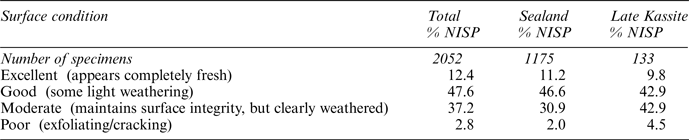
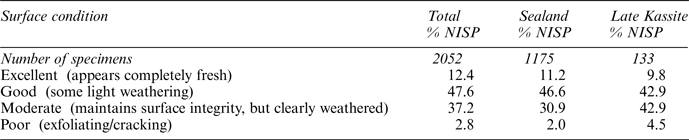
Most of the bones display good-to-excellent surface conditions ( table 2). Only nine bones (0.3%) show traces of carnivore gnawing; there is no rodent gnawing. Five percent of specimens (n = 183, 5.2%) are burned, mostly (n = 151) to high temperatures and across the entire specimen (i.e., in a manner not reflecting meat cookery). The low levels of burning are also inconsistent with incineration of trash as a standard discard practice. It appears that throughout time at Sakhariya animal carcasses and meal remnants generally were buried, and quickly; bones were not left lying around for dogs to gnaw or the sun and wind to weather.
Bone surface conditions at Sakhariya
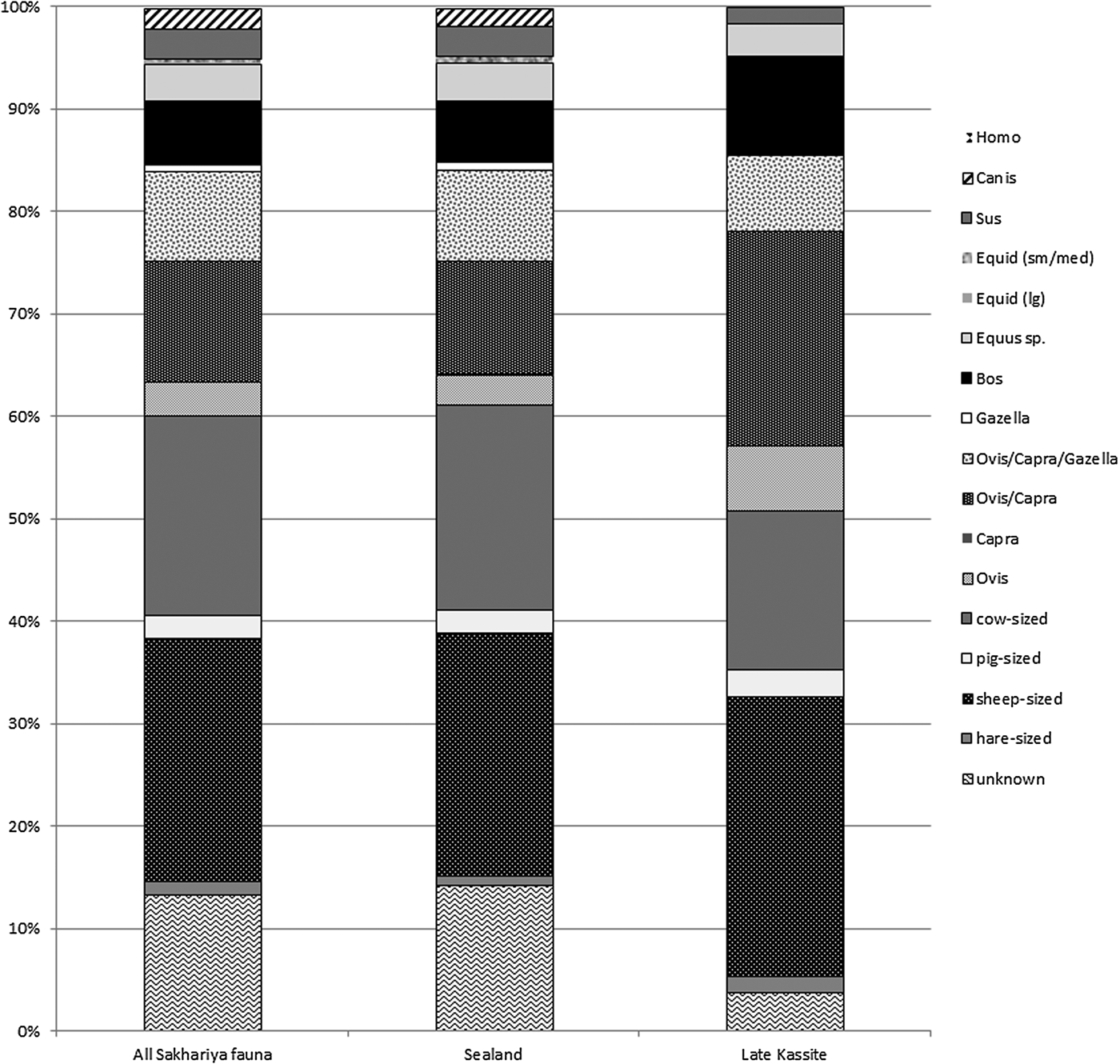
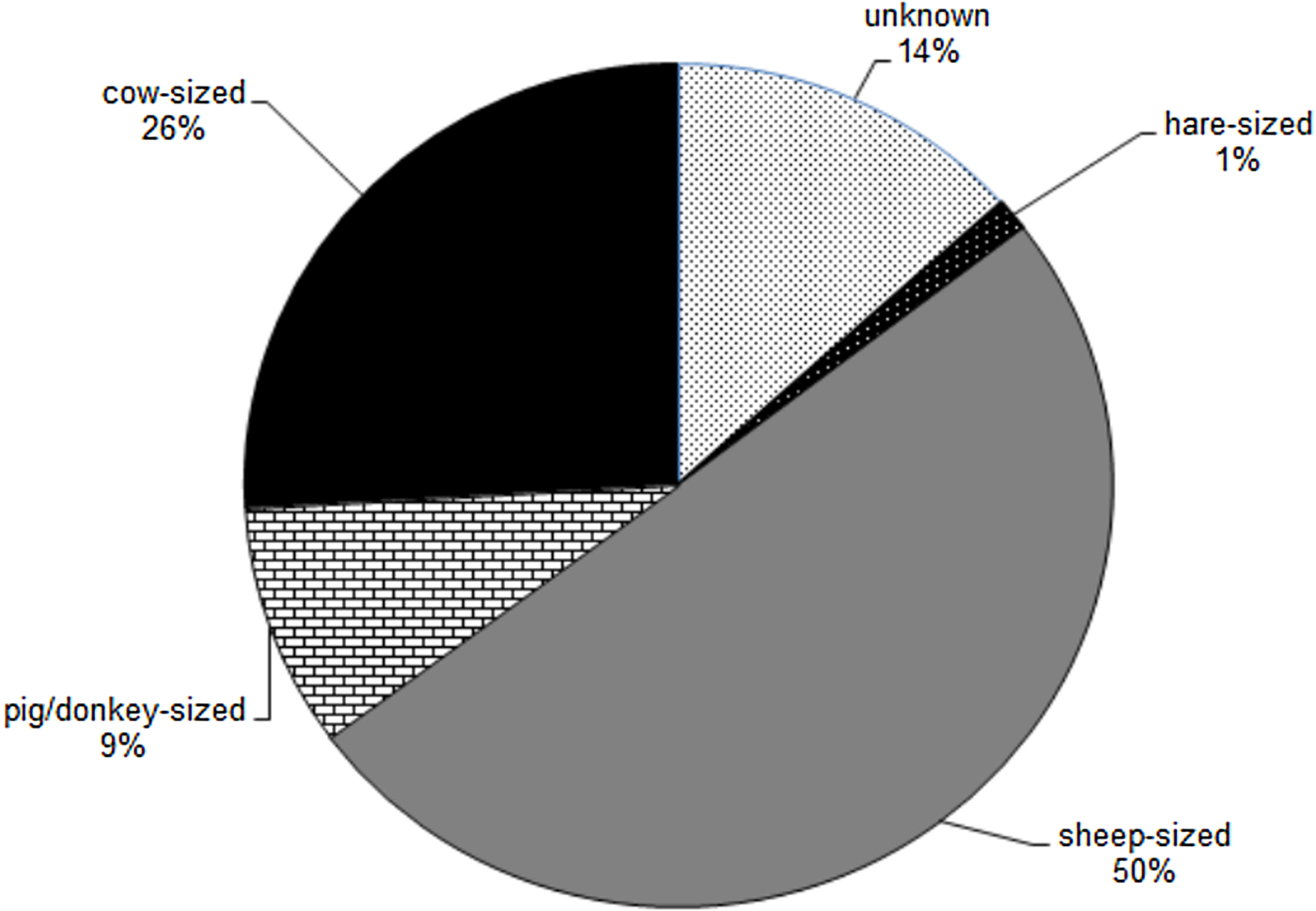
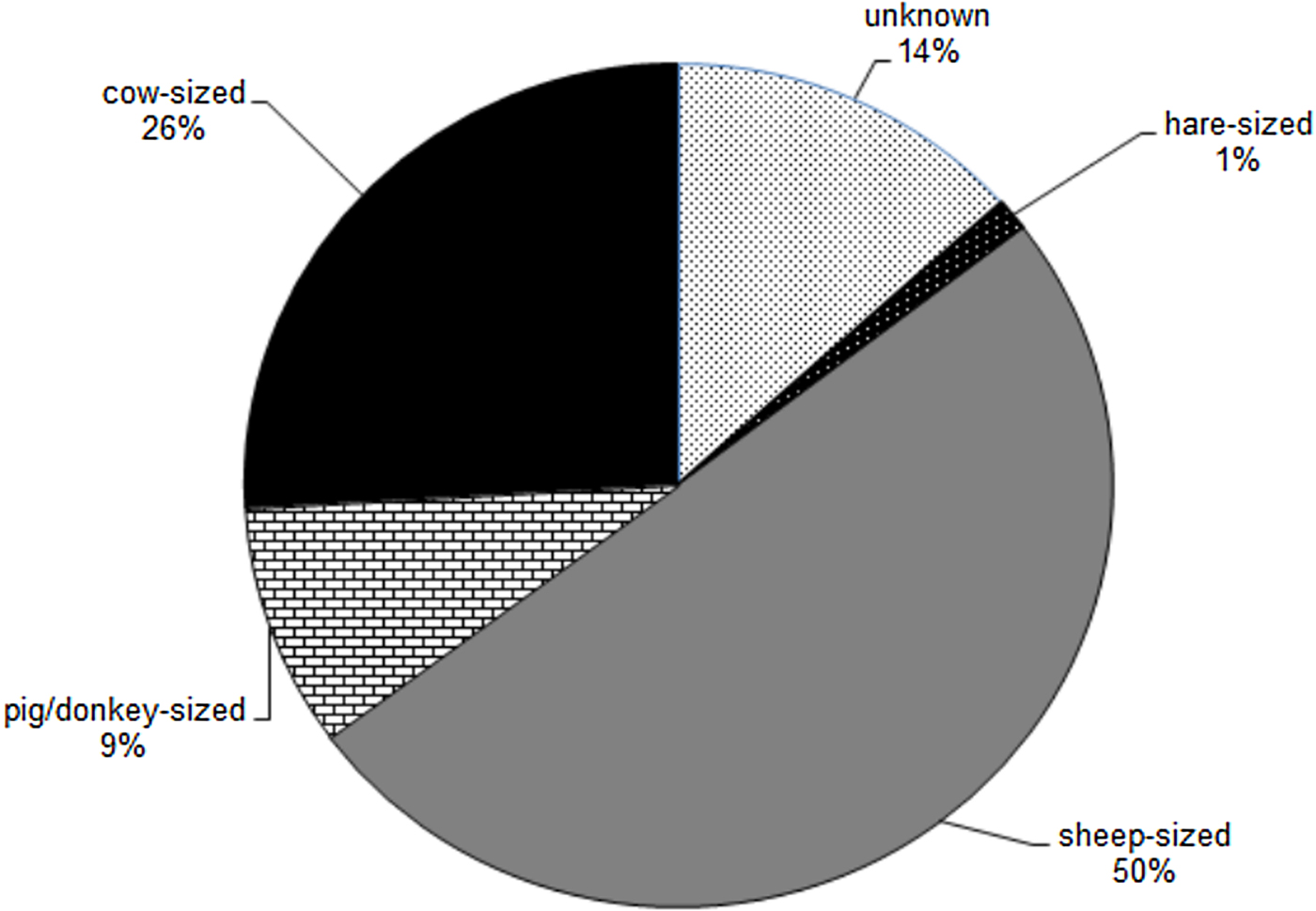
Caprines dominate the Sakhariya fauna (38% of specimens assigned a taxon, NISPFootnote 7 = 385; a sizable majority of the additional 22% identified as caprine or gazelle are undoubtedly sheep/goat). They are followed by cattle (16%; NISP = 160), equids (10%; NISP = 107), pigs (7%; NISP = 75), and dogs (5%; NISP = 50; table 2, Fig. 2). The preponderance of caprines is particularly apparent when one looks at the data by animal size class (Fig. 3). Taxonomic proportions vary only modestly between periods. Indeed, the apparent differences are probably mostly due to sampling bias in the small Late Kassite assemblage.
Taxonomic proportions at Sakhariya

Proportions of animal size classes at Sakhariya
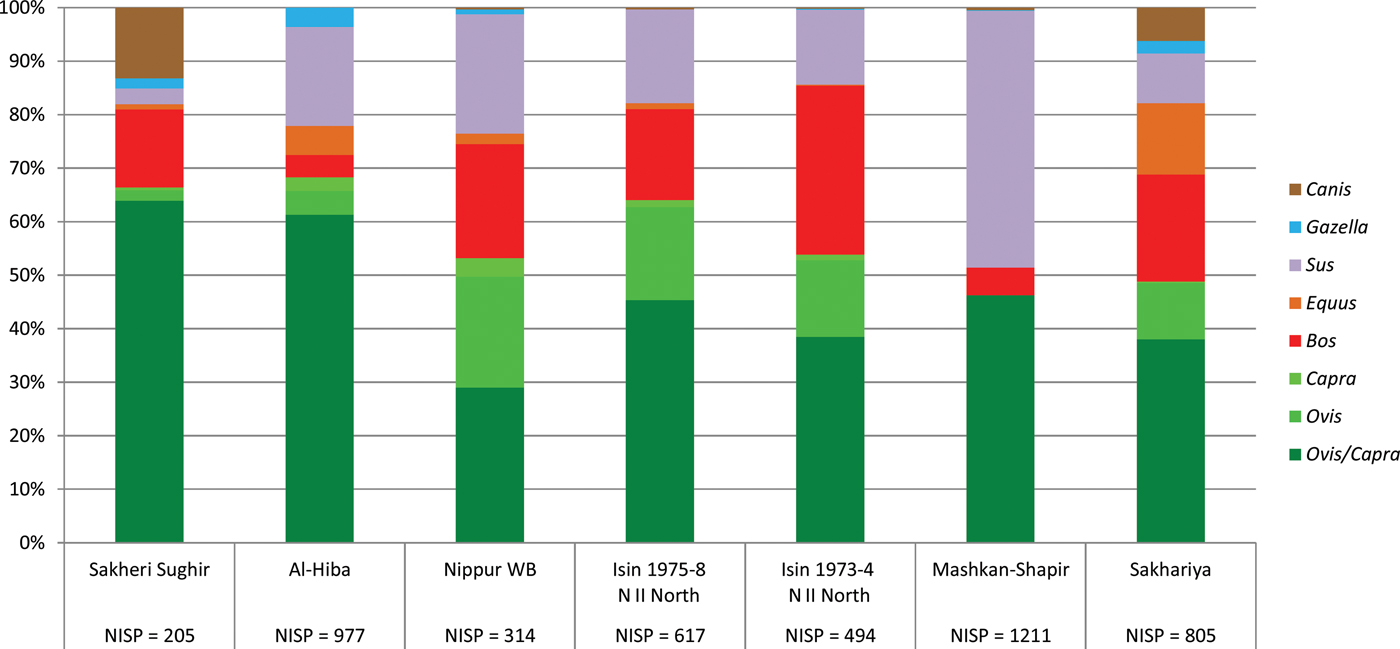
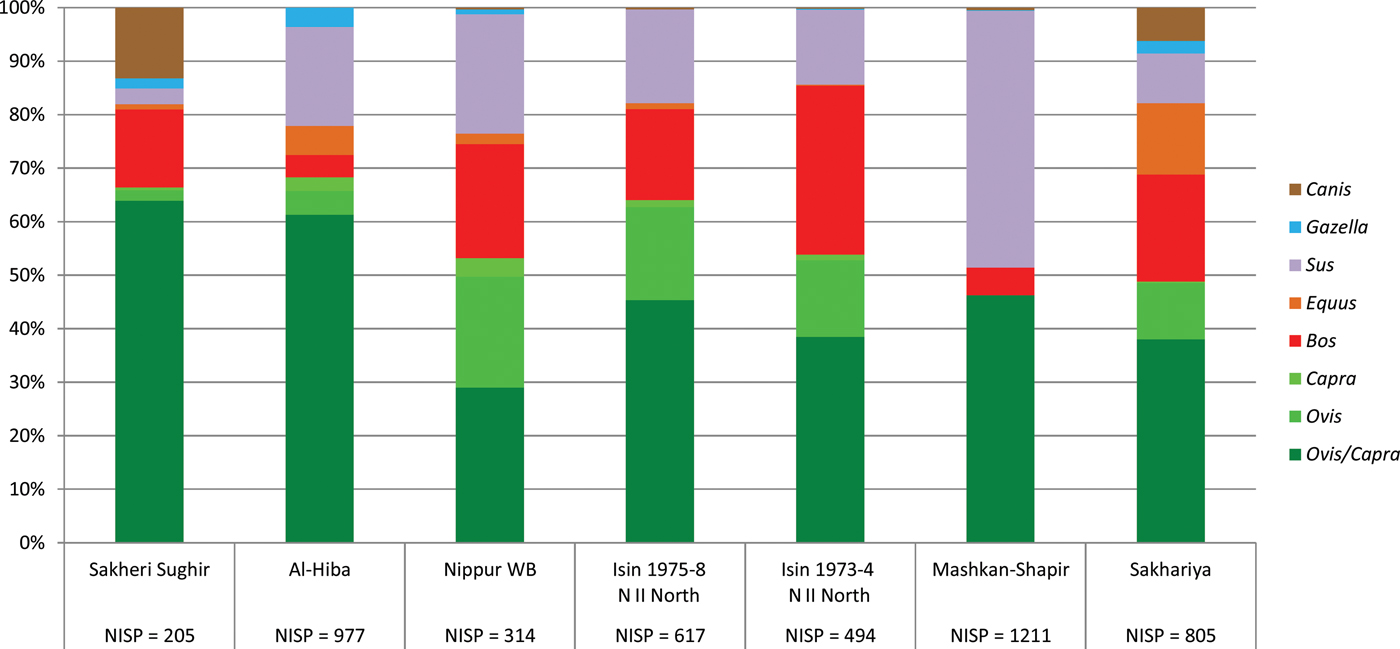
Sakhariya's high proportions of cattle (16% of specimens assigned to taxon; cattle-sized bones comprise 26% of the total assemblage) are surely due in great part to the lack of sieving. Some but not all similarly hand-picked assemblages from previous excavations of second-millennium b.c.e. sites in southern Mesopotamia contain comparable proportions (Fig. 4): Bos comprises 4% of the assemblage at al-Hiba, 5% at Mashkan-Shapir, 16% at Sakheri Sughir, 17–32% in relevant levels at Isin II North, and 21% at Nippur WB (Boessneck Reference Boessneck and Hrouda1977a; Reference Boessneck and Hrouda1977b; Reference Boessneck and Gibson1978; Boessneck and Kokabi Reference Boessneck, Kokabi and Hrouda1981; Bökönyi and Flannery Reference Bökönyi, Flannery and Wright1969; Mudar Reference Mudar1982; Redding Reference Reddingunpublished). It is certainly possible that differential recovery across the sites accounts for the variations, but it is also possible that Sakhariya's inhabitants relied more heavily on cattle than did some permanent settlements.
Comparative faunal taxonomic proportions at second-millennium b.c.e. southern Mesopotamian sites. Data from Boessneck (Reference Boessneck and Hrouda1977a; Reference Boessneck and Hrouda1977b; Reference Boessneck and Gibson1978), Boessneck and Kokabi (Reference Boessneck, Kokabi and Hrouda1981), Bökönyi and Flannery (Reference Bökönyi, Flannery and Wright1969), Mudar (Reference Mudar1982), Redding (Reference Reddingunpublished.) ED = Early Dynastic; OB = Old Babylonian. Mudar (Reference Mudar1982: 28) also reports “several” unspeciated canid bones at al-Hiba. Sakheri Sughir and al-Hiba are Early Dynastic sites; Nippur, Mashkan-Shapir and the Isin levels presented here are Old Babylonian/Isin-Larsa
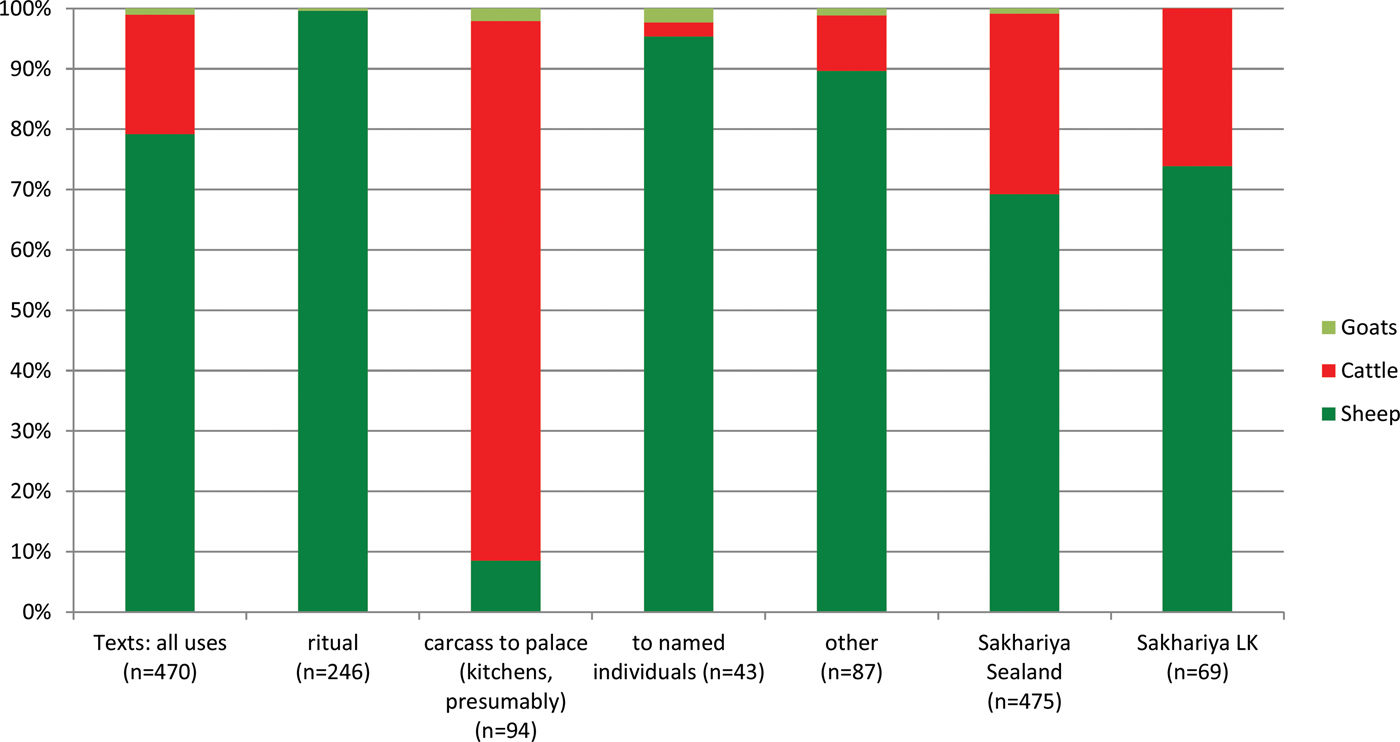
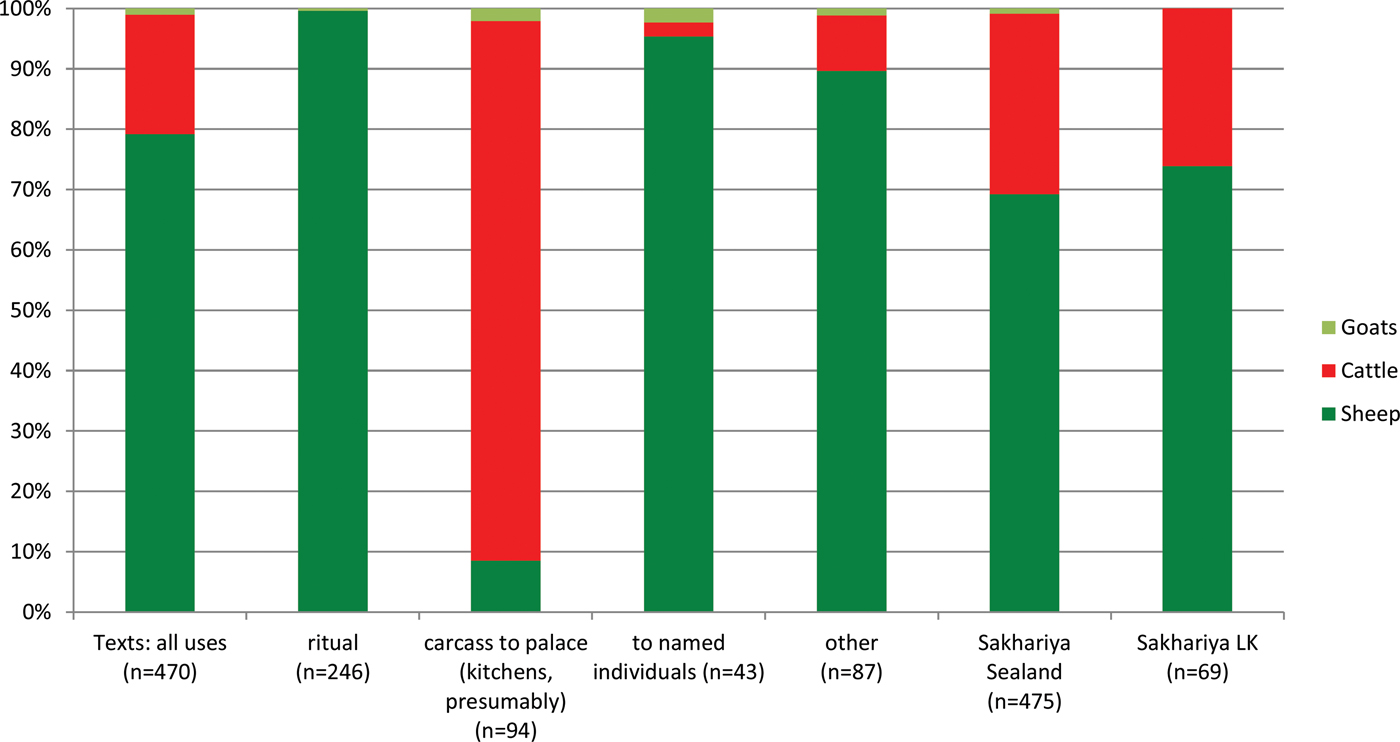
This possibility is interesting because Dalley's (Reference Dalley2009) unprovenienced texts associated with the Sealand Dynasty indicate that sheep were needed for sacrifice, whereas the vast majority of cattle were delivered to at least palatial consumers as carcasses (Fig. 5). Similar patterns of usage are recorded in other Mesopotamian eras as well (Postgate Reference Postgate1992 (2002): 163, Scurlock Reference Scurlock and Collins2002: 391, 397). Sakhariya—a site once (and perhaps continuingly) dedicated to ritual activity—might thus have consumed proportions of ritually useful vs relatively mundane animals similar to those seen in some cities. Indeed, its occupants might have consumed higher proportions of prosaic animals than did the residents of other cities. This inference is not certain, though: the higher proportions of cattle might indicate that meals at Sakhariya were often shared by relatively large groups of people; that cattle had ritual uses not recorded in the Sealand-era texts; or assorted other possibilities.
Inferences regarding cattle and sheep usage from Sealand texts (Dalley Reference Dalley2009) compared with faunal data from Sakhariya. This chart accepts all of Dalley's inferences about textual content. The “Sheep” numbers for Sakhariya were calculated as follows: (1) the NISP of Ovis remains, plus (2) a proportion of Ovis/Capra remains based on the ratio of Ovis to Capra remains in the broader assemblage (i.e., the Sealand assemblage contained two Capra and 68 Ovis, so 68/70ths of the Sealand Ovis/Capra remains were assumed to be Ovis and used in this chart; 2/70ths were assigned to Capra)
Animals and ritual in the Sakhariya faunal assemblage: dogs and the goddess Gula
For the goddess Ninisina [a goddess identified with Gula], his lady: Enlil-bani… mighty king, king of Isin, king of the land of Sumer and Akkad… built for her the Eurgira (‘Dog House’) (Frayne Reference Frayne1990: E.4.1.10.04)
Dogs were the sacred animals of Isin's patron deity, the healing goddess Gula, or “the Lady of Isin.” Gula's temple at Isin was known as the Dog House, or Temple of the Dog. She was depicted with—or as—a dog from the Old Babylonian through the Neo-Assyrian/Neo-Babylonian periods (Ornan, Reference Ornan2004). Dog figurines often bore prayers or dedications to Gula; uninscribed dog images were likewise for her; people swore oaths by Gula's dog and Gula punished those who mistreated her chosen animal (Böck Reference Böck2014; Ornan Reference Ornan2004). Surely, therefore, the 33 dog burials recovered at post-Kassite (ca. 1050 b.c.e.) Isin from the ramp leading to a temple represent ritual activity connected with the Lady of Health (Böck Reference Böck2014; Boessneck Reference Boessneck and Hrouda1977a).
At Sakhariya, excavators recovered a pair of complete canid forelimbs (surely articulated in the ground) that represent 38 of the site's 50 dog bones. If one excludes this “burial” then Sakhariya's canid proportions are roughly in line with what has been reported at other second-millennium b.c.e. southern Mesopotamian sites, where canid remains constitute less than 1% of all fauna (Fig. 4).
Sakhariya's articulated canid remains predate those of Isin by several centuries, but might they also represent Gula-related rituals? Of the 506 Sealand texts published by Dalley (Reference Dalley2009), nine mention Gula's name, which indicates that the goddess had at least theoretical religious significance for the dynasty.Footnote 8 Meanwhile, multiple archaeological lines of evidence indicate that Gula was an important deity for the Sealand-contemporary Kassites. Seidl (Reference Seidl1989) states that Gula and her dog were notably popular iconographically on Kassite kudurrus, which were stones inscribed with land grants or sales as well as symbols of the deities guaranteeing the transactions; Gibson (Reference Gibson1990) reports multiple dog figurines from behind the wall of Gula's temple at Late Kassite-era Nippur, as well as a bronze dog necklace pendant. Therefore, while one cannot be sure of the Sakhariya dog's meaning, ritual canid burial is plausible.
One final note with regards to the possibility of canid burial at Sakhariya: rituals involving dogs were primarily associated with Gula (and closely associated/syncretized goddesses), but Gula is not the deity primarily associated with the Akiti festivals of Ga'eš. The moon god Nanna (aka Suen or Sîn) was the god of Ga'eš, to the extent that the whole site was sometimes called by the name of the temple of Nanna located there (Zimansky and Stone Reference Zimansky, Stone, Kaelin and Mathys2016). Gula ceremonialism in Nanna's site is not an interpretive problem—indeed, gods are known to have “visit[ed] their friends and relatives” (Postgate Reference Postgate1992 (2002): 124). It simply suggests that multiple deities may have been worshipped at Ga'eš, at least after the heyday of the site as a pilgrimage destination. It is almost certainly pushing the data too far to link Sakhariya's moderately high proportions of cattle to the fact that Nanna's primary animal was the bull.
Feasting
At least some meals at Sakhariya appear to have involved large-scale food sharing (feasting), based on the recovery of large pieces of bone and some extensive articulations. Particularly noteworthy is a single deposit (958) that included a cattle forelimb from the distal humerus down through at least the metacarpal and a cattle spinal segment of eight sequential thoracic vertebrae, as well as what was probably once a complete equid femur, the distal end of a cattle femur, much of a cattle scapula, a cattle mandible, and assorted smaller fragments representing cattle, equids, caprines, pigs and fish. Interestingly, this potential feasting deposit derives from one of the ashy pits, rather than from an earlier context more easily associated with ceremonial activities.
Talismans or raw materials?
The only horn cores identified at Sakhariya are those of gazelles, and one of these has clearly visible chop marks around its base, although there are no other signs of modification or use. Gazelle horns are reported at multiple southern Mesopotamian sites dating from the Early Dynastic to the Old Babylonian periods, including al-Hiba (mid-third millennium b.c.e. levels) and Isin (early second millennium b.c.e. levels) (Boessneck Reference Boessneck and Hrouda1977b: 115; Mudar Reference Mudar1982), and a relief carving from 14th–12th century b.c.e. Meskene-Emar may depict a gazelle horn core (Moorey Reference Moorey1994: 112). Moorey (Reference Moorey1994) states that the horns are generally thought to have been from gazelles hunted for food, while Mudar (Reference Mudar1982) notes that they may have been used as material for tools. It is also possible that gazelle horns had some unknown symbolic significance, as has been reported among modern southern Iraqi marsh-dwellers. According to Nasiriya-born archaeologist Abdulameer al-Hamdani, “the use of [gazelle] horns as a symbol against evil spirits and envy is common among people in the marshes. For example, I have seen in the 1970s that my grandmother, and others in our village (al-midag) in the marshes (namely Hawr al-Hammar), used to hang horns in front of reed houses to ward off evil spirits”.Footnote 9 Such talismanic use is not Islamic in origin, and conceivably derives from far earlier ideology.
Conclusions
The Sakhariya faunal assemblage derives from a site once used for religious festivals. The extent of ceremonial activity conducted at Sakhariya after its Ga'eš heyday is uncertain, but faunal evidence points clearly toward large-scale food sharing (plausibly feasting). It may also reflect religious activities involving dogs. These activities parallel ritual practices prominent in both earlier and later southern Mesopotamian dynasties.
The Sealand occupants of Sakhariya may have been marsh-dwelling nomads, religious pilgrims from nearly farming settlements, and/or some other group(s). Whoever they were, they both herded and hunted their meat; exploited the desert, the sown, and the marshes; and kept their campsite clean of garbage. Daily meals might have been small or perhaps shared among only a few people, but at least periodically the Sealanders of Sakhariya gathered and shared hefty quantities of meat. Our knowledge of Sealand Dynasty life remains extraordinarily sparse, but basic inferences such as these can now be made using real data rather than mere assumption. The situation is likely to improve still further in the near future, as additional data emerge from the Tell Khaiber project (Campbell, et al., Reference Campbell, Moon, Killick, Calderbank, Robson, Shepperson and Slater2017). At last, the Sealand-shaped hole in Mesopotamian cultural history is being filled.