Speech perception reflects listeners’ linguistic experience at a variety of levels of sound structure. Listeners’ responses to their experiences can be seen in perceptual repair of sounds and sound sequences that do not conform to the patterns in the speech they have been exposed to (e.g., Dupoux, Kakehi, Hirose, Pallier & Mehler, Reference Dupoux, Kakehi, Hirose, Pallier and Mehler1999; Flege, Reference Flege, Schiller and Meyer2003). For example, words with initial /s/-consonant clusters (#sC) are plentiful in English (e.g., snob), but illicit in Spanish. This leads Spanish-speaking listeners to perceive #sC sequences as beginning with a prothetic [e] (e.g., perceiving snob as esnob; Cuetos, Hallé, Domínguez & Segui, Reference Cuetos, Hallé, Domínguez and Segui2011; Hallé, Dominguez, Cuetos & Segui, Reference Hallé, Dominguez, Cuetos and Segui2008). This ‘repairs’ the sound sequence in that the resulting percept (/esC/) is licit in Spanish. But what perceptual repairs occur when an individual's experiences exert different or conflicting influences, as is often the case for bilinguals? In English #sC is perfectly acceptable – how do bilingual users of Spanish and English navigate these conflicting patterns?
It is possible that bilinguals simply avoid the conflict. This could arise if bilinguals process speech according to their native or dominant system alone; alternatively, they could completely separate their two linguistic systems, allowing them to deploy one native-like pattern at a time. However, at the level of individual speech sound categories, a large body of evidence suggests that these alternatives are too extreme. Bilinguals can acquire multiple, distinct sound systems (e.g., Altenberg & Cairns, Reference Altenberg and Cairns1983; Gonzales & Lotto, Reference Gonzales and Lotto2013), but those systems can exhibit evidence of integration and mutual influence. Sound categories in a second language reflect properties of the first (Best, Reference Best and Strange1995; Flege, Reference Flege, Schiller and Meyer2003; Kuhl, Reference Kuhl2000), and acquisition of a second language can reshape the category structure of the first (Caramazza, Yeni-Komshian & Zurif, Reference Caramazza, Yeni-Komshian and Zurif1974; Flege & Eefting, Reference Flege and Eefting1987). Bilinguals also show evidence of hybridity in their phonotactic systems (constraints on possible sequences of sound categories; e.g., #sC is not found in Spanish) in that the acceptability of specific sequences in one language can be boosted by their acceptability in the other language (Anisfeld, Anisfeld & Semogas, Reference Anisfeld, Anisfeld and Semogas1969; but see Altenberg & Cairns, Reference Altenberg and Cairns1983).
Here, we build on this work by exploring the perceptual consequences of knowing contrasting phonotactic systems. This allows us to examine how crosslinguistic differences in higher-order linguistic knowledge (beyond individual speech sounds) shape the adaptation of acoustic information. We compare speech perception in Spanish across three groups of fluent Spanish speakers, from near-monolinguals to English-dominant bilinguals. To the extent that language-specific phonotactic systems interact – and that the relative strength of each system in such interactions reflects listeners’ experience – we expect a graded reduction in the perceptual repair of #sC sequences associated with greater knowledge of English.
These bilingual populations allow us to capitalize on the aforementioned contrast between Spanish and English, with demonstrated consequences for speech perception in Spanish. Namely, words with #sC are plentiful in English (e.g., sports, stem, school), but illegal in Spanish. We surveyed the SUBTLEX corpora for English (Brysbaert & New, Reference Brysbaert and New2009) and Spanish (Cuetos Vega, Glez Nosti, Barbón Gutiérrez & Brysbaert, Reference Cuetos Vega, Glez Nosti, Barbón Gutiérrez and Brysbaert2011) and found that nearly 6% of word types in English begin with #sC, but only 16 words (< 0.02%) in the Spanish corpus did, all of foreign origin (e.g., Spiderman). By contrast, both languages include a comparable proportion of words beginning with #sV (5% in English, and 6% in Spanish). Where loanwords with #sC are added to Spanish, they are typically repaired via the addition of a prothetic /e/, splitting the cluster by syllabifying the /s/ as a coda (Harris, Reference Harris1983; Hooper, Reference Hooper1976): English snob became Spanish esnob. The influence of this phonotactic constraint in Spanish is also evident in widespread prothesis in Spanish-accented English, e.g., sports → [es]ports, school → [es]chool (in fact, one of our participants reported her first language as “espanish” in the written language background questionnaire). Interestingly, while this repair strategy instantiates a pattern that is otherwise common in Spanish, i.e., #VsC, accounting for about 3% of word types, this pattern is rare in English, accounting for only about 0.5% of word types. Thus, English not only permits #sC, the prohibited sequence in Spanish, but it favors this sequence over #VsC, the preferred Spanish repair.
Crucially, the treatment of #sC in Spanish leads to perceptual repair when tokens with #sC are encountered. Cuetos et al. (Reference Cuetos, Hallé, Domínguez and Segui2011) – whose methodology we adopt for Experiment 1 – found that Spanish speakers reported hearing /e/ nearly 60% of the time in #sC nonwords. Speakers of French, which, like English, allows #sC sequences, did not report hearing any illusory vowel. When a brief interval of /e/ was left at the onset of the stimuli, the Spanish speakers increased their reporting of initial /e/ to 70%, but, interestingly, even when the brief initial vowel was /a/, they still reported hearing /e/ over 30% of the time. However, neither Spanish nor French participants reported hearing initial /a/ when the vowel was absent or when a brief interval of /e/ was included. This asymmetry in the results links the illusory vowel to the Spanish repair strategy: prothetic /e/. A similar asymmetry in perceptual repair was found in a lexical decision study using masked visual primes that were missing their initial vowel (Hallé et al., Reference Hallé, Dominguez, Cuetos and Segui2008).
These findings parallel other languages where disfavored phonotactic sequences are perceptually repaired using language-specific repair strategies. Japanese and Brazilian Portuguese, for instance, have a similar constraint disallowing consonant clusters, but perceptual repair of such clusters by speakers of these languages matches the epenthetic vowel specific to each language, /u/ in Japanese, and /i/ in Brazilian Portuguese (Dupoux et al., Reference Dupoux, Kakehi, Hirose, Pallier and Mehler1999; Dupoux, Parlato, Frota, Hirose & Peperkamp, Reference Dupoux, Parlato, Frota, Hirose and Peperkamp2011). Similarly, Catalan and English listeners exhibit different perceptual patterns for initial consonant sequences absent from both languages (e.g., /zg/; Davidson, Reference Davidson2011).
The knowledge that underlies these perceptual effects likely reflects multiple sources. These include language-specific (e.g., using /e/ to repair #sC) and language-independent (e.g., sonority-based markedness of syllable onsets) knowledge of patterns at both phonological and phonetic levels (Berent, Lennertz & Rosselli, Reference Berent, Lennertz and Rosselli2012; Berent, Steriade, Lennertz & Vaknin, Reference Berent, Steriade, Lennertz and Vaknin2007; Davidson & Shaw, Reference Davidson and Shaw2012; Dupoux et al., Reference Dupoux, Parlato, Frota, Hirose and Peperkamp2011; Wilson, Davidson & Martin, Reference Wilson, Davidson and Martin2014). With respect to phonetic properties, it is possible that the status of /e/ as the default prothetic vowel in Spanish is associated with more variable production of this vowel than of others in the same position (but see Hall, Reference Hall2013 for evidence that epenthetic vowels have comparable variability as lexical vowels in Arabic). If this were the case, it could lead Spanish speakers to accept more varied and/or ambiguous phonetic material as /e/ in #VsC words.
The nature of perceptual repair can thus be understood in a number of ways, e.g., a ‘rule’ inserting a prothetic vowel, a tendency to resolve the sequence as the most probable existing alternative given the phonetic material present, or differences in how acoustic space is divided into distinct sound categories. Our study is not designed to distinguish these accounts; our concern is the interaction between English- and Spanish-based linguistic experience. Whatever the mechanism that links linguistic experience to perception, we ask whether its outcome is different in bilinguals with varying degrees of dominance in these two languages. Our investigation of how linguistic experience affects the bilingual sound system relies on the critical contribution of language-specific (phonological and/or phonetic) knowledge to the perception of sound sequences. We focus on how bilinguals respond to phonotactic sequences that are illicit in one language (leading to consistent perceptual repair), but which can be interpreted veridically and unambiguously in the other. Regardless of the source or mechanism of perceptual repair, Spanish–English bilinguals must alternate between a phonotactic system that does not allow #sC (repairing it via /e/-prothesis when needed, e.g., in loanwords), and one that does.
While there is little evidence concerning gradient influence between bilinguals’ phonotactic systems (in which the amount of influence of one language on the other can vary depending on factors such as relative dominance or language usage patterns), there is evidence that phonotactic repair strategies can be learned in a second language. Japanese–Brazilian Portuguese bilinguals have experience with both languages’ repair strategies for illicit word-internal consonant clusters, epenthetic /u/ and /i/, respectively, but their choice of strategy depends on factors like age of acquisition and task. While older, first-generation immigrants, dominant in their L1 Japanese, demonstrated Japanese-like perceptual repair, second-generation Japanese immigrants who had learned and become dominant in Portuguese after early childhood demonstrated the Portuguese pattern of perceptual repair, as did simultaneous bilinguals (Parlato-Oliveira, Christophe, Hirose & Dupoux, Reference Parlato-Oliveira, Christophe, Hirose and Dupoux2010). Interestingly, in the explicit vowel-categorization task, all bilingual groups (including a Brazilian Portuguese L1 group who had learned L2 Japanese in adolescence) showed some evidence of the Japanese pattern as well (reporting /u/ when no vowel was present in the critical position), but in forced choice matching and sequence recall, in which the presence and quality of the epenthetic vowel are not the direct target of participants’ answers, the Portuguese-dominant bilinguals showed no influence of Japanese at all.
The results of Parlato-Oliveira et al. (Reference Parlato-Oliveira, Christophe, Hirose and Dupoux2010) demonstrate that substantial experience can lead to L2-like perceptual repair of sequences phonotactically illicit in both languages, and that at least under the circumstances studied (bilinguals dominant in the L2 living in a majority L2 environment), influence of the L1 can be restricted to explicit metalinguistic reasoning. However, it remains possible that more profound interactions between phonotactic systems may occur under other circumstances.
We pursue this question by investigating a different kind of language pairing in a thoroughly bilingual social context. Where Japanese and Brazilian Portuguese share a similar phonotactic constraint, and differ only in the quality of the epenthetic vowel, Spanish and English differ in the presence vs. absence of a phonotactic constraint against #sC sequences. We test whether bilinguals’ speech perception in the more restrictive language, Spanish, differs as a function of their knowledge of a less restrictive language. That is, is the perceptual repair of #sC sequences in Spanish reduced in Spanish–English bilinguals compared to monolinguals, even when they are performing a task in Spanish? Crucially, the participants are early bilinguals fluent in both languages, most of whom learned Spanish first. We are therefore testing for differences in one early-learned language stemming from knowledge of another early-learned language. Finally, we ask how relative dominance in Spanish and English modulates the influence of English on speech perception in Spanish.
To accomplish this goal we present two experiments. First, a more explicit (i.e., based on conscious metalinguistic judgments) vowel-detection task is used with two groups of fluent bilinguals, differing in whether they were dominant in Spanish or English. By adopting the same task and design as Cuetos et al. (Reference Cuetos, Hallé, Domínguez and Segui2011), we can also compare our results with theirs, from a population with far less experience with English. In Experiment 2 we present an AX discrimination task (following Davidson, Reference Davidson2011). In this task, the specific properties of the stimuli are not an explicit focus of the task – participants simply decide if two stimuli are the same or different. The task was configured such as to tap into low-level perceptual processes rather than metalinguistic category judgments. This will allow us to determine whether the influence of English phonotactics on Spanish speech perception extends to a task in which the category of the vowel is not the direct focus of participants’ decisions.
Experiment 1: Vowel detection
Methods
Participants
We recruited 102 fluent bilingual speakers of Spanish and English from undergraduate psychology classes in El Paso, Texas, a large US city situated directly on the border with Mexico. Thirteen participants were excluded due to equipment error, one due to misunderstanding the task, two who did not meet the criteria for participation, and three who did not complete the language background questionnaire. The remaining 83 participants were distributed randomly among the /e/-detection (n = 44) and /a/-detection tasks.
The linguistic environment from which participants were recruited is highly bilingual. Roughly 55% of students are fluent bilinguals. While the language of instruction is primarily English, Spanish is ubiquitous both in and out of the classroom. Many introductory courses, including psychology, are offered in both languages. In the language background questionnaire (see below), only 13 participants reported having learned English first, and these had learned Spanish from a median age of 3 (Mean = 3.73, SD = 3.04). Three of these participants reported Spanish as their dominant language. The 70 participants who had learned Spanish first reported learning English at a median age of 6 (Mean = 7.72, SD = 4.22). Of these participants, 43 reported Spanish, and 27 English as their dominant language.
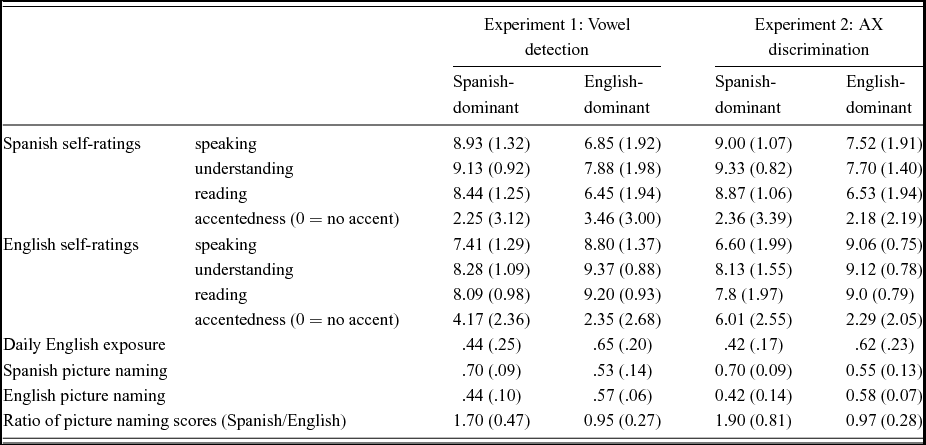
Participants completed the LEAP-Q language background questionnaire (Marian, Blumenfeld & Kaushanskaya, Reference Marian, Blumenfeld and Kaushanskaya2007), including self-reports of dominance (binary), accent, and proficiency. To gain a more objective measure of proficiency, participants performed picture naming tasks in both languages (Woodcock & Muñoz-Sandoval, Reference Woodcock and Muñoz-Sandoval1996). Different pictures are used in each language. The order of the languages was counterbalanced. These measures of proficiency, by self-reported language dominance, are summarized in Table 1.
By-participant mean (standard deviation) proficiency self-ratings and picture naming scores in English and Spanish for participants in both experiments (separated by self-reported dominance). Self-ratings are on a scale of 1–10, daily exposure to English and picture naming accuracy are expressed as proportions.
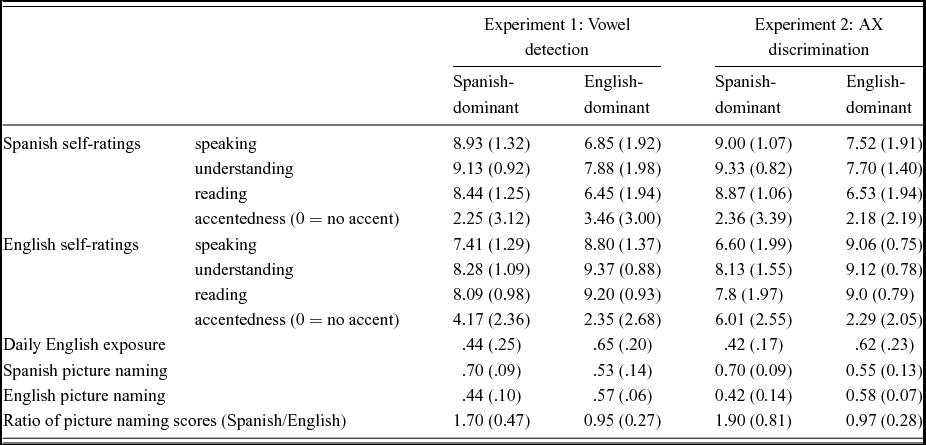
All participants were proficient in both languages. Both groups rated their proficiency in their dominant language highly and rated their non-dominant languages comparably. The picture naming task suggested more balanced proficiency for the English-dominant group: whereas the Spanish-dominant group scored significantly higher in Spanish (t(88.95) = 13.81, p < .0001), the English-dominant group obtained similar scores in both languages (t(51.25) = 1.49, p = .14). These results are typical of bilinguals in El Paso, who have often grown up speaking both languages, use both languages frequently in both social and employment settings, and may have completed primary and secondary education in Spanish, but use English in higher education. As self-reported dominance correlated well with objective measures,Footnote 1 it was utilized in analyses below.
Materials and tasks
The stimuli were designed following Cuetos et al.’s (Reference Cuetos, Hallé, Domínguez and Segui2011) gating procedure. A female native speaker of Mexican Spanish produced disyllabic nonsense words of the format #VsCid: /espid/, /esfid/, /esmid/, /aspid/, /asfid/, and /asmid/. In contrast to Cuetos et al., accent was always placed on the second syllable (the alternate stress pattern is quite unnatural, as /d/-final words with penultimate stress are virtually non-existent in Spanish). Word-final /d/ was lenited to [ð] and voicing assimilation in the medial sC clusters was avoided, in accordance with the original study. The initial vowels were either /e/, used in Spanish to repair #sC sequences (e.g., snob → esnob), or /a/, which may occur in this position, but is not used to repair illicit sequences (e.g., snob is not repaired as asnob).
The sC sequences used included one cluster with falling sonority, /sp/, one with rising sonority, /sm/, and one with level sonority, /sf/. They also differ in frequency, with /sp/ being most frequent and /sf/ least frequent, in both languages. However, none of these clusters is possible word-initially in Spanish (no #sC cluster is possible), and all of them are possible in English. Moreover, Cuetos et al. (Reference Cuetos, Hallé, Domínguez and Segui2011) found no difference in perceptual repair related to the specific clusters used.
Individual exemplars of each item were selected for gating so that tokens were consistent in prosody and pronunciation. Gate 1 stimuli were created by placing a boundary at the offset of the initial vowel's periodicity and the onset of strong frication for /s/. Then the initial vowel preceding this boundary was excised, along with the first 5 milliseconds (ms) of frication after the boundary. Finally, a 40 ms linear ramp was applied to the beginning of all Gate 1 files to better emulate the silence-to-fricative transitions observed in natural speech. Gates 2 through 5 were created by incrementally adding 2.5 periods of the initial vowel before the boundary. Given the average F0 of 180 Hz across stimuli, the average period was approximately 5.6 ms. Thus, Gates 2 through 5 increased in duration by roughly 14 ms each. Gate 6 was simply the complete recording of a stimulus.
The focal task in this experiment was a two-alternative forced choice vowel-detection task. The 36 stimuli described above (6 items x 6 gates) were repeated 4 times each and randomized for a total of 144 trials. Participants were randomly assigned to one of two task conditions in which they were asked to decide whether each stimulus began with a given target vowel or not. In the /e/-detection condition, they were asked to listen for an initial E-sound, and in /a/-detection they were asked to listen for an initial A-sound. Given the transparent orthography in Spanish, these instructions are unambiguous. Participants listened to the stimuli using studio-quality headphones and responded “yes” or “no” via button press, with a pause of 1000ms between each response and the onset of the next stimulus.
Procedure
The language of the experiment was exclusively Spanish up to the beginning of the English picture naming task. Upon arrival, participants were greeted in Spanish. Because both languages are commonly used across many settings at the university, including formal academic settings, greeting participants in Spanish is not unusual, and all participants accepted without comment the experimenter's initiative in language choice, switching to Spanish if necessary. All participants then provided informed consent in Spanish.
The experiment began with a lexical decision task in Spanish (Carlson & Gerfen, Reference Carlson and Gerfen2011), which was not analyzed for the present study. Because members of this population commonly rely on both languages throughout their day, we implemented this task to enhance the L1 Spanish environment for this experiment.
Participants then performed the vowel detection task described above, either /e/-detection or /a/-detection. The English and Spanish picture naming tasks followed in counterbalanced order, after which participants completed the LEAP-Q language background questionnaire (Marian et al., Reference Marian, Blumenfeld and Kaushanskaya2007).
Participants were tested individually in single one-hour sessions in a sound-attenuated booth using E-Prime software (Psychology Software Tools, Pittsburgh, PA, n.d.). Participants received course credit for participation.
Results
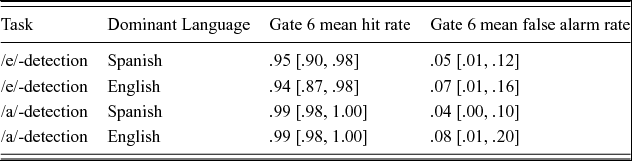
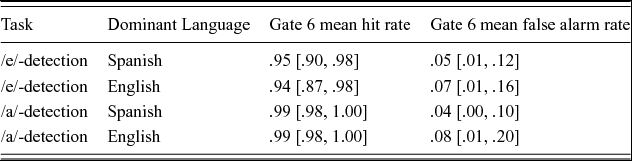
All non-responses and responses with latencies < 200ms were removed (approximately 0.5% of the data). Visual inspection of the false alarm rates revealed a non-monotonic change in behavior from gate 1, which differed qualitatively from the other stimuli in that the vowel was completely absent, as compared to gates 2–6. We therefore analyzed the gate 1 responses separately. Responses at gate 6 were at ceiling, showing that participants had no trouble with the task when the full vowel was present, and are not analyzed further. The mean accuracy (hit rates and false alarm rates) at this gate, by task and dominant language, is reported in Table 2, with 95% Confidence Intervals (CIs) computed over 1000 nonparametric bootstrap samples (where the distribution of a statistic is estimated by repeatedly re-sampling from the set of observations). The same procedure was followed for computing CIs for the observed mean proportions in all other instances.
Mean hit and false alarm rates by task and language dominance at gate 6 (full vowel present), with 95% CIs computed via nonparametric bootstrap in brackets.
The likelihood of affirmative responses was analyzed in each subset of the data (gate 1 vs. gates 2–5) using logistic mixed-effects regression, fitted using the glmer function in the lme4 library in R (Bates, Maechler, Bolker & Walker, Reference Bates, Maechler, Bolker and Walker2014). Response latencies were logged (to correct for skew)Footnote 2 and analyzed (correct detections and correct rejections were analyzed separately) using mixed-effects regression using the lmer function. In each case, the contrast-coded fixed effects included task (/a/- vs. /e/-detection) and language dominance. Gate (in the model of the gate 2–5 data) was coded as a centered numeric variable. All interactions of these fixed effects were included. The maximal by-subject random effects structure was used. Given that our stimuli were a small, non-random sample of possible Spanish disyllables, by-item random effects were not included. We cannot use this small sample to reliably estimate properties of a larger population, and the only property of the stimuli that is not already completely captured in the fixed effects was the consonant following the /s/. Since we had no a priori hypotheses about any dependence of perceptual repair on this consonant, and to avoid over-fitting the model, we did not include this consonant in the fixed effects. Model comparison via likelihood ratio tests was used to assess significance of fixed effects.
Gate 1
We first analyzed the gate 1 responses to determine whether Spanish phonotactics led bilinguals to perceive /e/ when no vowel was present, and whether knowledge of English modulated this propensity. The mean proportions of “yes” responses are reported in Figure 1.
Mean proportion incorrect “yes” responses (false alarms) at gate 1 (where no vowel is present), with 95% CIs computed via nonparametric bootstrap.
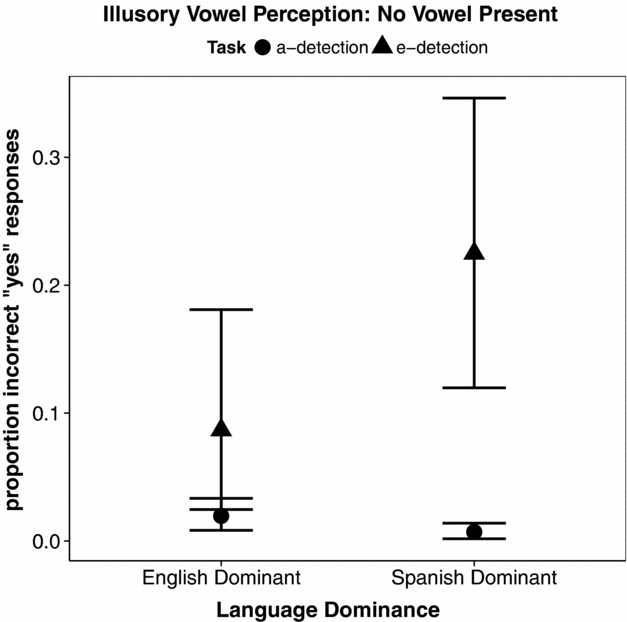
A significant main effect of task showed that participants were more likely to report hearing an illusory vowel (when no vowel was present) in /e/-detection than in /a/-detection (β = 2.83, SE = 0.66, χ 2(1) = 18.45, p < .0001). This reflects the occurrence of perceptual repairs; participants are reporting the presence of an illusory prothetic /e/, but not /a/. However, a significant interaction of task by language dominance (β = −3.02, SE = 1.32, χ 2(1) = 5.39, p = .02) showed that this was restricted to the Spanish-dominant participants. Separate models for each dominance group confirmed that the task effect was significant for Spanish-dominant participants (β = 4.68, SE = 1.15, χ 2(1) = 18.08, p < .0001), but not for English-dominant participants (β = 1.24, SE = 0.80, χ 2(1) = 2.39, p = .12). The main effect of dominance was not significant at gate 1 (χ 2(1) = 0.01, p > .9).Footnote 3
No significant effects of any predictor on response time were observed at gate 1 (all χ 2(1) < 2.5, p > .1).
Gates 2–5
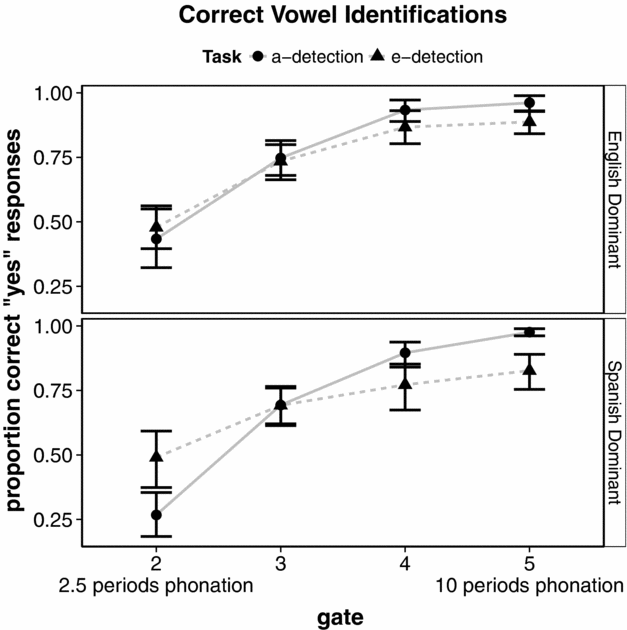
For trials where a portion of the vowel was present, we first analyzed the hit rates to determine whether participants detected the initial vowel more accurately as larger portions of the vowel were included, and whether detection of the target vowel was enhanced by /e/-prothesis. The mean hit rates and bootstrapped CIs are shown in Figure 2. A significant main effect of gate (β = 1.19, SE = 0.06, χ 2(1) = 151.36, p < .0001) confirmed that the presence of a larger portion of the initial target vowel led to more accurate detection. The main effect of task (β = −0.49, SE = 0.21, χ 2(1) = 5.47, p < .02) revealed that participants were overall more accurate in /a/ vs. /e/ detection, but this interacted with gate. Across groups, there was a shallower slope of the gate effect in /e/-detection than in /a/-detection (interaction of gate by task β = −0.81, SE = 0.12, χ 2(1) = 36.29, p < .0001). Participants’ rate of detecting /a/ dramatically increased to ceiling as more of the vowel is presented; in contrast, for /e/, participants’ rate of detection remained comparatively constant and did not reach ceiling. This interaction was substantially stronger for Spanish- vs. English-dominant listeners. This was confirmed by a three-way interaction of gate, task and dominance (β = 0.66, SE = 0.24, χ 2(1) = 7.23, p = .007) and follow-up analyses considering each dominance group individually (gate by task interaction: English-dominant: β = −0.47, SE = 0.19, χ 2(1) = 5.51, p = .02; Spanish-dominant: β = −1.14, SE = 0.15, χ 2(1) = 39.03, p < .0001). There was no main effect of dominance (χ 2(1) = 2, p > .15), and the two-way interactions of dominance with task and gate were also not significant (χs2(1) < 1).
Mean correct “yes” responses (hits) as a function of the amount of the initial vowel present, separated by task and language dominance, with 95% CIs computed via nonparametric bootstrap.

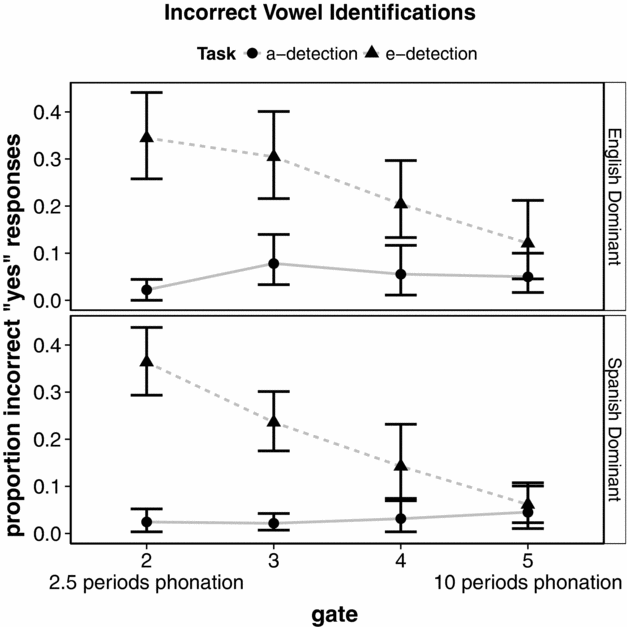
We then analyzed the false alarm rates to explore how misperceptions changed with the amount of vowel present. Mean false alarm rates with bootstrapped CIs are displayed in Figure 3. False alarms were more frequent in /e/-detection (main effect of task, β = 2.25, SE = 0.31, χ 2(1) = 47.83, p < .0001), and decreased as larger portions of the initial vowel were included (main effect of gate, β = −0.43, SE = 0.09, χ 2(1) = 22.30, p < .0001). However, a significant interaction between task and gate (β = −0.65, SE = 0.17, χ 2(1) = 12.39, p = .0004) revealed that false alarms were rare in /a/-detection across all gates, but were high in /e/-detection at short gates. Thus, a brief portion of an initial /a/ was likely to be mis-classified as /e/, and as larger portions of the initial /a/ were included, these misclassifications decreased. No interactions of these effects with language dominance were detected (χs2(1) < 0.8, p > .37). A main effect of dominance reflected a higher overall false alarm rate for the English dominant group (β = 0.63, SE = 0.30, χ 2(1) = 4.28, p = .04) but the lack of interactions showed that this was not related to either the quality or the duration of the initial vowel fragment.
Mean incorrect “yes” responses (false alarms) as a function of the amount of the initial vowel present, separated by task and language dominance, with 95% CIs computed via nonparametric bootstrap.

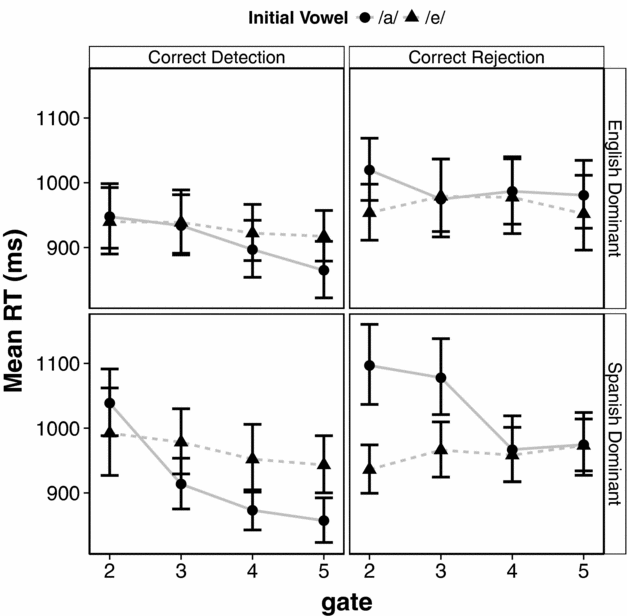
Finally, we analyzed the response latencies, measured from stimulus onset. This analysis was restricted to correct responses, and we built separate models for the correct detections (the target vowel in the task was present, and the participant answered “yes”) and for correct rejections (the target vowel was not present, and the participant answered “no”). The mean response latencies and 95% confidence intervals are shown in Figure 4.
Mean RTs (log ms) with 95% CIs based on the SE of the mean. Recall that gate 2 corresponds to 2.5, and gate 5 to 10 periods of vowel phonation.

A main effect of gate revealed that both types of correct response were faster at longer gates (correct detections, β = −0.03, SE = 0.01, χ 2(1) = 16.76, p < .0001; correct rejections, β = −0.01, SE = 0.005, χ 2(1) = 4.60, p = .03). That is, when more of the initial vowel was present, participants were faster to correctly report whether the stimulus matched the target vowel or not.
However, across both the /a/ detection and the /e/ detection tasks this effect was driven entirely by stimuli that began with /a/ (which is not the prothetic vowel in Spanish). In contrast, when the stimulus began with the prothetic vowel /e/, response latencies were insensitive to the amount of vowel present. This was confirmed by a significant gate by task interaction (correct detections, β = −0.03, SE = 0.01, χ 2(1) = 6.53, p = .01; correct rejections, β = −0.03, SE = 0.01, χ 2(1) = 8.54, p = .003) as well as follow-up regressions for each initial vowel. For /a/-initial stimuli there was a significant effect of gate on response latencies (correct detections, β = −0.04, SE = 0.01, χ 2(1) = 13.47, p = .0002; correct rejections, β = −0.03, SE = 0.01, χ 2(1) = 9.00, p = .003), but not when stimuli were /e/-initial (correct detections, β = −0.01, SE = 0.01, χ 2(1) = 1.95, p = .16; correct rejections, β = −0.004, SE = 0.007, χ 2(1) = 0.35, p = .55). This provides further evidence that, relative to the vowel /a/, bilinguals are more willing to accept phonetic material as /e/ when the phonetic information is ambiguous (here, due to its short duration).
This interaction appears to be stronger for Spanish-dominant listeners, based on the 3-way interaction of gate, task and dominance for correct rejections (β = 0.04, SE = 0.02, χ 2(1) = 3.81, p = .05), but this interaction was not significant for correct detections (p = .14). Separate regressions for the correct rejections of each dominance group revealed a significant gate by task interaction for Spanish-dominant listeners (β = −0.05, SE = 0.01, χ 2(1) = 12.65, p = .0003), but not for English-dominant listeners (β = −0.01, SE = 0.02, χ 2(1) = 0.41, p = .52). No other effects on RT were found, either for correct detections or for correct rejections (all χ 2(1) < 1.07, p > .3).
Discussion
These results suggest Spanish–English bilinguals perceptually repair #sC sequences in Spanish via prothetic /e/. The interactions with language dominance reveal modulation of perceptual prothesis by relative dominance in English or Spanish. Perceptual repair was evident in the tendency to perceive prothetic /e/ when no initial vowel is present (gate 1 results), in the tendency to misidentify a brief initial /a/ as /e/ (but not vice versa), and in the ability to accurately identify the target vowel in each task given only a portion of the initial vowel.
Only Spanish-dominant bilinguals showed a true illusory vowel effect, reporting initial /e/ 22% of the time when no initial vowel was present. This is substantially different from the illusory vowel reporting rate of 56% found in Cuetos et al. (Reference Cuetos, Hallé, Domínguez and Segui2011), whose study was conducted in Spain with participants who were likely to be much less proficient in English. Thus, knowledge of English appears to insulate bilinguals from perceiving an illusory /e/, diminishing the illusory vowel effect until it vanishes completely for participants dominant in English.
When a portion of the initial vowel was present (gates 2–5), both groups of bilinguals showed a greater propensity to accept a brief initial vowel as /e/ (the preferred repair of #sC sequences in Spanish) rather than /a/, regardless of its actual quality, and there was some evidence that this effect was stronger for Spanish-dominant bilinguals. Specifically, in the /e/ detection task, Spanish-dominant speakers' correct detection rate for /e/-initial stimuli was nearly equivalent across tokens with 2.5 to 10 periods of phonation (see Figure 2), and the availability of larger portions of an initial /e/ did not enable faster evaluations of whether the stimulus matched the target vowel in this task. This suggests that these tokens were all equally good tokens of /e/ despite their differences in duration. Conversely, participants had much greater difficulty across both tasks in judging whether a short initial /a/, which is not the favored repair vowel, matched the target vowel. This is seen in reduced correct detections of /a/ at short gates, increased false alarms, and in the finding that stimuli with a short /a/ led to significantly longer response latencies than those with long /a/. This latter observation is most salient in the correct rejections by Spanish dominant participants (Figure 4, bottom right); the long response latencies to short /a/ stimuli suggest that it was very difficult to reject this as a possible token of /e/, whereas the comparatively fast responses to short /e/ stimuli suggest that it was very easy to reject these as tokens of /a/.
Thus, for participants dominant in Spanish, the availability of more acoustic information did not have a robust impact on accuracy or response latencies when the actual initial vowel matched the prothetic vowel favored by Spanish phonotactics. This suggests that their perception of this prothetic vowel is driven more by top-down expectations regarding the structure of Spanish words, rather than by the canonicity of the acoustic signal as a token of /e/; in contrast, their perception of /a/ is driven more by the match between the acoustic signal and a canonical /a/ vowel. These vowel detection results thus provide support for our hypothesis: knowledge of a less restrictive phonotactic system (English) gradiently reduces perceptual repair effects when using a more restrictive system (Spanish), even when the more restrictive system is the first and/or dominant language.
Experiment 2: Discrimination
As explicit vowel detection is a complex, metalinguistic task in which the presence and quality of the initial vowel is the direct focus of the task, our second experiment utilized a more indirect task – deciding whether two auditory stimuli were identical or not. This will help ascertain the extent to which the effects of Spanish phonotactics, and their dependence on knowing English, arise within low-level perceptual representations and processes.
Methods
Participants
A new group of 32 bilinguals was recruited from the same population as in the first experiment. To obtain a more direct comparison of our data with the performance of (near) monolingual Spanish speakers, an additional group of 15 participants (Mean age = 21.73, SD = 2.71) was recruited in Granada, Spain. Only one of the latter group of participants reported being a user of a second language, having learned English in a classroom setting from age 8, but she reported learning to speak English only at age 20. This is similar to most university students in Granada, who take English as a subject during their schooling, but have little experience or proficiency in speaking it.
Among the bilinguals, 28 reported having learned Spanish first, having learned English at a median age of 6 years (Mean = 7.46, SD = 4.37). Thirteen of these participants reported being dominant in English. The 4 who had learned English first reported learning Spanish at a median age of 5.5 (mean = 5.5, SD = 5.26), and all four were English-dominant. Descriptive data on their proficiency and dominance in each language is included in Table 1, above, showing that the groups were comparable to those in the first experiment.
Materials and tasks
In order to control for possible effects of the consonant following /s/, a larger set of stimuli was designed in the same fashion as Experiment 1. The 10 different consonants that can follow /s/ in Spanish (all consonants except /x/) were used to create 10 different VsCid frames, and each frame was recorded twice, with initial /a/ or initial /e/, yielding the following 20 items: /esbid/, /esdid/, /esfid/, /esgid/, /eslid/, /esmid/, /esnid/, /espid/, /eskid/, /estid/, /asbid/, /asdid/, /asfid/, /asgid/, /aslid/, /asmid/, /asnid/, /aspid/, /askid/, and /astid/. The stimuli were recorded by the same talker and following the same procedure as in Experiment 1. Gating was applied in the same fashion as in Experiment 1, but only gate 2 (2.5 periods of initial vowel) and gate 5 (10 periods of initial vowel) were utilized. This yielded 4 versions of each VsCid frame (e.g., /esbid/ gate 2, /esbid/ gate 5, /asbid/ gate 2, /asbid/ gate 5).
The stimuli were presented in an AX task modeled after Davidson (Reference Davidson2011). The AX pairs were constructed such that both members always had the same consonant following the /s/, and for each VsCid frame, each unique combination of initial vowel and gate occurred once in each order.
As shown in Table 3, the task included 240 trials: 80 critical (non-identical) trials, 40 non-identical distractors, and 120 identical distractors. The critical trials comprised the subset of non-identical AX pairings where one vowel was shorter than the other. These critical trials can be divided into two subgroups, based on whether the initial vowel was the same (e.g., Gate 2 /esfid/ vs. Gate 5 /esfid/) or different (e.g., Gate 2 /esfid/ vs. Gate 5 /asfid/). Note that in the first of these subgroups the stimuli were acoustically identical except for the degree of truncation of the initial vowel (they were constructed from the same recorded token); in the second subgroup, the stimuli were from different tokens.
Trial types and counts in Experiment 2 AX discrimination task.

These pairs were selected as the critical stimuli because when vowels have different lengths, perceptual repair predicts asymmetric performance across pair types. In the face of the perceptual uncertainty associated with the short vowel (comprising only 2.5 periods of vocal fold vibration), we expected that knowledge of Spanish phonotactics would cause speakers to repair it as /e/, regardless of its quality. This would improve discrimination when the long vowel was /a/, but impair performance when the long vowel was /e/ – providing an index of the strength of perceptual repair effects. We predicted this effect would be strongest for Spanish monolinguals relative to bilinguals. Among the bilinguals, we predicted it would be weakest for English-dominant listeners.
Two types of distractors were used. First, one half of the trials were AX pairs that were truly identical (each identical pair repeated 3 times each). These trials ensured that any biases in responses do not reflect asymmetries in the distribution of stimuli. We also included non-identical pairs in which both initial vowels were equally short or long. These ensured that participants could not base their judgments on the durations of the initial vowels alone. These pairs could not be included among the critical stimuli because perceptual repair does not predict asymmetrical effects on discriminability.
Procedure
The overall procedure matched that used in Experiment 1. After signing consent forms in Spanish, the bilingual participants began with a lexical decision task in Spanish, followed by the AX discrimination task, picture naming in Spanish and English (counterbalanced), and the LEAP-Q. Monolingual participants performed only the AX task and a language background questionnaire (Li, Zhang, Tsai & Puls, Reference Li, Zhang, Tsai and Puls2014).Footnote 4 Only Spanish was used throughout the experiment, except for the English picture naming and LEAP-Q for the bilingual groups. This, coupled with the Spanish pronunciation of the nonwords in the AX task, was done to ensure that the AX task measured speech perception in Spanish.
On each trial of the AX task, participants heard one of the gated non-word pairs described above. Trials began with the simultaneous presentation of a fixation cross and the first auditory stimulus (the A). The second auditory stimulus, X, began after a silent 250 ms inter-stimulus interval (ISI). As per the instructions, participants indicated whether the A and X stimuli were the “same” or “different” via button press. The screen then blanked for 500 ms before the next trial.
Note that we followed Davidson's (Reference Davidson2011) procedure in order to evoke phonetic rather than categorical judgments about the relationship between the A and X stimuli. Specifically, the short ISI of 250 ms provides limited time to encode information about the first stimulus, forcing participants to directly compare the acoustics of the stimuli rather than developing categorical representations of them. This presents a strong test of the hypothesis that knowledge of English modulates the low-level perceptual consequences of Spanish phonotactics when processing in Spanish. This is in contrast to studies investigating perceptual processes like phoneme categorization, which typically implement longer ISIs to allow time for such higher level encoding and judgments (e.g., Dupoux et al., Reference Dupoux, Parlato, Frota, Hirose and Peperkamp2011).
Bilinguals were tested using the same sound-attenuated booth and equipment as in Experiment 1, and monolinguals were tested in a quiet room at the University of Granada, Spain.
Results
Identical distractors
Performance on the identical AX pairs was high for all three groups, although inspection of the average proportions correct and the 95% CIs suggests that the English-dominant bilinguals tended to report “same” at a slightly lower rate than the monolinguals, with intermediate accuracy for the Spanish-dominant bilinguals (Spanish monolinguals, mean = .94, 95% CI [.88, .97]; Spanish-dominant bilinguals mean = .92 [.89, .94]; English-dominant bilinguals mean = .86 [.80, .91]). As English proficiency increased, participants appear to have become a bit more conservative in identifying identical pairs.
Critical trials
For critical trials with the same initial vowel, the two tokens were acoustically identical in all respects but the duration of the initial vowel; when the initial vowel was different, the remainder of the stimulus was also acoustically (but not segmentally) different, because the /a/- and /e/-initial stimuli were recorded separately. We therefore chose to analyze the Same Vowel and the Different Vowel pairs separately. As in Experiment 1, the likelihood of an incorrect “same” response was analyzed using logistic mixed effects regression. Following Experiment 1, we also examined log RTs using mixed effects regression but no significant effects were found.
Participants’ language group (monolingual, Spanish-dominant bilingual, English-dominant bilingual) was coded using orthogonal contrasts. The first contrast compared both bilingual groups to the monolinguals, and the second contrast compared the Spanish- and English-dominant bilinguals to each other. For the Same Vowel trials, an additional (contrast-coded) factor encoded whether the AX pair contained initial /e/ or initial /a/, and for the Different Vowel trials an additional (contrast-coded) factor encoded whether the longer vowel in the pair was /a/ (e.g., Gate 5 /asfid/ vs. Gate 2 /esfid/) or /e/. These variables were allowed to interact with the language group factor. To determine whether the ordering of the AX pairs affected the results, we added a variable encoding whether the longer initial vowel occurred first or second to each of these models, plus all of its interactions in the fixed and random effects. No substantial effects were found,Footnote 5 and the pattern of results remained the same, so the effects of order were omitted from the final models. As in Experiment 1, the maximal by-subject random effects structure was used, and significance of fixed effects predictors was assessed via likelihood ratio tests.
The mean proportions of incorrect “same” responses for the Same Vowel and Different vowel critical trials are shown in Figure 5. As noted above, the tendency to resolve a brief, and thus ambiguous, vowel in this position as /e/ (what we refer to as perceptual repair) should improve discrimination when the long vowel is /a/, but impair performance when the long vowel is /e/. The respective models for each subset of the data confirmed that, on average, this was the case (Same Vowel pairs, β = 1.48, SE = 0.18, χ 2(1) = 52.11, p < .0001; Different Vowel pairs, β = 1.52, SE = 0.16, χ 2(1) = 55.35, p < .0001).
Proportion of critical AX pairs incorrectly judged to be the “same”, by participant group. A: AX pairs with acoustically identical stimuli except for the duration of the initial vowel. B: AX pairs with different tokens of the same nonword, in which the initial vowel differed in both quality (/a/ vs. /e/) and duration. Error bars show 95% confidence intervals based on a nonparametric bootstrap.

However, while no overall differences were found between bilinguals and monolinguals, or between dominance groups (all χ 2(1) < 2.6, p > .1), interactions of language group with this longer vowel effect revealed significant differences in the strength of perceptual repair across groups. The effects were stronger for Spanish monolinguals than for the bilinguals (Same Vowel pairs, β = −2.26, SE = 0.51, χ 2(1) = 18.43, p < .0001; Different Vowel pairs, β = −1.26, SE = 0.45, χ 2(1) = 7.49, p = .006). Spanish monolinguals showed much poorer discrimination of the short vowel from long /e/ vs. long /a/ in both sets of critical trials. In contrast, bilinguals showed a similar, but reduced asymmetry in discrimination. In order to make a more stringent test of the difference between Spanish monolinguals and bilinguals, we fit a post-hoc model that compared only the monolinguals and the Spanish-dominant bilinguals. In both subsets of the data, the difference in the perceptual repair effect remained significant (p < .04).
Within the bilinguals, the asymmetry was stronger for Spanish- vs. English-dominant listeners on the Same Vowel pairs (β = −0.79, SE = 0.38, χ 2(1) = 4.06, p = .04). Dominance was not found to modulate the effects of the longer vowel for the Different Vowel pairs (χ 2(1) = 0.18, p = .67).
Discussion
The results of the discrimination experiment confirm the pattern observed in vowel detection. While Spanish–English bilinguals show evidence of perceptual repair of #sC, comparison with the monolingual group shows that knowledge of English reduces these effects. Participants produced fewer incorrect responses when the long vowel was /a/ vs. /e/, but this asymmetry was significantly weaker for both bilingual groups than for the monolinguals: resolving the brief initial vowel in favor of prothetic /e/ was dampened for participants who spoke English. Moreover, when the two stimuli contained the same source vowel, dominance in English further weakened the asymmetry: English-dominant bilinguals had equal difficulty discriminating short from long /e/ as they did short from long /a/. Experience with English thus gradiently reduces the Spanish-specific bias to interpret the ambiguous short vowel as /e/.
General Discussion
In both experiments, knowledge of English modulated Spanish speakers’ tendency to resolve ambiguous initial vowels as /e/, given the same acoustic signal. Since this tendency is attributable to language-specific knowledge of Spanish phonotactics (the exclusion of #sC sequences), our results support the hypothesis that experience with two contrasting phonotactic systems interactively shapes bilinguals’ speech perception. The magnitude of the perceptual repair effects associated with the Spanish phonotactic restriction appears to have been reduced by knowledge of a language lacking that restriction, English. These effects emerge in explicit vowel detection as well as in a discrimination task designed to favor low-level auditory processing.
Several mechanisms could underlie these effects. Low-level speech perceptual processes and representations could be restructured through long-term experience of two languages. Top-down (e.g., lexical) information from both languages could interact with bottom-up information even at the lowest levels of processing (cf. McClelland, Mirman & Holt, Reference McClelland, Mirman and Holt2006). Alternatively, experience of two languages could restructure decision processes underlying perceptual judgments (cf. Norris, McQueen & Cutler, Reference Norris, McQueen and Cutler2000). Regardless of the underlying mechanisms, we have presented clear evidence that fluent bilinguals’ perception of Spanish seems to bear the marks of their knowledge of English.
Crucially, the impact of knowing English on bilinguals’ performance was graded, with English-dominant listeners departing more from the Spanish monolingual baseline than did Spanish-dominant listeners. The two bilingual groups differed most in their tendency to perceive /e/ when no initial vowel was present (Experiment 1, gate 1 stimuli). These stimuli are unique in that there is no ambiguous acoustic material present; the ambiguity arises at a more abstract level of representation, because Spanish phonotactics does not allow the signal to be encoded as #sC. Under these conditions, only the Spanish-dominant bilinguals reported hearing an illusory /e/; however, they reported the illusory vowel less than half as often as the native Spanish speakers tested in Spain by Cuetos et al. (Reference Cuetos, Hallé, Domínguez and Segui2011), who likely had much less knowledge of English.
When given enough evidence to conclude that some acoustic signal is present before the /s/, but little acoustic evidence for how to interpret the signal (gates 2–5), both groups showed influence of Spanish phonotactics on perception, but modulated by knowledge of English. The propensity to resolve the ambiguous acoustic material as /e/, the Spanish prothetic vowel, was evident for both groups of bilinguals, but it was weaker than for monolinguals. Differences associated with language dominance were more subtle, and were most apparent when confusability was very high (i.e., Same Vowel pairs in Experiment 2, differing solely in the presence of 7.5 additional periods of vocal fold vibration).
The results of our experiments thus support the hypothesis that bilinguals’ knowledge of two language systems can be integrated and jointly influence their processing of speech. This occurs even when the target language was the listener's dominant and/or first-acquired language (recall that nearly 90% of our participants had learned Spanish first, even though many of them became dominant in English). Thus, our results are compatible with others in which a bilinguals’ weaker language has been found to influence their stronger language (Chang, Reference Chang2012, Reference Chang2013; Cook, Reference Cook2003; Flege & Eefting, Reference Flege and Eefting1987; Gildersleeve-Neumann, Peña, Davis & Kester, Reference Gildersleeve-Neumann, Peña, Davis and Kester2009; Mora & Nadeu, Reference Mora and Nadeu2012) and that speech processing in a later-learned second language reflects influence from both the L1 and the L2 phonotactic systems (Cohen, Tucker & Lambert, Reference Cohen, Tucker and Lambert1967; Hanulíková, Mitterer & McQueen, Reference Hanulíková, Mitterer and McQueen2011; Lentz & Kager, Reference Lentz and Kager2014; Weber & Cutler, Reference Weber and Cutler2006). Integration of phonotactic knowledge across multiple languages appears to be a generalized feature of bilingualism.
These results raise questions about how two language systems interact in the bilingual mind, how knowledge of two languages is integrated, and how bilinguals navigate conflicting patterns in their two languages. They suggest that bilinguals do not necessarily go with their dominant or first language pattern, nor necessarily switch cleanly between two systems.
One possibility is that bilinguals possess a hybridized knowledge of language structure (Cook, Reference Cook1991, Reference Cook1992, Reference Cook1995; Hall, Cheng & Carlson, Reference Hall, Cheng and Carlson2006), with the results of hybridization dependent on the degree of experience with each language. This may represent a stable aspect of these bilinguals’ knowledge, reflecting the reconfiguration of each language's phonotactics over the long term.
Alternatively, bilinguals may have distinct knowledge of both patterns (Altenberg & Cairns, Reference Altenberg and Cairns1983; Gonzales & Lotto, Reference Gonzales and Lotto2013) but tune their expectations or processing to current conditions, such as the language(s) in use, talker characteristics, or task demands. There is evidence for variable, context-dependent crosslinguistic influence in bilinguals’ production of phonetic categories (Antoniou, Best, Tyler & Kroos, Reference Antoniou, Best, Tyler and Kroos2011; Balukas & Koops, Reference Balukas and Koops2014; Goldrick, Runnqvist & Costa, Reference Goldrick, Runnqvist and Costa2014; Gustafson, Engstler & Goldrick, Reference Gustafson, Engstler and Goldrick2013; Howell & Dworzynski, Reference Howell and Dworzynski2001; Olson, Reference Olson2013; Sancier & Fowler, Reference Sancier and Fowler1997). This raises the possibility that the influence of language-specific knowledge on speech perception, in a single target language, may shift according to contextual conditions.
One way this tuning might occur is if bilinguals selectively employ a mixture of processing strategies from either language that are useful in the moment. This is similar to Chang's suggestion that L2 users can apply helpful L1 strategies in the L2, and avoid those that are detrimental (Reference ChangChang, in press; Chang & Mishler, Reference Chang and Mishler2012; see also Lee-Ellis, Reference Lee-Ellis2012). This would explain the English dominant bilinguals’ ability to represent illicit #sC accurately when necessary (thus not perceiving a vowel that is not there). This is not to say that English dominant bilinguals lack the Spanish constraint against #sC, but that they treat it flexibly, suspending it when it is to their advantage.
The emergence of a hybridized system or the context-dependent integration of distinct systems might be a reflection of the linguistic environment in which our listeners reside. We tested fluent bilinguals dominant in Spanish or English, who were living and studying in a highly bilingual, but not diglossic, environment, whose reported daily exposure to English ranged between 40 and 70%. The listeners were therefore accustomed to hearing both languages regularly, including accented varieties of each language (there are many speakers of L2 English, some L2 Spanish speakers, and residents often refer to differences in the Spanish spoken in El Paso compared to Ciudad Juárez, just across the border, and to Chihuahua, Mexico, 260 miles to the south). This might tune listeners’ expectations to a position intermediate between the two languages. Following this logic, context-dependent integration would predict that different testing conditions – which decreased listeners’ expectations of hearing English – might enhance perceptual repair effects. While we conducted our experiments entirely in Spanish up through the vowel perception task (including the consent process), many psychology experiments with this population are conducted in English, such that the laboratory environment may be associated with an a priori greater likelihood of hearing English. This would lead us to expect that in alternative testing environments, where Spanish was more dominant, we might observe a greater top-down influence of Spanish phonotactics on speech perception.
A more radical shift in the testing paradigm would be to have listeners perform English-language identification and discrimination. If crosslinguistic influence between phonotactic systems is bidirectional, evidence of Spanish-like perceptual repair (modulated by dominance) should be found even in English. However, if bilinguals tune their processing based on what is useful (Reference ChangChang, in press; Chang & Mishler, Reference Chang and Mishler2012; Lee-Ellis, Reference Lee-Ellis2012), then crosslinguistic influence may be asymmetrical, dependent on specific properties of the two languages. It may be easier or more useful to diminish the effects of a phonotactic restriction (reducing perceptual repair) than to impose a restriction upon a more permissive system (e.g., leading to perceptual repair of #sC in English nonwords).
We did not explore this asymmetry by testing our participants’ perception or production of #sC sequences in English. While all participants were highly proficient in English, residing in a rampantly bilingual environment, and engaged in post-secondary studies primarily in English, they no doubt varied in their English proficiency – including the propensity to pronounce #sC words with a prothetic vowel. In fact, our interpretation of their speech perception in Spanish leads us to expect to find integration of their phonotactic systems when using English as well. Investigating such bidirectional effects in perception and production are interesting avenues for future work.
It should be noted that other results have suggested that strong L1-like perceptual effects can persist in a second language. Highly fluent bilingual speakers of Spanish and Catalan only reliably discriminate the /e/-/ɛ/ contrast, which occurs in Catalan but not Spanish, if they learned Catalan first (Pallier, Bosch & Sebastián-Gallés, Reference Pallier, Bosch and Sebastián-Gallés1997; Sebastián-Gallés, Echeverría & Bosch, Reference Sebastián-Gallés, Echeverría and Bosch2005), and French–Spanish bilinguals have considerable difficulty processing contrasting stress patterns in Spanish (Dupoux, Peperkamp & Sebastián-Gallés, Reference Dupoux, Peperkamp and Sebastián-Gallés2010; Dupoux, Sebastián-Gallés, Navarrete & Peperkamp, Reference Dupoux, Sebastián-Gallés, Navarrete and Peperkamp2008). However, unlike the effects we observe, these processing difficulties do not extend to discrimination; they are limited to more abstract levels of speech sound processing (Dupoux, Pallier, Sebastian & Mehler, Reference Dupoux, Pallier, Sebastian and Mehler1997).
Other studies have failed to find effects of L2 phonotactics on an L1. Sebastián-Gallés and Bosch (Reference Sebastián-Gallés and Bosch2002) found only subtle, dominance-related differences in Catalan–Spanish bilinguals’ sensitivity to the phonotactic probability of Catalan sequences (all of which were illegal in Spanish). And a post-hoc analysis by Dupoux et al. (Reference Dupoux, Kakehi, Hirose, Pallier and Mehler1999; Experiment 4) found that degree of proficiency in a non-native language (French) did not modulate the strength of phonotactic effects in native language perception (Japanese). Similar to our design, the non-native language allowed sequences that are absent from the native language; however, this study was not designed to test for effects of bilingualism, and their post-hoc analysis of proficiency had considerably less power (N=20) than our experiments. Perception of phonotactic sequences can also reflect the L2 in a monolingual-like way. As noted in the introduction, Parlato-Oliveira et al. (Reference Parlato-Oliveira, Christophe, Hirose and Dupoux2010) found that L2-dominant listeners living in a majority L2 environment can acquire native-like perceptual patterns in their L2, and influence of the L1 was restricted to explicit metalinguistic tasks.
While our results clearly show that bilingual perception can reflect the integration of two systems, under other conditions separation or dominance by one system can be found. It is not clear what gives rise to these distinct patterns, but several possible sets of factors are suggested by differences between these studies. One relates to the social context of bilingual acquisition and use; as noted above, our participants are drawn from a thoroughly bilingual social context, distinct from that of Parlato-Oliveira et al. (Reference Parlato-Oliveira, Christophe, Hirose and Dupoux2010) and Dupoux et al. (Reference Dupoux, Kakehi, Hirose, Pallier and Mehler1999). Second, the aspect of phonological structure defining the pattern (e.g., speech sound categories in Pallier et al. (Reference Pallier, Bosch and Sebastián-Gallés1997) and Sebastián-Gallés et al. (Reference Sebastián-Gallés, Echeverría and Bosch2005) vs. segmental sequencing constraints here) could influence the degree to which contrasting linguistics systems will be integrated. This clearly presents an area ripe for additional investigation.
Conclusion
The two experiments reported here have shown that perceptual repair (in favor of initial /e/) of illegal #sC sequences, and the bias to resolve ambiguous (truncated) #VsC sequences in Spanish as /e/ is weaker among fluent Spanish–English bilinguals than for Spanish monolinguals. Since English lacks the constraint against #sC sequences (in fact favoring #sC over #VsC), we interpret these results as reflecting an integration of their knowledge of these two languages for the purposes of perceiving sound sequences. Moreover, differences in the performance of English- and Spanish-dominant bilinguals provide evidence for gradient influence of English on bilinguals’ speech perception. These results support the hypothesis that contrasting restrictions on sound sequences (phonotactics) interact in the bilingual mind.