


1. INTRODUCTION
Plasma based charged-particle acceleration is an active field of research (Bingham et al., Reference Bingham, Mendonca and Shukla2004; Ruhl, Reference Ruhl1996; Ting et al., Reference Ting, Moore, Krushelnick, Manka, Esarey, Sprangle, Hubbard, Burris, Fischer and Baine1997; Chien et al., Reference Chien, Chang, Lee, Lin, Wang and Chen2005; Sheng et al., Reference Sheng, Mima, Sentoku, Jovonovic, Taguchi, Zhang and Meyer-Ter-Vehn2002a, Reference Sheng, Mima, Sentoku, Nishihara and Zhang2002b; Wu & Chao, Reference Wu and Chao2003; Kitagawa et al., Reference Kitagawa, Sentoku, Akamatsu, Sakamoto, Kodama, Taneka, Azumi, Norimatsu, Matsuoka, Fujita and Yoshida2004; Muggli et al., Reference Muggli, Blue, Clayton, Deng, Decker, Hogan, Huang, Iverson, Joshi, Katsouleas, Lee, Lu, Mash, Mori, ÒConnell, Raimondi, Siemann and Walz2004; Shevts & Fisch, Reference Shevts and Fisch1997; Reitsma et al., Reference Reitsma, Cairns, Bingham and Jaroszynski2005; Suk, Reference Suk2002; Esarey et al., Reference Esarey, Sprangle, Krall and Ting1996; Balakirev et al., Reference Balakirev, Karas and Levchenko2001; Faure et al., Reference Faure, Glinec, Pukhov, Kieselev, Gordienko, Lefebvre, Rousseau, Burgy and Malka2004; Geddes et al., Reference Geddes, Toth, Van Tilborg, Esarey, Schroeder, Bruhwiler, Nieter, Cary and Leemans2004; Joshi, Reference Joshi2007; Mangles et al., Reference Mangles, Murphy, Najmudin, Thomas, Collier, Dangor, Divall, Foster, Gallacher, Hooker, Jaroszynski, Langley, Mori, Norreys, Tsung, Viskup, Walton and Krushelnick2004; Reitsma & Jaroszynski, Reference Reitsma and Jaroszynski2004; Singh et al., Reference Singh, Gupta, Bhasin and Tripathi2003; Yugami et al., Reference Yugami, Kikuta and Nishida1996). It relies on the excitation of a large amplitude large phase velocity plasma wave by a relativistic electron beam or a short pulse laser (Meyer-Ter-Vehn & Sheng, Reference Meyer-Ter-Vehn and Sheng1999; Leemans et al., Reference Leemans, Catravas, Esarey, Geddes, Toth, Trines, Schroeder, Shadwick, Tilborg and Faure2002; Kong et al., Reference Kong, Miyazaki, Miyanaga and Ho2003; Cao et al., Reference Cao, Yu, Xu, Zheng, Liu and Li2004; Balakirev et al., Reference Balakirev, Karas, Levchenko and Bornatici2004; Kulagin et al., Reference Kulagin, Cherepenin, Hur, Lee and Suk2008; Li et al., Reference Li, Ishiguro, Skoric, Takamaru and Sato2004; Niu et al., Reference Niu, He, Qiao and Zhou2008; Xie et al., Reference Xie, Aimidula, Niu, Liu and Yu2009) of pulse length comparable to plasma period or by beating two long laser pulses with frequency separation equal to plasma frequency. The plasma wave accelerates the trapped electrons to high energies up to half GeV. Some experiments have even reported generation of mono-energetic electrons up to hundreds of energy with only ~3% energy spread (Ebrahim, Reference Ebrahim1994; Rosenbluth & Liu, Reference Rosenbluth and Liu1972; Salamin & Keitel, Reference Salamin and Keitel2002; Sauerbrey, Reference Sauerbrey1996; Shvets et al., Reference Shvets, Fisch and Pukhov2000; Pukhov et al., Reference Pukhov, Sheng and Meyer-Ter-Vehn1999; Amiranoff et al., Reference Amiranoff, Antonetti, Audebert, Bernard, Cros, Dorchies, Gauthier, Geindre, Grillon, Jacquet, Mathieussent, Marques, Mine, Mora, Modena, Morillo, Moulin, Najmudin, Specka and Stenz1996; Lindberg et al., Reference Lindberg, Charman and Wurtele2004; Kimura et al., Reference Kimura, Babzien, Ben-Zvi, Campbell, Cline, Dilley, Gallardo, Gottschalk, Kusche, Pantell, Pogorelsky, Quimby, Skaritka, Steinhauer, Yakimenko and Zhou2004; Tochitsky et al., Reference Tochitsky, Narang, Filip, Musumeci, Clayton, Yoder, Marsh, Rosenzweig, Pellegrini and Joshi2004; Clayton et al., Reference Clayton, Everett, Lal, Gordon, Marsh and Joshi1994).
Magnetized plasma offers a richer variety of electrostatic modes that may be employed for charged particle acceleration. Katsouleas and Dawson (Reference Katsouleas and Dawson1983) developed the surfatron concept of unlimited electron acceleration by plasma when a transverse magnetic field is present. Prasad et al. (Reference Prasad, Singh and Tripathi2009) studied the effect of an axial magnetic field and ion space charge on laser beat wave acceleration and surfatron acceleration of electrons. Sugaya (Reference Sugaya2004) studied the acceleration of electrons along and across a magnetic field via nonlinear electron Landau damping and cyclotron damping of almost perpendicularly propagating extraordinary waves, and the generation of an electric field transverse to the magnetic field. Oieroset et al. (Reference Oieroset, Lin, Phan, Larson and Bale2002) observed energetic particles inside a magnetic reconnection diffusion. Istomin and Leyser (Reference Istomin and Leyser2003) presented a model of electron acceleration by trapped upper hybrid waves inside density cavities that are pumped by an ordinary mode electromagnetic wave transmitted into the ionospheric F-region plasma. Akimoto (Reference Akimoto2002, Reference Akimoto2003) studied the acceleration and heating of charged particles by a dispersive electrostatic pulse.
In this paper, we study the acceleration of electrons by an electron Bernstein wave in magnetized plasma. Bernstein waves possess large phase velocity along the direction of ambient magnetic field and small phase velocity across it, and can be driven by electron beams or electromagnetic waves (Kumar & Tripathi, Reference Kumar and Tripathi2004). A large amplitude Bernstein wave can trap electrons moving close to its parallel phase velocity and accelerate them to large parallel and perpendicular energies, where parallel and perpendicular refer to the ambient magnetic field. Dephasing of electrons along the magnetic field can be avoided for a longer distance by the transverse energy gain and mass increase due to the transverse electric field of the Bernstein wave.
In Section 2, we deduce the mode structure of an electron Bernstein wave in a plasma slab with parabolic density profile. In Section 3, we formulate the relevant equations governing the motion of electrons and solve them numerically to obtain energy gain. In Section 4, we discuss our results.
2. ELECTRON BERNSTEIN EIGEN MODE
Consider a slab model of plasma channel with static magnetic field  and plasma density (hence plasma frequency) profile ω p2 = ω p02 (1 − x 2/a 2). A large amplitude electron Bernstein wave exists in the plasma with potential

The local dispersion relation for the Bernstein wave is

where ɛ = 1 + χe and χe is the electron susceptibility. In the limit of  , ω − ω c ≫ k zv th, one may write (Liu & Tripathi, Reference Liu and Tripathi1986)

where  and v th = (2T e/m)1/2 are the thermal speed of plasma electrons at electron temperature T e, ω c is the electron cyclotron frequency, ω p is the electron plasma frequency, I 1(b) is the modified Bessel function, and
 . We presume k y2 ≫ k x2. The mode structure equation for the Bernstein wave in the inhomogeneous plasma can be deduced from ɛϕ = 0 by replacing k x2 by
 in ɛ (Kumar & Tripathi, Reference Kumar and Tripathi2004),
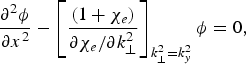
or for k y2v th2/2ω p02 ≪ 1, this equation takes the form

where

For b ≥ 1,  , that is, α2 is positive and the mode structure equation reduces to harmonic oscillator equation. The Eigen value for the fundamental mode is

and the Eigen function is

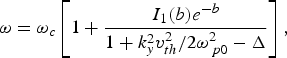
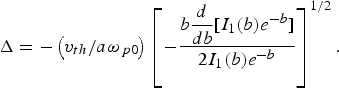
where x 0 = α2−1/4. Eq. (6) gives the dispersion relation for the Bernstein mode
3. ELECTRON ACCELERATION
The response of an energetic electron to the electron Bernstein wave is governed by the equation of motion

where γ = [1 + p 2/m 2c 2]1/2, ω c = eB s/mc, and n 0, −e, m, are the electron density, charge and mass, respectively.
On changing d/dt to (p z/mγ)d/dz, one can write different components of Eq. (9) as


These equations are supplemented with


In terms of dimensionless quantities A 0′ → eA 0/mc 2, Z → ω cz/c, X → ω cx/c, Y → ω cy/c, P X → p x/(mc), P Y → p y/(mc), P Z → p z/(mc), T → ω ct, X 0 → ω cx 0/c, Eq. (10)–(15) can be written as


We solve Eqs. (16)–(21) numerically for following parameters x 0 = 40c/ω c, ω c/ω ~0.9, ω/(k yc) ~0.1, ω/(k zc) ~0.99. The electron is injected initially with small energy. It follows a helical path. As the electron moves in plasma it interacts with the pre-existed electron Bernstein wave and gains energy from it. Electrons gyrate about the axial direct current magnetic field and are pushed forward by the wave electric field. As the electron advances along z it moves away from the region where Bernstein mode amplitude is maximum. In Figure 1, we display the trajectory in two dimension between normalized variable X and Z. For ω c/ω ~ 0.9, ω/(k yc) ~ 0.1, ω/(k zc) ~ 0.99, with the initial values of the parameters Φ ≈ 0.3, P X = 0.0001, P Y = 0.0001, P Z = 0.001, X = 0, Y = 0, T = 0, the electron moves away from x = 0 plane up to x ~ −30c/ω c over a distance of 30c/ω c. In Figure 2, we display the electron trajectory in two-dimension between normalized variable Y and Z for x 0 = 40c/ω c, ω c/ω ~0.9, ω/(k yc) ~ 0.1, ω/(k zc) ~ 0.99 where we have considered the initial values of the parameters Φ ≈ 0.3, P X = 0.0001, P Y = 0.0001, P Z = 0.001, X = 0, Y = 0, T = 0. In Figures 3, 4, and 5, we displayed the momentum evolution. p x attains negative values up to p x/mc ~ −30. p y shows much rapid oscillations, although of smaller amplitude due to gyromotion. p z goes almost linearly with z. Figure 6 shows the energy evolution of electron by varying Z for the parameters x 0 = 40c/ω c, ω c/ω ~0.9, ω/(k yc) ~ 0.1, ω/(k zc) ~ 0.99 where we have considered the initial values of the parameters Φ ≈ 0.3, P X = 0.0001, P Y = 0.0001, P Z = 0.001, X = 0, Y = 0, T = 0. The energy rises almost monotonically to ~2.1 MeV. The acceleration decreases with the increase of the value of parallel component of the Bernstein wave vector along the axial magnetic field. There are two possible resonance conditions ω − k yv y − k zv z ≈ 0 and ω − k yv y − k zv z∓ω c ≈ 0. The first condition corresponds to Landau damping of the Bernstein wave in relativistic acceleration of electrons. In Figure 7, we display  versus Z. Obviously, R 0 > 0(R 0 < 0) corresponds to the acceleration (deceleration). The second resonance condition ω − k yv y − k zv z ∓ ω c ≈ 0 arises from the cyclotron damping of the Bernstein wave. The acceleration results from the resonance of the Bernstein wave with the gyromotion of electrons. In this case,
 is satisfied.
Variation of normalized coordinate X as a function of Z the parameters Φ ≈ 0.3, x 0 = 40c/ω c, ω c/ω ~ 0.9, ω/(k yc) ~ 0.1, ω/(k zc) ~ 0.99.

Variation of normalized coordinate Y as a function of Z for the parameters Φ ≈ 0.3, x 0 = 40c/ω c, ω c/ω ~ 0.9, ω/(k yc) ~ 0.1, ω/(k zc) ~ 0.99.

Variation of normalized momentum P X as a function of Z for the parameters Φ ≈ 0.3, x 0 = 40c/ω c, ω c/ω ~ 0.9, ω/(k yc) ~ 0.1, ω/(k zc) ~ 0.99.

Variation of normalized momentum P Y as a function of Z for the parameters Φ ≈ 0.3, x 0 = 40c/ω c, ω c/ω ~ 0.9, ω/(k yc) ~ 0.1, ω/(k zc) ~ 0.99.

Variation of normalized momentum P Z as a function of Z for the parameters Φ ≈ 0.3, x 0 = 40c/ω c, ω c /ω ~ 0.9, ω/(k yc) ~ 0.1, ω/(k zc) ~ 0.99.

Variation of γ factor as a function of Z for the parameters Φ ≈ 0.3, x 0 = 40c/ω c, ω c/ω ~ 0.9, ω/(k yc) ~ 0.1, ω/(k zc) ~ 0.99.

Variation of R 0 as a function of Z for the parameters Φ ≈ 0.3, x 0 = 40c/ω c, ω c/ω ~ 0.9, ω/(k yc) ~ 0.1, ω/(k zc) ~ 0.99.

4. DISCUSSION
A large amplitude electron Bernstein wave has potential for electron acceleration up to a few MeV energy. The energy is primarily contained in the parallel motion (along the ambient magnetic field); however, transverse motion is also significant and helps in increasing the phase detuning length between the electron and the wave. The scheme may be relevant to current drive in tokamak, where electrons of hundreds of KeV energy carry the toroidal current. In a parabolic density profile (across the ambient magnetic field), Bernstein waves are localized around the density maximum, with Gaussian amplitude profile. The mode structure half width scale as square root of density scale length and is sensitive to transverse wave number. Bernstein waves with parallel phase velocity close to c are useful for electron acceleration. Such waves can be excited by nonlinear mixing of two nearly counter propagating intense electromagnetic waves across the magnetic field when the frequency difference in them is close to electron cyclotron frequency. The Bernstein wave amplitude is limited by relativistic detuning where the oscillation of plasma electrons in the combined fields of the laser and Bernstein wave results in a decrease in the plasma frequency taking the system off resonance. They may also be driven by relativistic electron beams via Cerenkov or slow cyclotron interaction.



