Introduction
With a growing ageing population, more patients suffering from dementia are presenting for elective surgery. This calls for specific attention to a variety of dementia-specific issues.Reference Funder, Steinmetz and Rasmussen1
Mastoid surgery for advanced cholesteatoma can be performed under general or local anaesthesia.Reference Neumann, Yung and Carroll2 Mastoid surgery performed under local anaesthesia requires patient co-operation. Unfamiliar environments may contribute to anxiety in patients with dementia and efforts should be made to minimise this.Reference Waller and Masterson3 The 2019 Association of Anaesthetists guidelines advocated that carers and relatives should accompany a person with cognitive impairment before and after surgery, as they provide invaluable patient support.Reference White, Griffiths, Baxter, Beanland, Cross and Dhesi4
At our unit, two patients with advanced cholesteatoma and severe dementia were identified who could be managed surgically. Given their dementia and co-morbidities, the anaesthetist deemed that the general anaesthesia risks were high. With the aforementioned peri-operative guidelines in mind,Reference White, Griffiths, Baxter, Beanland, Cross and Dhesi4 it was proposed that surgery could be performed under local anaesthesia with the involvement of a dedicated caregiver in the operating theatre. This article describes our experience.
Materials and methods
Two patients with advanced cholesteatoma and severe dementia underwent ear surgery. As the formal dementia diagnosis had been made by the elderly care team, it was deemed unnecessary to repeat cognitive score measurements.
After discussion with the patient's family regarding the risks of cholesteatoma and the distress that the symptoms were causing, it was deemed appropriate to proceed with mastoid surgery performed under local anaesthesia, with knowledge of the low risk of complications from surgery. The possible complications included profound ipsilateral hearing loss, balance disturbance and facial palsy. It was judged, in agreement with the family, that the symptom-related distress outweighed the distress of the procedure, with the knowledge of the potential negative outcomes from surgery. The consent form 4 was used in both cases. This consent form is used for adults who lack the capacity to consent to investigation or treatment.
The primary caregivers were briefed on the peri-operative journey, particularly the intra-operative experience. They were given a tour of the operating suite beforehand to familiarise them with the operating theatre suite and set-up. In addition, on the day of the procedure, operating theatre staff members were allocated to the caregiver to look after their wellbeing.
Based on past experience of managing otological cases under local anaesthesia where general anaesthesia was contraindicated or considered high-risk, both the senior authors (SP and MY) were confident in managing these cases if the patient became agitated or unable to tolerate the procedure. However, an anaesthetist was on standby for the duration of the procedure, ready to act if the patient were to become agitated or unable to tolerate the procedure after commencement.
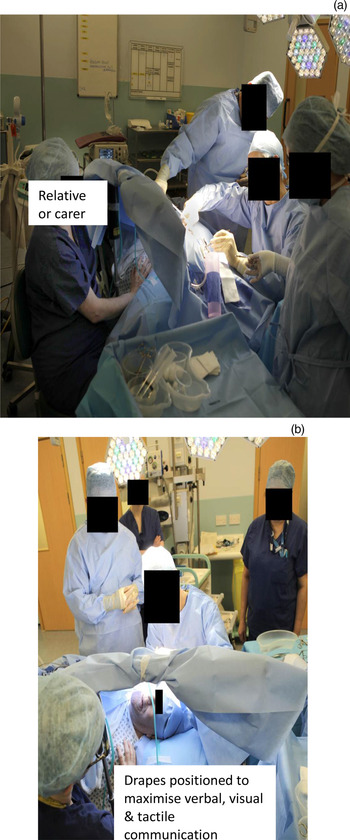
For each case, one caregiver, well known to each patient, was asked to be present during surgery. The caregiver and patient were counselled pre-operatively. The carer sat at eye level adjacent to the patient such that they were visible to the patient at all times (Figure 1). The carer acted as the communicator between the patient and the surgeon. The surgeon did not directly address the patient.
Set-up of the operating theatre demonstrating the relative positions of the patient, carer and surgeon.

The technique for infiltration of local anaesthesia (lidocaine 2 per cent with adrenaline 1:80 000) and positioning was previously published in a description of mastoid surgery for patients with multiple co-morbidities.Reference Neumann, Yung and Carroll2 Sedation was not used. Complete extirpation of cholesteatoma was achieved in both cases. The surgical findings and techniques for both cases are described below, in the relevant patient subsections.
Six to eight weeks post-operatively, caregivers were engaged in telephone interviews. The first author explained the aims and objectives of the study. The carers were asked to narrate their experiences. The interviews started with the following question: ‘Please describe your father/patient's experience of undergoing local anaesthetic ear surgery’. The carers spoke freely and were only interrupted where clarification was required.
Case reports
Patient one
An 89-year-old man was referred with a chronically discharging left ear and dizziness. He had a past medical history of moderately advanced Alzheimer's disease, hypertension, congestive cardiac failure and aortic stenosis.
An audiogram indicated left-sided moderate-to-profound mixed hearing loss and right-sided high-frequency moderate-to-severe hearing loss. Pre-operative computed tomography (CT) illustrated scutum erosion, facial canal dehiscence and probable lateral semi-circular canal dehiscence.
The management options discussed were: (1) regular or six-weekly visits to the ENT clinic for reassessment and suction clearance, if required; and (2) surgery that aimed to provide an infection-free dry ear and prevent the potential complications of ear disease.
In light of the advanced CT findings and otovestibular symptoms, surgery was proposed. Upon the patient's daughter's endorsement of the proposed plan, the patient was scheduled for ear surgery under local anaesthesia. The consent form 4 was signed.
Intra-operatively, an endaural approach with a front-to-back Bondy's mastoidectomy procedure was performed. Attic cholesteatoma was found extending into the antrum and mastoid. The posterior canal wall was eroded. The patient was discharged home the same day as the operation. There were no post-operative complications.
Patient two
An 82-year-old man was referred with occasional dizzy spells and a persistently discharging right mastoid cavity. Four years previously, he had undergone right-sided modified radical mastoidectomy at a different hospital. Since his original surgery, his memory had deteriorated and he was diagnosed with vascular dementia. He had a past medical history of type II diabetes mellitus, peripheral neuropathy, recurrent falls and mild frailty.
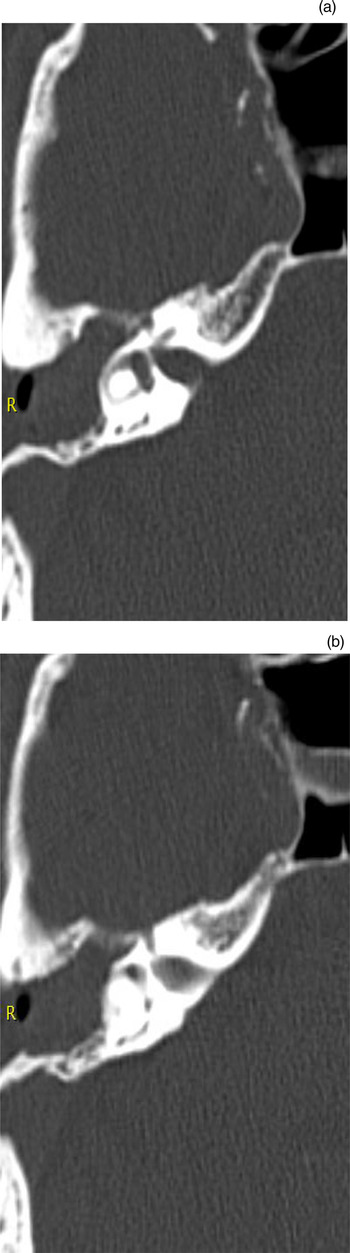
An audiogram indicated bilateral moderate-to-severe mixed hearing loss. Pre-operative CT suggested lateral semi-circular canal thinning (Figure 2) and dehiscence of the facial nerve canal.
Pre-operative computed tomography images demonstrating possible lateral semi-circular canal dehiscence. R = right

Similar to the first case, conservation and surgical management options were discussed. With progression of the disease and symptoms, surgery was proposed. The patient's daughter, who was a community nurse herself, was his primary caregiver. She approved of the plan and agreed to be present during the operation performed under local anaesthesia. The consent form 1 had been signed in advance; however, due to a deterioration in cognitive status, on the day of surgery the consent form 4 was signed.
A revision mastoidectomy and obliteration procedure, using hydroxyapatite granules and a mid-temporal flap, was performed. Intra-operatively, there was extensive granulation and cholesteatoma within a small mastoid cavity, and a 2 mm lateral semi-circular canal fistula (the membrane was intact). The fistula was covered with bone dust and perichondrium. The patient was discharged home the same day as the operation. There were no post-operative complications.
Results
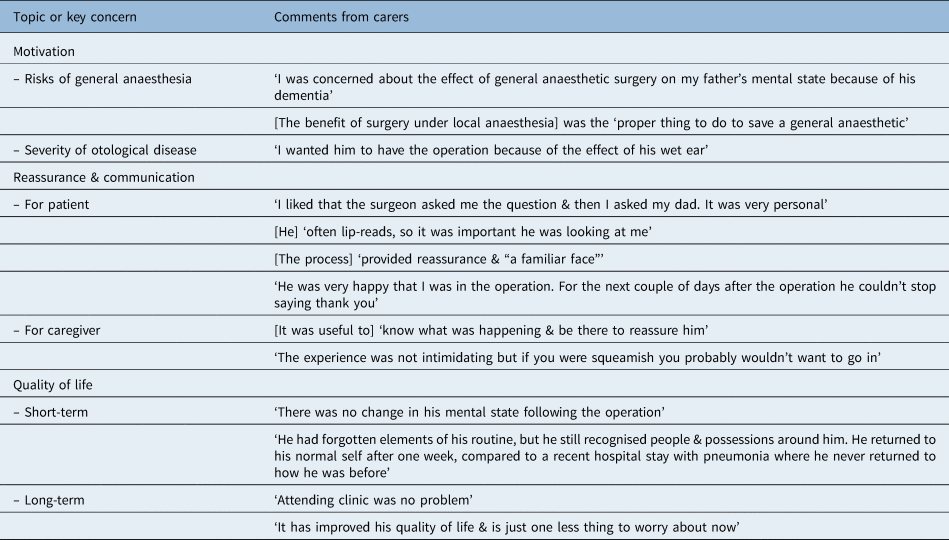
As only two patients underwent this technique, formal thematic analysis was not possible. Analysis was conducted as follows: the verbatim-transcribed narratives were read several times to comprehend the narrative context. Topics that represented areas of particular importance or concern were identified. These topics were compared between the interviews to identify common ideas. Three primary topics were identified during the interviews: motivation, reassurance and communication, and quality of life. The results are summarised in Table 1.
Summary of topics gleaned from carer interviews

In terms of motivation for considering surgery, the narrated events illustrated that the carers had two main concerns pre-operatively: the risks of general anaesthesia in patients with dementia and the severity of otological disease. These factors were important in their motivation for considering surgery. As anticipated, the local anaesthesia technique provided reassurance for the patient. An unexpected benefit was that the caregivers reported finding the experience beneficial personally as they were not worrying in the waiting room.
Pre-operatively, both patients reported otological and vestibular impairments, which were negatively affecting their quality of life. The likely link between the ear disease and symptoms was carefully explained to patients and their caregivers with the aid of illustrations. Post-operatively, there was no significant deterioration in the patients’ mental state or post-operative delirium.
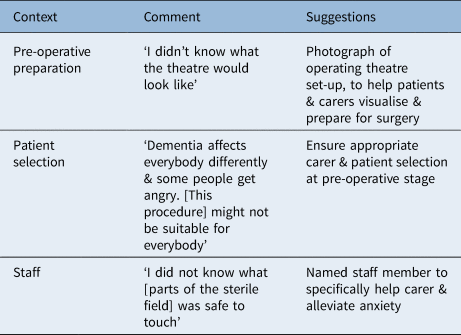
Table 2 summarises suggestions made by carers to help prepare future patients.
Suggestions made by carers to improve process for future patients

Discussion
Dementia is an age-related clinical syndrome characterised by progressive cognitive decline. In the UK, approximately 850 000 people have dementia.Reference White, Griffiths, Baxter, Beanland, Cross and Dhesi4 This figure is expected to reach one million by 2025. Surgeons need to be aware of the anaesthesia considerations when scheduling patients with dementia for surgery, alongside the options that are available in their sub-specialty, to enable optimal patient care.
General anaesthesia considerations
Patients with dementia present a number of challenges for anaesthetists.Reference Alcorn and Foo5 These challenges can be considered in terms of pre-, intra- and post-operative issues. Pre- and intra-operative considerations are discussed in detail in a variety of publications on anaesthesia,Reference Funder, Steinmetz and Rasmussen1,Reference White, Griffiths, Baxter, Beanland, Cross and Dhesi4–Reference Hu, Liao, Chang, Wu and Chen6 and further discussion is beyond the scope of this article.
Post-operatively, several studies have shown that general anaesthesia can increase the risk of post-operative cognitive decline and delirium.Reference Mason, Noel-Storr and Ritchie7 Post-operative cognitive decline describes a significant deterioration in comparison with pre-operative cognition, occurring between 7 days and 1 year post-operatively.Reference White, Griffiths, Baxter, Beanland, Cross and Dhesi4 In contrast, post-operative delirium is a fluctuating disturbance that develops over a short period of time (hours to days) as a direct physiological consequence of surgery.Reference White, Griffiths, Baxter, Beanland, Cross and Dhesi4 It may be associated with a prolonged length of stay, mortality and onward cognitive decline.
Local anaesthesia considerations
Regional anaesthesia is recommended by the Association of Anaesthetists to reduce opioid requirements, unless it is contraindicated.Reference White, Griffiths, Baxter, Beanland, Cross and Dhesi4 However, locoregional anaesthesia can be challenging in patients with dementia, who may be unable to co-operate with the procedure requirements. A qualitative study of cataract surgeons highlighted concerns regarding the potential lack of a patient's co-operation and comprehension associated with cognitive impairment.Reference Jefferis, Clarke, Taylor and Brittain8 Sedation is one option to reduce anxiety; however, it has been demonstrated that sedation can have a detrimental effect on elderly patients with dementia.Reference Sugimura, Kudo, Hanamoto, Oyamaguchi, Morimoto and Boku9
A survey of 108 patients who underwent otological surgery under local anaesthesia indicated that discomfort included noise, anxiety and dizziness.Reference Yung10 Some of the aforementioned discomforts, alongside being in an unfamiliar environment, may be distressing for patients with dementia.
The two cases presented suggest that these concerns may be minimised by the presence of a carer during surgery. The patients received additional reassurance and familiarity to contribute to a calmer patient. The perceived advantages also facilitated communication between the surgeon and patient. We propose that a similar technique could be adapted and used in other surgical specialties.
Surgery performed under local anaesthesia, particularly in patients with dementia, requires co-ordination of the operating team.Reference Neumann, Yung and Carroll2 The environment should be quiet, and the medical display screen should be obscured from the patient and carer. There is a need for sterile draping, but it is important to avoid claustrophobia by keeping the patient's face uncovered. The carer's needs should be anticipated, and it would be ideal for a designated member of staff to sit near to the carer to allow them to ask questions without disturbing the surgeon. Feedback from these two cases suggested creating a leaflet with a photograph of the operating theatre layout, to prepare patients and caregivers.
Patient selection
Not all patients with cholesteatoma and dementia require operative management. Patients, particularly those with dementia, need to be managed in a manner appropriate for their condition(s), and the surgeon must be cognisant of the potential negative impact of surgery (even that performed under local anaesthesia) on mental status. In those patients with advanced ear disease who are undergoing surgery, the presence of a caregiver in the operating theatre is a potential solution.
Caregiver selection is also important, to ensure a good patient–carer relationship, and prevents a carer being overwhelmed by the operating theatre environment.
Conclusion
Operating surgeons should be cognisant of the impact of dementia on disease, and of all management options including surgical options. Otologists should not disregard patients for mastoid surgery based upon a diagnosis of dementia; rather, there is a need to be patient advocates. Selected patients, in multidisciplinary consultation with relatives, caregivers and anaesthetists, can undergo surgery in the presence of a familiar carer. Opportunities exist to improve patient care through a more targeted, personalised approach. Further studies, with larger numbers of cases, are desirable, to confirm the feasibility of incorporating a caregiver into the operating theatre environment.
Competing interests
None declared