Noncommunicable diseases can develop in disaster victims as a result of poor diet, stress, and physical inactivity. In fact, negative health parameters, such as high blood pressure, impaired glycemic control, and increased cardiovascular events, have previously been reported to emerge following catastrophes. Similary, these chronic conditions may also be a problem after nuclear disasters. Fear of radiation exposure reduces the incentive for outdoor activity, changes dietary habits, and increases mental stress. Even though serious concern has been raised with regard to the negative impacts of radiation exposure, the consequences of living in a contaminated radioactive area after a nuclear disaster have not been thoroughly investigated.
After the Fukushima nuclear accident, the World Health Organization (WHO) performed a health risk assessment. 1 The reports suggested that the incremental incidence of disease was not likely to increase on average in the general population, but that lifetime risk might be somewhat increased in the most affected areas. This assessment was only an estimation based on the radiation exposure levels during the acute phase; the effect of living in a radioactively contaminated area after the acute phase remains unclear.
The Tamano district in Soma city is located adjacent to the evacuation zone set after the nuclear accident and is known to be one of the most contaminated residential areas outside the evacuation zone (see Supplementary Figure 1 in the online data supplement). According to the Japanese government’s announcement on May 6, 2011, the surface deposition density of cesium (134Cs and 137Cs) in Tamano was 600 to 1000 kBq/m2, which was higher than the level imposed for obligatory evacuation in Chernobyl 5 years after the nuclear disaster there. 2 , Reference Handl, Beltz and Botsch 3 To assess the health problems of those who remained in Tamano, the local government instituted a health evaluation as well as examinations for internal and external radiation exposure levels.
In this report, we retrospectively assessed the results of this health evaluation to gauge the short-term health effects of living in the highly contaminated areas.
Methods
Study Population
Tamano district, Soma city, had a population of 474 (median age, 58; 242 females, 51.1%), with individuals over the age of 65 years accounting for 35.7% of the population, on February 28, 2011. The levels of airborne radiation in Tamano were in the range of 1.9 to 3.8 μSv/h in April 2011 and 1.0 to 1.9 μSv/h in June 2012. 4
Data Collection
Clinical Parameters
Health evaluations in Tamano were conducted on May 28–29, 2011, and July 16–17, 2012. Clinical parameters included body mass index (BMI), systolic and diastolic blood pressure, and blood parameters including blood cell counts, LDL (low-density lipoprotein) and HDL (high-density lipoprotein) cholesterol levels, and triglyceride levels. The value for glycated hemoglobin (HbA1c; %) was calculated as the National Glycohemoglobin Standardization Program HbA1c equivalent by using the formula HbA1c (%)=HbA1c (Japan Diabetes Society) (%) +0.4%.
Radiation Exposure
Radiation exposure screening programs were provided for all Tamano residents, who were invited to attend the program voluntarily over the course of 2012. A screening program for internal exposure (134Cs and 137Cs) was conducted from June 11 to August 28, 2012, by using a whole-body counter (Fastscan Model 2251, Canberra Inc, Meriden, CT) with shielding against background radiation. Analysis was performed by using Apex-InVivo and Genie software (Canberra Inc). Detection limits of the system were set to 220 Bq for 134Cs and 250 Bq for 137Cs with a 2-minute scan. Owing to the detection limits of the machine, residents 6 years of age or older participated in the study.
A screening program for external exposure was conducted twice yearly for 3-month periods (October to December 2011 and July to September 2012) for residents 15 years old or younger. Personal film badge dosimeters (Glass Badge, Chiyoda Technol Corp, Tokyo, Japan) were distributed.
Data Analysis
The changes in clinical parameters from 2011 to 2012 were compared with paired t-tests (a P value <0.05 indicating significance) by using SPSS statistics19 (IBM Corp, Armonk, NY). For internal exposure, cesium exposure levels were measured as whole-body exposure (Bq). Concentration by body weight (Bq/kg) was then calculated and reported as median ranges (minimum to maximum values).Reference Tsubokura, Gilmour, Takahashi, Oikawa and Kanazawa 5 Annual effective doses from internal contamination were evaluated on the basis of the effective dose coefficients 1.9×10⁻⁵ mSv/Bq for 134Cs and 1.3×10⁻⁵ mSv/Bq for 137Cs derived from Internal Commission on Radiological Protection Publication 67. This was with the assumption that the amount of cesium detected was in equilibrium between consecutive ingestion and excretion throughout the year, and that all cesium ingested within that year occurred at one time point. For external exposure, Sievert measurements and annual radiation doses were calculated by multiplying the results by 4 (Sv/y).
Ethics and Informed Consent
The Institutional Review Board of the Institute of Medical Science at the University of Tokyo approved the study (approval number 25-40-1011). Soma City instituted the health screening program and the anonymized results were provided to us. The ethics committees agreed that written consent for this study was not required for each participant.
Results
Clinical Parameters
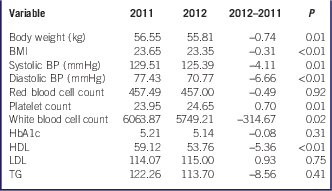
A total of 155 residents participated in the health evaluations conducted in both 2011 and 2012. The median age in 2011 was 61 years, and there were 85 female subjects (54.8%). The participants’ median age and male:female ratio were similar to those of Tamano residents. The results are summarized in Table 1. Significant decreases in average body weight, BMI, systolic and diastolic blood pressure, white blood cell counts, and HDL cholesterol were observed from 2011 to 2012, whereas the average platelet counts significantly increased over the course of the year.
Summary of the Average Clinical Parameter Values for Participants in the Health Evaluation Conducted in 2011 and 2012 (n=155)Footnote a

a Abbreviations: BMI, body mass index; BP, blood pressure; HbA1c, glycated hemoglobin; HDL, high-density lipoprotein cholesterol level; LDL, low-density lipoprotein cholesterol level; TG, triglyceride level.
Internal Exposure
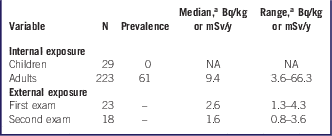
A total of 252 residents, which comprised 60% of the registered population of Tamano, participated in the screening for internal exposure. The participants consisted of 29 children (defined as individuals below the age of 16 years; 14 girls; median age [range]: 11 [6–15] years) and 223 adults (128 women; median age [range]: 57 [16–88] years). We observed internal exposure above the detection limit in 61 adults (27.4%), whereas internal exposure was absent in children. This difference in detection rates between adults and children was statistically significant (χ2=10.84, P<0.001). Among the 61 adults, 40 were male and 21 were female. Whole-body cesium concentrations ranged from 232 to 3514 Bq (median: 610 Bq), and cesium concentrations by body weight ranged from 3.6 to 66.3 Bq/kg (median: 9.4 Bq/kg; Table 2). Annual exposure levels for those under the whole-body counter detection limit were predicted as less than 0.02 mSv/y, with no individual exceeding 1 mSv/y.
Summary of Statistics From the Internal and External Radiation Exposure Screening Program

a Values for internal exposure are Bq/kg; values for external exposure are mSv/y.
External Exposure
A total of 23 children participated in the first screening for external exposure (11 girls; median age [range], 12 [1–15] years), of which 18 also participated in the second screening (8 girls; median age [range], 12.5 [2–15] years). The levels of external exposure during the first test period ranged from 1.3 to 4.3 mSv/y (median, 2.6 mSv/y), and those during the second test period ranged from 0.8 to 3.6 mSv/y (median, 1.6 mSv/y; Table 2).
Discussion
The results of the present study indicated that the physical health of Tamano residents did not deteriorate during the first year following the nuclear disaster. In addition, the radiation exposure levels were limited to moderately low levels, considering the reference levels for the emergency exposure situation recommended in ICRP publication 109.Reference Clarke and Valentin 6 These findings suggest that living in such areas is not an acute risk factor for physical health.
Several significant changes were observed in the clinical parameters. The decrease in average blood pressure was considered a preferable change, and decreasing the average BMI may also be advantageous. Although there was an increase in the number of underweight residents, the number of those with normal BMI increased, with the average still in the range of lowest mortality (data not shown). Among lipid metabolism markers, HDL showed a significant decrease, but the LDL and triglyceride levels did not show significant changes. It was recently suggested that low HDL might not be a cause of cardiovascular disease. Taken together, these findings suggest that the changes in lipid metabolism might not affect overall health. As for blood cell counts, although white blood cell and platelet counts showed significant changes, they were small enough to be clinically negligible. In summary, these changes might not have a major impact on overall health.
Natural disasters negatively impact metabolic health. After the Great East Japan Earthquake and evacuation-related health deterioration, an increase in cardiovascular disease and impaired metabolic conditions were reported.Reference Tsubokura, Takita and Matsumura 7 , Reference Nomura, Gilmour and Tsubokura 8 Even though Tamano inhabitants did not experience forced evacuation, they suffered from a fear of radiation exposure. In view of these circumstances, Tamano inhabitants were at high risk for deteriorated health conditions. However, contrary to our prediction, the participants’ metabolic markers were not impaired. Because metabolic health has been reported to deteriorate shortly after a disaster, the changes we saw from 2011 to 2012 in Tamano might reflect a return to the pre-disaster health state. Our data imply that evacuation from radioactively contaminated areas is not always necessary to protect inhabitants’ health.
The internal exposure levels in Fukushima inhabitants were much lower than estimated.Reference Hayano, Tsubokura and Miyazaki 9 In this study, the internal exposure levels were below the detection limit in most participants. The presence of individuals who exhibited abnormal radioactivity levels suggests that there is a specific risk such as contaminated food intake.Reference Tsubokura, Kato and Nomura 10 It is hard to ascertain the quantity of contaminated food consumed by these individuals and whether this internal exposure is due to highly contaminated food intake during the past acute phase or due to ongoing intake of contaminated food. However, it is apparent that intake of contaminated food and accumulation of radioactivity in those tested were minimal and under good control. In a developed country like Japan, the food distribution system is sophisticated even in rural areas; thus, the residents can easily avoid contaminated local products. In addition, radioactive contaminant testing and delivery restrictions for certain products were mandated. At this stage, it appears that the control of internal exposure through food is manageable even in contaminated areas.
Notably, this study also suggests that the measured external radiation was lower than the official estimated airborne radiation level. The levels of external exposure among children in the study area were limited in the range of 1.3 to 4.3 mSv/year, although the level of airborne radiation in June 2012 was 1.0 to 1.9 µSv/h, 4 or 8.8 to 16.6 mSv/year. This may be the result of shielding effects and countermeasures taken to reduce the overall radiation levels in living spaces, such as bedrooms and schools. However, a small number of children had relatively high levels of exposure. In addition, exposure for high-risk adults, such as those who work outside, might be underestimated. More focus on countermeasures to reduce the overall radiation levels may be necessary.
Nuclear disasters generally raise serious concern for cancer. Even in the most contaminated areas in Fukushima, the increase in the incidence of cancer is estimated to be only a few percent. 1 The percentages represent estimated relative increases over baseline risk for cancer incidence and are not absolute risks for developing cancer. Tamano residents did not show metabolic health deterioration, whereas the health status of those who were evacuated was reportedly impaired. Since it has recently emerged that deteriorated metabolic health also brings an increase in cancer risks, evacuation presents a trade-off between cancer risks increased by radiation exposure and those increased by metabolic health deterioration, especially for adults.
Limitations
This study had several limitations. The data only allow comment on short-term changes to physical health and do not account for volunteer bias. Additionally, health evaluation parameters were not specific to natural or nuclear disasters, and these screenings were not conducted within the same periods. Therefore, further careful monitoring is essential.
Conclusions
Short-term physical health could be preserved in radioactively contaminated areas where the surface deposition of cesium is within 1000 kBq/m2. Overall exposure can be reduced by monitoring radioactive contaminants in foods and by decontamination work. Furthermore, lifetime attributable cancer risks for adults were in a permissible range in these areas. The practicality of evacuation should be considered, particularly in terms of the health risks versus benefits.
Acknowledgments
We express our sincere appreciation to the officers of the Soma city and Seto health checkup clinic for kind support in organizing the health screening program. In addition, we thank the volunteers from Seisa University, Soma-gun Medical Association, Soma Central Hospital, Soma General Hospital, Soma Social Welfare Council, and Fukuoka Houeikai Hospital.
Supplementary Material
To view supplementary material for this article, please visit http://dx.doi.org/10.1017/dmp.2015.102