Introduction
Maternal high-fat diet (HFD) consumption is a risk factor for developing arterial hypertension in offspring through a complex mechanism involving sympathetic overactivity, enhanced peripheral chemosensitivity, baroreflex dysfunction, and impairment in kidney function. Reference Guimaraes, de Araujo and Aquino1−Reference Tain, Lin and Sheen3 Additionally, HFD intake during pregnancy and/or lactation has been shown to shift the composition of maternal–fetal gut microbiota, which has been linked to impaired gut barrier integrity and developmental programming of arterial hypertension. Reference Hsu, Hou, Lee, Chan and Tain4 .
Oxidative stress plays a significant role in developing many diseases, being characterized by increased production of oxygen/nitrogen/sulfur reactive species and reduced tissue antioxidant capacity. Reference Halliwell and Gutteridge5 Increased renal oxidative stress and gut microbiota dysbiosis have been linked to the development of arterial hypertension and chronic kidney disease. Reference Mennuni, Rubattu, Pierelli, Tocci, Fofi and Volpe6−Reference Cavalcanti Neto, Aquino and Romao da Silva8 It has been previously demonstrated that offspring from dams fed a high-fat high-cholesterol diet during pregnancy and lactation developed arterial hypertension linked to renal dysfunction and increased oxidative stress along the gut-kidney axis at 90 days of age, Reference do Nascimento, Neto, de Andrade Braga, Lagranha and de Brito Alves9 indicating that postweaning intervention targeting the gut microbiota could be a potential strategy to reprogramming arterial hypertension.
The administration of probiotics, an approach based on the administration of live nonpathogenic microorganisms that confer a health benefit to the host when administered in adequate amounts, has been considered a safe strategy capable of reducing oxidative stress. Reference Hill, Guarner and Reid10 Growing evidence has demonstrated that interventions targeting gut microbiota with probiotics have emerged as an innovative strategy to treat arterial hypertension, Reference da Silva LF, de Oliveira and de Souza11,Reference Chi, Li and Wu12 and to protect cells from oxidative damage due to their antioxidant capacity. Reference Feng and Wang13
The administration of Limosilactobacillus fermentum 139, 263, and 296 has been shown to cause improvements in lipid profile and autonomic function in rat offspring from dams with maternal dyslipidemia. Reference de Oliveira, Cavalcante and Cavalcanti Neto14 However, whether postweaning probiotic therapy with a multistrain formulation containing these Limosilactobacillus fermentum strains effectively reduces blood pressure, kidney dysfunction, and oxidative stress along the gut-kidney axis in the offspring later in life remains to be elucidated. These Limosilactobacillus fermentum strains have been previously characterized as having probiotic aptitudes and qualities to be translated into nutritional approaches. Reference de Oliveira, Cavalcante and Cavalcanti Neto14,Reference Cavalcante, de Albuquerque and de Luna Freire15
In the present study, the effects of a daily administration of a multistrain formulation with Limosilactobacillus fermentum 139, 263, and 296 on blood pressure, renal function, and oxidative stress along the gut-kidney axis in male offspring from dams fed with a high-fat high-cholesterol during pregnancy and lactation were evaluated.
Methods
Ethical aspects and experimental design
Wistar rats were used in this study. The animals were maintained in collective polypropylene cages under controlled temperature (22 ± 1 °C), humidity between 50 and 55 % 12 h light-dark cycle, and received water and diet ad libitum. All animal procedures were approved by the Institutional Animal Care and Use Committee of the Federal University of Paraíba (CEUA-UFPB protocol #9635020519; #9492260418) and followed the guidelines of the National Council for the Control of Animal Experimentation (CONCEA) and International Principles for Biomedical Research.
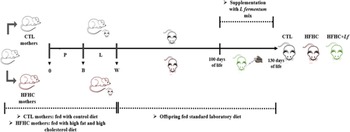
The female Wistar rats (n = 8) were maintained in polypropylene cages up to 90 days of age. Posteriorly, pregnant rats were allocated to a control group (n = 4) and received a diet prepared according to the American Institute of Nutrition – AIN-93G; or a HFHC group (n = 4) that received a diet (Table 1) purchased from Rhoster Company (Araçoiaba da Serra, São Paulo, Brazil) during pregnancy and lactation period as previously described. Reference Guimaraes, de Araujo and Aquino1,Reference Pinheiro, Lins and de Carvalho16,Reference de Araujo, Guimaraes and Magnani17 After weaning (postnatal day 21), male rat offspring (CTL, n = 16 and HFHC, n = 15) were weighted, housed separately (3−4 per cage), and had free access to a commercial diet (Presence Purina, Paulínea, São Paulo, Brazil) and water ad libitum up to 100 days of age. At that age, the experimental groups were randomly formed with one to two rats from each litter. The CTL group was formed for six male offspring (n = 6) from the dams fed a CTL diet. The HFHC group was formed for five male offspring (n = 5) from the dams fed a HFHC diet. Similarly, HFHC + Lf group was formed for five male offspring (n = 5) from the dams fed a HFHC diet and received the multistrain Limosilactobacillus fermentum formulation (HFHC + Lf group) twice a day in a solution of approximately 3 × 10⁹ CFU/mL by oral gavage for 4 weeks (Fig 1).
Graphic design of the formation of experimental groups. B: Birth; CTL: Control; HFHC: High fat and high cholesterol; HFHC + Lf: High fat and high cholesterol diet and Limosilactobacillus fermentum formulation; L: Lactation; P: Pregnancy; W: weaning.

Nutritional composition of control diet (CTL diet) and high fat and high cholesterol diet (HFHC diet)

Composition values obtained from previously established protocols.
* CTL diet adapted from Reeves; Nielsen; Fahey, (1993).
** HFHC diet according to Rhoster - Industry and Trade Ltda.
∞ Casein had 85% purity (85 g protein for each 100 g casein).
# Tert-butylated hydroxytoluene.
Limosilactobacillus fermentum strains
Limosilactobacillus fermentum 139, 263, and 296 strains were gently provided by Laboratory of Food Microbiology, Department of Nutrition, Federal University of Paraíba (João Pessoa, Paraíba, Brazil). Stocks were stored at −20 °C in Mann, Rogosa, and Sharpe (MRS) broth (HiMedia, Mumbai, India) containing glycerol (Sigma-Aldrich, St. Louis, USA; 20 mL/100 mL). The probiotic cell suspension was obtained from overnight cultures grown on MRS broth (HiMedia, Mumbai, India) under anaerobic conditions (Anaerobic System Anaerogen, Oxoid Ltda., Wade Road, UK) at 37 °C. Reference de Oliveira, Cavalcante and Cavalcanti Neto14,Reference Cavalcante, de Albuquerque and de Luna Freire15 The mixed cell suspension with counts of approximately 9 log CFU/mL of each strain was obtained with a mixture of each probiotic strain suspension in a ratio of 1:1:1.
Urinary analysis
After the supplementation period, the male rats were individually acclimatized in metabolic cages for 3 days and on the 4th day, 24-h urine collection was done. The urinary volume was measured and freeze-stored (−20 °C). The urinary measurements of urea, creatinine, and total proteins were done with commercial kits following the protocols according to the manufacturer instructions (Bioclin, Belo Horizonte, Minas Gerais, Brazil). The creatinine clearance (CCr) was calculated with the formula: CCr = Urinary Creatinine × Urinary volume of 24h/plasmatic creatinine. Reference Ogundipe, Akomolafe, Sanusi, Imafidon, Olukiran and Oladele18
Blood pressure and heart rate measurement
Blood pressure (BP) was recorded by tail-cuff plethysmography (V2.11 Plethysmography, Insight, Ribeirão Preto, São Paulo, Brazil). For 3 days, rats were encouraged to walk into the restraint tubes and acclimatized for approximately 1 h before experiments began. After the adaptation period, BP and heart rate were measured. Reference do Nascimento, Neto, de Andrade Braga, Lagranha and de Brito Alves9 For each record, 15 cycles of inflation and deflation were done. Ten out of the 15 recorded values were used to calculate the average.
Euthanasia and blood collection
After urine collection and BP measurements, the rats were euthanized by decapitation, and blood was collected. To obtain the serum, the blood was centrifuged (58.136 g, 15 min, 4 °C). Serum measurements for creatinine concentration were done with enzymatic colorimetric kits (Bioclin).
Measurement of oxidative stress in colon and kidney
The right kidney and a portion of the colon were collected and freeze-stored (−80 °C) for further analysis. Renal cortex and colon tissues were homogenized in a cold buffer solution with 50 mm Tris and 1 mm EDTA (pH 7.4), 1 mm sodium orthovanadate, and 200 μg/mL phenylmethanesulfonylfluoride using an IKA RW 20 digital homogenizer, a pestle of potter-Elvehjem and glass tubes on ice. Homogenates were centrifuged (1,180 g, 10 min, 4 °C). Reference Pedroza, Ferreira and Santana19 Protein contents were determined with Bradford protocol. Reference Bradford20
Assessment of lipid peroxidation
An aliquot (0.3 mg/mL) of homogenate of tissues (renal cortex and colon) was used to quantify the production of malondialdehyde (MDA) in reaction with thiobarbituric acid (TBA, 100 °C). Sequential addition of 30% (v/v) of trichloroacetic acid and Tris−HCl (3 mm) was done to the sample, followed by centrifugation (2500xg, 10 min, 4 °C). TBA (0.8%, v/v) was added to the resulting supernatant, mixed, boiled for 15 min, and after cooling, the reaction was read at 535 nm on a spectrophotometer.
Assessment of superoxide dismutase (SOD) activity
Total superoxide dismutase (SOD) enzyme activity was determined according to Misra and Fridovich method. The tissue (renal cortex and colon) samples (0.3 mg/mL) were mixed with sodium carbonate buffer (0.05%, pH 10.2, 0.1 mmol/L EDTA, 37 °C), added of 30 mM/L of epinephrine (in 0.05% acetic acid). SOD activity was measured by the kinetics of epinephrine auto-oxidation inhibition for 1.5 min at 480 nm read on a spectrophotometer. Reference Misra and Fridovich21
Assessment of catalase (CAT) activity
Catalase activity was determined by the decomposition of H2O2 into O2 and H2O. A sample of tissue (renal cortex and colon) homogenate (0.3 mg/mL) in 50 mm phosphate buffer (pH 7.0) was added of 0.3M H2O2. Absorbance was measured at 240 nm for 1.5 min on a spectrophotometer. Reference Aebi22
Assessment of glutathione S-transferase (GST) activity
A sample of tissue (renal cortex and colon) homogenate (0.3 mg/mL) was used to quantify GST activity, as previously described. Reference Habig, Pabst and Jakoby23 Phosphate buffer (0.1 M, pH 6.5 containing 1 mm EDTA), 1 mm 1-chloro-2,4-dinitrobenzene (CDNB), and 1 mm reduced glutathione (GSH) were added to tissue homogenate samples. Absorbance was measured at 340 nm for 1.5 min on a spectrophotometer.
Assessment of total thiols groups
Tissue (renal cortex and colon) homogenates samples (0.3 mg/mL) were incubated in extraction buffer (previously described) with 10 mm of 5,5'-dithiobis (2-nitrobenzoic acid) in a dark environment for 30 min. The absorbance of the reaction was measured at 412 nm on a spectrophotometer. Reference Ellman24
Statistical analysis
Kolmogorov Smirnov test was used to assess the normality of data. The variables were reported as mean ± standard deviation and required the one-way analysis of variance (ANOVA) parametric test and Tukey post hoc test. For body weight measurements, statistical significance was evaluated with ANOVA (two-way test) with Bonferroni’s post hoc test. Statistical analysis was done with the software Prism 5 (GraphPad Software, San Diego, CA, USA). The difference was considered significant when p was < 0.05.
Results
Body weight
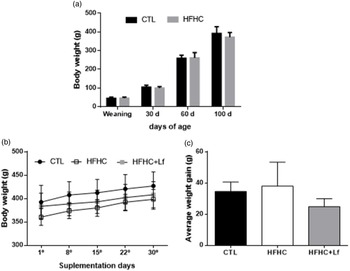
Body weight at weaning up to 100 days of age was similar between groups (p > 0.05, Fig 2A). The body weight and weight gain at the end of the protocol were similar among groups (p > 0.05, Fig 2B and C).
Assessment of bodyweight at weaning up to 100 days of age and the effects of a multi-strain formulation with Limosilactobacillus fermentum 139, 263 296 on body weight in male offspring of dams fed a HFHC diet during pregnancy and lactation. Groups: control (CTL); high fat and high cholesterol (HFHC); high fat and high cholesterol receiving Limosilactobacillus fermentum 139, 263, and 296 (HFHC + Lf). Data are presented as mean ± standard deviation and analyzed by ANOVA one-way test with Tukey as post-hoc test or ANOVA two-way with Bonferroni post-hoc test.

Blood pressure
Male offspring from dams fed a HFHC diet had increased SAP (CTL: 115 ± 6.5 vs HFHC: 127 ± 1.1mmHg, p = 0.013, Figure) and MAP (CTL: 89 ± 5.5 vs HFHC: 98 ± 3.8 mmHg, p = 0.034) when compared to the CTL group (Fig 3A and C). Administration of Limosilactobacillus fermentum formulation reduced SAP (HFHC: 127 ± 1.1 vs HFHC + Lf: 112 ± 4.2mmHg, p = 0.004), DAP (HFHC: 83 ± 5.3 vs HFHC + Lf: 74 ± 3.7mmHg, p = 0.049), and PAM (HFHC: 97 ± 1.9 vs HFHC + Lf: 87 ± 3.4 mmHg, p = 0.015) when compared to HFHC group (Fig 3A-C). HR was similar among groups (p > 0.05, Fig 3D).
Effects of a multi-strain formulation with Limosilactobacillus fermentum 139, 263, and 296 strains on blood pressure in male offspring of dams fed a HFHC diet during pregnancy and lactation. Assessment of systolic arterial pressure (SAP, A), diastolic arterial pressure (DAP, B), mean arterial pressure (MAP, C) and heart rate (D). Groups: control (CTL); high fat and high cholesterol (HFHC); high fat and high cholesterol receiving Limosilactobacillus fermentum 139, 263, and 296 (HFHC + Lf). Data are presented as mean ± standard deviation and analyzed by ANOVA one-way test with Tukey as post-hoc test. *p < 0.05 indicates significant difference between HFHC or HFHC + Lf and CTL group; #p < 0.05 indicates significant difference between HFHC + Lf and HFD group.

Renal function
The HFHC group had a low urinary creatinine concentration compared to the CTL group (p = 0.018, Table 2). In contrast, the HFHC + Lf group had higher creatinine levels than the group exposed to HFHC diet (p = 0.007, Table 2). The urinary and serum creatinine values allowed to analyze creatinine clearance, an important indicator of renal function. There was a reduction in CCr in the HFHC group compared to the CTL group (p = 0.048, Table 2). On the other hand, administration of Limosilactobacillus fermentum formulation restored the renal function in male offspring from dams fed a HFHC diet (p = 0.040, Table 2). Serum levels of creatinine, urea, total proteins, and urinary volume were similar among groups (p > 0.05, Table 2).
Biochemical parameters of male offspring of dams fed a control diet (CTL) or high-fat high cholesterol diet (HFHC) during pregnancy and lactation and supplemented with a multi-strain formulation with Limosilactobacillus fermentum 139, 263, and 296 (HFHC + Lf)

CCr, Creatinine clearance.
* Shows significant difference compared to CTL.
† Shows significant difference compared to HFHC
Indicators of oxidative stress in the colon
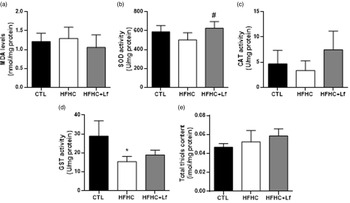
The MDA levels, CAT activity, and thiols content in colonic mucosa were similar among groups (p > 0.05, Fig 4A, C, and E). HFHC group displayed reduced GST enzyme activity (CTL: 28.9 ± 8.1 vs. HFHC: 15.3 ± 2.8 U/mg protein, p = 0.003) compared to the CTL group (Fig 4D). Administration of a mixed Limosilactobacillus fermentum formulation increased antioxidant SOD activity (HFHC: 502 ± 75 vs. HFHC + Lf: 626 ± 70 U/mg protein, p = 0.040) in colon mucosa of male offspring exposed to maternal HFHC diet (Fig 4B).
Effects of a mixed formulation with Limosilactobacillus fermentum 139, 263, and 296 on oxidative stress parameters in colon mucosa in male offspring of dams fed a HFHC diet during pregnancy and lactation. Assessment of malondialdehyde levels (MDA, A), superoxide dismutase activity (SOD, B), catalase activity (CAT, C), glutathione S-transferase activity (GST, D), and total thiols content (E) in the colon mucosa. Groups: control (CTL); high fat and high cholesterol (HFHC); high fat and high cholesterol receiving Limosilactobacillus fermentum 139, 263, and 296 (HFHC + Lf). Data are presented as mean ± standard deviation and analyzed by ANOVA one-way test with Tukey as post-hoc test. *p < 0.05 indicates significant difference between HFHC or HFHC + Lf and CTL group; #p < 0.05 indicates significant difference between HFHC + Lf and HFD group.

Indicators of oxidative stress in the renal cortex
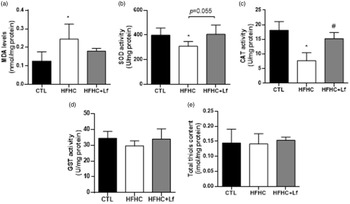
The GST activity and thiols content in the renal cortex were similar among groups (p > 0.05, Fig 5D and E). Male offspring from dams fed a HFHC diet had increased MDA levels (CTL: 0.12 ± 0.05 vs. HFHC: 0.25 ± 0.08 nmol/mg protein, p = 0.023) and reduced SOD (CTL: 399 ± 58 vs. HFHC: 309 ± 38 U/mg protein, p = 0.051) and CAT activities (CTL: 18.2 ± 2.9 vs. HFHC: 7.7 ± 2.7 U/mg protein, p = 0.003) in renal cortex when compared to CTL group (Fig 5A-C). Administration of Limosilactobacillus fermentum formulation restored the functional capacity of CAT activity in the renal cortex (HFHC: 7.7 ± 2.7 vs. HFHC + Lf: 15.2 ± 2.1 U/mg protein, p = 0.005, Fig 5C), besides tending an increase SOD activity (HFHC: 309 ± 38 vs. HFHC + Lf: 406 ± 75 U/mg protein, p = 0.055, Fig 5B) in male offspring from dams fed a HFHC diet.
Effects of a mixed formulation with Limosilactobacillus fermentum 139, 263, and 296 on oxidative stress parameters in renal cortex in male offspring of dams fed a HFHC diet during pregnancy and lactation. Assessment of malondialdehyde levels (MDA, A), superoxide dismutase activity (SOD, B), catalase activity (CAT, C), glutathione S-transferase activity (GST, D), and total thiols content (E) in the renal cortex. Groups: control (CTL); high fat and high cholesterol (HFHC); high fat and high cholesterol receiving Limosilactobacillus fermentum 139, 263, and 296 (HFHC + Lf). Data are presented as mean ± standard deviation and analyzed by ANOVA one-way test with Tukey as post-hoc test. *p < 0.05 indicates significant difference between HFHC or HFHC + Lf and CTL group; #p < 0.05 indicates significant difference between HFHC + Lf and HFD group.

Discussion
The HFHC consumption during pregnancy has been shown to induce oxidative stress on the gut-kidney axis in rat offspring, renal dysfunction, and arterial hypertension later in life. Reference do Nascimento, Neto, de Andrade Braga, Lagranha and de Brito Alves9 The results of the present study have demonstrated for the first time that administration of a multistrain Limosilactobacillus fermentum formulation reduced systolic, diastolic, and mean blood pressure levels and alleviated renal dysfunction and oxidative stress along the gut-kidney axis in male offspring from dams fed a HFHC diet during pregnancy and lactation.
Programmed arterial hypertension provoked by HFD consumption during pregnancy and/or lactation is complex and involves several impairments in key mechanisms related to blood pressure control. Reference Guimaraes, de Araujo and Aquino1,Reference Zhang, Huo and Fang25 It has been reported that gut inflammation and oxidative stress can compromise gut barrier integrity, favor LPS-translocation, and promote low-grade inflammation. Reference Tremaroli and Backhed26 At the central nervous system, inflammation can lead to sympathetic overactivity and increased blood pressure. Reference Yang, Santisteban and Rodriguez27 On the other hand, the activation of the sympathetic nervous system induces increased gut permeability, low-grade inflammation, and alterations of gut microbiota composition, which in turn contribute to neuronal activity by releasing pathogenic bacterial metabolites into circulation. Reference Santisteban, Qi and Zubcevic28,Reference Li, Yang, Zhou and Cai29 Early studies have found increased gut damage, sympathetic hyperactivity, and enhanced blood pressure in offspring from dams fed a HFHC diet during pregnancy and lactation. Reference Guimaraes, de Araujo and Aquino1,Reference Pinheiro, Lins and de Carvalho16
Therapeutic strategies to alleviate the deleterious effects of maternal HFD consumption on blood pressure and cardiovascular function in offspring later in life are under investigation. Recent studies have suggested that interventions targeting the gut microbiota during pre-and postnatal periods could be important to prevent or reduce the risk of cardiovascular disorders in offspring later in life. Reference de Oliveira, Cavalcante and Cavalcanti Neto14,Reference Guimaraes, Braga and Noronha30,Reference de Brito Alves, de Oliveira and Carvalho31 Dams fed a HFD and supplemented either with a prebiotic (long-chain inulin) or probiotic (Lacticaseibacillus casei) Reference Hsu, Hou, Chan, Lee and Tain32 or Lactiplantibacillus plantarum WJL Reference Guimaraes, Braga and Noronha30 during pregnancy and lactation improved maternal gut microbiota diversity and protected male offspring against arterial hypertension and endothelial dysfunction.
Furthermore, it has been demonstrated that oral administration of Limosilactobacillus fermentum postweaning up to 90 days of age improved blood pressure and autonomic dysfunction in rat offspring exposed from dams fed a HFD. Reference de Oliveira, Cavalcante and Cavalcanti Neto14 This study has shown that administration of Limosilactobacillus fermentum in adult rats also had a hypotensive effect in male offspring from dams fed a HFHC diet during pregnancy and lactation. These results suggest that targeting the gut microbiota on different developmental windows can exert a reprogramming strategy against arterial hypertension induced by maternal HFD consumption.
Although the underlying mechanisms by which Limosilactobacillus fermentum reduced blood pressure have not been assessed in the present study, some possible pathways related to probiotic-induced-hypotensive effects have been proposed. Reference Cookson33 First, it has been demonstrated that gut barrier integrity can be rescued by probiotic therapy, reducing LPS-translocation, inflammation, sympathetic activity, endothelial dysfunction, and blood pressure. Reference Li, Yang, Zhou and Cai29,Reference Grylls, Seidler and Neil34 Second, short-chain fatty acids (SCFA), including acetate, propionate, and butyrate, are produced by specific gut microbes and can be enhanced during probiotic therapy. Reference de Luna Freire, do Nascimento and de Oliveira35 An early study demonstrated that butyrate could lower arterial blood pressure via colon-vagus nerve signaling and GPR41/43 receptors. Reference Onyszkiewicz, Gawrys-Kopczynska and Konopelski36 The propionate effect on blood pressure showed that propionate at low concentrations could activate Gpr41 and decrease blood pressure. In contrast, high concentrations can activate Olfr78 and increase blood pressure via renin signaling in the renal juxtaglomerular apparatus. Reference Pluznick, Protzko and Gevorgyan37,Reference Natarajan, Hori and Flavahan38 Third, the genus Lactobacillus has abundant gamma-aminobutyric acid (GABA)-producing species, including Limosilactobacillus fermentum. Reference Cui, Miao, Niyaphorn and Qu39 Although the effects of luminal GABA in the gut on blood pressure control are still controversial, there is evidence demonstrating that GABA can bind GABAB receptors and stimulate 5-HT release, attenuate sympathetic activity, and reduce blood pressure. Reference Kimura, Hayakawa and Sansawa40
In agreement with early studies, Reference do Nascimento, Neto, de Andrade Braga, Lagranha and de Brito Alves9,Reference Jackson, Alexander and Roach41 maternal HFD diet consumption increased susceptibility to renal dysfunction and oxidative stress in kidney and colon mucosa in offspring later in life. Early investigations have demonstrated that administration of probiotic decrease renal dysfunction Reference Wanchai, Yasom and Tunapong42,Reference de la Visitacion, Robles-Vera and Toral43 and alleviate oxidative stress Reference Feng and Wang13,Reference Yadav, Khan, Mada, Meena, Kapila and Kapila44 in rats fed a HFD. For the first time, the results of this study have shown that the administration of a multistrain formulation with Limosilactobacillus fermentum with probiotic aptitudes, Reference de Oliveira, Cavalcante and Cavalcanti Neto14,Reference Cavalcante, de Albuquerque and de Luna Freire15 improved renal function and antioxidant capacity along the gut-kidney axis in male offspring from dams fed a HFHD during pregnancy and lactation.
Although underlying mechanisms by which examined Limosilactobacillus fermentum formulation increased antioxidant capacity in colon and renal cortex were not explored in the present study, it has been reported MnSODs enzyme activity, Reference Feng and Wang13 pseudocatalases, Reference Kono and Fridovich45 and heme-dependent catalase Reference Knauf, Vogel and Hammes46 for some lactic acid bacteria. This becomes important since SOD has a key role in catalyzes of dismutation of superoxide anion in hydrogen peroxide, while CAT has a fundamental role in cellular detoxification of hydrogen peroxide, promoting a critical oxidative stress tolerance and antioxidant effect. Reference Feng and Wang13 Second, the effects promoted by the administration of Limosilactobacillus fermentum formulation on renal function may be due to their ability to improve impermeability and immune function of the intestinal epithelium, preventing toxic compounds, such as lipopolysaccharides, from reaching the kidneys and causing their deleterious effects. Reference Yang, Richards, Pepine and Raizada47 Lastly, short-chain fatty acid (acetate, propionate, and butyrate) generated from colonic bacterial fermentation can directly affect epigenome through histone posttranslational modifications. Reference Koh, De Vadder, Kovatcheva-Datchary and Backhed48 Whether epigenetic pathways are involved in antioxidant capacity provoked by Limosilactobacillus fermentum formulation remains to be elucidated.
Although we have recently shown that Limosilactobacillus fermentum formulation alleviated gut microbiota impairment in male rats fed a HFD, Reference de Araujo Henriques Ferreira, Magnani and Cabral49 the lack of gut microbiota composition after Limosilactobacillus fermentum administration could be considered a bias for the results in this preclinical study.
In conclusion, administration of a multistrain containing three potentially probiotic Limosilactobacillus fermentum strains alleviated programmed hypertension, renal dysfunction, and enhanced antioxidant capacity along the gut-kidney axis in male offspring from dams fed a HFHC diet during pregnancy and lactation. These results indicate that gut targeting interventions could be a safe strategy for developmental reprogramming of arterial hypertension.
Acknowledgments
The authors thank the Coordenação de Aperfeiçoamento de Pessoal de Nível Superior (CAPES, Brazil – Finance code 001) for a scholarship awarded to MO de Luna Freire. Additionally, authors thank the Paraiba State Research Foundation (FAPESQ) for the scholarship awarded to LCP do Nascimento and supported grants (PRONEX, ID: 007/2019 FAPESQ-PBMCTI/CNPq). Lastly, the authors thank the research productivity fellowship from Brazilian National Council for Scientific and Technological (CNPq) awarded to JL de Brito Alves.
Financial support
This study received grants of Paraiba State Research Foundation (PRONEX, ID: 007/2019 FAPESQ-PBMCTI/CNPq).
Conflicts of interest
The research was conducted in the absence of any commercial or financial relationships that could be construed as a potential conflict of interest.
Ethical standards
The authors assert that all procedures contributing to this work comply with the ethical standards of the relevant national guides on the care and use of laboratory animals (National Council for the Control of Animal Experimentation) and has been approved by the institutional committee of Federal University of Paraíba.