1. INTRODUCTION AND THEORETICAL ASSUMPTIONS
The evolution of French sentential negation is one of the important features of French morphosyntactic variation in diachrony and it reveals a major morphosyntactic change that is still ongoing. This change can be summarised as described by Jespersen (Reference Jespersen1917): initially, ne was the unique pre-verbally placed particle of negation. Later, a number of post-verbal particles of reinforcement like pas, mie or point were grammaticalised and used together with ne.Footnote 1 In Modern French, the use of ne alone is heavily restricted,Footnote 2 and ne-pas is the standard sentential negation. In modern spoken French, there is a clear tendency to drop ne (J'viens pas – 1SG come-PRS.1SG NEG – ‘I don't come’). This more recent evolution is discussed in other contributions to the present Special Issue (e.g. in Zimmermann and Kaiser as well as in Meisner and Pomino), but it is not the focus of our paper. We will concentrate on Old French negation instead.
The medieval variation between ne-Ø and ne-particles has been discussed primarily in terms of emphasis marking and grammaticalisation (e.g. Detges, Reference Detges, Blank and Koch2003; van der Auwera, Reference van der Auwera and van Gelderen2009), but only little in terms of variationalFootnote 3 linguistics. The research presented in this paper will not be concerned with the process nor with the grammaticalisation of pas, mie, point (and their variants); it has been motivated by our intention to uncover factors that correlate with the variation between ne-Ø and ne+reinforcment in ‘text languages’ in general, i.e. languages or language stages that no longer have living native speakers, but only written sources.Footnote 4 In order to be able to identify the variance between text types, we will first examine variations found in the manuscripts of one and the same narrative text, i.e. the Charroi de Nîmes (composed in the 12th century, manuscripts from the 13th and 14th centuries), and then compare these results with those of the study of variation in a corpus of 180 Old French charters from the 13th century.
We have chosen these sources for the following reasons: Firstly, they provide us with different text types, which allow textual comparisons. Secondly, these text types permit us to study linguistic variability inside each of the sub-corpora due to their internal comparability. Both corpora present linguistic variation framed by their respective tradition (all Charroi manuscripts contain the same narration) and sociopragmatic context (the charters represent the parochial political and economic relations between given medieval sovereigns), which excludes thematic randomness. Importantly, we insist that different manuscript versions of one story should no longer be considered errors of copyists (as claimed in the Lachmannian tradition). The so-called ‘New Philology’ has drawn medievalists’ attention to the fact that copyists working on non-authoritative secular texts are not just copying an original or ‘Vorlage’. More often than not they are in fact involved in a complex activity of transmission of a cultural product with a specific public in mind (see Cerquiglini, Reference Cerquiglini1989, the special issue of Speculum vol. 65, 1990 and Schøsler, Reference Schøsler, Bozzi, Cignoni and Lebrave2004a, with references).
Our choice of descriptive factors that potentially correlate with ne alone or ne-reinforcement is rooted in basic assumptions of variational linguistics in the tradition of Flydal (Reference Flydal1952) and Coseriu (Reference Coseriu1966). Among these assumptions, we maintain in particular that in order to understand language change, it makes sense to investigate not only language internal correlations, but also extralinguistic factors, including diatopic, diastratic, and diamesic ones, because we believe that language change is not only linked to internal, but also to language external factors. We combine these variational assumptions with the ideas on the spreading of language change presented by Andersen (Reference Andersen and Eythórsson2008). According to the actualisation theory of Andersen, innovation ‘from below’ spreads from unmarked to marked syntactic contexts: ‘Typically in internally motivated change, an innovation is extended to unmarked contexts earlier than to corresponding marked contexts [. . .]’ (Andersen, Reference Andersen and Eythórsson2008: 36). An innovation ‘from above’, on the other hand, spreads from marked to unmarked syntactic contexts and is typically introduced in a situation of language contact. This could, for example, consist of an influence from the standard language on dialects, or from a foreign language of prestige. In the case of innovations that start from below and are internally motivated, such as the negation particles studied in this paper, we would expect to find the first occurrences in unmarked contexts, which in terms of text genre are closest to direct speech. These will later spread to other contexts. Moreover, in terms of language structure, we expect internally motivated changes to start in unmarked categories, i.e. in main clauses before embedded clauses.
Combining the insights from variational linguistics and from the actualisation theory, the goal of this paper is to cast light on the interplay between potential factors, which are predictable from the two theoretical sources, in order to provide a better understanding of synchronic variation in ongoing language change. Thus, the purpose of this study is not an exhaustive description of variation in negation in medieval French, but a paradigmatic description of a ‘synchronic snapshot in history’ which allows us to identify intra- and extralinguistic factors triggering the different variants.
In the following sections, we will first present our corpora (section 2), and our methodology (section 3). The sections 4, 5 and 6 present the results of our empirical investigations. We will study potential factors determining variation, starting from intralinguistic factors (section 4), and progressing to extralinguistic factors (sections 5 and 6). We conclude in section 7.
2. TEXTUAL BASE
Our study provides a comparative analysis of two different text types: one subcorpus consists of manuscripts from the 13th to the 14th centuries that contain the same narrative text (Charroi de Nîmes); the second one consists of 180 Old French original charters dispatched or received by the Counts of Luxembourg between 1237 and 1281.
2.1 Corpus I (Charroi de Nîmes)
Corpus I consists of eight manuscripts and a fragment of the Charroi de Nîmes, which is a narrative verse text probably composed in the 12th century. The manuscripts all narrate the same plot, so the overall frame is identical (i.e. Guillaume d'Orange's reconquest of the Saracen-occupied city of Nîmes, by replicating the ruse of the Trojan Horse). However, the presentation and the wording vary among manuscripts, which date from the 13th to the 14th centuries and have been located by means of the method elaborated by Anthonij Dees (Reference Dees1987).Footnote 5
The manuscripts have been transcribed by Lene Schøsler and Pieter van Reenen. They are included first in the electronic data base of Antonij Dees, later in the new version of the Amsterdam corpus elaborated by Achim Stein (Stein et al., Reference Stein2006). There is no printed edition of the manuscripts with a systematic indication of variants.Footnote 6 The investigation of the manuscripts has been carried out manually.
2.2 Corpus II (charters)
Corpus II consists of 180 Old French original charters dispatched or received by the Counts of Luxembourg between 1237 and 1281, edited by Holtus, Overbeck and Völker (Reference Völker2003).Footnote 7 The reason for this choice is twofold:
1. The period of time: The corpus covers the period from 1237 (when the first Old French charter from Luxembourg was written under Countess Ermesinde) to 1281 (the death of Ermesinde's son, Count Henri Blondel), and therefore corresponds to the midpoint of the time period covered by the Charroi de Nímes texts (12th–14th century).
2. The regional origin of the corpus: The issues treated in the charters are mainly located in a zone around the county of Luxembourg, with the communicative range of the charters differing from charter to charter.Footnote 8 The corpus enables us to distinguish between charters with a bigger communicative range and those with a locally restricted communicative range, and to examine them separately.
2.3 Editors' policy
Both subcorpora are diplomatic editions. The editors have not changed or ‘normalised’ the text in any way. This policy assures a realistic representation of variants in the corpus, which seems to us an indispensible condition for linguistic work with diachronic texts. Due to the absence of native speaker judgements, it is not possible for a current-day editor to identify variants from mistakes with absolute certainty; even mistakes may be diachronic variants in the sense of past or future variants. In short: In the context of linguistic analysis, mistakes are simply too valuable to be eliminated from a text.
3. METHODOLOGY AND PROCEEDING
3.1 Variation in and between texts
In our manuscripts, we find that a verse is almost identical between manuscripts, except for variation in the expression of sentential negation, see e.g. verse 2897/ 1448Footnote 9 of the Charroi de Nîmes quoted below in example (1). This implies that the variants are more or less synonymous. The verse in question is found in eight out of the nine manuscripts. The mss. of the families A and B (verse 2897 / 1582) present ne + Ø,Footnote 10 C (verse 2897 / 1472) ne + mie. Ms D (verse 2897 / 1444) displays irrelevant variation without negation:
(1)

Example (1) is an illustration of the usefulness of manuscripts for the understanding of variation, because they permit an examination of comparable content, expressed in slightly different terms.
3.2 Negation: Cases included and cases excluded in the study
Our study will focus on the frequent Old French sentential negation ne + Ø in comparison to the negation with the preverbal negation particle and one of the postverbal negative adverbs mie (< lat. mica ‘breadcrumb’), pas (< lat. passus ‘step’), point (< lat. punctum ‘point’). We exclude negative pronouns like personne ‘nobody’ and partialFootnote 11 negative adverbs like gaire ‘hardly’, jamais ‘never’, plus ‘no more’ as well as negative quantifiers like aucun ‘any’. We have also excluded a number of other postverbal elements that do not occur in the charter subcorpus: âme, alie, goutte, mot (see Möhren, Reference Möhren1980).
We will not specially investigate partitive negation, i.e. negative constructions that define a quantity as distinct from a whole (Je vois des oiseaux ‘I see (some) birds’ -> Je ne vois pas d'oiseaux ‘I do not see any birds’). According to Price (Reference Price1962) and according to recent research by Martineau (Reference Martineau, Kawaguchi, Durand and Minegishi2009), point is chosen in a partitive context in Old French; the particle mie is rare, and pas is not found in a partitive context before the 17th century.
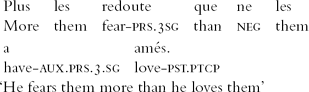
Finally, we exclude examples with expletive ne, i.e. cases where ne has no negative meaning, for example in contexts of comparison, see v. 0948 from ms. C:
(2)
3.3 Inventory of factors to study for the variation between ne . . . Ø, ne . . . mie, ne . . . pas, and ne . . . point
The traditional accounts of the distribution of ne . . . Ø, ne . . . mie, ne . . . pas, and ne . . . point have usually investigated just one of a number of possible factors of variation.Footnote 12 In contrast to traditional approaches, we have chosen to test more potential factors. As explained in the introduction, our two theoretical sources, i.e. variational linguistics and actualisation theory, adapted to the present field of investigation, lead us to propose a number of potential factors, which may provide a better understanding of the variation between ne alone and ne+reinforcement for sentential negation in our corpus, embracing both potential intra- and extralinguistic factors.
4. INTRALINGUISTIC FACTORS OF VARIATION
4.1 The closer linguistic context
It is generally accepted that the modern French particles of reinforcement of sentential negation originated as direct objects, which later lost their original meaning and grammaticalised as the second part of a bipartite sentential negation, following the well-known cycle of Jespersen (Jespersen, Reference Jespersen1917). If this is correct, there are at least two consequences:
– If particles of negation originate from direct objects, in the early stages, we should find accordingly more transitive than intransitive verbs with negative adverbs. However, verbs of movement + pas (‘step’) will supposedly behave differently from transitive verbs. We will have a closer look at this in section 4.1.1.
– If particles of negation originate from direct objects, we would expect that a ‘proper’ direct object might have an influence on the use of particles of negation. A ‘proper’ direct object might indeed block the use of particles, until these have been fully grammaticalised.
The following examples from the Charroi de Nîmes illustrate this last point, the hypothesis being that an expressed direct object prevents the use of a particle of negation.
The examples (3) 0848 A3 0406 and (4) 1200 A1 0618 clearly have ‘proper’ direct objects (honneur, gant), and no particle of negation:
(3)
(4)


In contrast to that, examples (5) and (6) have objects without articles, which function almost as incorporated objects. These objects are very close in meaning to a reinforcement particle (mal, mot):
(5)
(6)


Footnote 13 The ms B2 verse 0898 B2 0460 illustrates the case where a measure phrase (.i. denier, ‘one coin’) is very close in meaning to a reinforcement particle:
(7)

A first reading indicates to us that in the Charroi, the absence or presence of a direct object seems to have an influence on the use of negation particles. While we found that pas, mie and point never occurred together with nominal direct objects, we have observed that a pronominal direct object may be combined with the particle mie, as illustrated in verse 1270:
(8)

Therefore we need to have a closer look at the importance of transitivity for the variation between ne-Ø, ne-mie, ne-pas, and ne-point.
4.1.1 Transitivity of the verb
As stated in the beginning of section 4.1, the accepted line of thinking is that the particles of reinforcement in Modern French are grammaticalised direct objects. Consequently, it is legitimate to think that old texts display more attestations of particles with transitive verbs than with intransitive verbs, with the important exception of verbs of movement that – according to the same line of thinking – combine with the particle pas (‘step’), which was originally a measure phrase.
According to Mosegaard Hansen and Visconti (Reference Mosegaard Hansen, Visconti, Rossari, Ricci and Spiridon2009), pas and especially mie are frequently found with negated transitive verbs and with negated copula verbs (labelled predicative verbs). However, since the authors do not provide the frequencies with ne + Ø in their corpus, we cannot compare their results quantitatively to ours.
In what follows, we will present the quantitative results of our corpus study for this factor, based on corpus I.
A) Charroi de Nîmes
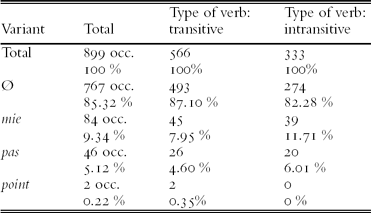
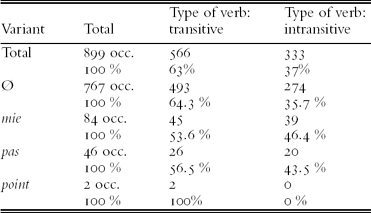
The results for the distribution of zero and particles with transitive and intransitive verbs in the Charroi are given in Table 1a: The frequency profiles of the variants do not differ sizeably between transitive and intransitive verbs. In addition to this, Table 1a' shows that the overall frequency of transitive verbs is higher than that of intransitive verbs, which explains the results of Mosegaard Hansen and Visconti (Reference Mosegaard Hansen, Visconti, Rossari, Ricci and Spiridon2009) and accordingly reduces the relevance of their observation. In our data, we see that the figures for of ne + Ø, ne + mie and ne + pas with transitive and intransitive constructions mirror the total distribution of transitive vs. intransitive verbs. This leads us to conclude that the distribution of ne + Ø and ne + particles with transitive or intransitive verbs does not permit the conclusion that transitivity is a relevant factor for the variation between the negation variants, as we find every variant with transitive and intransitive verbs. The only exception is ne + point constitutes, but this result with only two occurrences has to be interpreted with caution.
Type of verb, transitive / intransitive, and variant profiles (Charroi)

Type of verb, transitive / intransitive and frequency profiles (Charroi)
B) Charters
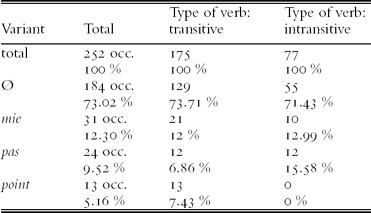
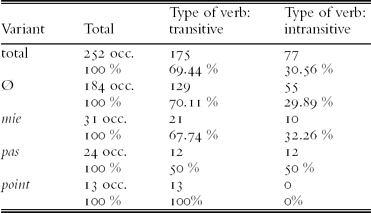
As shown in Table 1b, the frequncy of ne + Ø is stable across the two categories. In addition to this, Table 1b' shows that in the charters the distribution of ne + Ø and ne + mie between transitive and intransitive constructions coincides with the total distribution of transitive vs. intransitive verbs (ne and pas to a lesser extent). This leads us to the same conclusion, namely that transitivity is not a relevant factor for the choice of one of the negation variants. Consequently, both the figures from the charters and from Charroi fail to confirm the hypothesis of Mosegaard Hansen and Visconti (Reference Mosegaard Hansen, Visconti, Rossari, Ricci and Spiridon2009).
In both corpora, point constitutes an exception, because it seems to be tied to transitivity (tr. = 100 %), in the case of the charters (with 13 occurrences) the result is more significant than in the case of Charroi.
Type of verb, transitive / intransitive, and variant profiles (Charters)
Type of verb, transitive / intransitive and frequency of profiles (Charters)
4.1.2 Lexical semantics of the negated verb
A second consequence of the accepted line of thinking, i.e. that the particles of reinforcement in Modern French stem from grammaticalised direct objects, is that we should expect a semantic connection between certain verbs and the original object, for example between manger and mie (‘to eat’, and a ‘crumb’), between voir and point (‘to see’ and a ‘dot’), and also between verbs of movement and pas (‘step’), see e.g. the suggestion in Buridant (Reference Buridant2000: § 606).
A) Lexical semantics Charroi
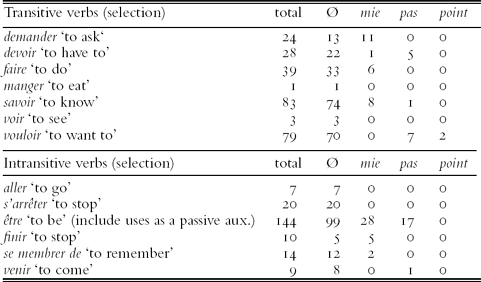
However, the investigation of a number of verbs in the Charroi, as illustrated in Table 2a, does not confirm the existence of such a connection. The verbs studied comprise a selection of transitive and intransitive verb for which a semantic link with NEG-PARTICLE could be conceivable (e.g. to go + a step ‘pas’, to see + a point ‘point’, to eat + a crumb ‘mie’, to ask + a word ‘mot’) and others for which such a link is less conceivable (e. g. to stop, to be, to remember, to have to, to do, to know, and to come).
Investigation of a semantic connection between a selection of frequent verbs having a possible semantic relation to particles of reinforcement (Charroi)
In contradiction with what could be conceived, none of the verbs mentioned above favours ‘its’ transitive object as particle of negation. Thus, our investigation clearly disproves the existence of any etymological or semantic link between the verb and NEG-PARTICLE. This result confirms the studies of Price (see e.g. 1962) and Mosegaard Hansen (Reference Mosegaard Hansen, Mosegaard Hansen and Visconti2009).
B) Lexical semantics Charters
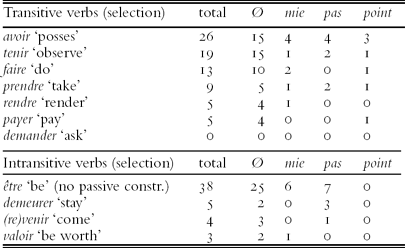
Just as in the Charroi corpus, Table 2b shows that there is no apparent semantic selection of the particle of negation by the negated verb. The overall distribution of ne + Ø, ne + pas, ne + mie and ne + point does not differ significantly from their distribution in negations with specific verbs. This might be interpreted as a hint of early grammaticalisation of the reinforcement or that there has been a missing semantic link between verb and reinforcement from the very beginning.
Semantic connection between the most frequent full verbs and the negation variants (Charters)
We find that the frequency of specific verbs differs considerably between the two corpora. The semantic constraints of different text types favouring different verbs appears to be more important than any hypothesised semantic link between the negation type and the verb.
On the contrary, influence from modal auxiliary constructions may prove interesting: Isolating modal auxiliary constructions in a supplementary analysis (Table 2c) generates a result that shows a quasi-total absence of reinforcement particles in auxiliary constructions. We conclude that the variant ne + Ø persists longer in modal auxiliary constructions and seems to be backed by them.
Semantic connection between the most frequent verbs and particles (Charters) – supplementary analysis with modal auxiliary constructions.

4.1.3 Word order: Order of the negative elements
It is known that the order of elements becomes increasingly fixed during the process of grammaticalisation (see e.g. Hopper and Traugott, Reference Hopper and Traugott1993: 50ss.). Since the grammaticalisation process of the double negation in French was not yet complete in the Middle Ages, the order of the negative elements may have an impact on the choice of the forms, i.e. ne + reinforcement or reinforcement + ne.
A) Charroi
In the mss, we find only two cases of the word order NEG-Particle + ne, both with the particle of reinforcement pas, see examples (9–10) below. In (9), mss B1–2 illustrate the inverted order, in (10), A1–4 present the inverted order. It is tempting to conclude that the presence of the particle of reinforcement has not yet reached a stage of full grammaticalisation. However, no conclusions can be drawn, due to the insufficient number of relevant examples.
(9)
(10)
B) Charters
In the charters subcorpus, no attestation of the order NEG-Particle + ne was found. All occurrences with pas, mie and point follow the word order ne + verb + reinforcement. This means that if reinforcement is used in sentential negation in this subcorpus, the word order is fixed. Together with only two attestations of reinforcement + ne in the Charroi corpus – both of which could be interpreted as resulting from rhyme or metric influence – this could be seen as an argument for an advanced grammaticalisation of pas, mie and point.
4.2 The larger linguistic context: main vs. embedded clauses
It is known that syntactic variation between main and embedded clauses may be linked to ongoing changes.Footnote 14 We will therefore investigate the possible relevance of the larger context, i.e. the opposition between main clause vs. embedded clause for the distribution of ne-Ø, ne-mie, ne-pas, and ne-point.
A) Charroi
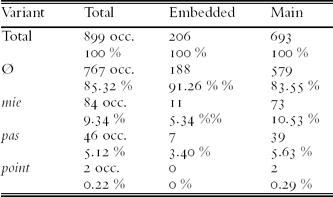
The distribution of particles of negation in the Charroi shown in Table 3a clearly shows that ne + Ø prevails overall, but more so in embedded clauses. Hansen and Visconti (Reference Mosegaard Hansen, Visconti, Rossari, Ricci and Spiridon2009) arrive at similar conclusions. Why should this be so? Here, the theory of actualisation formulated by Andersen (Reference Andersen2001 and Reference Andersen and Nedergaard2006) may provide the answer. According to this theory, language internal changes spread through the categories of a given language following a predictable order of markedness. In the case of negation, it is predictable that the innovation, i.e. the use of particles of reinforcement, will start in main clauses and subsequently spread to subordinate clauses, the latter representing the original syntax. This is indeed shown by the Charroi-data.
Correlation between clause type and ± reinforcement (Charroi)
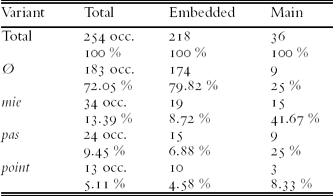
Correlation between clause type and ± reinforcement (Charters)
B) Charters
Concerning the preservation of the original syntax, i.e. of ne + Ø in the subordinate clauses, the charters confirm the observations made above. We find an even clearer overrepresentation of mie and pas in main clauses. As a collateral result, we state that the charters show a remarkably different overall distribution of main clauses vs. embedded clauses when compared with the Charroi corpus. In the charter corpus, negation occurs far more frequently in embedded clauses than in main clauses. This is certainly due to the fact that charters follow a model composed of the following formulation parts: intitulatio (INT), pubicatio (PUB), narratio (NAT), corroboratio (COR) and datatio (DAT), of which INT, PUB, COR and DAT do not usually contain formulas with negation. The only part of a charter that semantically permits negation is the NAR, the part in which the situation and the deal is described. The narratio is introduced by the publicatio e.g. with je fais savoir a tous que. . . (‘I make known to everybody that. . .’), thus the entire narratio syntactically depends on this introduction, see example (11):
(11)
[1] [INT] · Je Hanríſ Coenſ de Luceleborch · de la Rouche / et March(is) de erlonſ / [PUB] faſ conoiſſant a tous celſ quí ceſ
[2] Lettreſ verront et ourront · [NAR] que ſe Marguerite dame de la Rouche etarnoulſ ſeſ filſ Sireſ de la
[3] Rouche ne tenoent le uendage quil ont fait a touſ iorſ / al abbeeſſe et aucouant del abbeie de
[4] cleirefontaíne del ordre de citiaus qui ſiet deleiſ Erlonſ le chaſtel / eínſí comleſ Lettreſ qui en ſunt
[5] faiteſ le teſmoignent · Je le feroe tenír en bone foí loialment auſ deuant díſ ·Marg(uerite) · dame de la /
[6] Rouche / et a arnoult ſon fil ſignor de la Rouche a lour proíere et a lourrequeſte · [COR] Et pour
[7] ce que ce ſoít eſtable choſe / Je ai faít ceſ preſenſ Lettreſ ſaeleir de mon ſael / en teſmoignage
[8] de veríteí · [DAT] leſ quelſ furent doneeſ et faiteſ / En lan del íncarnatíon noſtre ſignor de – M · CC . Lv ·
[9] anſ on moíſ de feuríerFootnote 15
‘[INT] · I, Henry, Count of Luxembourg and Larochette and Marquis of Arlon, [PUB] make known to all those who see and listen to this letter· [NAR] that if Marguérite, Dame of Larochette, and Arnold, her son, Sire of [3] Larochette, do not comply with the selling of the castle of Arlon, done for keeps, to the abbess and the convent of [4] Clairefontaine of the Cistercian order just as the documents [5] written on this behalf bear witness to it, I shall make the above named Marguérite, Dame of [6] Larochette, and Arnold, her son, Sire of Larochette, following their request, observe it. [COR] And in order to [7] validate and confirm this testimony I affix my seal to the here present letter · [8] [DAT] which was issued in the year of the incarnation of Christ 1255Footnote 16 [9] in the month of February
Put differently, the massive presence of negation in embedded clauses is a consequence of the fact that the major part of the charters is the narratio, formally subordinated to aforementioned introductions like . . . fais savoir a tous que. . . / . . . fais connaissant a tous que. . .
In light of this, the overrepresentation of reinforced negation in main clauses is even more meaningful in the charters than in the Charroi.
5. THE EXTRALINGUISTIC CONTEXT (IN LITERARY TEXTS)
The following subsections provide the results of our investigations on discourse-pragmatic and textual aspects (prose vs. poetry and narration vs. direct speech); due to the nature of the texts it was only possible to do this with the Charroi subcorpus.
5.1 Discourse-new vs. discourse-old
According to a hypothesis first presented by Schwenter (Reference Schwenter, Horn, Birner and Ward2006), later elaborated by Hansen and Visconti (Reference Mosegaard Hansen, Visconti, Rossari, Ricci and Spiridon2009), specific discourse-pragmatic factors influence the use of particles of reinforcement. According to this hypothesis, the variation between forms of negation performs different pragmatic or discourse functions. Following these authors, ne . . . Ø is favored in propositions that are discourse-new, whereas in discourse-old contexts ne + reinforcement particle is used to refer to information already introduced. Accordingly, we should expect to find variation only among different particles of negation, whereas variation between the zero-form and reinforcement should be excluded, because discourse-new and discourse-old will be the same in all manuscripts. However, such a variation exists, see e.g. the verse 2897, quoted above as example (1), with variation between the zero-form and mie. In conclusion, the variation between forms of negation at this stage of language is independent of the distinction between discourse-new and discourse-old. Interestingly, Wallage (Reference Wallage2013) arrives at a similar conclusion concerning Middle English negation.Footnote 17
5.2 Prose vs. poetry
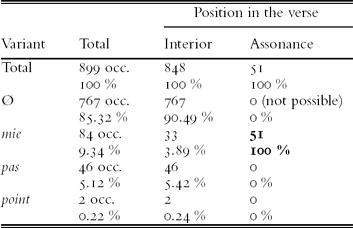
It is known that in literary texts, the distinction prose vs. verse is relevant for the understanding of variation between competing forms. For this reason we will investigate whether this distinction is also relevant for the distribution of particles of negation.Footnote 18Table 4 shows the importance of the position of the particle of reinforcement in the verse, and in particular the influence of assonance position on the use of the particle mie. This result confirms the study by Price (Reference Price1962: 18), who has found that mie is particularly frequent in assonance or rhyme position, especially in Anglo-Normand, Normand, and central dialects (Price, Reference Price1962: 24–25). Indeed, Price interprets the frequency of mie in verse texts from the 15th century as a stylistic feature.
Assonance and the distribution of Ø / particles of reinforcement (Charroi)
5.3 The distinction between narration and direct speech
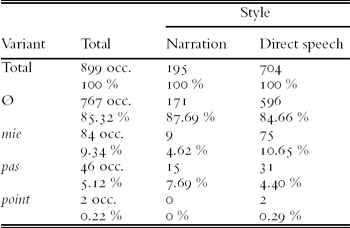
According to the principles of the theory of actualisation formulated by Andersen (Reference Andersen2001, Reference Andersen and Nedergaard2006) referred to previously, we expect internally motivated language changes to appear first in speech and later in written texts.Footnote 19 In a ‘text language’, we do not have direct access to direct speech, and we should not accept all instances of direct speech as actually reproducing orality. However, research in different domains (see Andersen Reference Andersen2001) points to systematic differences between narration and direct speech in older stages of languages. This has motivated us to study the possible relevance of this distinction for the variation of forms of negation in the Charroi. Table 5 shows that this distinction is not relevant for making a choice between Ø and particles of negation. However, against our expectation, the variant frequencies do not differ significantly between direct speech and narration. This result does not confirm the results of Price (Reference Price1962: 21).
The distribution of Ø and particles of negation according to the conception of the text (narration – direct speech, Charroi)
Let us recall that the text investigated here, the Charroi de Nîmes, was originally an epic text of oral composition, which was later written down. There are many passages of fictional direct speech in the text, and it is not sure that they are traces of its oral origin.
6. THE EXTRALINGUISTIC CONTEXT: DIASYSTEMATICALLY RELEVANT FACTORS
In the framework of variational linguistics, the general starting point is the observation that variation in linguistic productions does not only depend on internal, linguistic factors or on pure ‘performance’ errors, but that it can also be described as the reflex of coexisting different subsystems or ‘grammars’ inside one language community. Following Berruto (Reference Berruto, Auer and Schmidt2010), the most frequently assumed extralinguistic dimensions of these subsystems are the diatopic (geographic), the diastratic (social group), the diaphasic (communication context), the diachronic (time) and the diamesic (medium, oral vs. written).
As extralinguistic information is more easily available in the case of the charters than in literary texts, in the following we will focus on diatopic and diastratic factors of variation in these texts.
6.1 Diatopic variation
Regarding the influence of dialects on the distribution of negation particles in older stages of French, the most detailed study is that of Price (Reference Price1962). Price distinguishes the following diatopic distribution:
In Anglo-Normand, and Normand varieties, Price mainly found the particle pas, but hardly any cases of mie.
In central texts (Île-de-France, Champagne, Orléanais), Price mainly found the particle pas, but hardly any cases of mie or point.
In the Lorrain varieties, Price found the opposite pattern, i.e. mainly mie, but hardly any cases of pas.
In the Picard and Wallon varieties, pas and mie were rather frequent, but mie was the most frequent of the particles.
In the following, we will compare our results with those of Price (Reference Price1962).
A) Charroi
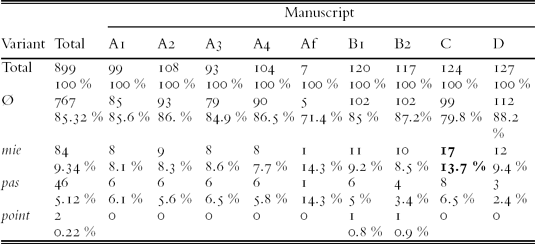
Little is known about the geographical distribution of the manuscripts of the Charroi. Only ms. C stems from the North-Western part of France, according to the localisation of Dees (Reference Dees1987). Table 6a shows an extensive use of the particle mie. This result confirms the dialectal investigation by Price (Reference Price1962).
Distribution in the manuscripts (Charroi)
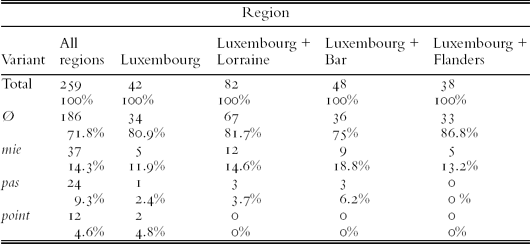
Diatopic variation of ne + Ø, ne + mie, ne + pas and ne + point (Charters)
B) Charters
The slightly elevated percentage of ne . . . mie in the charter corpus (which is mainly of Eastern and North Eastern provenance) as well as the even higher percentage of ne . . . mie in the partial corpus ‘Luxembourg + Flanders’ confirm the results of Price (Reference Price1962).
6.2 Diastratic variation
Due to its literary character, the Charroi corpus is free from socially triggered variation.
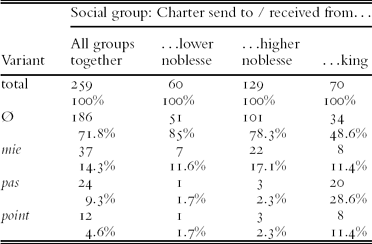
On the basis of Titz's statement (Reference Titz1926: 80s.) that the crown had a conservative influence on the written language, one might expect the frequency of ne + Ø to be higher in the King's charters than charters from a lower social strata. In order to verify this hypothesis, the charters were sorted in three diastratic groups (see Table 7). Table 7 shows the social distribution of different negation variants in the charters corpus, with a high percentage of ne + pas and a significantly low percentage of the traditional ne + Ø in the charters with an implication of the royal administration. The King's charters do not stand for the traditional variant (ne . . . Ø), but show a relatively high percentage of the innovative variant (the modern standard variant ne . . . pas). We interpret this as a hint of the important role of the King's chancery in defining written, and later on standard, French.Footnote 20 Recent studies confirm the importance of the French King's chancery for the early formation of the French standard variety (e.g. Videsott, Reference Videsott2013 and Grübl, forthcoming). This result clearly contradicts Titz Reference Titz1926.
Diastratic variation of ne + Ø, ne + mie, ne + pas and ne + point (Charters)
6.3 Diachronic variation
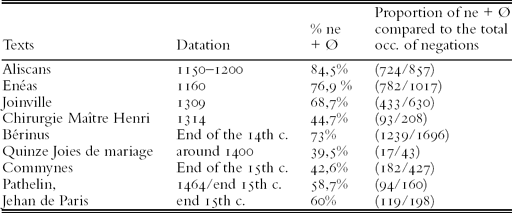
Table 8 represents an overall overview of percentages of ne . . . Ø in literary texts from the 12th to the 15th century based on information quoted in Martineau (Reference Martineau, Kawaguchi, Durand and Minegishi2009), Marchello-Nizia (Reference Marchello-Nizia1997), and Price (Reference Price1962). It shows a decline of ne + Ø, even if this decline is not a linear one. The leading theory to explain the evolution of negation is the Jespersen (Reference Jespersen1917) cycle, which interprets this evolution as a weakening cycle followed by a reinforcement cycle of negative elements. Our corpora are synchronic cuts in history and do not represent sufficient diachronic successivities. Thus, they are not composed in such a way as to permit an investigation on diachronic evolution. However, the cut is well placed to represent the transformation period from ne + Ø to ne + reinforcement. The King's charters in particular may be interpreted as a witness for this ongoing change, linked to the beginning of standardisation in French. Charters produced in relative isolation and not influenced by the King's chancery show a distinctly higher percentage of ne . . . Ø than the King's charters that prefer the innovative variant that later on will be the French standard negation.
Proportion of ne + Ø, in a selection of literary texts from the 12th to the 15th century
7. CONCLUSION
In this paper, our intention was to identify linguistic and extralinguistic factors correlating with the variation between multi-morpheme negations and the older variant ne + Ø in Old French, in order to provide a better understanding of the variation across a synchronic cut in an ongoing language change. The choice of factors to investigate was mainly rooted in variational linguistics and in the theory of actualisation. Our investigation proceeded from intra- to extralinguistic factors. Among the intralinguistic factors, we have examined factors of the textual context related to transitivity and to the lexical semantics of the negated verb. We have found indications for a correlation between the presence of a nominal direct object and the absence of negation particles, which could be interpreted in that way that the negation particle is still perceived as filling the direct object-slot. On the other hand, particles of negation are equally frequent with transitive and intransitive verbs (section 4.1 and 4.1.1). We rejected the hypothesis of a semantic link between particles of negation and verbs (section 4.1.2). We found that the order of the particles of negation virtually always conforms to patterns of modern French, i.e. ne + particle, which could be taken as a sign of advanced grammaticalisation (section 4.1.3). Concerning the larger context (still linguistic), we found that the type of clause (main vs. embedded) seems to be relevant for the distribution of ne + Ø vs. ne + particles, which conforms to the prediction made in actualisation theory. Indeed, main clauses are unmarked compared to embedded and therefore display innovation earlier than embedded clauses (section 4.2). An interesting collateral result was that the overall representation of negation in embedded vs. main clauses differs significantly between the two subcorpora. We take this as an argument for the relevance of diatextual variation. Referring to this diatextual variation turned out not to be epiphenomenal. This leads us to plead clearly for taking into account diatextual variation and the peculiarities of text types while assembling historical text corpora.
In terms of the extralinguistic context, we tested a discourse pragmatic hypothesis on the distribution of ne + Ø vs. ne + particles, because this hypothesis has been widely discussed for a number of languages. However, this hypothesis is not confirmed by our corpus. Our results do not confirm neither the relevance of factors of distribution predicted from the actualisation theory and from principles of variational linguistics, i.e. the frequency of negation particles in direct speech. Finally, our investigation has shown the relevance of factors related to diasystematic differences for the distribution of ne + Ø vs. ne + particles. Because our investigation deliberately discarded the diachronic perspective in order to study the interplay of factors in synchrony, we focused on diatopic and diastratic factors. As for diatopy, we found that the geographic origin of the texts is a relevant factor of distribution (section 6.1). Concerning diastratic variation, our investigation points to the King's chancery as a factor of innovation.
In short, our research has permitted us to study in detail the interplay of possible factors of change in a synchronic cut in time. The composition of our corpus enabled us to go into detail with distinctions that are usually difficult to study in a historical ‘text language’. In particular, it permitted us to study variants with comparable meaning, and to study both diastratic and diatopic variation.
Finally, based on a historical synchronic cut, our investigation sheds some light on the understanding of synchronic variation. Let us conclude by elaborating on this point: In order to function as a means of communication, any language has elements of stability. On the other hand, any language has elements that change. At any synchronic point, we find elements of stability and elements of innovation that the linguist can identify as such only because of his or her knowledge of diachronic processes. Our choice of negation, a linguistic variable undergoing a profound modification in the Old French period, enabled us to investigate a number of influence factors predictable from our basic assumptions about language change. We have examined in which contexts we find the old forms, and in which contexts we find the new, competing forms. Thus, our synchronic cut reveals factors of change ‘at work’, so to speak. These factors point both to the past, because the old form (ne + Ø) survives in certain contexts, and to future changes and their gradual actualisation (ne + particle) that appears in other contexts.