Abnormalities in attention are one of the best documented and most severe of the neurocognitive performance deficits in schizophrenic patients (Braff, 1993; Censits, Ragland, Gur, & Gur, 1997; Cornblatt & Keilp, 1994; Nuechterlein, 1991; Nuechterlein & Dawson, 1984b; Saykin et al., 1991, 1994). Attentional abnormalities are enduring across periods of psychosis and remission in schizophrenia (Asarnow & MacCrimmon, 1978; Nuechterlein et al., 1991, 1992; Wohlberg & Kornetsky, 1973), suggesting that these abnormalities are not secondary to symptomatic states but rather are underlying core components of the disorder (Cornblatt & Keilp, 1994; Nuechterlein, 1991). Furthermore, the presence of similar, but less severe, attentional abnormalities among the first-degree relatives of schizophrenic patients indicates that these anomalies are probably components of genetic susceptibility to schizophrenia and related disorders (Asarnow et al., 2002; Asarnow, Steffy, MacCrimmon, & Cleghorn, 1977; Cannon et al., 1994; Faraone et al., 1995; Maier, Franke, Hain, Kopp, & Rist, 1992; Nuechterlein, 1983; Nuechterlein et al., 1998; Rutschmann, Cornblatt, & Erlenmeyer-Kimling, 1977).
The relevance of abnormalities in attention to the developmental course of schizophrenia is also apparent. Attentional abnormalities among children with a schizophrenic parent have been found by late childhood and early adolescence (Asarnow et al., 1977; Nuechterlein, 1983; Rutschmann et al., 1977), and are among the best of the known predictors of a later schizophrenia spectrum outcome in such “high-risk” children (Cornblatt, Obuchowski, Roberts, Pollack, & Erlenmeyer-Kimling, 1999; Erlenmeyer-Kimling et al., 2000). In the New York High-Risk Project, a sustained, focused attention task with a high immediate memory load (Continuous Performance Test—Identical Pairs [CPT]) was able to detect a deficit by age 12 in offspring of schizophrenic parents who went on to develop a schizophrenia spectrum disorder (Cornblatt et al., 1999). This deficit remained relatively stable, relative to age-matched normal control subjects, into the early 1920s of these high-risk individuals. Thus, attentional deficits apparently can precede development of schizophrenia or related personality disorders by a number of years.
Another aspect of developmental course, changes in attentional performance over time and clinical state after onset of the first psychotic episode, also suggests the relevance of these processes for symptom formation. A focused, sustained attention task including a moderate immediate memory demand (the 3–7 CPT) identified significantly increased levels of impairment from remission to psychotic periods in recent-onset schizophrenia patients (Nuechterlein et al., 1991, 1992). This pattern of abnormality, presence even in a remitted state and increasing severity as one moves into an active symptom period, suggests the potential of certain attentional abnormalities to be mediating factors in symptom formation (Nuechterlein & Dawson, 1984a). Furthermore, poor baseline performance on this same memory-load attentional task interacts significantly with occurrence of interpersonal stress to predict higher expression of odd thoughts by schizophrenic patients (Rosenfarb, Nuechterlein, Goldstein, & Subotnik, 2000), consistent with a vulnerability/stress model of schizophrenia. Overall, this pattern of results supports the view that certain attentional processes may play a developmental role in symptom formation in schizophrenia.
Evidence that not all “attentional” deficits in schizophrenia show this same pattern of increasing significantly in severity from remission to psychotic state came from this same longitudinal study of recent-onset schizophrenia patients. A sustained attention test that shares many features with the memory-load CPT, but emphasizes sustained attention to difficult perceptual discriminations instead of a memory load (degraded stimulus CPT), showed deficits of comparable size in remitted and psychotic states (Nuechterlein et al., 1991, 1992). Thus, the relationship of attentional deficits in schizophrenia to fluctuations in symptom state may depend on the particular types of cognitive processes that are required by a specific attentional task.
Abnormalities in attention in schizophrenia also have substantial promise as predictors of later functional outcome. In a meta-analysis, attentional abnormalities in schizophrenia as indexed by sustained, focused attention, reaction time (RT), dichotic listening, and digit span tasks were clearly linked to later work and social outcome (Green, Kern, Braff, & Mintz, 2000). Indeed, cognitive abnormalities seem to predict work difficulties more clearly than do psychotic symptoms (Green, 1996). Furthermore, the contribution of attentional abnormality to prediction of work outcome in schizophrenia in some studies appears to be substantial. In first-episode schizophrenia patients, we found that a d′ index from a CPT dual-task interference paradigm produced the highest relationship (r = .55) with work outcome 9 months later (Nuechterlein, Subotnik, Green, et al., 2003). Thus, attentional deficits are viewed as one of the rate-limiting factors in successful rehabilitation of patients with schizophrenia (Green, 1996; Green & Nuechterlein, 1999).
Advantages of Dual-Task Studies for Examining Abnormalities in Attention
The words of William James (James, 1890/1983), “Everyone knows what attention is,” suggest that agreement on the nature and scope of attention would be simple to achieve. However, this has clearly not been true in studies of normal human information processing (Parasuraman, 1998; Pashler, 1998; Pashler & Johnston, 1998; Posner, 2004; Posner & Petersen, 1990) or of attentional dysfunction in schizophrenia (Cornblatt & Keilp, 1994; Hemsley, 2005; Mirsky & Duncan, 2001; Nestor & O'Donnell, 1998; Nuechterlein, 1977, 1991; Nuechterlein & Dawson, 1984b). Indeed, despite the prominence and importance of attentional deficits in schizophrenia, the basic cognitive processes that contribute to abnormalities in attention in this disorder remain unclear. One contributing factor has been that the term “attention” has sometimes been used very broadly to refer to almost all cognitive deficits in schizophrenia (Mirsky, Anthony, Duncan, Ahearn, & Kellam, 1991) and other times to refer to only one of several separable components of cognitive dysfunction (Nuechterlein et al., 2004).
Beyond this difference in semantic preferences, however, the rarity of direct collaboration between basic behavior scientists and clinical scientists studying attentional processes has slowed progress in this field. This article and the ongoing studies that it describes are the product of collaboration between a basic behavioral scientist and two clinical researchers. Theoretical and empirical developments in cognitive psychology offer ways to greatly enhance our understanding of attentional dysfunctions in schizophrenia, their possible interface with memory deficits, and their contributions to symptom onset and functional outcome. In this article, we illustrate one direction that such translation of basic cognitive paradigms to the study of schizophrenia can take to examine in more detail the nature of attentional abnormalities in this disorder.
Even before “multitasking” took on its microcomputer connotation, basic behavioral scientists recognized that the interference that occurs when people try to do two tasks simultaneously (dual-task interference) has particular promise for clarifying the nature of attentional deficits (Broadbent, 1958; Pashler, 1994a, 1998; Welford, 1952). Fine-grained analysis of dual-task performance allows direct tests of whether impairments are due to graded sharing of limited attentional processing resources (Kahneman, 1973; Wickens, 1984), strategic scheduling of processing stages (Meyer & Kieras, 1997a, 1997b), or to structural processing bottlenecks (Pashler, 1994a, 1994b, 1998).
Processing resource models of attention
The distinctions between models that view attention as one or more pools of processing resources and those that posit structural processing bottlenecks are fundamental, and have many implications for the nature of abnormalities in attention (Heuer, 1996; Kahneman, 1973; Pashler, 1993, 1998; Wickens, 1980). Processing resource models posit that limitations in attention have a fluid nature and are not specific to the type of cognitive processes that a task demands. Attention is conceptualized as one or more pools of resources that can be flexibly allocated to facilitate the efficiency of many different cognitive operations (Kahneman, 1973; Wickens, 1980, 1984). Certain types of cognitive processes, such as perceptual encoding of simple stimuli, require a low level of processing resources, whereas others, such as mental arithmetic for complex numbers, require substantial attentional resources (Beatty, 1982).
From this perspective, the performance impairments that arise when people do two cognitive tasks at once, compared to doing each separately, are due to the fact that fewer processing resources can be devoted to each task. Processing resource models generally hypothesize that a graded impairment in task performance should occur when demands of two tasks exceed available processing resources. Because allocation of the overall pool of processing resources can normally be controlled voluntarily, whether the graded impairment in performance occurs mainly on the first task or the second task depends on the task instructions and the consequences of impaired performance on each of the tasks. Thus, a processing resource model of attention leads to a search for ways to quantify the processing resource demands of different tasks and cognitive operations and for the rules that govern allocation of the flexible resources (Kramer & Spinks, 1991; Norman & Bobrow, 1975; Wickens, 1984).
Structural processing bottleneck models of attention
In a structural processing bottleneck model, although many types of cognitive processes can proceed in parallel, certain types of cognitive operations cannot occur simultaneously (Pashler, 1994a, 1998; Welford, 1952, 1967). Thus, when an individual is asked to do two tasks at once, some processes in one task can operate without interference from the other task, but interference between tasks will arise whenever both tasks demand one of the bottleneck-prone processes at the same instant. This means that some operations in one or both tasks will be postponed while corresponding operations in the other task are completed (Pashler, 1998; Pashler & Johnston, 1998). A structural processing bottleneck might arise because only one neural mechanism exists that can perform a given cognitive operation, or it might reflect some other inhibitory interactions between anatomically distinct structures (Pashler & Johnston, 1998).
Over the years, research conducted in the bottleneck tradition has tended to implicate the operation of selecting and planning responses, as well as certain other kinds of decision making, as being subject to this bottleneck. Because these kinds of operations are not closely tied to either input (sensory) or output (motoric) systems, this framework has sometimes been called the “central bottleneck theory” (Pashler, 1993, 1994a, 1998).
In schizophrenia, both structural processing bottleneck and processing resource models have been applied to interpret the abnormalities in attention. However, research with schizophrenic patients has not generally incorporated strong tests to distinguish between these different models empirically. Earlier interpretations of attentional dysfunction in schizophrenia as the result of a malfunctioning stimulus filter (McGhie, 1969; Payne, 1966; Venables, 1964) tended to assume a specific form of bottleneck model (Broadbent, 1958). This stimulus filter concept has continued to influence current interpretations of sensory or sensorimotor gating data (Adler et al., 1998; Braff & Geyer, 1990). In normal information processing, however, early perceptual bottlenecks are now considered unlikely; there is a wealth of evidence suggesting that the brain can carry out many sensory discriminations in parallel with each other and with central processing whereas, as noted above, bottlenecks involving certain central processes during dual-task performance have received empirical support (Pashler, 1998). The view that attentional abnormalities in schizophrenia are due to reduced availability or abnormal allocation of processing resources has also been very influential (Asarnow, Granholm, & Sherman, 1991; Gjerde, 1983; Granholm, Asarnow, & Marder, 1996; Nuechterlein & Dawson, 1984b). Because the basic nature of attentional deficits, the variables influencing them, and the likely strategies for reversing them are very different in these two models of attention, clinical research that can determine which model best accounts for attentional abnormalities in schizophrenia has far-reaching implications. Abnormalities within a structural bottleneck model, for example, could be found to involve an altered cognitive architecture in which a certain stage of processing (e.g., initial perceptual processing) interferes with simultaneous decision, response selection, and memory retrieval processes in a way that does not characterize normal cognition. This result would implicate a much more specific locus of attentional dysfunction than a processing resource model.
Making these distinctions could have strong implications for possible intervention strategies to alleviate attentional deficits in schizophrenia. Processing resource models lead one to emphasize monitoring overall processing loads and either avoiding excessive loads or finding ways to allocate limited processing resources to the key aspects of tasks (Asarnow et al., 2002; Fowler, Garety, & Kuipers, 1995; Nuechterlein & Dawson, 1984a). Identifying specific stages of processing that interfere with each other in abnormal ways or to an abnormal extent could refine the intervention focus. For example, studies focusing on structural processing bottlenecks in dual-task situations might demonstrate that in schizophrenia initial perceptual processing in a task cannot occur in parallel with decision making and response selection. Alternatively, these two processes might proceed in parallel as in normal individuals, but the decision-making process in one task might interfere with decision making in the other task much more than normally occurs. These structural processing bottleneck findings would lead one to emphasize cognitive training or pharmacological interventions that particularly target specific processing mechanisms to alleviate attentional dysfunction in schizophrenia rather than overall influences on the availability or allocation of processing resources.
Psychological Refractory Period (PRP) Paradigm
To discriminate between structural processing bottleneck and processing resource models of attention, one needs to examine dual-task performance in a temporally fine-grained manner, measuring the latency of individual operations (Pashler, 1994a, 1998). This approach contrasts with the common practice in many attention studies (both basic and clinical in focus) in which subjects perform some tasks for many seconds or even minutes, and their aggregate performance is examined. These relatively coarse forms of measurement are not likely to pinpoint bottlenecks, or even to discriminate between bottleneck theories and capacity-sharing theories. If processing bottlenecks exist (i.e., certain cognitive processes must be done one at a time), one would expect people to switch back and forth between the two tasks very rapidly when cognitive operations that cannot be accomplished simultaneously are required during the same time period. Thus, dual-task performance impairments that result from this sort of switching between tasks may look very similar to impairment that is a result of graded sharing of processing resources. However, examining dual-task performance by measuring performance on individual tasks performed in temporal proximity to each other allows more precise predictions because of greater ability to isolate the periods during which various cognitive operations are required.
One paradigm that is particularly well suited to differentiating graded performance impairments from the more discrete impairments hypothesized for a structural processing bottleneck is the PRP design. This classic paradigm (Welford, 1952) has been refined over the years to allow specific tests of a series of predictions concerning the presence and the nature of a processing bottleneck (Pashler, 1994a, 1998; Pashler & Johnston, 1998). The basic design involves discrete trials in which the subject is presented with two different stimuli (S1 and S2) presented in rapid succession and must make a speeded response to each (R1 and R2). The interval between the onset of the two stimuli (stimulus onset asynchrony [SOA]) is varied, usually from short intervals of about 50 ms to longer intervals of 1 s or greater. As the SOA between the stimuli is shortened, responses to the second stimulus become slower, often by hundreds of milliseconds. That is, as the beginning of the second task comes very shortly after the beginning of the first task, the second task takes much longer to complete than it does when there is little or no temporal overlap between the two tasks.
This dramatic slowing of the response to the second task (R2) occurs on almost all tasks that involve a choice of response. Slowing of Task 2 response occurs even when the two stimuli are in different input modalities (auditory and visual) and even when the two responses are quite separate (manual and vocal), which is consistent with the idea of a central bottleneck (Pashler, 1998). Furthermore, slowing of response to the second task (R2) at shorter SOAs often occurs in the absence of any slowing of the first-task response (R1; Pashler & Johnston, 1989).
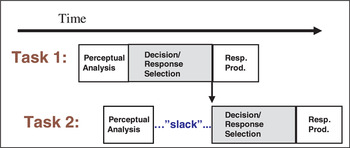
This slowing of response to the second task at short SOAs is clearly consistent with the idea of a bottleneck, that is, some processing stages in the second task must wait until completion of some aspects of processing in the first task. In contrast, the total time taken to complete both tasks together (S1 to R2) is often significantly less than the sum of the time required to do each task separately, indicating that some components of the two tasks are performed in parallel. Figure 1 shows how a bottleneck at a central processing stage could account for the observed slowing of response for the second task. Both tasks have perceptual processing, decision or response selection, and response production components, which is typical of choice RT tasks. The processing bottleneck is shown at the decision or response selection stage, as hypothesized by Welford (Welford, 1967, 1980). Thus, at short SOAs, perceptual processing for both tasks can occur in parallel. However, although the response selection stage proceeds in Task 1, response selection for Task 2 cannot start. Thus, a waiting or “slack” period occurs for Task 2, which lengthens RT for this task (RT2), while RT for Task 1 (RT1) is unaffected. As the SOA increases, duration of waiting to start the decision or response selection component of the second task decreases. If the SOA is long enough to allow the response selection phase of Task 1 to be completed before perceptual processing for Task 2 is completed, no waiting time is needed to begin the decision or response selection phase of Task 2. Thus, at long SOAs, there is no slack or “down time” during Task 2.

A central structural processing bottleneck model. The shaded portion of Task 2 cannot begin until the shaded portion of Task 1 is complete. Nonshaded stages can overlap with the other task, however. From The Psychology of Attention, by H. E. Pashler, 1998, Cambridge, MA: MIT Press. Copyright 1998 by MIT Press. Reprinted with permission.
Beyond this basic result, the PRP design allows the locus of a processing bottleneck to be isolated by testing a series of predictions which involve manipulating the duration of different task stages for each task (Pashler, 1994a). Each of these predictions focuses on effects at short SOAs, those for which there is substantial overlap in Tasks 1 and 2. As will be explained later within descriptions of specific studies, several of these predictions contrast with what would be hypothesized for graded capacity sharing in a processing resource model.
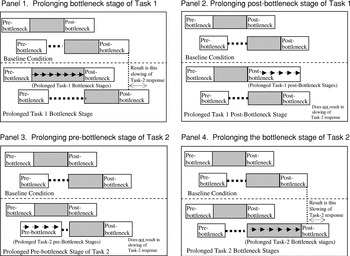
As discussed by Pashler (1994a, 1998), manipulations of specific processing components of Task 1 or Task 2 in the PRP paradigm can be used to test discrete predictions from a structural processing bottleneck model. These predictions can be used to test where the processing bottleneck occurs. Thus, one can determine the types of cognitive processes that cannot proceed simultaneously and must occur serially. The situations that give rise to these predictions are summarized in Figure 2.

Predictions of a central processing bottleneck model for dual-task interference. From “Dual-Task Interference in Simple Tasks: Data and Theory,” by H. Pashler, 1994, Psychological Bulletin, 116. Copyright 1994 by the American Psychological Association. Reprinted with permission.
Prediction 1
If a stage of Task 1 before or at the processing bottleneck is prolonged by increasing its difficulty level, then both RT1 and RT2 are slowed, and to the same degree, as shown in Panel 1 in Figure 2. This pattern occurs because any added processing time at or before the Task 1 bottleneck stage causes an equivalent delay in starting the bottleneck stage of Task 2.
Prediction 2
If stages of Task 1 after the bottleneck are lengthened, RT1 is increased but RT2 is not, because completion of Task 2 does not need to wait for these stages. That is, because the stages of Task 1 that are lengthened involve processes that can occur in parallel with processing in Task 2, Task 2 is not delayed. Thus, as shown in Panel 2 in Figure 2, a longer postbottleneck stage of Task 1 occurs in parallel with Task 2 processing without interference.
Prediction 3
At short SOAs, if stages of Task 2 before the bottleneck are slowed by a certain amount, RT2 does not show a corresponding increase. Thus, prebottleneck stages of Task 2 can be made more difficult and longer to a certain degree without causing an increase in the time taken to complete this task at short SOAs. As shown in Figure 2, Panel 3, this distinctive prediction of a bottleneck model is a result of the fact that a waiting or slack period is present for Task 2. An increase in prebottleneck processing of Task 2 can thus fill part of this slack period without affecting the total time to complete this task.
Prediction 4
Lengthening the duration of stages of Task 2 that are at or after the bottleneck will slow RT2 to that same extent, regardless of SOA, but will have no affect on RT1. As shown in Figure 2, Panel 4, making the bottleneck stage longer in the second task adds a constant to RT2 but nothing to RT1. Thus, in this situation, increasing the difficulty of Task 2 does not affect performance of Task 1 because the extra processing added to Task 2 can occur in parallel with the remaining (postbottleneck) components of Task 1.
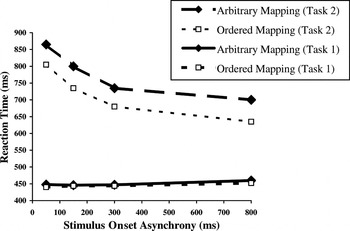
A series of PRP studies using choice RT tasks are consistent with the view that dual-task performance of normal subjects is constrained by a central structural bottleneck in response selection processes (Pashler, 1994a, 1998, 2000). Perceptual encoding and response production processes are typically not part of this central processing bottleneck, but rather operate before and after it, respectively, as was shown in Figure 1 (Dell'Acqua, Pascali, & Peressotti, 2000; McCann & Johnston, 1992; Pashler, 1994a, 1998, 2000; Pashler & Johnston, 1989). That is, the four predictions just described hold for the hypothesis that it is the decision or response selection process that is the processing bottleneck, and that processing before and after the decision or response selection stage can be completed simultaneously without interference. An example of the findings with normal subjects is shown in Figure 3, which was a test of Prediction 4. In these results from McCann and Johnston (1992), lengthening the response production phase of Task 2 produced a slowing of completion of this task (RT2) that was additive across SOAs, but did not affect completion time for Task 1 (RT1). Thus, the results across multiple PRP studies that manipulated different components of Task 1 or Task 2 suggest that normal human information processing is characterized by an inability to make two sets of response selections simultaneously, such that interference between two tasks is dependent on the degree to which there is temporal overlap in the response selection stages.

Mean reaction times for Task 1 and Task 2 as a function of stimulus onset asynchrony and Task 2 difficulty (ordered mapping vs. arbitrary mapping). From “Locus of the Single-Channel Bottleneck in Dual-Task Interference,” by R. S. McCann and J. C. Johnston, 1992, Journal of Experimental Psychology: Human Perception and Performance, 18. Copyright 1992 by the American Psychological Association. Reprinted with permission.
Basic research (Carrier & Pashler, 1995; Pashler, 2000; Ruthruff, Miller, & Lachmann, 1995) has been clarifying further the nature of the cognitive processes that are subject to the central bottleneck in simultaneous processing in normal individuals. Response selection involves use of the stored stimulus–response mapping for a task. Studies using a paired-associate task as Task 2 (Carrier & Pashler, 1995) have demonstrated that the processes subject to the central bottleneck are broader than response selection per se, apparently encompassing memory retrieval more generally. This likelihood that memory retrieval processes are subject to the central bottleneck is noteworthy for studies of attentional abnormalities in schizophrenia, as several key findings involve attentional anomalies during memory-load tasks.
Recently, Meyer and Kieras (1997b) suggested that the results of research with the PRP design may indicate that central stages are typically performed sequentially, but this might not reflect the existence of a structural central bottleneck. Instead, they hypothesized, the PRP results might reflect an optional strategy that people adopt to complete one task component before another, rather than reflect a structural factor in the human cognitive architecture. Most PRP studies, they pointed out, have tended to emphasize the speed of Task 1 performance, and if subjects construe this instruction as a demand that they never allow the Task 2 response to be produced before the Task 1 response, they might enage in queuing even if they were perfectly capable of carrying out the central operations in parallel. To assess this possibility, recent studies have begun to examine the effect of task instructions. It now seems clear that it is at least possible to find evidence of central queuing even when the instructions do not place any particular priority on one or the other task (Levy & Pashler, 2001; Ruthruff, Pashler, & Hazeltine, 2003; Ruthruff, Pashler, & Klaassen, 2001). Although the role of instructions and strategies in the PRP task deserves further attention, it seems clear that the PRP effect is not easily and automatically overcome by simply eliminating any overt stress on one or the other task.
Dual-Task Interference in Schizophrenia
Whether this same pattern of a discrete processing bottleneck at the response selection stage characterizes schizophrenia is unknown. Available evidence does indicate that dual-task interference is clearly significantly greater among individuals with schizophrenia than among normal individuals. Based on a performance operating characteristic analysis of dual-task trade-off, Granholm et al. (1996) concluded that the more severe dual-task interference in schizophrenia was consistent with a smaller pool of processing resources rather than with abnormal allocation of processing resources. Furthermore, a dual-task interference study involving a memory-load CPT and secondary simple RT (Nuechterlein, Subotnik, Dawson, et al., 2003) revealed abnormal slowing of secondary RT among first-episode schizophrenia patients at certain points in the primary memory-load CPT: those involving memory and response selection. Delayed secondary RTs also clearly predicted later work and social functioning in these patients, indicating that dual-task interference indices have promise as contributors to these practical aspects of the disorder.
Recent evidence suggests that dual-task interference may also be a key characteristic of cognitive dysfunction in individuals at genetic risk for schizophrenia. In twins discordant for schizophrenia, a dual-task interference measure was found to contribute substantially to a multivariate discrimination of genetic liability to schizophrenia (Cannon et al., 2000). This finding suggests that dual-task interference may index forms of attentional dysfunction that contribute to genetic predisposition or vulnerability to schizophrenia that would be expected to be present even before an initial episode of schizophrenic psychosis. Thus, studies that focus on dual-task interference in prodromal, first-episode, and chronic schizophrenia have the potential to shed critical new light on the developmental course of attentional dysfunction in schizophrenia.
PRP designs that would allow specific tests for a structural processing bottleneck have not been applied to schizophrenia. Application of PRP designs to research on schizophrenia would allow a much more precise analysis of dual-task processing in patients, distinguishing predictions of processing resource and structural processing bottleneck models. If a structural processing bottleneck model fit the data from schizophrenia better than a processing resource model, other more specific questions could be addressed. It is also possible that the basic cognitive architecture is altered in schizophrenia, such that a processing stage that can proceed in parallel when a normal individual performs two tasks will be found to operate sequentially in a patient with schizophrenia. The hypothesis that a subtle deficit in parallel processing in schizophrenia might contribute to disruptions in serial processing, a possibility suggested earlier (Nuechterlein & Dawson, 1984b) could be rigorously tested in PRP studies. Alternatively, the cognitive architecture may remain the same in schizophrenia patients as in normal individuals, but the degree of slowing at the response selection stage may be greater, perhaps because bottleneck-prone processes are slower in these patients. This alternative would yield a distinctively different pattern of PRP results. Thus, translation of PRP paradigms from studies of normal cognition to studies of schizophrenia has the potential to shed important new light on cognitive deficits in schizophrenia.
An Ongoing Series of PRP Studies in Schizophrenia
To address these issues, we have designed and are currently in the midst of collecting data for four PRP studies using paradigms that have well-documented utility in basic cognitive research for detecting and locating a processing bottleneck in dual-task performance. These clinical studies are being completed at UCLA within the Center for Neurocognition and Emotion in Schizophrenia, the first National Institute of Mental Health Translational Research Center in Behavioral Sciences. To examine the development of attentional dysfunction over the course of schizophrenia, these studies are assessing patients who have prodromal features but have never had a psychotic episode, first-episode schizophrenia patients, and chronic schizophrenia patients. Performance of each patient group is being compared to that of a normal control group with comparable demographic characteristics.
This set of studies bears directly on abnormalities in schizophrenia that have typically been referred to as deficits in divided attention or attentional capacity. The four clinical studies are testing whether the cognitive architecture affecting dual-task interference is altered in persons with prodromal symptoms or in first-episode or chronic schizophrenia patients, such that the processing bottleneck includes perceptual encoding or response production in addition to response selection processes. Alternatively, these studies might demonstrate that greater than normal interference is isolated at the response selection phase. These first four PRP studies correspond to the four predictions of a central processing bottleneck model noted earlier in this article. More than one of the stages or components of processing is likely to be impaired in schizophrenia during an individual cognitive task (Braff, 1993; Nuechterlein & Dawson, 1984b), but this analysis extends beyond that question to ask whether they interfere with each other when two tasks overlap in time.
Studies 3 and 4 will also allow us to examine another alternative: that dual-task interference occurs through graded capacity sharing in the patients. As explained below, a different distinctive PRP performance pattern will be found if such graded capacity sharing within a processing resource model is a better fit for these attentional deficits in schizophrenia.
Study 1: Manipulating the length of response selection in Task 1
All four studies are using two-choice RT tasks for Task 1 and Task 2. To test whether prolonging the normal bottleneck stage (response selection) in Task 1 produces equivalent slowing in Task 2 at short SOAs (Figure 2, Panel 1), we are manipulating stimulus–response compatibility within Task 1 using a manipulation devised by McCann and Johnston (1992). Task 1 uses visual stimuli that either have symbolic compatibility with responses (right arrow or left arrow for button press with right or left forefinger) or depend upon an arbitrary mapping of stimuli to responses (M or T for button press with right or left forefinger). Thus, the arbitrary relationship between the letters and right or left forefinger button presses yields a slower response selection process in Task 1 than the right and left arrows. In Task 2, pure tones of two frequencies are presented. Subjects make a verbal response (“high” vs. “low”). Dual-task performance is being assessed in eight blocks of 32 trials, corresponding to two replicates of a factorial combination of the variables: (a) Task 1 stimulus–response compatibility (compatible vs. arbitrary), (b) Task 2 tone frequency (high vs. low), and (c) SOA (50, 150, 300, or 1200 ms). Subjects are asked to respond as quickly as possible while maintaining accuracy and to respond to Task 1 as soon as it is competed.
If a structural processing bottleneck for the patients is at or before response selection, reducing the stimulus–response compatibility in Task 1 will slow not only RT1 but also, at short SOAs, RT2. This pattern will occur because, at short SOAs, Task 2 central processing must wait for completion of Task 1 central processing. Thus, an interaction of Compatibility × SOA in RT2 is predicted. If the bottleneck is at response selection in patients, but response selection is abnormally slow when stimulus–response compatibility is reduced, then the SOA effect will have a steeper than normal slope (Diagnostic Group × Compatibility × SOA interaction).
Study 2: Manipulating the duration of response production in Task 1
Study 2 focuses on whether response production of one task can be completed in parallel with processing for a second task, as it would if response production is after the processing bottleneck. The number of responses required to a stimulus is being used to lengthen the response production stage of Task 1 and to determine whether it is after the processing bottleneck in the patient groups. Paralleling Pashler and Christian (1994), Task 1 involves either one or three button presses, depending on whether a visual stimulus is letter A and B. A means tap key1 once and B means tap key2–key3–key2 (sequence of three responses). Task 2 involves saying high or low in response to a high- or low-pitched tone. Trial blocks parallel those of Study 1, using the same SOAs.
If response production is postbottleneck for the patients, the RT1 slowing in the three-press condition will not delay the vocal RT2. Furthermore, the effect of longer Task 1 response production will be large, for example, over 400 ms (Pashler & Christian, 1994) and additive for RT1 across SOAs, while having little or no effect across SOAs for RT2. Pashler and Christian (1994) found a small amount of slowing of RT2, but the vast majority of the response production slowing in Task 1 did not propagate to Task 2. If response production delays response selection in patients with schizophrenia or those with prodromal feataures, RT2 will show an increase of a magnitude that parallels that of RT1 at short SOAs. That is, if patients cannot complete response production of one task while completing response selection of another task, the delays in finishing Task 1 will be accompanied by very similar delays in finishing Task 2, at least at short SOAs. This alteration in the cognitive architecture of dual-task interference would lead to a Diagnostic Group × Response Production Complexity × SOA interaction in RT2, because normal subjects should not show a parallel effect on RT2 with increased Task 1 response production complexity.
Study 3: Manipulating the duration of perceptual encoding in Task 2
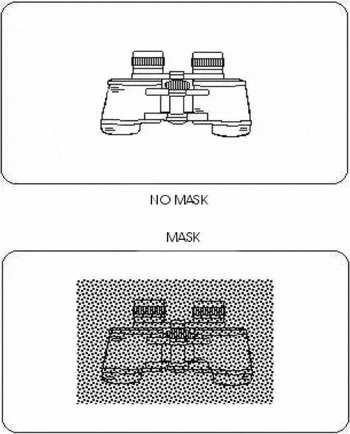
To test whether a prebottleneck stage in normal individuals, perceptual encoding, is also a prebottleneck stage in individuals with schizophrenia or at risk for its development, we are using a perceptual degradation manipulation that was developed by Dell'Acqua et al. (2000). Stimulus degradation may have advantages over earlier manipulations of stimulus intensity (Pashler, 1984; Pashler & Johnston, 1989) because it is likely to affect all aspects of stimulus identification (not just the earliest ones) and thus provides a more challenging test of independence from response selection. Task 1 is a two-alternative choice RT with manual response (button press) to high- versus low-frequency pure tones, as used by Dell'Acqua et al. (2000). In Task 2, we are presenting pictures of objects at two levels of stimulus quality, either normal or degraded by superimposing a visual noise mask on the stimulus (see example in Figure 4). For Task 2, subjects name the object aloud. Trial blocks again parallel Study 1, using the same SOAs.

The manipulation of degradation to influence the perceptual encoding time. From “Modulazione di una variabile percettiva in un contesto di doppio-compito” [“Modulation of a perceptual variable in a double-task context”], by R. Dell'Acqua, A. Pascali, and F. Peressotti, 2000, Giornale Italiano di Psicologia, 27. Copyright 2000 by La Edizioni del Mulino. Reprinted with permission.
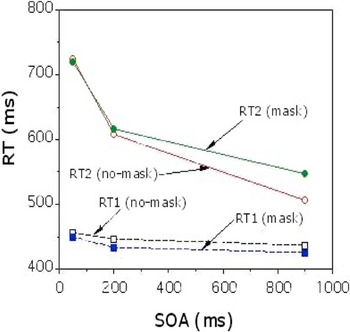
In normal subjects, Dell'Acqua et al. (2000) showed that increasing the time required for perceptual encoding in Task 2 through degradation did not increase the time required to complete Task 2 at short SOAs. This form of underadditivity for RT2 follows Prediction 3 described earlier (Figure 2, Panel 3). Because of the slack or waiting time hypothesized within Task 2 at short SOAs, increasing the duration of a prebottleneck processing component simply uses part of this slack time rather than adding to Task 2 completion time. At longer SOAs, this slack time is not present, so degrading the Task 2 stimulus with a mask does increase completion time for Task 2 (see Figure 5).

The underadditivity interaction for reaction time 2 (RT2) at short stimulus onset asynchronies (SOAs) when the perceptual encoding phase of Task 2 is made more difficult, as predicted by the central bottleneck model. From “Modulazione di una variabile percettiva in un contesto di doppio-compito” [“Modulation of a perceptual variable in a double-task context”], by R. Dell'Acqua, A. Pascali, and F. Peressotti, 2000, Giornale Italiano di Psicologia, 27. Copyright 2000 by La Edizioni del Mulino. Reprinted with permission.
Following this same argument, if perceptual encoding is a prebottleneck process in the patients, the RT2 slowing at short SOAs (greater task overlap) will actually be smaller than at long SOAs, as shown in a significant interaction between Mask and SOA. However, if the bottleneck encompasses perceptual encoding as well as response selection in the patients, then the perceptual encoding for Task 2 cannot occur during slack and RT2 will show an additive effect of the Mask across SOAs.
This study also provides a distinctive prediction if a processing resource model fits better than a structural processing resource model. If dual-task interference in the patients occurs through graded capacity sharing as hypothesized in processing resource models, then a significant Mask × SOA interaction that reflects an overadditive effect of degradation at short SOAs will occur. This prediction is due to the increased response time for Task 2 that should accompany the combination of greater Task 2 difficulty and greater temporal overlap of tasks (fewer resources for Task 2; McLeod, 1977). If this pattern of graded capacity sharing fits the patients better than the normal comparison subjects, a Diagnostic Group × Mask × SOA interaction will result.
Study 4: Manipulating the duration of response selection in Task 2
The fourth study examines Prediction 4 described earlier in Figure 2, panel 4. To test whether prolonging the stage in Task 2 that is normally the bottleneck produces the typical constant effect on RT2, without affecting RT1, we are again manipulating stimulus–response compatibility using the procedure of McCann and Johnston (1992). Task 1 uses pure tones of two frequencies. Subjects make a verbal response (high or low). Task 2 uses the visual stimuli that have symbolic compatibility with responses (right arrow or left arrow for button press with right or left forefinger) or arbitrary mappings to responses (M or T for button press with right or left forefinger), as in Study 1. Trial blocks and SOAs parallel Study 1.
If the processing bottleneck for patients with schizophrenia and persons with prodromal features of schizophrenia includes response selection, the arbitrary stimulus–response mapping will create RT2 slowing that is additive across SOAs, compared to compatible stimulus–response mapping. RT1 will be unaffected if a processing bottleneck model holds. Figure 3 presented earlier shows this pattern of results. If the processing bottleneck for patients is later than normal (after response selection), then a pattern of underadditivity for RT2 will be present at short SOAs, due to use of slack to complete the more complex response selection condition of Task 2.
Study 4 also provides another distinctive test of whether a structural processing bottleneck or a processing resource model best fits the divided attention deficits in schizophrenia. If dual-task interference in the patients occurs by graded capacity sharing rather than through the usual processing bottleneck involving response selection, then a pattern of overadditivity of response selection complexity will occur in RT2 at short SOAs. Again, this follows McLeod's (1977) reasoning regarding the joint effects of greater Task 2 difficulty and greater temporal overlap of tasks. That is, when Task 2 is made more difficult, a processing resource model would predict that reduced resources for Task 2 would result in slower completion of Task 2 when the tasks overlapped more in time (short SOAs) than when they overlapped less (long SOA). This alternative would lead to a significant Diagnostic Group × Compatibility × SOA interaction if graded capacity sharing is a more severe limitation for the patients than for normal subjects.
Testing PRP Abnormalities Over the Developmental Course of Schizophrenia
As mentioned above, these four studies are being completed across several different phases of schizophrenia to shed critical new light on the development of attentional dysfunction in this disorder and to address whether attentional deficits change in their specific nature or severity over the course of the illness. To address whether attentional deficits characterized by structural processing bottlenecks or processing resource limitations occur even prior to a first psychotic episode, patients with prodromal features of schizophrenia are being examined. This emphasis on research during a hypothesized prepsychotic period is consistent with a recent emphasis on understanding the factors that may predict and contribute to onset of psychosis (McGlashan & Johannessen, 1996; Yung & McGorry, 1996). To examine whether certain patterns of structural processing bottlenecks or processing resource limitations characterize patients even at and following a first psychotic episode, we have extended earlier studies of attentional deficit in recent-onset schizophrenia (Nuechterlein et al., 1992, 1998) to include this series of PRP studies. Finally, to determine whether the nature, severity, or correlates of such attentional deficits differ in a more chronic phase of schizophrenia, a chronic schizophrenia sample is also being assessed.
Patients with prodromal features
For prodromal patients, we are testing the hypothesis that the pattern of dual-task interference is abnormal even at baseline assessment. This patient sample and demographically matched normal sample is being recruited within the Center for the Assessment and Prevention of Prodromal States at UCLA. A short-term longitudinal design is being used to test indices of dual-task interference at baseline and changes in these indices over the following 6 months. We hypothesize that dual-task interference will be more pronounced at the central bottleneck location than normal in patients with prodromal features, even before a first episode of psychosis, will increase in severity before a first psychotic episode occurs, and will predict functional outcome. Risk of a psychotic episode in these prodromal patients is expected to be 20–40% within 12 months, with about 80% of these episodes being of a schizophreniform or schizophrenia type. Functional impairment is increasingly recognized as another feature of this prodromal period, so understanding its determinants is of substantial importance (Niendam et al., in press).
First-episode patients
Assessment occasions for first-episode patients are designed to test whether dual-task interference shows an abnormal pattern in this initial period of schizophrenia, changes over time, and predicts short-term functional outcome (particularly work outcome) and risk of psychotic exacerbation. The first-episode schizophrenia sample and their demographically matched normal sample are being recruited through the UCLA Aftercare Research Program. Of particular interest in the first-episode schizophrenia sample is the 1-year, repeated-measures longitudinal component, which is testing the hypothesis that the severity of initial dual-task interference, especially of the central bottleneck involving response selection, will be a strong predictor of, and probable contributor to, short-term functional outcome and changes, particularly in work functioning. Although a number of studies now indicate that cognitive deficits in schizophrenia are a predictor of functional outcome (Green et al., 2000; Green, Kern, & Heaton, 2004), the results of these PRP studies have the potential to specify the cognitive processes that contribute to the impairments in functional outcome in a much more precise way.
The first-episode schizophrenia sample is also being used to test the hypothesis that dual-task interference shows an abnormal pattern at clinically stabilized baseline and increases in severity from the stable baseline to any return of psychotic symptoms during a 1-year follow-through period. This would be consistent with the view that it reflects a mediating factor in symptom formation (Nuechterlein & Dawson, 1984a). A secondary hypothesis is that indices of dual-task interference may also predict relapse risk.
Chronic schizophrenia patients
The chronic schizophrenia sample is included to test the hypothesis that certain dual-task abnormalities are characteristics of those patients with a more chronic illness and poorer long-term functional outcome. This patient sample is being recruited from patients who were formerly treated and studied at the UCLA Aftercare Research Program as recent-onset schizophrenia patients. They were selected with the same set of inclusion and exclusion criteria as the current first-episode patient sample.
Because the chronic schizophrenia sample in this revised application is one initially studied intensively in earlier first-episode studies in the UCLA Aftercare Research Program, a single follow-up assessment will provide data on long-term changes in functional outcome. A demographically matched normal comparison group is also being recruited for this patient sample. Thus, a cross-sectional set of dual-task assessments will allow an examination of the dual-task characteristics of chronic patients with differing long-term trajectories of functional changes, as well as a comparison of the magnitude of dual-task inference in prodromal, first-episode, and chronic patients.
The relative magnitude of dual-task interference abnormalities in the prodromal, first-episode, and chronic phases of illness will be examined to shed light on the possibility that the severity or pattern of dual-task interference changes during the course of schizophrenia.
Concluding Comments
The approach to translating paradigms from cognitive psychology to clinical research on attentional dysfunction in schizophrenia that is described here shows how theoretical and methodological refinements can be brought to bear on key clinical research questions. Our own experience is that this process is facilitated by direct interactions between basic behavioral scientists and clinical investigators, as each brings a perspective that is needed to select the most productive paradigms and to adapt the specifics of these paradigms to research with cognitively impaired patients. Although our studies are still ongoing, we are hopeful that the results will provide important new insights into the nature of attentional dysfunction in schizophrenia and the processes by which it develops over the course of the illness.
Models of attentional dysfunction in schizophrenia have often emphasized greater overall processing resource limitations or inadequate control over allocation of limited processing resources (Gjerde, 1983; Granholm et al., 1996; Nuechterlein & Dawson, 1984b). These models of deficits in schizophrenia stem from conceptions of attention as a processing resource pool that could be allocated voluntarily and flexibly to various specific cognitive operations (Kahneman, 1973; Wickens, 1984). This model of attentional dysfunction has been influential in vulnerability-stress models of schizophrenia (Nuechterlein & Dawson, 1984a; Nuechterlein et al., 1992) drawing on evidence that the integrated, stable allocation of limited processing resources is influenced by arousal level (Kahneman, 1973). These vulnerability-stress models, in turn, have formed one part of the rationale for certain forms of cognitive behavior therapy (Fowler et al., 1995), cognitive training (Brenner et al., 1994), and other coping strategies (Ventura & Liberman, 2000) for schizophrenia patients. Using this conception of attentional dysfunction, interventions have emphasized finding ways to keep the overall processing resource demands moderate, to allocate limited processing resources more effectively, and to control the impact of environmental stress on arousal.
The structural processing bottleneck model of divided attention described in this article has many implications for the nature of dysfunctions in attention in schizophrenia. If the results of the studies outlined in this article demonstrate that a structural processing bottleneck model of deficits in divided attention in schizophrenia accounts for the data better than a processing resource model, the nature of the underlying deficit may be more specific and delimited than is implied by a processing resource conception of attention. Furthermore, the studies described here will provide evidence that identifies the location of structural processing bottlenecks. Thus, they allow one to conclude that certain cognitive processes can operate simultaneously without interference, whereas other cognitive processes need to be completed one at a time (Pashler, 1994a; Pashler & Johnston, 1998). As a first step, these studies will demonstrate whether structural processing bottlenecks in schizophrenia patients are in the same locations that characterize dual-task performance in normal subjects (decision and response selection phases). An alternative is that some processes that typically can proceed in parallel with other processes (perceptual analysis and response production) interfere with other simultaneous processing in schizophrenia. If the structural bottleneck model fits well and the bottleneck locations are the ones that characterize normal human information processing, these studies will indicate whether greater slowing at these central decision and response selection phases can account for the schizophrenic deficits in divided attention or whether additional processes (e.g., switching time) are important contributors (Pashler, 2000).
Greater specification of the cognitive processes that contribute to attentional abnormalities in schizophrenia would also have implications for interventions targeting the cognitive deficits in this disorder. Currently, the attempts to enhance cognitive functioning in schizophrenia through training focus on a very broad range of cognitive functions (Bell, Bryson, Greig, Corcoran, & Wexler, 2001; Bell, Bryson, & Wexler, 2003; Hogarty et al., 2004; Medalia, Revheim, & Casey, 2000, 2002). Although these cognitive remediation strategies look very promising in recent studies, the training efforts might be made much more effective in the future if they could be focused on aspects of cognitive dysfunction in schizophrenia that are particularly disruptive to functional outcome. Given that multitasking is a prominent part of many aspects of everyday life, sources of interference in dual-task situations would be expected to have substantial relevance to many work and social situations. Indeed, preliminary data on dual-task interference in recent-onset schizophrenia patients already suggest clear relationships to functional outcome (Nuechterlein, Subotnik, Dawson, et al., 2003). Thus, the more we understand which aspects of processing are interfering with each other during multitasking situations, the more focused our intervention strategies can become.
If initial perceptual analysis and response production processes are sources of dual-task interference in schizophrenia (i.e., the normal cognitive architecture is altered), then one would need to include procedures for remediating such abnormal sources of interference in training to reduce attentional deficit in this disorder. In contrast, if initial perceptual processing and later response production processes are not contributing to dual-task interference in schizophrenia, one could focus on training methods that reduced the effect of processing bottlenecks in the central decision and response selection processes. These strategies might either aim to remediate slowed decision and response selection processes directly (Bell et al., 2001; Hogarty et al., 2004) or to compensate through environmental supports that made slowing of these processes less consequential (Velligan et al., 2000).
Greater specification of the cognitive processes that are interfering with each other would also be of substantial importance in the development of pharmacological interventions for attentional disturbances in schizophrenia. During the development of a consensus neurocognitive battery to evaluate the impact of potential cognitive enhancing agents in schizophrenia (Green, Nuechterlein, et al., 2004; Nuechterlein & Green, 2006), the need for continued research to parse the key cognitive processes contributing to deficits in schizophrenia was readily apparent. The recent greatly increased interest in developing pharmacological interventions for cognitive deficits in schizophrenia could be much more clearly focused through the development of more explicit models of the key cognitive deficits and the neuropharmacological systems that influence them (Chudasama & Robbins, 2004; Geyer & Tamminga, 2004).