

Introduction
Acquired brain injury (ABI) describes any acute, single insult neurological condition that occurs after birth, inclusive of traumatic brain injury (TBI) and stroke (Turner-Stokes et al., Reference Turner-Stokes, Pick, Nair and Disler2015). Disabilities acquired after birth, such as ABI necessitate adaptation and adjustment to injury-related changes. Following ABI, survivors typically experience changed physical, cognitive, communication and emotional functioning and a subsequent loss or change of life roles and friendships (Douglas, Reference Douglas2020; Ponsford et al., Reference Ponsford, Sloan and Snow2013). The aim of ABI rehabilitation is to support reintegration into the community, rebuilding social connections and returning to meaningful and productive occupational engagement (Doig et al., Reference Doig, Fleming and Kuipers2008). While the recovery and disability experience varies for each individual, many people report ongoing challenges associated with the experience of loss of identity (Douglas, Reference Douglas2013; Nochi, Reference Nochi2000; Ownsworth, Reference Ownsworth2014), social isolation and disconnection from the community (Douglas, Reference Douglas2020; Levack et al, Reference Levack, Kayes and Fadyl2010).
In the context of ABI rehabilitation, narrative storytelling is gaining attention as one potential approach to supporting adjustment post-injury. A recent scoping literature review conducted by the authors (KD, JD, TS) found 12 qualitative research studies in which adults with TBI shared their stories of lived experience (D’Cruz et al., Reference D’Cruz, Douglas and Serry2019). An updated literature search conducted in December 2019, using the same search terms but expanded to include stroke, retrieved an additional seven studies (D’Cruz, Reference D’Cruz2019). Across the 19 studies, a range of narrative practices was identified including visual approaches such as photography or digital storytelling, written approaches including song writing or poetry as well as individual or group-based spoken storytelling. Despite variability in approaches, storytelling was found to support emotional expression, reflection and communication, contributing to overall positive identity growth (D’Cruz et al., Reference D’Cruz, Douglas and Serry2019). This finding is consistent with a well-established view of storytelling as the way in which humans make sense of experiences (Charon, Reference Charon2006). Indeed, it is suggested that the temporal structure of storytelling, with a beginning, middle and end, supports the integration of new experiences with past experiences, creating a more coherent narrative (Adler, Reference Adler2012; McAdams, Reference McAdams2001). With the experience of survivors adapting to an acquired disability such as brain injury, this notion of integrating the past with the present is closely aligned.
Building upon this emerging evidence, the authors (KD, JD, TS) conducted a qualitative study of the experience and impact of narrative storytelling from the perspective of storytellers with brain injury and storytelling facilitators. This study was conducted within the context of an advocacy storytelling programme. In the initial phase of the study, 21 interviews were conducted with 8 storytellers, 3 male and 5 female. Drawing upon constructivist grounded theory methods, data analysis revealed storytelling to be a humanising experience in which the storytellers felt valued and heard through the opportunity to share their story (D’Cruz et al., Reference D’Cruz, Douglas and Serry2020a). A second phase of the study involved seven interviews with six storytelling facilitators. Analysis of the intersection of the storyteller data and facilitator data revealed a strengths-based partnership between the storytellers and the facilitators, reflecting the socio-relational nature of narrative storytelling (Gergen & Gergen, Reference Gergen, Gergen, Gergen and Gergen2014). The storytellers described this partnership as central to their positive and humanising experience of narrative storytelling (D’Cruz et al., Reference D’Cruz, Douglas and Serry2020b).
Given the significance of the storyteller–facilitator partnership as part of the storytelling experience, this study sought to examine how the facilitators engaged with the storytellers. It was hoped that this exploration would provide insights into approaches to building and investing in positive relationships in ABI rehabilitation. Building upon the strengths based and humanising nature of the storyteller–facilitator partnerships, a humanising values framework was chosen to guide the analysis (Galvin & Todres, Reference Galvin and Todres2013; Todres et al., Reference Todres, Galvin and Holloway2009). This framework consists of eight interacting values-based dimensions (insiderness, agency, uniqueness, togetherness, sense-making, personal journey, sense of place, and embodiment) expressed across a spectrum of humanising and dehumanising possibilities. The framework was developed to enable exploration of what it means to be human, as well as providing a lens through which to identify and guide humanly sensitive practice (Galvin & Todres, Reference Galvin and Todres2013; Todres et al., Reference Todres, Galvin and Holloway2009).
Materials and methods
Design
This study was a secondary qualitative analysis of an existing data set from an earlier grounded theory study. Within this context, data were created within the paradigm of social constructivism in which knowledge construction is recognised as a socially constructed process with multiple realities (Charmaz, Reference Charmaz2014). The secondary analysis was also conducted within these ontological and epistemological positions. However, to examine how storytelling facilitators engaged with storytellers from a humanising perspective, this study drew upon content analysis (Liamputtong, Reference Liamputtong2019) and included a process of mapping previously analysed data (D’Cruz et al., Reference D’Cruz, Douglas and Serry2020b) to a humanising values framework (Galvin & Todres, Reference Galvin and Todres2013; Todres et al., Reference Todres, Galvin and Holloway2009).
Study setting and recruitment
Research participants were recruited from an advocacy organisation that facilitates storytelling workshops for adults with disability who reside in or are at risk of entering a nursing home. The storytelling workshops are designed to support story sharing between storytellers and facilitators, resulting in personal narratives that are used, with permission of the storytellers, as an advocacy tool. The produced personal stories are either in the format of a short co-constructed digital story narrated by the storytellers, or a third person written profile in an electronic or paper document with a photograph of the storyteller. While the earlier study included interviews with storyteller participants as well as facilitators, this study focussed exclusively on the facilitator interview data. A more detailed description of the study setting, recruitment and storyteller participants are documented in an earlier publication (D’Cruz et al., Reference D’Cruz, Douglas and Serry2020a).
Participants
To be eligible to participate in this study, the facilitators must have previously facilitated a storytelling workshop. No limit was placed on age, gender, professional background or facilitation experience. All participants gave written consent prior to participation, pseudonyms were ascribed and ethical approval was granted by the University Human Research Ethics Committee (HEC16-085).
Data collection
Face-to-face semi-structured interviews were conducted by the first author. Single interviews were conducted with each of the six facilitator participants, although two interviews were conducted with one of the facilitators who had extensive experience in storytelling facilitation at the advocacy organisation. Each of the interviews was on average 1 h in length and audio-recorded for transcription.
Data analysis
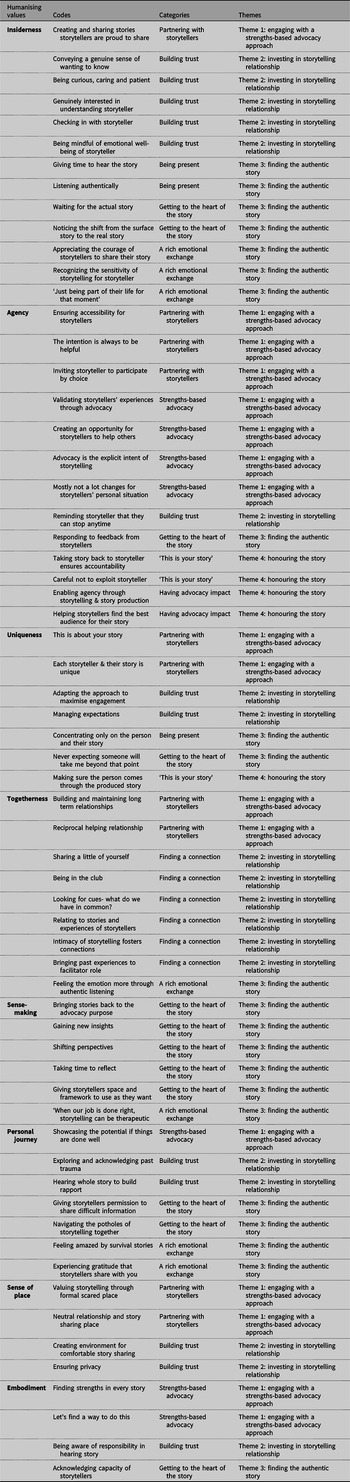
The first stage of analysis drew upon a content analysis approach (Liamputtong, Reference Liamputtong2019) by coding the facilitator interview data to the eight pre-determined humanising dimensions. Seven interview transcripts were coded following this process. The first author (KD) conducted all of the coding, regularly discussing the coding with the other two authors (JD & TS) to ensure consensus with the process. A second stage of analysis involved mapping the data coded under the eight humanising dimensions to the codes, categories and themes previously generated from the earlier grounded theory study (D’Cruz et al., Reference D’Cruz, Douglas and Serry2020b). This process involved comparing and contrasting the definitions of the eight humanising dimensions with the properties of the previously analysed data, ensuring congruence between the coded data and the corresponding humanising dimensions. Each of the three authors participated in mapping the data, with regular discussions, debate and reflection guiding the process. The facilitator codes mapped to each of the eight dimensions of the framework, with a breadth of codes represented in each dimension, revealing the depth of humanisation within the data (Galvin & Todres, Reference Galvin and Todres2013; Todres et al., Reference Todres, Galvin and Holloway2009). Given the positive experiences of the storyteller participants, as outlined in earlier publications (D’Cruz et al., Reference D’Cruz, Douglas and Serry2020a; D’Cruz et al., Reference D’Cruz, Douglas and Serry2020b), it is unsurprising that the findings of this study only revealed humansing experiences, despite the intent of the humansing framework to capture experiences across the spectrum from humanising to dehumanising. Table 1 provides a summary of the mapping of the previously generated codes, categories and themes to the humansing dimensions.
Humanising values mapped to thematic findings of facilitator data

Results
Given the aim to better understand the way in which the facilitators engaged with the storytellers, this article focuses exclusively on the results of mapping the facilitator data to the values framework. The facilitator participants ranged in years of facilitation experience from 1 to 11 years, with a mix of professional backgrounds, including health care (3), journalism (1) and community development (2). The following results are presented within the framework of the eight dimensions and provide insights into how facilitators engaged in humanising practice within the context of a storytelling advocacy programme.
Insiderness
According to the humanising values framework (Galvin & Todres, Reference Galvin and Todres2013; Todres et al., Reference Todres, Galvin and Holloway2009), the insider or subjective experience is described as insiderness. Central to this dimension is an appreciation of the unique nature of life, as experienced by individuals. The insider experience encapsulates feelings, emotions and thoughts, as well as physical and sensory experiences. In the context of this study, storytelling presented as an opportunity to understand and connect with each of the storytellers’ lives from the inside. Anna shared, ‘I’m really interested in people and I really want to understand what has led people to be the person that they are at the moment and what sort of sits behind what you perhaps see.’ Analysis revealed a number of ways in which the facilitators engaged with the insider experience of the storytellers, such as taking time with the storyteller, intentionally listening, and showing compassion. Patricia explained, ‘I was really excited about having the time – you know, a really devoted amount of time – to really explore what was going on for someone.’ Clare described the feeling of connecting with the insider experience of the storytellers. ‘Just being part of their life for that moment. And watching the walls come down and them open up, is yeah, very rewarding.’ This connection to the insider experience extended to the production of the stories, as evidenced by the intent of the facilitators to produce stories that truly reflected the personal experiences of the storytellers.
Agency
Agency is about enabling choice and the experience of dignity and personhood (Galvin & Todres, Reference Galvin and Todres2013; Todres et al., Reference Todres, Galvin and Holloway2009). The facilitators identified a number of ways in which the storytelling programme fostered experiences of agency. Consistent with the mission of the organisation, the storytelling programme itself was designed with the aim of storytellers having a positive and personally validating experience. Anna shared
If we go somewhere [for storytelling] that’s sort of nice and a bit more formal, there’s an element of these people are really taking my story seriously… [they] are prepared to invest in me to hear my story, so they must value my story.
The facilitators also recognised the significance of the storytellers ‘having a voice’ in the context of sharing their lived experiences. As reflected by Gideon,
‘Because so often people in nursing homes in particular aren’t getting asked questions about what they want… They get told what to do and all of a sudden [in the storytelling] someone’s asking these intimate questions about their life, I can imagine it’ll be a really impactful experience.’
Felicity added, ‘I think particularly for people who are non-verbal, they don’t get that opportunity to have their voice heard, and so for them to be able to hear that - or to see it [their story] - is really important.’ Agency was also extended to storytellers having control over the content of their stories. Each of the facilitators described feeling supported by the organisation to ensure that the storytellers experienced this control. Clare explained, ‘… if they’ve said something, you know if you definitely do not want it in there, then there’s always that opportunity that it doesn’t go in. You know, they always have the final say and I think that’s really lovely.’
Uniqueness
Uniqueness refers to the individuality of humans and efforts are taken to recognise and act upon this individuality, as opposed to classifying humans and their traits into categories or groups (Galvin & Todres, Reference Galvin and Todres2013; Todres et al., Reference Todres, Galvin and Holloway2009). While the advocacy intent of the storytelling programme positioned the storytelling with an outward-looking focus, the story-sharing experience remained person focussed. The facilitators communicated that the storytellers and their stories are celebrated for their uniqueness, and the needs of the storytellers take priority. Gideon shared, ‘I’ve always said this is about your story. Yes we’ve got an agenda, but you have to be comfortable with it and it’s got to be right. So yeah we try and work pretty hard doing that.’ The facilitators described feeling supported by the organisation to take time with storytellers to get to know them as individuals. Clare shared, ‘And it’s just so special to have you know, that time with those people. And yeah, I just meet so many amazing people that I think each time, like I said before, it’s different each time.’
Togetherness
The dimension of togetherness is described as the experience of belonging and human connectedness (Galvin & Todres, Reference Galvin and Todres2013; Todres et al., Reference Todres, Galvin and Holloway2009). The facilitators recognised the relational nature of storytelling, and the experience of human connectedness fostered through the storytelling. Patricia expressed this experience of human connectedness when she explained, ‘I’ve worked with so many people and the things I’m listening to are no better or worse or harrowing than anything I’ve ever heard, but I’m feeling more. I just feel a lot of gratitude around it, actually.’
The facilitators identified the importance of taking time to build these connections, as well as personal sharing by both the storytellers and the facilitators. Jemima said, ‘I think you need to be able to connect with people. Also giving a little bit of yourself and telling them a little bit about yourself because you can’t expect someone to share if you don’t tell them’. Patricia noted the bonds that are created during the storytelling. She reflected, ‘You notice that after every session, the person that’s had the conversation [storyteller and facilitator] there’s a bit of a bond that’s been created and we all like our particular relationship. You know, we sit with that person at lunch’. The facilitators also described how togetherness was fostered between the storytellers at the storytelling workshops. Clare said, ‘When they [storytellers] do have that opportunity to come in the workshop, I think there’s a sense of, ‘Oh you know, like I’m part of something a bit bigger.’
Sense-making
Sense-making is defined as the opportunity to find meaning and significance in experiences (Galvin & Todres, Reference Galvin and Todres2013; Todres et al., Reference Todres, Galvin and Holloway2009). As outlined in the introduction, narrative storytelling is well understood as a meaning-making process. The facilitators actively supported the storytellers to reflect about themselves and their recovery experience, through the storytelling. Felicity shared her understanding of the importance of this opportunity for the storytellers. She said, ‘Everyone likes to feel connected, but also see themselves in something, and so I think the digital stories are a way for them [storytellers] to see themselves in a light that they wouldn’t usually, or say "yeah, that’s me’.’
The facilitators also acknowledged opportunities for self-learning that arose through the experience of engaging in storytelling that traversed complex issues. Clare described, ‘I think there’s an opportunity for them [storytellers] to open up and think about other ways that they might like to share their story and make a change that they may not have thought was possible.’
Personal journey
Personal journey considers the temporality of human life (Galvin & Todres, Reference Galvin and Todres2013; Todres et al., Reference Todres, Galvin and Holloway2009). While the produced personal stories reflect a moment in time, storytelling is a temporal experience (Adler, Reference Adler2012; McAdams, Reference McAdams2001). The facilitators used the temporal structure of storytelling to explore the storytellers’ past, present and future personal journeys. As described by Felicity:
She (storyteller) was just really looking for anything that could be an answer, and we were able to nut down to some of the more personal things or traumatic things that had happened in the past. And it was just that sort of realisation of trying to get someone to think about the future, and they really do need to acknowledge all of these other things that have happened.
Consistent with the strengths-based advocacy approach of the organisation, the facilitators actively looked for capacity in the shared stories, identifying opportunities and future potential. Anna shared, ‘… our style of advocacy is not about criticising, it’s about showing what the potential is if things are done well, in terms of the system, and I think our storytelling kind of aligns with that’. Similarly, the facilitators committed to work with people holistically, considering potential sensitivities for storytellers in the planning of the storytelling workshops. Therefore, the past experiences of the storytellers were understood and considered in planning for the current storytelling experience. Furthermore, the facilitators talked about the enduring partnership created between the storytellers and the organisation, recognising future opportunities for storytelling enabled through this partnership.
Sense of place
Sense of place is defined as a sense of comfort in both the physical environment, as well as recognition of feelings of familiarity, security and being at home in a space (Galvin & Todres, Reference Galvin and Todres2013; Todres et al., Reference Todres, Galvin and Holloway2009). Creating a comfortable space for storytelling was central to the role of the facilitators. This was described in terms of a safe and pleasant physical space, situated within a welcoming and caring relationship with the storytelling facilitator. Sense of place extended to ensuring privacy and respect to support personal story sharing. Anna described, ‘From the storyteller’s perspective, making them feel comfortable is a really important thing and making them feel like it’s a private conversation to me is an important thing’. She further explained the importance of privileging storytelling above other roles or relationships in the storytelling experience. She shared:
If we go somewhere that we’ve both never been before, well we are meeting there to equally do something… I very happily pay for a support worker to be there because I don’t want to empty a catheter bag… that changes the dynamic of the relationship, because I’m just here to talk to that person and to hear from that person. That’s the reason that I’m there.
Embodiment
Embodiment is a way of being with others that is grounded in recognising people as unique beings living in their own context (Galvin & Todres, Reference Galvin and Todres2013; Todres et al., Reference Todres, Galvin and Holloway2009). Data analysis revealed storytelling to be a way of supporting the experience of humanness for the storytellers. Gideon described embodiment in the way that he engages with the storytellers, with a firm belief in the capacity of each and every person, despite different personal strengths. When talking about the storytellers, he said,
‘They’ve been robbed so much in their life. And so the last thing they need from me is to rob what they’re perfectly capable of doing, and yes we’re all vulnerable….’. Similarly, Anna said: I think our approach has been more about, ‘let’s find a way to do it’ – we might have to try five different things to find the right way but, you know, there’s a way to do it… on different levels with different people.”
The facilitators also discussed creating space for stories to be told by both those with brain injury and their family/close others. In doing so, the facilitators recognised and communicated that each of their stories is unique, grounded in their own perspectives and equally valid. Anna shared:
I feel like the story or the perspective of the person with brain injury can sometimes be very different to the story or perspective of the family… I think there’s a value in speaking to both and it doesn’t actually even matter that their stories are different because they are equally valid because it is their journey and their story.
Discussion
The humanising values framework guides our understanding of what it means to be met as fully human (Galvin & Todres, Reference Galvin and Todres2013; Todres et al., Reference Todres, Galvin and Holloway2009). In the context of this study, mapping the facilitator data to this framework provided insights into the humanising ways in which the storytelling was facilitated. These findings contribute to a deeper understanding of the positive experiences reported by the storytellers, revealing both the value of storytelling, as well as approaches to facilitation or engagement between the storytellers and facilitators.
Central to the humanising nature of the storytelling examined in this study is the advocacy context. This advocacy context frames both the altruistic purpose of the storytelling, and also the strengths-based and person-focussed approach employed by the facilitators. The storytelling programme is founded on the organisation’s commitment to advocacy that is informed by the experience of people with disability, thereby valuing lived experiences shared through storytelling. Influenced by this approach, the facilitators met the storytellers as fellow humans. By showing interest in hearing and understanding the lived experiences of the storytellers, the facilitators affirmed the individuality and value of each storyteller. The temporal narrative structure encouraged sharing of stories across the lifespan including life pre-and-post ABI, and the personal nature of the shared stories enabled entry into the insider experience. The facilitators used active facilitation skills and were prepared to navigate emotional work, scaffold reflective learning and seek out strengths in the shared stories. The facilitators also created physically and emotionally safe and respectful story-sharing environments, considering wheelchair accessibility, a neutral and private space, and funded transport to and from the workshop. In addition, support workers were paid to support the storytellers, segregating the ‘doing to’ away from the facilitators, therefore privileging the storytelling and a humanised, person-centred relationship between the storytellers and facilitators. A defining feature was the importance placed upon ensuring that the produced stories were stories that the storytellers would be proud to share. At all times, the storytellers were positioned at the centre of their stories, consistent with the aim of the humanising framework to position people as human beings at the centre of their care.
In the context of dehumanising experiences and feelings of isolation and disconnection frequently reported by survivors of ABI (Douglas, Reference Douglas2020; Douglas, Reference Douglas2013; Levack et al., Reference Levack, Kayes and Fadyl2010; Nochi, Reference Nochi2000; Winkler et al., Reference Winkler, Holgate, Sloan and Callaway2012), approaches to humanise rehabilitation are important. While person-centred care has become an expectation of rehabilitation services, the implementation of such practice remains challenging (Hersh, Reference Hersh2015; Franklin et al., Reference Franklin, Willis, Lewis, Rogers and Smith2021). Studies continue to reveal that while health care professionals may perceive themselves to be person-centred in their practice, an incongruence often exists between this espoused perspective and its delivery (D’Cruz et al., Reference D’Cruz, Howie and Lentin2016; Franklin et al., Reference Franklin, Willis, Lewis, Rogers and Smith2021). Indeed, the voice of survivors with ABI, especially those with cognitive and communication impairments is frequently ignored within healthcare (Hersh, Reference Hersh2015). The findings of this study draw attention to the potential role of narrative storytelling to build positive humanising relationships, founded on listening to the voice of people living with ABI. This finding is consistent with an emerging body of research drawing attention to the importance of relationships and engagement to the implementation of person-centred approaches to healthcare (Bright et al., Reference Bright, Kayes, Cummins, Worrall and McPherson2017; Stagg et al., Reference Stagg, Douglas and Iacono2019; Terry & Kayes, Reference Terry and Kayes2019). However, it has also been suggested that healthcare professionals may not have the necessary skills for relational aspects of care, especially with clients with cognitive and/or communication impairments, lack of insight, impaired social relationship skills and complex social/family contexts (Bright et al., Reference Bright, Kayes, Cummins, Worrall and McPherson2017; Franklin et al., Reference Franklin, Willis, Lewis, Rogers and Smith2021; Stagg et al., Reference Stagg, Douglas and Iacono2019). Indeed, a lack of skill and confidence in working in relationship with clients with complex care needs, may partly explain why in practice healthcare professionals revert to a more traditional role of directing care, despite identifying as person-centred in their practice. More attention needs to be directed toward educating health professionals and equipping them with the necessary knowledge, skills and attitude to better engage with clients, both valuing and supporting their input (Bright et al., Reference Bright, Kayes, Cummins, Worrall and McPherson2017; Hersh, Reference Hersh2015; Stagg et al., Reference Stagg, Douglas and Iacono2019). The findings of this study suggest that the humanising values framework offers potential in drawing attention to humanising and dehumanising experiences, providing a structure to guide the development of humanised relationships with clients. Furthermore, narrative storytelling is well-positioned as a rehabilitation approach to support the development of positive relationships, through the process of valuing and listening to the voice of lived experience. Indeed, as suggested by Hersh (Reference Hersh2015), ‘The process of narrative co-construction is itself relationship building. It sends a message that the person is worth listening to and that the healthcare professional is interested in learning and reflecting on the lessons in the story’ (p. 233).
In addition to the humanising relationship experiences afforded through the storytelling, the advocacy context of the storytelling programme in which this study was located, added an additional experience of agency for the storytellers. Through sharing their story, the storytellers had a voice in helping to prevent young people with disability from being forced to live in a nursing home following discharge from hospital. Indeed the set up of the storytelling as a group workshop enabled further relational connection with other storytellers, adding to the experience of agency. Given the profound experience of loss and social disconnection frequently experienced by those living with ABI (Douglas, Reference Douglas2020; Ownsworth, Reference Ownsworth2014), the contribution of agency to personhood must not be underestimated. Sharing stories of lived experience to help others in the community offers significant potential as a humanising experience, embedded with opportunities for agency, capacity building and community connections.
Quality
While this study has limitations related to the generalisability of the findings given recruitment from one organisation, and a convenience sample of participants, the data is rich and deeply grounded in the experiences of the research participants. A number of approaches were included in the design and implementation of the study to ensure the trustworthiness of the research (Liamputtong, Reference Liamputtong2019). Triangulation of data was achieved with the involvement of three researchers in the data analysis. Use of participant quotes and the mapping of facilitator codes to a humansing values framework (Galvin & Todres, Reference Galvin and Todres2013; Todres et al., Reference Todres, Galvin and Holloway2009) served to ensure that the findings were grounded in the experiences of the participants.
Conclusion
The findings of this study provide new insights into facilitator engagement with adults living with ABI in the context of an advocacy storytelling programme. Mapping the facilitator data to a humanising values framework revealed the humanising potential of storytelling as a tool for engaging with clients, hearing their voice and better understanding their needs. Indeed, the findings of this study draw attention to the value of a humanising approach to facilitator engagement with those involved in a storytelling advocacy programme. Consistent with the aims of the humanising values framework (Galvin & Todres, Reference Galvin and Todres2013; Todres et al., Reference Todres, Galvin and Holloway2009), the findings of this study help us to think about what it means to be human, guiding us to find ways to better partner with and support people living with brain injury.
Ethical standards
The authors assert that all procedures contributing to this work comply with the ethical standards of the relevant national and institutional committees on human experimentation and with the Helsinki Declaration of 1975, as revised in 2008.
Ethical approval granted by the University Human Research Ethics Committee, La Trobe University, Melbourne, Australia, 2016 (HEC16-085).
Conflicts of interest
None
Funding
This work was supported by a postgraduate doctoral scholarship made available through La Trobe University and Summer Foundation Research Partnership.
Acknowledgements
Sincere thanks are extended to the participants of this research who generously shared their experiences.