‘Let holy church receive him duly,
Since he paid the church-tithes truly.’
(John Webster, The white devil, act v, scene iv, lines 106–7)Cornelia's rather Skeltonian couplet in the dénouement of The white devil illustrates the poignancy of late medieval tithes: on their payment depended the acceptance of the body into the communal resting place in the churchyard, the immortal soul into the community of purgatory and heaven and the intercession of the priest. By the early sixteenth century, however, some contributions to ecclesiastical income were being challenged, particularly probate fees and mortuary payments exacted as administrative charges by the ecclesiastical courts. The suggestion has been made about these events, culminating in the legislation about probate and mortuary in 1529, that the regularisation of clerical income was an attempt to compel the clergy to perform their obligations.Footnote 1 The effect might have been to give permission to parishioners to consider benefice income. In particular, some testators were quick to assume the restriction imposed on mortuary payments: defining in their wills the payment of mortuary according to the law (1529) or ‘After the Hacte of the Parlayment’, ‘after the Act of Parliament late made, according to the Act of Parliament of our sovereign lord Henry viii’ (1530–2).Footnote 2 Thus Richard Byckerton's will (Drayton, 1539) prescribed: ‘I wyll that Master vicar shall haue for my mortuary acordynge unto the kynges Acte.’Footnote 3 A significant number of writers of wills recognised the recent changes in religious prescriptions by alluding in the date of the will to the status of Henry viii as supreme head of the Church of England.Footnote 4 Tithes were more closely related to regular contributions. Superficially, tithes appear to be part of the content of benefice income, but their deeper significance was different, and especially was that so with the benefaction in wills for tithes forgotten.
Changes in religious observance in the vicissitudes of the Henrician Reformation are likely to be manifested at the micro-level, in the localities, the parish and in small differences, which result from confusion, opportunity, anxiety or hedging.Footnote 5 Rupture is not necessary, for the practices of everyday life are replete with residues of past practices, inventive, but stubborn, creative, but obstinate.Footnote 6
The following discussion is concerned with benefactions to the high altar for tithes forgotten in the diocese of (Coventry and) Lichfield and the archdeaconry of Leicester in the diocese of Lincoln. Lichfield diocese comprehended an immense part of the west and north-west Midlands, but was subject to numerous changes in the middle decades of the sixteenth century.Footnote 7 If we address the changes first, the diocese before 1539 was constituted as the diocese of Coventry and Lichfield, with a secular cathedral chapter at Lichfield (St Chad) and a regular one at Coventry (St Mary), but the latter was dissolved in 1539. With the establishment of new dioceses in 1540, the northerly part of the diocese was subtracted to form part of the new diocese of Chester. Those changes do not produce great complications for this present analysis for several reasons. The configuration of the diocese thus changes during the time frame, both in geographical extent, but also with the transition from a dual see to a single see. In fact, however, because the archdeaconry of Chester was largely autonomous, few of its wills were proven at Lichfield before 1540. The dissolution of St Mary's, Coventry, might have had some impact if testators had had a firm attachment to the religious there. Most testators, nonetheless, made oblations equally to St Mary and St Chad.
The diocese consisted of five archdeaconries, comprising part of Warwickshire (Coventry archdeaconry), Staffordshire (Stafford archdeaconry), Derbyshire (Derby archdeaconry), northern Shropshire (Shrewsbury archdeaconry), and Cheshire and Lancashire south of the Ribble (Chester archdeaconry), although the last was subtracted after 1540 and had always maintained much administrative autonomy.Footnote 8 A significant part of the archdeaconry of Chester was, moreover, encompassed in Christopher Haigh's examination of Lancashire.Footnote 9 Since, additionally, few wills from the archdeaconry were proved in Lichfield, Chester archdeaconry is excluded from this present exploration. Little probate material survives for peculiar jurisdictions before the early seventeenth century. The archdeaconry of Leicester was almost coterminous with the county (with ambiguous parishes in the north-west which changed between Derbyshire (Lichfield) and Leicester) and contained more than 200 parishes.
As Tim Cooper has explained, Lichfield is a useful spatial and geographical location for consideration. When the archdeaconry of Chester is included, the diocese was the third largest in terms of area, after York and Lincoln.Footnote 10 Even omitting that archdeaconry, the extent was still considerable. As further justification, Cooper remarked on the diversity of its pays (countrysides), which also affected parochial organisation, with contrasting dispersed settlement in immense parishes redolent of those further north and nucleated settlement in more compact parishes. At the extreme, a parish like Stone in Staffordshire contained eighteen hamlets in addition to the parochial centre.Footnote 11 He remarked also upon the urban diversity, with two large centres in Coventry and Chester and developing urban entities such as Birmingham. From these characteristics, he deduced that it might be representative of the country at large.Footnote 12 That contention is not emphasised here. What ‘regional’ approaches to religion and society have hitherto revealed is the particularity of locations, from which is composed a regional and comparative geography of religious allegiance, a mosaic. The location is important because the diocese resides at the juncture of Tyacke's proposed crescent, in a liminal location between a south where there was some reception of evangelical ideas and a north which retained a stronger traditional allegiance.Footnote 13
The urban characteristics are also important. Despite some relative decline in the early sixteenth century, Coventry remained a significant urban centre. The other ‘county towns’ had an important role within the diocese, for both Shrewsbury and Derby attracted collegiate foundations and multiple urban parishes which increased the complement of clergy and devotional resources for the urban laity. Omitting the archdeaconry of Chester, the diocese comprised some 620 parishes of varying composition.
The focus of this present discussion is a potential transformation in the attitude towards tithes, and benefice income, in the 1530s and 1540s, as an indirect consequence of the obtuse challenge to clerical prestige in Henrician acts and actions. The indicator – again an indirect variable – is bequests to the high altar and more specifically bequests to the high altar for tithes forgotten in wills of ordinary folk. For the purpose of considering only common people, wills proven in the Prerogative Court are omitted, confining the information to wills proven in the Lichfield consistory court and the archdeaconry court (as bishop's commissary) of Leicester. Much dependence is placed on acute quantitative analysis of the bequests. Additional context is derived from sources outside these two ecclesiastical jurisdictions for the simple reason that the records for the two are deficient, either in detail or survival. The contention is that in times of such ambiguity, change can be detected in small differences rather than substantial transformations. The particular issue, however, demands some elucidation of the context and the earlier development of tithing in the late Middle Ages and into the early sixteenth century.
In contrast with the ‘forgetfulness’ about tithes and the high altar elucidated below, it is perhaps significant that some wills engaged directly with the changes introduced recently by the regime in two distinct ways: firstly by a preamble which referred to the king as supreme head of the Church of England; and by proffering their mortuary (principal) in terms of the law (of 1529). Some things were remembered; others forgotten.
Late medieval subtraction of tithes
Post-Reformation disputes over tithes were frequently associated with impropriators demanding tithes. These successors to the great tithe had acquired their rights through the dissolution of religious houses. Those houses had in the twelfth and thirteenth century received the advowson of parish churches, to which they instituted vicarages with defined income, whilst reserving to the convent the great tithes as rector.Footnote 14 By the late fifteenth and sixteenth century, therefore, a proportion of the tithe causes in ecclesiastical courts were prosecuted by religious houses. One of the common complaints against these monastic rectors was their failure to distribute part of the tithes among the parish poor according to canonical custom on tithes.Footnote 15 By no means all such causes were instituted by religious houses, however. Clerical complainants, vicars and rectors, were involved in the recovery of subtracted tithes.Footnote 16
An illustrative cause is Thomas Alderson, rector of Halsham, Yorkshire, contra John Eglesfeld, of Sutton on Derwent, gent., c.1514. Although the focus below on bequests to the high altar will be directed to the diocese of Coventry and Lichfield and the archdeaconry of Leicester, there are precious few detailed cause papers from those administrations and only desultory entries in the court registers. The proceeding in Alderson c. Eglesfeld is thus discussed as a general context for the retraction of tithes and its potential consequences. The cause reflects the ostensible animosity which could be generated about the payment of tithes in the early sixteenth century: tithe causes could be highly contentious. Secondly, the libel or promotions indicate the rhetorical and coercive repertoire at the disposal of the ecclesiastical authorities: the implied threat to the soul of the sinner in the retraction of tithes. The anathema-like monition at the foot of the libel proclaims the danger to the offender's (Eglesfeld's) soul and the perilous example to others in withholding tithes and not adhering to the ecclesiastical sentence to observe paying the tithe (‘denegauit in presenti in anime sue graue periculum & aliorum in exemplum perinconsissimum’).Footnote 17 It might be posited that isolated causes such as this one are not representative of a wider sentiment, but they indicate the potential for latent currents of dissatisfaction and, indeed, questions about the authenticity of benefice income. There is sufficient corroboration in testamentary dispositions. Testamentary bequests reflected this concern for any peril for the soul by negligence in contributing tithes or sufficient tithes.
Tithe disputes formed a regular part of the business of the court of the deanery of Wisbech between 1458 and 1484.Footnote 18 The apparatus of ecclesiastical coercion is reflected in some of the tithe causes detected by the dean of Salisbury in his visitations of parishes within the deanery's peculiar jurisdiction. Although fewer than thirty individuals refused to pay tithes, contention is apparent in those instances. The diplomatics of ‘willingly condemned’ represent the appearance before the dean or the ecclesiastical court.Footnote 19 Whilst lay defendants appeared personally, the plaintiffs (the incumbents) were represented by proctors, versed in the formularies of the courts.Footnote 20 Excommunication at the request of the cleric was a threat.Footnote 21 Perhaps there was greater safety in numbers, as when all the parishioners denied the vicar of Woodford the tithe of their wool-fells, which, as discussed below, reflects on attitudes to benefice income.Footnote 22
Peter Marshall indicates that the number of tithe causes initiated annually in courts usually did not exceed ten and was often lower, citing the dioceses of Norwich, Winchester and (one year, 1530) Lichfield.Footnote 23 Indeed, in another four sample years, 1469–72 inclusive, sixteen causes were entered in the Lichfield consistory court registers.Footnote 24 Thus, Sir John Barton, rector of Middleton, impleaded Hugh Holt and his son, Richard, in 1472.Footnote 25 Tithe causes consistently appeared in the ecclesiastical courts in the later Middle Ages. The acceleration of tithe litigation occurred after 1540, however, as tithes became contentious for two particular reasons. First, tithes were increasingly transferred into the hands of lay impropriators after the dissolution of the monasteries and much of the introduction of causes in the church courts was at their promulgation.Footnote 26 Second, the extraction of tithe came to be perceived as an impediment to agricultural ‘improvement’.Footnote 27 Such an impetus to conflict did not obtain before 1540.
Compensating for forgotten tithes
‘In the first three decades of the sixteenth century’, it has been suggested, ‘well over half the people making wills gestured towards virtue by setting aside small sums for “tithes forgotten”.’Footnote 28
The issue, however, was more profound than ‘virtue’: it went right to the heart of salvation.Footnote 29 At the very least it was a matter of conscience: as Philip Pole, of Heage (Derbyshire), esquire, bequeathed 1s. to the high altar to discharge his conscience in 1537.Footnote 30 Robert Hardall of Long Clawson in 1531 designated 1s. 8d. be directed to the high altar for tithes forgotten in discharge of his soul, an act replicated precisely by William Hiccleyng of Long Clawson in 1540.Footnote 31 The concern for the welfare of the soul is paramount.Footnote 32 Bequests to the high altar in wills in the archdeaconry of Sudbury in the fifteenth century frequently employed the formula of ‘in exoneration of my soul’.Footnote 33 Other bequests to that principal altar were intended for the honour of God and for amending transgressions.Footnote 34 Like Robert Bocher, of Duckmanton, in 1545, and James Grayley, of Hanbury, in 1536, payments were intended to the high altar for the blessed sacrament.Footnote 35 More usually, the real significance of the benefaction is occluded: ‘to ye hy auter For theythys nyclygently for goten ij.s’.Footnote 36 It might then be necessary to distinguish between benefactions to the high altar specifically for tithes forgotten and those simply to the high altar, for the latter might impute grace through the high altar.
This anxiety extended to whether tithes had not been fully assessed, not merely forgotten: ‘male decimatis’ (incorrectly tithed); ‘for getten or necgligently payd’; ‘oblitis seu non bene decimatis’ (‘forgotten or not properly tithed’).Footnote 37 Numerous testators in the archdeaconry of Sudbury between 1461 and 1474 were concerned that tithes had been ‘underpaid’ or ‘minus bene solutis’ (‘not well paid’). About 30 percent of those who intended a benefaction to the high altar for tithes intimated their concern for underpayment (‘underpaid’) (130 of 437 wills).Footnote 38 When the soul was at issue, every lapse was potentially damning. The high altar was the locus for the high mass, the sacrament which most overtly operated for the salvation of all souls (although specific masses also requested that salvation). Its significance was heightened.
Many benefactions were made, nevertheless, specifically to the incumbent, sometimes by name.Footnote 39 A shilling was directed to his curate for tithes forgotten by Henry Beghton, of Hanbury, in 1537.Footnote 40 Fifteen other testaments from the diocese of Coventry and Lichfield between 1533 and 1546 instructed the payment for forgotten tithes to be made to the incumbent. The former affection for particular named clergy obfuscates the canonical meaning of tithes and elicits the question of the merits of the clergy in popular perception. More significantly, the direction of the payment specifically to the incumbent may illustrate how altarage had become confused with general benefice income.
Lichfield diocese and Leicester archdeaconry
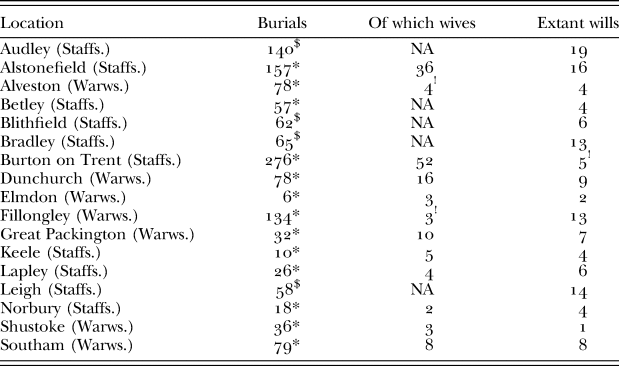
The probate material for both ecclesiastical units furnishes particular advantages for analysing bequests for religious purposes. Not only are there extant more than 2,800 testaments for Lichfield diocese (1533–46 inclusive) and 1,100 for Leicester archdeaconry (1522–46, but predominantly 1530–46), but there is also a substantial survival of associated probate inventories. In the 1530s and 1540s, the number of probate registrations increased to a level which allows a critical quantitative approach. The inventory valuations allow a perception of the economic status of the testators. For this purpose, the Prerogative Court of Canterbury probate material in the National Archives is omitted since the intention is to consider only the ordinary laity, not to complicate the pattern with the unusually wealthy. The issue with testamentary material is, of course, the extent to which the extant wills are representative of the wider population. Wills exist for only a small proportion of deceased inhabitants. Table 1 illustrates this point by comparing burials in parish registers from the diocese with the number of extant wills (see Table 1). Despite the disparity, the evidence of wills has been a fulcrum of examinations of late medieval religious participation.Footnote 41
Comparison of burials and extant wills, Lichfield diocese, 1539–47

Notes:
*Adults only (sons and daughters omitted)
$Undifferentiated (names only, no status of relationship)
!Surprisingly low
Alveston from Aug. 1539; Lapley to March 1543; Shustoke from Aug. 1540; Southam from June 1539–46.
References for parish registers: Derbyshire Record Office: D1729; SRO: D689/P1/1; D795/1; D922/1; D1386/1/1; D3082/1/1; D3379/1; D3483/1/1; D3514/1/1; D3712/1/1; D4219/1/1; Warwickshire Record Office: DR0050/1; DR0065/1; DR0073/1; DR0158/1; DR 0404/1; DRB0014/1; DRB0039/1.
Fillongley 1546: ‘in tempore plage’ (in plague time); high mortality in Alveston in 1546.
In Lichfield diocese, 2,786 inventories survive, providing substantial coverage of the testators. More than 16 per cent of testators had personal estate below the level of bona notabilia, the £5 above which probate registration was required by the 1529 act. Another 7 per cent had just sufficient personal estate to qualify under the act, between £5 and £6. Between £6 and £10 accounted for another 23 per cent, £11 to £15 for 17 per cent, £16–£20 for 12 per cent, and £21–£30 for 11 per cent, so that 87 per cent possessed personal estate appraised at £30 or below. The pattern for Leicestershire archdeaconry was not dissimilar, although a smaller proportion of inventories survive for testators. Here, 635 inventories reflect the economic status of testators, 12 per cent of whom had personal estate below that level of bona notabilia, below £5. Almost 4 per cent received a valuation of £5–£6. Between £6 and £10 comprised almost 23 per cent; almost 20 per cent accounted for £11–£15, 12 per cent for £16–£20, and almost 13 per cent for £21–£30, so that valuations at or below £30 covered 83 per cent of the testators. These appraisals were modest and, indeed, included indigence at the lowest level with representation of the most penurious with less than £5 of movable property. The relatively insignificant levels are indicated in the descriptive statistics of the inventory valuations: in Lichfield a mean of £17 (standard deviation 19.697), median of £11 (interquartile range 14), with the fifth percentile at just £2; in Leicester archdeaconry a mean of £19 (standard deviation 19.381), median £13 (interquarile range 14), with the fifth percentile at £3. We are addressing very ordinary parishioners for the most part.Footnote 42
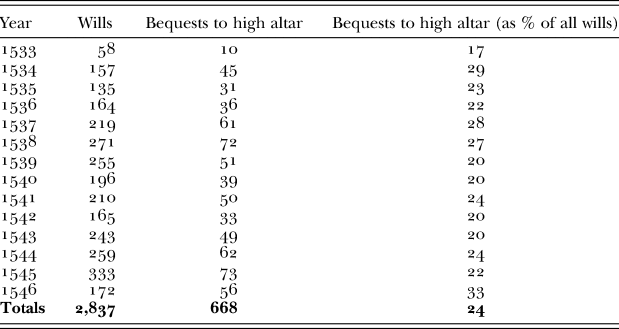
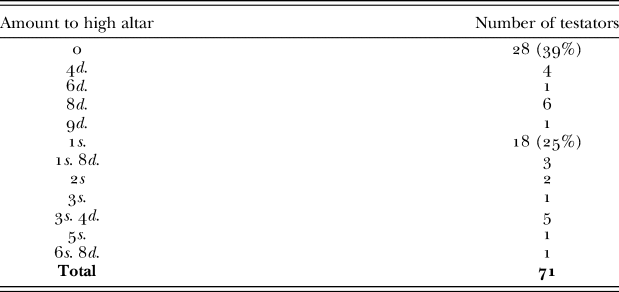
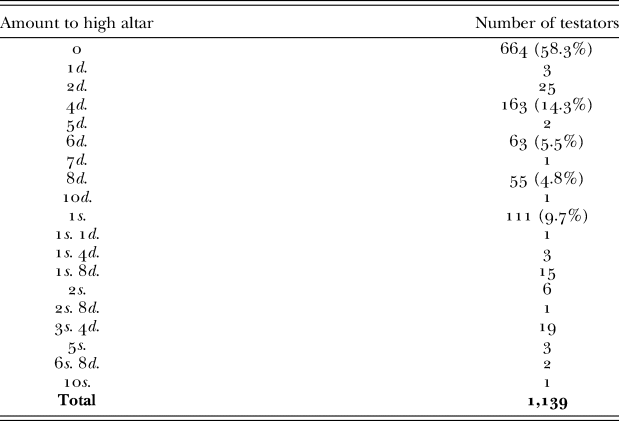
The number of benefactions had seriously subsided in the diocese by 1533, when only 17 per cent of testators included benefactions to the high altar for tithes forgotten. Through the remainder of the 1530s and in the 1540s to 1545, the proportion fluctuated between 20 and 29 per cent, more usually in the low 20s, with an apogee of 33 per cent in 1546 (see Table 2).Footnote 43 A register of some wills in the archdeaconry of Coventry contains wills, a large proportion of which made bequests to the high altar, more than 60 per cent (see Table 3).Footnote 44 The register, however, comprises merely seventy-one wills over a long time frame and the rationale for its production remains unclear. In the archdeaconry of Leicester, almost 60 per cent of wills between 1522 and 1546 failed to include a benefaction to the high altar (see Table 4).Footnote 45
Diocese of Coventry and Lichfield, 1533–46, including probate items

Register of wills in Coventry archdeaconry, 1527–40

Bequests to the high altar, Leicester archdeaconry, 1522–46

There is, moreover, a further complication. Not all the bequests to the high altar were specifically for tithes forgotten. A proportion conferred benefactions for prayers, for the sacrament and for accoutrements for the altar. Less than a quarter of the donations to the high altar in Lichfield wills contained a formula of bequest precisely for tithes forgotten. Of the 475 with instructions for payments to the high altar in Leicestershire wills, 120 (marginally over 25 per cent) specified that the benefaction was to compensate for tithes forgotten. We should, nevertheless, assume that most were indeed intended to compensate for any deficit in the payment of tithes.
How do we account for the omission of bequests to the high altar in the diocese of Coventry and Lichfield and the archdeaconry of Leicester by the 1530s and 1540s? One supposition might be that the testators were certain that they had acquitted their responsibilities during their lifetime. If so, their attitude might appear quite nonchalant given the apparent anxiety of other testators. Perhaps the testators who made no bequest conventionally assumed that their executors would make good the omission through the general consideration of the ‘health of my soul’. The will of 1544 of Roger Stubbes of Ellenhall contained no religious bequests or provision for his funeral, but his appraisers included in the probate inventory the costs of his burial: three dozen bread from Stafford for 3s., offerings of 15d., two priests for 8d. and ‘wax making’ 1s.Footnote 46 We can only assume that such inconsistencies do not interfere too much with the data. What does not obtain here is that the wills do not take into account life-course benefactions and donations (recorded in churchwardens’ accounts), for provision for tithes forgotten was specifically an end-of-life obligation.Footnote 47
Another explanation might be that there was now a diversity of routes to salvation, with altars to many different saints which allowed a more personal expression of devotion and wider intercession. There appears to be some slight corroboration for that supposition. Of the 2,169 testators who made no benefaction to the high altar, 237 (11 per cent) included bequests to the altars, lights, stock or services dedicated to saints, a vast proportion of which (152 – 164 per cent) supported those of Our Lady. The position in Leicestershire was different. Only twenty testators who did not remember the high altar made benefactions to saints’ altars, services or stock. Here, the relatively lower number of bequests to the high altar, comparative to a general trend before 1530, was partly associated with soul commendations which entrusted the soul to God only or (less frequently) to the mercy of God alone. The numbers of such commendations were comparatively small, just one hundred (9 per cent of all testaments). What is as significant, however, is that these soul commendations occurred in testaments dispersed throughout the county and archdeaconry in fifty-six different parishes, with multiple repetitions only in Great Bowden. The occurrences increased after 1539, the years from then inclusive to 1546 accounting for seventy-eight (78 per cent) of these commendations. Some such commendations were combined occasionally with a traditional recourse for salvation, such as a trental, but rarely.
Equally significant is that some testators who neglected to make provision for the high altar, for tithes forgotten or otherwise, did display a continuing devotion to the (blessed) sacrament (the high mass). Principal among these was Thomas Presson of Pickwell who in 1539 mandated £6 for a torch to burn before the sacrament and Thomas Prestberye of Packington who bequeathed 3s. 4d.. to the sacrament of the high altar. Two separate bequests of 1s. and another of 8d. were conferred in honour of the blessed sacrament. Four small amounts between 3d. and 8d. were directed for ornaments for the blessed sacrament. Altogether seventeen testators who did not make benefactions to the high altar did make gifts to the sacrament. Numerous Lincolnshire testators had directed their bequests for tithes forgotten to the sacrament before the mid-1530s, reflecting the predilection that the bequest was intended for salvation before benefice income, increasingly in the early 1530s.Footnote 48 John Hwitt, furthermore, elaborated in 1530 that his shilling should ‘be offeryd uppon the hye awter’ for tithes forgotten.Footnote 49 The husbandman Simon Pykyll in 1530 emphatically directed that a ewe and a lamb for tithes forgotten should be devoted to my Lord God.Footnote 50 Such benefactions confirm the residual sentiment that oblations for tithes forgotten were intended for the salvation of souls rather than benefice income.
Foundations for forgetting?
If that was the case, then clerical intercession seems to be occluded, which raises the question of belief or otherwise in the efficacy of priestly intercession, if not in official doctrine at least in popular perception.Footnote 51 The official distinction between ex opere operato and ex opere operantis might not have obtained popular certitude. Dissatisfaction with some of the clerical corpus is not necessarily tantamount to ‘anticlericalism’, but might have influenced very local attitudes towards particular clergy.Footnote 52 The proportion of the alternative benefaction, however, does not support a general replacement of the high altar by other altars and services. There is simply a comparative deficit of bequests to the high altar, for tithes forgotten or otherwise.
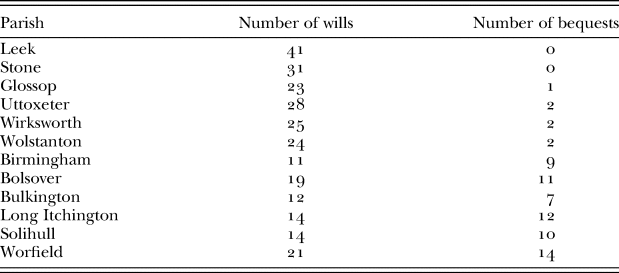
There existed, none the less, a wide gulf between those who made benefactions to the high altar and those who omitted the donation. In the diocese of Lichfield, there appears to be a division between parishes where the benefaction was regularly included in the testament and those where it was occasional, negligible or entirely missing (see Table 5). That difference then elicits the question of whether bequests to the high altar in the 1530s and 1540s had become a matter of local tradition, a particular convention and continuing example in some parishes, but had lapsed into desuetude in others. The impetus to retain the formula might have derived from the character of the writers of the wills, if clergy scribes, or from the emulation of neighbours.
Diocese of Coventry and Lichfield, 1533–46, including examples of low and high counts of bequests to the high altar

We might consider this discrepancy by a statistical test. Accounting for the parishes with more than ten wills, but excluding the county boroughs of Derby and Shrewsbury and the City of Coventry, Spearman's rank correlation of the number of wills with bequests to the high altar produces a value of 0.01968 (insufficient data for p [probability]). There is no conclusive association. The apparent reason is because of the diversity of the level of bequests, illustrated by forty such parishes having fewer than two bequests and indeed seventeen none at all by comparison with other parishes with a higher level.
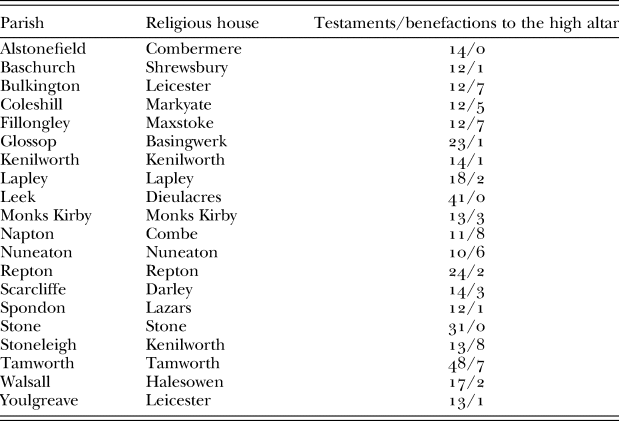
There is a certain degree of correspondence between omission of payments to the high altar and impropriation by religious houses. On the other hand, the issue here is not the great tithes. Equally, the bequest was omitted in parishes where the living had not been appropriated or a vicarage instituted. Nor does the chronology of benefactions correspond closely with the transfer of tithes to lay successors to the estates of the religious. Some of these estates did not devolve into lay hands until after 1546, even those confiscated in 1536 as well as 1539. The statute of 1540 (32 Henry VIII c.7) enabled process to recover tithes by lay impropriators, which effectively reduced tithes from a canonical due to a tax on movables. There is, however, no precise relationship between that legislation and the benefactions.
The question which must be posed is whether there could exist any scepticism about the efficacy of the priesthood and the sacrament.Footnote 53 The inclination here might be to dismiss the earlier circumspection of Lollardy as both expired and an aberration.Footnote 54 There is sufficient evidence that scepticism of the office of the priest and the sacrament persisted into the late fifteenth and early sixteenth century. Such heretical dissent was suppressed in the diocese of Salisbury between 1483 and 1499, but was detected (verb used advisedly) later in the dioceses of Canterbury, Coventry and Lichfield, Lincoln and London.Footnote 55 Since these inquisitions involved only three dozen dissidents detected in Salisbury diocese, the tendency might be to disregard them as insubstantial in number and impact. Geographically, moreover, the incidents were concentrated first around Newbury and then Reading, but extending in isolated cases into well over a dozen other locations. The further point is, however, that these deviants felt compelled to subscribe to the mass out of pressure and thus concealed their scepticism:
And more over we confesse and knowledge that we have receyved the said holy sacrament not for any devocion or byleve that we had therin but oonly for dreed of the people and to eschewe the Juberdye and daunger that we dredd to falle in if we had not doon as other crysten people dyd.Footnote 56
Not for that I had stedfast byleve therin; but that I shuld not be noted and knowen of the people.Footnote 57
Similarly, in Lichfield diocese, the inquisitions about heretical beliefs between 1486 and 1522, concentrated in 1511–12, focused on the city of Coventry, with some connection with the borough of Leicester. The interrogatories were also principally directed to pronunciations against the sacrament of the altar (‘contra sacramentum altaris’).Footnote 58 Richard Gilmyn opined that tithes not be devoted to the priest but offered to the poor (and of course, a proportion of tithes should have been directed by the rector to the poor).Footnote 59 Another, John Jonson, denied the real presence.Footnote 60
Correspondence between impropriation by religious house and benefactions to the high altar, 1533–40

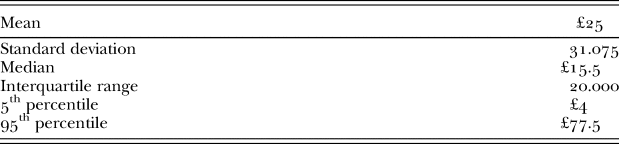
Diocese of Coventry and Lichfield: descriptive statistics of inventory valuations of donors to the high altar for tithes forgotten, 1533–46

Notes:
32 testaments have no corresponding inventory
36 per cent of inventory totals £10 or less
The problem, however, is that subsequent wills by Coventry testators preponderantly (77 per cent) made bequests to the high altar (whether specifically for tithes forgotten or in general). The testators are obviously a small proportion of the city's population. It is therefore necessary to assess how far the testators represented the wider urban population. If there were about 1,300 households in the city in 1523 (after significant decline in the preceding decades), and if the mortality rate between 1541 and 1551 remained stable at about thirty per 1,000, then about thirty-nine burials per annum might be expected.Footnote 61
About three-quarters of the Coventry wills (104) have accompanying probate inventories. The mean value of the inventories just exceeded £23 (standard deviation 33.334) and the median £10 10s. (third quartile £26). Twenty-six of the inventories were assessed at £5 (the level of bona notabilia) or less. Addressing wills which specifically provided for the high altar (seventy-eight wills with inventories), the descriptive statistics almost replicate the whole corpus: mean of just more than £23 (standard deviation 33.413), median of £11, and third quartile at £25 15s. with a similar distribution under bona notabilia and in the other lower ranges. There seems to be a representative sample.
In the borough of Leicester, precisely the same percentage benefited the high altar, out of more than fifty wills. Again, it is necessary to investigate how far these testators might have been representative of the wider urban population. It is demonstrable that the extant wills consist of only a small proportion of the burials in these years. The 1563 bishops’ return for Leicester contained 608 heads of household. We might consider a similar number before 1547, although the population might have been diminished by visitations of infectious disease. Assuming the mortality rate existed at about thirty per 1,000, we might then expect eighteen or so burials per annum in the borough. In fact, the extant wills comprise between one and five per annum with an excessive figure of eight in 1546, but no extant wills in four years.Footnote 62
Twenty-nine wills for Leicester deceased have corresponding inventories. The mean valuation occurred at £21 10s. (standard deviation 17.508), with a median of £17 and third quartile at £32. Eighteen of the inventories contained personal estate at or below £20. Examining only those wills with inventories which included benefactions to the high altar, the mean was slightly higher at £24 (standard deviation 20.233) with the median replicated at £17 and a slightly higher third quartile at £39 10s. As at Coventry, the testators remembering the high altar seem to have reflected the wider urban inhabitants.
The exceptions were Shrewsbury (26.3 per cent) and Derby (all except one omitting benefactions to the high altar). There is an ostensible inversion here, in which the urban places associated with Lollard activity later exhibited through their will-making a high level of conformity with traditional benefactions.
That very dissent had persisted too in the diocese of Coventry and Lichfield, the see at issue above. There heresy inquisitions were instigated, like those in Canterbury and London, by the exhortation of the convocation of bishops in their concern about the existence of heresy.Footnote 63 As elsewhere, the trials were conducted by the bishop with a substantial council of clerical advisers, overwhelming the accused who appeared as solitary defendants.Footnote 64 Here again, the examined belonged mainly to artisanal society.Footnote 65 The nexus of those detected was similarly circumscribed in the declining city and provincial capital, Coventry.Footnote 66 The dissemination of disbelief thus owed something to connection with Leicester and Leicestershire and in particular with urban anxiety. Associating the heretical dissent with the later reluctance in the same diocese to offer compensation in wills for tithes forgotten is thus tenuous, but allows for several conceptions. First, scepticism was possible. Secondly, the detections reflect only a concerted effort to prosecute some dissidents.
One interpretation of the Lollard confessions would emphasise their extraordinary nature, deviation from the norm, the adherence of a slender minority. On the other hand, it was still possible to conceive of the sacrament as not a miracle redeeming souls but a commemoration and no more. The criticism then extended to the clerical office: that the role was not supernatural and did not merit a significant benefice income: when others ‘spack of tythes and offrynges I was sone wery to here them’.Footnote 67 Perhaps, moreover, there was a longer-standing recalcitrant attitude by some towards divine service, the principal intervention of the priest.Footnote 68
When rectors, not least religious houses as impropriators, were delinquent in the maintenance of the sanctuary and chancel, moreover, the prick of conscience might have been at least temporarily dissolved. The abbot and convent of Leicester left the windows in the chancel at Cosby in such disrepair, it was reported in 1526, that the pigeons shat on the high altar, desecrating the consecrated principal locus for the high mass.Footnote 69 Such was alleged against the prior and convent of Lenton, pigeons entering through the broken main window in the chancel at Wigston Magna and disturbing the high altar.Footnote 70 Visitation reports implicating rectors in the poor maintenance of chancels were not infrequent.Footnote 71
Forgetting and confusion
Drawing conclusions from such non-narrative sources is inevitably fraught with difficulty and misinterpretation. How do we account for these small, almost imperceptible, changes? There are several fundamental aspects. First, the character of the changes escaped the scrutiny of the ecclesiastical courts. Second, tithes came to be perceived as benefice income at the same time as aspects of that revenue were being critiqued from above by legislation and below by legacy ideas from the recent past.
The contention is that we should look for small shifts, some resulting from acceptance of opportunities for avoidance, others from uncertainty, and ‘the power to control uncertainty is very unequally distributed, the greatest burden of uncertainties tends to fall on the weakest, with the fewest resources to withstand it, and in trying to retrieve some sense of autonomy and control they often compound and confirm their weakness’.Footnote 72 The weakness of the testators (actors) here is their being caught in the cross-fire between authorities. These alterations are tactical responses in the veritable Certeauesque sense: not only ‘the little victories of daily life’, but manifestations of what was just about possible, according with the urge to camouflage, the combinatoire.Footnote 73 These tours (turns) are ‘constantly mutating responses to constantly mutating distributions of power’ (power as legal force).Footnote 74 Surveillance by the ecclesiastical courts where probate was granted missed the omission of compensatory tithes. Although frequently conventional in other aspects (preamble and other benefactions), forgotten tithes had become a forgotten object.
It might be surmised, however, that through these small realisations, tithes, which were once regarded as contributing to the welfare of one's own soul and the collectivity of souls, through sustaining the performance by the priest of the sacrament of the mass, gradually came to be regarded as simply a matter of benefice income.Footnote 75 That change of attitude had been allowed, encouraged by the intervention by higher authority in the regulation of fees exacted by the ecclesiastical authority.Footnote 76 Before the dismantling of confession and the symbolism of the mass, authorisation had been given to question the grounds for benefice income.
The influence of Lollard predecessors is more difficult to assess. The notion of a linear descent of Lollards to evangelicals has been proposed, but also questioned.Footnote 77 It is not impossible, however, that Lollard ideas about the use of tithes received some loose reception, divorced from any profound theological content – what has been designated a ‘usable past’.Footnote 78 In particular, ‘some memories might form within islands of ideological coherence whilst others float in unpredictable, historically specific patterns’.Footnote 79 Memory is not unified, but fractured and, importantly, local and specific. Once disruption occurred, the lapse of memory persisted locally. The recognised difference between habit-memory and recollection (Bergson) became instrumental. Once habit-memory was turned off, omission became a local custom.Footnote 80 Such a diffusion and reception might explain why some localities eschewed bequests for tithes forgotten whilst others more rigidly preserved the benefaction.