For several months after the September 2005 publication of twelve cartoons of the Prophet Muhammad in the Danish newspaper Jyllands-Posten, the debate was largely confined to a Danish context. Early international protests of the cartoons were voiced by government officials in several countries, including Pakistan, Iran, and Egypt. However, until late December 2005, in what I will call phase one of the controversy, Danish Muslims fought a primarily domestic battle for some kind of recognition from the newspaper and the Danish government that the cartoons had hurt religious feelings. In October 2005 an ad hoc coalition of Danish Muslim organizations, with The Community of Islamic Faith (Det Islamiske Trossamfund) and its affiliated imams at the lead, tried to put pressure on the Danish government through ambassadors from Muslim countries posted in Denmark. The ambassadors' request for a meeting with the Danish prime minister was turned down, as were other attempts by Danish Muslims to raise claims with the government.
In reaction to the lack of progress eliciting an apology within Denmark, some Danish Muslims decided to internationalize the conflict. Their transnational activities, which initiated phase two of the controversy, occurred on at least two levels: sending delegations to the Middle East to meet with political elites and religious authorities in an attempt to secure external support for their claims; and using e-mail campaigns, chain text messaging, websites, blogs, and chat forums of a transnational scope, as well as transnational TV stations such as al-Jazeera and al-Arabiya, as a way of diffusing knowledge about the cartoons. Many of these activities, especially the so-called “imam delegations” to the Middle East, which were initiated in December 2005 and made up of self-appointed representatives of Danish Muslims, were received with skepticism by the Danish public: What were the motivations and interests behind making the cartoons an international affair? Were some Danish Muslims deliberately stoking the fire abroad? Were they presenting a fair and accurate picture of the situation in Denmark?
The fact is that the content of the Danish debate about the cartoons began to change in January 2006, as the conflict escalated abroad with the first mass demonstrations against the cartoons, along with flag burnings and consumer boycotts of Danish products. In the first week of February 2006, the beginning of phase three of the controversy, violent attacks were carried out on Danish consulates in Damascus, Beirut, and Tehran, which marked the high point of the controversy. The beginning of its demobilization—the fourth and last phase—can be detected from the end of February onward. It is likewise a fact that Danish Muslims involved in the imam delegations were forced into a defensive position during the last two phases of the controversy. Taking these observations as a starting point, this article sets out to explore 1) the choice by Danish Muslims to engage in transnational activities, 2) the way these activities “backfired” on the involved Danish Muslims, 3) the theoretical implications raised by this case of dynamic interaction between transnational action and forms of state repression, and 4) the possible long-term effects of the events on both Danish Muslims and the Danish political elite.
The article builds methodologically on a political claims-analysis approach that aims to integrate elements of protest event analysis, discourse analysis, and frame analysis.Footnote 1 It draws on an empirical database of claims making during the Muhammad cartoons controversy. The database contains detailed codings of all newspaper articles touching on the crisis that were published in the Danish daily Berlingske Tidende from the appearance of the cartoons on 30 September 2005 until the beginning of demobilization on the issue in late February 2006 (what I identify as the transition from the third to the fourth, and last, phase of the controversy). The choice of Berlingske Tidende is based on a pretest that found that the newspaper occupied an intermediary position among the three largest Danish dailies in terms of blaming the Danish government and/or Danish Muslims for the escalation of the conflict.Footnote 2 The choice of relying on one newspaper can be justified by reference to research on newspapers as sources of data on protest cycles, which has shown that during intense public debates of a national scale the same events and claims tend to be covered by all major newspapers.Footnote 3 This seems to have been the case during the Muhammad cartoons controversy in Denmark. Furthermore, from a pragmatic point of view, limiting the coding to one newspaper seemed necessary due to the extensive coverage of the controversy in the Danish press. Berlingske Tidende alone published 893 articles about the controversy during the period under study.
A common criticism raised against this type of claims-analysis approach is that the focus on newspaper data is bound to reproduce the selection bias inherent in newspaper coverage, which is based on certain criteria of newsworthiness. Some actors and some sorts of claims making (less audible or less visual forms of interest politics, for example) will be underrepresented in the data. I try to compensate for this by including in my empirical database codings of other types of material (internal newsletters, pamphlets, organizational documents, Friday sermons, and recordings of internal debates and meetings) containing claims by Muslim actors who were active in the public debate about the cartoons. Another critique of the claims-analysis approach is that the complexity of arguments and the dynamics of interaction involved in public claims making are oversimplified by the focus on quantifying who said what, when, where, and why. As a partial remedy to this objection my analysis is further supported by interviews conducted with representatives of the Muslim organizations active in the debate. In the empirical analysis that follows, the constructed database and interviews will be used to trace the effects of the transnational activities of Danish Muslims on 1) the general Danish debate about the cartoons, 2) the content of Muslim claims making in Denmark, and 3) mobilization/demobilization among different Muslim actors in Denmark. However, the article first presents some theoretical reflections on the relationship between different forms of state repression and transnational activism, as well as the prospect of either repression or activism “backfiring.”
REPRESSION, TRANSNATIONAL ACTIVISM, AND BACKFIRE
In making sense of the choice of Danish Muslims to engage in transnational activities, and the effects this choice had on subsequent Muslim claims making in Denmark, some insights can be drawn from existing literature on the relationship between state repression and mobilization of critical voices/claims in a society.Footnote 4 In this literature, the level and form of state repression are often theorized as constituting important elements of the “political opportunity structures” facing dissident voices in a given context and are believed to shape the form and level of claims making in opposition to state authorities. At least three effects of repression on mobilization are found in the literature. First, repressive policies such as protest policing, surveillance, preemptive arrests, and “stop-and-search” zones have been shown to heighten the costs of claims making, leading to demobilization of dissent.Footnote 5 This is obviously the intended effect of such policies.
Second, in other cases research has shown how repression does not always make protesters give up their claims but rather can transform the expression of protest. In authoritarian regimes like Pinochet's Chile or Franco's Spain, where repression is severe, resistance has been found to become more personal and internal and is expressed through more subtle means and arenas than those of collective action in the streets.Footnote 6 In a similar way, an extensive literature argues that domestic repressive policies can push protesters toward transnationalization of their claims making, elevating local, national, or regional grievances into a global arena in order to garner support.Footnote 7 A subliterature has focused on immigrant transnational activism, that is, the triangular relation between the country of origin, the country of settlement, and the immigrant group.Footnote 8 Here it is often emphasized how immigrants have remained socially, culturally, economically, and politically involved in their home countries, with important positive implications (investments, democratic know-how, trade, etc.) for the target societies.Footnote 9 Some scholars have specified that the level of transnational involvement of immigrants depends on the opportunities for integration and political participation in the country of settlement so that the greater the opportunities for participation in the country of settlement the less likely it is that immigrants will engage in transnational activities.Footnote 10
Using a similar framework of “closed” and “open” opportunity structures, Keck and Sikkink have proposed their “boomerang model” of transnational activism.Footnote 11 They originally developed the idea of the boomerang effect to account for cases of human rights improvements in authoritarian regimes. Faced with a repressive regime at home, national human rights nongovernment organizations (NGOs) appeal to foreign governments, international institutions, or NGOs in other countries to put pressure on the repressive regime. External allies might, for example, push for political change by threatening material or symbolic repercussions for noncompliance. Sikkink and Risse later expanded the “boomerang model” into the so-called “spiral model,” which recognizes that the effect of domestic–transnational linkages on domestic political change is not a single move but rather a longer-term process/dynamic with distinct phases.Footnote 12
Third, repression has been found to have unintended negative consequences by leading to increased mobilization of dissent.Footnote 13 When repression is perceived by the public or by allies of dissident groups as unjust or out of proportion, it can become an opportunity rather than an added cost of mobilization. This mechanism has been referred to as “backfire.”Footnote 14 Backfire has primarily been linked to acts of “hard” repression, such as police/military brutality in cases like the Sharpville massacre in South Africa or “Bloody Sunday” in Northern Ireland. However, “soft” forms of repression—such as ridicule of individuals, stigmatization of groups, and public statements that distance specific actors—can also backfire.Footnote 15 For example, the silencing and verbal delegitimization of Muslims in Western Europe who are categorized as “radicals” have in some cases proven counterproductive, because they have distanced these groups further from the majority and boosted their attractiveness to Muslims who themselves feel alienated from society.Footnote 16
It is important to note that the relationship between repression and mobilization is dynamic. In other words, mobilization and acts of dissent also shape state repression. Here the literature is in closer agreement: increased mobilization and challenges to authorities will make authorities want to increase repression. The media and public opinion play a crucial role in signaling to the state whether and to what extent repression of specific acts of dissent will be applauded. Through the framing of actions/claims as legitimate or illegitimate, the media and public opinion create “discursive opportunities,” which do or do not invite state repression.Footnote 17
If we look at the instances of transnational activism by Danish Muslims in light of the existing literature on the dynamic relationship between repression and mobilization, two things become evident. First, these activities, especially the imam delegations, followed the initial logic of the “boomerang” model of transnational activism. Confronted with closed opportunities in Denmark, the idea was to lift the issue of the cartoons out of a purely Danish context—to perform a “scale-shift”—and thereby put external pressure on the Danish government to make concessions.Footnote 18 Second, the transnational dynamic put into motion seems to have worked contrary to the hopes and expectations of the involved Danish Muslims. Because of the way they were framed and perceived in the Danish public sphere, the transnational activities had very negative short-term effects on the subsequent realization of Muslim claims in Denmark. The rest of this article analyzes these developments in detail.
THE CHOICE BY DANISH MUSLIMS TO ENGAGE IN TRANSNATIONAL ACTIVITIES
The protests against the cartoons were spearheaded in Denmark by an ad hoc coalition of Muslim organizations founded in the days after the publication of the cartoons, which comprised a wide variety of national and local organizations.Footnote 19 Most were dominated by Arab Muslims, but some members of the numerically large Somali and Turkish organizations also participated. The leading group in the coalition was the Community of Islamic Faith, the dominant Muslim organization in Denmark prior to the cartoons controversy. Mainly comprising Arab immigrants and descendants, it had occupied a central position in the relation between the Muslim minority and state authorities through, for example, participation in integration projects and in occasional debate meetings with members of the political elite.
Danish Muslims chose to engage in activities aimed at elevating the issue of the cartoons into a transnational arena and at finding external allies in reaction, as already indicated, to the experience of “closed” political opportunities within the Danish political context. Through demonstrations, letter writing, diplomatic contacts, petitioning, and lawsuits, the coalition first tried to raise claims through the political and legal systems of Denmark. These actions proved fruitless. Thus, in December 2005 the coalition decided to “internationalize” the issue. As the spokesperson of the coalition, Ahmed Akkari, put it, “After two months of trying to explain our viewpoints in Denmark without anybody listening or responding to them we saw no other way than to contact influential people abroad, hoping that they could make our voice heard.”Footnote 20 In other words, the transnationalization of the issue was a reaction to the soft repression exercised by the Danish government with its silence and its refusal to meet with the coalition's representatives.
At least three factors made the transnational arena “open” for such a move. First, the very nature of the imposed grievance on Danish Muslims—the mocking of the Prophet Muhammad— made Muslim communities abroad receptive to Danish Muslims' claims for an apology. For many Muslims the attack on Muhammad was an attack on all Muslims. The publication of the cartoons thus harbored a certain transnational conflict potential. Second, the Muhammad cartoons were a welcome opportunity for several Muslim regimes, in the Middle East and elsewhere, to show that they stood guard for respect for Islam and thereby soften the critique of Islamic opposition within. Here was a case that was highly value loaded and nearly costless as a diplomatic conflict. Third, the Danish Muslim actors possessed the necessary resources to make the transnational move possible. Most important, they had valuable transnational ties to powerful religious authorities in countries such as Egypt, Lebanon, and Syria—the “home countries” of several participants in the imam delegations. For example, the delegations met with Arab League Secretary Amr Moussa, the grand imam of al-Azhar University, Sheikh Muhammad Sayyid Tantawi, and the influential Sunni scholar Yusuf al-Qaradawi, among others.
The imam delegations were the most visible and, as we shall see, the most decisive of the transnational actions by Danish Muslims in the controversy. However, there were others. Activists made use of micro- and macromedia to diffuse claims about the cartoons transnationally.Footnote 21 By micromedia I mean e-mail campaigns, chain text messaging, websites, blogs, and chat forums, which Danish Muslims used extensively, taking advantage of the speed and ease by which claims are diffused through such IT-based communication. However, the “uncontrollability” of these media and the very ease with which claims are spread are also among their drawbacks. Rumors, misinformation, and misunderstandings tend to flourish and take on a life of their own. The Muhammad cartoons controversy produced several examples of this. One was the rumors of Qurʾan burnings in Denmark, which spread to the Middle East via text messaging on 4 February 2006 and apparently inspired the angry mob of protesters outside the Danish consulate in Damascus that same afternoon. In a similar vein, lists of “Danish” products/companies to be boycotted, which flourished in Muslim chat rooms and blogs on the Internet, included several companies that are not and never were Danish. In an attempt to counter such misinformation, members of a multiethnic Danish Muslim organization, Muslims in Dialogue (Muslimer i Dialog), logged on to transnational Muslim chat forums to monitor discussions of the cartoons and correct the widespread misunderstandings of the situation in Denmark. A representative of the organization explained the initiative in the following way:
We have to avoid further escalations. There are a lot of misunderstandings in the controversy, which have contributed to the sad situation we are facing. Therefore we find it natural to use the same media to tell the facts, what Danish Muslims feel, and that dialogue is always better than confrontation. We hope that our message to Muslims anywhere will spread like ripples across the bay in the same way as the misunderstandings did.Footnote 22
As far as macromedia, Muslim organizations and individuals in Denmark took advantage of contacts with television media and newspaper journalists in the “home country” to publicize claims. Attention to the cartoons in truly global networks like al-Jazeera and al-Arabiya allowed Danish Muslim representatives to speak to a large transnational community of Muslims (and non-Muslims) abroad.
Danish Muslims were, as indicated, involved simultaneously in claims making in different arenas—for example, local mosques, the Danish public sphere, foreign national public spheres, and on a transnational level. However, in at least one instance this strategy of multilevel claims making created problems for the involved Muslim actors, when inconsistency in claims making was detected across arenas. In late January 2006, Ahmed Abu Laban, an influential imam of The Community of Islamic Faith, made seemingly contradictory statements to the Danish and the Arabic press. He supported the boycott of Danish products in an interview with al-Jazeera while expressing sympathy with the Danish companies hit by the boycott in an interview with a Danish newspaper. This episode, and the perceived escalating effects of the imam delegations more generally, made the transnational activities of Danish Muslims central to the subsequent debate, albeit in a negative way. Notions of “two-tongued talk,” “hidden agendas,” and “Janus-faced imams” became common descriptions of Muslim claims making in the public debate. In what follows I investigate how this perception of Danish Muslims' transnational activities invited further acts of soft repression from Danish authorities against the involved actors and how this repression affected subsequent mobilization and claims making.
THE EFFECT OF MUSLIM TRANSNATIONAL ACTIVITIES ON SUBSEQUENT MUSLIM CLAIMS MAKING
In January 2006 (the second phase of the controversy) there were some signs that the transnational dialectic between events in Denmark and reactions/events abroad was working to the advantage of Danish Muslims. In other words, it seemed like the “transnationalization” of the controversy would have positive effects on the recognition of Muslim claims in Denmark. The indifferent attitude of the Danish government toward the Muslim ambassadors in Denmark in the first phase of the controversy led to growing criticism not only from Muslim actors abroad, especially Egypt and the Organisation of the Islamic Conference, but also from a range of non-Muslim actors, including national ministers and European Union and United Nations representatives. The Danish government and Jyllands-Posten thus found themselves under serious international pressure to resolve the conflict. However, the nature of the transnational dialectic changed with the rapid and violent escalation of the conflict abroad in early February 2006, which marked the beginning of the third phase of the controversy. Danish Muslims who had helped internationalize the conflict came under increased fire, and Western governments and international institutions circled their wagons in defense of the Danish government. What had happened?
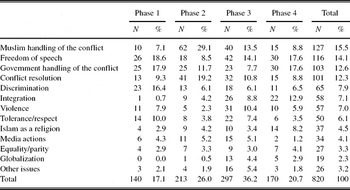
Shortly after the imam delegations returned to Denmark in late December 2005, the first large demonstrations against the cartoons in the Middle East occurred, and in mid-January 2006, the consumer boycott of Danish products spread rapidly in the region. The escalation of the conflict abroad culminated with the violent attacks on Danish consulates in early February 2006. Whether the imam delegations “triggered” this escalation through their activities abroad is a highly contested matter, which I will not discuss here. I simply note that the imam delegations, and their imputed motivations, entered the Danish public sphere in January 2006 and became central issues in the public debate, with serious implications for the involved Muslim actors. There was an overall shift in the debate during this phase of the controversy, as indicated by the issues that were the focus of claims raised.Footnote 23Table 1 shows the main issues of all claims by both Muslim and non-Muslim actors across different phases of the public controversy. An issue is defined as the topic about which a particular statement raises a claim. The table indicates how issues of discrimination, free speech, and government handling of the conflict (for example, the refusal to meet with the Muslim ambassadors) are dominant in phase one of the controversy, while issues regarding the legitimacy of Muslim handling of the conflict—foremost among them the use of transnational activism—dominated as the most frequently addressed issue in phase two of the controversy. Almost 30 percent of all claims raised in phase two touched on this issue.
Issues of all claims by phases of the controversy

Note: Phase 1: 30 September–25 December 2005; phase 2: 26 December 2005–3 February 2006; phase 3: 4 February–25 February 2006; phase 4: 26 February–20 March 2006. The percentages are of a specific issue relative to all issues raised within a given phase.
Several aspects of the imam delegations were publicly scrutinized in phase two. One issue was the content of the dossier that the imams had brought with them to Egypt, Lebanon, and Syria. Besides the twelve Muhammad cartoons and Arabic translations of the articles that had accompanied them in Jyllands-Posten, the dossier contained copies of letters that the coalition had sent to politicians, the letter from the Muslim ambassadors to the Danish prime minister, and the prime minister's response, as well as a number of mocking images that were never published but sent to Danish Muslims as hate mail. Many critics argued that it could be difficult to determine just by looking at the dossier what had been published and what had not. It was likewise pointed out that Arabic translations of the Danish names of the Muslim organizations involved in the protest coalition exaggerated the magnitude of support for the involved actors: for example, “Danish” became “Scandinavian” in one name.Footnote 24
One particular image in the dossier was discussed extensively. The image shows a man with pig ears and a snout, and its caption reads, “Here is your prophet Muhammad.” One of the Danish imams of the delegation, Abu Bashar, was seen showing it to the general secretary of the Organisation of the Islamic Conference, Ekmeleddin Ihsanoglu, in a BBC news report. Many voices in the Danish debate did not see how this picture, sent to a Danish Muslim in a private mail, was relevant to the Muhammad cartoons debate. It was also noticed that articles containing “misunderstandings” of the situation in Denmark often appeared in the Arabic press simultaneously with the Danish imams' visit. For example, it was claimed that the radical-right and Islamophobic Danish People's Party was part of the Danish government and that Danish Muslims were not allowed to build mosques. A Danish scholar monitoring the Arabic press said, “It is striking that every time a visit from the delegation is mentioned, the article contains very wrong information about the situation in Denmark. I have to say that it is a very suspicious coincidence.”Footnote 25 From these observations about the timing of the delegations and the subsequent escalation of the conflict in the Middle East, many claimants in the Danish debate, including actors within the political elite, concluded that the imams had helped stoke the fire abroad. The Danish minister of social affairs, Karen Jespersen, formulated it thus: “The imams poured gasoline on the fire through their travels abroad. In this way they contributed to the intensifying hysteria, which ended with the boycott, mass demonstrations, flag burnings, and the attacks on Danish diplomatic consulates abroad.”Footnote 26
Arguments about “loyalty” and “security” thus became central. Put differently, the imam delegations were “securitized” upon their entry into the Danish public debate. When the issue was turned into one of domestic security, it called for extraordinary political attention and action.Footnote 27 From this perspective, the imam delegations had jeopardized national security by channeling the wrath of Muslim regimes and extremists against Denmark. Accordingly, the involved Danish Muslims were referred to as, for example, “the enemy within” or simply “traitors.” This line of reasoning was taken to the extreme by the Danish People's Party, which called for an investigation of the possibility of revoking the Danish citizenship of four named imams who had participated in the delegations on grounds of treason. Such calls resonated well with the sense of a “state of emergency” among much of the Danish population and the political elite: Denmark was facing its worst foreign policy crisis since World War II. Thus, the securitization of the transnational activities of Danish Muslims in much of the public debate established a discursive opportunity for political authorities that invited repression of the involved Muslim actors. It was not only the radical right that seized this opportunity to stigmatize and alienate the central actors of the Muslim protest coalition behind the imam delegations. The delegitimization by the political elite was almost complete, as demonstrated when the minister of integration, Rikke Hvilshøj, proposed that the government stop involving Danish imams in integration projects—in which they had previously been called upon to give advice on how best to deal with, for example, youngsters of Muslim descent getting into fights with the police in certain urban neighborhoods. The proposal to discontinue such collaboration with Muslim religious authorities won wide support across the political spectrum in February 2006. It reflected the idea that the involved actors had not distanced themselves sufficiently from old loyalties, norms, identities, and connections to be trustworthy partners in the work of Muslim integration into Danish society.
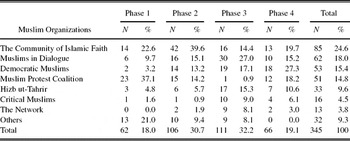
This massive criticism and soft repression, especially of The Community of Islamic Faith, led by imam Ahmed Abu Laban, and the protest coalition, represented by the young imam Ahmed Akkari, had serious effects on these actors' further claims making in the debate. Table 2 shows the share of total Muslim claims making by the main Muslim actors in the public debate across the phases of the Muhammad cartoons controversy. The table indicates that the share of claims making by the Muslim protest coalition dropped by more than 50 percent from phase one to phase two of the controversy. After the violent escalation of the conflict abroad at the start of phase three, the protest coalition almost disappeared as a claimant in the public debate—down from 14.2 percent of all Muslim claims making in phase two to only 0.9 percent in phase three. The Community of Islamic Faith, which had large stakes in the protest coalition and collaborated closely with the coalition leaders, seemed to take the lead in claims making about the controversy in phase two. However, after the violent attacks abroad, The Community of Islamic Faith was also forced into a more defensive role when its share of Muslim claims making dropped from about 40 to less than 15 percent. The retreat of the two dominant actors in the initial protests against the Muhammad cartoons at this specific time should be understood as a consequence of their role, perceived or real, in escalating the conflict abroad through transnational activities. Faced with harsh criticism, stigmatization, and alienation, the dominant actors of the first wave of protests saw their chances of further successful claims making reduced. The retreat of the actors who had contributed to the imam delegations paved the way for new Muslim actors in the debate to take advantage of the situation by positioning themselves in opposition to the Muslim actors of the first wave of protests. Thus, through critique of the imam delegations, actors such as Muslims in Dialogue, Critical Muslims (Kritiske Muslimer), The Network (the English term was used), and especially the newly created Democratic Muslims (Demokratiske Muslimer) gained momentum in the debate in phases two and three. Democratic Muslims was launched as an “alternative” voice to the “radical” imams. In the words of Member of Parliament Nasar Khader, the initiator of the organization, “What is needed is an organization that protests the religious enveloping of the youth by fundamentalist imams and ensures that moderate Muslims are heard in the debate about Islam. Muslims who are against capital punishment and shariʿa, and who endorse religion as a private matter.”Footnote 28
Number of claims raised by different Muslim organizations by phases of the controversy

Note: Phase 1: 30 September–25 December 2005; phase 2: 26 December 2005–3 February 2006; phase 3: 4 February–25 February 2006; phase 4: 26 February–20 March 2006. The percentages are for a particular Muslim organization's claims relative to the total claims raised within a given phase.
The actions and claims of the dominant actors of the first round of protests were thus labeled as “radicals” by both non-Muslim commentators/authorities and fellow Muslim organizations. While these “radical” actors were being excluded through soft repression, the new “moderate” Muslim actors on the stage, especially Democratic Muslims, were being certified and included by Danish authorities. This happened through a very symbolic meeting between Democratic Muslims and the Danish prime minister on 13 February 2006. The parallel authentication/deauthentication of different Muslim actors at this point in the controversy can be seen as an example of what has been called the “radical flank effect” within social movement theory. The logic of the mechanism is that protest actions that are perceived as radical and/or illegitimate by some actors lead to countermobilization among more moderate voices and increased resources for this new flank.Footnote 29 In other words, the balance of power, and the opportunities for different Muslim actors to mobilize claims, was altered by the repressive measures taken in response to the imam delegations.
The extensive public focus on and criticism of the transnational activities of some Danish Muslims in the second and third phases of the controversy did not just affect the relative level of claims making among Muslim actors. As indicated in Table 1, it changed the overall conditions of the debate. Danish Muslims prior to the imam delegations and the subsequent escalation of the conflict abroad had stressed that they were the victims of a gratuitous offense and were owed some kind of (symbolic) reparation. However, it became more difficult to claim gratuitous offense when the controversy moved into its third and fourth phases.
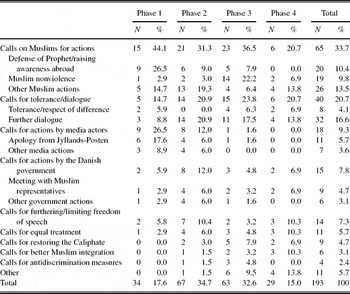
Danish Muslims adapted to this new situation partly by changing their modes of reasoning and calls for action (see Tables 3 and 4). Table 3 shows the prognostic frames—the envisioned solutions to the conflict—of Muslim claims throughout the controversy. It demonstrates that Muslim calls for action in the first phase were primarily concerned with either raising awareness about the cartoons (calls for defending the Prophet/spreading the word abroad) or receiving some kind of symbolic reparation (an apology from Jyllands-Posten or a diplomatic meeting with the government). Starting with phase two, calls for dialogue became central to Muslim prognostic framing. Likewise, following the embassy attacks in the Middle East, Muslim calls for nonviolence boomed in phase three (22.2% of prognostic frames in this phase). My argument here is that the linking of the imam delegations and the escalation of the conflict abroad in the public debate put heavy pressure on Muslim claimants in Denmark to officially distance themselves from the use of violence and actively embrace dialogue and calls for tolerance. To do so became a condition for further participation and claims making in the debate.
Prognostic frames of Muslim claims by phases of the controversy

Note: Phase 1: 30 September–25 December 2005; phase 2: 26 December 2005–3 February 2006; phase 3: 4 February–25 February 2006; phase 4: 26 February–20 March 2006. The percentages in each cell show the percentage of a specific prognostic frame relative to all prognoses proposed within a given phase.
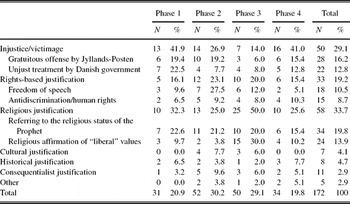
Justificational frames of Muslim claims by phases of the controversy

Note: Phase 1: 30 September–25 December 2005; phase 2: 26 December 2005–3 February 2006; phase 3: 4 February–25 February 2006; phase 4: 26 February–20 March 2006. The percentages in each cell show the percentage of a specific justificational frame of all justifications given by Muslim actors within a given phase.
A change in the same direction is observed in how Danish Muslims justified their claims. Table 4 shows the contours of a shift away from “blaming” Jyllands-Posten and others, justified by reference to how Danish Muslims were the victims of a gratuitous offense by the newspaper and of unjust treatment by the Danish government, and toward justifications based on references to specific rights and moral principles. This move sets in from phase two but really materializes in phase three of the controversy. Danish Muslims became less occupied with establishing victimage and more occupied with affirming, through their framing of claims, values and norms such as freedom of speech, public virtue, and democracy. It is especially interesting that a similar shift can be detected in the use of religious justifications of Muslim claims. The increase in religious justifications from phases two to three is driven by an increase in religious justifications of a certain type, namely, religious affirmations of values stressed by many non-Muslim actors in the debate, including freedom of speech, rational deliberation, and democracy. The authoritative sources of Islam (the Qurʾan and the sunna of the Prophet Muhammad) were used to highlight certain aspects, norms, and values of Islam. My argument here is that when Danish Muslims emphasize that freedom of speech, democracy, tolerance, and nonviolence are fundamental Islamic values at exactly this point in the debate, it can be seen as a way of turning external pressures for affirmation of certain values into an internal obligation of being a good and virtuous Muslim. An example is the following quote by Sherin Khankan, spokeswoman for Critical Muslims, a relatively small group of well-educated Muslims advocating a “European Islam”: “Some Muslims have forgotten the words of the Prophet: Islam is exemplary behavior. The example given by the prophet demands forgiveness, indulgence, and tolerance. Besides, it demands of us to meet our opponents with the best and most beautiful arguments.”Footnote 30 Rational dialogue and nonviolence here become religious imperatives. In a situation where some Danish Muslims were accused of being at least partially responsible for the violent escalation of the conflict, this increasingly defensive version of religious justification made good sense.
A NEGATIVE BOOMERANG EFFECT: THEORETICAL CHALLENGES AND ASPIRATIONS
My empirical argument, as presented previously, can be summarized as follows. The transnational activities of certain Danish Muslim actors, especially the imam delegations, were perceived in public debate in Denmark as the “trigger” of the conflict's escalation in the Middle East. Thus, the involved Muslim actors, foremost among them members of the protest coalition and The Community of Islamic Faith, were accused of deliberately stoking the fire abroad and of disloyalty or even treason against Denmark. This securitization, in the public sphere, of the transnational move invited political authorities to marginalize the central actors through processes of soft repression (stigmatization and silencing). These developments had important implications for further Muslim claims making. First, we saw how the actors behind the imam delegations reacted to the soft repression they met by downgrading their level of claims making in the public sphere, while other Muslim actors became more involved. These new actors were rewarded for their “moderateness”—for example, their insistence on religion as a private affair and on confining the controversy to the Danish context—through legitimization by authorities. Second, we saw how Muslim actors in general adapted to the new situation and shift in focus of the debate, by modifying their calls for action and justifications of claims.
Returning to the dynamic of repression and mobilization, and especially the theoretical model of the “boomerang effect,” this empirical argument has several implications. First, what is striking about the effect of Danish Muslims' transnational activities in the case of the Muhammad cartoons controversy is that it is overwhelmingly negative. Thus, contrary to Muslim expectations, and the classic boomerang/spiral model, the transnational move backfired and seriously impeded, rather than promoted, Danish Muslims' claims for recognition of hurt religious feelings. Second, the transnational move backfired because it was perceived and framed by powerful actors in the target society as an act of aggression, disloyalty, and even treason. This framing of the move invited soft repression from both the media and the political elite, which changed the political opportunity structure for mobilization and claims making for involved Muslim actors. In other words, the effect of the envisioned boomerang became negative because the transnational move was successfully “securitized.” Third, the securitization of the transnational activities and the soft repression of selected Muslim actors were fueled by the timing of developments in the crisis and the fact that in this version of the boomerang model we saw citizens of immigrant descent placed in a comparatively well-functioning democratic setting who appealed to regimes and religious authorities in societies with less impressive records of democratic participation and human rights observance for help and support in making their voices heard in the first context. It created an outcry in the Danish public sphere that Danish Muslims, some of whom had come to Denmark as political refugees, were reaching out to the same regimes they had fled. Commentaries and letters to the editor in newspapers overflowed with accusations of the involved Muslims “not showing gratitude” toward the Danish state and with invitations to “go back to where you come from” if that is where “your sympathies really lie.” Likewise, many claimants pointed to the apparent paradox: Danish Muslims were actively using their freedom of speech to protest the publication of the cartoons by enlisting foreign actors who wanted to limit free speech. Thus, even before the transnational activities of Danish Muslims were “constructed” as the trigger of the escalation of the conflict in the Middle East, these activities were harshly criticized in their own right. These particularities made the intended boomerang effect of the imam delegations dissonant with public perceptions of acceptable political activism.
The study of the transnational activities of Danish Muslims during the Muhammad cartoons controversy suggests some modifications to the boomerang/spiral model of transnational activism. First, engagement with transnational activism and the boomerang model is not only, as often suggested in the literature, a response to hard repression in authoritarian regimes but can also be a response to forms of soft repression exercised in more democratic regimes. Second, when transnational activities become successfully “securitized” in Context A (the country of the original claimants), the envisioned boomerang/spiral effect is likely to become negative on the likelihood of realization of the claimants' goals. Third, this is particularly likely to happen when the logic of the boomerang/spiral model is changed so that Context B (the target country of transnational outreach) is perceived as less democratic than Context A. I suggest some limitations on the scope conditions for the boomerang/spiral model of transnational activism. The model will only work as intended when the transnational move is not securitized and the move does not entail enlisting support from regimes that are perceived as less democratic than the country of the claimants. To be fair, several of the case studies in Keck and Sikkink's book imply that the boomerang effect depends on the legitimacy of the actors involved in transnational actions as well as their targets. However, these limitations remain implicit, and so does the implication that the successful use of the boomerang effect is not equally open to all actors in a society. For some actors, immigrants in particular, the boomerang effect is a tricky game that must be played carefully not to backfire. In this sense, immigrant actors' possibilities for external alliance building are narrower than for other actors. In fact, actors of immigrant background who involve their “home country” in order to change their situation in the “country of settlement” might be the least likely to have success with the boomerang effect. In this situation some combination of securitization, sovereignty dispute, and soft/hard repression is almost inevitable, and consequently the danger of the transnational move backfiring is high. Moreover, among minority actors in the West, Muslim actors are probably the most likely to experience backfire with transnational activism, at least since 9/11. In many ways, Muslim actors who engage in public discussions face exceptional demands on the nature and content of claims making. Thus, the bar for standards of clarity, explicit value affirmation, and expressed loyalty seems to be higher for Muslim claimants than for other actors. Those who fail to live up to these high standards are silenced and ex-communicated. In this sense, Muslim minority claimants face an exceptionally high risk of being targets of soft repression, and when this makes Muslim actors pursue claims through transnational activism by involving actors from “home countries,” such a move is almost certain to backfire. This is the Catch 22 that Muslim minority claimants face today as well as the democratic problem that their “host societies” face.
The case of transnational activism by Danish Muslims during the Muhammad cartoons controversy serves as a good reminder not to overestimate the positive potential of transnational activism, as is common in the literature. The legitimacy of putting pressure on a state or substate actor for political concessions through transnational activism can be questioned and turned against the transnational activists. So far, the literature has devoted too little attention to the risks and potential drawbacks of engaging in transnational activism, especially for actors with Muslim immigrant backgrounds.Footnote 31 Much work on transnational activism takes for granted that as the level of transnational activism increases, with the spread of transnational communication tools and greater mobility, the rate of successful transnational campaigns will increase as well. The study of the negative boomerang effect in the case discussed here suggests some limitations to this trend. Furthermore, the previous analysis underlines the importance of soft repression in determining mobilization/demobilization, both directly (choice of action) and indirectly through mechanisms of backfire (the effect of action taken). This insight can serve as a warning against the common assumption that repression is rare in democratic societies (though hard repression might be), while it is everyday life in authoritarian regimes.
POSITIVE LONG-TERM EFFECTS?
The activation of the boomerang effect by Danish Muslims during the 2005–6 controversy proved to have negative effects on the realization of Danish Muslims' claims of reparation or symbolic recognition. However, it might have had more positive long-term effects—especially for some Danish Muslims. As a way of putting the results of the empirical analysis and theoretical discussion above into perspective, I will briefly examine the long-term effects and lessons of the experience of Danish Muslims' transnational activism during the Muhammad cartoons controversy for both Danish Muslims and the Danish political elite. I will do so by discussing what has happened in the four years since the controversy ebbed out in March to April 2006. In particular, I will look at what happened during what is sometimes referred to as the second Muhammad cartoons controversy in Denmark, in February 2008, following the republication of the Muhammad cartoons in several Danish newspapers and weekly magazines in response to the disclosure of concrete plans to kill one of the Muhammad illustrators, Kurt Westergaard.
An examination of how the February 2008 republication of the Muhammad cartoons was handled in Denmark shows signs of a mutual learning process. The Danish Muslim actors behind the imam delegations of 2005–6 abstained from playing the transnational card this time and in fact tried deliberately to contain the conflict within a Danish context. They appeared to have been “socialized” through the first conflict into a better understanding of the risks of backfire when making the transnational move. Reflecting on what could have been done differently in the 2005–6 controversy, Ahmed Akkari, who was the spokesman of the ad hoc Muslim protest coalition and participated in the imam delegations, said, “If we had anticipated that our visits in the Middle East would be turned against us politically and that they moved the debate away from its real focus, we would probably have thought twice about going and whom to visit.”Footnote 32
Faced with the republication of the cartoons, the involved actors anticipated that transnational activism, using the same kind of boomerang logic as in 2005–6, was doomed to backfire once again. In addition, the main reason for engaging in transnational activism in the first place—closed domestic opportunity structures—was less prominent this time, as the Danish government proved more responsive to Muslim complaints. In the wake of the republication of the cartoons, the minister of integration agreed to meet with The Community of Islamic Faith to discuss the situation and to pay an official visit to the mosque and premises of the community. This is the kind of symbolic recognition that was absent in the Danish government's handling of the controversy in 2005–6. Whether the new willingness to accommodate Muslim claims should be seen as sincere or merely as a strategic move to avoid conflict escalation cannot be determined. No matter the underlying intentions, the reactions to the republication of the Muhammad cartoons in February 2008 indicate that some “socialization through conflict” followed the controversy of 2005–6.
The empirical analysis discussed previously shows how the imam delegations and their perceived escalating effects were securitized and how this framing of events invited (soft) repression. The actors engaged in the imam delegations were subsequently forced into the background while other Muslim actors filled their space in the public debate. In this way, the debate about the Muhammad cartoons initiated a reconfiguration process of the public representation of Danish Muslims, which seems to have continued during the four years since the first publication of the cartoons. Again, the republication of the cartoons in 2008 can serve as an example. As in 2005–6, The Community of Islamic Faith was the strongest Muslim opponent of the republication of the Muhammad cartoons. However, in contrast to the original controversy, the protests of The Community of Islamic Faith in 2008 were immediately questioned and denounced by other Muslim organizations in Denmark. Most notable were the critical comments from some of the large Turkish Muslim organizations, for example, the Association of Turkish Muslims in Copenhagen (De Tyrkiske Muslimers Trossamfund i København) and the Union of Muslim Immigrant Associations (Sammenslutningen af Muslimske Indvandrer Foreninger), two organizations that had kept relatively quiet in previous public debates concerning Islam in Denmark, including during the 2005–6 controversy. Spokesperson Erfan Kurtulos said, “We share a common religion, but they do not represent us, and we oppose the way the imams of The Islamic Community of Faith are participating in public debates. Fanatics cannot patent Islam and the work for integration in Denmark.”Footnote 33 Similarly, the status of The Community of Islamic Faith as representing “Danish Muslims” has been challenged by two new Muslim umbrella organizations established after the 2005–6 cartoons controversy in attempts to unite the majority of Danish Muslims and give them a common voice: the Muslim Common Council (Muslimernes Fællesråd), an initiative driven by Muslims in Dialogue, with more than 40,000 members, and the Danish Muslim Union (Dansk Muslimsk Union), an initiative of the Union of Muslim Immigrant Associations. It seems that the failure to unite Danish Muslims during the Muhammad cartoons controversy has renewed the interest in building a common organizational platform, which can work as the center of claims making in future debates.
In summary, the transnational activism of Danish Muslims during the 2005–6 Muhammad cartoons controversy impeded the immediate chances of securing symbolic recognition of Muslim grievances. This was true for all Danish Muslims who shared this goal but especially for the Muslim actors involved in the imam delegations. For The Community of Islamic Faith and other organizations involved in the Muslim protest coalition, the long-term implications of playing the transnational card seem negative. The position of The Community of Islamic Faith as the leading representative voice of Danish Muslims in public debates has been seriously challenged. From the perspective of other Muslim organizations, both newly established and previously silent ones, the developments look more positive because their room for maneuver, their support, and therefore their willingness to engage in public debates have increased. Seen from the perspective of those who were critical of the Danish government's handling of the 2005–6 controversy, there is comfort in the fact that the government has apparently learned how important and effective symbolic recognition can be as a means of conflict management. Thus, there is hope that Danish Muslims will not be met with hermetically closed political opportunity structures in future crises. Put another way, it seems as if Danish authorities have learned that even soft repression can backfire and lead to conflict escalation. Finally, many individual Muslims, as well as non-Muslims, in Denmark regard the development of a more pluralist public representation of Danish Muslims as a positive development. The transnational activism during the 2005–6 Muhammad cartoons controversy and the public debate that followed was, from this perspective, a welcome opportunity to break certain Muslim actors' “monopoly” on public representation. “Cultural Muslims” have gained public momentum in Denmark in the four years since the initial publication of the Muhammad cartoons, while many orthodox groups have been further marginalized. The relative balance of power among Muslim actors pushing different interpretations of Islam seems to have shifted, at least in public debates, in favor of actors who unconditionally embrace integrationism as their goal and who work for Muslim unity rather than compartmentalization. However, it remains to be seen whether Danish political authorities will know how to foster this development without delegitimizing the involved actors in the eyes of the wider Muslim community.