Introduction
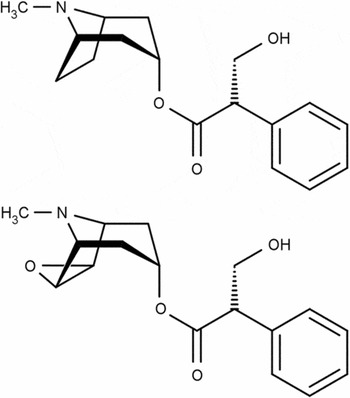
Numerous plant species in the nightshade family (Solanaceae) are consumed worldwide as medicinal and entheogenic drugs. Mandrake (Mandragora), tobacco (Nicotiana), jimson weed (Datura) and belladonna (Atropa) are especially renowned in these roles, although the pharmacological effects of many genera in the family are exploited ethnographically and commercially. With the exception of Nicotiana spp. (subfamily Nicotianoideae), whose main active component is the pyrrolidine alkaloid nicotine, most ethnopharmaceutical nightshades are exploited for their content of tropane alkaloids. By far the most important are atropine (C17H23NO3) and scopolamine (C17H21NO4) (Figure 1),powerful blockers of neurotransmitters in the parasympathetic nervous system that have numerous therapeutic uses as well as narcotic and psychotropic effects (Ott Reference Ott1996: 366–67).
The biologically active l-enantiomers of atropine (above) and scopolamine (below).

One particularly important tropane-bearing genus is Hyoscyamus L., the henbanes. These are mostly annual or biennial weedy forbs, bearing tubular to bell-shaped flowers with five petals and fruits in the form of dehiscent capsules loosely enclosed in the flower calyx (Feinbrun-Dothan Reference Feinbrun-Dothan1978: 162). Although distributed across the temperate Old World, the major centre of diversity may lie in the region of modern Iran, where at least 13 species are found (Sheidai et al. Reference Sheidai, Khatamsaz and Mosallanejad2000: 83). Phenotypic variation and interspecific hybridisation make the number of discrete species unclear, but all Hyoscyamus species contain atropine and scopolamine in varying quantities (see Bahmanzadegan et al. Reference Bahmanzadegan, Sefidkon and Sonboli2009), particularly concentrated in their seeds. Henbanes are consequently used in ethnomedicinal traditions across Eurasia to treat a variety of ills. But archaeological evidence of their cultural exploitation is sparse, and evidence of past henbane use has hitherto relied almost exclusively on historical sources. This article reports on henbane seed remains recovered as part of an archaeobotanical study of the Ottoman occupation phase at Kaman-Kalehöyük, a central Anatolian multi-period occupation mound. Specifically, it focuses on an anomalous concentration in one hearth context, which ethnographic parallels suggest comprises the in situ remnants of a deliberate henbane consumption event, the first direct archaeological evidence in Asia for medicinal henbane use.
Henbane and its archaeology
Archaeological sites across Eurasia and northern Africa have yielded henbane remains, from Great Britain (see van der Veen Reference van der Veen1985: 5) to central Mongolia (see Rösch et al. Reference Rösch, Fischer and Märkle2005) and south to central Egypt (see Fahmy Reference Fahmy2001). But alongside their medicinal properties, henbanes are also common ruderal weeds that may produce thousands of seeds per plant, and long-dormant seeds frequently germinate after episodes of soil disturbance (Conolly Reference Conolly1994). Medicinal plants, like spices, are usually also carefully hoarded and used in small quantities, reducing opportunities for incorporation into the archaeological record (Nesbitt 1995: 72). Securely identifying cultural significance for archaeological henbane remains is therefore challenging. Perhaps the most convincing example is ‘King Harald's Sibyl’, the wagon burial of a Norse völva or seeress in the eleventh-century Danish fortress of Fyrkat (Pentz et al. Reference Pentz, Baastrup, Karg and Mannering2009). Among the grave goods accompanying the Fyrkat seeress was a concentration of henbane seeds, probably originally contained in a waist pouch and most likely interred as an entheogenic agent (Helbæk Reference Helbæk, Olsen and Schmidt1977). Seeds of hemp (Cannabis sp.), another highly psychoactive species, had previously been found alongside remains of two women from the renowned Norse ship burial at Oseberg and were conjectured to have been buried as part of a völva's toolkit (Holmboe Reference Holmboe, Brøgger and Schetelig1927: 32–35). A few other European finds also represent probable cultural henbane use. A jar from a Bronze Age cremation grave in Leobersdorf, Austria, containing two handfuls of Hyoscyamus seeds mixed with small bones and snail shells (Werneck Reference Werneck1949: 71–72), almost certainly represents a ritual deposit. By contrast, medicinal use may be responsible for an Iron Age deposit of furnace debris in Walton-le-Dale, Lancashire, England, containing 211 henbane seeds (83.1% of the sample contents) and dating to the early to late second century AD (van der Veen Reference van der Veen1985: 5). The 136 seeds recovered from a suspected pharmacy in the Roman town of Novaesium (modern Neuss, Germany) (Knörzer Reference Knörzer1967: 65–75) also probably represent collection for medicinal purposes.
Henbane seeds elsewhere, however, are usually too few in number or too vaguely contextualised for one to be confident that they represent anything more than ruderal weeds, even where their presence is ultimately the result of synanthropy. For instance, Lempiäinen (Reference Lempiäinen1992) observed high concentrations of henbane seeds in medieval and post-medieval settlement layers from several Finnish sites, but as these were also from general fills containing substantial quantities of demolition waste (Lempiäinen Reference Lempiäinen1992: 231–32), it cannot be determined whether these seeds were deposited as a direct consequence of medicinal gathering or simply as part of the seed rain from a ruderal weed community. Similar concerns face sites across Eurasia, even where henbane seeds are reasonably numerous (e.g. Rösch et al. Reference Rösch, Fischer and Märkle2005; Kohler-Schneider & Caneppele Reference Kohler-Schneider and Caneppele2009). Partly for this reason, archaeological evidence for the cultural exploitation of henbane outside of Europe is virtually non-existent.
This contrasts starkly with rich Eurasian historical literary sources attesting to the plant's medicinal value (see Cockayne Reference Cockayne1865: 50; Yang Reference Yang1998: 76; Aziz et al. Reference Aziz, Nathan and McKeever2000; Lev Reference Lev2007: 286). In the Ottoman Empire in particular, it can be difficult to identify historical henbane use unambiguously—its Ottoman Turkish name, beng or benc, was quickly co-opted to refer also to hashish (Sariyannis Reference Sariyannis, Kolovos, Kotzageorgis, Laiou and Sariyannis2007: 310)—but at least for the Ottoman elite, there is good historical evidence for use of the seeds as medication, usually administered in electuaries or pills. One register of the Imperial palace confectioner, dating to 1608, records a recipe for a honey-based medicinal paste containing henbane seeds, black pepper and opium, and another Imperial register, dating to Hijri year 981 (AD 1573–1574), records a purchase of 16kg of henbane seeds for medicinal use (Yerasimos Reference Yerasimos2001: 29–30). However, for want of comparable textual records, it has remained unclear how, if at all, non-elite segments of Ottoman society may have made use of henbane medicinally.
The Ottoman archaeobotanical survey at Kaman-Kalehöyük
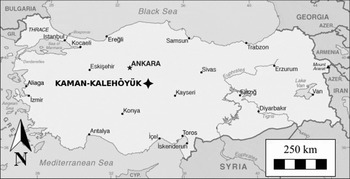
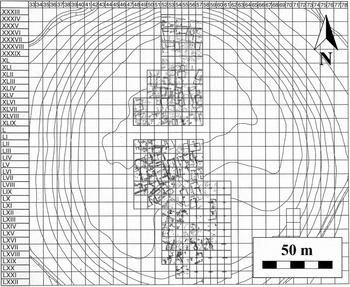
Kaman-Kalehöyük, a stratified settlement mound about 100km south-east of Ankara (Figure 2), was first identified as an important site in a survey and preliminary excavation conducted in 1985 by the Middle East Culture Centre in Japan (Mori & Omura Reference Mori, Omura and Miya1995). Full-scale excavation began the following year, and continues under the direction of Sachihiro Omura. Over 4000m2 of excavation (Figure 3) reveals a series of occupations from the Early Bronze Age to the middle Ottoman Empire period (Omura Reference Omura2007). With the exception of a five-year hiatus between 1996 and 2001, a systematic programme of machine flotation for botanical remains has been ongoing at the site since 1993 (see Fairbairn et al. Reference Fairbairn, Longford and Griffin2007); over 1500 flotation samples have been processed, yielding a rich suite of archaeobotanical remains from a variety of contexts.
Map of modern Turkey, showing the location of Kaman-Kalehöyük.

Contour map of Kaman-Kalehöyük, showing the extent of excavations of the Ottoman-period village (modified from Omura Reference Omura2007).

One aim of the archaeobotanical programme is to investigate the agricultural economy of Kaman-Kalehöyük's Ottoman occupation (Fenwick Reference Fenwick2013). The samples surveyed here come from 41 features—identified on typological grounds as pits (n = 25), hearths (n = 14), or room fills (n = 2)—belonging to Stratum I, the remains of Kaman-Kalehöyük's Ottoman-period occupation, dated to c. AD 1450–1640 on the basis of AMS radiocarbon determinations and Ming-dynasty Chinese export porcelains (Mori & Omura Reference Mori, Omura and Miya1995; Omori & Nakamura Reference Omori and Nakamura2007; Fenwick Reference Fenwick2013). In the laboratory, all flotation samples are sieved through a 4mm mesh. Fractions >4mm were sorted in their entirety; due to their richness, the <4mm fractions were subsampled. A uniform target minimum subsample of 502 seeds was calculated via van der Veen and Fieller's (Reference van der Veen and Fieller1982) statistical methodology, using critical values of P = 0.5, d = 0.05, Z α = 2.241 and N = ∞. Using an Endecotts sediment sample divider, the <4mm sieve fraction from each sample was divided into 1/16 portions, with two exceptions. Flot 131 was so voluminous that it was divided into 1/32 portions. Flot 95 had a quarter of its material removed by a previous researcher, and consequently the remaining 75% was divided into sixteenths, each corresponding to 3/64 of the original sample and calculated accordingly. Portions were cumulatively sorted until the target minimum was exceeded; samples containing fewer than 502 identifiable macrofossils were sorted to completion. Finally, subsample populations were multiplied back up to provide approximate equivalents for complete samples.
Seeds, fruits and cereal chaff were identified through comparison with the reference collection held at the University of Queensland, and with the seed reference atlases of Cappers et al. (Reference Cappers, Bekker and Jans2006), Nesbitt (2006) and Bojňanský and Fargašová (Reference Bojňanský and Fargašová2007). Identifications were made using low-power microscopy on a Labomed CZM6 stereoscopic microscope with variable magnification (8–50×), and photographs taken with a QImaging MicroPublisher 5.0 RTV camera on an Olympus SZ61 microscope at 15× magnification.
Results of the study
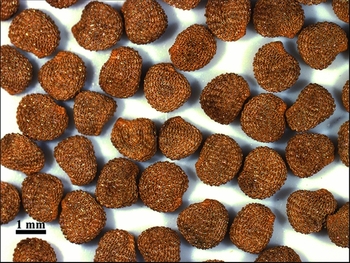
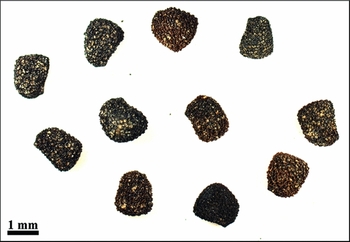
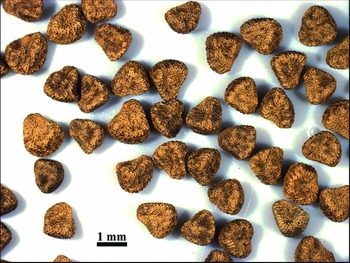
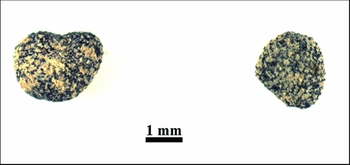
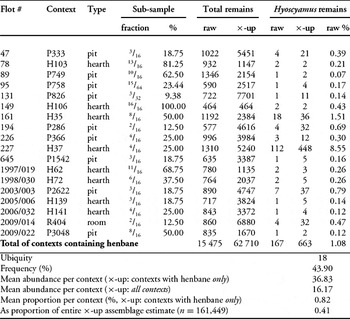
Henbane seeds were recovered from <4mm sieve fractions of 18 sampled contexts (Table 2). Although variation in Hyoscyamus seed morphology may be diagnostic to species (Zhang et al. Reference Zhang, Yang, Lu and Knapp2005), the Kaman-Kalehöyük henbane remains are difficult to identify as a result of distortion from charring. Most are at least consistent with the sub-trapezoidal shape of Hyoscyamus niger L. (Figures 4 & 5), while a few are more trigonous, reminiscent of H. reticulatus L. (Figures 6 & 7); both species are widespread on the central Anatolian plateau (Davis Reference Davis1978).
Modern seeds of Hyoscyamus niger L. (University of Queensland Archaeology Department reference collection, specimen RMN 1201).

Charred seeds of Hyoscyamus cf. niger from the earth-oven feature H37.

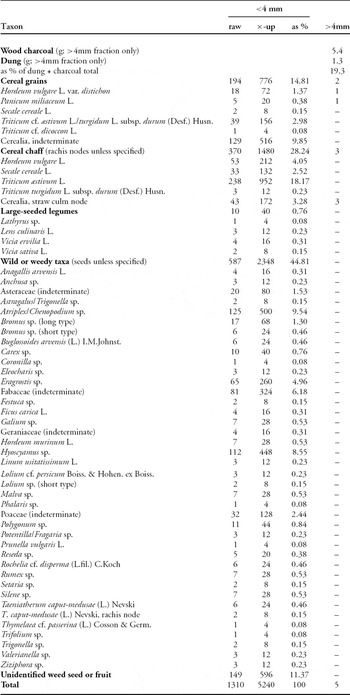
Summary of macrobotanical data for Kaman-Kalehöyük earth-oven H37.

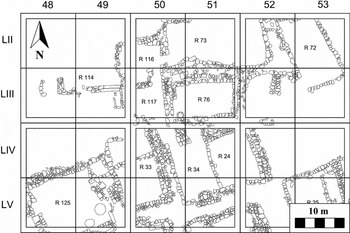
Relatively rare across the site, henbane seeds comprise only 0.52% of the total assemblage. This is consistent with the presence of henbane at Ottoman Kaman-Kalehöyük as part of the ruderal weed community (see Feinbrun-Dothan Reference Feinbrun-Dothan1978). One hearth context, however, contained far too many henbane remains to treat merely as part of the local weed flora. In the South Trench of the excavations, hearth H37—a ventilated earth-oven or tandır in the south-west corner of room R76—yielded 112 Hyoscyamus seeds (multiplied-up = 448) (Table 1). Although it has not been dated directly, this room belongs to a multi-roomed domestic complex (Figure 8) that forms part of Stratum I's second building phase, and so belongs to the Ottoman occupation previously identified in Stratum I on the basis of ceramic and radiocarbon chronologies (see Mori & Omura Reference Mori, Omura and Miya1995; Omori & Nakamura Reference Omori and Nakamura2007).
Modern seeds of Hyoscyamus reticulatus L. (University of Queensland Archaeology Department reference collection, specimen RMN 1215).

Charred seeds of Hyoscyamus cf. reticulatus from the earth-oven feature H37.

Squares LII-48 to LV-53, showing the position of R76 in the Stratum Ia-2 architectural complex; the walls of the tandır H37 can be seen as the small circular feature in the south-east of square LIII-50.

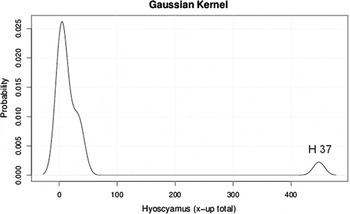
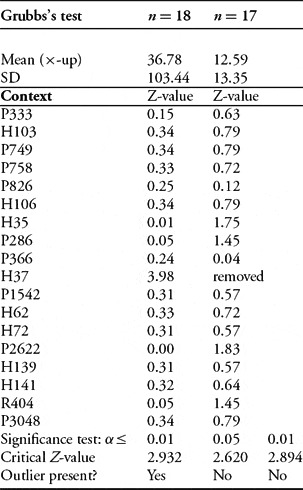
The Hyoscyamus seeds from H37 comprise 8.55% of all identified macrofossils in that context, and more than 2/3 of all henbane seeds from surveyed Ottoman contexts, both in terms of raw data (112 of 167, or 67.1% of the total) and multiplied-up equivalents (448 of 664, or 67.8% of the total) (Table 2). We applied kernel density estimation, which computes a Gaussian probability distribution approximating the distribution of the raw dataset (see Wessa Reference Wessa2013), to the multiplied-up percentages of henbane seeds from all contexts containing them. From this, it is clear that H37 is an extreme outlier among this population, the remainder of which otherwise exhibits a rough approximation to a normal distribution (Figure 9). Grubbs's test for outliers (see Grubbs Reference Grubbs1969) further supports the identification of H37 as a significant outlier, even at the stringent level of α≤0.01. By contrast, removing the outlier H37 yields a population within which Grubbs's test identifies no further outliers, whether at α≤0.01 or the more permissive (and usual) α≤0.05 (Table 3).
Gaussian kernel density estimation for multiplied-up henbane totals, showing the anomalous peak for H37 (modified from an image generated by Wessa Reference Wessa2013).

Macrofossil samples from Ottoman contexts containing Hyoscyamus seeds; multiplied-up (×-up) equivalents are rounded to the nearest integer, and sub-sample percentages to the nearest 0.01%.

Grubbs's two-sided test for outliers (see Grubbs Reference Grubbs1969) on multiplied-up henbane seed populations in the 18 contexts where henbane was identified.

Besides the anomalous content of henbane seeds, the contents of H37 are typical of what is expected from a rural agricultural production site—particularly one whose fuel regime is based on burning animal dung, as was the case at Ottoman Kaman-Kalehöyük (Nesbitt Reference Nesbitt and Miya1993; Kennedy Reference Kennedy2000). The presence of cereal remains (14.8% of the total) in a tandır is to be expected from accidental spillage events during cooking, and although the high percentage (84.1%) of weed seeds, chaff and straw is striking, it is entirely typical of incorporation through the burning of dung fuel (Miller Reference Miller1984; Anderson & Ertuğ-Yaraş Reference Anderson and Ertuğ-Yaraş1998). The high proportion (9.5%) of seeds from Atriplex/Chenopodium species, the only weed seed type appearing in H37 in greater proportion than henbane, also supports a likely incorporation through dung burning; these are leafy taxa favoured as green fodder in traditional Turkish agriculture through to the modern day (see Ertuğ-Yaraş Reference Ertuğ-Yaraş1997: 177–82). Confirming this hypothesis was the presence of a small amount of charred dung directly observable in the >4mm sieve fraction from H37, comprising 19.4% of the total quantity of charred fuel material in this fraction (see Table 1).
The henbane content of H37
As all parts of henbanes contain substantial quantities of atropine and scopolamine (see el Shazly et al. Reference El Shazly, Tei, Witte, El-Domiaty and Wink1997; Bahmanzadegan et al. Reference Bahmanzadegan, Sefidkon and Sonboli2009), henbanes cannot be usefully exploited as food or fodder. Furthermore, tropane alkaloids are easily dispersed from henbane tissues in smoke, precluding their use as tinder or fuel. This is particularly the case for the seeds, in which the alkaloid content is highest: levels exceeding 2.5‰ of total dry plant weight have been recorded for seeds from some H. niger and H. reticulatus specimens (Bahmanzadegan et al. Reference Bahmanzadegan, Sefidkon and Sonboli2009). This property has been exploited deliberately for medicinal purposes across Eurasia in the practice of henbane fumigation, whose earliest detailed attestation is in the Compositiones Medicamentorum (c. AD 47) of Scribonius Largus, physician to the Roman Emperor Claudius (Compositiones X.54; Bernhold Reference Bernhold1786: 41):
One must nevertheless fume the open mouth with henbane seeds sprinkled onto coals, directly afterward rinsing the mouth with warm water (something like little worms are sometimes ejected, in fact); the pain is lifted along with the tar deposited by the fumes [authors' translation].
The small ‘worms’ that were (and in some traditions remain) the alleged cause of these aches have been known for some time to be merely radicles of the seeds themselves detached during burning. Indeed, an eighteenth-century monograph is dedicated to dispelling the myth of ‘die eingebildeten Würmer in Zähnen’ [‘the imaginary worms in teeth’] (Schäffer Reference Schäffer1757). But the fumigation procedure itself was no doubt effective, if not for the reasons believed in folk medicine, and henbane fumigation practices are remarkably uniform across western Eurasia. A similar toothache treatment is prescribed in the Kitāb Zād al-Musāfir of the tenth-century Arab physician al-Jazzār (Almahdi Reference Almahdi2003: 57), and, although the delivery mechanics differ, also in the ninth-century Anglo-Saxon Lǣcebōc (folio 19a; Cockayne Reference Cockayne1865: 50):
For tooth worms, take acorn flour and henbane seeds and wax in equal proportion, mix together, work into a wax candle, and burn it. Let it fume into the mouth, and place a black cloth underneath; the worms fall out upon it [authors' translation].
Henbanes—most commonly H. niger (Tabata et al. Reference Tabata, Honda and Sezik1988), but also H. aureus (see Honda et al. Reference Honda, Yeşilada, Tabata, Sezik, Fujita, Takeda, Takaishi and Tanaka1996) and H. reticulatus (see Tabata et al. Reference Tabata, Sezik, Honda, Yeşilada, Fukui, Goto and Ikeshiro1994; Özgökçe & Özçelik Reference Özgökçe and Özçelik2004)—are also useful in traditional Anatolian pharmacopoeiae. In some Turkish regions other parts of henbanes are used, such as the leaves (Polat & Satıl Reference Polat and Satil2012) or roots (Tabata et al. Reference Tabata, Sezik, Honda, Yeşilada, Fukui, Goto and Ikeshiro1994), but fumigation using the alkaloid-rich seeds as a treatment for toothache, earache and eye irritations remains the most popular application for henbane in modern Turkish ethnopharmacology (e.g. Yeşilada et al. Reference Yeşilada, Honda, Sezik, Tabata, Fujita, Tanaka, Takeda and Takaishi1995; Honda et al. Reference Honda, Yeşilada, Tabata, Sezik, Fujita, Takeda, Takaishi and Tanaka1996; Özgökçe & Özçelik Reference Özgökçe and Özçelik2004; Polat & Satıl Reference Polat and Satil2012). Modern methods are slightly more elaborate than the simple addition of henbane to fire; in some areas the seeds are spread on an iron skillet rather than on the fire directly (Tabata et al. Reference Tabata, Honda and Sezik1988: 42). It is also usual to drape a blanket over the patient's head, forming a small smoke chamber around the embers in the hearth and concentrating the effect of the seeds' tropane-bearing fumes. A pot or dish of water is often placed on the embers as well (e.g. Tabata et al. Reference Tabata, Honda and Sezik1988; Honda et al. Reference Honda, Yeşilada, Tabata, Sezik, Fujita, Takeda, Takaishi and Tanaka1996: 84), the steam from which may assist in maximising alkaloid delivery. Scopolamine is highly soluble in water—c. 100mg/ml at 20°C (O'Neil Reference O'Neil2006)—and although atropine's higher solubility in organic solvents (c. 2.2mg/ml in water, c. 500mg/ml in ethanol at 20°C) (O'Neil Reference O'Neil2006) means that henbane preparations are sometimes based on oil, fat and butter in the Levant and northern Africa (e.g. Dafni & Yaniv Reference Dafni and Yaniv1994; Hammiche & Maiza Reference Hammiche and Maiza2006), as well as the inner Taurus Mountains of Turkey (see Yeşilada et al. Reference Yeşilada, Honda, Sezik, Tabata, Fujita, Tanaka, Takeda and Takaishi1995: 147), at high temperatures atropine reaches greater water solubility (c. 11mg/ml at 80°C), which would increase the efficacy of steam as its vehicle. Moreover, ethnographic surveys both in Turkey and elsewhere explicitly record henbane fumigation in which fumes are generated simply by boiling in water (e.g. Dafni & Yaniv Reference Dafni and Yaniv1994: 14; Tuzlacı et al. Reference Tuzlaci, Alparslan Işbilen and Bulut2010: 48).
But the abnormally high concentration of charred henbane seeds in H37 is consistent with fumigation by burning; further, because they were found in a hearth context, these seeds probably represent in situ remnants of a fumigation event rather than disposed-of hearth sweepings. Finally, as a tandır rather than an open fireplace (ocak), H37 indicates that the henbane seeds were most likely burnt directly on the embers of the fire rather than on a skillet or pan, as using a skillet in combination with an underground oven is logistically impractical. Reconstruction of additional detail proves more difficult, as no artefactual materials besides the walls of the tandır itself are clearly associated with the burning event in H37. Whether the process was still as simple as described by Scribonius's Compositiones, or was more elaborate during the Ottoman period, can only be conjectured on contextual grounds. In particular, there is no evidence of whether steaming was a component of the practice at Ottoman Kaman-Kalehöyük. But while the use of a smoking hood cannot be confirmed by archaeological materials, it seems probable that this would also have been done at Kaman-Kalehöyük for practical reasons. Alongside its psychotropic properties, henbane has a noxious odour—eloquently described by John Parkinson, botanist to King Charles I of England, as “an heavie evill [sic] soporiferous smell somewhat offensive” (Parkinson Reference Parkinson1640: 362)—which is both tenacious and only worsened by burning, and has earned for the plant the sobriquet of ‘stinking nightshade’ (Lee Reference Lee2006). Given that R76 is a terminal room with a single entrance (see Figure 7), it would have accumulated smoke quickly and been difficult to air. Using a hood would not only concentrate the smoke for the afflicted person, but also serve to minimise its spread into adjoining rooms. Conducting fumigation using a carefully ventilated underground tandır, rather than an open hearth, could have served a similar purpose.
Conclusion
Although not all details of the henbane burning event in Kaman-Kalehöyük hearth H37 can be reconstructed, the concentration of Hyoscyamus seeds in this hearth, a tandır or earth-oven, is consistent with Ottoman-period medicinal consumption of henbane through fumigation. It is clear that henbanes were common ruderal weeds during the Ottoman period at Kaman-Kalehöyük, and small quantities of their seeds survive in more than 40% of the Ottoman contexts examined, but none come close to the proportion of the H37 assemblage: 8.55% of macrofossils examined from the context comprised henbane seeds, a proportion fivefold greater than any other sampled context. Henbane's unsuitability as food, fodder or fuel, coupled with the anomalous proportion of henbane seeds in H37, is strongly indicative of an event of deliberate henbane-seed consumption at Ottoman-period Kaman-Kalehöyük. Although the absolute proportion of henbane seeds in H37 is low, the bulk of the remainder comprises chaff, straw and weed seeds, consistent with the use of livestock dung as a portion of the fuel upon which the henbane was burned.
Archaeological henbane finds with probable medicinal or entheogenic significance have been reported previously but are few in number and have hitherto been restricted to Europe. Moreover, the only historical records of Ottoman medicinal henbane consumption describe a tradition based on oral consumption of electuary pastes, very different from the practice seen in H37 at Kaman-Kalehöyük and perhaps indicating a broader social divide between elite and popular medicinal traditions in the Ottoman Empire. The dearth of artefactual material associated with H37 means that specific practical details of henbane fumigation practices during the Ottoman Empire period remain obscure, but the H37 seeds comprise the first Asian archaeological evidence for this practice, as well as being the first archaeological evidence at any site for a henbane consumption event preserved in situ. H37 adds a new datapoint to the globally sparse archaeological record of henbane as a culturally important plant, as well as to the relatively scanty archaeobotanical record of medicinal plants more generally. Medicinal plants tend to be preserved archaeologically only by serendipitous accidents, but H37 serves as a useful reminder that not all cultural plants are used simply for subsistence or shelter; outlying contexts within archaeobotanical assemblages must be interpreted carefully when apparent anomalies represent remains of plants with potential medicinal value.
Acknowledgements
Particular thanks go to Dr Andrew Fairbairn and Dr Jon Prangnell, Fenwick's advisors for the PhD project during which this discovery was made, and to the Japanese Institute of Anatolian Archaeology, whom Fenwick would like to thank for their hospitality and collegiality during the course of his work on the archaeobotanical materials from Kaman-Kalehöyük. We are grateful to Dr Kimiyoshi Matsumura for providing relevant maps and excavation journal entries from the Kaman-Kalehöyük site archives. Chris Lovell, Hilda MacLean, Tam Smith and Robyn ‘Qov’ Stewart offered encouragement and assistance during this article's development. We are grateful to Glynis Jones and an anonymous reviewer for their constructive comments on an earlier draft.