Introduction
Several studies of patients experiencing out-of-hospital cardiac arrest suggest that there are variables that are highly predictive of achieving return of spontaneous circulation (ROSC) in the field, namely ventricular fibrillation as the presenting rhythm, bystander cardiopulmonary resuscitation (CPR), witnessed arrest, and time to first defibrillation.Reference Sasson, Rogers, Dahl and Kellermann1 End-tidal CO2 (EtCO2) has been suggested as a further predictor of cardiac arrest outcome for more than a decade, but only recently has become used widely in the field by emergency medical services (EMS) personnel or in the emergency department.Reference Grmec, Krizmaric, Mally, Kozelj, Spindler and Lesnik2–Reference Cantineau, Lambert, Merckx, Reynaud, Porte, Bertrand and Duvaldestin5
EtCO2 reflects the efficiency of CPR, and correlates well with cardiac output. It is easy to perform, non-invasive, and allows for a rapid assessment that provides valuable information in regard to survival with advanced cardiac live support (ACLS) interventions. The first reference to the utility of EtCO2 as both an aid to CPR as well as a prognostic aid was made almost a half-century ago in Germany.Reference Koetter and Maleck6 Since then, the technology associated with monitoring EtCO2 has improved to the point where this information is available on patients receiving resuscitation regardless of where the event occurs.Reference Koetter and Maleck6–Reference Salen, O'Connor, Sierzenski, Passarello, Pancu, Melanson, Arcona, Reed and Heller8 This paper describes using EtCO2 as a predictor of survival in a large series of out-of-hospital cardiac arrest patients.
Methods
This was a retrospective study of all adult (>18 years of age), non-traumatic, out-of-hospital cardiac arrest patients in the city of Los Angeles, California (USA), from 01 January 2006 through 31 December 2007. Only patients on whom resuscitative efforts were initiated by paramedics were included. Emergency medical services in Los Angeles are provided by the Los Angeles Fire Department, a tiered EMS system staffed by Emergency Medical Technician-Defibrillation firefighters and firefighter paramedics.Reference Eckstein, Stratton and Chan9
Paramedics intubate adult cardiac arrest patients as per advanced cardiac life support guidelines. All patients are orally intubated after the provision of two minutes of CPR and one defibrillation (if indicated). Digital, waveform capnography is captured via the endotracheal tube as soon as the tube is secured, using the LifePak 12 (Medtronics Corp, Redmond, WA). Carbon dioxide is measured using a sidestream configuration that is located within the cardiac monitor (Oridion, Inc, Needham, MA).
All out-of-hospital cardiac arrest cases were reviewed after hand-written records were captured in an electronic database (Microsoft Access, Microsoft, Inc., Redmond, Washington). All patient identifiers were removed. The primary outcome variable was ROSC from the primary cardiac arrest. Approval to conduct this study was granted by the Institutional Review Board of the University of Southern California.
For the purposes of this study, the following variables were collected for analysis: gender, witnessed vs. unwitnessed arrest, initial EtCO2, final EtCO2, documented primary ventricular fibrillation (VF) (or pulseless ventricular tachycardia), use of automatic external defibrillator and presence or absence of bystander CPR.
Statistical analysis was performed using STATA 10.0 software (College Station, TX). Initial EtCO2 ≤10 was chosen a priori; and relative fall >25% from the initial value to final value upon termination of resuscitation or arrival at the emergency department was chosen a priori as independent variables. There was no specific recruitment goal, since this study is establishing the frequency of ETCO2 values <10 and percent change during the course of prehospital care. The records were reviewed and EtCO2 analyzed at initial and final values, and therefore, the specific rate of change was not analyzed. Multivariate logistic regression analysis was performed in order to determine if EtCO2 is a significant predictor of return of spontaneous circulation. Analysis of variance (ANOVA) was used for comparison of means. The Hosmer-Lemeshow statistic was determined to estimate the goodness of fit for the multivariate model.
Results
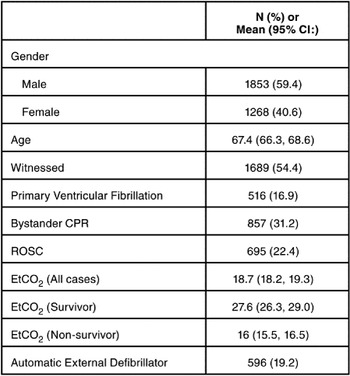
There were 3,121 patients included in the study, of which, 1,689 (54%) were witnessed arrests and 516 (17%) were primary VF. The mean initial EtCO2 was 18.7 (95%CI = 18.2–19.3) for all patients. Return of spontaneous circulation was achieved in 695 (22.4%) of patients, for whom the mean initial EtCO2 was 27.6 (95%CI = 26.3–29.0). For those patients who failed to achieve ROSC, the mean initial EtCO2 was 16.0 (95%CI = 15.5–16.5). (Table 1).
Demographic information 2006–2007 (n = 3,121)

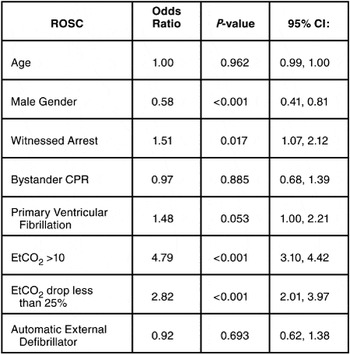
The following variables were significantly associated with ROSC: witnessed arrest (OR = 1.51; 95%CI = 1.07–2.12); initial EtCO2 >10 (OR = 4.79; 95%CI = 3.10–4.42); and EtCO2 falling <25% of baseline (OR = 2.82; 95%CI = 2.01–3.97) (Table 2).
Multivariate logistic regression analysis of return of spontaneous circulation (ROSC)

The combination of male gender, lack of bystander CPR, unwitnessed collapse, non-vfib arrest, initial EtCO2 ≤10 and EtCO2 falling >25% was 97% predictive of failure to achieve ROSC.
Discussion
There is evidence that suggests that EtCO2 can be used to determine when resuscitative efforts should be discontinued.Reference Asplin and White10–Reference Levine, Wayne and Miller12 Our study was one of the largest to-date that compared EtCO2 data with other known variables that have been associated with survival of out-of-hospital cardiac arrest victims studies, such as age, gender, witness present, bystander CPR, and primary VF.
A model was used to predict survival using dichotomous (CO2 >10 or ≤ 10) EtCO2 values. The cut-off value of 10 mm Hg was chosen because previous clinical studies reported a correlation with ROSC above and below these values.Reference Sanders, Kern, Otto, Milander and Ewy13–Reference Levine, Wayne and Miller15 In this study cohort, individuals with an EtCO2 >10mmHg were four times more likely to survive relative to those patients with EtCO2 <10mmHg. These factors had the highest correlation with ROSC relative to the other variables also analyzed in this study: age, gender, witnessed, bystander CPR, primary VF, or automatic external defibrillator (AED). This is consistent with the findings of Cantineu et al., who reported that a maximal EtCO2 >10 during the first 20 minutes of resuscitation after intubation had a sensitivity of 100% in predicting ROSC.Reference Mauer, Schneider, Elich and Dick4 Given this previous report, and the data from this study, it appears that an initial EtCO2 of ≤10 mm Hg is the strongest predictor of mortality in the setting of cardiac arrest. Even so, it was not possible to create a model that was 100% predictive of mortality in the current population.
Death, as represented by lack of ROSC, was predicted in 97% of patients if they were male, no bystander was present to perform CPR, the collapse was unwitnessed, and the patient was not in primary VF, if EtCO2 was ≤10 or if EtCO2 fell >25% from baseline, and if no AED was used. However, since 3% of patients who had all of these variables present achieved ROSC, this data alone does not justify terminating resuscitative efforts.
The value of the change in EtCO2 during resuscitation also was examined. Although the number of subjects was smaller, there was a significant difference between survivors and non-survivors, even when correcting for the initial EtCO2 value. Patients who survived demonstrated the smallest decreases in EtCO2 during their resuscitative events when compared to those who did not survive. It has been suggested that this lack of change in ETCO2 for eventual survivors may be an earlier indicator of returned cardiac function, preceding a palpable pulse.Reference Sehra, Underwood and Checchia16
Limitations
As our study was retrospective, it suffers from the same limitations as any retrospective study, including inaccuracy of data. In addition, hand-written data records were used, since electronic downloads were not available at the time. Not all patients had EtCO2 values recorded. Finally, ROSC was used as the primary outcome variable, which is only a surrogate marker of survival. Final hospital outcome data on patients who achieved ROSC in the field are not available.
Conclusions
An initial EtCO2 >10 is associated with an almost five-fold higher rate of ROSC in out-of-hospital cardiac arrest. In addition, a decrease in the EtCO2 during resuscitative events of >25% was associated with a significant increase in mortality, independent of other variables known to effect outcome. EtCO2 values should be included as important variables in protocols to terminate or continue resuscitation in the prehospital setting.
Abbreviations:
ACLS = advanced cardiac life support
AED = automatic external defibrillator
CPR = cardiopulmonary resuscitation
EMS = emergency medical services
ROSC = return of spontaneous circulation
VF = ventricular fibrillation