Between 1963 and 1964,Footnote 1 Steve Reich composed music for a Robert Nelson film called The Plastic Haircut. This was the first time Reich had worked with tape, and he drew his materials from a compilation called Greatest Moments in Sport, which featured voices of famous American athletes such as Babe Ruth and Jack Dempsey. The form is much looser and less process-oriented than Reich's later and more famous tape pieces such as It's Gonna Rain (1965) and Come Out (1966), but one can hear his burgeoning interest in splicing and looping, and also in manipulating recordings of the speaking voice. The work begins with a mélange of phrases such as ‘outstanding contender’ and ‘national pastime’, many of which are performed in the distinctively forced style of mid-century sports announcers. As it progresses, collage gives way to seamless mixture: the source material becomes increasingly fragmented and less indexical, prefiguring the more methodical process of It's Gonna Rain.
Compare the musique concrète-inspired The Plastic Haircut to Music for 18 Musicians, premiered in 1976. At first blush, these two works could easily be by different composers. The uses of the voice, in particular, are remarkably dissimilar. Music for 18 Musicians is performed entirely by live players (with the help of microphones and amplification), and its steadily pulsed, wordless texture offers no obvious purchase in terms of indexicality. In The Plastic Haircut, as well as Reich's better-known early tape pieces, he cuts, loops, and layers the speaking voice, placing it in an estranged aesthetic context. In Music for 18 Musicians, we hear something quite different: a singing voice, and – more importantly – a singing voice imitating musical instruments, blurring the line between one and the other.
In this article, I propose a deep relation between these pieces: I suggest that, in both cases, Reich takes on the voice as a problem. Across his career, Reich's solutions to this problem are manifold, and inform – or even drive – such singular works as Tehillim (1981). Ultimately, I claim that Reich is motivated by reinvigorating for himself what I will call the ‘vocal imaginary’ of Western classical music. My argument unfolds in four parts. First, I do close readings of Reich's writings and interviews that illuminate this problem. Second, I turn an analytic lens on two works composed before and after Music for 18 Musicians, respectively – It's Gonna Rain and Tehillim – to see how it plays out in music. Third, I focus on a reading of Music for 18 Musicians. Finally, I close with some thoughts about how Reich's relationship with the voice might complicate his professed relationship with modernism, calling into question his adversative stance vis-à-vis modernist practice.
The problem of the voice
As a way into the deep relation between The Plastic Haircut and Music for 18 Musicians, I turn to Reich describing the optimism he felt upon completing the music for the earlier piece:
The exciting thing was that the voices, used as sound, nevertheless have a residual meaning that was also very ambiguous – it could be sporting, or sexual, or political – and immediately seemed to me to be the solution to vocal music. (1970)Footnote 2
First of all, this work is nowhere to be found in the official catalogue on Reich's well-maintained website, suggesting that it failed to constitute a lasting solution.Footnote 3 Second, the need for a solution implies a problem, and yet, his problem is articulated only in the most indirect terms. The fact that almost half of his works to date feature voices suggests that the problem is not simply the presence of the voice itself. In fact, in 1997, Reich confirmed the important and continuing role that voice plays in his music:
It's Gonna Rain, Come Out, Drumming, Music for Mallet Instruments, Voices and Organ, Music for 18 Musicians, Tehillim, The Desert Music, Different Trains, The Cave, City Life, and Proverbs – they're all vocal pieces, though in very different ways. Sometimes they're recorded words, with or without instruments, sometimes it's singing words, sometimes it's vocalise. I realized that many of my best pieces do, in fact, use a singing or speaking voice.Footnote 4
If the problem does not reside within the voice itself, is it something that accompanies the voice? Something the voice does? Reich does express often, and in strong terms, his dislike for the classically trained singing voice; his writings are strewn with severe opinions such as the following:
I find most operatic voices to be somewhat artificial, loud and abrasive to listen to. (1989)Footnote 5
Bel canto . . . at least to my ear, sounds artificial as a vocal style in English. (1996)Footnote 6
These accusations of artificiality, made seven years apart, suggest that, for Reich, the decision of what kind of voice to use is an ethical one. His concern about an artificial voice implies that there exists the possibility of a better voice that is somehow real – authentic. In Western aesthetics, voice is often used as a metaphor for authenticity, for the singularity of a particular human subjectivity: an artist finds her ‘voice’ as a means of distinguishing herself from other artists, and also as a way of communicating an authorial subjectivity – a ‘her-ness’ – through her work.Footnote 7 Discussion of the voice in the long discourse of Western music is especially intriguing because of how deeply intertwined metaphorical and literal uses of the term are. Edward Cone's seminal The Composer's Voice (1974) attempts to disentangle some of these uses: the actual singing voice; the ‘voice’ of a character in texted music; the narrative ‘voice’ of instrumental accompaniment; the authorial (and titular) ‘composer's voice’; and the ‘virtual persona’ that emerges when an instrumental melody stands in for a singing voice. Within these categories, Cone forms explicit links between melody and voice, and between voice and subjectivity. It is a linkage with deep roots: Cone's work rehearses one of classical music's enduring origin myths, that of Rousseau's ‘passional song’.
For Rousseau, music, poetry, and speech all share an origin in the voice.Footnote 8 Both musical and vocal utterance arose from the passions, and it is this imitation of the passional voice that marks music as a fine art and not a natural science.Footnote 9 Rousseau and Cone both see melodic gesture as a product of a voice and thus synecdochical of a human subject – where a melody exists, so must a voice; where a voice exists, so must a subject. Thus singing, voice, melody, and subjectivity are bound into a tight and mutually dependent network where the presence of one brings forth the others. In Unsung Voices, Carolyn Abbate builds off Cone's theorization of the voice while calling the all-encompassing ‘composer's voice’ into question. She formulates the melody–voice–subjectivity connection especially eloquently: ‘I endow certain isolated musical moments with faces, and so with tongues and a special sonorous presence.’Footnote 10
Some definitions are in order: What, exactly, is a melody? And what do I mean by subjectivity? The former term remains under-theorized in Cone's and Abbate's work, but a few generalizations can be made. Melody is characterized by some combination of pure timbre, mostly conjunct motion, breath length, phrase length, moderate tempo, and somewhat varied rhythm; notice how all these qualities are especially endemic to the human voice.Footnote 11 Throughout this article, I will trace the complicated relationship Reich's music bears to traditionally conceived melody.
As for the latter term, Nick Mansfield has shown that the conceptualization of human subjectivity is by no means fixed across history and different thought traditions. He does, however, describe a particularly Rousseauian subject, one that is ‘autonomous and free . . . authentic and naturally occurring . . . the thinking, feeling, agent making its way through the world, giving expression to its emotions and fulfilment to its talents and energies’.Footnote 12 Jacqueline Waeber traces the history and influence of Rousseau's conception of unité de mélodie – ‘a simple musical principle, that the melody should be one and that it should have primacy over all other musical parameters’.Footnote 13 Rousseau's insistence on the dominance of melody has everything to do with how he thinks of subjectivity:
For a Music to become interesting, for it to convey to the soul the feelings it is intended to excite, all the parts must concur to fortify the expression of the subject; the harmony must serve only to make it more energetic; the accompaniment must embellish it without covering or disfiguring it; the bass must, by a uniform and simple progression, somehow guide the person who sings and the one who listens, without either of them perceiving it.Footnote 14
This particular passage refers to vocal music, but it holds true for instrumental music as well: a single and coherent melody is the only way to express a single and coherent subject. For Rousseau, music is distinguished from a science by its fundamentally imitative nature. Explicit in his argument then, and implicit in especially Cone's, is an ethical judgement based on music's melodiousness: lack of melody and/or voice is tantamount to a lack of humanity. Melody is what transforms music from a cold and calculated science to a warm and breathing art. It is this connection, the long-standing linkage between ‘unified’ melody, singing voice, and Rousseauian subjectivity, that I would like to call the ‘vocal imaginary’ of Western classical music.
The Plastic Haircut is not a particularly melodic work – it is composed almost entirely of voices that never approach singing. Taking a more leisurely pass through Reich's statement about the piece, however, reveals that his early ‘problem of vocal music’ already registers a concern with the part of the vocal imaginary that links voice and subjectivity:
The exciting thing was that the voices, used as sound, nevertheless have a residual meaning that was also very ambiguous – it could be sporting, or sexual, or political – and immediately seemed to me to be the solution to vocal music.
In stating that he uses these voices as sound, Reich's first move is to call for ‘reduced listening’, a practice extensively theorized by Pierre Schaeffer and more recently Michel ChionFootnote 15 and Brian Kane.Footnote 16 In reduced listening, one isolates a sound from its cause in order to appreciate it aesthetically as a ‘sound object’. In this case, the cause is people speaking. The voices in The Plastic Haircut are not meant to be heard as voices, Reich says, but simply as sounds. Right away, though, he turns back on himself: the reduction is somehow incomplete, and leaves a residual meaning. These voices pass through a filter meant to separate sound from source, vocalization from vocalizing subject, and yet, the filtration process is imperfect, deliberately so. It leaves a remainder, a residue, which is itself very ambiguous – underdetermined – and yet, it is something that connects the voices back to their sources, and particularly to the communicative intentions and subject positions (sporting, sexual, political) behind these utterances. I suggest that this residue, this entity that evokes subjectivity but in an underdetermined way, is Reich's solution to subjectivity in vocal music, a means of recuperating the voice as capable of ‘fortify[ing] the expression of the subject’.
But to recuperate it from what? Why, according to Reich, is the operatic voice artificial? He complains about a grating timbre, but the real problem seems to lie in what he perceives as its reified, historically over-determined nature. The operatic voice is a historical artefact, an anachronism: ‘if your opera is about characters who lived anywhere from the 1930s to the present, and then you unquestioningly have your singers sing as if they stepped out of eighteenth- or nineteenth-century Germany or Italy, you create a superficial and inadvertently foolish and amusing situation’ (1992).Footnote 17 Reich proves himself a bad historian here, for of course opera's history is rife with polemics and reformations surrounding different kinds of ‘operatic voices’. But collapsing the plethora of vocal styles that flourished in eighteenth- and nineteenth-century Germany and Italy (opera seria and its Gluckian reform, bel canto, verismo, Wagnerian melodrama, etc.) into a single category allows him an ethics of the voice that reveals a distinctly Rousseauian strain. For Reich, representing a contemporary character through the modality of the classically trained voice is ‘superficial’, even ‘foolish’ – too rigid, too codified, too historical. It is an over-standardized practice, an outmoded tool impinging upon an authentic mode of expression.
Rousseau similarly narrativizes and ultimately mourns the voice's long-ago induction into a systemized and standardized set of codes, which, he supposes, robbed it of its natural variation and range of expressive possibilities as well as disconnecting the speech act from the primal power of sound:
All this leads to the confirmation of this principle: that by a natural progression all lettered languages must change character and lose force as they gain clarity, that the more one aims at perfecting grammar and logic the more one accelerates this progress, and that in order to make a language cold and monotonous in no time, one has only to establish academies among the people that speak it.Footnote 18
For Rousseau, it is at the moment when vocal production becomes too rigidly organized that it loses its power to move and persuade, instead entering into an ossified, academic exchange. His plea is for a voice which is neither metaphysical – disembodied, abstract, ‘above it all’ – nor trapped and parsed by the bureaucracy of a symbolic order – signifiers, codes, and grammars. For both Rousseau and Reich, the voice is uniquely equipped to escape these established codes and grammars, which I will henceforth refer to as technē. But the exact nature of technē differs between them: for Rousseau, it is in standardized language, while for Reich, it is in the standardized practice of operatic singing.
Voice, technē, and jouissance
Technē is one of a pair of opposed terms: its codification exists in relation to the indeterminacy of Reich's ‘residual meaning’. Michel Poizat, at once a reteller and revisionist of the Rousseauian myth, describes a tension between two different ways of being affected by singing. In the first, one listens for pleasure, a feeling brought on by a sense of rightness, orderliness, everything in its place. Pleasure, then, would be produced by the effective use of technē. In the second, one seeks jouissance, a sensation in excess of pleasure, and caused by excess, by ‘sensory upset and emotional turmoil’.Footnote 19 For Poizat, pleasure exists in order and jouissance in chaos, pleasure in the known and jouissance in the unknown and unknowable. I will use the term jouissance as the complement of technē.Footnote 20
An important difference between Reich and Rousseau is that for Rousseau the story of the voice is one of a fall – the prelapsarian voice is tragically, irrevocably lost. For Reich, however, a voice free from technē is a moving target, a goal to be strived for. Reich is adamantly pro-progress, and he consistently values music in its immediate moment, rejecting notions of absolute worth or timeless musical precepts. The operatic voice is thus not inappropriate for past composers – Rossini, Verdi, and Wagner had their own ways of dealing with the voice, which was acceptable in their own times. But in the twentieth and twenty-first centuries, it is an unseemly piece of technē better unheard and unseen.
Rousseau's idealization of the prelapsarian voice, its lack of mediation between internal state and externalized sound and its resistance to quantification and systemization, has continued to reverberate throughout musical thought. Lydia Goehr discusses Wagner's reception of the vocal imaginary, for instance,Footnote 21 and even Adorno – usually such an eager iconoclast – seems to buy into the vocal imaginary. In a short essay on the relationship between music and language, he suggests that music is similar to language in that both are forms of sound that bear meaning, and even hints that they co-originate: that ‘the gesture of music is borrowed from the speaking voice’.Footnote 22 As opposed to language, however, music is ‘freed from the magic of making anything happen, the human attempt, futile, as always, to name the name itself, not to communicate meanings’, while new music especially ‘does away with the congealed formulae and their function, as mechanical, but not with the similarity to language itself’.Footnote 23 For both Adorno and Rousseau, music exists in a vocal sphere that has yet to be mortified by the technē of language.
Philosopher Adriana Cavarero similarly champions the voice's resistance to logical parsing, and its singularity. She takes a number of thought traditions to task for their tendencies towards generalization when it comes to the voice, including Platonic metaphysics, ‘whereby speech is separated from speakers and finds its home in thought’;Footnote 24 linguistics, ‘where the voice becomes the scientific object of a cold analysis that understands it from the perspective of the semantic, in order to then incorporate the voice into a coherent system’;Footnote 25 and psychoanalysis and the study of oral cultures, which fail ‘to be tuned into the plurality of voices, each one different from the other, that make up the symphony.’Footnote 26 For Cavarero, this appeal to logos is inherently masculinizing, and she traces an alternate history where women's voices, particularly singing voices, upset the logical and metaphysical order by drawing attention to the singularity of a body:
Silence – which according to the patriarchal order is ‘golden,’ especially for women – concerns speech, not song. As the myth of the Sirens teaches us, song is heard as naturally feminine, just as speech is naturally masculine. Destined to substantiate themselves in the semantic, men's voices tend to disappear in the mute labor of the mind, or thought. By modulating themselves in song, on the other hand, women's voices come to show their authentic substance – namely, the passionate rhythms of the body from which the voice flows . . . the singing voice cannot be domesticated; it disturbs the system of reason by leading elsewhere.Footnote 27
For Cavarero, song is a way out of the trap of logocentrism, quantitative thinking, technē. Reich would agree to some extent, but for him, a practitioner of music, song is not an undifferentiated category. It is rather a pluralistic field that has itself has been infiltrated by the systemizing tendencies of logocentrism. Reich feels the impetus to seek a new, unknown, underdetermined kind of song. The operatic voice exists as a piece of technē in Reich's mind; banishing it is necessary to achieve authenticity. Necessary but not, as it turns out, sufficient, for his written and composed output to date shows a restless preoccupation with finding a modality of vocal expression that is not determined by the strictures of classical convention. I suggest that we might productively think about his problem of vocal music as a problem of singing.
I also suggest that as much as the singing voice presents a problem for Reich, it is nonetheless a means by which he seeks out jouissance in his works; that he pursues this ‘sensory upset’ and attempts to evoke the ‘ambiguous’ and ‘residual meaning’ of the singing voice by means of a double move. First, using widely varying techniques, Reich reduces what he understands as technē out of the singing voice. This category encompasses ‘bel canto’ vocal production, as described above, as well as other aspects of vocal performance – in the following section, I will understand technē along three axes identified by the composer. Second, by reducing out technē, he aims to invite jouissance back in as something ‘ambiguous’ and underdetermined. As I will show, Reich's understanding of what constitutes technē is idiosyncratic and raises serious problems, particularly in his early works; indeed, he at times rejects one form of artifice only to fall into another. To illustrate how the reductive process plays out, I turn now to two pieces: one from early in Reich's career and one from mid to late.
Persona, melody, and meaning in It's Gonna Rain and Tehillim
In the two most famous tape works from the 1960s, Come Out and It's Gonna Rain, Reich loops and phases short spoken phrases. The result is that the musical aspects of speech – pitch and rhythm – become increasingly salient; here, then, is the melody absent from The Plastic Haircut. I will focus on It's Gonna Rain, part 1. Reich's professed intent, at least at the time of this piece (1965), is to ‘keep the original emotional power that speech has while intensifying its melody and meaning through repetition and rhythm’.Footnote 28 In this formulation, meaning and melody are mutually reinforcing. A reflection two decades later on Different Trains (1988) echoes this idea: ‘We are, with speech melody, in an area of human behaviour where music, meaning, and feelings are completely fused.’Footnote 29
Notice the consistent terminology in these statements:
keep the original emotional power that speech has while intensifying its melody and meaning through repetition and rhythm.
We are, with speech melody, in an area of human behaviour where music, meaning, and feelings are completely fused.
In each, we have three terms for the ‘residual meaning’ (remember, this is Reich's phrase) that accompanies the voice. The first is melody or music – the sound of the voice experienced aesthetically. Let's call this melody a heuristic. The second is meaning – the semantic information conveyed by a vocalist's words. The third is emotion or feeling – the affective urgency that lies behind a vocal utterance, the sense that it issues from a human subject. Again, as a heuristic, let's call this persona. Martin Scherzinger and others have rightly pointed out that the relationship between these three elements is not nearly so harmonious and mutually reinforcing in It's Gonna Rain as Reich maintains.Footnote 30 Contra Reich, a more critical way of interpreting this piece would note how it separates these aspects of the voice (persona, meaning, melody), and performs an act of reduction on each. I will take them up in turn.
Persona
It's Gonna Rain has a ‘character’ of sorts, a subject whose ‘emotion’ and ‘feelings’ are supposedly ‘intensified’ through the compositional process itself. This subject is Brother Walter, the African-American Pentecostal preacher Reich recorded in San Francisco's Union Square in 1964. In his note to the piece, Reich maintains that ‘[a] human being is personified by his or her voice. If you record me, my cadences, the way I speak are just as much me as any photograph of me. When other people listen to that they feel a persona present’ (1965).Footnote 31 Note the Rousseauian echo here: Reich strives for Rousseau's all-important expression of a subject, a cohesive ‘persona’, through a voice. It's a structural feature of the piece, however, that the body of Brother Walter – the subject in question – be absent from actual performance. The auditory experience of It's Gonna Rain is pointedly acousmatic, and invites ‘reduced listening’ in the Schaefferian sense.
This ambivalent relationship to the staging of a ‘character’ is, in fact, entirely consistent throughout Reich's oeuvre; alongside his experimentation with the voice exists a deeply related search for a ‘new kind of musical theatre’ (a term that surfaces repeatedly in his writing beginning in the late 1980s). Why new? In an interview about a much later work, The Cave (1993), Reich described the problems he encountered at the idea of incorporating singing characters into the work: ‘I don't really feel comfortable with the idea of singers acting biblical roles – that tenor is Abraham . . . hmm.’Footnote 32 He limits his discussion here to biblical roles, but, surveying his work from the very earliest pieces to the most recent, one notices a distinct lack: despite all the voices in Reich's works, and despite his many claims to music theatre, there exists not a single actor. That is, he has never asked a singer to take on a particular persona, to speak in the first person as a character.Footnote 33 The acousmatic reduction of It's Gonna Rain constitutes one way that Reich reduces ‘acting’ from his works while maintaining a sense of character. It is a bit of a paradox, and more than a bit of a problem: according to Reich, the best way to present a vocal subject is to physically absent the subject through the very medium of its presentation.Footnote 34
It's Gonna Rain also brings to light a distinction I would like to make between technē and technology. By technology, I refer to the means by which he realizes his compositions – in this case, technology includes tape, the phasing technique, etc. This is an important, if idiosyncratic, distinction for Reich, especially because throughout his career he is ready to embrace technology precisely as method for circumventing technē. Tape recording, for instance, allows him to access what he sees as a new and less determined form of subjectivity in the form of speaking voices.
Meaning
Though Brother Walter's original oration was quite coherent, he does not speak full, semantically intact sentences in this piece. Instead, his words are fragmented, looped, and layered. The result of this reduction, however, is that the apocalypse that Brother Walter describes actually arrives; what word prophecies, sound delivers. Another paradox: the less speech is understood, the more the music makes the content of its text understood. Loss of semantic content becomes a kind of enactment of its message.Footnote 35
Melody
For Reich, who is remarkably consistent about giving the recorded spoken voice pride of place in terms of authenticity, it is important that Brother Walter's voice is unmediated by the ‘interpretive’ act of singing. In an interview about Different Trains, for instance, he identifies technē in the mediated nature of singing, favouring the ‘documentary’ quality of the recorded voice: ‘There is no singer's “interpretation” but, rather, this: people bearing witness to their own lives. Their speech melody is the unpremeditated organic expression of the events they lived through’ (1996, emphasis mine).Footnote 36 For Reich, a singer ‘interpreting’ Brother Walter's words in a ‘premeditated’ way would be ‘inorganic’, and incapable of ‘expressing’ his subjectivity. Singing is out of the question. And yet speaking is ‘unpremeditated’, ‘organic’, ‘expressive’. In another interview, Reich further raises the stakes by claiming that ‘speech melodies are windows into people's souls’ and emphasizing their importance in dramatic music: ‘because it's impossible to separate the music from the person speaking’.Footnote 37 If singing is a form of technē here, a tool separable from the subject wielding it, the spoken voice – inseparable from its source – exists in the category of jouissance. It would seem that rather than abandoning Rousseau's (and Cone's) call for the subjective immediacy of the vocal act, Reich has simply relocated these qualities from the singing voice to the speaking voice.
His tape manipulations effect a parallel move in their aestheticization, even stylization, of the voice. As Diana Deutsch showed empirically in 1995, looping a recorded voice gives it the ‘illusion’ of melodiousness:Footnote 38 the singing voice, structurally absented from the piece, thus re-emerges in unconventional form. In the early tape pieces, Reich has turned the speaking voice into a singing voice in terms of both what it sounds like and what it signifies.
There are problems here–serious ones. And the last decade of scholarly work on Reich has initiated a robust critique of his early tape pieces. Martin Scherzinger points out that ‘Reich's descriptions of Brother Walter's role in the making of It's Gonna Rain are disarmingly technical’, with the result that the singular, corporeal personage of the preacher is lost in two kinds of abstraction. First, when his voice is subjected to the impersonal process of phasing, it loses its context:
Walter's voice becomes an instrumental abstraction in service of new musical subject matter and compositional technique. Walter's own field of referents and coordinates is thereby set adrift, if not banished, and the disruptive interrogations that Walter's sermon potentially pose, as well as the historical conditions of discrimination, inequality, and poverty (within which Reich, probably without permission, is able to amplify and transform the voice of a black street preacher), are thereby disavowed.Footnote 39
Second, Brother Walter is made to stand for a ‘topos, as arbitrary as it is generalizing, about those racialized as “Black” . . . African American vocalization is here sent up into the service of an age-old preoccupation with the originary unity of speech and song, a site of what Hal Foster calls “symbolic plenitude” and “natural vitality”, all too often associated with the “primitive” Other.’Footnote 40 For Reich, speech is more natural than song. And throughout his writings there is a sense that even within speech, a black voice – one that ‘hovers between speaking and singing’Footnote 41 – is even more natural than a voice he would consider unmarked, such as his own. Further, this assumption relies upon a Rousseauian origin myth; in fact, the power of this myth remains strong in the musical world, despite a steady siege from a number of different fronts. Perhaps most famously, Derrida reads Rousseau's Essai closely and expertly deconstructs his valorization of speech as natural and originary.Footnote 42 More recent work by Nina Eidsheim has also shown the broad and potentially damaging stakes of ‘the assumption that vocal timbre is the unmediated reality of the body’, exploring the ‘racialized perception and reification of timbre’ and showing how the black singing voice is constructed – performed, in the sense of Judith Butler.Footnote 43 Thus, Reich relies on technē after all, a technē that is all the more insidious in his obliviousness to it. Rather than accessing something authentic, he falls back upon a construction of racialized vocal timbre that is as reified as it is problematic.
It should be clear by now that I am using ‘reduction’ somewhat differently from Schaeffer. First, I am relocating it from a practice of listening to a practice of composition. Recent work by Brian Kane is helpful in setting up the idea of acousmatic listening as ‘a historical and cultural practice’,Footnote 44 and I wish to do the same here, albeit on a scale both larger and smaller: smaller, in that I have limited my scope to Reich and the voice; larger, in that I see the acousmatic reduction as only one of many techniques Reich uses to reduce vocal technē and invite jouissance. For instance, the much later Tehillim (1981) uses a very different technique of reduction.
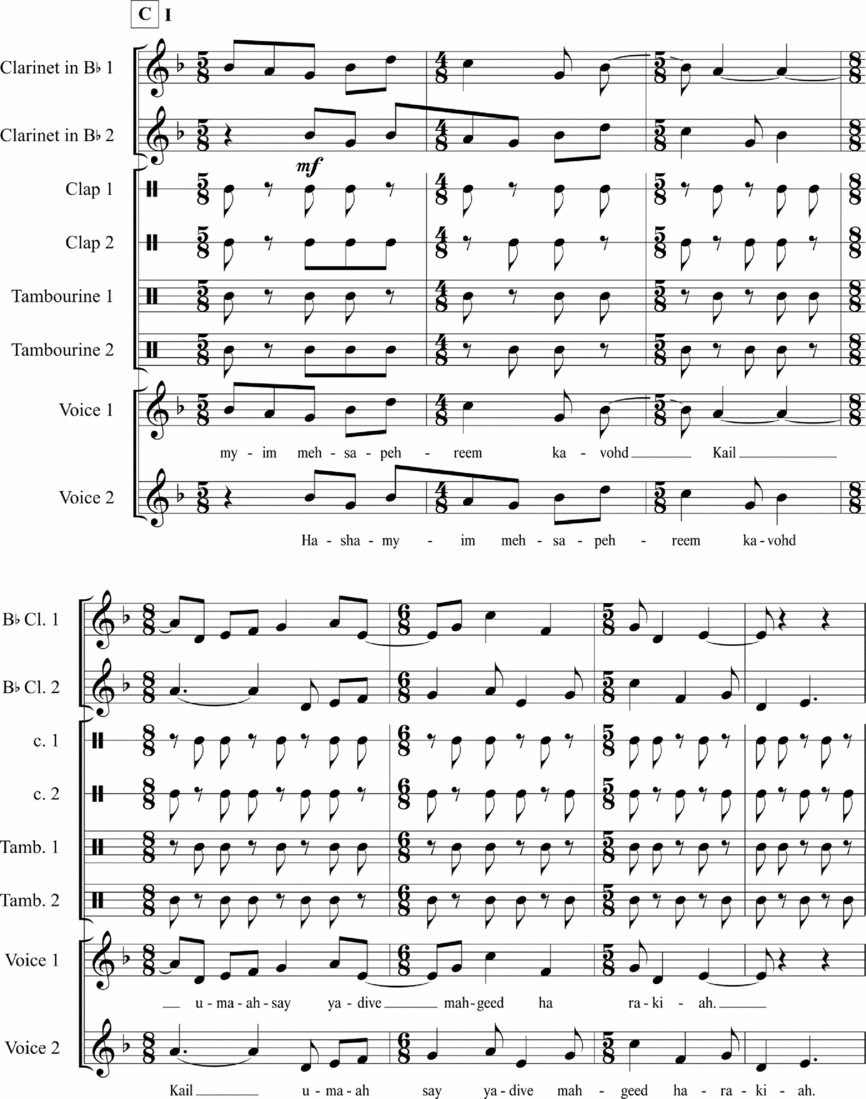
Given Reich's association between the singing voice and mediation – his accusing the singing voice of being a form of technē – the newly, radically melodic Tehillim raises questions. Has Reich simply made peace with the singing voice? From the opening bars of the piece until its close half an hour later, singing voices bubble forth almost without pause – sometimes one, sometimes many, sometimes in unison, and sometimes in counterpoint or phase. Example 1 shows a passage near the beginning where two voices rise and fall in a lively, modal counterpoint.
Tehillim, section CI. © 1981 by Hendon Music, Inc., a Boosey & Hawkes company. Revised version © 1994 by Hendon Music, Inc.

Reich gives a transcription and translation of the first movement's text as follows:
Tehillim is Reich's first attempt at text-setting, and he claims that it was the first time that ‘the music had to serve the purpose of the meaning of the words’ – a statement one must take with a grain of salt considering the foundational role of text–music relationships in, for instance, It's Gonna Rain.Footnote 45 Antonella Puca discusses the importance of the recurring fifth line of this text (italicized above), which itself describes a vocal reduction. Reich intentionally chose to set this phrase on pitches that could fit any number of keys (G, A, D, E minor; see Example 2): the ‘basic ambiguity [of its pitches] suggests that when we hear a voice without speech and words we are not only hearing music, but music of the most open sort, which is consonant with many harmonic interpretations’.Footnote 46 What we are hearing, in other words, is a form of jouissance.
Tehillim, section AIII, Voice 2. © 1981 by Hendon Music, Inc. Revised version © 1994 by Hendon Music, Inc.

Notably absent in Tehillim are some of the reductions present in It's Gonna Rain: the voice is allowed to sing, to present text, even to present the body – this song comes from singers. Who could describe this music as critical of the voice? But even as certain reductions fall away, others come into play. First of all, the text is a third-person narration of vocalization rather than being a vocalization itself – Tehillim’s vocalizing psalmists lack the specificity of the ‘character’ Brother Walter in It's Gonna Rain. A voice is heard, but without speech and without words. Because of Reich's choice of texts that are descriptive rather than emotive, as well as how he disperses these texts across the vocal ensemble, there is no specific subjectivity or presence that could be understood to lie behind the vocal utterances.
This reconciliation to the singing voice also involved an act of reduction before he even began work on the piece. Beginning with Music for Large Ensemble (1978), Reich has expressed an interest in what he calls ‘somewhat longer and ornate melodic lines’ that stem from his study of Hebrew cantillation in 1976–77.Footnote 47 Before this time, the word ‘melody’ recurs frequently in his writings and interviews but is used to refer only to short motivic cells such as those found in the phasing pieces. But beginning around 1977, melody refers to a number of cells that are strung together in a way that is meant to replicate the structure, but not the sound, of cantillation.Footnote 48 In an essay on cantillation in his compositional practice, Reich describes an unbroken legacy of biblical intonation that reaches back to pre-literate times.Footnote 49 He relies on musicologist Abraham Idelsohn, quoting him extensively in his essay on cantillation:
The Biblical intonations preserved in the memory of the people, were transmitted orally from generation to generation. Yet an attempt was made in the early centuries to find a way by which these intonations could be preserved. Similar attempts, as we know, were also made by all the other ancient nations, such as the Indians and the Greeks; and were the beginnings of musical notation, which, after a long development, resulted in the modern system of writing music. The earliest system was the notation of the rise and fall of the voice . . . with . . . handsigns, in Greek cheironomia, made by the teacher or musical leader . . . We notice this custom in ancient Egypt, shown on the wall-pictures of the pyramids. The Talmud gives evidence of the custom of using finger-motions in the air in Palestine and in Babylonia in the beginning of the Christian Era . . . Gradually, there developed the system of naming each detail of the nuances marked by voice and hand. But not satisfied with the cheironomia, every nation mentioned above invented written signs independently which were imitations of the hand-marks . . . The development (among Jews) continued for several centuries until the system received its finishing touches in Tiberias and was introduced in the Bible in the ninth century as a means by which the Scripture should be chanted. However, the use of an accented Bible for public reading in the service was not permitted. For this purpose only the original Scroll without vocalization or accents had to be used.Footnote 50
In this narrative, Reich finds an origin story to rival Rousseau's.Footnote 51 Cantillation moved from the voice to gesture and finally to the written page – a narrative of the advent of technē in the vocal act. Especially after the 1980s, Reich sees himself as involved in ‘the restoring of melody, counterpoint and harmony in a recognizable but completely new context’.Footnote 52 But it is crucial, I think, that this is a context entirely distinct from the Western classical tradition, especially in Reich's own narration. In essence, the tradition, and the very word that signifies it, affords Reich in Tehillim his double move: reduction of classical vocal technē, and the invitation of jouissance back in – this time as actual singing – but nonetheless under the sign of the authentic. Singing is re-sanctioned.Footnote 53
Vocal reduction in Music for 18 Musicians
It's Gonna Rain and Tehillim represent two different operations through which Reich recuperates singing and its excesses from deep suspicion, but there exists in his oeuvre a third approach to the voice mostly clearly seen in a set of four classic works from the 1970s: Drumming; Music for Mallet Instruments, Voices and Organ; Music for 18 Musicians; and Music for a Large Ensemble. The late 1960s and early 1970s find the composer exploring: having allegedly exhausted the possibilities of phasing, he sought new structural imperatives. Around 1970, with Drumming, he arrived at a distinctive texture composed of a steady and rapid pulse, relatively slow-moving tertian harmony, and short repeated motivic patterns. This quartet of pieces also all feature wordless, repetitive female vocal parts, raising the question of whether the voice can be ‘just another instrument’ in a musical ensemble. Given Reich's demonstrated preoccupations, one might guess the answer to be ‘no’ – and it is. But in a way that may be surprising. Works such as Music for 18 Musicians do perform vocal reductions; and moreover, they do reduce voices to instruments. But these reductions are undertaken precisely so that the music may sing. I am going to again consider these reductions along the three axes that Reich identified.
Melody
In a performance of Music for 18 Musicians, there are vocalists on stage, executing sound predetermined in terms of rhythm, pitch, and timbre. This is singing, but of a very different kind than that which usually happens on a musical stage – say, the stages of hundreds of other Manhattan venues featuring singers on the night of Music for 18 Musician’s 1976 premiere at Town Hall.Footnote 54 I touched upon some common features of melody at the beginning of this article, and analysing these vocal parts alongside one another shows how Reich at least partially disentangles voice and melody in Music for 18 Musicians.
Timbre
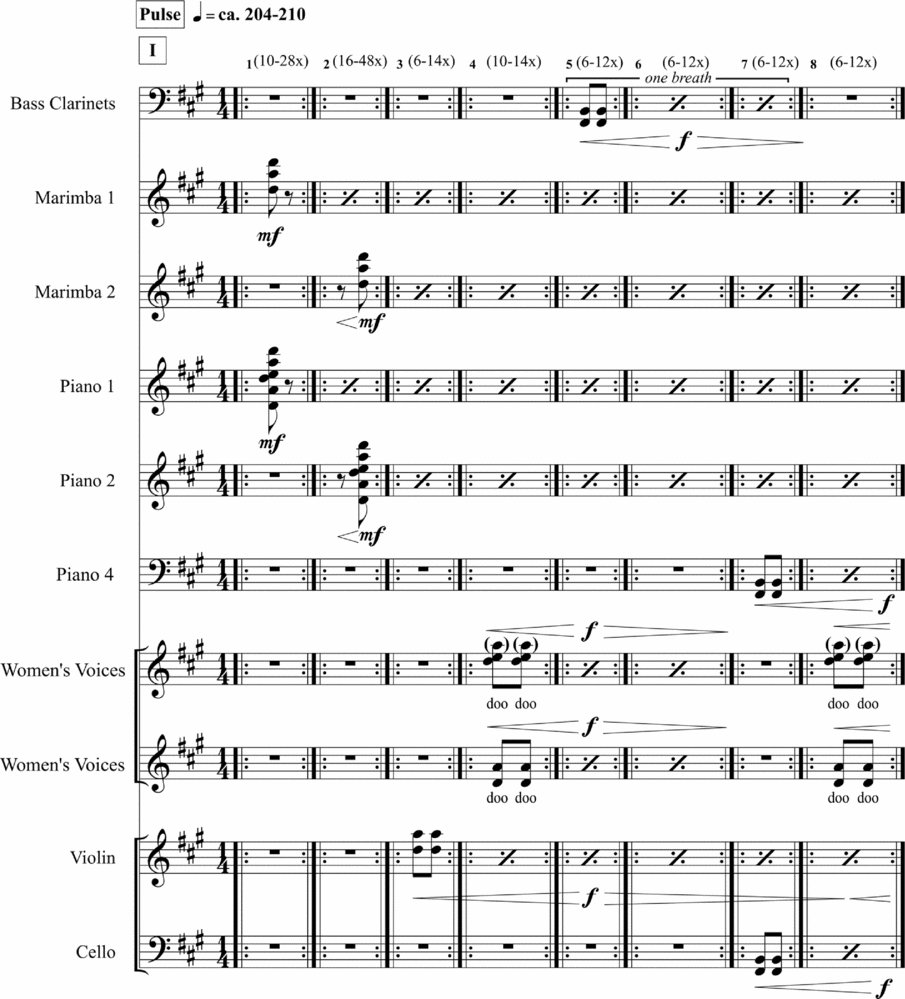
In his performance notes, Reich instructs the vocalists to ‘vocalise syllables, which are chosen so as to imitate, as exactly as possible, the sounds of some of the instruments’. They are almost always doubled by instruments and their syllables are designed to match: ‘doo’ for piano, ‘ee’ for violin, ‘ah’ for clarinet. Example 3 shows the opening of the work, with the voices doubled by and imitating the sound of the pianos. The piece performs an inverse of Rousseau's musical mimesis, with voices imitating instruments rather than the other way around – one way of reducing out the operatic vocal style that Reich deems ‘abrasive’ and ‘artificial’. It also radically resituates the singers within the ensemble. As Carolyn Abbate has pointed out, the listening practice of classical musical is extremely voice-centric: ‘In varying degrees, in all vocal music . . . the sound of the singing voice becomes, as it were, a “voice-object” and the sole centre for the listener's attention.’Footnote 55 Contrary to this convention, which extends across most Western popular genres as well, the listening experience of Music for 18 is not structured as melody and accompaniment or even voice and accompaniment. Rather, Reich wishes to blur the ontological categories of voice and instrument. And further, it is not that the instrument aspires to the condition of the vocal, but rather that the voice attempts to sound like an instrument – an attempt that has the distinct feel of a demotion in the context of the vocal imaginary.
Music for 18 Musicians, bb. 1–10. © 1978 by Hendon Music, Inc. Revised edition, 1998 Hendon Music, Inc.
Insofar as this blend is successful, subjectivity is distributed across the ensemble in the manner of the West African and Balinese ensembles Reich is so eager to emulate. But if one takes Reich seriously when he claims that a human is personified by her voice, perhaps it is also unsuccessful, even deliberately so. Music for 18 Musicians’ voices could be heard as instruments, but given Reich's consistent preoccupation with the voice and what appears to be a continued faith in the vocal imaginary (if a relocated one), perhaps it makes more sense to experience this voice/instrument blend in a constant state of uncoupling, of attempting to disentangle into a Rousseauian unité de mélodie with accompaniment. The baggage of the singing voice, the ‘residual meaning’ that it bears, creates another paradox: the more alike the voice and instruments become, the more pressure is exerted on this voice/not-voice distinction, and the more tension arises between these categories.
Phrasing
Melodies in the classical tradition are usually composed of phrases that last roughly the length of a breath; sometimes, they take the form of a period or a sentence. Although breath-length phrases are structural, actually absolutely integral, to Music for 18 Musicians, they operate in a completely different way. Reich identifies two different kinds of time occurring simultaneously in the piece. The first is grid-time: a relentless quaver pulse often maintained by the mallet instruments and pianos. The second is fluid, dynamic time created by the constant push-and-pull of voices and winds, which perform hairpin gestures based on the length of a breath. In Example 3, the hairpin shapes of the winds and strings rise and fall against the consistent background of percussive repetition. They are staggered and of varying lengths: first, one hears the violins swell, then the voices, then the bass clarinets, then the cellos; the violin's phrase lasts between 9 and 18 seconds, while the bass clarinets’ is between 5 and 10. The wave shapes are dictated by logistical bodily concerns – the physical limitations of those instruments in the ensemble animated by breath – but they also lend the work a respiratory quality that exists in tension with its inexorable pulse. The result is that different musical elements continually snap into focus and mesh back into the texture; instead of one unified phrase, there are many overlapping ones sounding simultaneously. Focus points differ for different listeners, in different performances, and even with different sound engineers.
Rubato
It is the melodist's privilege to take liberty with tempo, to hold a particularly poignant note just a little bit longer, to pick up speed when the music intensifies. Music for 18 Musicians, however, demands that its performers maintain strict pulse throughout the span of the hour-long work. The beginning of the work (Example 3) is especially austere in how its repeated cells last only a beat or sometimes a half beat; in other sections, the cells last up to six beats. This is physically and mentally gruelling labour; some pianists even tape their fingers together in order to avoid repetitive stress injuries.
In Repeating Ourselves, Robert Fink draws a parallel between the mechanical nature of Suzuki pedagogy and minimalism, claiming that:
Suzuki training turned its tiny charges not into fluent improvisers, or budding interpreters of the canon (as advertised), but into young protominimalists: inured to repetition, estranged from interpretation, precisely calibrating their own moving in and out of phase with a sound recording; like Steve Reich, doing their best, while playing along with a machine, to give a fair approximation of its perfection.Footnote 56
It is true that striving for mechanical production is an important part of Music for 18 Musicians, but had Reich wanted the music to be mechanically perfect, he would have pursued means of mechanical reproduction in order to ‘police interpretation’ à la Suzuki.Footnote 57 In fact, he did experiment with mechanical reproductions in the 1960s by using electronic devices to create phasing effects. He composed Melodica (1966) by playing the eponymous instrument on tape loops, and created a device called the ‘Phase Shifting Pulse Gate’ that provided what were essentially click tracks for musicians to use as they perform phasing music. Reich, however, seems generally dissatisfied with the results of these experiments – he speaks of Melodica as ‘a transition from tape music to instrumental music’Footnote 58 rather than a work that stands on its own merits, and similarly, the Pulse Gate languishes on the top shelf of his closet, unopened since 1970. He describes the discovery he made upon achieving this higher level of rhythmic accuracy:
the ‘perfection’ of rhythmic execution of the gate (or any electronic sequencer or rhythmic device) was stiff and unmusical. In any music that depends on a steady pulse created by human beings, it is actually tiny microvariations of that pulse created by human beings, playing instruments or singing, that gives life to the music . . . I felt that the basic musical ideas underlying the gate were sound, but that they were not properly realized in an electronic device. (1970)Footnote 59
Reich's reasoning here resonates with Charles Keil's notion of ‘participatory discrepancies’ – Keil argues that the ‘power of music’, its capacity to be ‘personally involving’ and ‘socially valuable’, results from human indeterminacy, the fact that good performance ‘must be “out of time” and “out of tune”’.Footnote 60 It is thus that another paradox emerges: it is the unflinching fidelity to the ‘inhuman’, the attempt to achieve mechanical perfection, that produces the humanity of the performers and the live performance situation. Since 1970, this paradox has been absolutely central to Reich's aesthetics.
Persona and meaning
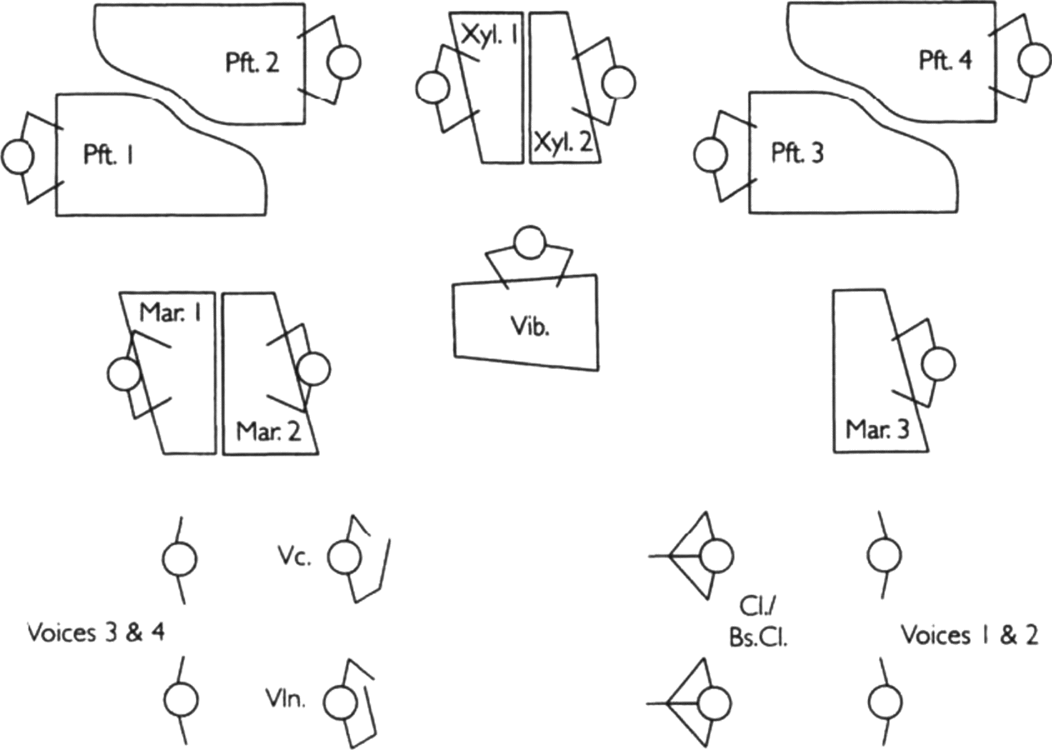
I would like to return to the idea of a voice as index of persona, as articulated in Reich's note for It's Gonna Rain. If, as Reich says, voice stands in for subject, what is one to make of the voices in Music for 18 Musicians? Narrative, words, and affect are all reduced from the vocal parts: they resist the assignment of a persona to an unprecedented degree (not preacher or psalmist or testifier). If these singers are acting, they are taking on the role of musical instruments – sounding, yet inanimate, conglomerations of metal and wood. In this sense, they are acting in a way that deconstructs the act of acting. The distribution of the singers’ bodies on stage contributes to their instrumentalization. As Figure 1 shows, Reich suggests that they stand two-deep, facing inward rather than outward towards the audience – not soloists, but members of a cohesive ensemble.Footnote 61 For Reich, meaning emerges out of the reduction of singer-as-actor, at least in this oft-quoted analysis of It's Gonna Rain:
When that persona begins to spread and multiply and come apart, as it does in It's Gonna Rain, there's a very strong identification of a human being going through this uncommon magic. (1965)Footnote 62
Reich's suggestion for stage placement in Music for 18 Musicians.
Although the use of voice in Music for 18 Musicians is extremely consistent – it never undergoes the destructive process Reich describes here – there is nonetheless an effect of ‘uncommon magic’ to be discovered in this piece. Rather than coming into being over time, though, it exists within the vocal writing from its very onset.
Reich as modernist?
The Plastic Haircut, It's Gonna Rain, Music for 18 Musicians, and Tehillim: for Reich, all of these pieces represent different solutions to the problem of the singing voice. And the fact that each is representative of a distinct period in his oeuvre suggests that his response to this problem, his need to reduce the singing voice, has been of fundamental importance for much, or even all, of his output to date. I propose that Reich's careful and critical approach to the voice productively complicates the relationship he claims with modernism. More specifically, it blurs the Reich vs modernism dichotomy proffered by the composer and too often reinscribed in the literature on him.
In studies of musical minimalism, 1974–76 is often identified as a watershed between the minimalist works of the 1960s and the emergent phenomenon of postminimalism.Footnote 63 The former category, including works such as Reich's and Philip Glass's process music, is more concerned with conceptual purity and thus is more associated with modernism; the latter category comprises works where a preponderance of influences – high and low, near and far – are meant to coexist happily and seamlessly, and is thus more associated with postmodernism. Jelena Novak goes so far as to define postminimalism as ‘neither a style nor a movement, but a heterogeneous conceptual field’.Footnote 64 Robert Fink points out that terminology tends to be quite inconsistent – in fact, by the time minimalism entered a wide public consciousness, it was already postminimalism.Footnote 65
The year 1976 saw the premieres of Music for 18 Musicians and Philip Glass's Einstein on the Beach within three months. Keith Potter describes the ‘relationships between chord and pulse, tentative melody, sensory textures and, most of all, the dastardly double-act of speed-warp and incipient harmonic directionality’ that marked a departure for both composers.Footnote 66 This was also the time during which John Adams, a decade younger than Reich and Glass, was beginning to establish his own career with works such as Phrygian Gates and China Gates (both 1977). The harmonic directionality in these pieces makes them a better fit with postminimalism, and Adams was the first of a younger generation of composers that continues to work within the postminimalist paradigm today.Footnote 67 Novak quotes Philip Glass as a way of illustrating postminimalism's ‘heterogeneous conceptual field’: ‘From my point of view, all things are available. Any stylistic development. If I can make it work, if it makes sense in the music, then I use it. In that case for me there are no barriers connected with history or places. Pieces come out of the historical moment, but after that they exist as kinds of techniques.’Footnote 68 The only prohibition Glass holds, it seems, is on prohibition itself. Reich's embrace of certain elements of popular music, including pulse and quasi-functional harmony, aligns him with a postminimal/postmodern heterogeneity. His rhetoric is also suffused with the capitalist notion that a composer should ‘give the people what they want’.Footnote 69 The plentitude of America, for instance, requires an act of recalibration:
Stockhausen, Berio and Boulez were portraying in very honest terms what it was like to pick up the pieces of a bombed-out continent after World War II. But for some Americans in 1948 or 1958 or 1968 – in the real context of tail-fins, Chuck Berry and millions of burgers sold – to pretend that instead we're really going to have the dark-brown angst of Vienna is a lie, a musical lie.Footnote 70
Faced with a million burgers sold, Reich sees no room for angst. And yet, even amid this excess, there remains a privation in his music, a prohibition. I do not wish to say that Reich's ethics of the voice cannot or should not be understood in relation to these concerns, nor that modernism cannot be present in popular culture and its aesthetic objects. To do so would only serve to draw more starkly boundaries that seem ever less useful.Footnote 71 But I do think it is important to note that the voice remains a site of resistance in his music, and further, that although the notion of eradicating the barriers between high and low is important to understanding Reich's music, it also fails to capture something essential about it. For Reich, steps must be taken in order to ensure the voice's singularity and mystery: to use it in its role as a ‘window’ into a person's soul, to evoke its ‘residual meaning’. An act of reduction is ethically necessary, and certain prohibitions remain in place even as they support a music of supposed plenitude and pluralism, consumer-ready, buoyed by burgers, tail-fins, and Chuck Berry. Reich's career-long problematic of the singing voice suggests that he did not make the seamless transition to postminimalism along with Glass. All things are not available, not just any stylistic development is allowed, not all barriers connected to history and places are removed. And this bears itself out in concrete form: Reich cannot – or will not – compose straightforward singing actors such as those found in Glass's Fall of the House of Usher and Adams's Nixon in China. This fact, I would argue, has deep roots in Reich's prohibitive or ‘ascetic’ relationship to the past, and it is a relationship that bears more than passing resemblance to those characterizing various musical modernisms throughout the twentieth century.Footnote 72
Such relationships are, of course, part of Reich's own ‘origin story’, and this is hardly a repressed narrative. His excitement at having found a potential ‘solution to the voice’ came while he was deeply involved in the Bay Area's avant-garde scene; Ross Cole has shown the influence of Reich's fellow members of the San Francisco Mime Troupe with its emphasis on Funk art, Terry Riley, Robert Nelson, and the members of the San Francisco Tape Center during this time.Footnote 73 Cole also touches briefly on Reich's relationship with Luciano Berio, with whom he studied at Mills during his San Francisco years. I would like to further explore that connection here in order to reveal a shared and distinctly modernist attitude. In fact, Reich's ethics of the voice, his search for vocal jouissance and rejection of what he sees as ossified vocal technē, reveals a closer allegiance to composers such as Berio than with the postminimalists he claims as comrades.
Berio was famously enthralled with the voice, and with specific voices such as Cathy Berberian's. But he was also preoccupied with the voice-as-a-problem, as something whose excess had to be dealt with, and carefully:
I have always been very sensitive, perhaps overly so, to the excess of connotations that the voice carries, whatever it is doing. From the grossest of noises to the most delicate of singing, the voice always means something, always refers beyond itself and creates a huge range of associations, cultural, musical, emotive, physiological, or drawn from everyday life, etc. . . . As has already been said many times, the voice of a great ‘classical’ singer is a bit like a signed instrument which, as soon as you have finished playing, you put away in a case. It has nothing to do with the voice that the great singer uses to communicate in everyday life.Footnote 74
It is striking how both Berio and Reich ‘receive’ the historical voice as a carrier of both outmoded technē and inevitable excess – all the more striking, given their vastly different ‘solutions’.Footnote 75 The idea of putting ‘the voice of a great “classical” singer’ away in a case after use corresponds with Reich's accusations of artificiality and instrumentality, and suggests that Berio also sees an ethical problem in representing a character within classical singing conventions. Certainly Berio's musical-theatrical characters, from the fractured persona in Sequenza III and the schizoid protagonist of Recital I (for Cathy) through the highly ambiguous characters of the late musical actions Outis and La Cronaca del Luogo, are great ‘problem-carriers’ of the voice. Furthermore, the way Berio characterizes the baggage of the voice (cultural, musical, emotive, physiological) reflects the same double-sided sense of excitement and anxiety about ‘residual meaning’ that surfaces in Reich's assessment of The Plastic Haircut. Each composer fashions himself as contending with an excess inherent in the voice, an excess intimately connected to the human subject producing it.
Berio's comments are part and parcel of a long-standing critique of the classical singing voice, made not only by Reich, but also by some of the most well-known practitioners of musical modernism's endlessly disputed ‘tradition of the new’.Footnote 76 Interrogating the voice, seeking both to bring forth and control and to summon and restrict its signifying power, is absolutely endemic to this tradition from the 1950s forward. Consider, for instance, Helmut Lachenmann's acknowledgement that his opera came about ‘thanks to my – still unfinished – struggle with the singing voice’;Footnote 77 or Iannis Xenakis's admission that ‘sometimes a sentimental melody can move me to tears. However, I don't want to be moved’;Footnote 78 or Salvatore Sciarrino's desire to escape the ‘mountains of songs, in short what constitutes the giant landfill in which we live’;Footnote 79 or Elliott Carter's refusal to write choral music on the basis that ‘choral music represents a social cohesiveness and agreement about worthy goals – which I no longer see in the world we live in, except on very superficial matters’.Footnote 80 There are countless other examples, and it is worth noting that what unites them is not so much a positive feature – they give rise to often stunningly different and sometimes antagonistic aesthetics and sound-worlds – as a negative one: the voice as something which cannot be allowed to continue ‘as it was’.
The historiography of composition in the second half of the twentieth century relies on Reich's difference from such figures; it is arguably one of its most important partitions. And despite the notable resonances between his and Berio's discussion of the voice, Reich is an active upholder of this partition: he has again and again reduced American and European modernism to straw men, almost caricatures. The former is often subsumed under the heading of ‘John Cage’, the latter under ‘serialism’. Cage represents ‘the idea of composing through tossing coins, or oracles, or other chance forms’,Footnote 81 while serialism was a ‘break with the natural principles of resonance and with human musical perception . . . the postman does not whistle Schönberg’.Footnote 82 Of course European modernism, especially since the 1960s, surely encompasses more than serial techniques, and serial techniques are used in a variety of ways in this repertory, many of which are neither totalizing nor meant to constitute a work's most salient feature. Similarly, American experimental practice is more than Cage, and Cage himself is more than aleatoric compositional techniques.
Some scholarship dealing with minimalism and modernism has perhaps been too quick to follow Reich's lead. The editors of the recent Ashgate Research Companion to Minimalist and Postminimalist Music, for instance, compare minimalism – comprising ‘the composers who command a large following both within and outside the orchestral establishment’ – to the ‘ongoing dissonant abstraction of what's come to be termed High Modernism’.Footnote 83 The specific repertory they refer to here is not clear; I suspect that, like Reich, they mean the Darmstadt serialism of the 1950s and now less certain ‘serial tyranny’ of ‘American “PhD music”’.Footnote 84 For both Reich and the editors of the Companion, the simplified understanding of modernist trends allows Reich to be neatly situated within these practices. In a manner similar to his approach towards non-Western musics, Reich is able to articulate a few concepts that he incorporated into his own compositional process while compartmentalizing and essentially disowning the rest: ‘I sometimes see both serial music and Cage as influencing my music . . . by suggesting that any radical kind of organization is possible, on the one hand, and, on the other, forcing me back on my own rhythmic and tonal inclinations that received no satisfaction whatever from either of these musics. Serialism and Cage gave me something to push against’.Footnote 85
A commonplace understanding of musical modernism (here coded as serialism and Cage), which Reich seems to share, associates it with a specific set of taboos – most famously a taboo against tonality, but also against pulse. As the above citation demonstrates, Reich has been adamant that these features play a role in his music to the point of thumbing his nose at high modernists such as Stockhausen and Boulez. He also sees modernists as out of touch with, and opposed to, popular musical styles:
We are living at a time now when the worlds of concert music and popular music have resumed their dialogue. Perhaps I have had a hand in this restoration myself . . . It seems that the wall between serious and popular music was erected primarily by Schönberg and his followers. Since the late 1960s, this wall has gradually crumbled and we are more or less back to the normal situation where concert musicians and popular musicians take a healthy interest in what their counterparts have done and are doing. (1992)Footnote 86
Reich's treatment of the voice complicates both of these narratives, leaving certain walls untouched, and others unexpectedly collapsed. For what is more endemic to popular music than melody and singing – and, more importantly, their zealous cooperation in a staging of the performative vocal subject as a persona, a character, a frontman? A more provocative corollary question would be: What is the difference between Reich's complex prohibition of such qualities and the alleged ‘serialist’ prohibition of tonality and pulse – and, not incidentally, melody? Certainly, as Robert Fink and others have pointed out, Music for 18 Musicians and the works that follow it embody now canonic aspects of postminimalism: the intervention of wilful decision-making in otherwise more automated processes, the increasing role of harmonic directionality, and ‘recombinant teleologies’.Footnote 87 But the boundary between minimal/modernist and postminimal/postmodernist becomes much more difficult to maintain when considering that the early process pieces depended on the ‘residual meaning’ of the recorded voice or the imperfections of live performance – the small mysteries that constitute jouissance – whereas the late pieces remain rigorous and anti-subjective in their prohibition on a certain kind of singing voice and a certain kind of acting.
At the end of his famous essay on ‘the grain of the voice’, Roland Barthes hints at new possibilities for thinking about voice and modernism: ‘It goes without saying . . . that the simple consideration of “grain” in music could lead to a different history of music from the one we know now . . . Were we to succeed in refining a certain “aesthetics” of musical pleasure, then doubtless we would attach less importance to the formidable break in tonality accomplished by modernity.’Footnote 88 Modernism ‘broke’ tonality in a complicated and incomplete way. The same could be said of pulse. Reich, by contrast, is adamant about the place of both tonal harmony and pulse in his music. And yet, his complex and ambivalent endeavours in vocal reduction strike me as haunted by a particularly modernist prohibition. At the least, they are essential to what continues to make Reich's music modern, obsessed with its past as much as its future, as anxiously preoccupied with ‘making it new’ as the work of any of his more officially modernist contemporaries. What if, to extend Barthes’ reasoning, we think of modernism as ‘breaking’ the voice? What if Reich appears to be, almost accidentally, on the vanguard of the very discourse he disavows?