

Introduction
Triglochin L. is the largest of the currently recognised four (Haynes et al., Reference Haynes, Les, Holm-Nielsen and Kubitzki1998; Stevens, Reference Stevens2001 onwards) or five (Dahlgren et al., Reference Dahlgren, Clifford and Yeo1985) genera of the small monocotyledon family Juncaginaceae, and contains 25–35 annual and perennial species. The genus has an almost cosmopolitan distribution with Australia as the centre of specific diversity. Common habitats of Triglochin are coastal salt marshes, tidal mud-flats, freshwater wetlands, seasonal pools and inland saltpans.
In the Mediterranean region and southern Africa Triglochin is represented by a group of widely distributed taxa with ovoid to very narrowly ovoid fruits consisting of three fertile carpels that separate at maturity. A carpophore may be present or absent. Since all taxa belonging to this group have been included in Triglochin bulbosa L. at some point, the group is here called the T. bulbosa complex. In a molecular phylogenetic study of Triglochin (von Mering & Kadereit, unpubl. data), this complex forms a well-supported monophyletic clade. Additional species of Triglochin in the Mediterranean region but which are not in the T. bulbosa complex are T. maritima L., T. palustris L. and T. striata Ruiz & Pav. Triglochin striata is also found in southern Africa as the only non T. bulbosa complex species. These three species can easily be distinguished from the Triglochin bulbosa complex by fruit characters. The fruits of Triglochin maritima are composed of six fertile carpels, T. palustris has fruits with only three carpels that do not separate at maturity, and T. striata is easily recognisable by roundish fruits consisting of three fertile and three sterile carpels.
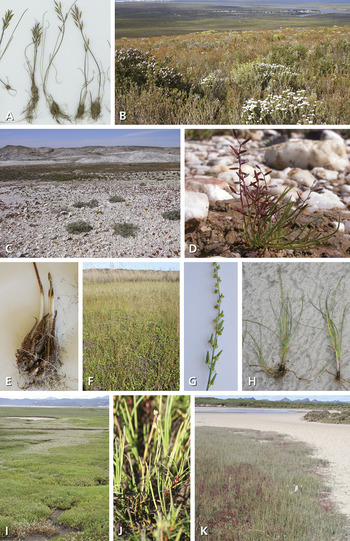
The Triglochin bulbosa complex is a systematically difficult group as is evident from its complex taxonomic history. In South Africa, five species of the Triglochin bulbosa complex have been recognised in the past, but currently only a broadly circumscribed T. bulbosa is accepted within the complex (e.g. Obermeyer, Reference Obermeyer, Codd and de Winter1966; Goldblatt & Manning, Reference Goldblatt and Manning2000; Glen & Cook, Reference Glen, Cook, Germishuizen and Meyer2003; Trinder-Smith, Reference Trinder-Smith2003). In this broad circumscription, Triglochin bulbosa shows substantial morphological (e.g. in leaf and fruit characters and underground parts) and ecological variation (Fig. 1). In the Mediterranean area, Triglochin barrelieri and T. laxiflora have been variously treated as separate species (e.g. Talavera, Reference Talavera, Valdés, Talavera and Fernández-Galiano1987; S. Talavera, ms. Flora Iberica) or as subspecies of the South African T. bulbosa (e.g. de Bolòs & Vigo, Reference Bolòs and Vigo2001).
Triglochin bulbosa L. subsp. calcicola Mering, Köcke & Kadereit subsp. nov.: A, habit; B, habitat (De Hoop). T. bulbosa L. subsp. quarcicola Mering, Köcke & Kadereit subsp. nov.: C, habitat (Moedverloren); D, habit. T. compacta Adamson: E, bulbs; F, habitat (Goukamma); G, infructescence. T. elongata Buchenau: H, habit (with rhizomes). T. buchenaui Köcke, Mering & Kadereit sp. nov.: I, habitat (Knysna); J, habit. T. elongata Buchenau: K, habitat (Overberg). Photographs A, B, F, H–K: L. Mucina; C–D: U. Schmiedel; E, G: J. Naudé.

No revision of the entire complex has ever been attempted. This paper reports the findings of an analysis of extensively researched herbarium material and our own collections from the Mediterranean area and South Africa. Based on morphology, phenology, ecology and geographical distribution, seven species and four subspecies are recognised. These are Triglochin barrelieri Loisel., T. buchenaui Köcke, Mering & Kadereit sp. nov., T. bulbosa L. (with subspecies T. bulbosa subsp. bulbosa, T. bulbosa subsp. calcicola Mering, Köcke & Kadereit subsp. nov., T. bulbosa subsp. quarcicola Mering, Köcke & Kadereit subsp. nov. and T. bulbosa subsp. tenuifolia (Adamson) Horn), T. compacta Adamson, T. elongata Buchenau, T. laxiflora Guss. and T. milnei Horn.
Taxonomic History
Triglochin bulbosa L. was described by Linnaeus in 1771 based on collections by Thunberg from the Cape of Good Hope (Buchenau, Reference Buchenau1896). However, Barrelier’s account of ‘Juncago maritima’ (1714) from the western Mediterranean is the first description of a member of the Triglochin bulbosa complex. Despite its morphological distinctness stressed by Barrelier (Reference Barrelier1714), Linnaeus did not recognise Barrelier’s taxon as a separate species but included it as var. β in Triglochin palustris L. (Linnaeus, Reference Linnaeus1762). Loiseleur-Deslongchamps (Reference Loiseleur-Deslongchamps1806) at first included this taxon as Triglochin palustris L. var. β in his Flora Gallica, but in the amendments to this Flora (Loiseleur-Deslongchamps, Reference Loiseleur-Deslongchamps1807) recognised it as a distinct new species, T. barrelieri Loisel. An affinity to, or a possible synonymy with, Triglochin bulbosa was suggested (‘An Triglochin bulbosum. Lin. Mant. 226 ?’; Loiseleur-Deslongchamps, Reference Loiseleur-Deslongchamps1807). The second Mediterranean taxon, Triglochin laxiflora Guss., was described by Gussone (Reference Gussone1825) from Sicily and Corsica.
Subsequently, Triglochin barrelieri and T. laxiflora were both recognised as distinct species (e.g. Loiseleur-Deslongchamps, Reference Loiseleur-Deslongchamps1828; Battandier & Trabut, Reference Battandier and Trabut1884; Bonnet, Reference Bonnet, Bonnet and Barratte1896; Jahandiez & Maire, Reference Jahandiez and Maire1931). Other authors accepted only Triglochin laxiflora as a species while T. barrelieri was treated as a synonym (e.g. Micheli, Reference Micheli1881; Buchenau, Reference Buchenau and Engler1903) or as a subspecies of the South African T. bulbosa (e.g. Hayek, Reference Hayek1933; Maire, Reference Maire1952). Rouy (Reference Rouy, Rouy and Foucaud1912) was the first to reduce the two Mediterranean taxa to subspecies of the South African Triglochin bulbosa (T. bulbosa subsp. barrelieri (Loisel.) Rouy, and T. bulbosa subsp. laxiflora (Guss.) Rouy). Some recent Floras treat them as distinct species, Triglochin barrelieri and T. laxiflora (Talavera, Reference Talavera, Valdés, Talavera and Fernández-Galiano1987; S. Talavera, ms. Flora Iberica), and others as subspecies of T. bulbosa L. (e.g. de Bolòs & Vigo, Reference Bolòs and Vigo2001).
Based mainly on differences in fruit size and pedicel length, Pau (Reference Pau and Font Quer1914) described Triglochin barrelieri var. maura Pau, a variety endemic to Morocco. It was later also treated as Triglochin bulbosa var. maura (Pau) Maire (Maire, Reference Maire1952) or as a synonym of T. bulbosa subsp. barrelieri (Govaerts, Reference Govaerts2008).
Buchenau (Reference Buchenau and Engler1903) newly described Triglochin elongata Buchenau from South Africa and recognised T. bulbosa (syn. T. barrelieri) and T. laxiflora. The occurrence of the last in South Africa was recorded with reservations because only one specimen could be assigned to Triglochin laxiflora by Buchenau (Reference Buchenau and Engler1903). Bennett (Reference Bennett and Thiselton-Dyer1897) also believed Triglochin laxiflora to occur in South Africa, while Horn af Rantzien (Reference Horn af Rantzien1961) excluded this species from the South African flora.
Adamson (Reference Adamson1939), who contributed considerably to the compilation of the Flora of the Cape Peninsula, studied the South African species of Triglochin in more detail and also published notes on habitat preferences. He provided detailed descriptions and diagnostic characters for the South African taxa of the Triglochin bulbosa complex known to him (Adamson, Reference Adamson1939). Adamson described two new Triglochin species, T. tenuifolia Adamson (Reference Adamson1939) and T. compacta Adamson (Reference Adamson, Barker, Gerstner, Adamson and Compton1943), and accepted T. elongata. Thus, Adamson (Reference Adamson1939, Reference Adamson, Barker, Gerstner, Adamson and Compton1943) recognised the following four species of the Triglochin bulbosa complex in South Africa: T. bulbosa, T. elongata, T. tenuifolia and T. compacta. We follow Adamson in the recognition of his newly described Triglochin compacta and T. tenuifolia, but treat the latter as a subspecies of T. bulbosa.
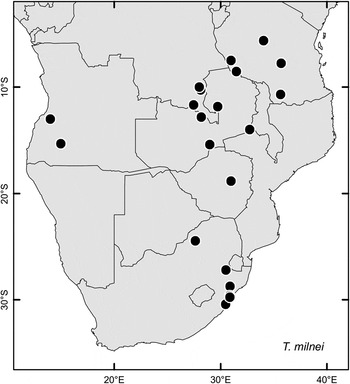
The last treatment of the African species of Triglochin was carried out by Horn af Rantzien (Reference Horn af Rantzien1961). This author did not regard his publication as a full revision since it was based on herbarium material from Kew and Stockholm only. He provided an identification key to the species and subspecies of Triglochin in Africa which was mainly based on differences in fruit characters and underground organs. In his study only taxa with bulbs were investigated in great detail, especially with respect to flower and fruit morphology. As a result of this he described a new species, Triglochin milnei Horn, from southern Central Africa (Tanzania, Angola, Zambia, eastern South Africa), recognisable by its conspicuously larger flowers and fruits. Apparently Horn af Rantzien (Reference Horn af Rantzien1961) was not aware of the existence of Triglochin compacta and did not include this taxon in his study. He did, however, include Triglochin tenuifolia in T. bulbosa as subsp. tenuifolia (Adamson) Horn, and also treated the other taxa at intraspecific rank. This resulted in the recognition of five subspecies of Triglochin bulbosa: subsp. bulbosa (South Africa), subsp. tenuifolia (South Africa), subsp. barrelieri (Mediterranean), subsp. laxiflora (Mediterranean) and subsp. maura (Pau) Horn (Morocco). Such treatment seemed justified by great similarities within the complex and the occurrence of transitional forms. Like Adamson (Reference Adamson1939), Horn af Rantzien (Reference Horn af Rantzien1961) also accepted Triglochin elongata as a separate species. However, this taxon was overlooked by later authors.
Most recent Floras and checklists of Central and southern Africa accept Triglochin bulbosa as the only species (plus the distinct T. striata, which does not fall into the T. bulbosa complex; e.g. Obermeyer, Reference Obermeyer, Codd and de Winter1966; Goldblatt & Manning, Reference Goldblatt and Manning2000; Glen & Cook, Reference Glen, Cook, Germishuizen and Meyer2003; Trinder-Smith, Reference Trinder-Smith2003) and treat T. milnei as a synonym (e.g. Obermeyer, Reference Obermeyer, Codd and de Winter1966; Lisowski et al., Reference Lisowski, Malaisse and Symoens1982). Only Cook (Reference Cook2004) recognised Triglochin milnei as a distinct species. The World Checklist of Monocotyledons (Govaerts, Reference Govaerts2008) currently recognises only Triglochin bulbosa with a broadly circumscribed T. bulbosa subsp. bulbosa (Tanzania to South Africa), and T. bulbosa subsp. barrelieri and T. bulbosa subsp. laxiflora (both in the Mediterranean).
Material and Methods
This revision is based mainly on the study of c.800 specimens from AV, B, BC, BM, BOL, EA, FB, HBG, JE, K, M, MJG, MO, MSB, NAP, NBG, NBG-SAM, NBG-STE, NY, P, POZG, RNG, RO, S, STEU, WHB, Z and ZT (abbreviations according to Holmgren & Holmgren, Reference Holmgren and Holmgren1998). Names were typified as far as possible, and most type material cited has been seen, in some cases as digital images (indicated by ‘!’ and ‘photo!’, respectively).
The distribution maps are based on information from herbarium labels and unambiguous records in the literature. Coordinates of older collections were taken mainly from the NGA GEOnet Names Server (GNS) (National Geospatial-Intelligence Agency, http://earth-info.nga.mil/gns/html/index.html) and the Gazetteer of the Cape Region (Institute of Systematic Botany, University of Zurich, www.systbot.uzh.ch/Bestimmungsschluessel/GazeteerRSA.html). In addition, the Google Earth web-based satellite imagery database (earth.google.com) was used. All maps were generated using the programme ArcGIS 9.0 (ESRI, 2006). The locations of new collections made between 2000 and 2008 were ascertained by using a GPS device. Some information on collector names and/or localities in Africa was verified using Aluka (Ithaka Harbors, Inc., www.aluka.org). Measurements were made on herbarium material and may deviate from fresh material. Longer field trips were made in 2006 (March–May) in South Africa, in October 2006 in Sardinia (Italy), and in 2007 (March–April) in France and Spain. The conservation status of each taxon was assessed using the IUCN Red List categories and criteria (IUCN, 2001).
Taxonomic Treatment
Triglochin L., Sp. Pl. 338 (1753). – Type species: Triglochin palustris L. – Type specimen: ‘Habitat in Europae inundatis uliginosis’ (lecto LINN 466.1 photo!).
Hexaglochin Nieuwl., Amer. Midl. Naturalist 3: 10 (1913). – Type species: Hexaglochin maritima (L.) Nieuwl. (= Triglochin maritima L.). – Type specimen: USA, Indiana, Chain of Lakes, 19 v 1909, Nieuwland 547 (lecto ND photo!, designated here).
Notes. We have not seen type material of other names that have been cited as synonyms of Triglochin by Govaerts (Reference Govaerts2008). The synonyms given by Govaerts (Reference Govaerts2008) are Juncago Ség., Juncago Tourn. ex Moench, Abbotia Raf., Tristemon Raf., Cycnogeton Endl. and Maundia F.Muell. Of these, Juncago Tourn. ex Moench is an illegitimate superfluous name (nom. illeg.). Tristemon was described as a segregate of Triglochin, but no diagnosis was given and no type material was indicated. The descriptions provided and their geographical distribution and habitat suggest that Juncago Ség. and Abbotia should indeed be regarded as synonyms of Triglochin as suggested by Govaerts (Reference Govaerts2008). Cycnogeton Endl. and Maundia F.Muell. are distinct genera (see von Mering & Kadereit, in press).
Description of the Triglochin bulbosa complex
Erect perennial herbs, 5–90 cm high, with scapose inflorescences and rhizomes or (often aggregated) bulbs. Base of plants covered with fibrous remains of old leaves. Leaves basal, distichous, ± succulent, linear, ± terete (semi-terete), ligulate, sheathing at the base. Inflorescence a spike. Flowers hermaphrodite, 3-merous, ebracteate, proterogynous. Perianth of six green or sometimes reddish tepals; tepals conchiform, deciduous. Stamens six or three, sessile or subsessile; anthers dorsifixed, dithecous, dehiscing longitudinally, extrorse. Infructescence a raceme. Fruits ovoid to very narrowly ovoid (Figs 2, 4). Fertile carpels three, connate, sessile, with one ovule and sessile stigma each, usually separating into one-seeded mericarps at maturity. Sometimes an outer whorl of three vestigial carpels present (Triglochin milnei and T. compacta). Carpophore mostly present, sometimes carpophore very thin or lacking and then mericarps not always separating. Seeds erect, embryo straight.
Notes. Flowers of Triglochin usually have six stamens. However, this number may be reduced to three as reported for Triglochin milnei (Horn af Rantzien, Reference Horn af Rantzien1961). Such reduction was also noted in this study in Triglochin bulbosa subsp. calcicola. The gynoecium of Triglochin is variable. In principle, carpels are arranged in two whorls of three carpels each (e.g. Tomlinson, Reference Tomlinson and Metcalfe1982). Whereas in some species (e.g. Triglochin maritima) all six carpels are fertile, in others (e.g. Triglochin striata) the three carpels of the outer whorl are sterile (e.g. Tomlinson, Reference Tomlinson and Metcalfe1982; pers. obs.). In the Triglochin bulbosa complex only three fertile carpels are present. However, in some species (especially Triglochin compacta and T. milnei) membranous outgrowths are present at the base of the carpophore, which have been interpreted as remains of the second whorl of carpels. Size and form of these outgrowths are variable. Sometimes they are extremely small, but in Triglochin milnei these structures are often very distinctive. Horn af Rantzien (Reference Horn af Rantzien1961) considered them sterile carpels and accordingly described Triglochin milnei as having six carpels, of which three are sterile. However, not all specimens studied have outgrowths that can be identified as sterile carpels. Fruits in the complex mostly separate from bottom to top. In some species this character seems to be variable (i.e. carpels separate from bottom to top or from top to bottom). Currently we are not able to give accurate information on the mode of carpel separation for all taxa and accordingly do not know whether this character can be used for the distinction of taxa. This character should be further studied on fresh material.
Distribution. The Triglochin bulbosa complex is native to the Mediterranean region, extending along the Atlantic coast to NW France and Morocco (Fig. 3), and to southern Central Africa extending to South Africa (Figs 5, 8, 9). A subspecies of Triglochin bulbosa has been reported to be naturalised in Western Australia (Western Australian Herbarium, 1998 and onwards; Australian Plant Census, 2008; see also under T. bulbosa subsp. bulbosa).
Habitat and ecology. Plants of this group are typically found in hygro-halophytic habitats such as coastal salt marshes, tidal mud-flats and along lagoons. They also occur on coastal rocks exposed to salt spray or in temporary pools, in inland saltpans, in dry, non-saline habitats on mountain slopes or in seasonally wet grassland and along river banks. Some collections were made at altitudes above 1000 m.
Chromosomes. In Triglochin chromosome numbers of up to 2n = 144 are known (e.g. Löve & Löve, Reference Löve and Löve1958; Robb & Ladiges, Reference Robb and Ladiges1981). No chromosome counts are available for the southern African species of the complex, and only few for the Mediterranean species. For Triglochin laxiflora 2n = 18 (Gardé & Malheiros-Gardé, Reference Gardé and Malheiros-Gardé1953; Bartolo et al., Reference Bartolo, Brullo, Majorana and Pavone1977; Talavera et al., Reference Talavera, Ortiz, Arista and Bastida1995; Castro et al., Reference Castro, Fraga, Torres and Rosselló2007), and for T. barrelieri 2n = 30 (de Castro & Carvalho Fontes, Reference Castro and Carvalho Fontes1946), 32 (Dahlgren et al., Reference Dahlgren, Karlsson and Lassen1971; Bartolo et al., Reference Bartolo, Brullo, Majorana and Pavone1977) and 36 (Castro et al., Reference Castro, Fraga, Torres and Rosselló2007) have been reported.
Nomenclatural note. Although Linnaeus (Reference Linnaeus1753) treated Triglochin as neuter in his original publication of the name, the feminine gender has to be used (ICBN Vienna Code 2006, Art. 62.2b and Ex. 5).
Key to the species of the Triglochin bulbosa complex
The following key is based on herbarium material. Characters such as size of flowers, fruits or pedicels often are not sufficient to identify species because of the existence of (in this respect) intermediate forms. Underground parts are sometimes lacking in herbarium specimens but are important for the identification of species. When the geographical origin of the material and/or its phenology are unknown, special attention must be paid to the presence of either bulbs or rhizomes. Notes on habitat and distribution should also facilitate the identification of species. As already stated by Horn af Rantzien (Reference Horn af Rantzien1961: 102): ‘In identifications statements on locality, habitat, and time of anthesis are of more use than those on morphological characters.’ This implies that the combination of morphological attributes, ecology and geographical distribution defines species best.
1a. Plants from the Mediterranean region or the Atlantic coast of western Europe and North Africa 2
1b. Plants from Central or southern Africa 3
2a. Leaves present at flowering time, mostly as long as or longer than plant height; pedicels spreading (Fig. 2A); plants flowering in spring (ii–v) 1. T. barrelieri
2b. Leaves formed after flowering, usually much shorter than plant height; pedicels ascending, ± appressed to infructescence axis (Fig. 2B); plants flowering in autumn (ix–xii) 2. T. laxiflora
3a. Plants with rhizomes, of salt marsh estuaries or estuarine rivers 4
3b. Plants with bulbs, of inland habitats, never under direct influence of tidal flooding 5
4a. Inflorescences dense, with 10–100 flowers; infructescences (6–)10–25 cm long; fruits with carpophore; plants growing in the upper zone of salt marsh estuaries and estuarine rivers 6. T. elongata
4b. Inflorescences lax, with 3–17 flowers; infructescences 2–7 cm long; fruits without carpophore; plants restricted to the lower tidal zone of salt marsh estuaries 7. T. buchenaui
5a. Flowers usually > 3 mm long; fruits (8–)10–14 mm long and ± 3 mm wide (Fig. 2D); plants flowering and fruiting in summer (x–ii/iii); plants from Central and southern Africa (incl. eastern South Africa) 5. T. milnei
5b. Flowers usually < 3 mm long; fruits 4–10(–12) mm long and (0.5–)1–2 mm wide; plants flowering and fruiting in spring (vii–xi) or autumn (ii/iii–v); plants from South Africa 6
6a. Leaves present at flowering time, mostly as long as or longer than plant height; plants flowering and fruiting in spring (vii–xi) 3. T. bulbosa
6b. Leaves formed after flowering, mostly only half as long as plant height; plants flowering and fruiting in autumn (ii/iii–v) 4. T. compacta
1. Triglochin barrelieri Loisel., Fl. Gall. ed. 1, 725 (1807), ed. 2, 1: 264 (1828). – Triglochin bulbosa subsp. barrelieri (Loisel.) Rouy, Fl. France (Rouy) 13: 271 (1912). – Type: France, Arles (Arelatem), ‘habitat Arelatem ad Rhodanu’, Artaud s.n. (holo AV photo!). Figs 2A,3.
Triglochin barrelieri var. maura Pau, Bol. Real Soc. Esp. Hist. Nat. 14: 425 (1914). – Triglochin bulbosa var. maura (Pau) Maire, Fl. Afrique N. 1: 213 (1952). – Type: Morocco, inter Ceuta et Tetauen, l. d. Rincón de Medik, 13 iii 1930, Font Quer s.n. (lecto MPU-Maire photo!, designated here).
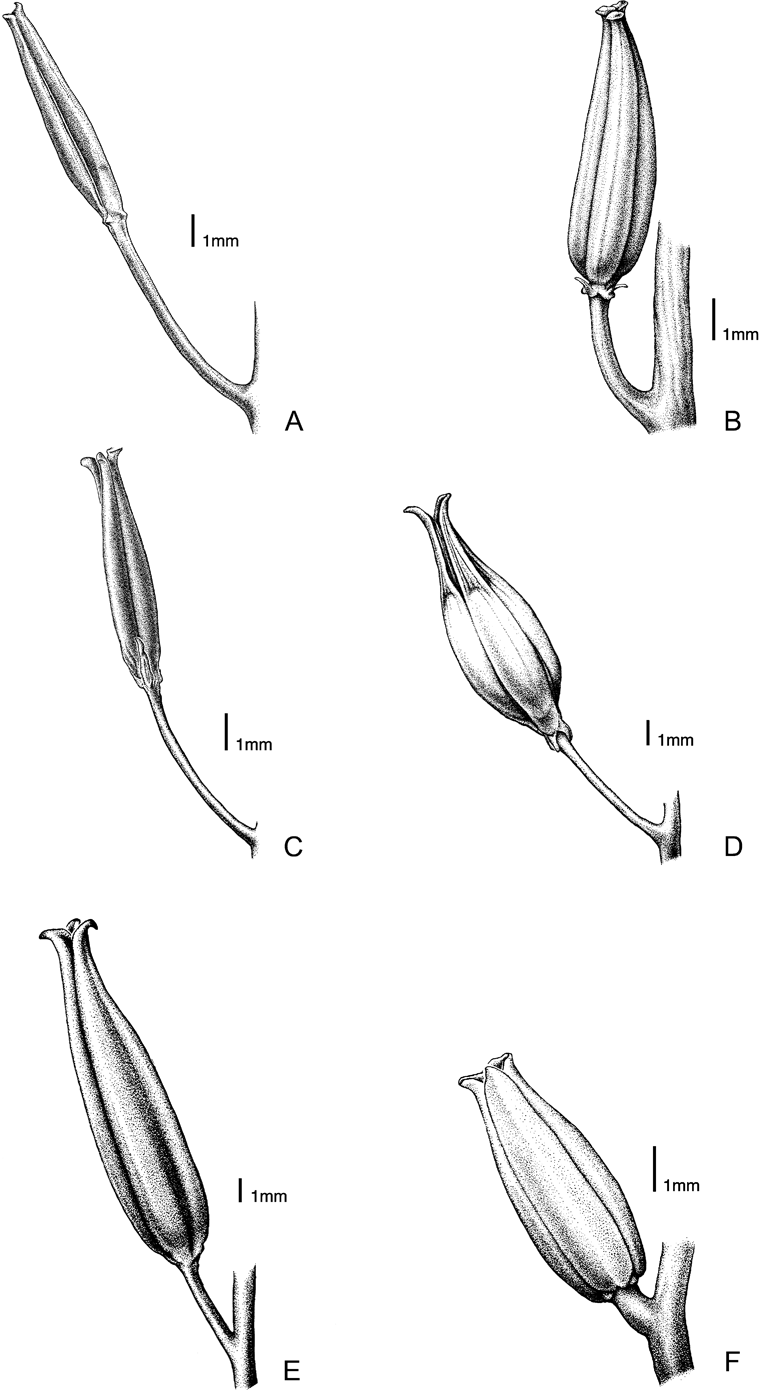
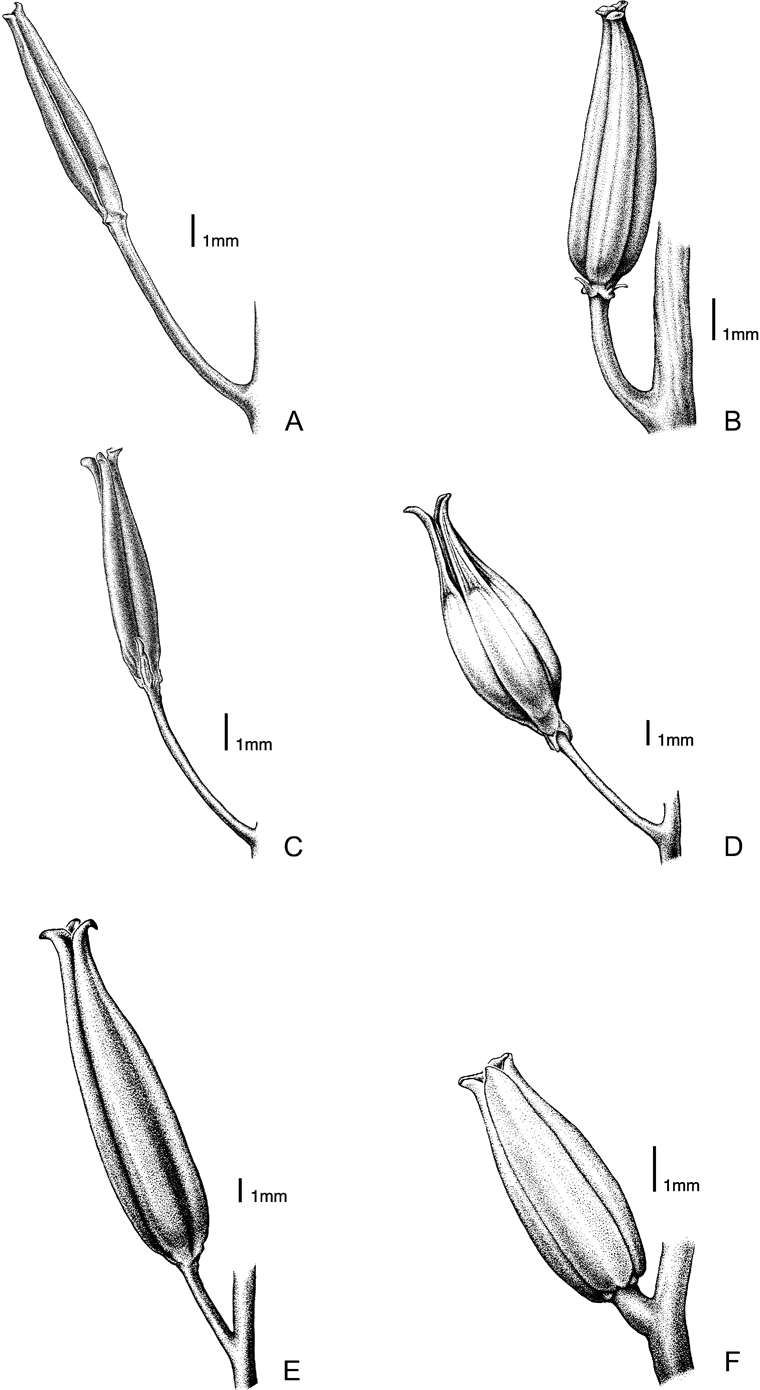
Fruits of A, Triglochin barrelieri Loisel.; B, T. laxiflora Guss.; C, T. compacta Adamson; D, T. milnei Horn; E, T. elongata Buchenau; F, T. buchenaui Köcke, Mering & Kadereit. Drawings by L. Klöckner (Mainz).
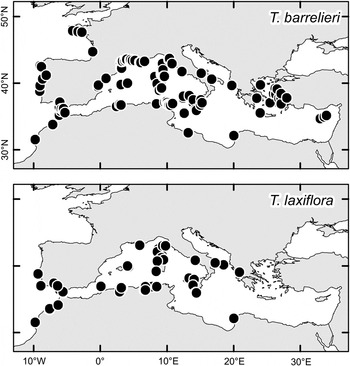
Geographical distribution of Triglochin barrelieri Loisel. and T. laxiflora Guss.

Notes. Some other names have previously been cited as synonyms of this taxon. No type material of Triglochin atlantica Willd. ex Kunth was found in B-W. The short description of Triglochin palustris L. var. β (Sp. Pl. ed. 2, 1: 483, 1762) matches that of T. barrelieri. The description, distribution and flowering time of Juncago chabraei Bubani (Fl. Pyren. (Bubani) 4: 8, 1901) suggest that this name is an additional synonym. However, we could not fully verify the identity of these names because we have not seen any type material. The name Triglochin bulbosa var. genuina Maire, Jahandiez & Maire (Cat. Maroc 859, 1934) implies that the authors considered it to be the type variety.
Plants 10–45 cm high, with fusiform bulbs; bulbs covered in dry, brown, stiff, sometimes spiky fibres, these up to 4 cm long. Plants without rhizomes. Leaves usually many, present at flowering time, mostly as long as or longer than plant height, uniform. Inflorescences rather dense, with 10–25(–30) flowers. Flowers (2.5–)3–4.5 mm long. Pedicels elongated at fruit maturity, up to 2–7 mm long, rarely longer, spreading at angles of 45–90° from the inflorescence axis, slightly curved inwards towards the apex. Infructescences 8–16 cm long. Fruits narrowly ovoid, 5–10 mm long, rarely longer, 1–2 mm wide (Fig. 2A), sometimes turning dark or black at fruit maturity. Mericarps linear, connate at the carpophore; tips only slightly curved outwards.
Distribution. The species is widely distributed in the Mediterranean region (with a noteworthy gap in Egypt) reaching the Atlantic coast of NW France and Morocco (Fig. 3). It is known from all large Mediterranean islands.
Habitat and ecology. Triglochin barrelieri is commonly found in coastal wetlands, for example in salt marshes and along lagoons, and less frequently on coastal rocks exposed to salt spray, in depressions in coastal dunes or in cork oak forests (e.g. in Andalusia, Spain). In North Africa it typically occurs in sabkhas (rarely flooded salt marshes of desert coasts). The species usually grows in very open vegetation and is often associated with Sarcocornia fruticosa (L.) A.J.Scott and Juncus acutus L.
Phenology. Flowering in spring (ii–v); leaves present at flowering time.
Chromosome number. 2n = 30 (de Castro & Carvalho Fontes, Reference Castro and Carvalho Fontes1946), 32 (Dahlgren et al., Reference Dahlgren, Karlsson and Lassen1971; Bartolo et al., Reference Bartolo, Brullo, Majorana and Pavone1977), 36 (Castro et al., Reference Castro, Fraga, Torres and Rosselló2007).
Notes. This species is very variable in overall size and fruit and pedicel length. Triglochin barrelieri var. maura has been described from Morocco as a taxon of larger size and with longer pedicels. However, such large forms are also found in other parts of the species’ distribution range and are not limited to Morocco. The presence of Triglochin barrelieri in Israel seems possible because the description of T. palustris for this area by Post (Reference Post1933) partly matches T. barrelieri. We have, however, not seen any material of the species from Israel, where it may be extinct.
Taxonomic remarks. Triglochin barrelieri is clearly distinct from the only other Mediterranean species of the complex, T. laxiflora, by its spring flowering (vs. autumn), the presence of leaves at flowering time (vs. leaf formation after flowering), and by having spreading pedicels (vs. appressed to infructescence axis).
The distinction between Triglochin barrelieri and T. bulbosa subsp. bulbosa is difficult, and these two species are morphologically very similar to each other. They can be distinguished by their distribution and ecology, and results of our molecular studies (von Mering, Köcke & Kadereit, unpubl. data) support their recognition as separate species because they are not even each other’s closest relative.
Nomenclatural notes. In the protologue of Triglochin barrelieri the following localities are given: ‘Habitat in maritimis Neutstriae, Occitaniae, Provinciae; ad ripas Rhodani prope Arelatem collegit D. ARTAUD’ (Loiseleur-Deslongchamps, Reference Loiseleur-Deslongchamps1807). The herbarium of Loiseleur-Deslongchamps in Avignon (AV) contains several specimens bearing the name Triglochin barrelieri. Only the specimen cited above corresponds to the protologue (location and collector), was annotated by Loiseleur-Deslongchamps himself (P. Moulet, pers. comm.) and thus probably represents the holotype.
Proposed IUCN conservation status. Least Concern (LC). The species used to be widely distributed in the Mediterranean region and is probably not under immediate threat. However, coastal wetlands (where the species is typically found) are among the most vulnerable habitats in the Mediterranean region. Large areas have already been lost or degraded or are under severe threat due to drainage, construction, urbanisation and tourism (e.g. Finlayson & Moser, Reference Finlayson and Moser1991; MedWet, 1996). Only few data are available on the current area of occupancy due to the very low number of recent collections. Several collecting localities of older specimens have been destroyed by settlements. Other populations might also be destroyed or threatened by habitat destruction. Therefore, the area of occupancy might be declining, and the global conservation status of this species may be prone to change. Further conservation assessments are also necessary at the national level. Triglochin barrelieri is already protected in Aquitaine, France (Muséum National d’Histoire Naturelle, 2003–2006) and in the Italian regions of Molise, Basilicata, Calabria and Sicily (Conti et al., Reference Conti, Manzi and Pedrotti1997).
Selected specimens examined. Europe. France. Aquitaine. Gironde: Bordeaux, Bassin d’Arcachon, vi 1831, Endress s.n. (B, BM, HBG, JE, M, P). Bretagne. Finistère: Loctudy and Combrit, sine dato, Bonnemaison s.n. (AV). Morbihan: Gâvres, 15 vii 1847, Debrez s.n. (ZT); Gâvres, 1847, Pontarlier s.n. (P); Gâvres, 1847, Taslé s.n. (P); Gâvres, 3 vi 1851/4 vii 1847, Toussaints s.n. (P); Port-Louis, vi 1847, Pontarlier s.n. (ZT), 1849, Grenier s.n. (ZT); Port-Louis, 30 vi 1877, Lloyd s.n. (BM); Port-Louis, 1891, Renou s.n. (P); Port-Louis, 27 v 1912, Charrier s.n. (BM). Corsica. Haute-Corse: Ghisonaccia, 30 v 1900, Rotgès 339 (P); Saint-Florent, river l’Aliso, 20 v 1973, Auquier 3037, Baguette & Lambinon (M). Corse-du-Sud: Bonifacio, 29 iii 1849, Kralik 787 (P); Porto-Vecchio, 19 iv 1868, Mabille s.n. (BM, K, P); Bonifacio, Santa-Manza, 12 iv 1876, Revelière s.n. (BM); Bonifacio, 12 v 1880, Reverchon s.n. (BM); Bonifacio, Santa-Manza, 12 v 1880, Reverchon 246 (JE, P); Bonifacio, Santa-Manza, 2 vi 1894, Stefani s.n. (P); Bonifacio, Piantarella, 5 iv 1895, Stefani s.n. (BC-SENNEN, P), 9 iv 1895, Stefani s.n. (M, ZT); Porto-Vecchio, iv 1911, Stefani s.n. (P); iv 1912, Roux s.n. (P); Porto-Vecchio, E side of Stabiacco estuary, 13 iv 1939, Brenan C.408 (K). Languedoc-Roussillon. Aude: Leucate, 30 v 1887, Chevallier s.n. (M); La Nouvelle, iv 1899, Sennen s.n. (BC-SENNEN); La Nouvelle, 10 vi 1904, Sennen s.n. (P). Hérault: Maguelonne, 1 vi 1821, Cufino s.n. (HBG, RO); Sète (formerly Cette): 1834, Gath s.n. (BM), 3 v 1882, Neyra s.n. (JE), 4 v 1882, Neyra s.n. (B, JE, RO), 9 v 1891, Dirmède s.n. (K), v 1905, Bee s.n. (P); Roquehaute, near Béziers, v 1855, Personnat s.n. (P); Montpellier, v 1857, Cramer s.n. (HBG); Maguelonne, 13 vi 1857, Cosson s.n. (P); Palavas, 27 v 1899, Morot s.n. (P); Palavas, 20 v 1908, Vichet s.n. (P); Lattes, Montpellier, 23 iv 1914, Sudi s.n. (ZT); E of Palavas, 10 v 1914, Noaik s.n. (Z); Pérols, 1 vi 1915, Braun s.n. (ZT); St. Marcel, Pérols, 1 vi 1915, Braun-Chur s.n. (Z); Montpellier, v 1921, Jenny s.n. (ZT); Etang de Pérols, Palavas, 12 v 1934, Zobrist s.n. (ZT). Pyrénées-Orientales: Vendres, 28 iv 1891, Sennen s.n. (M), 7 vii 1891, Sennen s.n. (BC-SENNEN). Provence-Alpes-Côte d’Azur. Bouches-du-Rhône: Étang de Marignane, 7 vi 1894, Rouy & Blaise s.n. (P); Saint-Louis-du-Rhône, v 1906, Thiébaut s.n. (P, ZT); without locality, v 1909, Thiebaut s.n. (M); Les Saintes-Maries-de-la-Mer, 12 iv 1957, H. & E. Walter 68 (B); Ile des Rièges, 24 iv 1967, Lüpnitz F 233, F 234, F 235 (MJG); Etang de Vaccarés, 11 iv 1969, Hecker F 320 (MJG). Var: Hyères, v 1839, Kugel s.n. (BM, M); Toulon, Les Sablettes, 16 v 1848, Bourgeau 361 (M, P); Hyères, 1853, Jordan s.n. (HBG); Hyères, v 1863, Huet & Jacquin s.n. (B); Hyères, 29 iv 1869, Shuttleworth s.n. (P); Toulon, Les Sablettes, 9 v 1870, Antheman s.n. (B); Hyères, iv 1873, Allard s.n. (P, Z); Toulon, 23 vi 1887, Chevalier s.n. (P); Hyères, 14 iv 1898, Mouillefarine s.n. (P); Hyères, 30 iv 1903, Raine s.n. (P); Saint Tropez, Les Salins, iii 1910, A. & E.G. Camus s.n. (P), iv 1910, A. & E.G. Camus s.n. (P), 22 iii 1911, A. & E.G. Camus s.n. (P); Hyères, 25 iii 1913, Beger s.n. (B); Hyères, 25 iii 1913, Noaik s.n. (Z); Hyères, 3 iv 1913, Thompson s.n. (BM); Saint Tropez, Les Salins, 31 iii 1919, Hibon s.n. (P); Hyères, Ceinturon, 14 iv 1925, Ruppert s.n. (M); Hyères, La Londe, river Pansard, 30 iv 1929, Ruppert s.n. (M); Saint Tropez, Les Salins, 5 iv 1931, Paul s.n. (M); Hyères, 30 iii 1932, Oberneder & Oberneder 457 (BM); Hyères, 5 iv 1955, Schumacher s.n. (HBG).
Italy. Apulia. Brindisi: Saline di Punta della Contessa, 23 v 2007, di Pietro & Wagensommer s.n. (MJG), 9 iv 2008, di Pietro s.n. (MJG). Foggia: Monte Gargano, Manfredonia, iv 1876, Comes, Freda, Pedicion s.n. (RO); Mte. Gargano, mouth of river Cervaro, 14 km S of Manfredonia, road to Bari, 20 iv 1964, Dietrich s.n. (M), Hertel 3575 (M), Podlech 9554 (MSB); between Sciale Borgia and the mouth of river Cervaro, 12–14 km S of Manfredonia, 22 v 1972, Hein s.n. (B). Taranto: Taranto-Ginosa, 18 iv 1879, Pasquale s.n. (RO). Lazio. Rome: Ostia, near Rome, v 1925, Meebold s.n. (K). Sardinia. Cagliari: Cagliari, vi 1854, Huet du Pavillon s.n. (P); Cagliari, La Madeleine, 3 iv 1958, Titden 128 (K); Cagliari, near Maddalena, 6 iv 1858, Schweinfurth s.n. (HBG); Quartu Sant Elena, Stagno di Simbirizzi, c.20 m, 18 iv 1975, Urmi s.n. (Z); Domus de Maria, SW of Stagnioni de su Sali, 4 iv 1992, Stud. biol. Acad. Turic. in itinere 92-12 (Z). Olbia-Tempio: Terranova, 11 iii 1885, Forsyth Major s.n. (HBG); Golfo Aranci, 1 iv 1909, Poeverlein 25009 (B); near Olbia, 8 iv 1962, Podlech 7872 (MSB); Porto di Cugnana, iv 1966, Merxmüller 20931 & Oberwinkler, Merxmüller 20932 & Oberwinkler (M); 3 km S of Palau, 19 iv 1973, Humphries & Richardson 378 (RNG). Oristano: Oristano, prope locum dictum Torre Grande, 19 iii 1912, Fiori s.n. (BC, BM, RO, Z). Sassari: Stintino Peninsula, Capo Falcone, 3 iv 1968, Hecker I 27, I 28 (MJG); Capo Falcone, c.10 m, 13 iv 1971, Hecker I 500 (Hec.691) (MJG); Capo Falcone, 0–15 m, 9 iv 1973, Humphries & Richardson 167 (BM); Capo Falcone, 4 x 2006, von Mering s.n. (MJG). Sicily. Agrigento: Licata, iv 1902, Ross 376 (B, HBG, M, ZT); Isola di Lampedusa, 10 iii 1907, Martarana s.n. (RO). Caltanisetta: San Cataldo, 1847, Rabenhorst s.n. (BM); San Cataldo, 26 v 1875, Porta & Rigo 299 (JE, P). Catania: Catania, 26 iii 1856, E. & A. Huet du Pavillon s.n. (BM, M, P). Siracusa: Siracusa, 26 iv 1898, Rigo 161 (HBG, M, P); near Siracusa, iv 1898, Rigo s.n. (B, BM, M, P, Z, ZT); Pachino, 31 iii 1952, Harries & Doppelbaur 343 (M); near Siracusa, iii 2005, Uhink s.n. (MJG). Trapani: Marsala, v (sine anno), Todaro s.n. (BM, RO); Trapani, 9 iv 1966, H. & H. Doppelbaur 14565 (M). Tuscany. Grosseto: Follonica, 27 v 1911, Fiori s.n. (BC-SENNEN). Livorno: Livorno, Paduletta, 19 v 1861, Savi s.n. (B, P). Pisa: near Pisa, 1868, van Heurck s.n. (BC).
Spain. Andalusia. Cádiz: Bonanza, 17 iv 1951, Alston 10267 (BM); entre San Fernando y Chiclana, 28 v 1951, de Bolos s.n. (BC); between Tarifa and Puerto Real, 8 iv 1953, Merxmüller & Wiedmann 648/53 (M); near Los Barrios, c.150 m, 14 v 1967, Brinton-Lee 1306 (BM); Tarifa, Rio de la Jara, iii 1973, Deil s.n. (FB); Tarifa, 19 iv 1974, Carr 1636 (RNG); Puerto de Santa María, 13 iv 1978, Luque & Valdés s.n. (B, BC, HBG, M, RNG); entre San Fernando y Chiclana, 4 v 1979, Cabezudo, Gallego & Talavera s.n. (RNG); Tarifa, mouth of Rio Jara, 20 vi 1990, Deil 5967 (FB); Tarifa, Zahara de los Atunes, 16 v 1992, Deil 6329 (FB). Sevilla: Isla Menor, Rio Guadalquivir, 17 iv 1972, Heywood, Moore, Bramwell et al. 218 (RNG). Balearic Islands. Mallorca: near Porrata, 5 iv 1921, Welti-Hug s.n. (Z); SE of Albufera, v 1985, Beckett s.n. (RNG). Catalonia. Girona: Castelló d’Empúries, 27 iv 1908, Sennen 613 (BM); Castelló d’Empúries, vii 1916, Pascual s.n. (BC-SENNEN); Rosas, v 1943, Bolos s.n. (BC); Aiguamolls de Castelló d’Empúries, 14 v 1983, Blanché & Vallès s.n. (M). Tarragona: Delta de l’Ebre, Sant Carles de La Ràpita, 2 iv 1934, Font Quer s.n. (BC); Alfaques peninsula, near Sant Carles de la Ràpita, 2 iv 1934, Koch 34/50 (ZT); Delta de l’Ebre, Sales, 16 ii 1975, Balada s.n. (BC). Galicia. A Coruña: Olveira, 24 iv 1981, Amich, Rico, Sánchez & Giraldez s.n. (BC); Olveira, Santa Uxía de Ribeira, 4 v 1985, Valdés-Bermejo 10148 & Grupo Botanico Gallego (BC, M, Z). Valencian Community. Valencia: Valencia, iv 1892, Reverchon s.n. (M); Sagunt(o) (French: Sagonte), iv 1893, Reverchon 834 (B, BM, HBG, M, P, Z).
Portugal. Aveiro: Aveiro, Mina, 20 v 1954, J. Matos, A. Matos & Marques 4752 (P); Ílhavo, Gafanha da Boavista, 20 v 1954, J. Matos, A. Matos & Marques 4768 (P); Ílhavo, between Forte da Barra and Ponte Nova (Costa Nova), 30 v 1979, Marques 1260 (B). Coimbra: Figueira da Foz, Gala, 11 v 1950, J. Matos & A. Matos s.n. (BM). Faro (Algarve): between Vila Real de San António and Castro Marim, 22 iv 1956, Malato-Beliz et al. 2890 (RO); Martinhal near Sagres, 1 iv 1971, Davis 50919 (RNG); Alvor, iii 1990, Univ. of Oxford Plant Sciences undergraduate field course (RNG). Leiria: S of Nazaré, 7 iv 1961, C. & J. Poelt 207, 227 (M). Lissabon: Sacavém, 31 iii 1943, Carvalho Fontés 8909 (BC). Porto: Porto, Boucas, Mattosinhos, v 1895, Sampaio s.n. (M, P). Sétubal: Bank of river Tejo (‘ad Tagum’), Coina, iv 1840, Welwitsch 237 (P); ‘ad Tagum’, 1848–1850, Welwitsch 993 (BM); Transtagana (SE Portugal, later Prov. Alemtejo), near Fornos d’El Rei, vi 1851, Welwitsch 333 (P); Trafaria, iii 1888, Daveau 348 (P).
Cyprus. Famagusta: near Paralimni village, 10 iv 1953, Kennedy 1782 (D 3755) (K). Limassol: Akrotiri, W side of Limassol salt lake, 15 iv 1992, Lambinon 92/Cy/359 & van den Sande (MSB).
Gibraltar. Palmones, 7 ii 1913, Wolley-Dod 1573 (K), 11 iii 1922, Wolley-Dod 349 (BM).
Croatia. Zadar. Pag (island), near Vlasici, 13 v 2005, Bernhardt s.n. (WHB). Šibenik-Knin. Near Sibenik, 8 vi 2006, Bernhardt & Hermanowski s.n. (WHB).
Greece. Attica. Athens: near Athens, 1820, Sartori s.n. (M); Faliro (also Faliron/Phaliron, latin Phalerum), iv 1849, Orphanides s.n. (P); Eleusine, 19 iii 1876, Heldreich s.n. (HBG); v 1876, Pichler s.n. (P); Faliro, iv 1886, Heldreich s.n. (B), 8 iv 1897, Heldreich s.n. (Z); Athens, Loutsa, 15 ii 1931, Guiol 1714 (BM). Central Greece. Euboea: Evvia: ep. Karistias, W of Karistos, 0–10 m, 4 v 1996, S. & B. Snogerup 12651 (B). Crete. Chania: near Suda (also Souda), iii 1846, Heldreich s.n. (BM, P); location illegible, iii 1846, Heldreich s.n. (BM, K, P). Ionian Islands. Corfu: Kastrades, am Hylläischen Hafen, 3 m, 22 iv 1896, Baenitz s.n. (B, HBG, M, P, ZT); Potami, 21 v 1887, name illegible (ZT); Alikes, iv 1980, Bowen 1897 (RNG). North Aegean. Chios: c.1930, Guiol s.n. (BM). Samos: Tigani, 2 iv 1934, K.H. & F. Rechinger 3642 (BM, K). Peloponnese. Argolis: Argolis, Ep. Ermionidhos, 3.3 km ENE Portoheli, 0–5 m, 14 iv 1996, Eisenblätter & Willing 43.814, 43.815 (B). Laconia: Ep. Epidhavros Limiras, opposite island Elafonisos, 10 iv 1979, Greuter & Merxmüller 17076 (B, M, P); mouth of river Evrotas, near Elos, iv 1979, Bowen 1307 (RNG); Vinglafia, opposite Elafonisos, 21 ii 1991, Jagel s.n. (B). Messenia: Ep. Pilia: Voidhokoilia Bay between Petrohori and Paleokastro Navarinou, 0–5 m, 17 iv 1979, Greuter & Merxmüller 17215 (B, M); Methoni, iv 1981, Bowen 2051 (RNG). South Aegean. Cyclades: Naxos, Chora, 15 v 1992, Böhling 1491 (B); Naxos, Alluvai, 17 iv 1993, Böhling 2312 (B). Dodecanese: Kos, N coast, near Marmari, 0–3 m, 12 iv 1974, Buttler 18237 (M). West Greece. Achaea: near Kalogria SW of Patras, 25 iv 1991, Raabe s.n. (B); Ahaia, near Kalogria, 33 km W of Patra, 2 v 1995, Turland 849 (BM); Loutra Kounoupelli, road to Kalogria/Metohi, 7 v 1996, Raabe s.n. (B). Ilia: between Brinia and Manolada (Ilia), 17 v 1996, Raabe s.n. (B).
Turkey. Izmir. Smyrna (= Izmir), 29 iii 1854, Balansa s.n. (P, ZT); Smyrna, near Halcar-Bunar (Halkar Bunar), 12 v 1906, Bornmüller 10018 (B, BM, HBG, JE, P, ZT); Cesme Peninsula, end of Gülbahce Bay, 25 ii 1966, Bocquet 1133 (ZT); between Karsyaka and Izmir near Bairakli, 5 iv 1966, Bocquet 1887 (ZT).
North Africa. Algeria. Algiers. Algiers, Marais ou Baba Alg., iv 1850, Jamin s.n. (P); Marais de la Meteija, iv 1851, Jamin s.n. (P); Algiers, Maison-Carrée, iii 1856, Wolfe s.n. (K); Salines d’Argess, 6 v 1875, Cosson s.n. (P); Algiers, Maison-Carrée, 8 iv 1894, Chevalier s.n. (P); Algiers, marais de la Raasaura près Fort-de-l’Eau, 28 ii – 10 iv 1960, d’Alleizette s.n. (M); near Garaetz el Mkhada, 23 iii 1968, Leippert 7107 (B). Annaba. Annaba: Bône (= Annaba), 1834, Steinheil s.n. (P); Annaba, near Boudjima, 28 iii 1884, Letourneux s.n. (P). El Taref. El Kala: La Calle (= El Kala), 11 v 1841, Durieu de Maisonneure s.n. (P); La Calle, 18 v 1918, Clavé s.n. (P); La Calle, 5–10 m, 11 v 1971, Davis 52174 (BM, RNG).
Libya. Cyrenaica. Benghazi: Benghazi, 9 iv 1883, Ruhmer 315 (HBG, JE, P); Benghazi, 1884, Petrovich s.n. (Z); Tadjoura, near Tripoli, 8 iv 1886, Letourneux s.n. (P); Cyrenaica, without locality, 13 v 1887, Taubert 87 (P); road between Benghazi and Tocra, 19 iii 1929, Rikli s.n. (ZT); Barsis (also Bersis), 11 iii 1958, Guichard CYR/96/58 (BM); 4–5 km N of Benghazi, 3 iv 1970, Davis 50488 (K, RNG). Al Jabal al Akhdar: El-Hania, Sebka Chascem el-Chelb, 8 Mag.(v) 1934, Pampanini & Pichi-Sermolli 165 (K). Tripolitania. Tarabulus: Tripoli, Mlacha, 22 iii 1887, Taubert 87 (JE); near Tripoli, 29 iii 1938, Kracht 38/001, 38/002 (B); El Magazin, near Bezenicem, 20 iv 1938, Maire & Weiller 1461 (P).
Morocco. Chaouia-Ouardigha. Ben Slimane: Bouznika, 60 m, 23 iv 1979, Lewalle 9020 (P); Oulad Amara, N de Bouznika, 40 km SW of Rabat, 23 iv 1979, Damblon 79/63 (B, RNG). Tangier-Tétouan. Larache: Larache, bridge over river Loukkos, 17 iii 1995, 3 m, Mateos, Reina, Sangalli, Sardón & Valdés 4824/95 (RNG); Larache, 15 v 2003, Deil & Hamman 5 (FB). Tangier-Assilah: Tanger, Cap Spartel, 20 iv 1911, Pitard s.n. (P); Tanger, Cap Spartel, 10 m, 30 iv 1986, Deil 1321 (FB); Tahaddart, Sansouire, 17 v 2003, Deil & Hamman 34 (FB). Tétouan: Oued Laou, c.km E of Tetouan on road to Martil, 25 m, 25 ii 1994, Jury 13327 & Taleb, Upson, Walters (RNG).
Tunisia. Ben Arous. Hammam-el-Lif, 8 v 1883, Cosson, Letourneux, Reboud, Barratte & Bonnel s.n. (P); Hammam-el-Lif, 20 v 1888, Barratte s.n. (P); Hammam-el-Lif, 6 v 1893, Chevalier s.n. (P). Bizerte. Ruins Utique, 21 vi 1887, Letourneux s.n. (P); between Dindja and lake Ichkeul, 23 vi 1887, Letourneux s.n. (P); between Djebel Ichkeul and Mateur, 26 vi 1887, Letourneux s.n. (P); Utique, 4 v 1888, Barratte s.n. (P); Menzel, Djemil, 11 v 1888, Barratte s.n. (P); Menzel, Djemil, 2 vi 1888, Cosson, Barratte & Duval s.n. (P); near Protville, between Tunis and Bizerta, 16 iv 1938, Simpson 38298 (BM); Carthage–Tunis road, 28 iv 1939, Sandwith 2845 & Simpson 39779 (BM). Nabeul. Cap Bon, between Kurba and Menzel, Temim, v 1883, Cosson, Letourneux, Reboud, Barratte & Bonnel s.n. (P); c.7 km SW of Hammamet, 14 iv 1968, Wagenitz 1177 (B); Kelibia, E side of Cap Bon peninsula, 28 iv 1975, Davis 56931 & Lamond (BM, RNG). Sousse. Zaouiet-el-Mgaiz, 18 v 1883, Cosson, Letourneux, Reboud, Barratte & Bonnel s.n. (P). Tunis. Tunis, 4 iii 1874, Doûmet-Adanson s.n. (P); Tunis, Goletta, 9 iii 1880, Armitage s.n. (RO); Tunis, La Goulette, 2 v 1883, Cosson, Letourneux, Reboud, Barratte, Bonnel s.n. (P); Tunis, La Goulette, 19 v 1888, Barratte s.n. (P); Tunis, 12 iv 1971, Bolay & Kramer s.n. (B); Djebel Djeloud, iv 1909, Pitard s.n. (ZT).
2. Triglochin laxiflora Guss., Index Seminum Horto Boccad. 1825: s.p. (1825); Fl. Sic. Prod. 1: 451 (1827). – Triglochin bulbosa subsp. laxiflora (Guss.) Rouy, Fl. France (Rouy) 13: 272 (1912). – Type: Italy, Sicily, Palermo, ‘Palermo a Monte Peregrino’ [= Monte Pellegrino], Gussone s.n. (lecto NAP photo!, designated here). Figs 2B,3.
Triglochin palustre Desf., Fl. Atlant. 1: 322 (1798), non L. (nom. illeg.).
Plants 10–25(–35) cm high, with fusiform bulbs; bulbs covered in dry, brown fibres which are usually stiff, sometimes soft or spiky; fibres up to 5 cm long. Plants without rhizomes. Leaves few (mostly 2–4 per bulb), formed after flowering, usually much shorter than plant height (mostly reaching only half the height of plants). Outer leaves shorter and wider than inner leaves, up to 6 cm long, mucronate, inner leaves abruptly narrowing above the ligule, less than 1.5 mm wide. Inflorescences lax, with 4–15(–25) flowers. Flowers 2–3 mm long. Pedicels 2–3 mm long, rarely longer, usually much shorter than fruit, ascending, ± appressed to infructescence axis, diverging from it at angles of up to 45°, slightly curved inwards towards the apex. Infructescences 3–10 cm long. Fruits narrowly ovoid, 5–10 mm long, rarely longer, 1–2 mm wide (Fig. 2B). Mericarps linear, connate at the carpophore; tips curved outwards.
Distribution. Widely distributed in the Mediterranean region, largely sympatric with Triglochin barrelieri but absent from the Atlantic coast of France and from parts of the eastern Mediterranean (Fig. 3).
Habitat and ecology. This species is typically found in salt marshes and along lagoons, but also in cork oak or pine forests (e.g. Morocco, Andalusia) and in Mediterranean temporal pools (e.g. Corsica, Malta). Triglochin laxiflora is sometimes found in limestone areas (e.g. Malta, Sicily). Growing from 0 to 500 m (e.g. Monte Pellegrino, Sicily), in Algeria reaching c.1100 m (e.g. Djebel Ouach).
Phenology. The species flowers and fruits in autumn (ix–xii) and leaves are formed after flowering.
Chromosome number. 2n = 18 (Gardé & Malheiros-Gardé, Reference Gardé and Malheiros-Gardé1953; Bartolo et al., Reference Bartolo, Brullo, Majorana and Pavone1977; Talavera et al., Reference Talavera, Ortiz, Arista and Bastida1995; Castro et al., Reference Castro, Fraga, Torres and Rosselló2007).
Notes. The distributional gaps in many parts of the eastern Mediterranean might be a collecting artefact resulting from the autumnal flowering time of the species. Dandy (Reference Dandy, Tutin, Heywood, Burges, Moore, Valentine, Walters and Webb1980) indicated Albania, Crete, Greece and ex-Yugoslavia as part of the distribution area in the eastern Mediterranean. Triglochin laxiflora is not known from Turkey (Uotila, Reference Uotila and Davis1984).
Although reported from South Africa by some authors (Bennett, Reference Bennett and Thiselton-Dyer1897; Buchenau, Reference Buchenau and Engler1903), these records are due to misidentification and refer, at least in part, to Triglochin elongata or T. compacta. Triglochin laxiflora does not occur there and has to be excluded from the South African flora (Adamson, Reference Adamson1939; Horn af Rantzien, Reference Horn af Rantzien1961).
Taxonomic remarks. See Triglochin barrelieri for a short comparison with the only other Mediterranean species of the complex.
Nomenclatural notes. In the protologue of Triglochin laxiflora Gussone (Reference Gussone1825) does not cite any specimens or localities, but in his Florae Siculae Prodromus (Gussone, Reference Gussone1827) the following localities are given: ‘Palermo a Monte Peregrino a Monte Castellana sotto Baida Mondello Sferracavallo, Catania, Agosta, Siracusa’. Several Triglochin specimens from Gussone’s collections in the Herbarium Neapolitanum (NAP) were studied. Four specimens of Triglochin laxiflora are labelled with localities that were cited in Gussone (Reference Gussone1827). The specimen from the Monte Pellegrino in Palermo is here chosen as the lectotype because it contains several fruiting and some flowering plants in good condition.
Variation. One herbarium sheet (BC 76587) is a plant grown from bulbs in the Botanic Garden of Barcelona. This specimen has exceptionally large fruits which are 10–12 mm long.
Proposed IUCN conservation status. Least Concern (LC). The species used to be widely distributed in the Mediterranean region and probably is not under immediate threat. However, the habitat degradation problems described for Triglochin barrelieri also apply here. Mediterranean temporary pools have also been destroyed in considerable numbers by human activities (e.g. Grillas et al., Reference Grillas, Gauthier, Yavercovski and Perennou2004; Ruiz, Reference Ruiz2008). Only few data are available on the current area of occupancy. In contrast to the many collections of the species from the 19th century only a small number of recently collected specimens has been seen. Several collecting localities of older specimens have been destroyed by settlements. Other populations might also be destroyed or threatened by habitat destruction. This might imply that the species has become rare, and the global conservation status of this species may be prone to change. Further conservation assessments are also necessary at the national level. Triglochin laxiflora is a protected species in France (Muséum National d’Histoire Naturelle, 2003–2006) and in Lazio and Sicily, Italy (Conti et al., Reference Conti, Manzi and Pedrotti1997).
Specimens examined. Europe. France. Corsica. Corse-du-Sud: Bonifacio, 11 x 1856, Revelière 494 (BM, P); Porto-Vecchio, 16 x 1858, Revelière s.n. (P); Ajaccio, 20 ix 1868, Mabille s.n. (JE, K, P); Bonifacio, 26 x 1880, Reverchon 393 (BM, JE, P); Ajaccio, 1881, Reverchon s.n. (ZT); Bonifacio, x 1885, Reverchon 393 (B); Ajaccio, Parata, 16 x 1888, Le Grand s.n. (P, RO); Bonifacio, 9 x 1901, Stefani s.n. (BM, WTU), 6 x 1903, Stefani s.n. (ZT), 14 x 1910, Stefani s.n. (P); Ajaccio, Parata, 1 x 1916, Forsyth-Major 292 (K); Cargese, x 1923, Wyatt 63 (K); Bonifacio, Tonnara-plage, 3 x 1993, Dutartre s.n. (B, M, MSB, RNG). Haute-Corse: Calvi, golfe de la Revellata, plage de l’Alga, 14 x 1979, Lambinon 79/1043, Bellotte, Dellens & Monfort (BC, MSB, RNG).
Italy. Sardinia. Carbonia-Iglesias: Portoscuso, 9 x 1912, Bonomi s.n. (BM). Olbia-Tempio: Santa Teresa Gallura, Tempio, Bancamino, 20 ix 1881, Reverchon 194 (B, HBG, JE, K, M, RO, ZT); Terrnanova (= Olbia), 2 x 1922, Rikli s.n. (ZT); Terranova, x 1922, Schinz s.n. (ZT); road between Olbia and San Teodoro, km 310, Le Vecchie Saline, close to lagoons (stagno), 6 x 2006, von Mering s.n. (MJG). Sassari: Sassari, ix 1895, Nicotra s.n. (RO), ix 1899, Nicotra s.n. (B, M); Isola di Reulino, 23 x 1988, Bocchieri s.n. (B). Sicily. Agrigent: Licata, x 1911, Ross s.n. (ZT). Palermo: Palermo, Mte. Pellegrino, ix 1855, E. & A. Huet du Pavillon s.n. (BM, P, ZT); Mondello, x 1879, Lojacono s.n. (K, P); Castelbuono, x 1885, Lojacono s.n. (P); Palermo, x 1885, Todaro s.n. (ZT), 1886, Lojacono s.n. (K), x 1892, Todaro s.n. (RO); Palermo, Aquasanta, 19 x 1897, Fisch s.n. (ZT); Palermo, x 1901, Ross 377 (B, BC, HBG, JE, M, ZT); Palermo, Mte. Pellegrino, 300 m, 25 x 1903, Spencer s.n. (M); Palermo, x 1903, Ross s.n. (HBG, M), x 1906, Ross s.n. (BC); Palermo, Mte. Pellegrino, 430 m, 30 x 1935, Lusirne s.n. (RO); Palermo, Mte. Pellegrino, 400 m, 7 ix 1964, Davis 40243 (RNG). Puglia. Taranto: Taranto, Leucaspide, 23 x 1905, Lacaita 4808 (BM), 2 xi 1909, Lacaita 11461 (BM, P). Tuscany. Livorno: Isola di Capraia, 7 i 1898, Bèguinot s.n. (RO).
Malta. Mtahleb, W of Rabat, near coastal cliffs (limestone), c.600 m, 28 x 1974, Westra & Rooden 252 (Z); Mosta, Wied il-Ghasel, 22 xi 2007, Mifsud s.n. (MJG).
Spain. Andalusia. Cádiz: Cádiz, Laguna de la Paja, Chiclana, 20 m, 29 x 1925, Gros s.n. (M, RNG), ix 1929, Font Quer s.n. (RNG); entre Los Barrios y Casas del Castaño, Puerto de la Cebada, 1 xi 1967, Galiano & Valdés 128/67 (RNG); Cádiz, Laguna de la Janda, 3 xi 1978, Galiano, Rivera & Valdés 7097/78 (RNG). Balearic Islands. Menorca. Marina de Benisarmeña y San Antonio, ix/x (sine anno), Tremols s.n. (BC); without locality, 13 x 1865, Rodriguez s.n. (P); near Mahón, 21 x 1872, Rodriguez s.n. (P); near Mahón, 21 x 1872, Rodriguez s.n. (P); S. Antonio, x 1872, Rodriguez s.n. (P).
North Africa. Algeria. Algiers. Algiers, Pointe Pescade, ix (sine anno), Jamin 208 (P); Algiers, Cap Caxine, x 1850, Jamin s.n. (P); Algiers, Cap Caxine, xii 1850, Jamin s.n. (P); Algiers, x 1851, Jamin s.n. (P); Algiers, 1869, Durando s.n. (P); Algiers, La Reghaia, xi 1880, Battandier & Trabut 986 (P, RO); Maison-Carrée, x 1886, Luizet s.n. (P). Annaba. Annaba: La Calle (= El Kala), 17 xi 1840, Durieu de Maisonneure s.n. (P); Bône (= Annaba), 1860, Letourneux s.n. (B, K, P); Annaba, Oued-Fourcha, 25 x 1865, Tribout s.n. (BM, P); Annaba, Saint-Clous, 6 xi 1890, Luitfroy 337 (P); Bône, 29 x 1891, Luitfroy 370 (P); Bône, 1906/1907, Gandoger s.n. (BM). Constantine. Constantine: Constantina, mountain Djebel Ouach, c.1100 m, 10 xi 1868, Paris s.n. (BM, P). Médéa. Berrouaghia: Berrouaghia, road to Médéa, 1100 m, 6 x 1886, Luizet s.n. (P). Mostaganem. Mostaganem: Mostaganem, 14 ix 1848, Barlanez (partly illegible) s.n. (P).
Morocco. Greater Casablanca. Chaouia, Bouskoura, 190 m, x 1932, Gattefossé s.n. (M, P); 20 xii 1936, Gattefossé s.n. (B, JE, K, P). Tangier-Tétouan. Larache: Lukos (= Loukkos), El Araix, 4 xii 1929, Font Quer s.n. (BM). Tangier-Assilah: Tanger, between Cap Spartel and the Airport, 75 m, 30 x 1993, García Murillo, Gibb & Talavera ST 40/93 (RNG).
3. Triglochin bulbosa L., Mant. Pl. 226 (1771). – Type: South Africa, Cape of Good Hope (neo LINN 466.3 photo!, BOL photo!, designated by Obermeyer, Reference Obermeyer, Codd and de Winter1966); Malmesbury Distr., at turn out to Gansekraal, 15 ix 1940, Compton 9451 (epi NBG!, designated here). Figs 4,5.
Triglochin bulbosa β robustior Roem. & Schult., Syst. Veg. ed. 15 bis [Roemer & Schultes], 7(2): 1585 (1830), teste Kunth, Enum. Pl. (Kunth) 3: 144 (1841). – Type not seen.
Triglochin patens Steud., Nomencl. Bot. ed. 2, 2: 709 (1841), nom. illeg. = T. bulbosa L. β robustior (teste Kunth, Enum. Pl. (Kunth) 3: 144, 1841).
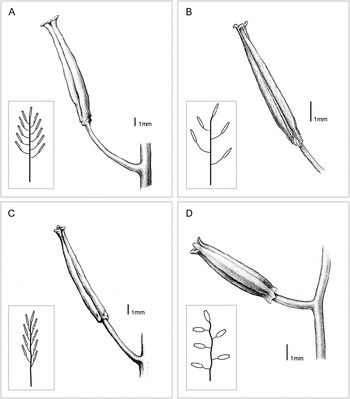
Fruits and infructescence structure of Triglochin bulbosa L. A, T. bulbosa subsp. bulbosa; B, T. bulbosa subsp. tenuifolia (Adamson) Horn; C, T. bulbosa subsp. calcicola Mering, Köcke & Kadereit subsp. nov.; D, T. bulbosa subsp. quarcicola Mering, Köcke & Kadereit subsp. nov. Drawings by L. Klöckner (Mainz).

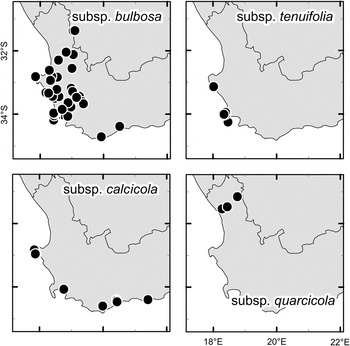
Geographical distribution of Triglochin bulbosa L. subsp. bulbosa, T. bulbosa subsp. tenuifolia (Adamson) Horn, T. bulbosa subsp. calcicola Mering, Köcke & Kadereit subsp. nov., and T. bulbosa subsp. quarcicola Mering, Köcke & Kadereit subsp. nov.

Plants 5–50 cm high, with fusiform bulbs and without rhizomes; bulbs covered in dry, brown or black, soft or stiff fibres, these 0.5–3 cm long. Leaves present when flowering, uniform, as long as or longer than plant height. Inflorescences lax or dense, with 4–50 flowers. Flowers 1.5–3 mm long. Pedicels elongated at fruiting time, 2–10 mm long, diverging at angles of 45° or 45–90° from the infructescence axis, not or only slightly curved inwards towards the apex. Infructescences 2–20 cm long. Fruits narrowly to very narrowly ovoid, 4–10(–12) mm long, 0.5–2 mm wide (Fig. 4), turning dark or black at fruit maturity. Mericarps linear, connate at the carpophore; tips not or only slightly curved outwards.
Distribution. Endemic to South Africa, where it is restricted to the Western Cape Province (mainly on Cape Peninsula, West Coast and in Overberg) and the Hantam region of the Northern Cape Province (Fig. 5).
Habitat and ecology. Variable (see subspecies), ranging from temporary pools to dry (shaded) inland habitats, but never in habitats under direct influence of tidal flooding.
Phenology. Flowering in spring (vii–xi).
Chromosome number. Unknown.
Taxonomic remarks. We characterise Triglochin bulbosa as a bulbous species with narrowly to very narrowly ovoid fruits, the outline of the seeds not visible through the pericarp, and the pedicels spread at an angle of 45–90° from the inflorescence axis. The fruits of Triglochin bulbosa often turn dark or black at maturity, unlike those of the other South African species of the complex. The species differs from Triglochin compacta, which has a similar distribution area, in flowering time (spring vs. late summer/autumn) and the presence of leaves at flowering time (vs. leaf formation after flowering). Additionally, the fruits of Triglochin bulbosa have no basal outgrowths and the outline of the seeds is not visible on the mericarp surface (as in T. compacta).
Adamson (Reference Adamson1939) described Triglochin tenuifolia on the basis of narrow leaves, few-flowered spikes, and its characteristic habitat. However, this species was later reduced to a subspecies of Triglochin bulbosa by Horn af Rantzien (Reference Horn af Rantzien1961). The newly circumscribed Triglochin bulbosa shows substantial variation in width of leaves as well as size and number of flowers and fruits. Several forms are geographically and ecologically well differentiated, but transitions in morphological characters are found. Thus, we recognise four subspecies in Triglochin bulbosa: subsp. bulbosa, subsp. calcicola, subsp. quarcicola and subsp. tenuifolia.
Nomenclatural notes. The neotype (LINN 466.3 photo!) designated by Obermeyer (Reference Obermeyer, Codd and de Winter1966) is ambiguous. Most importantly, its fruits are not mature which makes identification difficult. Additionally no data on locality or collecting date are given. Thus, an additional epitype (Compton 9451, NBG) is designated here which should be used in conjunction with the neotype.
Key to the subspecies
1a. Plants (8–)20–50 cm high, robust; leaves 1–3 mm wide; fruits 1–2 mm wide; widely distributed in the Western Cape and southern regions of the Northern Cape 3A. subsp. bulbosa
1b. Plants 5–25(–35) cm high, delicate; leaves 0.5–1 mm wide; fruits up to 1 mm wide; distributed in the Western Cape 2
2a. Inflorescences lax with 4–15(–25) flowers; pedicels diverging at 45–90° from the inflorescence axis; plants growing on granite soils or in quartz fields 3
2b. Inflorescences dense with (4–)10–30 flowers; pedicels diverging at 45° from the inflorescence axis; plants growing on limestone or aeolinite in coastal regions of the Western Cape 3B. subsp. calcicola
3a. Pedicels diverging at angles of 45–90° from the inflorescence axis; plants growing on granite soils on mountain slopes of the Cape Peninsula and Langebaan Peninsula 3D. subsp. tenuifolia
3b. Pedicels diverging mostly at angles of 90° from the inflorescence axis; plants growing in quartz fields of the Knersvlakte 3C. subsp. quarcicola
Plants (8–)20–50 cm high, with fusiform bulbs; bulbs covered in dry, rather stiff, brown or black fibres, these up to 3 cm long, usually separate, sometimes fused into layers. Leaves as long as or longer than plant height, 1–3 mm wide. Inflorescences dense to lax, with (8–)15–50 flowers. Flowers 1.5–3 mm long, rarely longer. Pedicels 2–10 mm long, diverging at angles of 45–90° from the inflorescence axis, not or only slightly curved inwards towards the apex, but often fruits bent further upwards. Infructescences 6–20 cm long. Fruits narrowly ovoid, 5–10(–12) mm long, 1–2 mm wide (Fig. 4A). Mericarps connate at the carpophore; tips slightly curved outwards.
Distribution. Endemic to South Africa, restricted to the Western Cape Province and southern regions (Hantam) of the Northern Cape Province (Fig. 5).
Habitat and ecology. Found in temporary wetlands, such as edges of vernal pools, in ditches and in other depressions, mainly in vegetation types classified as Cape Vernal Pools and Cape Inland Saltpans, and rarely also Swartland Granite Renosterveld (Mucina & Rutherford, Reference Mucina and Rutherford2006). The habitats are characterised by heavy clayey to lighter clayey-sandy soils, derived from nutrient-rich substrates such as shale, granite or geologically young sandy sediments of marine origin covering coastal lowlands; here it is often found in clay-filled depressions among stabilised sandy dunes. Waterlogging seems to be a major habitat-structuring factor. The taxon was found at altitudes of up to 500 m (Cederberg Mountains), but most localities are limited to altitudes below 100 m a.s.l.
Phenology. Flowering and fruiting in spring (viii–xi).
Notes. One specimen (Wörz 04.10.06.01, PERTH n.v., STU!) which is morphologically very similar to Triglochin bulbosa subsp. bulbosa was collected in 1994 in Australia (Western Australia, Swan-Valley near Perth), where the taxon has become established as a recent introduction (H. Aston, pers. comm.; see notes for T. bulbosa complex).
Taxonomic remarks. Triglochin bulbosa subsp. bulbosa differs from the other subspecies in having wider leaves (1–3 mm vs. < 1 mm wide) and wider fruits (1–2 mm vs. < 1 mm wide). The plants are more robust and often larger than those of the other subspecies.
Proposed IUCN conservation status. Least Concern (LC). The subspecies is widely distributed in the Western Cape Province, with some localities in southern regions of the neighbouring Northern Cape Province. It does not appear to be immediately threatened. However, as seasonal pools (as all lowland wetlands in general) are becoming rare due to cultivation of land and construction work (Mucina & Rutherford, Reference Mucina and Rutherford2006), the conservation status should be reassessed in the near future.
Specimens examined. South Africa. Northern Cape. Nieuwoudtville, Cloudskraal Farm, 7 xi 1962, Barker 9799 (NBG); Nieuwoudtville, 3 miles S of Nieuwoudtville, 7 ix 1963, Nordenstam 3032 (S). Western Cape. Stellenbosch, Hottentotts Holland, sine dato, Zeyher & Ecklon s.n. (P); Paarl, Klein Draakensteen, 10 ix 1827, Drège 8798 (P); Cape Town, Simon’s Bay, Constantia, 1853–1856, Wright s.n. (NY); Cape Town, Raapenburg Vlei, viii 1882, Guthrie 1242 (BOL); Caledon, near village, vii 1892, Guthrie 2526 (NBG); Cape Town, Kenilworth, 1892, Bolus 7926 (BOL); Ceres, Mostertsberg, 1200 ft, x 1894, MacOwan 1991 (BM, NBG-SAM, P, Z); Cape Town, Kenilworth Race Course, 5 ix 1897, Wolley-Dod 2858 (NBG); Cape Town, near Maitland Cemetery, 2 x 1897, Wolley Dod 3221 (BOL); Cape Town, Vaarsche Vley, 17 x 1897, Wolley-Dod 3139 (BOL); Cape Town, Simonstown, Constantia, Bergvliet Farm, 11 ix 1916, Purcell 66 (NBG-SAM); Cape Town, Simonstown, Constantia, Bergvliet Farm, E of lake, 11 ix 1917, Purcell 3 (NBG-SAM); Stellenbosch, behind Boys High School, 8 xi 1918, Garside 1139 (K); Worcester, Goudini Road, x 1921, Michell 2833 (BOL); Clanwilliam, Zeekoe Vlei, 1500 ft, ix 1925, Levyns 1192 (BOL); Cape Town, Somerset West, ix 1931, Schmidt 437 (M); Bredasdorp, between Bredasdorp and Elim, damp places near salt vlei, ix 1933, Levyns 4542 (BOL); Bredasdorp, The Poort, sides of temporary pool, 100 ft, ix 1933, Levyns 4460 (NBG); Stellenbosch, Faure, 9 ix 1934, Garside 4649 (K); Cape Town, Rondebosch Common, 15 vi 1936, Adamson 940 (BOL); Cape Town, Kenilworth Race Course, 6 x 1936, Adamson 1200 (BOL); Tulbagh, Saron Flats, viii 1937, Compton & party 1992/36 (BOL); Clanwilliam, Alpha, 28 vi 1938, Martin NBG 1258/37 (NBG); Olifantsrivier Valley, 11 miles N of Clanwilliam, 2 ix 1938, Salter 7529 (BOL); Napier, 24 viii 1940, Bond 470 (NBG); Darling, 15 ix 1940, Esterhuysen 3864 (BOL); [Yzerfontein], at turn out to Gansekraal, 15 ix 1940, Compton 9451 (epi NBG); Piketberg, Berg River, 21 ix 1940, Compton 9474 (NBG); Clanwilliam, Pakhuis, 29 ix 1940, Compton 9553 (NBG); Clanwilliam, Pakhuis, x 1940, Esterhuysen 3170 (BOL); Cape Town, Hout Bay, 4 ix 1941, Compton 11294 (NBG); Malmesbury Distr., Mamre Hills, 7 ix 1941, Compton 11608 (NBG); Strand, 8 viii 1942, Parker 3708 (BOL, NBG); Cape Town, Milnerton, 31 viii 1942, Compton 13424 (NBG); Cape Town, Firgrove, 3 ix 1942, Compton 13458 (BOL); Malmesbury Distr., Mamre Hills, 12 ix 1942, Barker 1596 (NBG); Stellenbosch, Stellenbosch Vlakte, 8 iv 1943, Jordaan 18 (NBG); Malmesbury Distr., foot of Mamre Hills, 22 ix 1943, Henderson 1858 (NBG); Malmesbury Distr., Kalabas Kraal, 28 ix 1943, Barker 3546 (NBG); Piketberg, Papkuils Vlei, 30 ix 1943, Leighton 119 (BOL); Piketberg, Sout Kloof, between Sauer and Berg River, 1 x 1943, Compton 15122 (NBG); Piketberg, Zoutkloof, 1 x 1943, Leighton 397 (BOL); Bredasdorp, The Poort, 2 xi 1943, Barker 2491 (NBG); Cape Town, Melkbosch Road, swamp, 31 viii 1944, Compton 15865 (NBG); Stellenbosch, Faure, swamp, 16 xi 1944, Compton 15984 (NBG); Citrusdal, 1 ix 1945, Leighton 1389 (BOL); Ceres, Cold Bokkeveld, near Elandskloof, 9 ix 1945, Leighton 1270 (BOL); Ysterfontein [Yzerfontein], 12 ix 1945, Compton 17379 (NBG); Darling, ix 1945, Stokoe 59918 (NBG-SAM); Cape Town, Kirstenbosch, ix 1945, Esterhuysen 11856 (BOL, NBG); Citrusdal, Citrusdal Vlei, 1 xi 1945, Compton 17106 (NBG); Paarl, flats N of Paarl, 30 viii 1946, Leighton 1961 (BOL, NY); Cape Town, Kenilworth Race Course, ix 1946, Lewis 1900 (NBG-SAM); Piketberg, Berg Valley, ix 1947, Lewis 2380 (NBG-SAM); Clanwilliam, Nardouw Kloof, ix 1947, Stokoe 61194 (NBG-SAM); Cape Town, Kraaifontein, 4 x 1947, Compton 20091 (NBG); Stellenbosch, Golfplatz, 6 viii 1948, Rehm 1950 (M); Stellenbosch, Stellenbosch Vlakte, ix 1948, Malherbe s.n. (NBG); Cape Town, Claremont, 19 ix 1951, Salter 9302 (BM); Cape Town, between Fernwood and Liesbeek River, 24 ix 1951, Salter 9045 (BOL); Darling, Darling Flora Reserve, 25 vii 1956, Rycroft 1973 (NBG); Darling, Darling Flora Reserve, 4 x 1956, Lewis 5087 (NBG); Cape Town, Rondebosch Common, 15 x 1962, Nordenstam 1564 (S); Cape Town, Durbanville, Peaslake, 15 viii 1963, Taylor 5009 (NBG); Cape Town, Rondebosch Common, 7 ix 1963, Stauffer 5136 (NBG, P, Z); Darling, 16 ix 1963, H. & E. Walter s.n. (B); Stellenbosch, 3 miles from Simondium to Stellenbosch, 16 ix 1968, Marsh 653 (NBG-STE); Caledon, Happy Valley Farm, High Noon Estates, on road from Caledon to Frensch Hoek Pass, below Ezeljacht, 30 ix 1971, Barker 10834 (NBG); Worcester, Bokkekraal, NW side of Brandvlei Dam, 18 ix 1974, Mauve & Oliver 254 (K); Cape Town, Rondebosch Common, 21 ix 1974, Nordenstam & Lundgren 1973 (S); Betty’s Bay, Groot Vleie, moist peaty area to south of vleis, 13 xi 1974, Boucher 2657 (NBG-STE); Darling, Platteklip, ix 1976, Liebenberg 8301 (K); Clanwilliam, outside Sandberg on road to Witels Kloof, 13 x 1976, Hugo 671 (NBG-STE); Cape Town, Isoetes Vlei, 1977, Gubb 50 (NBG); Malgas, De Hoop-Potberg Nature Reserve, Potberg, flats near Melkbosheuwel, moist sandy flats, 16 ix 1979, Burgers 2252 (STE); Tulbagh, foothills of Witzenberg Mountains, 7 ix 1980, Schonken 314 (NBG-STE); Malmesbury, Klipfonein, 16 ix 1982, van Zyl 3247 (NBG); Cape Town, Rondebosch Common, 15 ix 1983, Koutnik 1262 (BOL); Worcester, Worcester Commonage, 26 viii 1985, Bayer 4837 (NBG); Cape Town, Somerset West, public open space at Westridge, 5 ix 1993, Runnalls 574 (NBG-STE); Cape Town, Kraaifontein, Scottsdene, between Scottsdene Library and Wolwefontein Rd., 29 ix 1997, Cupido 48 (NBG); Malgas, De Hoop Nature Reserve, Potberg section, valley of Potbergsrivier, 3 iv 2006, Köcke & Mucina 030406/22 (MJG); Darling, Tienie Versveld Flower Reserve, at the entrance to the reserve, 14 iv 2006, Köcke & Mucina 140406/01 (MJG); Yzerfontein, E of Salt Pan, 14 iv 2006, Köcke & Mucina 140406/33 (MJG), 140406/34 (MJG); Stellenbosch, Klipheuwel, S of road crossing, 19 iv 2006, Köcke & Steffen 190406/02 (MJG); Velddrif, road Velddrif to Piketberg, Tasaars Kuil Farm 253, at turnoff to Aurora, 19 iv 2006, Köcke & Steffen 190406/27 (MJG); Wellington, road between Perderberg and Wellington, Boland Agricultural College, 30 vii 2006, Mucina 300706/21 (MJG); Darling, road between Malmesbury and Darling, Langekloof Farm, 4 viii 2006, Mucina & Jakubowsky 040806/02 (MJG); Darling, road between Malmesbury and Darling, near Waylands, 4 viii 2006, Mucina & Jakubowsky 040806/05 (MJG); Velddrif, road Velddrif to Piketberg, Tasaars Kuil Farm 253, at turnoff to Aurora, 4 viii 2006, Mucina & Jakubowsky 040806/28 (MJG); Elim, road Bosheuwel and Wiesdrif, 14 x 2006, Mucina 141006/20 (MJG); Paternoster, Tietiesbaai, coastal rocks at the entrance to Cape Columbine Nature Reserve, 25 x 2008, Mucina 251008/05 (MJG), 251008/06 (MJG); Darling, Tienie Versveld Flower Reserve, at the entrance to the reserve, 26 x 2008, Mucina 261008/04 (NBG).
3B. subsp. calcicola Mering, Köcke & Kadereit, subsp. nov.Figs 1A–B,4C,5.
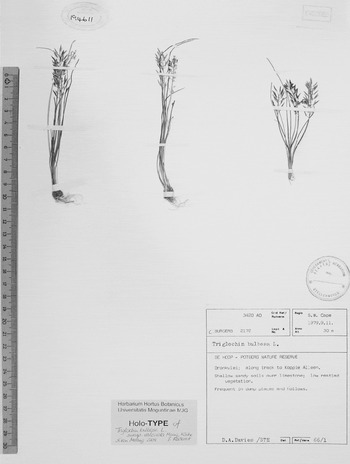
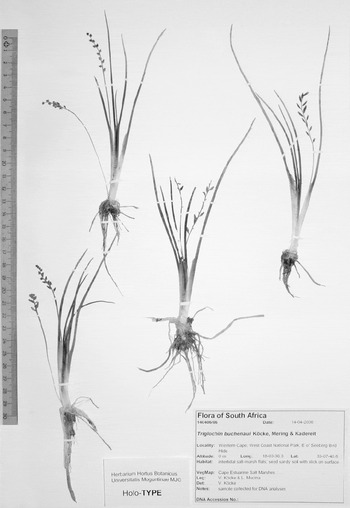
Differt a subspecie typica habitu minore et graciliore, foliis perangustis, infructescentia densa; solo in substrato calcareo. – Type: South Africa, Western Cape, De Hoop-Potberg Nature Reserve, Dronkvlei, ‘along track to Koppie Alleen, shallow sandy soils over limestone, low restiad [restioid] vegetation, frequent in damp places and hollows’, 11 ix 1979, Burgers 2172 (holo NBG-STE!; Fig. 6).
Holotype of Triglochin bulbosa subsp. calcicola Mering, Köcke & Kadereit subsp. nov. (NBG-STE).

Plants (5–)10–25 cm high, stiffly erect, with small, fusiform bulbs; bulbs covered by thin soft or thicker stiff, brown fibres, these ± 1 cm long, fibres sometimes not separate but fused into layers. Leaves as long as infructescence, very narrow, 0.5(–1) mm wide. Inflorescences dense, with (4–)10–30 flowers. Flowers 1.5–2.5 mm long, number of stamens sometimes reduced to three. Pedicels 2–4 mm long, diverging at angles of approximately 45° from the inflorescence axis, slightly curved inwards towards the apex. Infructescences 2–8 cm long. Fruits very narrowly ovoid, 4–7 mm long, rarely longer, mostly < 1 mm wide, very regularly spaced (Fig. 4C). Mericarps connate; tips short and slightly curved outwards. Carpophore only very thin and short or lacking.
Distribution. This taxon is limited to parts of the West Coast (Langebaan Peninsula), the coast of False Bay (Swartklip and Macassar) and to the South Coast (De Hoop and Stillbaai regions) (Fig. 5).
Habitat and ecology. Triglochin bulbosa subsp. calcicola is a strict endemic of Tertiary calcareous bedrocks such as lime-rich aeolinites (False Bay) and limestones of the Bredasdorp Group (De Hoop and Stillbaai regions, Fig. 1B) and of the Sandveld Group (Langebaan and Saldanha regions). The sparse populations of this subspecies here occur in shallow loam-filled depressions (filled with fine loam and lime-rich sand) in limestone pavements; these depressions are wet in winter and spring and dry out completely in summer. The vegetation types housing this taxon are De Hoop Limestone Fynbos, Canca Limestone Fynbos, and Saldanha Limestone Strandveld (Mucina & Rutherford, Reference Mucina and Rutherford2006).
Phenology. Flowering and fruiting in spring (viii–xi).
Etymology. The epithet calcicola refers to the typical substrate of the species (hard lime-rich substrates such as limestones and aeolinites).
Taxonomic remarks. Triglochin bulbosa subsp. calcicola differs from the other subspecies in having dense inflorescences with (4–)10–30 flowers and pedicels diverging at angles of approximately 45° from the inflorescence axis.
Proposed IUCN conservation status. Vulnerable (VU B2ab(iii)). This subspecies is ecologically specialised and occurs only on limestone substrates, which are generally rare in the Western Cape. Its populations on the South Coast (Overberg and Canca) and part of the False Bay coast do not experience direct threats because of current effective conservation (De Hoop Nature Reserve, Pauline Bohnen Nature Reserve, Wolvengat Nature Reserve). However, the populations on the West Coast (Langebaan and Saldanha) are found outside formally protected areas; limestone mining as well as development of coastal settlements may pose serious threats to these populations. Based on the limited area of occupancy (AOO, estimated to be less than 2000 km2) and severely fragmented distribution area, plus the threat to the habitat (at least in some areas), this subspecies is here classified as Vulnerable.
Specimens examined. South Africa. Western Cape. Bredasdorp, The Poort, limestone ridge, in depressions in rock on top, 400 ft, ix 1933, Levyns 4491 (BOL); Strand, Macassar Downs, between St. Joseph’s Tomb and sea, 2 ix 1934, Garside 4630 (B, K); Strand, 8 viii 1942, Parker 3707 (BOL, NBG); Bredasdorp, The Poort, 0.5 miles E of the road Bredasdorp–Elim, on rocks below limestone hill, 19 ix 1962, Nordenstam 1503 (S); Cape Town, Swartklip, 6 ix 1972, Taylor 8169 (NBG-STE); Stillbaai, ridge below reservoir, southerly aspect, gentle slope, limestone, 60 m, 24 viii 1979, Bohnen 6191 (NBG-STE); Malgas, De Hoop-Potberg Nature Reserve, Dronkvlei, along track to Koppie Alleen, 11 ix 1979, Burgers 2172 (holo NBG-STE); Malgas, De Hoop, 4 km from Moerasfontein turnoff on Bredasdorp–Skipskop road, 8 viii 1984, Fellingham 732 (NBG-STE); Malgas, De Hoop, Buffelsfontein, 9 viii 1984, van Wyk 1773 (NBG-STE); Vredenburg, lower NW slopes of limestone koppie at Paternoster, 28 vii 1998, Goldblatt & Manning 10928 (MO, NBG); Malgas, De Hoop Nature Reserve, plains below the slope at road from entrance of reserve to the information center, limestone pavement, 28 ix 2008, Mucina & Meruňková 280908/04 (MJG); Malgas, De Hoop Nature Reserve, 28 ix 2008, Meruňková KM03/27 (NBG), 14 x 2008, KM27/24 (NBG), KM28/51 (NBG); Langebaan Peninsula, Jacobsbaai, 26 x 2008, Meruňková KM44/44 (NBG), KM45/41 (NBG), 30 x 2008, Meruňková KM52/28 (NBG), KM53/33 (NBG); Langebaan Peninsula, Paternoster, Cape Columbine, 29 x 2008, Meruňková KM50/34 (NBG), KM51/44 (NBG).
3C. subsp. quarcicola Mering, Köcke & Kadereit, subsp. nov.Figs 4D,5.
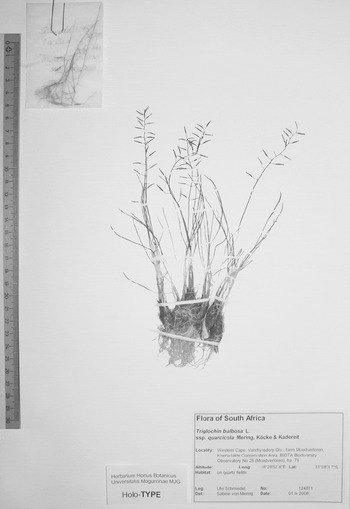
Differt a subspecie typica habitu minore et graciliore, foliis perangustis, pedicellis divergens sub angulo circa 90°; solo in substrato quarcitico. – Type: South Africa, Western Cape, Vanrhynsdorp Div., farm Moedverloren, Knersvlakte Conservation Area, on quartz fields, BIOTA Biodiversity Observatory No 28 (Moedverloren), ha. 78, 31°28′3.7″S, 18°26′52.8″E, 1 ix 2008, Schmiedel 124811 (holo MJG; iso NBG; Fig. 7).
Holotype of Triglochin bulbosa subsp. quarcicola Mering, Köcke & Kadereit subsp. nov. (MJG).

Plants 5–20 cm high, delicate, slender, with small, fusiform bulbs; bulbs covered in dry, soft or stiff brown fibres, these 1–2 cm long. Leaves uniform, as long as or shorter than infructescence, very narrow, about 0.5–1 mm wide. Inflorescences lax, with 4–15(–25) flowers. Flowers (1.5–)2–3 mm long. Pedicels shorter than fruit at fruiting time, 2–5 mm long, held at angles of almost 90° from the inflorescence axis, usually not curved inwards towards the apex. Infructescences lax, axis sometimes flexuose. Infructescences 3–8 cm long. Fruits very narrowly ovoid (to almost ellipsoid), 5–8 mm long, 0.5–1 mm wide (Fig. 4D). Mericarps linear, sometimes with short basal spurs, connate; tips not curved outwards. Carpophore very thin or lacking.
Distribution. Triglochin bulbosa subsp. quarcicola is only found in the Western Cape Province of South Africa and appears to be endemic to the Knersvlakte (a major centre of plant endemism of the country; van Wyk & Smith, 2001; Fig. 5), a slightly undulating, low-lying basin in southern Namaqualand (near the town of Vanrhynsdorp). Triglochin bulbosa subsp. quarcicola is the only subspecies of Triglochin bulbosa found outside the Fynbos Biome. The farm Moedverloren is known to harbour a high number of very restricted local endemics (U. Schmiedel, pers. comm.; B. Nordenstam, pers. comm.).
Habitat and ecology. The subspecies is restricted to saline quartz fields (Fig. 1C), especially the dry slopes of koppies, covered with a layer of white, angular quartz gravel (Schmiedel & Jürgens, Reference Schmiedel and Jürgens1999). The vegetation housing populations of Triglochin bulbosa subsp. quarcicola is a dwarf succulent shrubland, rich in succulent shrubs and ‘stone plants’ (Knersvlakte Quartz Vygieveld according to Mucina & Rutherford, Reference Mucina and Rutherford2006). The climate of the Knersvlakte is typical for winter-rainfall semi-desert, with mean annual precipitation of around 120 mm and mean annual temperature of about 18°C (Mucina & Rutherford, Reference Mucina and Rutherford2006).
Phenology. Flowering and fruiting in early spring (vii–viii). The subspecies seems to grow only following sufficient rainfall (U. Schmiedel, pers. comm.). According to notes on one specimen (Le Roux 2205, STE), the leaves are deciduous.
Notes. According to notes on two specimens, flowers are brownish-purple or purple (Nordenstam 587, S; Le Roux 2205, STE).
Taxonomic remarks. Triglochin bulbosa subsp. quarcicola differs from the other subspecies in having lax inflorescences with 4–15(–25) flowers and pedicels diverging mostly at angles of 90° from the inflorescence axis.
Proposed IUCN conservation status. Vulnerable (VU D2). Triglochin bulbosa subsp. quarcicola shows a very restricted area of occupancy (AOO, estimated to be less than 100 km2) and is currently only known from three locations (Fig. 5), where it was found only in small populations (B. Nordenstam, pers. comm.; U. Schmiedel, pers. comm.; see also a remark on the label of one of the specimens (Le Roux 2205, STE)).
The farm Moedverloren (or Moedverloor on some maps) is currently managed by CapeNature, the provincial nature conservation authority, as part of the ‘Knersvlakte Protected Area’ (U. Schmiedel, pers. comm.). However, some of the populations are found outside the borders of formally protected areas, and the survival of this taxon depends on the owners of these neighbouring farms. Further field studies are required to estimate more precisely the area of occupancy and extent of occurrence.
Specimens examined. South Africa. Western Cape. Knersvlakte, Koekenaap, 15 vii 1962, Nordenstam 587 (S); 20 vii 1962, Hall 2397 (NBG-SAM); Knersvlakte, Vanrhynsdorp, Moedverloor [‘Moedverloer’ in Hall 4124], 28 vii 1962, Nordenstam 790 (S); 10 viii 1962, Nordenstam 898 (S); 23 viii 1971, Hall 4124 (NBG); 5 viii 1981, Hall 5078 (NBG); Knersvlakte, Lutzville, 7 km N of Hol River railway station on the farm Klipdrift, 10 viii 1977, Le Roux 2205 (NBG-STE); Knersvlakte, Vanrhynsdorp, farm Moedverloren, Knersvlakte Conservation Area (BIOTA Biodiversity Observatory No 28), quartz fields, 1 ix 2008, Schmiedel 124811 (holo MJG; iso NBG).
3D. subsp. tenuifolia (Adamson) Horn, Svensk. Bot. Tidskr. 55: 85 (1961). – Triglochin tenuifolia Adamson, J. S. African Bot. 5: 30–31 (1939). – Type: South Africa, Table Mountain West side, Pipe Track, sheltered slopes, 5 ix 1936, Adamson 986 (holo BOL!). Figs 4B,5.
Plants 8–25(–35) cm high, delicate, slender, with fusiform bulbs; bulbs covered in dry, rather stiff or soft, brown fibres, these < 1 cm long. Leaves as long as or much longer than plant height, very narrow, about 0.5–1 mm wide. Inflorescences lax, with 4–15 flowers. Flowers 1.5–2.5 mm long. Pedicels as long as or longer than fruit at fruiting time, 5–10 mm long, diverging at angles of 45–90° from the inflorescence axis, slightly curved inwards towards the apex. Infructescences 2–5 cm long. Fruits very narrowly ovoid, 5–8 mm long, 0.5–1 mm wide (Fig. 4B). Mericarps connate at the carpophore; tips slightly curved outwards.
Distribution. This subspecies is (as far as known) restricted to the lower slopes of Table Mountain on the Cape Peninsula and to the Postberg (near Langebaan, West Coast National Park) (Fig. 5).
Habitat and ecology. The subspecies is found in sheltered, shady inland habitats on mountain slopes at altitudes below 400 m. It is restricted to coarse, sandy soils derived from granites (Archaean Cape Granite Suite). The vegetation types supporting this taxon are classified as Cape Peninsula Granite Renosterveld and Saldanha Granite Strandveld (Mucina & Rutherford, Reference Mucina and Rutherford2006).
Phenology. Flowering and fruiting vii–ix; one specimen (with flowers and fruits) was collected in v.
Notes. The preference of this taxon for granite soils was already noted by Adamson (Reference Adamson1939).
Taxonomic remarks. Triglochin bulbosa subsp. tenuifolia differs from the other subspecies in having lax inflorescences with 4–15 flowers and pedicels diverging at angles of 45–90° from the inflorescence axis.
Nomenclatural notes. At least one paratype of Triglochin tenuifolia (Dümmer 1050, SAM) cited by Adamson (Reference Adamson1939) represents a misidentified specimen of T. compacta. Not all material cited by Adamson has been seen by us.
Proposed IUCN conservation status. Near Threatened (NT). The taxon meets the area requirements under criterion B for threatened (extent of occurrence (EOO) < 20,000 km2 and/or area of occupancy (AOO) < 2000 km2) and is declining, but the population is not severely fragmented, and the taxon occurs at 12 locations.
Judging from the available herbarium material, the subspecies has a very restricted distribution area. The EOO is estimated to be only several square kilometres. It is known from parts of the Cape Peninsula and one locality at the Postberg (Langebaan Peninsula). All of the historical localities are today protected within the Table Mountain National Park and the private Postberg Nature Reserve (contractual portion of the West Coast National Park). No data are available on the current AOO of Triglochin bulbosa subsp. tenuifolia as all herbarium specimens seen are at least 60 years old, apart from one collection from Postberg dating from 1966. Several collecting sites are located within the borders of Cape Town and might have been destroyed long ago. Field work is needed to assess the current range and the conservation status of this taxon.
Specimens examined. South Africa. Western Cape. Cape Town, Stinkwater, 1875–1880, Rehmann 1194 (BM, Z); Cape Town, locality illegible, 14 vii 1883, Wilms 36451 (BM, Z); Cape Town, top ridge over Klassenbosch, 15 viii 1897, Wolley Dod 2918 (BOL); Cape Town, Lion’s Head, lower west slopes, 29 viii 1897, Wolley-Dod 2915 (para BOL); Cape Town, Signal Hill, ix 1897, Thode 6089 (NBG-STE); Cape Town, Table Mountain, Pipe Track, above Camp Bay, viii 1920, Michell s.n. (BOL); Cape Town, Simonstown, Baviaans Kloof, 4 v 1927, Salter 344/10 (para BM); Cape Town, Hout Bay Nek, 23 viii 1928, Hutchinson & Pillans 104 (BOL); Cape Town, Kloof Nek, 27 vii 1929, Scott s.n. (para BM); Cape Town, Table Mountain W side, Pipe Track, 5 ix 1936, Adamson 986 (holo T. tenuifolia, BOL); Cape Town, Table Mountain, W side at 1000 ft, 11 viii 1940, Adamson 2899 (BM); Cape Town, Table Mountain, west slopes, 5 ix 1943, Esterhuysen 27104 (BOL); Cape Town, Table Mountain, Spring Buttress, ix 1945, Stokoe 59916 (NBG-SAM); Cape Town, Table Mountain, Llandudno end, 1000 ft, 19 x 1958, Esterhuysen 27923 (BOL); Langebaan, E slopes of Postberg, 9 ix 1966, Barker 10471 (NBG).
4. Triglochin compacta Adamson, J. S. African Bot. 9: 152 (1943). – Type: South Africa, Karbonkelberg, 1000 ft, 28 ii 1943, Compton 14436 (holo NBG!). Figs 1E–G,2C,8.
Geographical distribution of Triglochin compacta Adamson, T. elongata Buchenau, and T. buchenaui Köcke, Mering & Kadereit sp. nov.

Plants (10–)15–50 cm high, with fusiform bulbs; bulbs covered in dry, rather soft, brown fibres, these up to 5 cm long. Leaves few, formed after flowering, mostly reaching only half of the height of plants. Outer leaves strap-shaped, shorter and wider than inner leaves, up to 4 cm long, mucronate, inner leaves abruptly narrowing above the ligule, less than 0.5 mm wide, distinctly longer than outer leaves, leaves generally larger and more numerous after fruit maturity. Inflorescences dense, with (6–)10–50 flowers. Flowers 1.5–3 mm long. Pedicels elongated at fruiting time, up to 2–7 mm long, mostly curved inwards towards the apex. Infructescences 5–20 cm long. Fruits narrowly ovoid, 6–10 mm long, 1–2 mm wide (Figs 1G, 2C). Mericarps dorsally curved upwards, connate at the carpophore; tips curved outwards. Carpophore often with three basal membranous outgrowths.
Distribution. Endemic to South Africa: restricted mainly to the Western Cape Province where it occurs in the Cape Peninsula as far east as Goukamma on the Garden Route and in Seweweekspoort in Klein Swartberg Mountains, the Cederberg and in a handful of localities in the Northern Cape Province in the surroundings of Nieuwoudtville and near Kommagas (Namaqualand) (Fig. 8). The Kommagas collection is an unusual outlier and requires further attention. Unfortunately recent material from this locality was not available.
Habitat and ecology. Triglochin compacta is invariably found on deep (mainly nutrient-poor) sands. When of marine origin, these sands form stabilised (and highly leached) inland sand dunes, always outside the current direct influence of the sea. In some places at higher altitudes these deep sandy sediments are derived in situ from arenites such as Table Mountain and Nardouw sandstones. The vegetation types characteristically supporting this taxon are Hangklip Sand Fynbos, Cape Flats Sand Fynbos, Albertinia Sand Fynbos, Knysna Sand Fynbos, Cederberg Sandstone Fynbos and Bokkveled Sandstone Fynbos (sensu Mucina & Rutherford, Reference Mucina and Rutherford2006).
Phenology. Flowering mostly in autumn from (ii)iii–v; some fruiting material was collected in vi.
Chromosome number. Unknown.
Taxonomic remarks. Apart from its initial description by Adamson (Reference Adamson, Barker, Gerstner, Adamson and Compton1943), this species has been incorrectly classified as being synonymous with Triglochin bulbosa. However, the two species can be easily distinguished by phenology as well as morphology (see Triglochin bulbosa for a comparison between these two sympatric species). The affinities of Triglochin compacta to T. milnei will be discussed under the latter species.
Proposed IUCN conservation status. Data Deficient (DD). The low number of collections of this taxon could be a result of poor sampling (failure to distinguish this species in the field from the much more common Triglochin bulbosa subsp. bulbosa), habitat loss, natural rarity, or a combination of these factors. Some of the sandveld areas (system of lowland stabilised dune-fields) have been suffering from pressure of urban sprawl through both the spread of formal housing development and the explosive spread of informal settlements on the Cape Flats (now part of the Cape Town metropolis). The conservation status of this taxon can only be judged once an intensive search for extant localities has been conducted. We therefore suggest classifying Triglochin compacta as Data Deficient.
Specimens examined. South Africa. Northern Cape. Niewoudtville, sine dato, Leipoldt 808 (BOL); Niewoudtville, 19 ii 1932, Maughan-Brown s.n. (BOL); [Namaqualand], Komaggas (‘Bethel, Kammaggas’), 24 iii 1952, van Niekerk 3833 (BOL); Nieuwoudtville, Farm Arendskraal, 30 iii 1982, Snijman 597 (NBG). Western Cape. Cape of Good Hope, c.1770, Auge or Oldenburg s.n. (BM); iii or iv 1771, Banks & Solander s.n. (BM); Cape Town, Wynberg, 23 iii 1892, Schlechter 607 (Z); Hermanus, Vogelgat, 11 iv 1897, Schlechter 10424 (BM, PRE, Z); Cape Town, Muizenberg, iii 1908, Dümmer 1050 (NBG-SAM); Caledon, 21 ix 1916, Purcell 104 (NBG-SAM); Cape Town, Constantia, Bergvliet Farm, Peter’s Hill, 26 iii 1917, Purcell 12 (NBG-SAM); Cape Town, Ladies Mile Hill, 12 iv 1918, Purcell 65 (NBG-SAM); Knysna, Goukamma, West Hill, iv 1928, Fourcade 3925 (BOL, NBG-STE); Strand, on sand dunes near the sea, 22 vi 1940, Parker 3515 (BOL, NBG); Cape Town, Slangkop, 9 v 1942, Bond 1498 (NBG); Cape Town, Karbonkelberg, 25 ii 1943, Isaac 10 (BOL); 28 ii 1943, Compton 14436 (holo NBG); 4 iii 1943, Leighton 934 (NBG); 30 iv 1944, Compton 15657 (NBG); 2 iv 1945, Levyns s.n. (Adamson 3615) (BOL); Cape Peninsula, Buffels Bay, 27 v 1945, Compton 17061 (NBG); Cape Town, slopes above Rheboksdam Bay, 27 v 1945, Leighton 970 (BOL); Cederberg, Sandfontein Peak, 5 iv 1947, Esterhuysen 13870 (BOL); Cape Town, hillside above Kommetjie, vi 1947, Lewis 2379 (NBG-SAM); Clanwilliam, Krom River, 1 iv 1956, Esterhuysen 25489 (BOL); Cape Town, Kalk Bay Mountain, slope below Boyes Drive, 12 v 1974, Goldblatt 1792 (NBG); Stillbaai, Panorama Circle, 10 iii 1979, Bohnen 5112 (NBG, PRE); Stellenbosch, Bo-Onderpapagaaiberg, 20 v 1988, Becker 0001 (NBG); Sedgefield, Buffelsbaai, Goukamma River estuary, camping site, 6 v 2006, Köcke & Mucina 060506/02 (MJG); Stillbaai, Pauline Bohnen’s ex-garden on Panoramasingel, 18 iii 2008, Naudé et al. s.n. (NBG).
5. Triglochin milnei Horn, Svensk. Bot. Tidskr. 55: 85 (1961). – Type: Zambia, Mwinilunga Distr., ½ mile S of Matonchi farm, c.1350 m, 30 x 1937, Milne-Redhead 3012 (holo K photo!, BOL photo!; iso S photo!). Figs 2D,9.
Geographical distribution of Triglochin milnei Horn.

Plants (15–)20–60 cm high, with bulbs; bulbs covered in dry, rather soft, brown fibres, these up to 5 cm long. Leaves few at flowering time, much shorter than, and mostly reaching only half of the height of plants, becoming larger and numerous after fruit maturity. Outer leaves strap-shaped, shorter and wider than inner leaves, up to 4 cm long, with mucronate tips, inner leaves abruptly narrowing above the ligule, > 1–2 mm wide, distinctly longer than outer leaves. Inflorescences lax, with 5–30 flowers. Flowers usually > 3 mm long. Pedicels elongated at fruit maturity, then 3–15 mm long, diverging at angles of 45° and curved inwards towards the apex. Infructescences 6–14 cm long. Fruits narrowly ovoid to ovoid, (8–)10–14 mm long, ± 3 mm wide (Fig. 2D). Mericarps connate at the carpophore. Carpophore with three basal membranous outgrowths.
Distribution. Angola, Democratic Republic of Congo (DRC), Tanzania, Zambia, Zimbabwe; in South Africa in KwaZulu-Natal, southern Mpumalanga and Zuurberg, Griqualand East, Eastern Cape (Fig. 9). Usually found at altitudes above (500–)1000 m, in Tanzania at up to 1900 m. According to Govaerts (Reference Govaerts2008), Triglochin milnei is also found in Malawi, but no herbarium material from there has been seen.
Habitat and ecology. Triglochin milnei is found in seasonal (summer-wet) wetlands and seasonally wet, sometimes burnt, grasslands, often on grey or black clayey soils. At least some of these grasslands of the mid and high altitudes in Tanzania and Zimbabwe (and possibly also in Malawi) would qualify as ‘afromontane’. At low altitudes in the DRC and Zambia this taxon is found in so-called dambos – seasonally waterlogged, predominantly grass-covered depressions bordering headwater drainage lines (Mackel, Reference Mackel1985). On the Mpumalanga Highveld and in the KwaZulu-Natal Midlands (South Africa), this taxon appears to be limited to azonal wetlands embedded within the Grassland Biome.
Phenology. Flowering and fruiting from x–ii(iii).
Chromosome number. Unknown.
Taxonomic remarks. Triglochin milnei is morphologically similar to T. compacta by having outgrowths at the base of the carpophore and narrowly ovoid to ovoid fruits, in which the outline of the seeds is often visible on the mericarp surface. However, the fruits differ in width (± 3 mm vs. 1–2 mm) and in most cases in length ((8)10–14 mm vs. 6–10 mm). Furthermore, the two species are geographically, ecologically and phenologically clearly differentiated.
Most Floras covering the distribution area of the species do not recognise Triglochin milnei, but treat it as a synonym of T. bulbosa (e.g. Bennett, Reference Bennett and Thiselton-Dyer1902; Obermeyer, Reference Obermeyer, Codd and de Winter1966; Lisowski et al., Reference Lisowski, Malaisse and Symoens1982). Napper (Reference Napper, Milne-Redhead and Polhill1971) accepted Triglochin milnei (p. 3: ‘The circumscription of T. bulbosa in F.S.A. 1: 93 (1966), which includes T. milnei, is less satisfactory’) but doubted the sole record of this species in South Africa. However, the study of extensive Triglochin material from South Africa and comparison with material of T. milnei from other parts of Africa revealed that the species occurs in eastern South Africa. Nevertheless, only limited material is available for South Africa and more collecting is needed.
Nomenclatural notes. The holotype (Milne-Redhead 3012, K) does not have fruits and should be used together with fruiting material.
Proposed IUCN conservation status. Data Deficient (DD). Triglochin milnei seems to be widely distributed in Central and southeastern Africa and is probably not under immediate threat. However, little is known about the current area of occupancy. The species is under-represented in herbarium collections and few other data are available. In economically more developed African countries, such as South Africa, subtropical and warm-temperate grasslands are under pressure from intensive stock grazing associated with frequent (often too frequent) burning. Sparse and vulnerable wetlands within these grasslands also suffer from over-utilisation by high grazing stock concentrations. Threats and current conservation status at the national level are likely to differ among countries, and therefore differential assessments are needed. In South Africa the species is only known from six, mostly very old, collections.
Specimens examined. Angola. Distr. Huilla, Alto plana, ad ripas Rivi de Lopollo, prope Ohai (Háy), 5000 ft, xi/xii 1859, Welwitsch 3017 (para BM, P); Benguela [formerly Benguella], country of the Ganguellas and Ambuellas, 1910, Gossweiler s.n. (para K).
Democratic Republic of Congo. 1.5 km E of Kabiasha, Katanga, 1020 m, 7 xii 1967, Malaisse 6189 (POZG); Haut-Shaba, close to Lubumbashi (formerly Elisabethville), 8 km W of Kasapa University, 25 xii 1968, Lisowski 84458 (POZG); Kinshasa, Haut-Katanga, close to Lubumbashi, on the fringes of Natwebo, 1220 m, 22 x 1969, Lisowski 731 & 732 (POZG), 27 xi 1970, Lisowski 733 (POZG); Plateau de Kundelungu, Katanga, bank of Kalundariver, 1590 m, 9 i 1971, Lisowski, Malaisse & Symoens 12645 & 12698 (POZG); Plateau des Kundelungu, 3 km N of source of river Lutshipuka, 9 i 1971, Lisowski, Malaisse & Symoens 12644 (BOL).
Tanzania. Uyansi, Lake Chaya, c.1240 m, 4 i 1926, Peter 45784 (B); Sumbawanga, 6200 ft, 30 i 1950, Bullock 2364 (para K, S photo!); 12 km E of Songea by Nonganonga stream, 1050 m, 28 xii 1955, Milne-Redhead & Taylor 7934 (para B, EA, P, S photo!); Iringa Distr., 4 miles N of Iringa, Great North Road, 5150 ft, 5 ii 1962, Polhill & Paulo 1362 (B, EA, P); 7 miles from Iringa on Dabaga road, 26 xii 1965, Harris 10256 (EA); Sumbawanga, Tatanda Mission, 1700 m, Bidgood, Mbago & Vollesen 2409 (K); Nkansi Distr., 5 km on Namanyere–Karonga road, 1500 m, 4 iii 1994, Bidgood, Mbago & Vollesen 2603 (P).
South Africa. KwaZulu-Natal. Inanda, i 1800, Medley Wood 997 (BM); Griqualand East, Zuurberg Mountains, x 1883, Tyson 1866 (BOL); Alexandra Distr., Station Dumisa, Farm Friedenau, Umgaye, 600 m, 15 x 1908, Rudatis 440 (para BM, P); Krantzkop (‘Kranskop’), 4500 ft, xii 1910, Thode 3870 (NBG-STE); Krantzkloof, Gillitto Kloof, 1800 ft, x 1921, Haygarth s.n. (STE 260, 261). Mpumalanga. Wakkerstroom Distr., N of Dirkiesdorp, SE of main road, on the farm Roodekraal, 1340 m, 13 xii 1995, Balkwill 9389 (PRE).
Zambia. Mwinilunga Distr., ½ mile S of Matonchi farm, 16 xii 1937, Milne-Redhead 3693 (para S photo!); 5 miles E of Lusaka, 4200 ft, 10 i 1958, King 403 (para K); Chadiza, 850 m, 25 xi 1958, Robson 686 (BM); Lusaka, 4 xii 1964, Robinson 6266 (M); Kitwe, 9 ii 1969, Fanshawe 10515 (K).
Zimbabwe. Charter Distr., Charter, 4000 ft, 27 xii 1926, Eyles 4587 (para K).
6. Triglochin elongata Buchenau in Engler, Das Pflanzenreich IV.14: 10, fig. 3 (1903). – Type: South Africa, Div. Malmesbury, ‘Umgegend von Hopefield, Weg nach Coeuratenberg’, xi 1886, Bachmann 1693 (lecto Z!, designated here); drawing of fruit and habit (from Bachmann 1693, B) in Buchenau (Reference Buchenau and Engler1903), fig. 3, p. 11 (epi, designated here). Figs 1H, 1K,2E,8.
Plants 15–90 cm high, with rhizomes (Fig. 1H). Rhizomes whitish to beige with bracts. Leaves uniform, thickened at the base but not forming a bulb, as long as or longer than plant height, 1–2 mm wide, leaf bases covered by soft, whitish to brown fibres, fibres mostly 3–6 cm, rarely up to 15 cm long. Inflorescences dense, with 10–100 flowers. Flowers 1.5–2.5 mm long. Pedicels elongated at fruiting time, then 2–6 mm long. Infructescences (6–)10–25 cm long. Fruits narrowly ovoid to ovoid, often secund, 5–9 mm long, 1–2.5 mm wide (Fig. 2E). Mericarps connate at the carpophore; tips mostly curved outwards.
Distribution. Endemic to South Africa: distributed mainly in coastal regions of the KwaZulu-Natal, Eastern, Western and Northern Cape Provinces (Fig. 8). In the last province there are two outlying localities – always located near the mouths of intermittent rivers draining the coastal plains of Namaqualand. We have failed to detect any morphological uniqueness of these Namaqualand populations. They are exceptional in terms of their geographical distribution and deserve further study. Many isolated inland localities are presumably of relictual character as they are found abundantly in regions frequently flooded by the sea during the altithermal marine transgressions (Overberg, parts of West Coast).
Habitat and ecology. Triglochin elongata commonly grows in the upper tidal and supratidal zones of estuarine salt marshes (Fig. 1K), usually on heavy clayey (partly also clayey-sandy) saline soils. In coastal habitats it is found on elevated banks of sandy beaches, edges of estuarine rivers as well as on rocks exposed to salt spray. Along some estuarine rivers it penetrates deeply inland (Bushmans River in the Eastern Cape), and in some regions (West Coast, Breede River, Overberg) it is found in (obviously relictual) inland localities, on banks of intermittent rivers (in Namaqualand) and on the edges of saline and brackish temporary pans, here often intermingled with dense Juncus stands. According to Mucina & Rutherford (2006) these habitats belong to the following vegetation units: Arid Estuarine Salt Marshes, Cape Estuarine Salt Marshes, Cape Inland Saltpans, Cape Lowland Freshwater Wetlands and Cape Seashore Vegetation.
Phenology. Flowering throughout the year as long as water is available.
Chromosome number. Unknown.
Taxonomic remarks. Triglochin elongata is similar to T. buchenaui in having rhizomes instead of bulbs, but differs in having dense inflorescences with 10–100 flowers (vs. lax inflorescences with 3–17 flowers), (6–)10–25 cm long infructescences (vs. 2–7 cm long), and fruits with a carpophore. Unlike Triglochin buchenaui, which is restricted to the lower tidal zone of salt marsh estuaries, T. elongata is ecologically more variable and grows in the upper zone of salt marsh estuaries and estuarine rivers.
Nomenclatural notes. In the protologue of Triglochin elongata, Buchenau (Reference Buchenau and Engler1903) cites three specimens which were probably destroyed in B during World War II. A duplicate of one of these syntypes has been discovered (Bachmann 1693, Z) and is designated as the lectotype here. This specimen, however, has flowers but no fruits. The fruit (and habit) of one of the original syntypes (Bachmann 1693, B) is illustrated in Buchenau (Reference Buchenau and Engler1903, fig. 3, p. 11). This drawing is designated here as an epitype.
Variation. Several exceptionally large individuals (up to 90 cm) with long infructescences and numerous fruits have been seen.
Proposed IUCN conservation status. Least Concern (LC). Triglochin elongata is a widespread species recorded from many riversides near the sea and almost all major estuaries in South Africa (Fig. 8). However, some of these estuaries are under serious pressure through silt deposition or reduced freshwater flow (Turpie et al., Reference Turpie, Adams, Joubert, Harrison, Colloty and Maree2002; Turpie, Reference Turpie2004).
Specimens examined. South Africa. Eastern Cape. Uitenhage Div. [probably Swartkops Estuary near Port Elizabeth], xii (sine anno), Ecklon & Zeyher 620 (BOL); Port Elizabeth, Zwartkopsrivier, sine dato, Zeyher 4326 (NBG-SAM); East London, Kwenxura (= Kwenqura) River mouth, 23 xii 1900, Galpin 5815 (NBG); [Transkei], Kentani, coast, 100 ft, 1903, Pegler 335 (BOL); [Transkei], Kentani, 4 xii 1905, Pegler 335 (SAM, Z); [Transkei], Kei River Bridge, 19 x 1931, Taylor 3669 (NBG); Tsitsikamma, Nature’s Valley, Groot River lagoon, ii 1932, J. & B. Rennie 545 (BOL); [Transkei], near Kei River mouth, 25 xi 1945, Compton 17675 (NBG); [Transkei], Coffee Bay, iii 1947, Lewis 2374 (NBG-SAM); East London, 27 x 1962, Batten 1.Pl.115 (NBG); East London, Nahoon River, 26 vi 1963, Tölken 402 (NBG-STE); Port Alfred, Kowie River estuary, 28 i 1964, Mauve & Wells 7 (NBG); East London, Bridle Drift, 2 iv 1966, Pamphlett 5 (NBG); Humansdorp, on water edge, 21 xi 1972, Montgomery 182 (NBG-STE); Tsitsikamma, Nature’s Valley, Groot River estuary, 6 v 2006, Köcke & Mucina 060506/29 (MJG, NBG); Jefferey’s Bay, Kabeljous River estuary, 7 v 2006, Köcke & Steffen 070506/01 (MJG); Port Alfred, Kowie River estuary, 9 v 2006, Köcke & Steffen 090506/22 (MJG). KwaZulu-Natal. [Herbarium Natal, locality burnt, possibly Durban], xi 1882, Medley Wood 396 (BM); Durban, shores at bay, 20 xi 1884, Medley Wood 396 (BOL); Durban, xi (sine anno), Medley Wood 925 (BM); Durban, Congella, sine dato, Medley Wood 11985 (BOL); Durban, x 1888, Wilms 2278 (BM); Durban, Levy, iii 1894, Kuntze s.n. (NY); Durban, Beach Terminus, vi 1913, Thode 4901 (NBG-STE); Durban, Isipingo, 22 iv 1921, Forbes STE 12526 (NBG-STE); 1 xi 1926, Schröder s.n. (ZT); Durban, Fusel, ix 1933, Meebold 12994 (M); Durban, Isipingo Beach, 13 viii 1949, Ward 917 (K); Port Edward, Palm Beach, 21 iii 1992, Weigend 2335 (M); Port Edward, Umtamvuna River mouth, 9 iv 2006, Pienaar, Jakubowsky & Swelankomo 090406/1 (MJG, NBG). Northern Cape. Namaqualand, Hondeklipbaai, Spoeg River mouth, 5 m, 18 x 1980, Le Roux & Parsons 59 (NBG-STE); Namaqualand, Kleinzee, 5 ix 2005, Mucina 050905/04 (MJG). Western Cape. Cape Town, False Bay prope Muizenberg, iii 1892, Schlechter 7184 (BOL); Bonnievalle, swamp near Breede River, iii (sine anno), Marloth 11592 (NBG-STE); Cape Peninsula, Muizenberg Vley, 11 iii 1896, Wolley-Dod 969 (BOL); 14 xi 1897, Wolley-Dod 3658 (BOL); Cape Town, Paarden Island, ii 1908, Dümmer 1171 (NBG-SAM); Cape Town, Lakeside, i 1918, Michell s.n. (BOL); West Coast, Graafwater, ix 1923, Adamson 39042 (NBG-SAM); Cape Peninsula, E of Paulsberg, 3 v 1929, Salter 344/9 (K); Robertson, Breede River, 25 ix 1935, Lewis s.n. (BOL); Cape Town, Paarden Island, 24 iii 1936, Adamson 843 (BOL); Cape Town, Lakeside Vlei, 17 x 1936, Adamson 1235 (BOL); 17 xi 1936, Adamson 1370 (BOL); 17 i 1937, Adamson 1614 (BOL); Cape Town, Sand Vlei, 17 xi 1936, Adamson 1373 (K); Cape Town, Sand Vlei, E side, 17 xi 1936, Adamson 1370 (NBG-SAM); Cape Town, Muizenberg, Sand Vlei, 20 iii 1938, Adamson 1689 (BM); West Coast, between Bokbaai and Darling, 15 ix 1940, Esterhuysen 3866 (BOL); Caledon, at streamside, xi 1940, Esterhuysen 3865 (BOL); Hermanus, Onrust, beside the lagoon, 22 iii 1944, Leighton 413a (BOL), Leighton 413 (NBG); Gansbaai, Frikkiesbaai [Uilkraalsmond], 21 iv 1946, Leighton 1669 (BOL); Gansbaai, Franskraal, 21 iv 1946, Leighton 1669 (NY); George, Kaaimansgat, Kaaimans River, xi 1947, Wilman s.n. (BOL, K); Plettenberg Bay, 24 ix 1967, Thompson 588 (NBG-STE); Cape Town, Cape Flats, Isoetesvlei, 9 iii 1970, Strauss 10 (NBG); Pearly Beach, Klein Hagelkraal, 50 ft, 10 iii 1979, Thompson 3898 (M, NBG); Stillbaai, Kransfontein Farm, humus rich river bank in forest, 7 x 1980, Bohnen 7731 (NBG-STE); Gansbaai, Franskraal, N bank of Uilkraal River, 2 m, 3 xi 1987, O’Callaghan 3/11/2 (NBG-STE); Struisbaai, at entrance to Corona Farm, 28 xii 2003, Mucina 281203/05 (MJG); Cape Town, Zandvlei, near station and boat club area, 20 viii 2004, Walton 341 (MJG); Gansbaai, Franskraal, Uilkraalsmond Estuary, N of the road bridge, 8 v 2005, Mucina 080505/05 (MJG); Malgas, De Hoop Nature Reserve, Potberg section, Cupido’s Kraal, 3 iv 2006, Köcke & Mucina 030406/14 (MJG); Struisbaai, Vogelzang Farm, 4 iv 2006, Köcke & Mucina 040406/22, 040406/24 (MJG, NBG); Gansbaai, Franskraal, Uilkraalsmond Estuary, N of the road bridge, 5 iv 2006, Köcke & Mucina 050406/03 (MJG), 050406/07 (MJG), 050406/09 (MJG); Hermanus, Fisherhaven, near jetty at the Botrivier Lagoon, 5 iv 2006, Köcke & Mucina 050406/11 (MJG, NBG); Bredasdorp, Patryskraal on road between Oupos and Bredasdorp, 5 iv 2006, Köcke & Mucina 050406/18 (MJG, NBG); Gansbaai, Franskraal, Uilkraalsmond estuary, 5 iv 2006, Köcke & Mucina 050406/19 (MJG, NBG); Struisbaai, W of Zoetendalsvlei, at road Struisbaai to Elim, km 59.9, 5 iv 2006, Köcke & Mucina 050406/24 (MJG, NBG); Struisbaai, at entrance to Corona Farm, 5 iv 2006, Köcke & Mucina 050406/27 (MJG); Cape Town, Milnerton, Rietvlei Nature Reserve, close to parking area, 20 iv 2006, Köcke & Steffen 200406/01, 200406/03 (MJG); on the way to bird hide, 20 iv 2006, Köcke & Steffen 200406/10 (MJG); at bird hide, 20 iv 2006, Köcke & Steffen 200406/17 (MJG); Hermanus, Voëklip, 23 iv 2006, Köcke & Mucina 230406/18 (MJG); Mosselbaai, Hartenbos, near the bridge over river, 4 v 2006, Köcke & Mucina 040506/24 (MJG, NBG); [Cape Town], Faure, Vergenoeg Farm, 4 x 2006, Boucher 7412 (NBG); Elim, near homestead of Heuningrug Farm, 14 x 2006, Mucina 141006/23 (MJG); Malgas, De Hoop Nature Reserve, Potberg section, near Bultfontein, 21 x 2006, Mucina 211006/17 (MJG); Struisbaai, Vogelzang Farm, N of Heuningnes River estuary, 17 iii 2007, Mucina 170307/03 (MJG), 170307/04 (MJG); Struisbaai, De Mond Nature Reserve, Heuningnes River estuary, left bank, 17 iii 2007, Mucina 170307/13A (MJG).
7. Triglochin buchenaui Köcke, Mering & Kadereit, sp. nov.Figs 1I–J,2F,8.
Herba scaposa, rhizomatosa, non bulbosa, ad 30 cm alta. Differt a Triglochin elongata inflorescentia laxa cum 3–17 flores, fructibus angustus ovoideus usque fere globosus, carpophoris deficiens. – Type: South Africa, Western Cape, West Coast National Park, E of Seeberg Bird Hide, intertidal salt marsh flats, 14 iv 2006, Köcke & Mucina 140406/06 (holo MJG; iso NBG; Fig. 10).
Holotype of Triglochin buchenaui Köcke, Mering & Kadereit sp. nov. (MJG).

Plants 9–30 cm high, with rhizomes. Rhizomes whitish to beige with bracts. Leaves uniform, thickened at base but not forming a bulb, as long as or longer than infructescence, leaf bases with mostly (very) few, soft, whitish to beige fibres which can be more than half as long as height of plant. Inflorescences lax, with 3–17 flowers. Flowers ± 2 mm long. Pedicels up to 2 mm long at fruiting time, usually shorter. Infructescences 2–7 cm long, fruits distant. Fruits narrowly ovoid to ovoid, 4–8 mm long and 1 to > 2 mm wide (Fig. 2F). Mericarps dorsally curved upwards, filled with air, tips not curved or weakly curved outwards; carpophore absent.
Distribution. Endemic to South Africa, restricted to major estuaries of the West and South Coast, spanning Groot Berg River estuary near Velddrif (Western Cape Province) and Kariega estuary near Kenton-on-Sea (Eastern Cape Province) (Fig. 8).
Habitat and ecology. Triglochin buchenaui is a typical species of periodically flooded lower salt marsh estuaries (Fig. 1I). The soils in these habitats are sandy to sandy-clayey. Triglochin buchenaui usually occurs together with Sarcocornia tegetaria S.Steffen, Mucina & G.Kadereit, Triglochin striata, Cotula coronopifolia L., Poecilolepis ficoidea (DC.) Grau, Chenolea diffusa Thunb. and various Limonium species. The vegetation in these habitats is classified exclusively as Cape Estuarine Salt Marshes (Mucina & Rutherford, Reference Mucina and Rutherford2006).
Phenology. Flowering throughout the year.
Etymology. The species is named after Franz Georg Philipp Buchenau (1831–1906), a German botanist who contributed significantly to the knowledge of Triglochin and Juncaginaceae.
Chromosome number. Unknown.
Taxonomic remarks. See Triglochin elongata for a comparison of these two rhizomatous species.
Proposed IUCN conservation status. Least Concern (LC). Triglochin buchenaui is a widespread species recorded from a number of large lagoons and estuaries in South Africa (Fig. 8) and therefore is not immediately threatened. The Berg River and Swartkops River estuaries support large populations of Triglochin buchenaui and are also among the highest ranked South African estuaries in terms of botanical and conservation importance (Turpie et al., Reference Turpie, Adams, Joubert, Harrison, Colloty and Maree2002). The estuaries of the Langebaan and Knysna Lagoons as well as estuaries of Kromme and Swartkops enjoy formal protection as part of either national parks or local authority nature reserves.
Specimens examined. South Africa. Eastern Cape. Port Elizabeth, Redhouse, i 1915, Paterson 288 (BOL); Boesmansriviermond, Bushmans River mouth, 14 i 1936, Dyer 3365 (PRE); Port Elizabeth, Swartkops River mouth, 4 ii 1964, Mauve & Wells 38 (NBG-STE); Tsitsikamma, Blaubaai by Robbehoek, 8 iii 1979, Taylor 9954 (NBG-STE); Kenton-on-Sea, Ghio Wetland, below the bridge over Bushmans River, 26 xi 2005, Mucina 261105/05 (MJG); St. Francis Bay, Kromme River estuary, at the bridge, 7 v 2006, Köcke & Steffen 070506/07 (MJG); Port Elizabeth, Swartkops River estuary, 8 v 2006, Köcke & Steffen 080506/06 (MJG); Kenton-on-Sea, Ghio Wetland, at bridge over Bushmans River, 9 v 2006, Köcke & Steffen 090506/04 (MJG); 9 v 2006, Köcke & Steffen 090506/08 (MJG); Kenton-on-Sea, Kariega River estuary, 9 v 2006, Köcke & Steffen 090506/13 (MJG). Western Cape. Knysna, Woodbourne, edge of lagoon, 31 i 1924, Duthie 876 (NBG-STE); Knysna, Belvidere, edge of lagoon, 22 i 1925, Duthie 876 (BOL); Langebaan, wet places, ix 1925, Leipoldt 27103 (BOL); Knysna, Knysna Lagoon, 6 ii 1964, Mauve 36 (PRE), Wells 37 (PRE); Langebaan Lagoon, near Oesterwal, 4 v 1967, Simons 1991 (BOL); Knysna, Nature’s Valley, Groot (Wes) River mouth, 8 iv 1981, Parsons 161 (NBG-STE); Velddrif, Port Owen, Berg River, 13 ii 1981, Le Roux 2855 (NBG-STE); 16 ii 1986, Boucher 5123 (NBG-STE); 22 ii 1988, Becker 0002 (NBG-STE); Velddrif, salt marsh opposite Berg River Mouth, 14 x 1986, O’Callaghan 157 (NBG); Velddrif, N bank of Berg River, Wreck, 4 ii 1987, O’Callaghan 1468 (NBG-STE); Velddrif, Berg River, W of Port Owen, 8 ix 1987, O’Callaghan 8/13 (NBG-STE); Langebaan, West Coast National Park, Churchhaven, 21 viii 1997, Mucina 6435/11 (PRE); Langebaan, West Coast National Park, Geelbek at Bird Hide, 14 iv 2006, Köcke & Mucina 140406/27 (MJG); Velddrif, Berg River estuary, at Carinus Bridge, 19 iv 2006, Köcke & Steffen 190406/15 (MJG, NBG), 190406/19 (MJG); Stillbaai, Goekoe River estuary, E bank of the river, 4 v 2006, Köcke & Mucina 040506/10 (MJG); Knysna, Knysna Lagoon, turnoff to Leisure Island, 5 v 2006, Köcke & Mucina 050506/05 (MJG); Plettenberg Bay, Bitou River estuary, 6 v 2006, Köcke & Steffen 060506/25 (MJG), 060506/27 (MJG).
Discussion
The seven species of the Triglochin bulbosa complex recognised here are not only morphologically distinct but also differentiated in terms of geographical distribution, ecology, phenology and, where known, chromosome number.
In the Mediterranean region, Triglochin laxiflora is autumn-flowering whereas T. barrelieri is spring-flowering. The two Mediterranean species also have different ploidy levels, with Triglochin laxiflora having 2n = 18 and T. barrelieri having 2n = 30, 32 or 36 chromosomes.
In Africa, Triglochin milnei is the only species of the complex found in several countries of Central and southern Africa. The distribution of Triglochin milnei does not overlap with the other four species in South Africa. In eastern South Africa it is the only species to be found in inland localities and at altitudes above 500 m. Both rhizomatous species, Triglochin elongata and T. buchenaui, grow sympatrically (in a broad sense) along the South and West coasts of South Africa. However, they differ in ecology by Triglochin buchenaui being limited to lower tidal habitats, while T. elongata is found in upper tidal or semi-terrestrial inland habitats such as edges of water courses and pans. Where the two bulbous species, Triglochin bulbosa and T. compacta, occur in the same area (e.g. Cape Peninsula), they differ in both phenology and ecology. Triglochin bulbosa flowers between July and November, while the flowering time of T. compacta is between February/March and May. Triglochin bulbosa subsp. bulbosa occurs on the Cape Peninsula on Archaean granites, while T. compacta is found on quartzite sands derived from Ordovician Table Mountain sandstone.
The importance of edaphic factors (geology, soils and associated pedo-hydrological conditions) in the diversification of the Cape flora has been widely suspected (Marloth, Reference Marloth and Chun1908) and in many instances also well documented (Rourke, Reference Rourke1972; Williams, Reference Williams1972; Goldblatt, Reference Goldblatt1979; Linder & Ellis, Reference Linder and Ellis1990; Kurzweil et al., Reference Kurzweil, Linder and Chesselet1991; see also Linder, Reference Linder2003 and van der Niet et al., 2006). Triglochin bulbosa may be a good candidate for the study of adaptive radiation of a non-insect pollinated taxon. The four subspecies now distinguished within Triglochin bulbosa are clearly differentiated along pedo-hydrological habitat axes. The only water-bound subspecies of Triglochin bulbosa is the widely distributed T. bulbosa subsp. bulbosa occurring in temporarily wet (flooded) coastal and inland habitats, while the other three subspecies radiated into fully terrestrial inland habitats characterised by contrasting geologies, such as granite (T. bulbosa subsp. tenuifolia), limestone (T. bulbosa subsp. calcicola) and quartz fields (T. bulbosa subsp. quarcicola).
Morphology of underground parts appears to be correlated with water availability. Whereas the species with rhizomes (Triglochin elongata, T. buchenaui) are limited to habitats with constantly available water, the bulbous species (Triglochin bulbosa, T. compacta, T. milnei, T. barrelieri, T. laxiflora) grow in places where at least abundant water is available only for a short period of the year.
The similarities in differentiation between Triglochin species from the Mediterranean Floristic Region and the Cape Floristic Region are striking. Thus, morphologically similar species from the two regions flower either in spring (Mediterranean: Triglochin barrelieri, South Africa: T. bulbosa) or in autumn (Mediterranean: T. laxiflora, South Africa: T. compacta). This divergence of flowering time was already noted by Buchenau (Reference Buchenau1896) and Rainha (Reference Rainha1944) for the Mediterranean region and by Adamson (Reference Adamson, Barker, Gerstner, Adamson and Compton1943) for South Africa. The species of the complex thus are a good example of parallel ecological differentiation under similar climatic conditions in mediterranean-type ecosystems.
Several species of the Triglochin bulbosa complex are of conservation concern. Even though only Triglochin bulbosa subspp. calcicola and quarcicola are threatened according to the IUCN Red List categories (IUCN, 2001), the habitats of many taxa (e.g. seasonal pools, estuaries) are under manifold pressures from human activities.
Acknowledgements
We thank the directors and curators of AV, B, BC, BM, BOL, EA, FB, HBG, JE, K, M, MJG, MO, MSB, NAP, NBG, NY, P, POZG, RNG, RO, S, NBG-SAM, NBG-STE, STEU, Z and ZT for loan of specimens or for putting material at our disposal during personal visits. We are also much indebted to the following for providing valuable information, specimens or digital images of specimens and/or references: D. Albach (Oldenburg), B. Gehrke (Zurich), B. Hellenthal (ND), A. Johannsmeier (PRE), M. Kropf (WHB), H. P. Linder (Z), S. Mifsud (MaltaWildPlants.com), P. Moulet (AV), B. Nordenstam (S), N. Schmalz (Mainz), U. Schmiedel (Hamburg), M. Steinhof (BREM), R. Vallariello (NAP), G. Wagenitz (GOET) and R. Wagensommer (Rome, Florence). CapeNature and South African National Parks kindly provided collecting permits to A. V. Köcke and L. Mucina. Simone Steffen and Gerhard Jakubowsky are gratefully acknowledged for their help with field collections in South Africa. Linda Klöckner prepared the excellent line drawings and J. M. Kalwij prepared the maps. L. Mucina acknowledges the financial support of the National Research Foundation of South Africa. Finally, we wish to thank H. Aston and an anonymous reviewer for helpful comments on an earlier version of this paper.