Introduction
Everyday activities, such as tea making and teeth brushing, are familiar tasks that are normally performed with ease. Tiredness and distraction can cause errors on these tasks (Reason, Reference Reason1990), as can brain damage and disease (Humphreys & Forde, 1998). Individuals with dementia are prone to everyday action impairment. Studies of error monitoring in people with dementia (Bettcher, Giovannetti, Macmullen & Libon, Reference Bettcher, Giovannetti, Macmullen and Libon2008; Giovannetti, Libon, & Hart, Reference Giovannetti, Libon and Hart2002) show that this patient group is less likely to notice and correct their errors than healthy older adults. Bettcher and Giovannetti (Reference Bettcher and Giovannetti2009) argue that errors of action may be unavoidable and that research should focus not on error prevention, but instead on the ability to quickly and accurately detect and correct errors (error monitoring). This highlights the potential for behavioral strategies that aid error monitoring in people with dementia.
Action errors are measured using naturalistic action sequences: learned and habitual sequences of movements, required in achieving a goal (Schwartz, Segal, Veramonti, Ferraro, & Buxbaum, Reference Schwartz, Segal, Veramonti, Ferraro and Buxbaum2002). Action errors are categorized into errors of omission (when a step or subtask is never performed) or commission (when a task step is inaccurately performed or an extra off-task step is performed) (Schwartz et al., Reference Schwartz, Montgomery, Buxbaum, Lee, Carew, Coslett and Mayer1998). Studies have shown that action errors are widespread in neurological groups and that the distribution of error types appears similar across patient groups, specifically they make more errors of omission (left hemisphere stroke: Buxbaum, Schwartz, & Montgomery et al., Reference Buxbaum, Schwartz and Montgomery1998; dementia: Giovannetti, Libon, Buxbaum, & Schwartz, Reference Giovannetti, Libon, Buxbaum and Schwartz2002; right hemisphere stroke: Schwartz et al., Reference Schwartz, Buxbaum, Montgomery, Fitzpatrick-Desalme, Hart, Ferraro and Coslett1999) than their age-matched counterparts. Schwartz and colleagues (Reference Schwartz, Segal, Veramonti, Ferraro and Buxbaum2002) argue that action errors in neurological patients may be an exaggeration of the slips of memory and distraction that happen in healthy individuals (Norman, Reference Norman1981; Reason, Reference Reason1990).
Error monitoring refers to the responses to an error (i.e., error detection, explanation and correction; Bettcher & Giovannetti, Reference Bettcher and Giovannetti2009; Blavier, Rouy, Nyssen, & de Keyser, Reference Blavier, Rouy, Nyssen and de Keyser2005). Behavioral studies examining error monitoring in people with dementia are limited. In a naturalistic task, Giovannetti, Libon, and Hart (Reference Giovannetti, Libon and Hart2002) reported that patients with mild to moderate dementia were less aware of their errors and corrected a significantly smaller proportion of action errors, compared to healthy controls (20% vs. 73% for healthy controls). Additionally, neither error detection, nor correction scores were significantly correlated with neuropsychological measures, dementia severity or the total number of action errors committed.
In a follow-up study, Bettcher and colleagues (Reference Bettcher, Giovannetti, Macmullen and Libon2008) investigated microslips. These corrections were considered to reflect auto-control processes, because they occur before the error is fully completed (Giovannetti, Schwartz, & Buxbaum, Reference Giovannetti, Schwartz and Buxbaum2007). Bettcher and colleagues (Reference Bettcher, Giovannetti, Macmullen and Libon2008) reported that, while their participants with dementia corrected most of the errors they detected (75.8%), even with the inclusion of microslips they detected only one-third of their total errors (32.7%), whereas controls detected 73% of their errors. Most corrections in the dementia group were microslips; if the error was actually completed, it was unlikely to be corrected.
The aforementioned studies focused on error detection and error correction. Few studies, however, have sought to investigate the active monitoring or checking in an everyday task through which the participant ensures error prevention and/or error detection. To our knowledge, only three studies to date (Bettcher et al., Reference Bettcher, Giovannetti, Klobusicky, Wambach, Eppig and Libon2011; Brennan, Giovannetti, Libon, Bettcher, & Duey, Reference Brennan, Giovannetti, Libon, Bettcher and Duey2009; Giovannetti, Bettcher, et al., Reference Giovannetti, Bettcher, Libon, Brennan, Sestito and Kessler2007) have examined checking behavior, and all focused on older adults with dementia. Using the Naturalistic Action Task (NAT) under conditions that manipulated the amount of task support (e.g. by spatially ordering the items required for the task; by providing a cue to check performance). Cueing reduced commission errors, but not omission errors (Giovannetti, Bettcher, et al., Reference Giovannetti, Bettcher, Libon, Brennan, Sestito and Kessler2007), while spatial ordering alone produced no benefits (Bettcher et al., Reference Bettcher, Giovannetti, Klobusicky, Wambach, Eppig and Libon2011). Explicit cues that restated the task goals were effective in prompting participants to check their work, and did reduce omission errors (Brennan et al., Reference Brennan, Giovannetti, Libon, Bettcher and Duey2009). However, this improvement was interpreted as not clinically meaningful, because the cues did not shift performance from the impaired to unimpaired range of the NAT scoring system. The authors concluded that failure to monitor task progress may not be the primary cause for everyday action deficits in a dementia population (Brennan et al., Reference Brennan, Giovannetti, Libon, Bettcher and Duey2009).
The predominant model of action impairment, the resource model (Buxbaum et al., Reference Buxbaum, Schwartz and Montgomery1998; Schwartz, Reference Schwartz2006; Schwartz et al., Reference Schwartz, Buxbaum, Montgomery, Fitzpatrick-Desalme, Hart, Ferraro and Coslett1999, Reference Schwartz, Montgomery, Buxbaum, Lee, Carew, Coslett and Mayer1998, Reference Schwartz, Segal, Veramonti, Ferraro and Buxbaum2002), suggests that goal maintenance required for accurate task implementation is resource demanding, and thus errors are likely to occur when cognitive resources are limited, either through age-related change, brain damage, disease or distraction.
Patient studies support the resource model (Buxbaum et al., Reference Buxbaum, Schwartz and Montgomery1998; Giovannetti, Libon, et al., Reference Giovannetti, Libon, Buxbaum and Schwartz2002; Schwartz, Reference Schwartz2006; Schwartz et al., Reference Schwartz, Buxbaum, Montgomery, Fitzpatrick-Desalme, Hart, Ferraro and Coslett1998, Reference Schwartz, Montgomery, Buxbaum, Lee, Carew, Coslett and Mayer1999). First, patients with high rates of omission errors also have high rates of commission errors (Schwartz, Reference Schwartz2006; Schwartz et al., Reference Schwartz, Montgomery, Buxbaum, Lee, Carew, Coslett and Mayer1998), suggesting that a single construct of resource capacity may be responsible for impairments on outwardly distinct components of performance (Giovannetti et al., Reference Giovannetti, Bettcher, Brennan, Libon, Kessler and Duey2008). Second, different patient groups have shown nearly identical distributions of error types (mostly omissions), suggesting that action errors reflect a general cognitive impairment and not a particular neuropsychological profile (see Schwartz, Reference Schwartz2006, for a review). Third, everyday action performance appears strongly linked to measures of global cognitive functioning, rather than specific cognitive processes (Buxbaum et al., Reference Buxbaum, Schwartz and Montgomery1998; Giovannetti, Libon, Buxbaum, et al., Reference Giovannetti, Libon, Buxbaum and Schwartz2002; Schwartz et al., Reference Schwartz, Buxbaum, Montgomery, Fitzpatrick-Desalme, Hart, Ferraro and Coslett1998, Reference Schwartz, Montgomery, Buxbaum, Lee, Carew, Coslett and Mayer1999). Further support for the resource model is provided by Rusted and Sheppard (Reference Rusted and Sheppard2002), who monitored the breakdown of an everyday routine (tea making) over a 6-year period of a developing dementia. Again, omissions were the most common error type in this population and increased as dementia severity limited available resources.
More recently, however, results have led researchers to reconsider the resource theory. Giovannetti, Schwartz, and colleagues (Reference Giovannetti, Schwartz and Buxbaum2007) compared healthy participants performing a complex Coffee Challenge under a novel task condition, compared to a dual-task condition (in which the task was well-learned, but had an added divided-attention component). The resource theory would predict a similar pattern of errors in each condition, because the conditions are comparable in terms of resource limitations. Omission errors were frequent in the novel condition, while in the divided attention condition the rate of commission errors was high and omissions were rare. Additionally, Giovannetti, Libon, and colleagues (Reference Giovannetti, Libon, Buxbaum and Schwartz2002) and Bettcher and colleagues (Reference Bettcher, Giovannetti, Macmullen and Libon2008) found no relation between dementia severity and number of errors, which again contradicts the predictions made by the resource model. Finally, Giovannetti and colleagues (Reference Giovannetti, Bettcher, Brennan, Libon, Kessler and Duey2008) reported in a sample of 70 dementia participants, that omission errors were predicted by tests of general dementia severity (i.e., MMSE) and episodic memory performance, whereas commissions were predicted by measures of executive control and working memory. The data suggest independent contribution to action-based memory from two processes: episodic memory is essential to schema selection, remembering task goals and which steps have been completed; while executive control abilities are needed for smooth sequential execution of task steps and target object selection. In a dementia population, errors of omission dominate, as anticipated in a population experiencing significant global cognitive impairment and episodic memory deficits. Where executive control impairments exist or co-exist, commission errors will be observed. Giovannetti et al. (Reference Giovannetti, Bettcher, Brennan, Libon, Kessler and Duey2008) did not explore error monitoring, but their explanation would suggest that this would be compromised in the executive-impaired group only.
The present study explored whether global cognitive resource or executive control resources better predict errors and error monitoring in an everyday task in non-demented individuals. Using a comprehensive error and error monitoring taxonomy, we compared performance of young and older adults on a naturalistic Tea-Making Task (TT) developed to complement the Coffee Challenge task (Giovannetti, Schwartz, et al., Reference Giovannetti, Schwartz and Buxbaum2007). Participants carried out the TT under standard and dual task conditions. According to the resource theory, in a condition that limits cognitive resources (i.e., a dual task condition) we would expect young adults to perform like older adults in a standard (i.e., single task) condition. We predicted that older adults would make more errors compared to younger adults, reflecting age differences in global cognitive resources. Reduced resources in the dual condition would elicit more errors for both age-groups. Additionally, we document checking behavior during an everyday task and whether this changes with age. Critically, we anticipated less monitoring in the dual condition compared to the standard condition, reflecting executive resource limitations imposed by the dual-task, and that older adults would experience greater disruption to monitoring capacity than their younger counterparts.
Method
Ethical Approval
Ethical approval was obtained from the University of Sussex Schools of Psychology and Life Sciences Research Ethics Committee. Informed consent was taken from each participant before data collection.
Participants
Twenty-nine older adult participants (aged 57–80 years; 16 females) were recruited from the general community, staff and alumni of the University of Sussex. Twenty-eight young adult participants (19–35 years; 15 females) were recruited from the University of Sussex psychology subject pool. For a mixed-subjects design, the sample size (n = 57) provided sufficient power (.96) to detect a small effect size (.25) when alpha (p value) was set to .05 (Erdfelder, Faul, & Buchner, Reference Erdfelder, Faul and Buchner1996).
Measures
Naturalistic Tea-Making Task
All participants carried out the TT, which was performed in a kitchen and filmed for subsequent observational analysis. The TT is an adaptation of the Coffee Challenge (Giovannetti, Schwartz, et al., Reference Giovannetti, Schwartz and Buxbaum2007). It comprises two conditions: standard and dual.
Standard condition
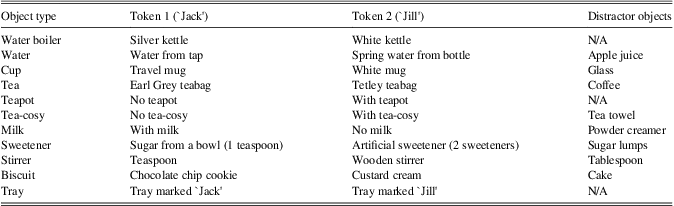
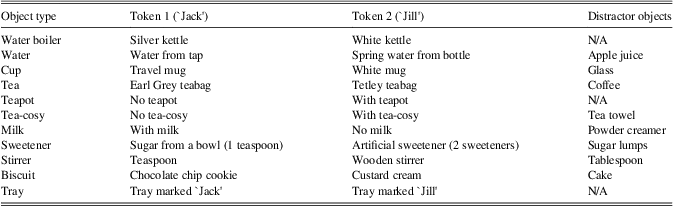
Participants are presented with objects needed to make two cups of tea, along with eight distractor objects. They are required to make two cups of tea for two fictitious people (“Jack” and “Jill”), who have different and specific tea requirements (see Appendix A for the objects used in the TT). Participants are instructed to make the cups of tea as quickly as possible, and are encouraged to interleave the steps required for the two teas. They are asked to avoid touching the objects until they need to use them. Participants are encouraged to say when they think they have made an error or when they are unsure that what they were doing was right, so that error monitoring can be coded. Participants are encouraged to ask questions about the task and instructions before the task begins, but not during the task.
Dual condition
Participants are required to complete the same task while simultaneously performing the Oral Trail Making Task (OTMT; Ricker & Axelrod, Reference Ricker and Axelrod1994). The OTMT requires participants to generate a verbal sequence of alternate letters and numbers (e.g., A1, B2, C3….). Participants are not permitted to stop one task to carry out the other (in such cases, participants are prompted to “carry on” or “keep going”), unless it is to verbalize an error. If participants reach the end of the alphabet they start the alphabet again, but continue the same number sequence (e.g., A27).
Neuropsychological Measures
The National Adult Reading Test (NART; Nelson, Reference Nelson1982) is a vocabulary test, which provides an estimate of verbal IQ.
Trail Making Task A and B (TMT; Army Individual Test Battery, 1944) is a measure of executive processing, requiring visual-conceptual and visuo-motor tracking. The TMT ratio (TMT-B/TMT-A) provides a good indicator of executive functioning (Arbuthnott & Frank, Reference Arbuthnott and Frank2000). It also controls for age and education (Lamberty, Putnam, Chatel, Bieliauskas, & Adams, Reference Lamberty, Putnam, Chatel, Bieliauskas and Adams1994) and thus can be compared between young and older adults.
The Digit Symbol Substitution Test (DSST; Wechsler, Reference Wechsler1987) is a pen and paper test of psychomotor performance and measures speed of information processing.
The Map Test of Everyday Attention (Map-TEA; Robertson, Ward, Ridgeway, & Nimmo-Smith, Reference Robertson, Ward, Ridgeway and Nimmo-Smith1996) is a visual search task measuring sustained attention.
Procedure
Informed consent was first taken, followed by the NART, TMT-A, and TMT-B and finally the TT. The standard condition of the TT was always completed before the dual condition. This was to ensure that the dual condition always included practice effects, making it consistent among all participants. Finally, participants were debriefed and thanked for their participation.
Data Coding for Errors and Error Monitoring
The Noldus Observer software (Version 5.0; Noldus Information Technology, 2003) was used to code performance on the TT from digital video.
Errors
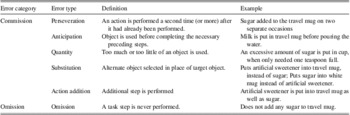
Errors were coded using the error taxonomy developed by Giovannetti, Schwartz, et al. (Reference Giovannetti, Schwartz and Buxbaum2007) for the Coffee Challenge. Errors were coded as either commissions or omissions. Following Giovannetti, Schwartz, et al. (Reference Giovannetti, Schwartz and Buxbaum2007), commissions were broken down into specific error types: when a task step was performed incorrectly (i.e., anticipation, perseveration, substitution, quantity) and when an off-task step was performed (i.e., action addition). Omissions were recorded when a task step was completely omitted. See Appendix B for the error taxonomy.
Error Monitoring
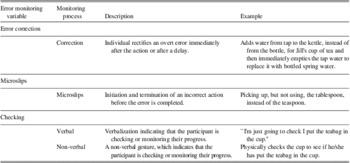
An error monitoring taxonomy (modeled on Bettcher et al., Reference Bettcher, Giovannetti, Macmullen and Libon2008) was used to analyze error correction, microslips and checking behavior (see Appendix C). In contrast to Bettcher et al. (Reference Bettcher, Giovannetti, Macmullen and Libon2008), microslips were coded as an independent category, and were not included as errors and corrections. Additionally, a novel checking category was added to capture any verbal or non-verbal indication that the participant was monitoring their performance.
TT Performance Speed
The TT performance speed for each participant in each condition was recorded in seconds.
Inter-rater Reliability
The error taxonomy has previously shown to have high inter-rater reliability (Giovannetti, Schwartz, et al., Reference Giovannetti, Schwartz and Buxbaum2007), as has the error-correction and microslip component of the error monitoring taxonomy (Bettcher et al., Reference Bettcher, Giovannetti, Macmullen and Libon2008). Inter-rater reliability of the novel checking category was established across two raters (SB and another lab member) using Cohen's Kappa analysis. A Kappa of .62 (p < .0001) indicated substantial agreement (Landis & Koch, Reference Landis and Koch1977).
Data Analysis
All data were analyzed using IBM Statistics 20. For demographic data, independent samples t tests were carried out. Effect sizes were reported using Pearson's correlation coefficient (r). Age-group × condition mixed design analyses of variance were conducted on all main variables and Bonferroni corrections were applied. Effect sizes were reported using partial eta squared (η2). Correlations were calculated using Spearman's Rho (some variables were non-parametric). P values of below .05 were considered statistically significant. All data have been reported to two decimal places, except where borderline p-values were found. In which case these were reported to three decimal places.
Results
Preliminary Analyses
Demographic and neuropsychological characteristics of the sample
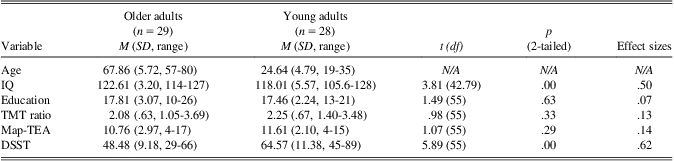
Young and older adults were comparable on years of education, TMT ratio scores and Map-TEA (all p > .05). Older adults had a significantly higher NART estimated IQ than the younger adults (p < .001), but young adults performed better in the DSST compared to older adults (p = .00; see Table 1).
Mean averages of demographic and neuropsychological variables (+SD)
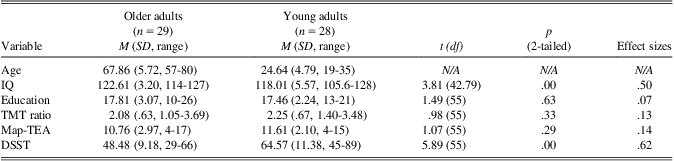
Note. IQ = NART estimated IQ; Education = Years of education; TMT ratio = Trails B/Trails A; Map-TEA = Map Test of Everyday Attention; DSST = Digit Symbol Substitution Test.
TT performance speed
TT performance speed did not differ across conditions or age-group, and there was no significant condition × age-group interaction (all Fs < 1). Conclusively, this analysis demonstrates that neither age-group had a speed of performance advantage that might have lead to a variation in error rate between age-groups.
Secondary task performance
The rate of OTMT responses per minute was calculated. On average young adults made 14.25 OTMT responses per min (SD = 3.61) and older adults made 14.10 OTMT responses per min (SD = 3.57); this difference was not significant, t(55) = 0.16, p > .05. Thus, any age-group difference in TT performance in the dual condition cannot be explained by difference in digit generation time (and by implication, difference in working memory load).
Principal Analyses: Errors and Error Monitoring
Errors
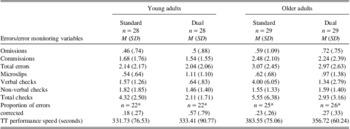
Errors were low across all participants (see Table 2). Contrary to prediction, there was no significant main effect of age-group or condition on total errors and no significant interaction (all Fs < 1). In terms of the main categories of errors, commissions were more common than omissions, regardless of age-group or condition, with substitutions being the most common type of commission in both age-groups and both conditions. Regarding errors of omission, there was no significant main effect of age-group or condition, and no significant interaction (all Fs < 1). Similarly with respect to commission errors, there was no significant main effect of age-group or condition and no significant interaction (all Fs < 1).
Mean averages of main error and error monitoring variables (+SD)

*Participants who made no errors were not included in this analysis.
Error monitoring
Verbal checks
Verbal checks were significantly more frequent in the standard condition, than the dual condition across both age-groups (F[1,55] = 17.77; p = .00; η2 = .25). There was a significant age-group × condition interaction (F[1,55] = 4.12; p = .047; η2 = .07), with older adults making more verbal checks than young adults in the standard condition (t[30.51] = −2.11; p = .04; 2-tailed), but no difference in the dual condition (t[55] = −1.28; p > .05; 2-tailed). The main effect of age-group just missed the .05 level of significance (F[1,55] = 21.89; p = .058; η2 = .06), reflecting a non-significant trend for older adults to make more verbal checks than young adults overall (regardless of condition).
Non-verbal checks
There was no significant main effect of condition or age-group and no significant interaction (all Fs<1).
Microslips and error-corrections
There was a significant main effect of condition on microslips (F[1,55] = 6.62; p = .02; η2 = .02), with more microslips made in the dual condition than in the standard condition for both age-groups. There was no significant main effect of age-group on microslips (F < 1), and no significant age-group × condition interaction (F < 1). The proportion of errors corrected was calculated for those who made errors (see Table 2); there was no significant main effect of condition or age-group, and no significant interaction (all Fs < 1).
Supplementary Analyses
Qualitative breakdown of verbal checks
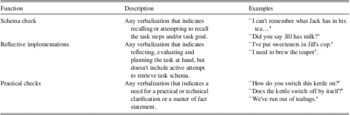
To investigate verbal checks further, a coding scheme was developed for qualitative analysis of verbalizations (see Appendix D). Thus, checks were classified as: schema checks (SC; recalling or attempting to recall the task steps and/or task goal); reflective implementations (RI; reflecting, evaluating, and planning the task at hand); practical checks (PC; any comment indicating technical clarification or a matter of fact statement). All statements were rated independently by two raters (S.B., J.R.); Kappa was .78 (p < .0001), indicating a substantial agreement (Landis & Koch, Reference Landis and Koch1977). Remaining inconsistencies were agreed through discussion.
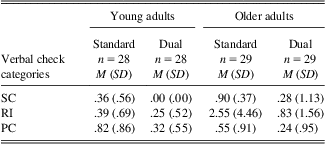
Verbal checks occurred almost exclusively in the standard condition. In this condition, there was a significant main effect of age-group (F[1,55] = 6.34; p = .02; η2 = .10), with older adults making more RIs than young adults. There were no significant differences between older and younger adults on schema checks or on practical checks (all Fs < 1). See Table 3.
Mean averages (+SD) of verbal check categories
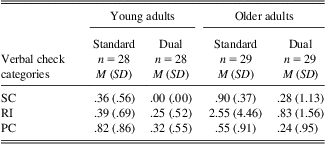
Note. SC = Schema check; RI = Reflective implementation; and PC = Practical check.
Following significant group differences on verbal checks and microslips, Spearman's Rho (r 2) correlations were carried out to determine any associations between verbal checks (specifically SCs, RIs, and PCs), errors (omissions and commissions), and microslips. Only significant correlations are reported here (r 2 range of non-significant correlations =−.19–.21, p > .05). Schema checks and reflective implementations in both conditions correlated with commissions in the dual condition (SCs and RIs in standard: r 2 = .57; p = .00; r 2 = .33; p = .014; SCs and RIs in dual: r 2 = .51; p = .000; r 2 = .384; p = .003). Microslips in the standard condition correlated with reflective implementations in the dual condition (r 2 = .32; p = .015). Similarly, microslips in the dual condition correlated with schema checks (r 2 = .43; p = .001) and reflective implementations (r 2 = .39; p = .003) in the standard condition, and schema checks (r 2 = .35; p = .008) and reflective implementations (r 2 = .32; p = .04) in the dual condition. This hints that microslips and verbal checks might be measuring the same construct (i.e., error monitoring), but that neither effectively reduced commission errors.
Relationship between TT performance and neuropsychological measures
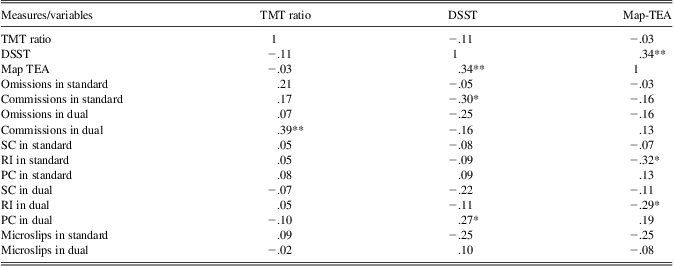
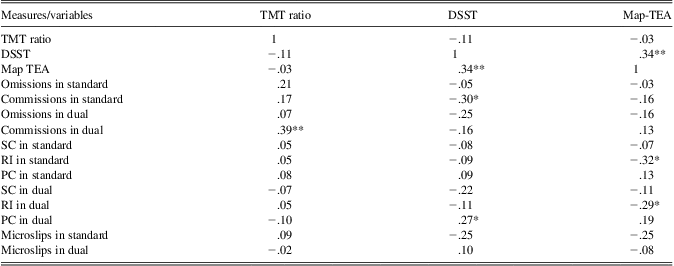
Spearman's Rho correlation (r 2) was conducted between the TMT ratio (a measure of executive functioning), DSST (a measure of speed of processing), Maps-TEA (a measure of sustained attention), and errors/error monitoring outcome variables across all participants regardless of age-group (see Appendix E). TMT ratio only correlated significantly with commissions in the dual condition (r 2 = .39; p = .00; 2-tailed), suggesting that poorer executive function is related to higher commissions. Good performance on the DSST was associated with fewer commissions in the standard condition (r 2 = −.30; p < .05; 2-tailed) and more practical checks in the dual condition (r 2 = .27; p < .05; 2-tailed). This suggests that speed of processing may also provide a proxy measure of executive competence. Additionally, performance in the Maps-TEA was associated with fewer reflective implementations in both conditions, suggesting that sustained attention was associated with reduced need to externalize online monitoring of the task.
Discussion
Building on previous studies (e.g., Bettcher et al., Reference Bettcher, Giovannetti, Macmullen and Libon2008; Giovannetti, Schwartz, et al., Reference Giovannetti, Schwartz and Buxbaum2007), this study presents a comprehensive analysis of errors and error monitoring behaviors by healthy young and older adults in a naturalistic task.
Consistent with the resource model, distribution of error types was similar across age-groups and across conditions. For both young and older adults, errors of commission were more common than omission errors. Contrary to expectations, older adults did not make more errors than young adults. The results are in line with studies reporting that healthy controls tend to be low error producers and produce mostly errors of commission (Schwartz, Reference Schwartz2006).
The error pattern observed in the older adults performing the TT when resources were limited differed from reported errors in people with dementia, who make mostly omissions (Giovannetti, Libon, Buxbaum, et al., Reference Giovannetti, Libon, Buxbaum and Schwartz2002; Ramsden, Kinsella, Ong, & Storey, Reference Ramsden, Kinsella, Ong and Storey2008; Rusted & Sheppard, Reference Rusted and Sheppard2002). Therefore, limiting the cognitive resources of older adults did not induce an error profile that modeled participants with dementia. The number of errors made in the present sample was surprisingly low, considering the complexity of the task, even when the secondary load (the OTMT) was added. The resource model would anticipate more errors when cognitive resources are limited (Schwartz et al., Reference Schwartz, Montgomery, Buxbaum, Lee, Carew, Coslett and Mayer1998), but this was not observed in our sample. Notably, the exceptionally good performance in the dual condition was not achieved by taking extra time: there was no difference in performance speed between conditions in either age-group. The dual condition always followed the standard condition and practice effects may have reduced the dual task impact. Although there were no changes in the task accuracy, however, we did observe a difference in monitoring behaviors, which is discussed later.
Giovannetti et al. (Reference Giovannetti, Bettcher, Brennan, Libon, Kessler and Duey2008) suggested that participants with dementia could be either omissive, commissive, or have a mixed pattern of everyday action impairment, as evidenced by different neuropsychological measures predicted different error categories in people with dementia: omissions were predicted by global cognitive ability and episodic memory; commissions were predicted by deficits in executive functioning. The present study explored this model for healthy adults without dementia: For both young and older adults, the dominance of commission errors suggests that the task requires and engages executive skills. Imposing a concurrent working memory task, however, did not increase commissions further.
Verbal checks occurred exclusively in the standard condition; older adults made more RIs than young adults; and there were no differences between SCs and PCs between age-groups. We suggest that RIs represent on-line planning and evaluation of the task at hand, and provide here an external index of executive engagement. The tendency for older adults to verbalize RIs is consistent with active monitoring to hold attention on task—a shift away from automatic executive engagement to more conscious executive engagement. This is supported by the inverse relationship between sustained attention and RIs—the poorer attentional focus, the higher the need for active monitoring. In the standard condition, commissions were associated with a slower speed of processing, and in the dual condition, with poorer executive functioning (the latter supporting Giovannetti et al., Reference Giovannetti, Bettcher, Brennan, Libon, Kessler and Duey2008). These results suggest that different domains may be engaged under different task conditions to minimize errors of commission.
Three measures of monitoring were recorded: error corrections, checking behaviors, and microslips. Surprisingly, there was no difference in the proportion of errors corrected between young and older adults, contradicting the notion that age-related resource limitations might be a limiting factor in error correction. There was also no difference (for either age-group) in the proportion of errors corrected under standard or dual conditions. The literature regarding error correction in older adults has reported mixed findings. In a serial choice reaction time task, older adults detected and corrected as many of their errors as younger adults, but they needed additional time (Rabbitt, Reference Rabbitt2002). In the present study, older adults did not require more time to maintain an error correction rate equivalent to their younger counterparts. Band and Kok (Reference Band and Kok2000) found that task complexity rather than time restrictions determined older adults’ error corrections, but our study was unable to support these findings.
A key finding in the present study was that both young and older adults do engage in active checking during performance of an everyday task, but this checking had little impact on task accuracy. First, for both groups, verbal checking was reduced significantly when the dual condition limited cognitive resources, likely reflecting use of the oral OTMT. However, actual errors did not increase for either group, suggesting that verbal checks were not a necessary part of performance accuracy even when they were used. In fact, verbal checks (schema checks and reflective implementations particularly) across all participants correlated with errors of commission in the dual condition. This suggests that verbal checks are ineffective in reducing errors. Second, older adults made more verbal checks (specifically RIs) than young adults. Again, eliminating RIs in the dual task condition did not affect performance accuracy, which suggests that verbal checks did not improve error detection/correction. Third, all participants adjusted to resource reduction with an increase in microslips. Thus, as verbal checking decreased, monitoring continued in a less overt form (microslips), and error rates did not change—an interpretation supported by the observed correlation between verbal checks in the standard condition and microslips in the dual condition across all participants. Brennan and colleagues (Reference Brennan, Giovannetti, Libon, Bettcher and Duey2009) found a similar pattern of data in a dementia population, where failure to monitor was not related to action deficits. Our data suggest that monitoring is similarly uncorrelated with action errors in older adults without dementia.
Previous studies show that action errors were related to unawareness of errors in dementia (Giovannetti, Libon, & Hart Reference Giovannetti, Libon and Hart2002) and head injury participants (Hart, Giovannetti, Montgomery, & Schwartz, Reference Hart, Giovannetti, Montgomery and Schwartz1998). This study suggests that healthy adults, even though they make use of overt monitoring as they perform an everyday task, do not use it as a route to improve accuracy. Awareness of errors is a prerequisite for effective training, and several studies have begun to explore awareness in dementia in relation to cognitive rehabilitation (Markova, Clare, Wang, Romero, & Kenny, Reference Markova, Clare, Wang, Romero and Kenny2005). Clare, Wilson, Carter, Roth, & Hodges (Reference Clare, Wilson, Carter, Roth and Hodges2004) demonstrated that awareness of memory difficulties in a dementia sample predicted outcome of a cognitive rehabilitation intervention. In an earlier study, the same authors reported that a higher level of awareness (Clare, Wilson, Carter, Roth, & Hodges, Reference Clare, Wilson, Carter, Roth and Hodges2002) was associated with better outcomes for cognitive rehabilitation interventions in early dementia.
There were several limitations in this study. First, there were, overall, few error and error monitoring behaviors. A design with a more complex everyday task could address this. Second, the dual condition always followed the standard condition; this may have reduced errors under the dual condition. Third, the oral aspect of the OTMT may have hindered verbal checking. Future research could use a non-verbal secondary task. Fourth, the sample predominantly comprised university students, staff and alumni; thus, higher than average education and IQ might have explained the exceptionally good performance in the everyday task.
Despite these limitations, using a comprehensive taxonomy of active error monitoring, this study demonstrated that for older adults overt monitoring of performance might have little impact on task accuracy. Future studies should investigate whether enhanced awareness or training would make monitoring more effective. This knowledge would certainly aid the development of more effective behavioral strategies to promote maintenance of everyday task performance by people with failing memory, including dementia.
Acknowledgments
We thank the participants for taking part in this study; Lucy Morrell for her assistance on recruitment and data analysis; and the editor, associate editor and reviewers for their valuable suggestions for improving the methodology and manuscript. This research was conducted in partial fulfillment of the requirements for Sara Balouch's PhD. Sara Balouch was funded by the Michael Chowen Scholarship (awarded to Jennifer M. Rusted) and a Graduate Teaching Assistantship from the University of Sussex. Part of the data from this study was presented at the 17th Meeting of The European Society for Cognitive Psychology in San Sebastian, Spain (2011). The information reported in this manuscript and the manuscript itself are new and original. The manuscript is not under review by any other journal and has never been published either electronically or in print. There are no financial or other relationships that could be interpreted as a conflict of interest affecting this manuscript.
Appendix A
Objects used in TT
Appendix B
Tea-making task error taxonomy

Appendix C
Error monitoring taxonomy

Appendix D
Verbal monitoring coding guide

Appendix E
Correlation table of neuropsychological measures and error/error monitoring variables