INTRODUCTION
Huntington’s disease (HD) is an autosomal dominant neurodegenerative disorder (Huntington Study Group, 1996) with an expanded CAG trinucleotide on chromosome 4 (Gusella, MacDonald, Ambrose, & Duyao, Reference Gusella, MacDonald, Ambrose and Duyao1993). HD is diagnosed after the onset of characteristic motor symptoms; however, subtle cognitive and psychiatric changes occur before diagnosis during the “premanifest” stage. A well-documented finding in HD, which occurs both during clinical disease and in the premanifest stage, is difficulty with emotion recognition (Johnson et al., 2007; Stout et al., Reference Stout, Paulsen, Queller, Solomon, Whitlock, Campbell and Aylward2011; for a review, see Henley et al., 2012). In particular, individuals with HD show deficits in recognizing “negative” emotions, including disgust, fear, anger, and sadness, which worsens as the disease progresses (Johnson et al., Reference Johnson, Stout, Solomon, Langbehn, Alyward, Cruce and Paulsen2007; Tabrizi et al., Reference Tabrizi, Langbehn, Leavitt, Roos, Durr and Craufurd2009). Although the emotion recognition deficit is a well-established feature of HD, the extent to which this deficit has social or functional consequences has not yet been demonstrated. To our knowledge, no studies have attempted to systematically remediate the emotion recognition deficit in HD, and it is unknown whether such remediation could improve the quality of day-to-day social interactions in HD.
The relationship between emotion recognition and everyday function has been examined in schizophrenia and other disorders. In schizophrenia, poor emotion recognition is associated with both social dysfunction and diminished social skills (Hooker & Park, Reference Hooker and Park2002; Kee, Green, Mintz, & Brekke, Reference Kee, Green, Mintz and Brekke2003). In fact, social outcomes are more strongly linked to emotion recognition performance than to other neurocognitive abilities in schizophrenia (Fett et al., Reference Fett, Viechtbauer, Dominguez, Penn, van Os and Krabbendam2011). Patients with HD and their families also experience disrupted social function, including reduced cohesion, conflict, and social isolation; however, rather than links to emotion recognition deficits, poor social outcomes have been associated with secondary factors such as personality change, or the ongoing distress of living with or supporting someone with a degenerative condition (Maxted, Simpson, & Weatherhead, Reference Maxted, Simpson and Weatherhead2014; Vamos, Hambridge, Edwards, & Conaghan, Reference Vamos, Hambridge, Edwards and Conaghan2007).
Despite differences in their underlying neuropathology, schizophrenia and HD both manifest with disruptions to frontal-subcortical circuitry (Tekin & Cummings, Reference Tekin and Cummings2002) and are associated with cognitive and behavioral features that have implications for successful remediation, such as apathy and executive dysfunction (Fioravanti, Carlone, Vitale, Cinti, & Clare, Reference Fioravanti, Carlone, Vitale, Cinti and Clare2005). In the absence of evidence from other neurodegenerative conditions (e.g., Alzheimer’s disease, Parkinson’s disease, etc.) we reasoned that a consideration of findings from the schizophrenia literature may be sufficiently relevant to inform our study of emotion recognition remediation in HD. Similar to schizophrenia, emotion recognition may contribute to social function in HD, and thus early remediation could play an important role in optimizing social outcomes.
Research in cognitive remediation in HD is very limited. In fact, a recent review identified just three studies trialing cognitive interventions in HD (Andrews, Dominguez, Mercieca, Georgiou-Karistianis, & Stout, Reference Andrews, Dominguez, Mercieca, Georgiou-Karistianis and Stout2015). A fourth study describes a multidisciplinary remediation program, including cognitive intervention, has since been published (Cruickshank et al., Reference Cruickshank, Thompson, Dominguez, Reyes, Bynevelt, Georgiou-Karistianis and Ziman2015). Of the four cognitive-intervention studies we are aware of, only one has used a control group to evaluate the treatment. All four studies required participants to either attend group sessions, or be admitted to an inpatient facility to receive the treatment. Thus, evidence for rehabilitation techniques in HD is sparse, and controlled studies are even sparser, leaving significant questions as to what rehabilitation approaches may be effective in HD.
Nonetheless, cost-effective, outpatient remediation programs for people with HD are greatly needed to ameliorate the impact of their symptoms. In schizophrenia, computerized remediation methods have been found to be as effective as non-computerized methods in improving social cognition, including emotion recognition (Grynszpan et al., Reference Grynszpan, Perbal, Pelissolo, Fossati, Jouvent, Dubal and Perez-Diaz2011). Moreover, computerized remediation has advantages because participants can complete training in their own homes, accommodating the training to their own schedule, and does not require administration by a trained professional. Computerized cognitive remediation programs have not been trialed in HD.
Computerized emotion recognition remediation studies in schizophrenia have used three commercially available programs. Two programs, “Mind Reading” (Baron-Cohen, Hill, & Wheelwright, Reference Baron-Cohen, Hill and Wheelwright2003) and the “Emotion Trainer” (Silver & Oakes, Reference Silver and Oakes2001), were developed for use in children and adolescents with autism spectrum disorders, and later applied to schizophrenia. The third, MicroExpression Training Tool (METT; Ekman, Reference Ekman2002) is an online tool that uses instructional videos, repeated practice, and feedback to train participants to recognize micro-expressions within a single 45-min session. The instructional videos direct participants’ visual attention to facial areas that convey important emotional information, which include the eyes, nose, and mouth. Although the METT is designed to improve recognition of micro-expressions, the content can also be applied to the recognition of “macro expressions,” the basis on which the emotion recognition deficit has been established and studied in HD.
Using METT, outpatients with schizophrenia improved their emotion recognition performance to similar levels as a healthy comparison group after only a single use (Russell, Chu, & Phillips, Reference Russell, Chu and Phillips2006). A follow-up study compared two groups of outpatients with schizophrenia who either watched the METT videos with verbal instructions and were given performance feedback during practice, or viewed the same videos but without the verbal instructions or feedback. Only the group who received instructions and performance feedback improved on an emotion recognition task after training (Russell, Green, Simpson, & Coltheart, Reference Russell, Green, Simpson and Coltheart2008).
Furthermore, improvements in emotion recognition generalized to novel faces (both static and dynamic) for a subset of METT-trained participants followed-up after 1 month (Marsh et al., Reference Marsh, Green, Russell, McGuire, Harris and Coltheart2010). After training, participants with schizophrenia displayed altered patterns of facial fixation consistent with the directions provided in the METT videos (Marsh, Luckett, Russell, Coltheart, & Green, Reference Marsh, Luckett, Russell, Coltheart and Green2012). Taken together, the findings suggest that patients with schizophrenia are able to follow and apply the instructions delivered in the METT, which can improve emotion recognition both immediately and after a 1-month follow-up. The successful application of the METT in schizophrenia introduces an exciting opportunity for patients with HD, who may also benefit from emotion recognition remediation.
We undertook a small initial study to examine: (1) The feasibility of delivering a computerized program to a group of individuals with premanifest and early symptomatic HD, as measured by their training adherence. We defined “training adherence” a priori as the completion of more than 50% of training sessions, based on actual adherence rates (average number of sessions/modules completed) from prior studies of computerized intervention in psychiatric populations (for a systematic review of 23 randomized-controlled trials see Christensen, Griffiths, & Farrer, Reference Christensen, Griffiths and Farrer2009. Specifically, we assessed the proportion of participants who reached this criterion. (2) The efficacy of the METT for participants who reached the training adherence criterion, as measured using a similar emotion recognition task. Based on previous findings in the schizophrenia population, we hypothesized that METT training would improve emotion recognition performance in individuals with premanifest or clinically diagnosed HD at post-training assessment for the training group (i.e., “near-transfer” effect), compared to the control group that did not receive training. (3) Based on the findings of Marsh et al. (Reference Marsh, Green, Russell, McGuire, Harris and Coltheart2010), we sought to investigate whether there was generalization of METT training to more ecologically valid social scenarios (i.e., “far-transfer” effect), as measured by an additional test of social function administered at baseline and post-training.
METHOD
Participants
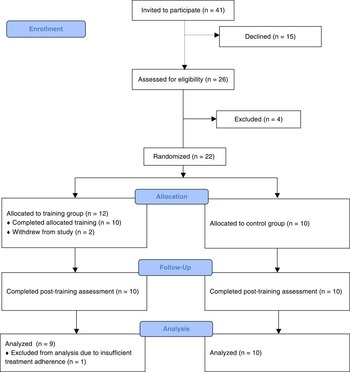
An a priori estimation of sample size using an alpha level of .05 revealed that a total of 24 participants (12 per group) would be needed to detect a large effect size (based on prior research using the METT in schizophrenia) with power of .90. We recruited participants with genetically confirmed HD from our internal research database at Monash University, Clayton, Australia. Forty-one of the 57 participants on our database responded to our invitation to participate in the study. Fifteen declined participation, mostly due to unavailability over the study period, or inability to transport to the testing location. A further four participants did not meet inclusion criteria, meaning the total sample consisted of 22 individuals (11 males, 11 females; mean age=47.45 years, SD=12.36, range=23–69) with HD. All participants were living in the community and had either premanifest (n=13) or early-symptomatic (n=9) HD.
Before recruitment, we screened and then excluded participants with premorbid brain injury, neurological impairment (other than HD), diagnosis of severe psychiatric conditions, and current or premorbid substance abuse or dependence. All participants spoke English as a first language and had access a computer and Internet connection for the training component. Two participants from the training group withdrew from the study after baseline, both citing they believed they would be unable to accommodate the training into their weekly schedule. The final sample consisted of 20 premanifest and early-symptomatic HD participants, 10 in each of the training and control groups. The study was approved by the Monash University Human Research Ethics Committee and each participant gave informed, written consent.
Participant Characterization
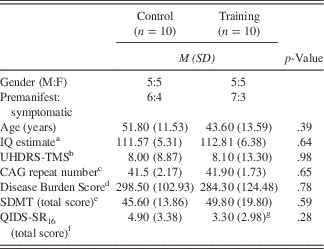
Premorbid intellectual function was estimated using the National Adult Reading Test 2nd Edition (NART-2; Nelson, Willison, & Owen, Reference Nelson, Willison and Owen1992). Participants completed the written version of the Symbol Digit Modalities Test (SDMT; Smith, Reference Smith1982) as a measure of psychomotor speed, and self-rated depressive symptomatology using the 16-Item Quick Inventory of Depressive Symptomatology (Rush et al., Reference Rush, Trivedi, Ibrahim, Carmody, Arnow, Klein and Keller2003). As a measure of disease severity, we obtained each participant’s Unified Huntington’s Disease Rating Scale – Total Motor Score (Huntington Study Group, 1996) from their most recent neurological appointment. Disease burden score was calculated using CAG repeat length number and age (Penney, Vonsattel, MacDonald, Gusella, & Myers, Reference Penney, Vonsattel, MacDonald, Gusella and Myers1997). Groups were comparable on characterization measures at baseline, p>.17, see Table 1.
Demographic characteristics and baseline task performance by group

Note. aIQ estimate according to NART-2 manual (Nelson et al., Reference Nelson, Willison and Owen1992).
b UHDRS-TMS=Unified Huntington’s Disease Rating Scale – Total Motor Score (Huntington Study Group, 1996), range: 0 – 124.
c Cytosine-adenine-guanine number of repeats.
d Disease Burden Score=(CAG repeats – 35.5) * age (Penney et al., Reference Penney, Vonsattel, MacDonald, Gusella and Myers1997).
e SDMT total score=16-Item Quick Inventory of Depressive Symptomatology number of items attempted – number of errors, range: 0 – 110.
f QIDS-SR16 total (Rush et al., Reference Rush, Trivedi, Ibrahim, Carmody, Arnow, Klein and Keller2003), range=0 (normal) – 27 (very severe).
g n=8.
Materials
METT
The METT (Ekman, Reference Ekman2002) trains participants to recognize micro-expressions, which are displays of “suppressed” emotion lasting approximately 25 ms (Ekman, Reference Ekman2009), and comprises five components: (a) a pre-test assessment of 14 trials of micro-expression recognition in which the user must select the expression displayed from a list of options, including “happy,” “angry,” “sad,” “disgust,” “fear,” “contempt,” and “surprise”; (b) instructional videos designed to teach the user to identify and differentiate emotions; (c) a practice trial of 28 micro-expressions, which follows the structure of the pre-test assessment, but with additional accuracy feedback; (d) a post-training review with a second set of instructional videos comparing different faces; and (e) a post-test assessment, which mirrors the pre-test assessment but using different facial images.
Participants completed METT components in sequential order. The instructional videos delivered throughout the METT focus on learning to identify a particular emotion (e.g., anger), or discriminate between two emotions (e.g., anger and disgust). The videos are short, approximately 30 s each, and feature verbal instructions explaining which areas of the faces provide important information in identifying a particular emotion. For example, the commentary states, “see how the brows are drawn together in the angry face,” over video of an actor displaying an angry expression. Eight videos are shown in each of the two instructional components.
Emotion Recognition Task
In the Emotion Recognition Task, participants viewed images of faces and selected the expressed emotion from a list of response options displayed on a computer screen. We used facial stimuli from the Karolinska Directed Emotional Faces (KDEF; Lundqvist, Flykt, & Öhman, Reference Lundqvist, Flykt and Öhman1998) dataset displaying one of six emotions; anger, disgust, fear, sadness, surprise, or neutral. The KDEF dataset has been widely used in emotion perception research and the hit-rates for identifying each emotion are comparable to other established facial datasets (Goeleven, De Raedt, Leyman, & Verschuere, Reference Goeleven, De Raedt, Leyman and Verschuere2008). Goeleven et al. (Reference Goeleven, De Raedt, Leyman and Verschuere2008) reported the concordance for emotion ratings of KDEF stimuli at 1 week as 87.96%, indicating good test–retest reliability.
We used KDEF faces, as they do not appear on the METT, in an attempt to limit direct practice effects on outcome measurement. Sixty-two stimuli for each emotion were shown. Stimuli were delivered randomly in seven blocks each separated by a short break. For each trial, a fixation cross appears for 500 ms followed by the emotion stimulus for 3000 ms. The response options were then displayed until the participant makes a selection using the keyboard. Participants completed five practice trials before commencing the test trials. The Emotion Recognition Task was administered through Presentation® software. The primary outcome measure for the Emotion Recognition Task was percentage accuracy scores for each emotion type and the mean total accuracy across emotion types.
The Awareness of Social Inference Test
The Awareness of Social Inference Test (TASIT; McDonald, Flanagan, Rollins, & Kinch, Reference McDonald, Flanagan, Rollins and Kinch2003) assesses understanding of emotion and social encounters via presentation of short video vignettes, and is considered an ecologically valid measure of social cognition (McDonald, Flanagan, Martin, & Saunders, Reference McDonald, Flanagan, Martin and Saunders2004). Two forms (TASIT-A and TASIT-B) are available, with alternate-forms reliability ranging from .62 to .83, respectively (McDonald et al., Reference McDonald, Bornhofen, Shum, Long, Saunders and Neulinger2006). The TASIT-R comprises three components; (a) Emotion Evaluation Test, where the participant appraises emotional expression from the face and prosodic features; (b) Social Inference – Minimal and (c) and Social Inference – Enriched, which examine comprehension of sincere and sarcastic interactions, and lies and sarcasm, respectively.
In the Emotion Evaluation Test, participants’ select the emotion expressed by an actor in the vignette (either “positive”: “happy,” “surprise,” or “neutral,”; or “negative”: “sad,” “anxious,” “angry,” or “revolted”) from a list of written response options. For Social Inference – Minimal and Enriched, the examiner asks questions about what the actor was doing, saying, thinking, or feeling (e.g., “is Ruth reassuring Gary that the shirt is nice?”) and the participant responds either “yes” or “no”. Participants completed all components of the TASIT and the dependent variable was the total score of correct items for each section.
Training adherence
We instructed participants in the training group to record the date of training, and the results of their post-test assessment, which is shown as a percentage of correct responses for each emotion and displayed after completing the final component of the METT. Participants’ records were cross-checked against possible response values. A session was noted to be “complete” if all of the participant’s records for a training date contained valid responses.
Procedure
We administered characterization measures, the Emotion Recognition Task, and TASIT-A at baseline. After baseline, we assigned participants to groups using the covariate adaptive randomization method (Taves, Reference Taves1974) to minimize variance in age, sex, and disease status. Participants completed post-training assessments (the Emotion Recognition Task and TASIT-B) 6 to 8 weeks after baseline. The examiner who conducted baseline and post-training assessments was not blinded to group. Figure 1 shows the flow of participants through the study.
The flow of participants through the study.

We instructed participants in the training group to use the METT program twice per week for 4 weeks, consistent with other research using computerized training in schizophrenia (Wykes, Huddy, Cellard, McGurk, & Czobor, Reference Wykes, Huddy, Cellard, McGurk and Czobor2011). Participants allocated to the training group nominated 2 days of the week to use the program, and the examiner e-mailed or text-messaged participants accordingly as a reminder. We also created a METT manual for participants in the training group. If required, the examiner visited participants’ in their homes and trained a family member or spouse to assist with administration of the METT (e.g., navigating to Web page, logging in), and to provide technological support if required. Family members were instructed not to assist participants in completing METT components. Participants also completed training adherence measures after each training session. The control group was waitlisted and given the opportunity to access the training program after completing their post-training session.
Data Analysis
The number of training sessions completed by each participant was expressed as a percentage of the total number of sessions, as the indicator of training adherence. One participant in the training group did not meet the training adherence criterion (completing only three of the eight training sessions) and was excluded from the efficacy analysis. One univariate outlier was identified in the baseline Emotion Recognition Task scores for fearful faces. To limit the impact of the outlier on normality, we replaced the outlier with a value one unit larger than the next extreme score (Tabachnick & Fidell, Reference Tabachnick and Fidell2013). Groups had similar baseline performances on the Emotion Recognition Task and TASIT-A (p>.28), except for angry faces which approached significance, p=.09, with higher scores for the training group.
To assess the efficacy of METT training, we conducted a series of two-way mixed repeated measures analyses of variance (ANOVAs) on Emotion Recognition Task Total percentage accuracy scores, and similarly for each emotion individually, with time as the within-subjects factor with two levels (baseline and post-training) and group as the between-subjects factor. A second series of two-way mixed repeated measures ANOVAs were conducted on the total score for each of the three components of the TASIT, with time as the within-subjects factor (TASIT-A and TASIT-B) and group as the between-subjects factor. We note, however, that our small sample size means that power might not be adequate to detect a large effect.
RESULTS
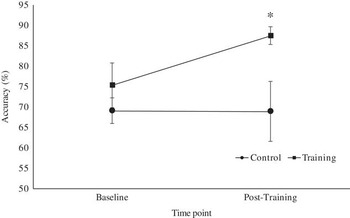
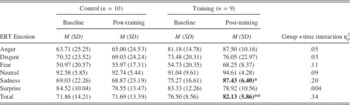
Ninety percent of participants in the training group reached the training adherence criterion. On average, participants in the training group completed seven of the eight METT sessions (range: five to eight), with the majority completing all eight sessions. Our analysis of the Emotion Recognition Task data revealed a significant interaction between group (training vs. control) and time (pre-training vs. post-training) such that individuals in the training group improved their overall performance on the Emotion Recognition task after training, F(1,17)=9.70, p=.01, ηp 2=.36, see Table 2. The effect size of the group by time interaction was large. Sadness was the only individual emotion for which post-training scores were significantly greater than baseline scores, F(1,17)=4.32, p=.05, ηp 2=.20, with higher (more accurate) scores for the training group compared to the control group at post-training, see Figure 2.
Accuracy for sad faces on the Emotion Recognition Task.

Mean score on Emotion Recognition Task, averaged across baseline and post-training, for training and control groups

*p=.05.
**p=.01.
No interactions for the remaining emotions achieved significance, p>.16. The group by time interactions on the three TASIT components were not significant, p>.25.
DISCUSSION
Our study aimed to assess the feasibility and efficacy of computerized emotion recognition remediation in individuals with HD. Participants with premanifest and early-symptomatic HD in our study were able to successfully complete our training protocol with very high adherence rates. On average, participants completed seven of the eight sessions with a moderate level of support, including reminders to complete training, a detailed training manual, and training of family member to provide technological support where required. Additionally, our findings suggest that brief training, using a self-guided, computerized tool (METT), may be able to improve emotion recognition accuracy in premanifest and early-symptomatic HD. In this small study of only 10 per group, improvements for the recognition of sad faces specifically, and on the Emotion Recognition Task overall, were significantly greater for the training group than for the control (non-training) group.
While our findings are promising, the clinical significance of these findings is not clear from the current study, particularly in the absence of any published norms against which the performance of the training and control groups in our sample can be compared. The normative data for emotion recognition using KDEF faces (Goeleven et al., Reference Goeleven, De Raedt, Leyman and Verschuere2008) is derived from a sample of younger, female participants and, therefore, was not an appropriate comparison for participants in our study. Preliminary analysis of data available to us from another study suggests that, at baseline, both our training and control groups performed more poorly than a healthy older adult sample (described elsewhere; Wasser et al., manuscript in preparation) who also completed the same Emotion Recognition Task; and that the overall post-training scores obtained by the training group, but not the control group, were comparable to those of the healthy participants. This suggests that our results may have clinical significance that warrants further investigation.
The overall improvement in emotion recognition observed in the training group does not appear to be explained by practice effects on the Emotion Recognition Task, because we did not observe a similar improvement in the control group from baseline to post-training. Furthermore, the training group’s improvement at post-training was not a result of repeated exposure to particular face stimuli as our primary outcome measure (the Emotion Recognition Task) used facial stimuli that did not appear in the METT. That is, using novel static facial photographs, we found that the METT was successful in achieving “near-transfer” (Royer, Reference Royer1979) effects, which are improvements on a task similar to the original training tool, in a way similar to the work by Marsh et al. (Reference Marsh, Green, Russell, McGuire, Harris and Coltheart2010), which used the METT in schizophrenia.
Although our analysis of individual emotions revealed the interesting finding for recognition of sad faces but not of other emotions, previous studies using METT in schizophrenia have only analyzed all emotions in aggregate, with the exception of one study. Marsh et al. (Reference Marsh, Green, Russell, McGuire, Harris and Coltheart2010) also reported a specific improvement in the recognition of sad faces presented at 50% intensity (a condition not included in our study). Our results, along with those of Marsh et al. (Reference Marsh, Green, Russell, McGuire, Harris and Coltheart2010) suggest that the METT may have particular utility in improving patients’ recognition of sad faces.
In contrast to these near-transfer effects to the static images of the emotion recognition task, “far-transfer” (Barnett & Ceci, Reference Barnett and Ceci2002) effects, which relate to generalization of training to a dissimilar, but related task (e.g., vocal emotion recognition), were not achieved in our study. We did not observe far-transfer to social inference abilities using dynamic emotion recognition stimuli from the TASIT-R, which was observed in the study with schizophrenia (Marsh et al., Reference Marsh, Green, Russell, McGuire, Harris and Coltheart2010). This may be due to methodological differences between studies; for example, Marsh et al. (Reference Marsh, Green, Russell, McGuire, Harris and Coltheart2010) used the first 14 items of the Emotion Evaluation Test (Form A) at baseline and the remaining 14 items at post-training, where our design used alternate forms (A and B) in their entirety. At least one set of authors (McDonald et al., Reference McDonald, Flanagan, Rollins and Kinch2003) argues that in the TASIT, angry, surprised, and sad items are more difficult on Form B, and neutral faces are more difficult on Form A, although these effects have not been shown to be statistically significant.
Alternatively, differences may be due to the differences in the underlying mechanisms of the effects of METT in HD compared to schizophrenia. Furthermore, although TASIT performances were below average, participants in our study did not fall into the “abnormal” range according to the published normative data for healthy controls. Therefore, the near-ceiling performance of our premanifest and early-symptomatic HD participants’ baselines might explain why we did not observe significant improvements on the TASIT at post-training.
The lack of far-transfer is not entirely unexpected in that the METT training videos address only emotion recognition and provide no training on applying emotional information to infer others’ thoughts or feelings. While not observed in our study, emotion recognition training may generalize to other social cognitive skills such as social inference, but participants may require additional support over a longer period to apply the training to more complex, dynamic, real-world scenarios.
Although the near-transfer benefits observed in our study were measurable in the short-term (i.e., within 2 weeks of completing the METT program), we did not examine the stability or maintenance of training effects, which is a limitation both of our study and computerized emotion recognition research in general (Fiszdon & Reddy, Reference Fiszdon and Reddy2012; Paquin, Wilson, Cellard, Lecomte, & Potvin, Reference Paquin, Wilson, Cellard, Lecomte and Potvin2014). The use of multiple time-points for post-training assessments in future research will be important for establishing the longitudinal stability of effects, although such studies will also need to consider the effects of disease progression, which may confound such assessments. It was not possible to examine the effects of disease stage on training outcome in our study due to the small sample size. Future studies using the METT in HD might consider stratifying participants by disease severity to determine if training gains are made across disease stages equally. Lastly, ongoing research would benefit from the use of an examiner blinded to group to conduct baseline and post-training assessments, which is a clear limitation of our study.
Our study has demonstrated that the delivery of the computerized METT program to premanifest and early-symptomatic HD is feasible in terms of training adherence, and that it may be effective in improving overall emotion recognition abilities in the short-term. Given the very small sample size, we see this as promising, but preliminary, evidence that must be further substantiated with larger single-blinded randomized controlled trials and longer-term follow-up. Nonetheless, with tailored support such as a participant manual and training reminders, participants completed METT sessions and measures of training adherence independently and without the need of a trained administrator, demonstrating feasibility of this approach for emotion recognition remediation in HD.
ACKNOWLEDGMENTS
We thank the participants for their time and ongoing commitment to this study. The Paul Ekman Group donated a METT training tool license for use in our research; however, they were not involved in data collection, interpretation of results, or preparation of this manuscript. The authors have no conflicts of interest to declare.