The nature and function of infants’ communicative attempts prior to the emergence of language have recently been in the spotlight of research for purposes ranging from support for theories of language development to the establishment of early indexes of developmental disorders. Recent empirical results confirm that infants’ early vocal activity is not unrelated to their subsequent linguistic development, as it was once thought (e.g., Jakobson, 1941/1968). Abundant evidence on the development of both formal and pragmatic properties of prespeech vocalizations Footnote 1 suggests their precursory character and central function in the emergence and development of language. Accordingly, transition into language seems rather gradual while early words seem to be built on the basis of knowledge and abilities progressively constructed during the prespeech period of communicative development (for reviews see McCune, Reference McCune2008; Oller, Reference Oller2000; Stoel-Gammon, Reference Stoel-Gammon2011; Vihman, Reference Vihman1996; Vihman, DePaolis, & Keren-Portnoy, Reference Vihman, DePaolis, Keren-Portnoy and Bavin2009).
More specifically, recent research has identified several early vocal precursors of speech, which are taken to reflect infants´: (a) phonological development, both segmental and prosodic; (b) communicative development; and (c) early symbolic development. They all are thought to constitute prerequisite developments for the emergence of language.
Early vocalizations as indexes of phonological development
The relation and continuity between prespeech vocalizations and early speech has been empirically documented by numerous studies focusing on the formal properties of early vocal activity. Recent research has identified phonological similarities between babbling and early words (e.g., McCune & Vihman, Reference McCune and Vihman2001; Vihman, Macken, Miller, Simmons, & Miller, Reference Vihman, Macken, Miller, Simmons and Miller1985) and has highlighted the gradual adaptation of early vocalizations to the properties of words in a variety of languages (e.g., Boysson-Bardies & Vihman, Reference Boysson-Bardies and Vihman1991). Cross-linguistic studies point to an influence of the ambient language already in the prelinguistic period (e.g., Boysson-Bardies, Hallé, Sagart, & Durand, Reference Boysson-Bardies, Hallé, Sagart and Durand1989; Levitt & Wang, Reference Levitt and Wang1991), as opposed to purely innate predispositions for language acquisition (e.g., Locke, Reference Locke1988). Moreover, both prespeech vocalizations and early words are consistently reported to coexist in the vocal repertoire of infants for several months, confirming a rather gradual transition into language (e.g., Elbers & Ton, Reference Elbers and Ton1985; Vihman et al., Reference Vihman, Macken, Miller, Simmons and Miller1985). Finally, certain types of early vocal behaviors are found to be prerequisites for a normative linguistic development, while qualitative or quantitative flaws are frequently associated with subsequent language disorders. For instance, the production of well-formed, ‘canonical’ syllables, often organized in syllabic sequences -so called ‘canonical babbling’- is found to precede normal lexical development (McCune & Vihman, Reference McCune and Vihman2001; Oller, Reference Oller2000; Stoel-Gammon, Reference Stoel-Gammon, Ferguson, Menn and Stoel-Gammon1992; Vihman, Reference Vihman, Lindblom and Zetterström1986).
Canonical babbling is argued to emerge at some time between 4 and 10 months providing the child with the necessary representations and resources for the identification and shaping of early word forms (Stoel-Gammon, Reference Stoel-Gammon2011; Vihman et al., Reference Vihman, DePaolis, Keren-Portnoy and Bavin2009). At the beginning, children´s babbling typically consists of the repetition of a single syllable (reduplicative babbling 2), but gradually infants manage to combine varying articulatory movements / syllables within the same vocalization (variegated babbling). Moreover, the age of onset of canonical babbling and the number of consonants produced consistently during children’s babble seem to be valid predictors of the onset of speech, the accuracy of speech production and lexical development (e.g., McCathren, Yoder, & Warren, Reference McCathren, Yoder and Warren1999; Menyuk, Liebergott, & Schultz, Reference Menyuk, Liebergott, Schultz, Lindblom and Zetterstrom1986; Vihman et al., Reference Vihman, DePaolis, Keren-Portnoy and Bavin2009; Vihman & Greenlee, Reference Vihman and Greenlee1987). Finally, children who present a delayed onset of canonical babbling (after the age of 10 months) are often reported to have auditory problems and/or later linguistic delays or anomalies (e.g., Eilers & Oller, Reference Eilers and Oller1994; Lynch et al., Reference Lynch, Oller, Steffens, Levine, Basinger and Umbel1995; Oller, Eilers, Neal, & Cobo-Lewis, Reference Oller, Eilers, Neal and Cobo-Lewis1998; Stark & Tallal, Reference Stark and Tallal1988; Stoel-Gammon, Reference Stoel-Gammon1989).
Regarding the suprasegmental properties of early vocalizations, it is widely acknowledged that prosodic features –such as intonation, duration and rhythm- also reflect a gradual influence of the ambient language. More specifically, there seems to be a consensus that prosodic properties of the speech signal are both perceived and produced before the production of speech-like segments (e.g., Boysson-Bardies, Reference Boysson-Bardies1999; Crystal, Reference Crystal, Fletcher and Garman1986; Jusczyk, Cutler, & Redanz, Reference Jusczyk, Cutler and Redanz1993; Kent & Murray, Reference Kent and Murray1982; Mehler et al., Reference Mehler, Jusczyk, Lambertz, Halsted, Bertoncini and Amiel-Tison1988; Nazzi, Bertoncini, & Mehler, Reference Nazzi, Bertoncini and Mehler1988). For instance, traces of prosodic modulation were recently detected even in the spontaneous cry-vocalizations of newborn infants, which seem to be shaped by the language they are exposed to prenatally (Mampe, Friederici, Christophe, & Wermke, Reference Mampe, Friederici, Christophe and Wermke2009). As will be discussed in the next paragraph, various studies suggest that these ‘melodic’ or ‘musical’ properties of the speech signal are closely linked to the affective functions of early communication and to the subsequent ability of infants to express different communicative intentions. Thus, in the last quarter of the first year, it looks as if different prosodic patterns become associated with the expression of different communicative functions or with different communicative contexts, even though in some cases such association may be child-specific (e.g., Delack & Fowlow, Reference Delack, Fowlow, Waterson and C.Snow1978; D’Odorico & Franco, Reference D’ Odorico and Franco1991; Halliday, Reference Halliday1975; Papaeliou, Minadakis, & Cavouras, Reference Papaeliou, Minadakis and Cavouras2002).
Early vocalizations as indexes of communicative development
From the very first months of life, early vocalizations are used by infants as means of expressing their affective states and needs (e.g., Malatesta, Culver, Tesman, & Shepard, Reference Malatesta, Culver, Tesman and Shepard1989; Nadel & Muir, Reference Nadel and Muir2005; Papousek, Reference Papoušek, Papousek, Jurgens and Papousek1992). In this early period, mother-infant communication is “‘held’ by means other than lexical meaning, grammar and syntax” (Malloch, Sharp, Campbell, Campbell, & Trevarthen, Reference Malloch, Sharp, Campbell, Campbell and Trevarthen1997, p. 495). Across cultures, the highly melodious characteristics of infant-directed speech and infant-directed music (i.e., nursery songs and lullabies) provide powerful means for emotional transmission (e.g., Trainor, Austin, & Desjardins, Reference Trainor, Austin and Desjardins2000; van Puyvelde et al., 2010) and communication of intentions (e.g., Fernald, Reference Fernald1989) or, in the words of Trevarthen (1999–2000), for the mother-infant synrhythmic interaction or attunement. Infants, from very early, engage in communications, characterized by rhythmic, melodic and bodily synchronization (‘communicative musicality’; Malloch, 1999/2000; Malloch & Trevarthen, Reference Malloch and Trevarthen2008). According to this line of research, these early communicative behaviors establish a setting of mutual understanding within which more ‘advanced’ forms of communication are built. Around 2 months, infants are known to already engage actively in similar structured communicative interchanges with their caregivers, characterized by rhythmic cycles of turn-taking, which are often called proto-conversations (e.g., Bateson, Reference Bateson and Bullowa1975; Jaffe, Beebe, Feldstein, Crown, & Jasnow, Reference Jaffe, Beebe, Feldstein, Crown and Jasnow2001; Trevarthen & Aitken, Reference Trevarthen and Aitken2001).
Imitation also seems to play a special part in these early emotional ‘dialogues’. It was recently documented that infants not only imitate but also seek out and enjoy being imitated by adults (Kugiumutzakis, Kokkinaki, Markodimitraki, & Vitalaki, Reference Kugiumutzakis, Kokkinaki, Markodimitraki, Vitalaki, Nadel and Muir2005; Nagy & Molnar, Reference Nagy and Molnar2004). Thus, infant imitation, involving body movements, vocalizations and facial expressions, appears to serve a communicative or social function, through which infants acquire information about people´s emotions, actions and intentions, but also a cognitive/learning function, through which infants acquire new skills and knowledge about the world (e.g., Kugiumutzakis, Reference Kugiumutzakis, Nadel and Butterworth1999; Uzgiris, Reference Uzgiris1981). As far as vocal imitation is concerned, babies as young as 2 to 6 months old are found capable of imitating mostly vocalic, but also consonantal sounds (e.g., Kokkinaki & Kugiumutzakis, Reference Kokkinaki and Kugiumutzakis2000; Kuhl & Meltzoff, Reference Kuhl and Meltzoff1996). Moreover, infants at 3 months regularly match their mother’s vocalization pitch and frequency intervals either in absolute, or in relative terms (i.e., by repeating an interval starting from a different tone) (van Puyvelde et al., 2010) and also imitate its prosodic contour (Gratier & Devouche, Reference Gratier and Devouche2011; Papoušek & Papoušek, Reference Papoušek and Papoušek1989). This early imitative activity is reported to accelerate during the second year (Masur, Reference Masur1993) and to include imitation of words (e.g., Masur, Reference Masur1995) and imitation of the prosodic patterns of larger units, such as entire phrases (Karousou, Reference Karousou2004). The importance of vocal imitative activity is highlighted by findings showing, for instance, a significant positive correlation between early vocal or verbal imitation and later lexical development (Masur & Eichorst, Reference Masur and Eichorst2002; Masur, Reference Masur1995; Rodgon & Kurdek, Reference Rodgon and Kurdek1977; Snow, Reference Snow, Speidel and Nelson1989). Additionally, defects in vocal imitation have been reported to be linked with problems or delays in language development (Bishop, North, & Donlan, Reference Bishop, North and Donlan1996; Sigman & Ungerer, Reference Sigman and Ungerer1984).
Although proto-conversations and early imitations do not seem to initially have an apparent goal or a material intentionality other than engaging affectively, caregivers from very early consistently interpret them and systematically produce contingent behaviors in response to particular types of infant vocalizations (Goldstein & West, Reference Goldstein and West1999; Gros-Louis, West, Goldstein, & King, Reference Gros-Louis, West, Goldstein and King2006; Halliday, Reference Halliday1975; Hsu & Fogel, Reference Hsu and Fogel2003). Thus, they gradually lead infants to realize, around 5 months, that their vocalizations can elicit reactions from others and, therefore, their vocalizing activity begins to acquire an instrumental value (Goldstein, Schwade, & Bornstein, Reference Goldstein, Schwade and Bornstein2009). Well before the emergence of their first words, infants progressively use vocalizations in triadic communicative settings (infant-adult-object) as a means of intentionally regulating the actions of their interlocutor towards a concrete goal they wish to achieve. This is the case for the proto-imperative or ‘instrumental’ vocalizations (e.g., Franco & Butterworth, Reference Franco and Butterworth1996; Karousou, Reference Karousou2004), which appear around the age of 8–9 months and usually accompany relevant gestures, such as reaching towards an object that infants want to be given to them (e.g., Bates, Benigni, Bretherton, Camaioni, & Volterra, Reference Bates, Benigni, Bretherton, Camaioni and Volterra1979; Bates, Camaioni, & Volterra, Reference Bates, Camaioni and Volterra1975). Shortly after, another critical intentional behavior emerges: the first proto-referential use of vocalizations (e.g., Franco & Butterworth, Reference Franco and Butterworth1996; Karousou, Reference Karousou2004), in the sense of directing the attention of the communicative partner to a specific phenomenon, an interesting experience that infants want to share with him. Such vocal behaviors are often referred to as ‘deictic’ or proto-declarative vocalizations in analogy with the pointing gestures that usually accompany them (e.g., Bates et al., Reference Bates, Camaioni and Volterra1975, Reference Bates, Benigni, Bretherton, Camaioni and Volterra1979; Capirci, Iverson, Pizzuto, & Volterra, Reference Capirci, Iverson, Pizzuto and Volterra1996; Caselli, Reference Caselli1983; Caselli & Volterra, Reference Caselli, Volterra, Volterra and Erting1990). Bates et al. (Reference Bates, Benigni, Bretherton, Camaioni and Volterra1979) described as ‘proto-forms’ these early vocal and gestural means to express declarative and imperative functions and established a relationship between their emergence and the development of language.
Apart from their communicative use, early vocalizations have long been reported to also occur outside of a social, communicative context, when infants do not appear to have an intention to communicate with an interlocutor. The nature of this ‘private’ use of prespeech vocalizations has recently begun to be explored. For instance, significant differences have been detected between the pitch patterns of vocalizations uttered apparently with the intention to communicate and those related to solitary activities, in children aged 10 months (Papaeliou & Trevarthen, Reference Papaeliou and Trevarthen2006) and 16–24 months (Fernández Flecha, Reference Fernández Flecha2009). Moreover, it has been proposed that these private or ‘solitary’ prespeech vocalizations may share the cognitive functions which are suggested for ‘private’ speech (Diaz & Berk, Reference Diaz and Berk1992; Halliday, Reference Halliday1975; Vygotsky, 1934/1962) or, in other words, that they could be taken as an expression of infants’ internal mental activity, of cognitive or perceptual processing, planning or self-regulation (see Winsler, Fernyhough, & Montero, Reference Winsler, Fernyhough and Montero2009, for a recent review). However, despite the growing consensus concerning the cognitive functions of private speech, the functions and the exact developmental patterns of private prespeech vocalizations have not yet been systematically explored.
Early vocalizations as indexes of symbolic development
Summarizing, by the end of their first year, most typically developing children can already produce well-formed syllabic vocalizations, which both phonetically and prosodically resemble speech, and also use them intentionally in declarative-referential and imperative-instrumental communication. By the same age, children have also started using conventional symbolic gestures to represent particular objects, states and qualities (Acredolo & Goodwyn, Reference Acredolo and Goodwyn1988) and have begun understanding quite a few words (e.g., Fenson et al., Reference Fenson, Dale, Reznick, Thal, Bates, Hartung and Reilly1993), thus forming their earliest lexical representations. At that time, a certain awareness of sound-meaning correspondences can also be observed in their vocalizations (e.g., McCune, Reference McCune, Ferguson, Menn and Stoel-Gammon1992). Specific vocalizations start being consistently produced in particular contexts (sometimes too broad or too narrow) or even bear a certain resemblance to the conventional form of an adult word. Vihman and McCune (1994, p. 519) have described as the “‘ragged beginnings’ of word production” this transitory phase where various precursors of a fully representational use of language can be observed. Terms like ‘early words’, ‘phonetically consistent forms’, ‘pre-words’, ‘protowords’, ‘context-bound’, ‘pre-referential’ or ‘performative’ words (for a review, see Vihman, Reference Vihman1996, p. 130) were suggested to describe these partial, unstable and often non-conventional or idiosyncratic productions of differing “degrees of wordiness”, as put by Vihman and McCune (1994, p. 518). In other words, the development of a full symbolic status of ‘wordiness’ also seems to be the result of a gradual and continuous learning process, which also has its roots in the prespeech period of communicative development.
Rationale, main aims and hypotheses of the study
All three broad areas of research presented above –on early phonological, communicative and symbolic development- provide abundant empirical support for the continuity between various prespeech vocal behaviors and the development of language. Canonical babbling –both reduplicative and variegated-, proto-conversations, proto-declarative and proto-imperative vocalizations, early ‘melodic’ vocalizations and early words, but also vocalizations that are taken to reflect underlying cognitive processing/learning mechanisms, such as the early imitative and private vocalizations, are all regarded as important indexes of linguistic development.
However, if one tries to find information about the developmental time line of many of those early vocal behaviors or about the way they are interrelated during the early phases of language development, one will realize that this is not a straightforward task. Most of the studies on prespeech vocalizations, mainly due to the great methodological complexity of the task, have their samples limited to a few infants and/or to a short developmental period. Moreover, the important inter and intra-individual differences recorded in the early phases of communicative development, as well as the wide variety of methodologies, coding and transcription schemes that have been applied by different research groups, make results difficult to compare and generalize (see Nathani & Oller, Reference Nathani and Oller2001, for a review). As a result, the picture of the prespeech vocal development and of its relation to language development often seems partial or fragmentary.
The main aim of this parental report study is to explore the development (onset, duration and extinction) of all the above-mentioned prespeech vocal behaviors, as well as possible relations or differences among them, based on a quite large sample of children (N = 1005) covering a wide developmental span (8–30 months). In addition, their relationship to early lexical development is also investigated in an attempt to explain those developments and to account for their importance in the emergence and development of language.
We expect that results will augment previous findings on the continuity of all those dimensions of early vocal communicative development, by adding interesting details on the onset, development and relation to language of some less studied vocal behaviors, such as the private or melodic vocalizations or vocal imitations. Moreover, owing to the wide age range covered in this study, including an extensive period after the emergence of children’s first words, we expect to find interesting results concerning the extent of their coexistence with early speech, often reported in other studies (e.g., Vihman et al., Reference Vihman, Macken, Miller, Simmons and Miller1985). Also, by examining these developments in a quite large sample of children, we expect that the results will reflect some individual differences reported in previous studies of both prespeech and early lexical development (e.g., Bates, Bretherton, & Snyder, Reference Bates, Bretherton and Snyder1988; Bates et al., Reference Bates, Marchmann, Thal, Fenson, Dale and Reznick1994; Fenson et al., Reference Fenson, Dale, Reznick, Bates, Thal and Pethick1994; Vihman, Reference Vihman, Lindblom and Zetterström1986). Finally, while early vocalizations reflect prerequisite developments for the emergence of language, one also has to bear in mind that they constitute ‘alternative’ means of communicating in the absence of fully-fledged linguistic abilities (phonological, lexical, grammatical, pragmatic). Therefore, as linguistic competence grows, we expect to see a gradual reduction in the use of certain vocalizations. In other words, we expect both their appearance as well as their later reduction to be significant indexes of linguistic development.
Data on prespeech vocalizations were collected using a new structured parental questionnaire, the Early Vocalizations Scale, which was developed, standardized and tested for its validity and reliability (for further details, see Method). Additionally, the expressive vocabulary of the participant children was assessed using the Vocabulary section of the European-Spanish MacArthur Communicative Development Inventories (ES-CDIs) (López Ornat et al., 2005).
Our decision to use a parental report method for evaluating the prespeech vocal development is supported by previous findings that suggest parents’ sensitivity in recognizing, consistently interpreting and validly reporting on various prespeech vocal behaviors (e.g., Harding, Reference Harding and Golinkoff1983; Meadows, Elias, & Bain, Reference Meadows, Elias and Bain2000; Oller, Eilers, & Basinger, Reference Oller, Eilers and Basinger2001; Oller et al., Reference Oller, Eilers, Neal and Cobo-Lewis1998). Moreover, in recent years, various parental report assessment instruments have also included sections on prespeech vocalizations and report positively on the reliability of parents as informants of their children´s early vocal development (e.g., Grimm & Doil, Reference Grimm and Doil2000; Kishon-Rabin, Taitelbaum-Swead, Ezrati-Vinacour, Kronnenberg, & Hildesheimer, Reference Kishon-Rabin, Taitelbaum-Swead, Ezrati-Vinacour, Kronnenberg, Hildesheimer and Miyamoto2004; Lyytinen, Poikkeus, Leiwo, Ahonen, & Lyytinen, Reference Lyytinen, Poikkeus, Leiwo, Ahonen and Lyytinen1996; Wetherby, Allen, Cleary, Kublin, & Goldstein, Reference Wetherby, Allen, Cleary, Kublin and Goldstein2002). As for the actual scale used in this study, all possible precautions were taken during its construction, validation and administration in order to maximize its validity as a new measure on early vocalizations (see Method-Instrument & Procedure-). Finally, the MacArthur-Bates Communicative Development Inventories, whose European Spanish adaptation was used for the evaluation of the participant children´s lexical development, are repeatedly reported to constitute valid measures for the assessment of productive vocabulary (e.g., Dale, Reference Dale1991; Dale, Bates, Reznick, & Morriset, Reference Dale, Bates, Reznick and Morisset1989; Fenson et al., Reference Fenson, Pethick, Renda, Cox, Dale and Reznick2000; Jackson-Maldonado, Thal, Marchman, Bates, & Gutierrez-Clellen, Reference Jackson-Maldonado, Thal, Marchman, Bates and Gutierrez-Clellen1993; Law & Roy, Reference Law and Roy2008; Ring & Fenson, Reference Ring and Fenson2000; Thal, Jackson-Maldonado, & Acosta, Reference Thal, Jackson-Maldonado and Acosta2000).
Method
Participants
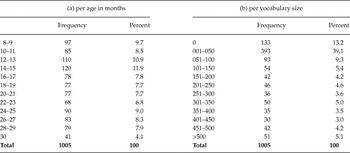
The sample consists of 1005 children (see Table 1) aged from 8 to 30 months Footnote 3 (approx. 44 children per month of age, 48.4% boys and 51.6% girls). An analysis of variance showed no effect of gender on the score of the Early Vocalizations Scale, F(1, 1003) = .52, p > .05. All children were healthy, with no diagnosed sensory, physical or mental impairment. Furthermore, children at risk for language delay (i.e., children with prenatal or perinatal complications or premature low birth-weight < 2.200 kg) were also excluded from the sample.
Distribution of the sample

Many of the questionnaires were completed by families living in Madrid (44%) and the rest came from families all over Spain. Most questionnaires (88%) were completed by the children’s mothers. The impact of parental education on the scores of the Early Vocalizations Scale was found non-significant (see López Ornat et al., 2005).
For all 1005 children, Spanish (Castilian) was the main language spoken in their homes. Nonetheless, 21.95% of those children were reported to also have contact with some other language. For 8.3% this exposure was less than 5 hours per week (e.g., watching a DVD in English, or occasionally visiting a Catalan speaking aunt, etc.). The remaining 13.6% of the sample (N = 137) had a more regular contact with some other language either at home or outside. These data were not excluded from the analyses, as no significant effect of the exposure to a second language was detected, neither on the total score of the Early Vocalizations Scale, t (1003) = .35 p > .05, nor on the scores of the individual vocal behaviors studied, χFootnote 2 (2, N = 1005) ≤ 2.91, p > .05, in all cases. This result is consistent with previous research which has identified only some qualitative differences in the vocalizations of bilingual children (e.g., Maneva & Genesee Reference Maneva, Genesee and Skarbela2002; but not in Poulin-Dubois & Goodz, Reference Poulin-Dubois, Goodz, Cenoz and Genesee2001), but no significant differences in the age of onset, nor in quantitative measures of vocal performance (e.g., Oller, Eilers, Urbano, & Cobo-Lewis, Reference Oller, Eilers, Urbano and Cobo-Lewis1997). It is important to note that our data only reflect the occurrence of broad vocal behaviors (we ask whether the children have produced these behaviors) and the questions do not take account of any kind of qualitative/language-specific properties of vocalizing activity (e.g., particular phonetic content, manner or place of articulation, concrete intonation contours, etc.). For all those reasons, data of children exposed to a second language have not been excluded from the present analyses.
Instruments
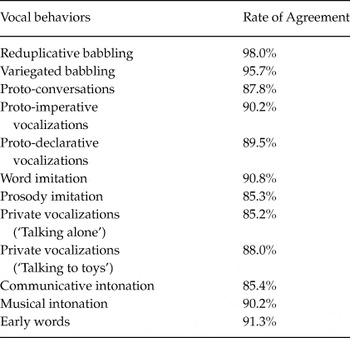
The Early Vocalizations Scale, a structured parental questionnaire on prespeech vocal behaviors, was developed, validated, standardized and used for the evaluation of the participant children´s early vocal development. Since it is a new measure, all possible precautions were taken in order to ensure the validity of the data collected. In a preliminary study (N = 50) including both observational data (video-recordings) and interviews with caregivers, 16 candidate vocal behaviors were selected and their exact wording was decided according to parents’ ability to understand and retrieve from memory the corresponding information (López Ornat et al., 2003). Subsequently, a rigorous concurrent validity study empirically established the reliability of parents as informants of their children’s early vocal development (López Ornat et al., 2005). Direct measures of the spontaneous vocalizing activity of 60 children (8–30 months), video-recorded for 45 minutes in three different everyday settings (play & personal care moments with parents and also when alone) were compared to the scores of the parental reports provided on the same day. An agreement between these measures (parental vs. observational) was calculated for each question. Results led to the elimination of two questions (on “silent babbling” and “invented early words”) which failed to reach a satisfactory parent-observer agreement. Furthermore, two additional questions (on “rhythmic hand banging” and “vocal expression of emotion”) were excluded as, in a subsequent pilot study (N = 96), they were proven to have no discriminative value. Concordantly, the 12 questions finally included in the standardized version of the Early Vocalizations Scale are the ones for which parents were most reliable: parent-observer agreement > 85%, (M = 89.8%, SD = 2.70). The parent-observer agreement rate for each vocal behavior is reported in Table 2. Moreover, this measure has a high degree of internal consistency (Cronbach´s alpha computed with each of the 12 items treated as an individual item, α = .874) and is highly reliable (Test-retest correlation: r(65) = .93).
Concurrent validity study results: Parent – Observer rate of agreement for each vocal behavior included in the Early Vocalizations Scale

A description of each of the 12 early vocal behaviors included in the standardized Early Vocalizations Scale can be found in the second section of the Results. As mentioned earlier, the wording of those questions was carefully adapted to the parents’ ability to recognize the corresponding vocal behaviors and included, where possible, an example of the vocalization or a description of the everyday settings in which similar behaviors can be observed. For instance, the question on reduplicative babbling asks parents about syllables they can hear well and which they could repeat, like pa-pa-pa or ma-ma-ma, or the question on private vocalizations specifies the context in which similar vocalizations are usually emitted (when children are alone in their cot / bed or on their playing mat).
Three possible answers/options were offered to parents for each vocal behavior (a) “Not yet” answer: the vocal behavior has never been observed so far, (b) “Yes” answer: the child is producing this vocal activity at this moment, and (c) “No longer” answer: the behavior has been observed in the past, but the child no longer produces it. After its conclusion and given the results obtained, the Early Vocalizations Scale was published as an optional Appendix section to the European Spanish version of the MacArthur CDIs [ES-CDIs] (López Ornat et al., 2005) and included in both its Infant Form (8–15 months) and its Toddler Form (16–30 months).
In parallel, for the assessment of the same children´s productive vocabulary, the Vocabulary sections of the Infant (8–15 months) and Toddler (16–30 months) forms of the ES-CDIs were used. As in all versions of the MacArthur-Bates CDIs, they are lengthy checklists of words, where parents are asked to mark the words that their child uses. The Infant form includes 303 words and the Toddler form 588 words, organized in 20 semantic-syntactic categories (e.g., social words, animals, furniture, people, locations, actions, pronouns, prepositions, quantifiers, etc.). The score of productive vocabulary is calculated by adding-up the total number of words marked by parents. The ES-CDI Vocabulary scales have been found to have a high degree of internal consistency (α = .990) and be highly reliable (Test-retest correlation; Infant form: r(25) = .987; Toddler form: r(38) = .986). Finally, we should mention that the vocabulary section of the ES-CDI is fully adapted to the particular linguistic, social and cultural characteristics of families living in Spain. At the same time, it is fully equivalent to all other versions of the MacArthur-CDIs, including the original US-English CDI (Fenson et al., Reference Fenson, Dale, Reznick, Thal, Bates, Hartung and Reilly1993) and the Mexican-Spanish CDI (Jackson-Maldonado et al., Reference Jackson-Maldonado, Thal, Fenson, Marchman, Newton and Conboy2003).
Design
A cross-sectional design was used with two group factors: (a) ‘Age in Months’ with twelve equally spaced intervals from level 1 (8–9 months) to level 12 (30 months), and (b) ‘Productive Vocabulary Size’ with twelve equally spaced intervals of 50 words, from level 1 (0 words) to level 12 (more than 500 words). Twelve vocal behaviors were measured using a structured parental questionnaire.
Procedure
All questionnaires were handed out personally to caregivers who were recruited through personal contacts of the research group members, or through pediatricians and local nursery schools. Once caregivers gave their informed consent to participate in the study, they were offered explicit instructions as to how they should fill in the form that corresponded to their child’s age. During the whole administration of both the Early Vocalizations Scale and the Vocabulary checklists of the ES-CDIs, either a researcher, or a childhood professional (Pediatrician or Speech Therapist) or a trained Psychology student was present with them, discussing any doubts or difficulties. We should note that this procedure of ‘assisted administration’, differs significantly from the one frequently used in the standardization of other versions of the MacArthur-Bates CDIs (i.e., sending the Inventories by mail, with a paid mail response; e.g., Bates et al., Reference Bates, Marchmann, Thal, Fenson, Dale and Reznick1994). This additional measure was taken in order to minimize the possibility of parents not understanding the questions in the questionnaires and, thus, to enhance the validity of the parental reports. After the conclusion of the research, parents that wished to receive feedback on their child’s performance received a personalized debriefing letter.
Results and Discussion
First section: General overview of early vocal activity
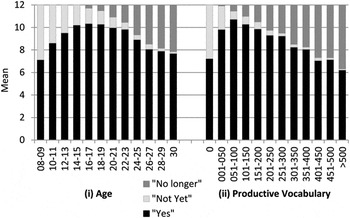
In this section, we present the mean distribution of answers (Not yet, Yes, No longer) per age and per vocabulary size for the total 12 questions. In Figure 1, we observe that children produce prespeech vocal behaviors (‘Yes’ answers) during the entire developmental period studied. The ‘Yes’ answer appears to be the prevailing answer for more than 60% of the questions at all ages. Its characteristic inverted-U shaped development is apparently due to certain vocal behaviors that are absent at the beginning of the study (‘Not yet’ answers), then appear during the middle age range, and then gradually start disappearing after the age of 16 months (‘No longer’ answers). Moreover, in Figure 1 we observe that vocal behaviors keep emerging until the vocabulary size reaches 51–100 words where the ‘Yes’ answers mark their highest rate (a mean of approx. 11 over 12 vocalizations are present). From that point on, as expressive lexicon increases, they gradually diminish to be replaced by the ‘No longer’ answers.
Mean distribution of “Not yet”, “Yes”, “No longer” answers (i) per age in months and (ii) per productive vocabulary size.

Therefore, it seems that the development of some early vocal behaviors follows an inverted-U curve: they gradually emerge and are mostly produced before word production becomes established; then they gradually become marginal as, we assume, they become “replaced” by more advanced linguistic behaviors. This finding is empirically illustrated by a significant positive correlation of the number of “No longer” answers with vocabulary size, r s (1003) = .74, p < .001 and also a negative correlation between the number of “Not yet” answers and vocabulary size, r s (1003) = −.73, p < .001.
We should note, however, that even when vocabulary is quite developed, with more than 500 words in the expressive lexicon of children, a mean of 6 (over 12) early vocal behaviors still remain present. We suspect that, at this point, the rate of production of these vocalizations in the children´s vocal repertoires may be quite reduced and they may constitute rather occasional or marginal behaviors. However, due to the fact that the Early Vocalizations Scale does not provide any quantitative information on the production of those behaviors (they are rather ‘all or nothing’ questions), this assumption cannot be empirically tested with the present data. In any case, this result suggests that, even when word production is well established, early vocal behaviors do not disappear abruptly; instead, they coexist (marginally or not) with lexical productions for quite a long time. We interpret this general result as empirical support for the hypothesis of a gradual transition into language held by non-nativist, emergentist approaches on language development (e.g., Vihman et al., Reference Vihman, DePaolis, Keren-Portnoy and Bavin2009).
Second section: Development of individual vocal behaviors
This section of Results and Discussion focuses on the development of the 12 individual vocal behaviors that compose the Early Vocalizations Scale in order to obtain a more detailed account of early vocal development and be able to attribute the exact course of the above general developmental pattern. Descriptive frequency analyses were carried out to trace the development of each vocal behavior per age in months, as well as per vocabulary size. Moreover, McNemar tests for assessing the difference between proportions of dependent/paired samples (hereafter ‘Difference Between Proportions’ or ‘DBP’) were performed in order to detect significant differences between different developments. We should point out that, due to the multiple comparisons performed, the most conservative significance level (α < .001) has been adopted in the following analyses.
We should note again, that the Vocalizations scale of the ES-CDIs does not record the frequency/rate of production of each vocal behavior within a child´s vocal repertoire, but just its presence (or absence). Thus, the following percentages reflect the proportion of children that do (or do not) produce these vocal behaviors at each given developmental moment, independently of whether they do so regularly or just marginally. In other words, these results inform us on the degree of generalization of each vocal behavior among (a) children of the same age and (b) children with the same vocabulary size.
Finally, we should draw attention to the fact that these results, by not presenting statistical means of the scores, but percentages of children that produce (or do not produce) each particular vocal behavior, directly reflect the individual differences registered in each developmental point: every percentage other than 0% or 100% implies an inter-participant variability of a major (closer to 50%) or minor (closer to 0% or 100%) degree. Obviously, the exploration of the underlying causes of these individual differences is a very complex empirical problem, which exceeds the scope of this work. In words of Bates et al. (Reference Bates, Marchmann, Thal, Fenson, Dale and Reznick1994), individual differences in early language development “often reflect a complex interplay of developmental and stylistic variation” (p.119). Their disentanglement, thus, will not be addressed in this paper.
Babbling
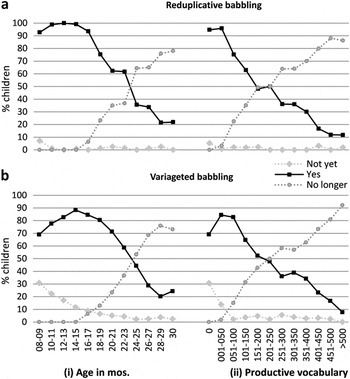
Τwo questions on babbling are included in the Early Vocalizations Scale, which both capture a segmental dimension of early vocalizing activity: one on reduplicative babbling in which parents report on whether their children repeat a well-formed syllable several or many times, and one on variegated babbling, in which parents are asked whether their children combine syllables ‘which are not all the same’. Figure 2 represents the developmental patterns for these two types of babbling.
BABBLING: Percentage of children per answer (Not yet, Yes, No longer) (i) per age in months and (ii) per vocabulary size.

Almost all parents (> 90%) report that reduplicative babbling is already present at 8–9 months or when their children have not yet produced any words. In the subsequent months (10–15 months) reduplicative babbling further increases, reaching approximately a 100% of the sample. In contrast, variegated babbling is produced by a significantly lower percentage of children (70–90%) in the earlier stages (’DBP’ significant [p < .001] from 8 to 17 months or from 0 to 50 words). In line with previous studies on babbling, this result probably reflects children´s difficulty in combining varying articulatory movements within the same vocalization, or, in words of Vihman et al. (2009:119), to ‘gain control over the content within each syllable’. Both types of babbling, after 18 months or after the production of 100 words, follow a similar developmental pattern: as vocabulary grows, the percentage of children that are reported to babble slowly diminishes. In the developmental periods between 22–27 months or between 100–350 words, we see the highest degree of individual differences: while an important percentage of children are reported to have ceased their babbling activity, some others seem to continue babbling. Finally, when productive vocabulary reaches > 500 words, the percentage of the latter has dropped to less than 10% while approximately 90% of the children are reported to no longer babble.
This result reinforces the gradual transition into language hypothesis, by showing that earlier forms of vocal communication do not disappear abruptly, even when word production is established. It is consistent with previous observational results reporting that babbling production continues to coexist with first words for several months and, also, that children vary in their use of babble after they have begun to produce words (Vihman et al., Reference Vihman, Macken, Miller, Simmons and Miller1985; Vihman & Miller, Reference Vihman, Miller, Smith and Locke1988). Nonetheless, the exact extent of this co-existence has never been reported until now since, to our knowledge, no study has explicitly looked for babbling in older children who already produce quite a few words. The causes of the above-mentioned individual differences would need further exploration, as they could be due not only to developmental, but also to stylistic differences among children, or even to differences in their parents’ reporting on these behaviors.
Proto-functions
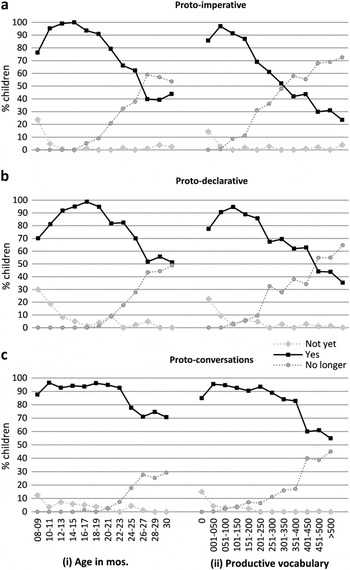
Children´s communicative development is captured by three questions on the functions of early vocal activity, namely: a question on Proto-conversations, in which parents report on whether, when they talk to their children, the latter seem to reply and take-turns, a question on Proto-imperative vocalizations, in which parents are asked whether their children vocalize to request different things, and one on Proto-declarative vocalizations, in which they report on their children’s use of vocal means to call their attention to a particular object or event they are interested in. Figure 3 represents the developmental patterns of these three proto-functions.
PROTO-FUNCTIONS: Percentage of children per answer (Not yet, Yes, No longer) (i) per age in months and (ii) per vocabulary size.

The three developments show a certain similarity; they are all of relatively early emergence, as > 70% of children are reported to produce them at 8 months or when they have not yet produced any word, they are all massively present (> 90% of the children) by 12–13 months or by the time 1–50 words are produced, and then they gradually all decrease. Nonetheless, there are also interesting differences in their rates that are worth considering. In particular, in line with research suggesting an early emergence of ‘protoconversations’, it seems that the earliest or most common communicative use of early vocalizations at 8–9 months takes place in a (proto) conversational context for 87.6% of the children. Interestingly, these turn-taking interchanges with no lexical content are the ones that by 30 months or by > 500 words show the minor reduction (’DBP’ significant [p < .001] after 200 words against proto-imperative, and from 200 to 350 words, & in > 500 words against proto-declarative vocalizations). Around 24–25 months, or when children have produced 400 words, there is an important drop in their rate but, even when vocabulary size grows to > 500 words, they are still produced by half of the sample. Given that the particular question addressed to parents does not specify the form of these early ‘dialogues’, nor as we explained earlier, does it record their frequency/rate of production, this perhaps reflects the fact that non-word vocalizations are sporadically used as a conversational tool even later, or even through adulthood (e.g., the phatic function of expressions like “hmm”, “ha”).
Proto-imperative and proto-declarative vocalizations, in turn, reach a rate of > 90% at 10–11 months and 12–13 months respectively. Proto-imperatives are also earlier than proto-declaratives, when vocabulary size is taken into account: the first reach their highest rate when 1–50 words are produced, while the latter in the 51–100 words interval (’DBP’ significant [p < .001] in 1–50 words and also at 10–11 months). These results, by showing an earlier development of proto-imperatives in relation to proto-declaratives, are consistent with previous findings on early vocal communicative development (Karousou, Reference Karousou2004) and on the emergence of relevant communicative gestures (e.g., Bates et al., Reference Bates, Benigni, Bretherton, Camaioni and Volterra1979). After 15–17 months both behaviors record an important drop in their developmental curve and, by the time expressive lexicon reaches > 500 words, they have gradually reduced their presence to only 20 or 30% of the sample respectively. This finding would be again consistent with the normal substitution-by-language process. In other words, as children develop lexical means for expressing their requests and for referring to the world, the presence of those early communicative resources drops. The explanation of the protracted co-existence of both proto-functions with conventional speech could be related again to the fact that present data do not reflect possible quantitative variations in the production of vocal behaviors. Thus, as a vocabulary of 200, 300 or even the maximum of 588 words would certainly not permit a child to express every intended request and reference by lexical means, it is to be expected that occasionally she could fall back on more ‘primitive’ ways of communication. Nonetheless, the exact causes of the important individual differences noted again, especially after the production of the first 200 words, should be the object of further exploration.
Private vocalizations
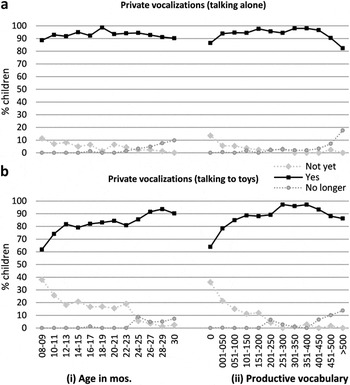
The Early Vocalizations Scale contains two questions on ‘private’ or ‘non-communicative’ vocalizations: one which is addressed to no one and nothing and could be considered as a form of ‘thinking aloud’ (talking alone or talking to oneself) and the other, which accompanies exploratory activities on inanimate objects (talking to toys). Figure 4 reflects the developmental patterns of these two vocal behaviors that apparently do not serve any direct communicative goal.
PRIVATE VOCALIZATIONS: Percentage of children per answer (Not yet, Yes, No longer) (i) per age in months and (ii) per vocabulary size.

The developmental pattern of the ‘talking alone / to oneself’ vocal behavior has been the only one, among the 12 behaviors studied, whose presence remains relatively stable for approximately 90–95% of the participant children throughout the entire developmental period under consideration. Only when plotted against vocabulary size can we observe a small percentage of children (approx. 20%) with a productive vocabulary of > 500 words who are reported to ‘no longer’ produce these activities.
This contrasts slightly with the other type of non-communicative vocal behavior, which accompanies the manipulation or exploration of an object. This ‘exploratory’ type of vocal activity shows a later development. In particular, in the 8–9 months interval or when children have not yet produced any words, it is produced by 62% of the sample. At 12–13 months its rate reaches 81.8% and only after the age of 25 months or when the vocabulary size grows to > 100 words, does the percentage of children that engage in similar activities exceed 90% of the sample. Accordingly, the ‘DBP’ analysis reveals that these two measures of ‘private’ speech follow a significantly different development (p < .001) throughout the 8 to 19 months interval or the interval between 0–50 words, and only during the subsequent stages do their paths converge. Since ‘vocalizing during the manipulation of an inanimate object’ could be, at times, reflecting a more symbolic activity (e.g., pretend play), we speculate that this developmental lag might be partially affected by the development of similar early representational abilities (McCune, Reference McCune1995).
The constant and robust percentage of solitary vocalizations does not address form stability across development, as the questions included in the ES-CDIs do not specify the form of these vocal behaviors. We suppose that their forms change and develop across the 8 to 30 month span in interesting ways which, as far as we know, are unknown in our field. The fact that these early vocal behaviors remain so frequent even at 30 months tempts to relate them to a stable mechanism, possibly reflecting internal perceptual and cognitive processing. In that sense, private prespeech vocalizations could constitute the precursors of private speech, fulfilling a learning or self-regulatory function (e.g., Diaz & Berk, Reference Diaz and Berk1992; Goldstein, Schwade, Briesch, & Syal, Reference Goldstein, Schwade, Briesch and Syal2010; Papoušek & Papoušek, Reference Papoušek and Papoušek1981; Vygotsky, 1934/1962; Winsler, Reference Winsler, Winsler, Fernyhough and Montero2009).
Melodic vocalizations.
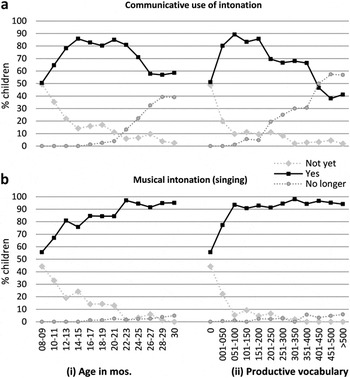
The development of children´s ability to manipulate melodic contours (musical or linguistic) is captured by two questions: one in which parents report on whether their children sing, perhaps after having heard an adult or some doll singing, and one in which they are asked whether their children engage ‘speaking without words’ and it seems as if they asked a question, they have been surprised, etc. Figure 5 represents the interesting development of these two vocal behaviors.
MELODIC VOCALIZATIONS: Percentage of children per answer (Not yet, Yes, No longer) (i) per age in months and (ii) per vocabulary size.

The two curves show a remarkable initial parallel and simultaneous development, starting at a rate of 50–55% of the sample and growing to 85–90% by the ages of 20–21 months or by the time vocabulary reaches 150–200 words (DBP non-significant). Interestingly, this development bifurcates at 22–23 months or at 200 words, separating ‘singing’ from using prosody in order to communicate (DBP significant [p < .001] from 24 to 30 months and from 251–300 to > 500 words). At that point, the proportion of children that use prosody (without lexical content) in order to communicate diminishes. We assume these vocalizations gradually become replaced by full linguistic productions, where communication is accomplished not only through prosodic modulations, but also through words. The use of singing however does not decline; it remains present in more than 90% of the children at the end of the developmental period studied.
These findings are consistent with results suggesting that children´s first singing attempts are produced at around 12 months and, at 18 months, children start generating recognizable songs (e.g., Ostwald, Reference Ostwald1973; for reviews, see Dowling, Reference Dowling and Deutsch1999). Moreover, and perhaps more interestingly, the remarkable initial simultaneous development of the two behaviors is consistent with the view of an early ontogenetic relation between music and language. As explained in more detail in the Introduction, ‘music’ is considered by various researchers as one of the earliest means of mother-infant communication. Across cultures, parents attract and maintain the attention of infants through the exaggerated melody of the infant-directed speech and through the melody of infant-directed music (e.g., Nakata & Trehub, Reference Nakata and Trehub2004; Shenfield, Trehub, & Nakata, Reference Shenfield, Trehub and Nakata2003). Infants actively reply by synchronizing to their parents´ vocalizations rhythm, melody, harmony and movements (e.g., Malloch & Trevarthen, Reference Malloch and Trevarthen2008). According to this line of research, these communications constitute a musical proto-language that sets up the emotional and communicative foundations for future forms of communication. In a recent research, van Puyvelde et al. (2010) by conducting a detailed tonal analysis of both infant directed speech and infant vocalizations found that they all share with music the same universal tonal basic aspects (harmonics). In the same vein, many scientists suggest that precursors of early speech are initially indiscriminable from precursors of spontaneous singing, and that early vocalizations can be regarded both as prespeech and as premusical behaviors (e.g., Chen-Hafteck, Reference Chen-Hafteck1997; Papoušek, Reference Papoušek, Deliege and Sloboda1996). In words of Papoušek (1996, p. 104): “Preverbal communication may represent a common ontogenetic avenue along which two highly structured and exclusively human capacities develop: speech and singing”. It is suggested that, only later, when children start to develop specialized language processing (Elman et al., Reference Elman, Bates, Johnson, Karmiloff-Smith, Parisi and Plunkett1996) and to fine-tune to culture-specific aspects of music (2–5 years; see Hannon & Trainor, Reference Hannon and Trainor2007, for a review), these two behaviors become more differentiated. Present results point to the end of the second year, or when children have produced 250 different words, as possible candidate moments for this divergence.
Vocal imitation
Two questions on spontaneous vocal imitation are included in the Early Vocalizations Scale, namely: one on imitation of the suprasegmental properties of speech, where parents report on whether their children try to reproduce the intonation / melody of a sentence they just heard (e.g., a question) and one, mostly pointing at imitation of the segmental content of speech, in which parents report on whether their children try to repeat a word they just heard. Figure 6 represents the developmental patterns of those two types of vocal imitation.
VOCAL IMITATION: Percentage of children per answer (Not yet, Yes, No longer) (i) per age in months and (ii) per vocabulary size.

On the whole, word imitation appears to develop earlier and reach a higher rate than imitation of sentence contours. More specifically, word imitation is produced by approximately 30% of the sample at 8–9 months or when no word is yet produced and develops to reach a rate of > 90% at 20–21 months or when 51–100 words are produced. Imitation of intonation, in turn, starts only marginally (11–12%) and develops gradually to reach its highest percentage (approx. 90% of children) at the 26–27 months or 251–300 words interval.
This result suggests that, although the ability to imitate prosodic contours appears to emerge early in the first year of life, during mother-infant communication of emotions (e.g., Gratier & Devouche, Reference Gratier and Devouche2011; Papoušek & Papoušek, Reference Papoušek and Papoušek1989), prosodic imitation of large linguistic units (i.e., entire phrases) fulfilling a more concrete pragmatic function (e.g., a question) seems to appear later. This relative delay is also in line with previous studies showing a difficulty in accurately imitating prosodic contours of linguistic phrases at 12 months (Schaerlaekens, Forrez, & Van Bael, 1990; Siegel, Cooper, Morgan, & Brenneise-Sarshad, Reference Siegel, Cooper, Morgan and Sarshad1990) while around 3 or 4 years this ability seems already quite developed (Loeb & Allen, Reference Loeb and Allen1993; Snow, Reference Snow2001). Furthermore, the difference between these two developments (’DBP’ significant, p < .001 from 8 to 24 months, and from 0 to 151–200 words) could reflect the existence of different underlying processing mechanisms: mostly segmental – analytic, in the case of word imitation, and mostly prosodic – holistic, in the case of imitation of ‘whole sentence contours’. These two processing types have been previously suggested by other researchers as different but complementary strategies of language learning (Peters, Reference Peters1977; Reference Peters1983).
Nonetheless, there are also interesting similarities in the two developments. When vocabulary size is taken into consideration, both imitative behaviors produce a most remarkable rise of approximately 80% in the period between the production of the very first word and the production of 100 words. It appears as if an ‘imitative mechanism’ is tied to the production of the first 100 words for 80% of those children. Then both imitative behaviors remain quite frequent indicating a high functionality of imitative behavior throughout the entire period studied and reinforcing previous findings on the relation between imitation of words and vocabulary size in the early phases of lexical development (e.g., Masur & Eichorst, Reference Masur and Eichorst2002). Only at the end of this period do we detect a very moderate decline, which is due to a relatively small percentage of children (12.2% and 19.5% respectively) who are reported to ‘no longer’ exhibit these imitative behaviors.
Early words
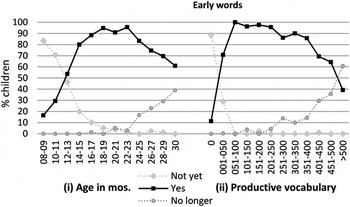
The ability of children to produce their early and still ‘immature’ representational vocalizations is captured by a question on ‘early words’. It asks whether the children produce words which sound a bit like real ones, but only the parents can understand immediately. Figure 7 represents the developmental pattern of these vocalizations.
EARLY WORDS: Percentage of children per answer (Not yet, Yes, No longer) (i) per age in months and (ii) per vocabulary size.

The development of early words is characterized by a curve of an inverted-U shape reflecting the temporary character of those ‘immature’ early words. More specifically, early words during the 8–9 month interval are scarce and produced by a small percentage of children (16.5%). This rate grows quite rapidly to reach 80% at 14–15 months, and exceeds 90% during the 18–23 months interval. Then, during the last months of the period studied, early words decline to be produced at 30 months by a 61% of the sample. Moreover, when the number of words produced is taken into account, some parents (11.28%) report that their children already produce ‘early’ words when no ‘real’ words are yet reported in the Vocabulary section. This proportion, then, rises very quickly to reach a full 100% in the 51–100 words interval, and remains practically stable until children have produced 250 different words. Then the production of early words gradually declines to be produced by only 40% of the sample when vocabulary grows to > 500 words.
Overall, results suggest that, after 23 months or after 250 words, early words are gradually being replaced by words with a tighter match to the sound – referent pair of the model language, as suggested by previous research (e.g., Vihman et al., Reference Vihman, DePaolis, Keren-Portnoy and Bavin2009). As mentioned before, Vihman and McCune (Reference Vihman and McCune1994) described as the ‘ragged beginnings of word use’ the developmental period where children produce vocalizations of varying ‘degrees of wordiness’. According to the results we present, this period seems to be of considerable length, since it covers the age span from 14 to 23 months for more than 80% of the children studied and extends beyond 29 months for 60% of them.
Third Section: Continuity of the Early Vocalizations Scale and correlations with Vocabulary
As discussed in the previous section of Results & Discussion, some of the vocal behaviors studied are abundant only temporarily. After a certain point of development, and especially as word production advances, their use gradually becomes less frequent among children. Moreover, in the first section of the results, it has been shown that this inverted-U shaped developmental pattern of early vocalizations is related to vocabulary growth process.
Accordingly, in this third section of Results and Discussion, in order to calculate the total score for the Early Vocalizations Scale, we assigned the following values to the three possible options offered to parents:
“Not yet” answer = 0, “Yes” answer = 1, “No longer” answer = 2
Note that, although both “Not yet” and “No longer” options imply an absence of each behavior, this scoring has been adopted in the following group of analyses so as to reflect the developmental value of the three options.
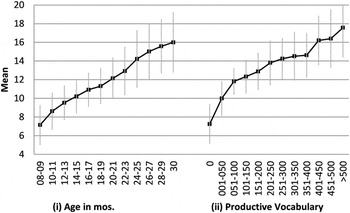
In Figure 8 we examine the development of the mean total scores (and their respective standard deviations) in the Early Vocalizations Section (a) per age in months and (b) per vocabulary size.
Mean scores (with standard deviations) in Early Vocalizations Scale (i) per age in months and (ii) per vocabulary size. Note: Scoring of the scale: sum of the 12 vocal behaviors scores. For every ‘Not yet’ answer 0 points, for every ‘Yes’ answer +1 point, for every ‘No longer’ answer +2 points.

These results illustrate a remarkable continuity of the Early Vocalizations Scale in measuring children´s vocal development for all ages covered by both Infant (8–15 months) and Toddler (16–30 months) forms of the ES-CDIs. An analysis of variance further demonstrates the highly significant effect that age has on the total scores in the Vocalizations scale, F(22, 982) = 59.100, p < .001. A Bonferroni post-hoc test (significance level α = .001) showed that all ages produce a significant variation to the total score, when compared to ages 4 to 7 months younger or older. Additionally, a Tukey Honestly Significant Difference post-hoc test (significance level α = .001) grouped ages (in months) to the following homogeneous subsets: 8–12, 10–15, 11–17, 13–19, 14–21, 19–24, 21–26, 24–30 months. These results confirm the continuity of this new scale and point to a gradual, slow and overlapping development.
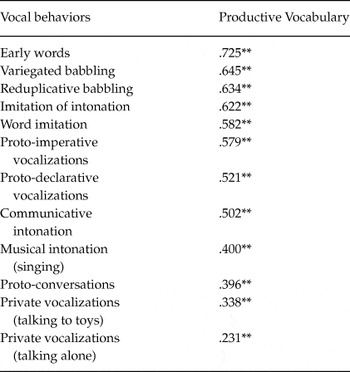
Furthermore, and most interestingly, results reveal an important relation between the total scores in the Early Vocalizations Scale and the size of Productive Vocabulary. This relation is statistically illustrated by a high correlation between these two measures of communicative development, r s (1003) = .845, p < .001. Moreover, table 3 presents the correlations between each individual vocal behavior and the participants’ vocabulary size, arranged in descending order.
Correlatons (Spearman’s rho): Individual early vocal behaviors * Vocabulary size

Note:
** Correlation is significant at level .001 (2–tailed).
In general, all vocal behaviors, as measured by the Early Vocalizations Scale, were significantly correlated (p < .001) with the total scores in Productive Vocabulary (i.e., the number of words children produce), confirming the relevance of those early behaviors in evaluating infants’ and toddlers’ linguistic development. Taking into account the previous results, this significance is quite high for vocal behaviors that present the inverted U-shaped development ‘not yet’ – ‘yes’ – ‘no longer’ (scored as 0–1–2, in this group of analyses) such as early words, variegated and canonical babbling. Both types of imitation, as well as proto-imperative and proto-declarative vocalizations, also predict a considerable amount of the variation in vocabulary size. Nonetheless, as expected, the vocal behaviors which do not tend to reduce their presence over time and rather have a stable development during the last months, or even throughout the whole developmental period, such as singing, proto-conversations, ‘talking alone’ and ‘talking to toys’, only predict a very low amount of variation in vocabulary.
We should, however, point out that when all these individual behaviors, with a higher or lower individual correlation to vocabulary, are combined in a scale with a high degree of internal consistency, as the Early Vocalizations Scale, the resulting amount of prediction is definitely enhanced (in this case, r s (1003) = .845, p < .001, see above).
On the whole, the present results extend previous findings on the relation between babbling and lexical development (see Stoel-Gammon, Reference Stoel-Gammon2011; Vihman et al., Reference Vihman, DePaolis, Keren-Portnoy and Bavin2009) and between word imitation and lexical development (e.g., Masur & Eichorst Reference Masur and Eichorst2002) by adding interesting results about the significant relation of all vocal behaviors studied with the growth in the size of vocabulary produced by infants and toddlers. The practical importance of these findings lies in the possibility that the Early Vocalizations Scale offers for an early and concise screening of communicative development of children aged 8 to 30 months. On the theoretical side, they constitute additional evidence on the relationship between prespeech vocalizations and lexical development, as well as on the interpretation of prespeech vocalizations as precursors of speech.
General Discussion
The present study investigated the development of 12 different prespeech vocal behaviors in a quite large sample of Spanish children (N = 1005) covering all ages from 8 to 30 months. Our main aim was to analyze in detail their developmental patterns and their relation with the same children’s early lexical development. Our expectation was that, by collecting data from a considerable number of children selected to represent quite an extended developmental period, we could provide an integrative view of early vocal and lexical development and, thus, fill in some of the existing gaps in the currently fragmented ‘landscape’ of prespeech vocal communication.
Due to the overwhelming methodological complexity that an observational study for such an extensive number of participants would entail (e.g., exceptionally time-consuming data collection, transcription, coding and analysis of many dimensions of the relevant data), we opted for an assisted parental report methodology. In particular, after having ensured that parents could provide reliable data on a variety of dimensions of prespeech vocal development, we adopted the use of a new structured questionnaire, the Early Vocalizations Scale. Given the results presented in this paper, this scale has been published as an optional Appendix section in the European-Spanish version of the MacArthur CDIs.
Naturally, this methodological option is not free of disadvantages. The information one can obtain through parental reports is necessarily limited to the dimensions of vocal activity that the particular scales measure and always depends on the wording of the particular questions which, in turn, are constrained by the information parents can provide in a reliable way. We assume this limitation is an unavoidable trade-off between the number of participants and the formal detail of a study. As explained in detail in the Method section, the vocal behaviors included in the questionnaire, as well as their wording, are the result of various studies and analyses (observational study, parent interviews, concurrent validity study, pilot study, etc.) which empirically established the reliability and the validity of the scale.
Another constraint is that the data collected using the Early Vocalizations Scale do not provide any quantitative information on the production of each vocal behavior. They just record the presence or absence of each vocalizing type in a child´s vocal repertoire, independently of its rate or frequency of production. Consequently, as pointed out earlier, the results we presented are not sensitive to possible changes in the proportions among different vocal behaviors along developmental change (e.g., from producing abundant ‘variegated babbling’ and scarce ‘early words’, to the opposite).
However, we believe the results we obtained are interesting in several ways. Currently, all vocal behaviors studied are considered precursors of speech, and many of them, if not all, have been established as prerequisites for normative linguistic development. This parental report study included, therefore, items on the best known phonological (segmental and prosodic), communicative, and early symbolic developments. But it also provided questions on behaviors which are taken to express important learning mechanisms for language, such as the imitative and private vocalizations. Several –though not all- of these behaviors have already been the object of extensive observational research, but still, the span, timing, and pattern of their development has not been fully defined. For instance, one of the most extensively studied prespeech vocal behavior is ‘canonical babbling’. In the literature, one may find many results on its nature and form (e.g., Oller, Reference Oller2000; Vihman, Reference Vihman, Lindblom and Zetterström1986), on its relation to first words (e.g., McCune & Vihman, Reference McCune and Vihman2001), on its age of onset (e.g., Oller at al., 1999) and on its coexistence with first words (e.g., Elbers & Ton, Reference Elbers and Ton1985; Vihman et al., Reference Vihman, Macken, Miller, Simmons and Miller1985). However, the present study has both reinforced previous findings with results on a large sample of children, and expanded them with information on the subsequent course of these vocal activities. For instance, it is found that some (few) children continue babbling even when they have produced quite a few words, that variegated babbling appears to coexist with early words for approximately 12 months for more than 70% of the population studied, and that early ‘immature’ words are produced for a whole year for more than 80% of the sample. We believe that these findings constitute interesting expansions of previous results which reported, but never detailed, the coexistence of prespeech vocalizations with early language and the important individual differences that characterize those early, transitory phases of vocal development.
Furthermore, the results on the developmental patterns of less studied vocal behaviors provide new evidence of the complexity of early vocal and communicative development, and shed light on the emergence of language out of various preceding abilities of varying nature. Thus, although the development of early communicative functions has been widely studied through the analysis of infant gestures (e.g., Bates et al., Reference Bates, Camaioni and Volterra1975, Reference Bates, Benigni, Bretherton, Camaioni and Volterra1979; Capirci et al., Reference Capirci, Iverson, Pizzuto and Volterra1996), to our knowledge, these results have not been corroborated with extensive data on early vocal communication. According to present results, children appear to use non-word vocalizations as a means for communicating since very early. In line with research on early ‘protoconversations’ (e.g., Trevarthen & Aitken, Reference Trevarthen and Aitken2001), during the earliest months of the study prespeech vocalizations are massively produced in turn-taking settings, during parent-infant communicative interchanges. Around the age of 10–11 months, the majority of children also start producing vocalizations with an instrumental value and two months later they start producing them in a proto-referential context, in an attempt to share their experiences and states with their communicative partners. The emergence of these early communicative functions has long been considered an important precursor of the emergence of lexical reference (e.g., Bates et al., Reference Bates, Benigni, Bretherton, Camaioni and Volterra1979). Concordantly, these non-word vocalizations appear to gradually reduce their presence, as children manage to produce vocalizations with a tighter match to the conventional sound-referent pair of the ambient language or, in other words, as they develop lexical means to refer to the world.
However, in parallel with the communicative use of vocalizations, the vast majority of children also seem to vocalize when they are alone, when they appear to have no intention to communicate with an interlocutor. This private use of vocalizations, interestingly, appears to be a robust and consistent behavior throughout the entire developmental period studied. In line with research on subsequent private speech (e.g., Winsler et al., Reference Winsler, Fernyhough and Montero2009), this result points to the interpretation of private vocalizations as related to a stable learning mechanism or even as a self-regulating tool for cognitive or perceptual processing.
Imitation, also, seems to play an important role in lexical development, since the emergence of children’s first words appears to be linked to their ability to imitate both the segmental content of speech and its melodic contour. The subsequent high functionality of these imitative vocalizations reinforces the assumption that vocal imitation constitutes an important mechanism which facilitates lexical development (e.g., Masur, Reference Masur1995).
Finally, the analysis of data on the melodic properties of early vocalizations showed that the vast majority of children, by their first birthday, appear to have developed the ability to modulate melodic contours in order to convey specific meanings (e.g., ask a question, show surprise or ‘scold’ someone) but also in order to sing a familiar song. The development of these two melodic vocal behaviors shows a remarkable initial parallel development, and only at 24 months or when 250 words are produced do their developmental paths significantly diverge: the vast majority of children keep singing, while communicative use of intonation (without lexical content) diminishes to be, presumably, integrated to productions with lexical content. These results reinforce the view of an early ontogenetic relation between music and language (e.g., Malloch & Trevarthen, Reference Malloch and Trevarthen2008; Papoušek, Reference Papoušek, Deliege and Sloboda1996) and support the role of communicative musicality in children´s early linguistic development.
The relevance of all the prespeech vocal behaviors studied to the development of language is further enhanced by the high correlation of the overall score in Early Vocalizations with lexical development, but also by strong correlations of the individual vocal behaviors studied with vocabulary size.
In summary, the general picture of early vocal development appears to be the result of various asynchronous and overlapping developments which reflect the underlying expansion and fine-tuning of a variety of facets of linguistic knowledge (segmental, prosodic, communicative, symbolic/representational). We interpret all these parallel developments as different, though interacting, pathways through which the learning system ‘gets in shape’ for language learning. Prespeech vocal activity seems to provide the toddler with a ‘kit’ of elementary but efficient tools for its language development process: tools for identifying, segmenting and articulating linguistic structures, whether holistic or discrete; for efficiently hypothesizing linguistic functions and mapping them onto distinct forms; for imitating any sort of input fragment, whether segmental or suprasegmental; for engaging in linguistic interaction with others, and also for using language as a tool for thinking and exploring the world.
Overall, we suggest that the tracing of these developmental patterns, as well as their significant relation with children’s early lexical development, constitute new evidence on the developmental continuity of the language learning process. We would argue that these results do support theoretical approaches that conceive language as the emergent product of various interacting developments progressively constructed during the prespeech period of communicative development (e.g., Elman et al., Reference Elman, Bates, Johnson, Karmiloff-Smith, Parisi and Plunkett1996; Thelen & Smith, Reference Thelen and Smith1994; Vihman et al., Reference Vihman, DePaolis, Keren-Portnoy and Bavin2009). On the practical side, the present results establish the relevance of all prespeech vocal behaviors studied for an early evaluation of communicative development, but also the potential for using assisted parental report methods to obtain valid and reliable data on these developments in infants and toddlers. Finally, we believe, these findings provide a solid base for planning specific observational or experimental studies aimed at refining, extending, validating and contrasting results on any particular early vocal behavior reported in this study.