Introduction
About 50% of the world population is considered to be bilingual (Grosjean, Reference Grosjean1989). Besides the obvious communicative advantage, several associated and even non-linguistic cognitive benefits of bilingualism have recently been explored. One well-replicated advantage is the finding that bilinguals show improved performance on a broad range of executive control tasks. Here, “executive control” refers to a range of high-level control functions that support goal-directed behaviour. Three main control functions can be identified: inhibition, updating and shifting (Miyake, Friedman, Emerson, Witzki, Howerter & Wager, Reference Miyake, Friedman, Emerson, Witzki, Howerter and Wager2000). In what follows, we will summarise earlier evidence pointing towards bilingual advantages for tasks assessing inhibition and shifting functions.
There are several reports that bilinguals outperform monolinguals on a range of tasks tapping into inhibition. Bialystok, Craik and Luk (Reference Bialystok, Craik and Luk2008), for example, observed that bilinguals outperform monolinguals on a Stroop task, an interference inhibition task in which participants have to name the ink colour of colour words (e.g. the word green printed in red), while suppressing the natural tendency to read the colour word. Another measure of interference inhibition is the Eriksen flanker task (Eriksen & Eriksen, Reference Eriksen and Eriksen1974). This task requires participants to react to the direction of the central one of five arrows (<<><<), while trying to ignore the direction of the four flanking arrows. Bilinguals outperform monolinguals on this task as well (Costa, Hernández & Sebastián-Gallés, Reference Costa, Hernández and Sebastián-Gallés2008). The positive effect of bilingualism on inhibitory control tasks also seems apparent throughout a person's life. It has been found that bilingual children already show enhanced performance compared to their monolingual peers on tasks tapping into inhibition (Carlson & Meltzoff, Reference Carlson and Meltzoff2008). In addition, the advantage remains consistent in bilingual elderly (Bialystok, Craik, Klein & Viswanathan, Reference Bialystok, Craik, Klein and Viswanathan2004; Bialystok et al., Reference Bialystok, Craik and Luk2008; Weissberger, Wierenga, Bondi & Gollan, Reference Weissberger, Wierenga, Bondi and Gollan2012).
These findings are compatible with a highly influential cognitive account of bilingualism and bilingual language control, the Inhibitory Control Model (Green, Reference Green1998). This model assumes that bilinguals experience a continuous competition (conflict/interference) between lexical representations of both languages, which are indeed always active to a certain degree in speaking (Hermans, Bongaerts, De Bot & Schreuder, Reference Hermans, Bongaerts, De Bot and Schreuder1999), reading (Van Assche, Duyck, Hartsuiker & Diependaele, Reference Van Assche, Duyck, Hartsuiker and Diependaele2009) and listening (Lagrou, Hartsuiker & Duyck, Reference Lagrou, Hartsuiker and Duyck2011). To resolve this competition, control resources are recruited to inhibit the conflicting activation of the non-target language. Importantly, these inhibitory mechanisms seem to be domain-general,Footnote 1 so that experience in managing competition between linguistic representations also transfers to non-linguistic tasks (Bialystok, Craik, Grady, Chau, Ishii, Gunji & Pantev, Reference Bialystok, Craik, Grady, Chau, Ishii, Gunji and Pantev2005; Bialystok, Craik & Ryan, Reference Bialystok, Craik and Ryan2006; Colzato, Bajo, Van den Wildenberg, Paolieri, Nieuwenhuis, La Heij & Hommel, Reference Colzato, Bajo, Van den Wildenberg, Paolieri, Nieuwenhuis, La Heij and Hommel2008; Costa et al., Reference Costa, Hernández and Sebastián-Gallés2008; Martin-Rhee & Bialystok, Reference Martin-Rhee and Bialystok2008). The central role for inhibition also becomes clear from a study by Emmorey, Luk, Pyers and Bialystok (Reference Emmorey, Luk, Pyers and Bialystok2009), who reported on the performance of bilinguals who know two spoken languages (unimodal bilinguals) and of bilinguals who know both a spoken and a sign language (bimodal bilinguals) in such a flanker paradigm. The clever manipulation here implies that only the unimodal bilinguals have to inhibit representations in the non-target language to be able to achieve lexical selection for production in the target language. Inhibition is not necessarily required in bimodal bilinguals, because they can both execute the sign and produce the word, even simultaneously if needed. And, indeed, only unimodal bilinguals showed an advantage in the flanker task, suggesting that resolving interlingual competition through inhibition is important for the executive control advantage.
Interestingly, the bilingual advantage on tasks tapping into inhibition is not only measurable on trials that involve competition between relevant and irrelevant information (like incongruent trials or switch trials) but also on trials that require a simple choice reaction without any cognitive conflict (like congruent trials or non-switch trials) (Costa et al., Reference Costa, Hernández and Sebastián-Gallés2008). This finding suggests that the cognitive benefits of bilingualism are not restricted to one specific executive control function, but may be extended to the entire, domain-general executive control system. Indeed, besides inhibitory control, bilinguals also show an advantage on tasks tapping into shifting, i.e. showing smaller shift costs compared to monolinguals (Bialystok & Viswanathan, Reference Bialystok and Viswanathan2009; Garbin, Sanjuan, Forn, Bustamante, Rodriguez-Pujadas, Belloch & Avila, Reference Garbin, Sanjuan, Forn, Bustamante, Rodriguez-Pujadas, Belloch and Avila2010; Prior & Gollan, Reference Prior and Gollan2011; Prior & MacWhinney, Reference Prior and MacWhinney2010). Prior and MacWhinney (Reference Prior and MacWhinney2010) also found reduced shift costs in the bilingual compared to the monolingual group.
Based on the findings that (i) the bilingual advantage does not only appear in conflict trials, but also in non-conflict trials, and that (ii) bilinguals also show enhanced performance on other executive functioning tasks, which do not necessarily tap into inhibition, it was suggested that mastering two languages not only enhanced inhibitory control, but leads to improved executive control functions in general.
Importantly, the mere fact of knowing two languages does not always suffice for enhancing executive control functioning. Luk, De Sa and Bialystok (Reference Luk, De Sa and Bialystok2011) administered a flanker task in a group of monolinguals, late bilinguals and early bilinguals. Only the early bilinguals showed better performance on the control task; no difference was found between the late bilinguals and monolinguals. So it seems that being bilingual per se does not suffice to enhance performance on executive control tasks.
Interestingly, the bilingual executive control advantage was also recently challenged by a large study by Paap and Greenberg (Reference Paap and Greenberg2013). They compared fairly large groups of monolinguals and bilinguals on a wide range of 15 executive control tasks. Although all of the tasks yielded the expected congruency or inhibition effects, none of these tasks yielded a bilingual advantage, and one actually showed a bilingual disadvantage. In another recent study (Hernández, Martin, Barceló & Costa, Reference Hernández, Martin, Barceló and Costa2013), the bilingual advantage also failed to show on several measures of task switching. These null effects, combined with the observation that most of the reported bilingual advantage reports indeed come from a very specific and limited number of bilingual populations, suggests that the bilingual advantage does not emerge from bilingualism in itself, but instead that certain characteristics of language use may be crucial for development of the control advantage. Currently, however, it is unclear what these language use/learning factors are.
In the current paper, we aim to clarify further one bilingual parameter that may be crucial for development of the bilingual control advantage. More specifically, we investigated further the role of language switching in daily life. Indirectly, it was already suggested in the paper by Emmorey et al. (Reference Emmorey, Luk, Pyers and Bialystok2009) that the amount of (language) switching might underlie the bilingual executive control advantage. They hypothesised that the difference in control performance between unimodal and bimodal bilinguals could be due to the fact that unimodal bilinguals have to switch languages in their communication, whereas bimodal bilinguals prefer to produce both the sign and the word (i.e. blend), therefore rarely switching between languages.
In addition, Prior and Gollan (Reference Prior and Gollan2011) compared the performance of a group of bilinguals who regularly switch between languages with the performance of a group of bilinguals who switch between languages less often. They only found an advantage on non-linguistic task shifting in the bilinguals who often switch languages. Discussing Prior and Gollan (Reference Prior and Gollan2011), Paap and Greenberg (Reference Paap and Greenberg2013) cite switching as a factor but dismiss it as a crucial determinant, because “our bilinguals overwhelmingly report that they use both languages every day and switch every day . . . our bilinguals switch as often, if not more often, than Prior and Gollan”. It is true that the bilinguals of Paap and Greenberg probably use their two languages every day (they did not actually assess language switching explicitly), and therefore once in a while must experience a language switch. This is very different, however, from the amount of language switching that the Spanish–English bilinguals in San Diego do. In southern California, Hispanics use Spanish and English interchangeably, often multiple times within a sentence. The same occurs in Catalan–Spanish speech in the bilingual population tested by Costa, Hernández, Costa-Faidella & Sebastián-Gallés (Reference Costa, Hernández, Costa-Faidella and Sebastián-Gallés2009) and Costa et al. (Reference Costa, Hernández and Sebastián-Gallés2008). It is unclear whether this also applies to the San Francisco population of Paap and Greenberg (Reference Paap and Greenberg2013). Although their sample will certainly contain Hispanics similar to those of Prior and Gollan (numbers are not provided for each language pair), it is definitely more diverse, with 30 language pairs for 122 bilinguals, and for most of these languages repeated language switching may not occur in everyday conversations. As such, we believe that the Paap and Greenberg (Reference Paap and Greenberg2013) study did not directly assess language switching and therefore it does not provide a definite answer of its importance as a determinant for the bilingual cognitive control advantage.
Finally, Yim and Bialystok (Reference Yim and Bialystok2012) also investigated the role of language switching on non-verbal and verbal task-shifting performance in a group of Cantonese–English bilinguals. They only found a positive effect of language-switching performance in an experimental language-switching task, but no relationship between the degree of language switching and non-verbal task shifting was found, in contrast to Prior and Gollan (Reference Prior and Gollan2011).
Above, we have summarised evidence suggesting that bilinguals develop more effective general control abilities because they must control the continuous interference between lexical representations associated with both languages, and we discussed what factor may contribute to this advantage. The primary aim of our study is to gain novel insight into the mechanisms that underlie the bilingual executive control advantage, by investigating the role of language-switching experience. From a memory perspective, the interference between languages comprises competition between active lexical representations of those languages in long-term memory. As described in the memory literature (Oberauer, Reference Oberauer2009), memory contents have the potential to cause interference when they are in an active state, but once the activation starts to decay, interference effects also rapidly disappear (Szmalec, Verbruggen, Vandierendonck & Kemps, Reference Szmalec, Verbruggen, Vandierendonck and Kemps2011). Therefore, we predict that the bilingual advantage originating from the competition between languages should primarily occur in bilinguals who show similarly strong activation in lexical representations of both languages at the same time, i.e. bilinguals who use both languages interchangeably within the same context (and even within the same sentence), and often switch languages. In contrast, equally proficient bilinguals who use different languages in different contexts and therefore do not switch that often, should suffer less from interference effects, so that the executive control system is less likely to develop a bilingual advantage.
It is the aim of this study to investigate whether high L2 proficiency suffices for developing the bilingual control advantage, or whether a high amount of language-switching experience, implying frequent simultaneous high activation in representations from both languages, is necessary. In the present study, we will therefore investigate whether a group of (Brussels) balanced bilinguals who typically switch languages within discourses or sentences show different control than regular bilinguals who do not switch that often, within the same language pair. We will compare their performance with a group of qualitatively different, but also balanced, bilinguals and with a group of unbalanced bilinguals. Prior and Gollan (Reference Prior and Gollan2011) already showed that bilinguals who often switch languages are better task shifters. This finding is important in the current context, but it remains unclear whether experience with language switching also interacts with bilingual advantages in tasks that share less task demands, as was the case for Prior and Gollan, i.e. cognitive control tasks that imply inhibition instead of switching. Obviously, language-switching experience is much more likely to transfer to non-verbal task shifting than to inhibition, and bilingual advantages across tasks that tap into different executive functions would suggest a more fundamental and general change to the cognitive system. Therefore, we will use two tasks that primarily measure inhibitory control, namely the flanker task and the Simon arrow task. The distinction between training tasks and training abilities is currently a major debate in the executive control literature. Some findings suggest that cognitive abilities can be trained. Jaeggi, Buschkuehl, Jonides and Perrig (Reference Jaeggi, Buschkuehl, Jonides and Perrig2008), for example, reported higher fluid intelligence in participants who were trained with an executive control demanding n-back task. Other researchers recognise several methodological concerns with such artificial training studies and claim that to this day, not one study has convincingly demonstrated that cognitive abilities can be trained, over and above (strategic) improvements in specific task demands (Shipstead, Redick & Engle, Reference Shipstead, Redick and Engle2010). In this view, showing that the amount of language switching by bilinguals produces an advantage for tasks with little overlap in task demands while measuring common cognitive (control) abilities, would make a strong case for this discussion in the control literature as well.
The second aim of this study concerns the dissociation of language-switching experience from language pair characteristics. Prior and Gollan (Reference Prior and Gollan2011) included Spanish–English bilinguals who regularly switch between languages and Mandarin–English bilinguals who switch less often. Only the Spanish–English bilinguals showed an advantage on task switching. It was assumed that only bilinguals who often language switch train their executive control capacities, causing better performance on executive control tasks. However, these two experimental groups do not only differ in their amount of switching between languages, but also in the amount of overlap between these languages. Because languages that share orthography (in this case: English and Spanish, both alphabetic languages) and language pairs with a distinct script (English and Mandarin) require different representational structures (Gollan, Forster & Frost, Reference Gollan, Forster and Frost1997) and hence also control demands, it is plausible that the bilingual advantages arising from competition between these two language pairs also differ. Indeed, task-shifting research has shown that shifting between overlapping cognitive tasks (e.g. by using bivalent stimuli) causes a much greater shift cost than shifting between tasks that share fewer task features (Rogers & Monsell, Reference Rogers and Monsell1995). Therefore, the higher shift cost for the Mandarin–English group in the Prior and Gollan study does not necessarily reflect the fact that they switch less often between languages, but may alternatively be explained by the smaller lexical overlap between Mandarin and English. Yim and Bialystok (Reference Yim and Bialystok2012), who investigated effects of language-switching performance in an experimental language-switching task within a single population of Cantonese–English bilinguals, observed no such effect on non-verbal task shifting.
In summary, our aim is twofold. We intend to further disentangle the role of language-switching experience for an executive function like interference resolution, while also controlling for language pair dissimilarities, including only a single language pair (unlike Prior & Gollan, Reference Prior and Gollan2011).
We hypothesise that the general control advantage in bilingualism originates from very frequent switching between both languages, within similar contexts and within conversations. To test this hypothesis, we tested three qualitatively different groups of bilinguals: a group of unbalanced bilinguals, a group of balanced non-switching bilinguals, and a group of balanced bilinguals that do often switch languages. Importantly, the bilinguals in the three groups all master the same languages, Dutch (L1) and French (L2). We predict that the switching group will show a better performance on inhibitory control tasks compared to the unbalanced group and the non-switching group that also has high L2 proficiency. We aimed to test only one executive function (i.e. interference control), and therefore only included a flanker task and a Simon arrow task, two tasks that tap into that specific function.
Method
Participants
To be able to include these three different groups of bilinguals, we recruited participants in two different ways: (i) psychology students of Ghent University, participating for credits, and (ii) bilinguals who were recruited through an advertisement on the university website, and who were paid for their participation. All participants had Dutch as their L1, French as L2, and had a good knowledge of English (L3). They were all born in Belgium, highly educated, and differed in their L2 proficiency and the extent of switching. We included participants from three bilingual populations; unbalanced (UB), balanced switching (BSB), and balanced non-switching bilinguals (BnSB). The three groups all consisted of both paid and voluntary participants.
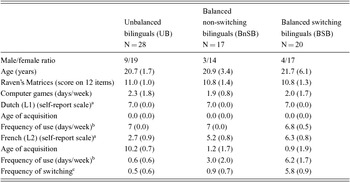
Demographic participant information is shown in Table 1. All groups were matched for age, sex, and general intelligence, based on the Raven Advanced Progressive Matrices. We employed a language questionnaire (see Appendix 1) to obtain self-reported language proficiency in Dutch and French, and to assess switching behaviour. Participants rated their proficiency for listening, speaking, reading and writing on a seven-point Likert scale for every language that they had acquired (1 = very badly, 7 = very well). These measures were then averaged to create a general proficiency level. They also stated how many days per week they spoke each language The UB lived in a Dutch-dominant environment and acquired French before the age of 11 at school. After the age of 18, they hardly came in contact with the French language again. All balanced bilinguals acquired the two languages before the age of six and were highly proficient in both. As mentioned, the balanced bilinguals were divided into switchers and non-switchers. This classification was based on the information retrieved from the language questionnaire. There, the bilinguals had to indicate how often they switched between languages on a scale ranging from 0 (= never) to 7 (= very often). Balanced bilinguals with a rating of 2 or lower were referred to the non-switch group (BnSB). Balanced bilinguals with a rating of 4 or higher were assigned to the switch (BSB) group (no participant rated him/herself 3). As expected, there were no unbalanced bilinguals who switched often. Consequently, the non-switch group (BnSB) were almost never (Mean = 0.9, SD = 0.7) confronted with contexts in which language switching took place, while the switch group (BSB) regularly switched between languages within sentences and conversations (Mean = 5.8, SD = 0.9).
Self-reported data and scores on Raven's Matrices by group.

aL1 and L2 proficiency was indicated on a seven-point Likert scale (1 = very bad, 7 = very good).
bParticipants reported how many days per week they spoke Dutch and French.
cFrequency of switching was indicated on an eight-point Likert scale (0 = never, 7 = very often).
Materials
Flanker task
The stimuli were white arrows on a black background. One stimulus consisted of five arrows and participants indicated the direction of the central arrow by pressing the left or the right button. The arrows could all be pointing in the same direction (congruent trials, e.g. >> > >>) or the central arrow could be pointing in the other direction from the flankers (incongruent trials, e.g. >> < >>). The proportion congruent/incongruent trials was 75%/25% (Costa et al., Reference Costa, Hernández, Costa-Faidella and Sebastián-Gallés2009).
Simon arrow task
The stimuli were single white arrows on a black background. The arrows could be pointing to the right or the left, and appeared on either the left or the right side of the screen. Trials in which the direction of the arrow corresponded with the side of the screen on which they appeared are labelled congruent trials; trials in which the direction and the side of appearance did not correspond are incongruent trials. The proportion congruent/incongruent trials was also 75%/25% (Costa et al., Reference Costa, Hernández, Costa-Faidella and Sebastián-Gallés2009).
Procedure and design
The informed consent form and language questionnaire were completed before starting the experiment. The procedure in both experiments was the following: (i) a fixation cross was shown for 400 ms; (ii) the experimental stimuli appeared until a response was given, or for maximum of 1700 ms; (iii) a blank screen was shown for 1000 ms. There were 24 practice trials, followed by three blocks of 96 trials each. Afterwards, participants completed the Raven Advanced Progressive Matrices. We used a 2 (Congruency) × 3 (Block) × 3 (Group) design with Congruency and Block as within-subject variables and Group as a between-subject variable. The experiments were run on a standard colour monitor and were programmed and conducted using Eprime. Reaction times were measured with a Cedrus serial USB response box.
Results
Demographic data
No significant differences were found across groups in male/female ratio, age, or intelligence (Raven) scores. Participants were asked to rate their proficiency, age of acquisition (AoA) and frequency of use of Dutch and French. There were no significant differences in general proficiency or AoA for Dutch. The UB and the BnSB used Dutch more frequently than the BSB. Significant differences between groups were found for French proficiency: the UB had significantly lower L2 proficiency scores than the BnSB (t(43) = −8.97, p < .001) and the BSB (t(46) = −15.50, p < .001). Differences in general French proficiency were also found between the two balanced groups (t(35) = −4.52, p < .001), although L2 proficiency was also very high in the BnSB group. The French AoA of the UB differed significantly from the BnSB (t(19.548) = 20.68, p < .001) and from the BSB (t(22.827) = 20.36, p < .001). No differences in AoA were found between the two balanced groups (t(35) < 1). The three groups differed significantly in frequency of use of French, with UB showing a lower frequency of use than the BnSB (t(17,904) = −4.71, p < .001) and the BSB (t(46) = −18.77, p < .001). In addition, a difference in frequency of use was found between the two balanced groups as well (t(35) = −5.90, p < .001). The BSB differed significantly from the BnSB (t(34.77) = −18.78, p < .001) and the UB (t(46) = −25.15, p < .001) in switching frequency.
Experiments
Reaction times (RTs) that deviated more than 2.5 SD from the participant's mean in that task were removed (0.02% of the total amount of trials). The error rate was 0.05%. Incorrect trials were excluded from the analyses. For both experiments we conducted an analysis of variance (ANCOVA) on RTs with Group as a categorical, between-subjects factor, and Congruency as within-subjects factor. Because of the difference between the groups concerning French proficiency and frequency of use of French (L2), we included these variables as covariates.Footnote 2 The dependent variable was the mean RT on correct trials and accuracy. In case of a significant difference across groups, we ran planned comparisons to investigate which group differed from the others. Furthermore, we calculated partial correlations, controlling for L2 proficiency, between the measure of switch frequency and reaction-time performance on flanker and Simon tasks, across all bilingual groups.
Flanker task
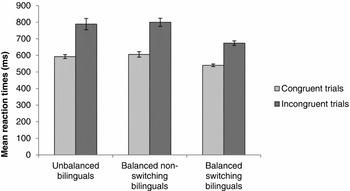
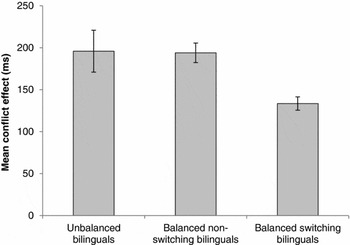
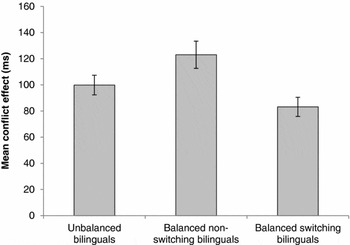
A significant main effect of Group (F(2,61) = 5.23, p = .008, MSE = 16746) and a marginally significant effect of Congruency (F(1,61) = 3.42, p = .069, MSE = 4318) on mean RTs was found (see Figure 1). The effect of the covariate French proficiency was not significant (F(1,60) < 1), nor was the interaction (F(1,60) < 1). The effect of French frequency of use also did not reach significance (F(1,60) < 1.20, p = .277). Planned comparisons show no significant differences in mean RTs between UB and BnSB (t(43) = 0.65, p = .517). The BSB were faster than the BnSB (t(35) = 4.22, p < .001) and than the UB (t(46) = 3.24, p = .002). Analysing the data with the flanker effect as dependent variable, we found no significant interaction between Group and Congruency (F(2,61) = 2.42, p = .097, MSE = 4318) (see Figure 2). However, to further elaborate this interaction, we ran planned comparisons showing a significant difference between the UB and BSB (t(32,266) = 2.38, p = .023) and between the BnSB and BSB (t(35) = 4.39, p < .001). The UB and the BnSB did not differ significantly (t(43) < 1).
Reaction times by congruency (congruent vs. incongruent) in the flanker task (bars represent standard errors).

Size of the congruency effect in the Flanker task by groups (bars represent standard errors).

Concerning the error rates, we only found a main effect of Congruency (F(1,62) = 65.55, p < .001, MSE = 0.83), validating the task. No other effects reached significance (F < 1).
Simon arrow task
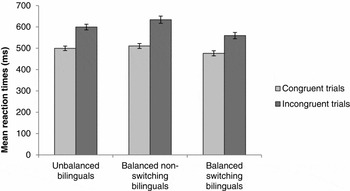
The ANCOVA on RTs revealed a significant main effect of Group (F(2,61) = 4.29, p = .018, MSE = 6751), and Congruency (F(1,61) = 4.10, p = .047, MSE = 721) (see Figure 3). The effect of the covariate French proficiency was again not significant (F(1,60) < 1), nor was the effect of French frequency of use (F(1,60) < 1). Planned comparisons show no significant differences in RTs between the UB and BnSB (t(43) < 1 for congruent trials and t(43) = −1.60, p = .117 for incongruent trials), nor between the UB and BSB for congruent trials (t(46) = 1.46, p = .150). For incongruent trials, we found a marginally significant difference (t(46) = 2.00, p = .051). The BnSB differed significantly from BSB (t(35) = 2.05, p = .047 for congruent trials and t(35) = 3.33, p = .002 for incongruent trials). Analysing the data with the Simon effect as dependent variable showed a significant interaction between Group and Congruency (F(2,61) = 6.68, p = .002, MSE = 721) (Figure 4). Planned comparisons show a significant difference between the BSB and BnSB (t(35) = 3.21, p = .003). The UB did not differ significantly from the BnSB (t(43) = −1.84, p = .073), nor from the BSB (t(46) = 1.54, p = .131).Footnote 3 French proficiency interaction with congruency was only marginally significant (p = .077), implying that the slightly higher L2 proficiency of BSB cannot account for the bilingual advantage.
Partial correlations, controlling for L2 proficiency, between switch frequency and measures of executive control (flanker and Simon arrow tasks) across the three groups.

* = p < .05; ** = p < .01
Note: Non-parametric Spearman correlations between switching frequency and executive control yield the same pattern of significant correlations.
Reaction times by congruency (congruent vs. incongruent) in the Simon arrow task (bars represent standard errors).

Size of the congruency effect in the Simon arrow task by group (bars represent standard errors).

Partial correlations
Partial correlation analyses (see Table 2), across groups and controlling for L2 proficiency, showed that frequency of language switching was significantly correlated with the size of the congruency effects and overall RTs on incongruent trials, for both Simon and Flanker tasks. For the flanker task, the correlation for congruent trials was also significant.
Discussion
The aim of this study was twofold. First, we wanted to investigate the influence of language-switching experience in bilinguals on a manifestation of executive control other than task switching. We therefore employed tasks tapping into interference control. Second, for the first time, this issue was studied by investigating language-switching experience effects within a single language pair, thereby controlling for possible confounds due to language pair dissimilarities (see Prior & Gollan, Reference Prior and Gollan2011). We conducted a flanker task and a Simon arrow task, and compared the performance of unbalanced Dutch–French bilinguals, balanced bilinguals who often switch between languages in their daily lives, and bilinguals who do not often switch between languages.
The results of both tasks point largely in the same direction; balanced bilingual participants who often switch (BSB) between languages show smaller congruency effects than balanced bilinguals who do not often switch between languages (BnSB),Footnote 4 even though these bilinguals also had very high L2 proficiency. Moreover, our measure of switch frequency was strongly correlated with performance on both flanker and Simon tasks, across groups and even after controlling for L2 proficiency. This suggests that an executive control advantage is only present when the lexical representations of both languages are often simultaneously active and used or inhibited during frequent language switching, e.g. in bilinguals who switch languages within conversations. The frequent simultaneous activation between strong lexical representations of different languages causes competition and necessitates the bilinguals to engage their executive control mechanism to select representations in the target language, and inhibit the non-target language. This practice then transfers not only to task switching (see Prior & Gollan, Reference Prior and Gollan2011), but also to interference resolution. It is our belief that demonstrating an effect of bilingual language switching on such measure is a stronger demonstration of the fact that the bilingual advantage is a domain-general phenomenon. Demonstrating that more frequent language switchers are also better task switchers is interesting, but less surprising, and more vulnerable to circularity considerations.
Additionally, we found that language switching was correlated with performance on both congruent and incongruent trials in the two tasks. Our results therefore seem to support the suggestion of Costa et al. (Reference Costa, Hernández, Costa-Faidella and Sebastián-Gallés2009) that bilingual advantages may not only relate to conflict resolution (Bialystok et al., Reference Bialystok, Craik and Ryan2006), but generalise to overall performance (Bialystok et al., Reference Bialystok, Craik, Klein and Viswanathan2004; Costa et al., Reference Costa, Hernández and Sebastián-Gallés2008). Costa et al. reasoned that the bilingual's more efficient monitoring system was at the basis of this, as bilinguals need to monitor continuously the appropriate language for each communicative interaction, depending on the interlocutor(s). Bilinguals who often find themselves in situations in which switching takes place frequently might have an even greater need to monitor the situation. This may explain why the frequent switchers in our study performed better on the two conflict tasks, not just regarding the congruency effect, but also for overall measures.
Our findings supplement the work of Prior and Gollan (Reference Prior and Gollan2011), who showed that language and (non-verbal) task shifting was only better in bilinguals who regularly switch between languages. However, because Prior and Gollan compared switching English–Spanish bilinguals with non-switching English–Mandarin bilinguals, it was yet unclear whether the difference between these groups reflected switching experience or rather different language pair similarity. The present study clearly shows that the bilingual advantage emerges from language-switching experience as groups with the same single language pair were compared. Nevertheless, given that Dutch and French are typographically similar, we do not know whether this switching effect would also generalise to a pair of typographically dissimilar languages. Yim and Biaystok (Reference Yim and Bialystok2012), for example, did not find a relation between language switching and non-verbal task shifting in Cantonese–English bilinguals. However, they did not investigate a specific group of language-switching bilinguals, but instead analysed effects of a continuous measure of language-switching performance in an experimental language-switching task.
The present findings may contribute to an explanation why findings about the bilingual executive control advantage are rather inconsistent. Whereas relatively consistent bilingual advantages have been found by Bialystok and colleagues in Canada (e.g. Bialystok, Reference Bialystok2006; Bialystok et al., Reference Bialystok, Craik, Klein and Viswanathan2004; Bialystok & Feng, Reference Bialystok and Feng2009) and Costa and colleagues in bilingual Barcelona (e.g. Costa et al., Reference Costa, Hernández, Costa-Faidella and Sebastián-Gallés2009; Costa et al., Reference Costa, Hernández and Sebastián-Gallés2008), a recent study by Paap and Greenberg (Reference Paap and Greenberg2013) failed to find such evidence in any of 15 executive control tasks, testing 122 bilinguals from 30 different language pairs in San Francisco. The present study suggests that active and frequent language switching may be the crucial determinant for the development of the bilingual executive control advantage. Although Paap and Greenberg claim that their bilinguals switch languages daily, it is unclear whether this implies just switching languages between contexts (e.g. speaking English at university and Russian at home), or instead active and very frequent language switching within conversations, as is the case for Catalan–Spanish bilinguals,Footnote 5 or for the BSB bilinguals in Brussels from this study. Given that the large number (30) of language combinations are unlikely to be used simultaneously in San Francisco, we suspect that their bilingual population is most comparable to the BnSB from this study, which also did not show a bilingual advantage. Furthermore, it should be noted that it may also be the type of switching and not simply switching frequency that plays a role in bilingual cognitive control. It seems that different types of language switching require different types of cognitive control processes (Green & Wei, Reference Green and Wei2014). This has also been suggested by Green and Abutalebi (Reference Green and Abutalebi2013) in their adaptive control hypothesis, which states that the interactional context (e.g. switching languages with different speakers vs. switching within a conversation) is important for the bilingual adaptation of cognitive control processes and to tune the networks of control.
An inevitable characteristic of this study is the lack of data about monolinguals. This is a more practical issue, given that everyone in Belgium has at least knowledge of two languages. The positive consequence of this language context is that we were able to compare different groups of bilinguals from the same language pair (Prior & Gollan, Reference Prior and Gollan2011). We cannot, however, exclude the fact that the unbalanced and balanced non-switching bilinguals in this study still show better performance than monolinguals. Nevertheless, note that in the Prior and Gollan study (Reference Prior and Gollan2011) also no differences were found between the monolinguals and the non-switching bilinguals.
Where future studies are concerned, we argue that it is advisable to include an objective measure of proficiency, such as a picture naming test in both languages, to objectify the language proficiency. In addition, because this is only the second demonstration of effects of daily language switching on cognitive control, future research may evolve towards more detailed, continuous measures of language switching (see also Yim & Bialystok, Reference Yim and Bialystok2012), to elaborate further the role of switching frequency in the development of a control advantage. It could also be interesting to broaden these results within the same language pair, to other executive functions, such as task shifting (e.g. Prior & Gollan, Reference Prior and Gollan2011), although this implies more shared task demands with language switching and is therefore a weaker demonstration of a general bilingual advantage.
To summarise, this study shows that language-switching experience in daily life is a key determinant for the development of a stronger executive control system, underlying the alleged bilingual advantage on executive control tasks. We believe that the current demonstration of language-switching experience effects demonstrates that this factor should not be neglected as a crucial determinant of the bilingual advantage, nor in further research assessing other cognitive control functions. As such, we believe that the current findings for interference tasks also contribute to this ongoing debate as a possible explanation for the inconsistent findings with other tasks.
Supplementary Material
For supplementary material accompanying this paper, visit http://dx.doi.org/10.1017/S1366728914000352.