Introduction
The syndrome of mitochondrial myopathy, encephalopathy, lactic acidosis and stroke-like episodes (MELAS) was first described by Pavlakis et al. in 1984 (Reference Pavlakis, Phillips and DiMauro1). MELAS is a neurodegenerative disorder caused by mitochondrial dysfunction, leading to disorders involving several organ systems, including central nervous system (CNS) and skeletal muscles (Reference Shapira2). MELAS is a maternally inherited mitochondrial disease, caused by an A-to-G transition mutation in the tRNALeu at base pair 3243 in the mitochondrial DNA (Reference Goto, Nonaka and Horai3). This mutation resulted in a defect in the translation of the respiratory chain enzymes that decreased the ability of cells to convert glucose into adenosine triphosphate (ATP). Approximately 80% of the patients with MELAS were found to possess this mutation (Reference Goto, Nonaka and Horai3). Here we report a MELAS patient, who was hospitalised due to progressive neurological deficits and global cognitive function impairment.
Case report
A 30-year-old male was prematurely born at about 36 weeks and had normal developmental milestones. At age 20, he was diagnosed with MELAS by DNA analysis, muscle biopsy and brain magnetic resonance imaging (MRI). The initial presentation was abruptly developed gait disequilibrium, right hemiplegia, apraxia, short-term memory loss and seizure. His clinical condition recovered gradually after conservative treatment with CoQ10 and anti-epileptic agent. He worked as an English translator under the same treatment strategy and had normal life during the past 10 years.
Early this year, the patient suffered from headache with left visual field defect, unsteady gait, cognitive deterioration with short-term memory loss, depleted verbal fluency, reduced visuospatial function with impaired clock drawing test (Fig. 1a) and had difficulty to find right words while talking and writing. He was hospitalised. Brain MRI showed multiple acute ischaemia infarctions over right-side cerebrum. The electroencephalography (EEG) revealed a seizure disorder with severe disturbance of cerebral function over bilateral temporoparietooccipital regions.
(a) The patient cannot pass the clock drawing test before treatment. (b) After treatment, the patient had significant improved visuospatial ability.

Behaviour disturbance emerged such as wandering, paranoid psychosis with refusal of medication and diet for fear of being poisoned, sexual disinhibition behaviour (grasping others' hand to touch his penis).
Quetiapine 12.5 mg was administered during nighttime. However, prolongation of corrected QT interval (QTc) developed from 440 to 527 ms in 1 week. After shifting to risperidone, the QTc returned to 500 ms 1 week later. Holter's ECG examination showed no abnormal finding.
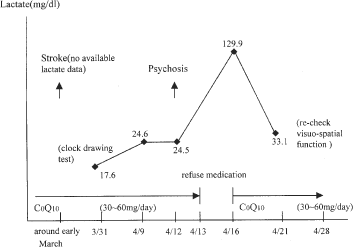
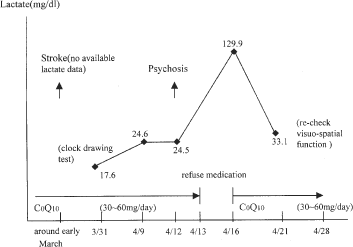
The patient refused CoQ10 treatment due to persecutory delusion for about 3 days. Then blood lactate level elevated from 24.5 to 129.9 mg/dl (normal range 6.3–18.9 mg/dl) in the absence of severe psychomotor agitation. The level returned to 33 mg/dl after re-challenging CoQ10 for 5 days. We keep using CoQ10 for about 2 weeks and the medical general conditions improved, along with improved cognitive function and psychiatric symptoms (Fig. 2).
Clinical course and metabolic changes. Serum concentrations of lactate increased during his refusal of medication. CoQ therapy re-challenge was still useful in decreasing lactate and improving visuospatial function.
Discussion
Global cognitive deficits in patients with mitochondrial disease (MD) were discussed in detail at most literatures but only a few studies were mentioned about the effect of CoQ10 on cognitive function. Some reports had described more than half of patients with MD having general intellectual deterioration with varying degree of focal cognitive deficits (Reference Finsterer4,Reference Turconi, Benti and Castelli5). In our case, the blood lactate increased to 129.9 mg/dl since his refusal of medication along with cognitive deterioration such as deficits in executive function, attention and visuoconstruction abilities. The blood lactate decreased to 33.3 mg/dl accompanied with cognitive improvement gradually in 2 weeks and maintained stable for 4 months after re-challenge with CoQ10. Several studies reported clinical and biochemical benefits of CoQ10 (Reference Remes, Liimatta and Winqvist6–Reference Remes, Liimatta and Winqvist10). Of these case reports found, CoQ10 showed biochemical efficacy on serum lactate improvement (Reference Shinkai, Nakashima and Ohmori7,Reference Goda, Hamada and Ishimoto8,Reference Ihara, Namba and Kuroda10), two on CSF lactate decrease (Reference Shinkai, Nakashima and Ohmori7,Reference Abe, Fujimura and Nishikawa9) and one on EEG improvement (Reference Ihara, Namba and Kuroda10). These studies also revealed clinical improvement on motor intolerance (Reference Abe, Fujimura and Nishikawa9,Reference Ihara, Namba and Kuroda10), psychiatric signs (Reference Shinkai, Nakashima and Ohmori7) and blindness (Reference Goda, Hamada and Ishimoto8). Remes et al. found only slight improvement of cognition in patient receiving CoQ10 plus nicotinamide. Ihara et al. showed improvement on Wechsler Adult Intelligence Scale under combination therapy with CoQ10 and idebenone. Similar to these studies, our case receiving CoQ10 may improve cognitive function, especially at visuospatial capacity, despite no detailed neuropsychological examination due to un-cooperation at the beginning (Fig. 1).
Several studies investigated the harmful effects of lactate on neurons (Reference Staub, Mackert, Kempski, Peters and Baethmann11). Kaufmann et al. concluded that high level of ventricular lactate was associated with severity of neurologic impairment (Reference Kaufmann, Shungu and Sano12). Berbel-Garcia et al. presented a MELAS patient who had been treated successfully with CoQ10 for at least 30 months (Reference Berbel-Garcia, Barbera-Farre and Etessam13). CoQ10 is theorised that it increases production of ATP and plays a central role in both mitochondrial electron transport and transmembrane proton movement. CoQ10, which is unable to pass the blood–brain barrier (BBB), may pass CNS and reduce the cerebrospinal fluid lactate when a broken BBB exists (Reference Abe, Fujimura and Nishikawa14). Because our case revealed acute infarction on brain MRI, oral CoQ10 may pass the broken BBB through blood and attributed to brain mitochondrial metabolism. Unfortunately, no other proofs such as cerebrospinal fluid lactate are available in our case to strengthen the correlation between serum lactic acid concentration and CoQ10 treatment. Some literature showed the effect of CoQ10 ON patients with MD (Reference Remes, Liimatta and Winqvist6–Reference Ihara, Namba and Kuroda10). We speculate that CoQ10 may contribute possible efficacy in CNS. Future studies are needed to investigate the effect of CoQ10 on cognitive functions.
Cardiovascular involvement is another clinical feature associated with mtDNA mutations. Finsterer reported that nearly half the MD patients developed heart disease (Reference Finsterer15). However, cardiac conduction abnormalities were less mentioned. In our case, QTc prolongation developed under psychotropic drugs. Psychotropic medications can inhibit complex I of the electron transport chain and contribute to worsen symptoms of the MD (Reference Neustadt and Pieczenik16). QTc prolongation is the most frequent pathologic finding on ECG of patients with mitochondrial disease, which could potentially lead to sudden cardiac death (Reference Baik, Chae, Lee, Kang, Lee and Kim17). Although psychotropic drugs alleviate psychiatric symptoms, they worsen the QT interval at the same time. It is still controversial whether psychotropic options are suitable for treating MD or not. We recommend regular electrocardiography (ECG) examinations for patients with MD, especially before and during psychotropic treatments.
Conclusion
MELAS patients have variable clinical presentation with multiple organ systems involved. We conclude as follows: first, cognitive functions and intellectual abilities decline with disease progression. Routine neuropsychological tests should be arranged. Secondly, CoQ10 is still a controversial therapy for MD (Reference Matthews, Ford and Dandurand18). Our case shows some benefits of CoQ10 even after re-challenge. Lastly, psychotropic agents may deteriorate heart conduction in patients with MD. Therefore, it is necessary to examine the QT interval regularly.