Introduction
The poultry chain in Algeria has shown major advances in the last three decades, mainly due to state intervention. This has had direct repercussions on human food quality (by increasing protein intakes from meat) and meeting the nutrient requirements of nearly two million people. White meat production levels are estimated to be 8 kg per capita, but remains low compared to other countries, e.g. France: 20 kg per capita. In comparison, the white meat consumption for Algeria was only 5.32 kg per capita in 1980 (Fenardji, Reference FENARDJI1990), so the trend for intake is upwards.
Unfortunately at the beginning of the 21th century, the Algerian poultry sector appears to be more vulnerable, because of the challenges imposed by liberalisation of trade, globalisation, the assignment of feed raw materials for biofuel manufacturing and the increase in feed material consumption by India, China and Russia, all of which has resulted in increased costs of poultry production inputs. The poultry sector in Algeria, even after the imposition of ameliorative state programs, is still relatively antiquated (i.e. extensive private breeding farms, technological delays, sub-standard production process and low productivity) which has direct effects on price of saleable products, making meat and eggs more expensive. This has severe consequences for poultry producers, primarily due to poor productive performance, seen as higher feed conversion ratios and death rates (Ain Baaziz et al., Reference AIN BAAZIZ, GERAERT, PADILHA and GUILLAUMIN2000; Belouam, Reference BELOUAM2000). Feed wastage as well as the reliance on prophylactic drugs and high production costs is reflected in the higher prices and quality of product passed onto the consumer (Kaci and Kabli, Reference KACI and KABLI2000). The semi-industrial production that typifies the Algerian poultry industry is marred by chronic price instability and recession conditions, which highly contribute to disorder in the whole sector and make difficult any attempts for rigorous business planning or improvements.
Relatively little information is available on poultry production in Algeria and, to our knowledge, very few research papers focussing on this countries poultry industry have been published. The following review comprises an evaluation of the poultry sector in Algeria, including the various constraints and prospects for production within the current international context and the proposal for certain revitalising measures.
Evolution of Algerian poultry production
Historically, the Algerian national poultry sector can be differentiated into three different time periods. The first period is the time from independence up to 1968, during which changes were limited essentially to the conversion of pigsties to poultry houses. The second phase, from 1969 to 1989, saw the creation of large public enterprise (ONAB) deals focussed mainly on the development of poultry and other livestock sectors. Several modern complexes have been realised under different national development plans. During this period, the management of certain production factors (e.g. breeder facilities, chicks, and feed) became the vocation of public structures, while the production of finished products (table eggs and chickens) was controlled by the private sector. This phase is noted for the exceptional effort approved by ONAB in training technicians abroad and assuring the spread and use of new techniques in poultry production. The third stage start, from 1990 to modern day following the abolition of the state monopoly, has been characterised by exponential development of the private sector and the total cessation of state investment in the poultry production chain.
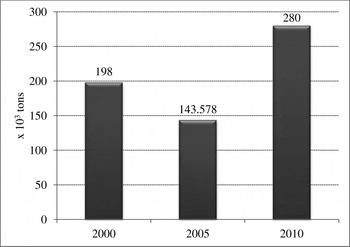
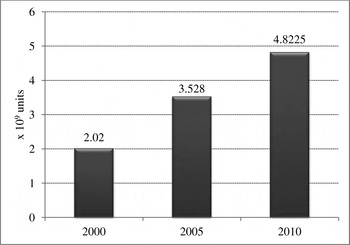
According to official data published from agricultural statistics and information released by the Algerian Ministry of Agriculture and Rural Development (MARD), poultry production reached 198,000 tons of white meat and 2.02 billion eggs in 2000, which were lower than those reported during state support periods (1989-1994) (MARD, Reference MARD2005; Reference MARD2006). According to latest figures, the production of poultry meat has risen to 340,000 tons and 4.82 billion eggs in 2011 (MARD, Reference MARD2012).
Furthermore, the abrupt appearance of bird flu (H5N1 virus) globally led to a net drop in poultry production resulting in a drop in poultry breeding and production, even though no cases of avian influenza have ever been detected in Algeria. Significant decreases in white meat production were observed; 15.5% less in 2005 compared to 2004 (MARD, Reference MARD2005) (Figure 1) although an abrupt increase (68%) was seen in 2006, causing outputs to reach 241,166 tons (MARD, Reference MARD2005). During the avian flu crisis, nearly 80% of the 20,000 producers ceased trading. The fall in poultry consumption led, at the beginning, to a critical situation characterised by the bankruptcy of a large number of producers and a fall in prices to levels whereby 1 kg of poultry meat was selling for only US$1.00 (90 DZD/kg). Since then, prices have increased to more than US$3.00/kg due to supply and demand, although recorded losses during the avian flu period have been estimated at US$250 million (OFAL, Reference OFAL2001).
Evolution of white meat production in the last decade (MARD, Reference MARD2012).

Following the applications of government policies in 1980, no significant evolution was seen in the structure of private companies (which constituted the basis of poultry production in Algeria) compared to economic state enterprises (EPE). Indeed the private sector still accounts for 92% and 73% of white meat and table egg production capacities respectively. Moreover the mean size of the privately operated farms is typically 3000 turkeys or 5000 broilers or 10,000 laying hens.
According to Mezouane (Reference MEZOUANE2010), the annual imports of broiler breeders reached 3.72 million chicks in 2009 with 15% being males, as well as 500,000 locally produced chicks. The number of starter chicks (with a mortality rate of around 8%) amounts to 21 million per annum and the total number of table eggs is about five billion units (Figure 2).
Evolution of egg production in the last decade (MARD, Reference MARD2012).

Companies and operators upstream of poultry production
This part of the poultry sector includes importers of inputs and raw materials as well as manufacturers of feed, and vitamin and mineral premixes. This sector is the result of state enterprises and integrated public groups, but the private sector has emerged in the last decade as a potential partner and deals mainly with the import of production factors and materials.
raw materials
The feed used in Algeria is manufactured from raw materials imported from various countries, principally the USA and Europe, with a high increase seen in imports during 2008 compared to 2000. This is primarily due to an increase in corn and soybean meal purchasing, as well as the principal components of premixes (Boumediene, Reference BOUMEDIENE2008).
Following the demonopolisation of foreign trade, private companies contributes to the trade of raw materials and their contribution was estimated in 2000 at 62% of corn and 41% of soybean imports (OFAL, Reference OFAL2001). The poultry industry in Algeria is directly affected by global commodity prices and the availability of corn and soybean on the international market, as more than 90% of the imports intended for the poultry sector are represented by corn and soybean as principal components of feed (Boukersi, Reference BOUKERSI2008).
livestock feed manufacturing
Poultry feed is produced by both state enterprises and private manufacturers. The former are well equipped with comparable technology and include 24 factories and an annual production capacity of 1.8 million tons. State enterprises deal mainly with turkey and broiler feed manufacturing (55% of the production in 2000) and layers feed (26% in 2000), while private manufacturers, with 330 factory units, produced 1.2 million tons and accounting for 24% of the national production of poultry feed in 2000, an increase of 41% market share compared to 1999 (OFAL, Reference OFAL2001).
hatching eggs and chicks
Increased local production of animals (chicks, started pullets, eggs for incubation) has reduced the reliance on imports of these biological inputs by 7% in 2000 compared to 1999. Previously Algeria was more reliant on imported fertile eggs and chicks.
veterinary equipments and products
Importation of equipment has strongly decreased in the last 20 years. In contrast, the importation of veterinary products has greatly increased since 2000, as a result of the development of production but more specifically due to the now common practise of overmedication. As an example of this increase, the number of importers increased by 50% in only one year. This may also be a feature of the loss of markets for certain prophylactic medications, hence drug companies are more focussed on less regulated countries for sales, such as Algeria.
The downstream companies
The downstream sectors of poultry production assume the following operations: collection, slaughtering, transformation, marketing and storage. Collection and slaughtering of poultry products in Algeria are primarily the work of private operators integrated in the sphere of production and marketing. State enterprises intervene somewhat in these activities through slaughterhouses. For 475,000 tons of white meats, the EPE accounts for processing only 46% in their 15 slaughterhouses, the remainder is carried out by local slaughterers using rudimentary installations (Mezouane, Reference MEZOUANE2010).
White meat processing and marketing is still in its infancy in Algeria, irrespective of whether state or private enterprises are involved. The lack of active marketing of chicken meat and eggs is mainly due to reduced purchasing power of consumers and low per capita intake of poultry products. In 2000, a total of 230 private industries were identified as manufacturing preserved poultry meat and were operating alongside state enterprises operating on the level of slaughterhouses. Marketing is provided exclusively by private operators controlling distribution of end products throughout the country, while retail business is dispersed and more than 1000 poultry business units exist in Algeria, represented mainly by retail stores specialised in poultry products.
Main constraints
Poultry farming is completely dependent on the supply of production factors (one day old chicks, started pullets and feed). Feed makes up an essential part of production in intensive poultry farming, and is fraught with numerous difficulties, e.g. the price of imported raw materials (corn and soya) which is well-known for its fluctuation on the international markets with severe consequences for the poultry production as a result (Kaci and Kabli, Reference KACI and KABLI2000). During periods of high demand, most private poultry farmers face difficulties in ensuring an adequate supply of basic requirements for production. Failures in the application of new breeding techniques have been widely observed, and, in particular, non-compliance of farmers with the basic rules of hygiene and biosecurity, have resulted in major losses and higher mortality due, in part, to infectious diseases. Building construction and equipment are often sub-standard and have a major impact on poultry, due to bad ambient conditions and insulation, resulting in e.g. heat stress. Higher temperatures during summer usually push the poultry farmers for a temporary respite in production due to heat stress (Ain Baaziz et al., Reference AIN BAAZIZ, GERAERT, PADILHA and GUILLAUMIN2000). Misunderstanding biosecurity rules is the main issue behind the contamination of many flocks by various disease vectors and the relatively high mortality rate in birds. All these technical constraints put great pressure on productive performance and the economic profitability of poultry farming. These constraints represent the main reason cited by farmers for leaving the industry and constitute a factor discouraging the engagement of new investors in this sector.
Conclusions
The development policies initiated in the 1980's provided an opportunity for profound remodelling of the poultry sector and was aimed primarily at feed self-sufficiency, using intensive poultry production to increase animal protein in human food intake at lower cost. The adopted model of poultry farming in Algeria is that which prevails worldwide, i.e. an intensive model based on imported inputs and technologies requiring integrated organisation of production with planning and rigorous coordination of related industries up and downstream. High dependency on foreign markets of poultry feed concentrates, mainly corn and soybean meal, is still the main limiting factor for development of the poultry sector
Rehabilitation and sustainable development of poultry farming in Algeria require supportive measures at various levels. These include:
• Creation of a national council for poultry farming, gathering representatives from various partners to work out development policy of the supply chain and controlling its implementation in the current international context and local specificities (Nouad, Reference NOUAD2009).
• Organisation of the industry through professional and inter-professional associations (Alloui, Reference ALLOUI2009).
• Improvement in marketing poultry products.
• Providing technical support and training for poultry producers to improve performance across the industry spectrum.
• Decreasing charges, in particular those regarding imports, by reducing or removing customs taxes and by removing VAT for breeders.
• Funding through interest-free loans for the creation of necessary structures for processing poultry products (slaughterhouses etc.).
• Diversification of poultry products and promotion for the consumption of turkey meat and other species (guinea fowls, ducks, game birds).
• Promotion and encouragement of research directed at improving poultry nutrition, breeding and management, development of local strains and in the search for suitable alternatives for partial substitution of imported corn and soya.