

Introduction
The population of sheep in Morocco is currently estimated at 17.1 million. According to Mason (Reference Mason1969), it is composed by some twenty different breeds that have ability to tolerate harsh climates, resistance to prevailing diseases, good recovery capacity from drought, efficient utilization of limited feed resources, suitability to extensive systems, etc. At present, the most important breeds are Sardi, Timahdite, Béni Guil, D'man and Boujaâd. These breeds were phenotypically characterized and their breed standards were established since the beginning of 1980s when the sheep plan, called “Plan Moutonnier” (MARA, 1980), was published. At that time, the breeding areas of these breeds were delimited and included only few thousands of animals. With the development of the breeders’ association, named “Association Nationale Ovine et Caprine, ANOC”, several other breeder groups were created, and breeding areas became very large and included several thousands of animals that were often different from those that were used initially for establishing breed standards. Moreover, Eyraud (1934) reported that some Moroccan sheep breeds were formed by grouping some subpopulations that existed in the past within the same breeding area. However, this hypothetical presence of subpopulations within some local breeds has never been tested. If true, important consequences may occur on selection and even conservation programmes of these breeds.
The first step of sheep characterization is the population identification based on morphological measurements, which allows the knowledge of sheep variability (Gizaw et al., Reference Gizaw, van Arendonk, Komen, Windig and Hanotte2007; Traoré et al., Reference Traoré, Tamboura, Kaboré, Royo, Fernández, Álvarez, Sangaré, Bouchel, Poivey, Francois, Toguyeni, Sawadogo and Goyache2008; Esquivelzeta et al., Reference Esquivelzeta, Fina, Bach, Madruga, Caja, Casellas and Piedrafita2011). Several researchers (Kunene et al., Reference Kunene, Nesamvuni and Fossey2007; Carneiro et al., Reference Carneiro, Louvandini, Paiva, Macedoc, Mernies and McManus2010; Birteeb et al., Reference Birteeb, Peters, Yakubu, Adeleke and Ozoje2013; Mavule et al., Reference Mavule, Muchenje, Bezuidenhout and Kunene2013; Yunusa et al., Reference Yunusa, Salako and Oladejo2013) have used body measurements to characterize sheep breeds, to assess between- and within-breed variability and to discriminate different populations. In Morocco, multivariate analyses of morphological traits were never reported in sheep; information was mainly focused on the assessment of production and reproduction performances (Boujenane, Reference Boujenane2006). Thus, in order to ensure proper utilization and conservation of Moroccan local breeds, it is necessary to evaluate genetic variation that exists within and among them.
The objectives of this study were to characterize Moroccan local sheep breeds and to assess the between- and within-breed variability of morphological traits using multivariate analyses. Results obtained from this study would provide information useful for updating breed standards both in magnitude and variability and to differentiate between the breeds.
Materials and methods
Studied breeds
The study was carried out on Béni Guil, Boujaâd, D'man, Sardi and Timahdite breeds that are the most important Moroccan local sheep breeds owing to their high number and extended breeding areas. All of them are thin-tailed and rams have fairly well developed spiral horns, except those of D'man breed that are polled (Boujenane, Reference Boujenane and Iniguez2005). The breeding areas of Béni Guil, Boujaâd, D'man, Sardi and Timahdite are located in eastern hills, central hills, southeastern oases, central hills and Middle Atlas Mountains of Morocco, respectively. The Béni Guil breed has a regular shape, short neck, brown face and legs and white fleece. The Boujaâd sheep have white to yellowish face with a white fleece, robust bone structure and strong head. The D'man breed has a fleece that is characteristically entirely black, although some animals are brown, white or various combinations of two or all three colours. The bone structure is fine and the head is narrow. The tail is long and usually extends below the hocks. The Sardi breed has animals with white head and black spots around the nose, mouth and eyes. The body fleece is white and the legs are bare. The Timahdite breed has brown face, white legs and fleece. These breeds are described as medium-sized and are reared mainly for meat, although the D'man is valued for its exceptional reproductive characteristics. They are well adapted to local environmental conditions.
Data collection
A total of 876 sheep showing good body condition and meeting the phenotypic standards, established by the “Association Nationale Ovine et Caprine” (ANOC), were used for the study. This sample included 143 Béni Guil, 138 Boujaâd, 148 D'man, 179 Sardi and 268 Timahdite of both sexes. For the purpose of uniformed comparison, only adult animals, i.e. having 4, 6 or 8 permanent incisors (i.e. more than 2 years old) were considered. However, pregnant ewes were excluded from sampling, as pregnancy may affect body weight (BW) and some other morphological measurements. The number of sheep by breed, sex and dentition is presented in Table 1. The high number of females is because they were retained by farmers for reproduction, while the males were very often sold. In each breeding area, farmers with sheep were randomly selected. Moreover, for the sake of large geographic and management variability, only 8–12 animals of both sexes and of different ages were randomly selected in each flock. At the end, a total of 98 flocks (12 Béni Guil, 10 Boujaâd, 15 D'man, 23 Sardi and 38 Timahdite) were visited. These flocks were located in 3, 5, 2, 5 and 7 geographic localities covering a wide range of environments of breeding areas of Béni Guil, Boujaâd, D'man, Sardi and Timahdite breeds, respectively.

In general, the sheep were exploited either extensively or semi-intensively with little supplementary feeding. Except the D'man breed that is indoors all year, the other breeds grazed during the day on natural pastures, low-grade forage or stubbles. They were housed throughout the night in constructed pens or under the open sky with a fenced enclosure made of bushes. Animals were vaccinated against enterotoxaemia and treated against endoparasites.
Studied traits
Morphological measures taken on each animal were those advocated by the FAO for breed characterization according to the DAD-IS program (FAO, 2013). These were body weight (BW), body length (BL, distance from the point of the shoulder to the pin bone), heart girth (HG, perimeter of the chest just behind the front legs and withers), withers height (WH, height from the withers to the ground), chest depth (CD, distance from the brisket between the front legs to withers), chest width (CW, maximum intercostals diameter, just behind the elbows), rump width (RW, maximum distance between left and right hurls), cannon circumference (CC, smallest circumference of the cannon bone of foreleg), head length (HL, frontal distance from poll to the lower lip), head width (HW, maximum distance between zygomatic arches), ear length (EL, distance from the base to the tip of the ear along the dorsal surface), ear width (EW, maximum distance at the middle of the ear), tail length (TL, distance from the tail droop to the tip of the tail excluding switch) and wool length (WL, length of wool fibres taken on the flank). All measurements were recorded using flexible tape (with records taken to the nearest cm), except for WH, RW, thorax width and thorax depth that were taken by graduated measuring stick and calibrated wooden calliper, and BW that was measured using an electronic scale. When measured, animals were put on a flat floor with the head held up, while restricting the animal by holding. Morphological measurements were taken from the right side of the animal by the same operator to avoid between-operator variations. These measurements were realized between February 2014 and March 2015, usually early in the morning before grazing or receiving feed in order to avoid undesirable variations due to weight and rumen volume change.
Statistical analyses
The statistical analyses were carried out using the SAS/STAT package (2002). Data were first analysed using MEAN and FREQ procedures to obtain descriptive statistics for morphological traits studied and frequency distribution of animals. The GLM procedure was used to assess the effect of breed on all body measurements through the multivariate three-way analysis of variance fitting a model that included fixed effect of breed (five levels: Béni Guil, Boujaâd, D'man, Sardi and Timahdite), sex (two levels: female and male) and age (three levels: 4, 6 and 8 permanent incisors). Likewise, to study the within-breed morphological variability, the GLM procedure was used to assess the effect of geographic locality on all body measurements of each breed through the multivariate analysis of variance fitting a model that included fixed effect of locality (from 2 to 5 localities according to the breed), sex (two levels: female and male) and age (three levels: 4, 6 and 8 permanent incisors) and random effect of flock nested within locality. After computing linear contrasts between the different localities of each breed, some were not found statistically different (P > 0.05) and, hence, the corresponding localities were combined. At the end, instead of 22 geographic localities, only 15 large localities were identified; three for Béni Guil (Aïn Béni Mathar, Outat Lhaj and Tendrara), three for Boujaâd (Boujaâd, Chougrane and Rouached), two for D'man (Tafilalet and Tinghir), four for Sardi (Béni Meskine, Béni Moussa, Rhamna and Sraghna) and three for Timahdite (Timahdite, Rhoualem and Khénifra). To assess the between-breed morphological variability, the PROC VARCOMP was applied by fitting the previous model that included breed as random effect. Likewise, to assess geographic locality and flock management contributions to within-breed variability, the VARCOMP procedure was used by fitting the previous model that included locality and flock nested within locality as random effects. To obtain an approximate overall multivariate variance component, locality and flock variance components for all traits were then averaged. The FACTOR procedure was used to perform factor analysis, which is a data reduction technique that combines measurements into uncorrelated components. The stepwise discriminant analysis was applied using PROC STEPDISC to identify which morphological traits have more discriminant power than others in separating the five breeds. The significance level applied for retaining or adding a variable was 0.05. The CANDISC procedure was used to perform canonical discriminant analysis for deriving canonical functions, which were linear combinations of body measurements that summarized variation between breeds, and for calculating the squared Mahalanobis distance matrix necessary for the differentiation between-breeds and between-localities within each breed. The DISCRIM procedure was applied to perform discriminant analysis to estimate the proportion of animals that were properly classified into their original breed or geographic locality. The percentage of misclassified animals indicated the degree of admixture between the breeds or geographic localities.
Results
Arithmetic means and coefficients of variation
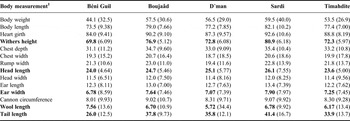
Arithmetic means and coefficients of variation for body measurements of the five breeds are presented in Table 2. The observed body measurements showed that Moroccan sheep were in general of medium size. Sardi animals had greater morphological measures, except for CW and RW that were greater in Boujaâd sheep. Sardi had tail hanging below hocks (41.4 cm), while Béni Guil had a short tail hanging above hocks (26.0 cm). Also, Sardi and Boujaâd had the widest head (12.0 cm). The overall coefficients of variation of body measurements were 11.3, 10.6, 12.6, 12.7 and 11.2 percent in Béni Guil, Boujaâd, D'man, Sardi and Timahdite, respectively. They were highest for BW (from 26.9 percent in Timahdite to 40.0 percent in Sardi) and lowest for HL (from 4.64 percent in Béni Guil to 7.55 percent in Sardi) and height at withers (from 5.12 percent in Boujaâd to 6.18 percent in Sardi), reflecting great differences in size among the studied animals and indicating some within-breed variability.
Arithmetic means (and coefficients of variation in %) for body weight (kg) and other morphological traits (cm) of sheep.

1 The most discriminating traits are in bold.
Between-breed differences
The multiple analysis of variance for morphological traits revealed that significant differences (P < 0.001) existed between breeds. The variance component analysis showed that proportion of total variance attributed to between-breed component represented 16.2, 23.5, 16.3, 60.5, 23.0, 3.80, 22.7, 34.4, 10.5, 23.3, 37.3, 33.0, 24.5 and 66.5 percent for BW, BL, HG, WH, CD, CW, RW, HL, HW, EL, EW, CC, WL and TL, respectively. The Kaiser's Measure of Sampling Adequacy (MSA) value was 0.923. Three factors with eigenvalues greater than 1 were extracted. The factors 1, 2 and 3 accounted for 50.1, 11.8 and 7.54 percent, respectively, totalizing 69.4 percent of the total variance, whilst subsequent factors contributed with less than 6 percent each. The factor 1 assigned positive coefficients to all morphological measurements. The factor 2 gave negative weights to BW, BL, HG, CD, CW, RW, HW and WL, and positive coefficients to all other traits. The factor 3 assigned negative coefficients to BW, BL, HG, CD, HL, HW, CC and TL, and positive coefficients to the remaining traits. The coefficients showed that the highest relative contributions to factors 1, 2 and 3 were BW and HG (0.91), TL (0.60) and WL (0.78), respectively. Variables’ communality, which represents the proportion of variance of each of the 14 variables shared by all remaining body measurements, were medium to high. They varied from 0.40 for HW to 0.89 for BW.
The stepwise discriminant analysis showed that all the 14 body measurements were significant (P < 0.05), suggesting that all measured variables had a discriminant power in differentiating between sheep breeds. Therefore, all the traits were maintained in the final model. Nevertheless, based on their partial R 2 and F-values (P < 0.001), TL, HG, BW, HL, WL and RW had more discriminant power than the others. Their partial R 2 were 0.580 (TL), 0.253 (HG), 0.214 (BW), 0.213 (HL), 0.206 (WL) and 0.157 (RW).
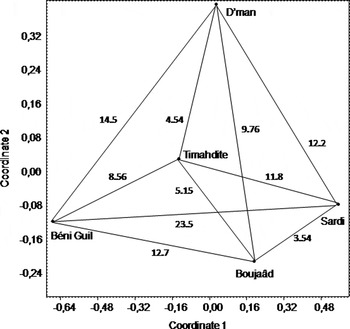
The squared Mahalanobis distances among the five sheep breeds are presented in Figure 1. All pairwise distances were highly significant (P < 0.001), indicating that the differences among breeds were important. The largest morphological divergence was shown between Béni Guil and Sardi (23.5) and the smallest one was between Boujaâd and Sardi breeds (3.54). Mahalanobis distance between Béni Guil and Sardi breeds can be qualified as long, those between Boujaâd and Sardi, Boujaâd and Timahdite, and D'man and Timahdite breeds as short, while the remaining distances as intermediate. Figure 1 showed also that the five breeds were classified into three major groups. The first group consisted of Boujaâd and Sardi breeds, the second associated D'man and Timahdite breeds, and the third group included the Béni Guil breed.
Representation of Mahalanobis distances between the five breeds.

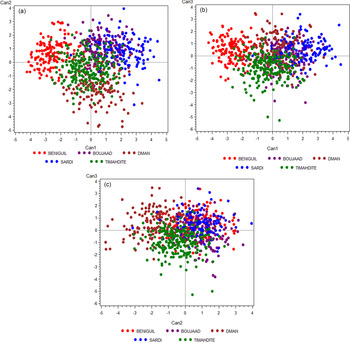
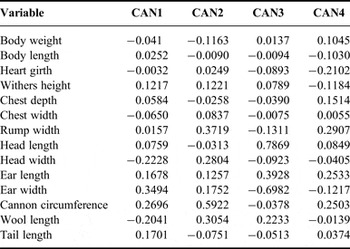
The canonical discriminant analysis identified four statistically significant (P < 0.001) canonical variables CAN1, CAN2, CAN3 and CAN4 that accounted for 57, 30, 11 and 2 percent of total variation, respectively. The canonical correlations were 0.83, 0.74, 0.55 and 0.27 for CAN1, CAN2, CAN3 and CAN4, respectively. The resulting R 2 values ranged from 0.03 for CW to 0.58 for TL, and all traits were significant (P < 0.001). Raw canonical coefficients used to derive canonical functions are presented in Table 3. CAN1, CAN2, CAN3 and CAN4 provided the greatest difference between the breed means. The breed means on CAN1 were −2.40, 1.00, 0.06, 2.43 and −0.45 for Béni Guil, Boujaâd, D'man, Sardi and Timahdite, respectively. These values indicated that Sardi breed was best discriminated by CAN1, and differed markedly in body measurements from Béni Guil and Timahdite breeds. Figure 2 showed that CAN1 separated clearly between Béni Guil and Sardi breeds and distinguished relatively well between Béni Guil and Boujaâd breeds. It showed also that the Béni Guil individuals were the most homogeneous and clustered together on the left hand of the CAN1; the Sardi were mainly distributed on the positive values of the CAN1; and the Boujaâd individuals showed an intermediate distribution but clearly close to the Sardi individuals. The second axis separated between the D'man on one hand and Béni Guil, Sardi and Boujaâd breeds on the other hand. It showed that Béni Guil, Sardi and Boujaâd individuals were clustered together on the top of the CAN2; the D'man sheep were mainly distributed on the bottom of the CAN2. The Timahdite individuals were in the middle of both canonical axes. Nevertheless, Figure 2 did not show a clear distinction between breeds.
Canonical representation of the Moroccan local sheep breeds using the morphological variables.

Raw canonical coefficients of canonical discriminant functions.

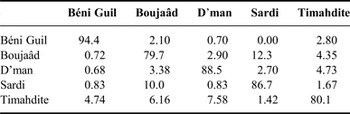
The discriminant analysis to determine the percentage of individuals correctly grouped into their own breeds is presented in Table 4. It revealed that 94.4, 79.7, 88.5, 86.7 and 80.2 percent of Béni Guil, Boujaâd, D'man, Sardi and Timahdite sheep, respectively, were correctly classified in their original breed. Most of misclassified Boujaâd individuals were classified as Sardi (12.3 percent) and vice versa (10.0 percent). No misclassified Béni Guil individuals were assigned as Sardi, whereas misclassified Timahdite individuals were classified as Béni Guil (4.74 percent), Boujaâd (6.16 percent) and D'man (7.58 percent).
Actual percentages of Moroccan sheep classified into breed.

Within-breed variability
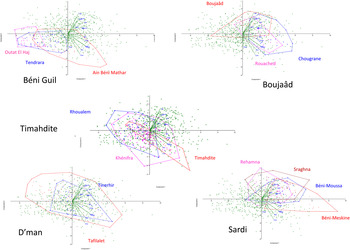
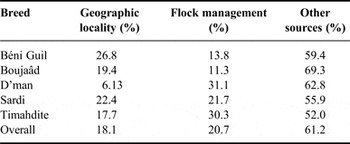
The objective of this study was to check if the heterogeneity of morphological measurements observed within-breeds originated from the presence of different geographic localities or from flock management. The partition of within-breed morphological variability showed that geographic locality and flock management components represented 18.1 and 20.7 percent, respectively for the five breeds, with other sources explaining more than 60 percent (Table 5). The contribution of geographic locality to the within-breed variability varied from 6.13 percent for D'man to 26.8 percent for Béni Guil breeds, whereas that of flock management ranged from 11.3 percent for Boujaâd to 31.1 percent in D'man breeds. For the five breeds, 4, 3, 4, 4 and 4 factors, having eigenvalues >1, were extracted, respectively. These factors were totalizing 69.5, 56.9, 67.1, 59.3 and 57.1 percent of the total variance, respectively. For the five breeds, factor 1 gave positive weights to all body measurements, except WL for which negative coefficient was assigned in Sardi and Timahdite breeds. However, the remaining factors assigned positive as well as negative coefficients to morphological traits. Highest contributions to each of the extracted factors were BW, TL, HW and EW for Béni Guil, BW, EW and WL for Boujaâd, BW, EW, WL and EL for D'man, BW, WL, EL and TL for Sardi, and BW, EW, WL and HW for Timahdite sheep. The representation of individuals in geographic localities on the first two factors (Figure 3) showed that within each breed some localities were clearly differentiated, whereas others exhibited partial overlapping.
Representation of individuals of each geographic locality-breed on the first two components.

Proportions of within-breed variability due to geographic locality and flock management.

The between geographic locality Mahalanobis distances were highly significant (P < 0.001), indicating large variation of body measures of animals raised in different localities of the same breed. The highest distances were found between Aïn Béni Mathar and Outat Lhaj localities (11.8) for Béni Guil breed, Chougrane and Boujaâd localities (9.87) for Boujaâd sheep, Beni Meskine and Sraghna localities (8.51) for Sardi breed, and Rhoualem and Timahdite localities (10.1) for Timahdite sheep. For the D'man breed, the distance between Tafilalet and Tinghir localities was 3.33.
Stepwise discriminant analysis showed that the three most discriminating traits between localities were HG, HL and BW for Béni Guil, BW, HL and WH for Boujaâd, CD, HG and TL for D'man, RW, CW and BW for Sardi, and RW, CD and BW for Timahdite sheep. This suggests that taking these traits would be more important in differentiating between geographic localities of each breed.
The discriminant analysis showed that the percentages of individuals correctly classified into their own geographic locality were 84.0, 93.3 and 95.8 percent for Béni Guil, 95.9, 100.0 and 90.9 percent for Boujaâd, 86.5 percent and 95.6 percent for D'man, 93.3, 57.6, 80.0 and 75.6 percent for Sardi, and 86.7, 87.0 and 85.0 percent for Timahdite sheep. Only 8.94, 4.39, 8.96, 23.3 and 21.4 percent of the Béni Guil, Boujaâd, D'man, Sardi and Timahdite animals, respectively, on average, being classified in wrong localities.
Discussion
The mean values for body measurements obtained in the present study would allow for the updating of morphological standards of the five sheep breeds. The most discriminant traits obtained through the canonical analysis were TL, WH, EW, HL and WL. Thus for each breed, the means of these discriminant traits are presented in bold in Table 2. The breed standards used until now in Morocco concerned BW and height at withers only. They were established more than 20 years ago and they did not cover as many animals as the current study. These new breed standards will be very useful for the national commission of the ANOC that selects animals once a year in different flocks around the country. Sardi animals showed a marked superiority for 11 measurements, suggesting better skeletal and muscle development and also indicating that they are suitable for meat production, whilst Béni Guil presented a clear inferiority for eight morphological traits. This may suggest that animals reared semi-intensively (Sardi and Boujaâd breeds) had superior morphological traits compared with those extensively managed (Béni Guil and Timahdite breeds). The D'man breed raised in a sedentary oasis system had intermediate body measurements. This variability between breeds might be due to differences in the growth rate of animals resulting from the adoption of better management practices (feeding conditions) in central hills of Morocco where the agro-pastoral system was practiced than in mountains and eastern upper hills where the pastoral system was adopted. Several researchers (Riva et al., Reference Riva, Rizzi, Marelli and Cavalchini2004; Agaviezor et al., Reference Agaviezor, Peters, Adefenwa, Yakubu, Adebambo, Ozoje, Ikeobi, Wheto, Ajayi, Amusan, Ekundayo, Sanni, Okpeku, Onasanya, De Donato, Ilori, Kizilkaya and Imumorin2012; Yadav et al., Reference Yadav, Jain, Kulkarni, Govindaiah, Aswathnarayan and Sadana2013) reported that management system was a source of variation in the body measurements of sheep. The overall coefficients of variation of body measurements were equal to 11.3, 10.6, 12.6, 12.7 and 11.2 percent in Béni Guil, Boujaâd, D'man, Sardi and Timahdite, respectively. For the five breeds, the coefficients were over the mean homogeneity within the breed that corresponds to 10 percent (Arredondo-Ruiz et al., Reference Arredondo-Ruiz, Macedo-Barragán, Molina-Cárdenas, Magaña-Álvarez, Prado-Rebolledo, García-Márquez, Herrera-Corredor and Lee-Rangel2013). This reflects differences among the studied animals indicating within-breed variability that might be useful for improving animal size by selection.
The Mahalanobis distances of morphological traits between breeds were highly significant (P < 0.001), indicating between breed differentiation. The longest distance was found between Béni Guil and Sardi breeds and the shortest was recorded between Boujaâd and Sardi, Boujaâd and Timahdite, and D'man and Timahdite breeds. The highest distance between Béni Guil and Sardi possibly reflects differences in body size and TL; Béni Guil sheep are relatively smaller in size and have a shorter tail compared to Sardi sheep. The shortest distance between Boujaâd and Sardi and between Boujaâd and Timahdite may be due to some gene exchange that had taken place overtime in the past between these breeds because of their geographic proximity that favoured intermixing on pasture during the periods of transhumance. In a study on blood biochemical polymorphism of six Moroccan sheep breeds, using post-albumin, transferrin and haemoglobin Beta systems, Boujenane et al. (Reference Boujenane, Ouragh, Benlamlih, Aarab, Miftah and Oumrhar2008) reported that the phylogenetic tree, constructed from the genetic distances data, divided the breeds into two main branches, with the D'man in one and the remaining breeds in the second branch further branched into two with Béni Ahsen (another local breed) on one branch and the Béni Guil, Boujaâd, Sardi and Timahdite in the other branch. Yunusa, Salako and Oladejo (Reference Yunusa, Salako and Oladejo2013) reported that the genetic distance is important to determine the heterosis expected during crossbreeding; the farther two breeds are, the more the expected improvement when they are crossed.
Discriminant analysis to determine the percentage of individuals correctly grouped 80 and 100 percent of animals into their own breed, confirming the difference between breeds. The low misclassification errors of Béni Guil, D'man and Sardi breeds may be an indication of the uniformity of these breeds suggesting a marked degree of differentiation. Béni Guil sheep were small in body size, so most of them could not be wrongly classified to larger breed, such as Sardi or Boujaâd. It is why no or few Béni Guil animals were erroneously cross-classified as Sardi or Boujaâd sheep. The D'man had a light fleece that differentiated it from the other breeds. Most misclassified Boujaâd individuals were categorized as Sardi animals and vice versa. The breeding areas of these two breeds are close to each other; some genetic exchange might take place between these breeds overtime in the past. Additionally, according to Eyraud (1934), these two breeds have the same origin as they belong to the Western Arabic branch of Moroccan sheep. The varied percentages of misclassified Timahdite animals as Béni Guil and Boujaâd sheep might be explained also by the proximity of their breeding areas; the one of Timahdite is located between those of Béni Guil and Boujaâd, therefore facilitating some gene flow between breeds on pasture at the time of transhumance. Also, it might be due to the origin of Timahdite breed that according to Eyraud (1934) was developed, some centuries ago, from crossbreeding between Boujaâd rams and some Moroccan Atlas Mountain populations, with a low contribution of the Béni Guil breed.
According to the approach (stepwise discriminant analysis, percentage (%) of variance and canonical discriminant analysis), the most discriminating variables between breeds are about the same in decreasing order: TL, WH, HL and WL. This is creditable because the Sardi, Boujaâd and D'man sheep have generally the longest tail hanging below hocks and Béni Guil has the shortest tail hanging above hocks. Also, the Sardi and Boujaâd sheep are generally higher on feet than the other breeds, and the D'man animals have a light fleece with wool of poor quality generally only covering the back. These most morphological discriminant traits should be taken into consideration in establishing studies of racial differences. Furthermore, classification functions obtained in this study could be directly used as criterion for establishing phenotypic standards to identify the Moroccan sheep breeds.
Results from multivariate analyses revealed that morphological variability existed within Moroccan sheep breeds. However, it is worthy to know if the observed variability was due to geographic locality differences (climate, topography, presence of subpopulations, etc.), to sheep management (feeding conditions, health care, etc.) or to other sources. Variance components analysis showed that geographic locality and flock management explained together 38.8 percent of within-breed morphological variability, leaving more than 60 percent variability unexplained. In addition, the variability due to geographic locality had the same overall magnitude as the one caused by flock management (18.1 versus 20.7 percent). However, these contributions varied according to the breed. The high contribution of geographic locality to morphological variability of Béni Guil (26.8 percent) and Sardi (22.4 percent) breeds might be explained by their large breeding areas, which extend over various climatic and topographic zones, whereas its low contribution to D'man variability was because the breed was kept indoors under similar oases environment all year, indicating that differences among D'man animals were mainly due to flock management and other sources, but not to geographic locality. The high contribution of flock management to within morphological variability of D'man, Sardi and Timahdite might be due to the presence in each of their geographic localities of two different categories of breeders; those who joined the ANOC recently, so not having enough training to modern sheep management, and those that were members for a long period, and handling perfectly the management techniques.
The other issue that might be raised concerned the structure of breeds and the future tendency of Moroccan sheep breeds. Since the beginning of 1980s in Morocco, breeding areas of different breeds were delimited by the Ministry of Agriculture. Officially, the same breed should be raised by breeders of each breeding area. Breeders located in a given breeding area who wish to raise a breed different from the one of that breeding area could not take advantage from government training and subsidies. This government's policy had greatly contributed to the homogeneity and preservation of local breeds by avoiding gene exchange between them and exotic gene introduction. However, within a breeding area, the mating system is based on exchange of rams from one breeder to another. Usually, beginner breeders, who just start selection, purchased selected rams from elite flocks located at any geographic locality of the breeding area of that breed in order to improve their sheep flock and to approach the breed standard. These exchanges contributed to the homogenization of breeds. Consequently, there will be in the future a clear tendency towards more differentiation between-breeds and more homogenization within-breeds.
Conclusions
The study revealed a clear variability between the Moroccan sheep breeds indicating a negligible gene flow between them. This was explained by the delimitation of breeding areas set up by the government more than three decades ago. In addition, multivariate analyses showed that morphological differences existed within each breed due to geographic locality and flock management. It was concluded that there is a tendency towards more differentiation between-breeds and more homogenization within-breeds. Also, morphological variations obtained in the current study should be complemented with molecular tools.
Acknowledgements
The first author would like to thank the technicians of ANOC who introduced him to farmers, and all sheep breeders in the study zones for allowing him to use their animals for body measurements. He is also grateful to Miss Halhaly S. and Mr El Makrouz S. for their contribution to the collection of data on some breeds. This study, part of WestMedSheep program, was supported partially by AOI of Limoges University.
Conflict of interest
None.