After decades of mistrust towards raw milk dairy products, considered to be potential carriers of pathogenic microorganisms, these products have regained interest in view of the various scientific studies highlighting their properties and the possibility of combining the healthiness of production with the preservation of their characteristics and the conservation of their natural microbial floras (Licitra, Reference Licitra2010; Metz et al., Reference Metz, Sheehan and Feng2020; Arias-Roth et al., Reference Arias-Roth, Bachmann, Fröhlich-Wyder, Schmidt, Wechsler, Beuvier, Buchin, Delbès, McSweeney and McNamara2022). The interest in such foods, often local and traditional, is also renewed for the gastronomic and cultural aspects they convey since their elaboration and know-how are linked to specific processing practices as well as to the local history and culture of the producing regions (Licitra, Reference Licitra2010). These products are generally characterized by typically richer and more appealing sensory characteristics than their pasteurized counterparts (Colonna et al., Reference Colonna, Durham and Meunier-Goddik2011; Montel et al., Reference Montel, Buchin, Mallet, Delbès-Paus, Vuitton, Desmasures and Berthier2014). They also have interesting nutritional and health potentials and they are endowed with a complex and highly diverse microbiota made of bacteria, yeasts and molds that are essential for their manufacture, may themselves have potential health benefits and may act as a protective barrier against pathogens (Montel et al., Reference Montel, Buchin, Mallet, Delbès-Paus, Vuitton, Desmasures and Berthier2014; Fernández et al., Reference Fernández, Hudson, Korpela and de los Reyes-Gavilán2015; Li et al., Reference Li, Huang, Zheng, Ge, Lin, Zhang, Chen, Wang and Shi2020; Arias-Roth et al., Reference Arias-Roth, Bachmann, Fröhlich-Wyder, Schmidt, Wechsler, Beuvier, Buchin, Delbès, McSweeney and McNamara2022; Cakebread, Reference Cakebread, McSweeney and McNamara2022; Olajide and LaPointe, Reference Olajide, LaPointe, McSweeney and McNamara2022).
Within the technologically important microorganisms found in raw milk dairy products, LAB bacteria that include several genera such as Lactobacillus, Lactococcus, Leuconostoc, Pediococcus and Streptococcus have been historically the most studied, whereas yeasts were more regarded as spoilage organisms (Wouters et al., Reference Wouters, Ayad, Hugenholtz and Smit2002; Serhan et al., Reference Serhan, Cailliez-Grimal, Borges, Revol-Junelles, Hosri and Fanni2009; Montel et al., Reference Montel, Buchin, Mallet, Delbès-Paus, Vuitton, Desmasures and Berthier2014; Olajide and LaPointe, Reference Olajide, LaPointe, McSweeney and McNamara2022). However, yeasts can play a key positive role in dairy fermentations, particularly in the development of texture and the production of various aromas and flavors. This is due to their numerous and versatile physiological and biochemical properties including variable proteolytic and lipolytic activities, lactose utilization ability, lactate and citrate assimilation as well as capacities to grow at low temperatures and tolerate high salt concentrations and a wide range of pH (Quigley et al., Reference Quigley, O'Sullivan, Stanton, Beresford, Ross, Fitzgerald and Cotter2013; Fröhlich-Wyder et al., Reference Fröhlich-Wyder, Arias-Roth and Jakob2019). Moreover, the association between bacterial and yeast species composition and abundance were proven to influence various product characteristics, whether sensorial or chemical (Tang et al., Reference Tang, Ma, Hou, Li, Xu, Liu, Sun, Haobisi and Menghe2020). For these reasons yeasts are now being considered for use as cheese adjunct cultures (De Freitas et al., Reference De Freitas, Pinon, Maubois, Lortal and Thierry2009; Xiao et al., Reference Xiao, Chen, Li, Shi, Deng and Wang2020). Safety is also a vital aspect for raw milk dairy products, since they may harbor various foodborne pathogens including Salmonella spp., Shigella spp., Brucella spp., Campylobacter spp., Listeria monocytogenes, Staphylococcus aureus or E. coli O157:H7 (Yoon et al., Reference Yoon, Lee and Choi2016; Olajide and LaPointe, Reference Olajide, LaPointe, McSweeney and McNamara2022).
In the foregoing context, we propose to study a Lebanese traditional dairy product, Anbaris (also written Ambarees or Ambaris), to better apprehend the phenomena underlying its elaboration. It can be called Serdeleh in some regions, and can be invariably designated in common language as terracotta labneh, its most common name, or terracotta cheese. Due to its acid taste, its grainy texture and its appearance, this product straddles the line between classical ‘labneh’ and ‘cottage cheese’. Anbaris is traditionally produced from raw goat milk through a natural fermentation process that is usually followed by a maturation or ripening stage, all without any starter addition. It is made in terracotta jars fitted with a kind of tap at their bottom to allow the whey to drain when needed. The distinctiveness of its manufacturing process lies in the fact that during its fermentation, raw milk is added each time curd is formed and whey is evacuated. Its elaboration and its typicality are linked to a unique and ancestral know-how which nevertheless risks being lost owing to a drop in consumer demand (probably due to health concerns), a drop in its production (probably due to its complexity), and the modification of the traditional process by the use of plastic containers and pasteurized milk inoculated with non-Anbaris starters. Anbaris has been only briefly studied so far, mainly in terms of the microbial safety and chemical characterization of the ready to consume products (Serhan and Mattar, Reference Serhan and Mattar2013; Dimassi et al., Reference Dimassi, Iskandarani, Afram, Akiki and Rached2020a), the container influence (Tabet et al., Reference Tabet, Salameh, Nehme, Daher and Hosri2019; Dimassi et al., Reference Dimassi, Iskandarani and Akiki2020b) or more recently some properties of Lactobacillus strains isolated from it (Abiad et al., Reference Abiad, Ajjour, Kassaify, Iskandar, Hamzeh and Hassan2022).
Since fermentation is carried out by an entirely native, certainly diverse, and hitherto mainly unknown microbial flora, we wanted to shed light on its diversity and dynamics, with an emphasis on yeasts which are not classically taken into account in such diversity studies and were never explored in Anbaris, while also encompassing certain physico-chemical aspects that result from the microbial flora's activity. Our work will thus give a first in depth insight about the concomitant chemical and microbial phenomena occurring throughout the transformation of Anbaris in an effort to understand how this unique product is elaborated. The ultimate goal is to preserve and promote this raw milk product, as well as to conserve and make use of its indigenous microbial flora.
Materials and methods
Sampling of Anbaris
A batch of Anbaris was manufactured at a local producer's facility in the Lebanese Bekaa valley according to an artisanal procedure (online Supplementary Fig. S1) in a 10 l terracotta jar using raw goat's milk without the addition of starter cultures. Production started mid-May and lasted till the end of July, with a mean ambient temperature of 30 °C in the production room. The cyclic process of milk and salt additions, acid coagulation and whey evacuation was repeated over a period of 61 d, until the jar was full (online Supplementary Fig. S2). The product was then kept for a further 14 d before taking the final sample at day 75. Throughout the whole process, the different samples were collected after acid coagulation and evacuation of whey and before the addition of fresh raw goat milk and salt. Seven samples were considered over the whole period, at days (D) 0, 6, 15, 29, 47, 61 and 75. Samples were taken from the curd core, collected aseptically and transported cooled to the laboratory. Microbial analyses were performed as soon as the samples arrived at the laboratory whereas chemical analyses were either performed the same day or the next, while the samples were refrigerated. Two additional samples of milk used during the production were analysed for Enterobacteriaceae and Coliforms as specified hereafter.
Microbial counts
Dynamics of the following microbial groups were monitored from D0 to D75: Total aerobic mesophilic microorganisms (MA), mesophilic presumptive Lactobacilli (MLB), mesophilic presumptive Lactococci and Streptococci (MLS), yeasts, Enterobacteriaceae and Coliforms (online Supplementary materials and methods). In the final product, the presence of the following additional pathogens was determined according to the reference methods indicated hereafter between brackets: Salmonella spp. (ISO 6579-1:2017), Brucella spp. (NF U47-105), Listeria monocytogenes (ISO 11290-1:2017), presumptive Escherichia coli (ISO 7251:2005), and Staphylococcus aureus (ISO 6888-2-1999).
Isolation, purification and conservation of yeasts
Four samples were chosen for study of the yeast populations. The first sample of D6 was considered as representing the early stages of fermentation, and will be referred to as the beginning of fermentation stage (BF). Two samples, of D29 and D47, were considered as representing the middle of fermentation (MF1 and MF2) and the sample from D75 represented the end of the fermentation (EF). 30 colonies were isolated from YGC agar for each stage. 120 yeast colonies were thus selected and purified on YPD agar (1% yeast extract, 2% peptone, 2% glucose and 2% agar) and stored at −25 °C in YPD liquid medium supplemented with 20% glycerol for further identification.
Yeast species molecular identification
DNAs of the yeast isolates were extracted according to the phenol/chloroform procedure by Hoffman (Reference Hoffman2001) after overnight cultures in YPD liquid medium at 28 °C. PCR amplifications of the ITS1-5.8S-ITS2 rDNA region were performed using a Q-Cycler II Thermocycler (Quanta Biotech, Canada) according to Esteve-Zarzoso et al. (Reference Esteve-Zarzoso, Belloch, Uruburu and Querol1999). PCR amplicons were then digested with the restriction endonucleases HinfI, HaeIII and CfoI according to manufacturer's instructions (Promega, USA) (online Supplementary materials and methods). RFLP patterns obtained for the different isolates permitted their classification into groups having the same patterns with the three restriction endonucleases. Sequencing of the ITS1-5.8S-ITS2 region was done for all the strains of a group when the number of strains was less than 10 and by choosing 10 random isolates for the groups encompassing more than 10 strains. Chromatograms were viewed and edited using the Chromas DNA Sequencing software v2.6.6 (Technelysium, Autsralia). Sequences were subjected to BLASTn analysis against the NCBI GenBank database to identify them at the species level by sequence homology.
Kluyveromyces marxianus typing
Inter-LTR PCR was carried out for 60 isolates of the K. marxianus species according to Sohier et al. (Reference Sohier, Le Dizes, Thuault, Neuveglise, Coton and Casaregola2009). The 60 isolates originated from 5 dairy products of 5 different producers and regions. Two were of Anbaris (A1/our production and A2) and three of another Lebanese dairy product, Darf Labneh (D1, D2, D3). 10 isolates were taken per sample at the middle of the fermentation (MF1 in the case of A1). For A1, 5 additional isolates were sampled from BF and 5 from EF. Clustering of the K. marxianus inter-LTR PCR profiles was done according to the UPGMA method based on the Dice similarity coefficient and using the VisionWorks-V8 software (UVP/Analytik Jena, Germany). Distance values were used to create the dendrogram where distance D = 1- similarity.
Chemical and compositional analyses
Moisture content and pH were determined using a moisture analyzer (i-Thermo 163L, Bel Engineering, Italy) and a precision pH meter (Model pH211, Hanna Instruments, Italy) respectively. The following analyses were performed, each according to the associated method in parenthesis: NaCl Salt content according to Volhard's titration (AOAC Official Method 935.43), titratable acidity by NaOH titration (AOAC Official Method 920.124), fat content according to Gerber's method for milk (ISO 19662:2018) and van Gulik's method for Anbaris (ISO 3433, 2008) and protein content according to Kjeldhal's method (ISO 8968–1:2014) using a digestion block (Bloc Digest 20, JP Selecta, Spain) and a distillation unit (Vapodest 12, Gerhardt, Germany). Proteolysis was assessed by determining the water-soluble nitrogen (WSN) and 12% (w/v) trichloroacetic acid soluble nitrogen (TCA-SN) fractions according to Bütikofer et al. (Reference Bütikofer, Rüegg and Ardö1993), and expressing them as percentage of total nitrogen (%TN). Lipolysis was monitored according to Richardson (Reference Richardson1985) and consisted of quantifying the release of free fatty acids (FFAs) by extraction and titration with alcoholic KOH to determine an acid degree value (ADV) defined as the number of milliequivalents of alkali required to neutralize the FFAs in 100 g of fat and expressed as meq.KOH/100 g of fat (online Supplementary materials and methods). All tests were performed in duplicate except pH, titrable acidity and salt content that were done in triplicate. Salt content, lipolysis and proteolysis assessment were considered as non-relevant in milk (D0) and therefore were not analyzed.
Statistical analysis
Descriptive statistics, analysis of variance and correlations (according to Pearson's coefficient) were performed using Xlstat software (Addinsoft, version 2022.1)
Results
Microbial dynamics
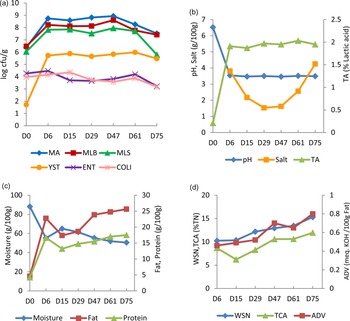
Mesophilic aerobic (MA) flora, presumptive mesophilic Lactobacilli (MLB) and presumptive mesophilic Lactococci and Streptococci (MLS) started in milk at 6.37, 6.47 and 6.03 log cfu/ml respectively, but their populations increased rapidly and significantly from D0 to D6, by 2.37, 1.75 and 1.79 log cfu/g respectively (Fig. 1A and online Supplementary Table S1). From D6 to D61, no significant changes were recorded and population means during this fermentation phase were of 8.67 ± 0.26 log cfu/g for MA, 8.17 ± 0.30 log cfu/g for MLB and 7.77 ± 0.16 log cfu/g for MLS. After the last milk addition was made at D61, populations of MA, MLB and MLS had decreased at D75 to reach in the final product 7.52, 7.42 and 5.78 log cfu/g, respectively. In comparison to MA, MLB and MLS populations, a sharper and significant counts increase of 4 log cfu/g was observed at D6 for yeast populations that were at low levels in milk (1.71 cfu/g). After that point, counts stayed stable with a mean of 5.75 ± 0.18 and a value of 5.47 log cfu/g in the fresh final product. Enterobacteriaceae and Coliforms populations were rather stable through the whole process, from D0 till D75, with no significant counts differences and means of 3.90 ± 0.43 log cfu/g for Enterobacteriaceae and 3.83 ± 0.39 log cfu/g for Coliforms. Contamination with Enterobacteriaceae and Coliforms and their levels (between 3.5 and 4.5 log cfu/g) were confirmed in raw milk by testing 2 additional samples used during the production (data not shown).
Microbial dynamics (a) and chemical changes (b, c, d) occurring during Anbaris production. (a) MA: Mesophilic Aerobic flora; MLB: presumptive Mesophilic Lactobacilli; MLS presumptive Mesophilic Lactococci and Streptococci; Ent: Enterobacteriaceae; Coli: Coliforms (b) TA: Titrable Acidity (d) ADV: Acid Degree Value; WSN: Water Soluble Nitrogen; 12% TCA: 12% Trichloro Acetic Acid soluble Nitrogen

Chemical changes
At D0, pH and acidity of milk were 6.52 and 0.21 g lactic acid/100 g respectively. pH had decreased at D6 and acidity increased, both sharply, significantly (Fig. 1B and online Supplementary Table S2) and inversely (−0.996 significant correlation), reaching 3.54 for pH and 1.91 g lactic acid/100 g for acidity. They stayed rather stable afterwards and reached in the final product 3.49 and 1.95 g lactic acid/100 g respectively. Salt content was 3.81 g/100 g at D6, and varied consistently (0.878 significant correlation) with the regular and arbitrary salt additions made during manufacturing by the producer (Figs. 1B and online Supplementary Fig. S2) to reach in the end product 4.25 g/100 g. Moisture in the product decreased from 88.09 g/100 g in milk to reach 55.23 g/100 g at D6. This was followed by an increase to 65 g/100 g at D15 after which moisture decreased steadily to reach 50.54 g/100 g in the end-product. Fat and protein changes were negatively and significantly correlated with the changes in moisture (−0.997 and −0.993 respectively) and reached 25.63 g fat /100 g in the final product and 17.51 g protein /100 g (Fig. 1C and online Supplementary Table S2). Proteolysis and lipolysis indices registered an overall, though not sharp increase during the process, and more so after the end of milk additions (Fig. 1D and online Supplementary Table S2). ADV was 0.46 meqKOH/100 g fat at D6 and reached 0.80 at D75. Proteolysis indices ranged from D6 to D75 between 10.24 and 15.30 for the WSN fraction, and between 8.66 and 11.95 for the 12%TCA-SN fraction (online Supplementary Table S2).
Yeast diversity and dynamics
A total of seven species was found in the product during the process (Fig. 2). They are Pichia kudriavzevii that represented 54.17% of the total yeast populations, Kluyveromyces marxianus (31.67%), Candida parapsilosis (4.17%), Rhodotorula mucilaginosa (3.33%), Saccharomyces cerevisiae (2.50%), Debaryomyces hansenii (2.50%) and Kazachstania exigua (1.67%). Only two species, P. kudriavzevii and K. marxianus, were found throughout the whole process, with P. kudriavzevii dominating all stages (representing between 43.33 and 73.33% of the individual samples populations) followed by K. marxianus (23.33 to 40.00%), while most of the others were found at one or two stages and were minor, representing less than 10% of any sample's population. R. mucilaginosa and K. exigua were found at BF and MF1, respectively, S. cerevisiae and D. hansenii at both MF stages while C. parapsilosis was found at BF, MF2 and EF. At EF the two major species were still found, with P. kudriavzevii representing 73.33% of the sample population and K. marxianus 23.33%.
Yeast species composition according to fermentation stage. BF: Beginning of fermentation; MF1: Middle of fermentation 1; MF2: Middle of fermentation 2; EF: End of fermentation. Proportions at each stage are relative to the corresponding sample's yeast population while TOTAL is relative to the whole yeasts isolated culturable population from all stages.

Kluyveromyces marxianus intraspecies diversity
Kluyveromyces marxianus isolates taken from our production (herein called A1) were compared to a collection of strains originating from 4 dairy samples of different producers, one of Anbaris (A2) and three of Darf (D1 to D3), another Lebanese dairy product distinct from Anbaris by the addition of goat Laban (yogurt fermented with natural starters by back-sloping) instead of milk, and manufactured in goat skin instead of terracotta jars. Only 9 different profiles were recorded for the total population of 50 isolates taken from the middle of fermentations and a low diversity was found within individual samples with 1 profile in A2 (pattern C) and D3 (pattern I), 2 different profiles in A1 (patterns A and B) and D2 (patterns G and H) and 3 different profiles in D1 (patterns D, E and F) for populations of 10 isolates per sample. Apart from the unique profiles of samples A2 and D3, one pattern was clearly dominant in the other samples, representing between 50% (E pattern) and 80% (A pattern) of the samples isolates population.
Clustering of the isolates showed a grouping related to the sample with what seemed to be sample specific patterns (Fig. 3). Indeed, most patterns from the same samples were very closely related with similarities > 90% (A/B patterns from A1, G/H from D2 and D/E from D1). The F pattern from D1 was also found in the same cluster as D and E. Moreover, during the production of our Anbaris A1, pattern A that represented 80% of MF1, was further found at stages BF (100%) and EF (80%) while pattern B was found at EF. Though patterns were all different from one sample to the other, profiles of Anbaris were distinctly found in one cluster (A) and those of Darf in another (D) which might suggest a further grouping related to product type.
Clustering of profiles of K.marxianus isolates from Anbaris and Darf labneh typed by Inter-LTR PCR. A1 correponds to our Anbaris production; A2 to another Anbaris sample. D1, D2, D3 are three different samples of Darf. Distances indicated on the tree are 1- similarity coefficient.

Discussion
We found in this work that Anbaris, a Lebanese traditional raw goat's milk product, made by means of a spontaneous fermentation, was endowed with a highly acidifying microbial community including high counts of LAB and yeasts that readily increased from raw milk and were quickly established after a few days of natural fermentation. The counts remained high throughout the process, as new milk additions continuously provided new microorganisms and nutrients that kept the populations actively fermenting. At the same time, salt levels were transiently low and moisture levels higher than that of the final product which should have positively affected the populations of microorganisms. For example, the growth of salt tolerant species, that are expected to have been selected for as early as D6, is known to be positively affected by the decrease in salt concentrations (Merchán et al., Reference Merchán, Ruiz-Moyano, Hernández, Benito, Aranda, Rodríguez and Martín2022). The microbial populations only began decreasing when milk additions were stopped. At this time, moisture had decreased and salt increased, which should have also contributed to the reduction in populations, salt and moisture being two important factors controlling microbial growth (Betts et al., Reference Betts, Everis, Betts, Kilcast and Angus2007; Roos, Reference Roos, McSweeney and McNamara2022). Our figures for raw milk microbial populations are close to what is reported for goat milk (Quigley et al., Reference Quigley, O'Sullivan, Stanton, Beresford, Ross, Fitzgerald and Cotter2013) and such rapid increases in microbial populations are also observed in other milk fermentations (Nyambane et al., Reference Nyambane, Thari, Wangoh and Njage2014). However, a different dynamic was found in a study on Serdeleh where a decrease of Lactobacilli was observed over time (Tabet et al., Reference Tabet, Salameh, Nehme, Daher and Hosri2019). This is probably due to the different processes adopted in terms of milk addition frequency (nine in our study vs. two in the other, for an equivalent period of 35 d) and fermentation time between new additions (an average of ~ 4.5 d in ours vs. 15) leading to probable depletion of nutrients and competition between microorganisms. Salt content is not reported in that study, while pH is higher than ours, also suggesting different microbial equilibrium.
Activity of the microbial flora led to an early and sharp decrease of pH that reached its lowest levels early during production and coincided with the quick increase in microbial populations. It paralleled an increase in acidity, known to be linked in fermented dairy products with the production of organic acids like lactic acid from lactose (Broadbent, Reference Broadbent, McSweeney and McNamara2022). Anbaris pH is close to those of fermented milk products like tarag, airag, koumiss or kefir (Akuzawa et al., Reference Akuzawa, Miura, Surono, McSweeney and McNamara2022; Rattray and O'Connell, Reference Rattray, O'Connell, McSweeney and McNamara2022; Uniacke-Lowe, Reference Uniacke-Lowe, McSweeney and McNamara2022) and is consistent with other studies on this product that report pH values ranging between 3.50 and 4.09 (Serhan and Mattar, Reference Serhan and Mattar2013; Dimassi et al., Reference Dimassi, Iskandarani, Afram, Akiki and Rached2020a). The simultaneous presence of LAB and yeasts that produce an array of organic acids, including lactic acid, could be one factor explaining the low pH of our production. Kazak cheese, only fermented by commercial LAB, shows lower organic acid contents than Kazak fermented with associations of LAB and different yeast species, including K. marxianus and P. kudriavzevii, the two major species we found in Anbaris. The association with K. marxianus in particular, a lactose-fermenting yeast species, has a major effect on organic acid concentration, practically doubling the lactic acid content in Kazak (Xiao et al., Reference Xiao, Chen, Li, Shi, Deng and Wang2020). K. marxianus presence in all our production stages, along with LAB, could have contributed to the low pH that was maintained throughout the whole process.
The acidity developed induced coagulation, as milk casein become insoluble and aggregates at or below the isoelectric point (pH ≈ 4.6), leading to gel formation and enabling separation of whey from curd and subsequent syneresis (Lucey, Reference Lucey, McSweeney and McNamara2022). Over time, and associated to regular whey drainage, coagulation filled the jar with curd and in turn led to a regular decrease of moisture, except for a surprisingly low moisture observed at D6. The high salt concentration found at this stage in comparison to the other fermentation stages can explain this moisture decrease, salt having diffused into the product from D0 when an initial very high salt quantity was added. High levels of salt interfere with moisture content of cheese and cause significant moisture loss (Rako et al., Reference Rako, Kalit, Rako, Zamberlin and Kalit2022). The moisture increase that followed at D15 was due to an association between previous additions of large milk quantities and a simultaneous decrease in salt content. From that point on, moisture decreased steadily. The variation trend of moisture content understandably influenced the trends of protein and fat variation that concentrated over time to reach, in the end product, values in the range of what is described elsewhere for Anbaris (Dimassi et al., Reference Dimassi, Iskandarani, Afram, Akiki and Rached2020a, Reference Dimassi, Iskandarani and Akiki2020b).
The high salt content associated to high acidity and other factors like moisture content or temperature/time profile of cheesemaking are expected to select for populations and species that are tolerant to such conditions (Péter and Rosa, Reference Péter and Rosa2006; Büchl and Seiler, Reference Büchl, Seiler and Fuquay2011; Arias-Roth et al., Reference Arias-Roth, Bachmann, Fröhlich-Wyder, Schmidt, Wechsler, Beuvier, Buchin, Delbès, McSweeney and McNamara2022; Guinee and Sutherland, Reference Guinee, Sutherland, McSweeney and McNamara2022). These factors, associated with the microbial consortium species nature and equilibrium, are thought to contribute to raw milk products safety (Montel et al., Reference Montel, Buchin, Mallet, Delbès-Paus, Vuitton, Desmasures and Berthier2014; Arias-Roth et al., Reference Arias-Roth, Bachmann, Fröhlich-Wyder, Schmidt, Wechsler, Beuvier, Buchin, Delbès, McSweeney and McNamara2022). No reports are available to know if food borne illnesses are associated with the consumption of Anbaris, but the product is reported as most frequently exempt of pathogens (Dimassi et al., Reference Dimassi, Iskandarani, Afram, Akiki and Rached2020a, Reference Dimassi, Iskandarani and Akiki2020b). Our results also showed that major pathogens usually found in milk were absent from our final fresh product. However, the product safety cannot be completely guaranteed. High contamination levels of Enterobacteriaceae and Coliforms, widely used as indicators of sanitary quality, were recorded throughout the process and in the final fresh product. Contamination of a product was also found elsewhere (Tabet et al., Reference Tabet, Salameh, Nehme, Daher and Hosri2019) and in other fermented milks (Nyambane et al., Reference Nyambane, Thari, Wangoh and Njage2014; Costanzo et al., Reference Costanzo, Ceniti, Santoro, Clausi and Casalinuovo2020). In our case, the contamination might have been fueled by the process of very frequent milk additions, where contaminated milk fed the ecosystem with new microbes. Raw milk indicator levels >1000 cfu/ml, similar to the values we found, are mostly attributed to unsanitary milk-related conditions or productions (Metz et al., Reference Metz, Sheehan and Feng2020). However we cannot exclude other sources of contamination during the entire manufacturing process, such as equipment or personnel (Mladenović et al., Reference Mladenović, Grujović, Kiš, Furmeg, Jaki Tkalec, Stefanović and Kocić-Tanackov2022). Nevertheless, it is not excluded that further ripening might lower indicator levels as is observed in other dairy products (Criste et al., Reference Criste, Copolovici, Copolovici, Kovacs, Madden, Corcionivoschi, Gundogdu, Berchez and Urcan2020; Metz et al., Reference Metz, Sheehan and Feng2020). For Anbaris, after the fermentation stage, a variable ripening period in the jar and a further dehydration in cloth bags usually precede long-term conservation in olive oil, a very wide practice adopted to seasonally preserve the product. Consequently, further moisture loss is expected, through exchange with the earthenware jar, the cloth and evaporation, which in turn might possibly lead to higher salt concentrations. With prolonged exposure to low pH, then conservation in olive oil, whose polyphenols might exert antimicrobial effects (Nazzaro et al., Reference Nazzaro, Fratianni, Cozzolino, Martignetti, Malorni, De Feo, Cruz and d'Acierno2019), conditions are present which might contribute to lowering the levels of indicator bacteria. It would be interesting to test if, through the various ripening steps, such high indicator levels would indeed be reduced.
The seven yeast species we found in Anbaris are typical of raw milk and traditional dairy products microbiota (El Sharoud et al., Reference El-Sharoud, Belloch, Peris and Querol2009; Lavoie et al., Reference Lavoie, Touchette, St-Gelais and Labrie2012; Quigley et al., Reference Quigley, O'Sullivan, Stanton, Beresford, Ross, Fitzgerald and Cotter2013; Togay et al., Reference Togay, Capece, Siesto, Sandikci, Yilmaz, Romano and Karagul2020; Bintsis, Reference Bintsis2021; Sessou, Reference Sessou, McSweeney and McNamara2022). Their counts, similar to figures reported elsewhere, were in the higher margins usually recorded in dairy products (Bai et al., Reference Bai, Qing, Guo, Zhang, Chen, Bao, Zhang and Sun2010; Bintsis, Reference Bintsis2021). Yeasts also seemed to be the least affected microbial group in the final fermentation phases, which might indicate their adaptation to the prevailing conditions encountered during Anbaris manufacture. All the species we found are reported to be high-salt and low-pH tolerant (Russo et al., Reference Russo, Libkind, Sampaio and van Broock2008; Radecka et al., Reference Radecka, Mukherjee, Mateo, Stojiljkovic, Foulquié-Moreno and Thevelein2015; Buzzini et al., Reference Buzzini, Turchetti and Yurkov2018; Stratford et al., Reference Stratford, Steels, Novodvorska, Archer and Avery2019; Heaney et al., Reference Heaney, Laing, Paterson, Walker, Gow, Johnson, MacCallum and Brown2020; Navarrete and Martínez, Reference Navarrete and Martínez2020). Species dynamics changed over time but P. kudriavzevii and K. marxianus remained dominant throughout the process and might be signature species for this product. Wider sampling would confirm such a hypothesis. These two species are similarly found to be dominant in Kazak cheese, where C. parapsilosis is also present in the final product (Zheng et al., Reference Zheng, Li, Shi, Ni, Li and Zhuge2018). Merchán et al. (Reference Merchán, Ruiz-Moyano, Hernández, Benito, Aranda, Rodríguez and Martín2022) showed that most P. kudriavzevii and K. marxianus strains originating from ewe milk cheeses exhibit excellent growth at 30 °C, 1% NaCl, and pH value of 3.5, while isolates of P. kudriavzevii show optimal growth conditions at 30 °C, 8% NaCl, and pH 3.5. Such features might explain the dominance of these two species in Anbaris, particularly P. kudriavzevii's, that stayed in high percentages in our acidic end product which was also high in salt. P. kudriavzevii is reported to be a multi-stress tolerant species towards various extreme environmental conditions particularly low pH and high salt concentrations (Radecka et al., Reference Radecka, Mukherjee, Mateo, Stojiljkovic, Foulquié-Moreno and Thevelein2015). Interactions between the various microbial groups of dairy products, which are of complex nature (Viljoen, Reference Viljoen2001; Álvarez-Martín et al., Reference Álvarez-Martín, Flórez, Hernández-Barranco and Mayo2008; Fröhlich-Wyder et al., Reference Fröhlich-Wyder, Arias-Roth and Jakob2019; Siedler et al., Reference Siedler, Rau, Bidstrup, Vento, Aunsbjerg, Bosma, McNair, Beisel and Neves2020) must have also played a role in species dynamics and equilibrium as it is observed in Koumiss, where specific high positive or negative correlations are found between bacterial and yeast species composition and abundance (Tang et al., Reference Tang, Ma, Hou, Li, Xu, Liu, Sun, Haobisi and Menghe2020).
K. marxianus is known for its interesting biotechnological properties (Mounier and Coton, Reference Mounier, Coton, McSweeney and McNamara2022) and thus we explored its intraspecies diversity to facilitate screening for future biotechnological exploitation. Compared to other studies, including that of Sohier and colleagues that developed the discriminatory method we used, our K. marxianus isolates showed lower diversity (Sohier et al., Reference Sohier, Le Dizes, Thuault, Neuveglise, Coton and Casaregola2009; Tittarelli et al., Reference Tittarelli, Varela, Gethins, Stanton, Ross, Suzzi, Grazia, Tofalo and Morrissey2018). This can be due to the stressing characteristics of our product which may have selected for a few adapted strains. It will be interesting in this perspective to compare Lebanese dairy strains of this species to worldwide dairy isolates of K. marxianus, using for example MLST typing as developed by Tittarelli et al. (Reference Tittarelli, Varela, Gethins, Stanton, Ross, Suzzi, Grazia, Tofalo and Morrissey2018), to check for any specificity they might have as it is found in other Lebanese species involved in natural fermentations (Ayoub et al., Reference Ayoub, Legras, Abi Nakhoul, Nguyen, Saliba and Gaillardin2021). It also appeared that the same lineage of isolates was involved in the fermentation of a given sample since the same or almost identical patterns were found at our different fermentation stages. Very close patterns of K. marxianus originating from the same cheese batch were also observed by Sohier et al. (Reference Sohier, Le Dizes, Thuault, Neuveglise, Coton and Casaregola2009) who found similarity coefficients of 85% or higher between strains, like we did. Moreover, it is reported that P. kudriavzevii strains can survive throughout the cheesemaking process onto the raw milk cheese (Lavoie et al., Reference Lavoie, Touchette, St-Gelais and Labrie2012). Sample or batch related patterns can arise from the presence of adapted strains originating from raw milk or from an in-house installed flora (Lavoie et al., Reference Lavoie, Touchette, St-Gelais and Labrie2012; Bokulich and Mills, Reference Bokulich and Mills2013). The strains of the two products we studied, Anbaris and Darf labneh, were clustered according to product type. Using MLST typing, Tittarelli et al. (Reference Tittarelli, Varela, Gethins, Stanton, Ross, Suzzi, Grazia, Tofalo and Morrissey2018) found that strains of Pecorino di Farindolo cluster together, while strains of Parmigiano Reggiano are clustered in several sub-groups. Nevertheless, the low number of different profiles we obtained requires further examination and still larger sampling to ascertain that the clustering we found is indeed due to product type specificity.
Proteolytic and lipolytic activities are altered by low pH and high salt and can be hindered in some dairy products (Cardoso et al., Reference Cardoso, Borelli, Lara, Soares, Pataro, Bodevan and Rosa2015; Soltani et al., Reference Soltani, Guzeler and Hayaloglu2015; Rako et al., Reference Rako, Kalit, Rako, Zamberlin and Kalit2022). However, proteolysis and lipolysis appeared to occur in Anbaris. The proteolytic and lipolytic indices that increased over time reflect activities mostly related to microbial groups like lactobacilli, yeasts or even Enterobacteriaceae which were in high numbers in our product (Coolbear, et al., Reference Coolbear, Wilkinson, Weimer, McSweeney and McNamara2022; Juillard et al., Reference Juillard, Lopez-Kleine, Monnet, McSweeney and McNamara2022; McSweeney, Reference McSweeney, McSweeney and McNamara2022; Ritschard et al., Reference Ritschard, Van Loon, Amato, Meile and Schuppler2022; Sessou, Reference Sessou, McSweeney and McNamara2022). Lipolytic and proteolytic activities are variable among various bacteria and yeast species and within species, among different strains (Hayaloglu et al., Reference Hayaloglu, Guven, Fox and McSweeney2005; Zheng et al., Reference Zheng, Li, Shi, Ni, Li and Zhuge2018; García-Cano et al., Reference García-Cano, Rocha-Mendoza, Ortega-Anaya, Wang, Kosmerl and Jiménez-Flores2019). Studies report varying results concerning strains of the two dominant yeast species we found in Anbaris. In one of them, it is shown that all seven K. marxianus isolates of raw ewe milk cheeses lack lipolytic and proteolytic activities while only one P. kudriavzevii strain out of 16 shows moderate proteolytic activity and esterase activity at low temperature (Merchán et al., Reference Merchán, Ruiz-Moyano, Hernández, Benito, Aranda, Rodríguez and Martín2022). Variable proteolytic activities are observed for 41 P. kudriavzevii strains isolated from Kazak cheese, and no proteolytic activity is detected for any of 16 K. marxianus isolates, while variable lipolytic activities are observed for P. kudriavzevii and K. marxianus (Zheng et al., Reference Zheng, Li, Shi, Ni, Li and Zhuge2018). Out of 28 K. marxianus isolates from Brazilian raw milk Serro Minas cheese, only one and two show protease and lipase activity respectively (Cardoso et al., Reference Cardoso, Borelli, Lara, Soares, Pataro, Bodevan and Rosa2015). When they are present, lipolytic and proteolytic activities are associated with key flavor compounds production in P. kudriavzevii and K. marxianus (Zheng et al., Reference Zheng, Li, Shi, Ni, Li and Zhuge2018). It will be interesting to explore such activities in the Lebanese strains we isolated as well as other properties relevant to Anbaris production in the aim of developing mixed cultures of LAB and yeasts, as recently proposed for Kazak cheese, where the use of simultaneous P. kudriavzevii and K. marxianus isolates in adjunct cultures with commercial LAB showed that both species were important auxiliary starters for this cheese production, influencing texture and flavor (Xiao et al., Reference Xiao, Chen, Li, Shi, Deng and Wang2020).
In conclusion, in this study of Anbaris production we found a diversified microbial flora possessing intense acidifying properties as well as proteolytic and lipolytic activities obviously contributing to the distinctive characteristics of the product. The identity of culturable yeasts and their dynamics during Anbaris production were revealed for the first time showing the involvement of two major possibly signature species. These could potentially serve as a starters reservoir, after adequate tests and co-cultures with strains from Anbaris dominant LAB species, once uncovered, confirm suitability for production. This strategy could be used as an alternative to pasteurizing milk then adding starters that are foreign to the product. Adopting such an approach would contribute to both product microbiological safety, by using pasteurized milk, and product typicality preservation, by selecting starters indigenous to Anbaris. The outcome of this research could consequently be exploited to develop starters or adjunct cultures for Anbaris.
Supplementary material
The supplementary material for this article can be found at https://doi.org/10.1017/S002202992200067X.
Acknowledgments
This work was funded by a Grant from the Scientific Research Projects Program of the Lebanese University (Beirut, Lebanon).