INTRODUCTION
Approximately 300,000 Americans are hospitalized with traumatic brain injuries (TBI) each year (Hirtz, Thurman, Gwinn-Hardy, Mohamed, Chauldhuri, & Zalutsky, Reference Hirtz, Thurman, Gwinn-Hardy, Mohamed, Chaudhuri and Zalutsky2007), and many of these victims will incur chronic memory impairment (Ruttan, Martin, Liu, Colella, & Green, Reference Ruttan, Martin, Liu, Colella and Green2008; Van Zomeran & Van Den Berg, Reference Van Zomeran and Van Den Berg1985). Memory impairment following TBI is characterized mostly by deficient initial learning (DeLuca, Schultheis, Madigan, Christodoulou, & Averill, Reference DeLuca, Schultheis, Madigan, Christodoulou and Averill2000), perhaps due to poor attentional control (Mangels, Craik, Levine, Schwartz, & Stuss, Reference Mangels, Craik, Levine, Schwartz and Stuss2002). In fact, when DeLuca et al. used a selective reminding paradigm to ensure adequate initial learning of a word list, persons with TBI showed comparable delayed recall as healthy controls. As such, rehabilitative interventions aimed at improving initial learning may enhance subsequent retrieval. To date, however, the literature on memory rehabilitation for persons with brain injuries is relatively underdeveloped (for review, Cicerone et al., Reference Cicerone, Dahlberg, Malec, Langenbahn, Felicetti and Kneipp2005), and the efficacy of existing memory interventions is weak (Rohling, Faust, Beverly, & Demakis, Reference Rohling, Faust, Beverly and Demakis2009).
The cognitive psychology literature can inform memory rehabilitation. For instance, Ebbinghaus (1885/Reference Ebbinghaus, Ruger and Bussenius1913) observed that memory is enhanced when learning is distributed over time (spaced restudy) relative to massed learning at a single time point (massed restudy; for review, Cepeda, Pashler, Vul, Wixted, & Rohrer, Reference Cepeda, Pashler, Vul, Wixted and Rohrer2006). Although the exact mechanism by which spacing improves memory is uncertain, one explanation is that information learned at distributed time points is linked to more and varied contextual cues, which then aid in subsequent retrieval (encoding variability hypothesis). Another mnemonic strategy receiving recent attention is retrieval practice (also known as the testing effect; for review, Roediger & Karpicke, Reference Roediger and Karpicke2006a). If a person practices retrieving information shortly after it is presented (but before it is forgotten), that information is much more likely to be remembered in the future (e.g., Karpicke & Roediger, Reference Karpicke and Roediger2008), even relative to spaced restudy (Carpenter & DeLosh, Reference Carpenter and DeLosh2005; Cull, Reference Cull2000; Roediger & Karpicke, Reference Roediger and Karpicke2006b). Most support for retrieval practice has been demonstrated with undergraduate samples, but recent research has extended this mnemonic to memory-impaired persons with multiple sclerosis (Sumowski, Chiaravalloti, & DeLuca, Reference Sumowski, Chiaravalloti and DeLuca2010).
The current research evaluates massed restudy, spaced restudy, and retrieval practice as potential interventions for persons with chronic memory impairment following TBI. Consistent with previous research in healthy (for reviews, see Cepeda et al., Reference Cepeda, Pashler, Vul, Wixted and Rohrer2006; Roediger & Karpicke, Reference Roediger and Karpicke2006a) and memory-impaired (Sumowski et al., Reference Sumowski, Chiaravalloti and DeLuca2010) populations, we predict that spaced restudy will lead to greater memory than massed restudy, but that retrieval practice will produce the greatest memory advantage. We predict this pattern for persons with chronic memory impairment following a TBI, as well as matched healthy controls.
METHOD
Participants
Participants were 14 persons with a history of TBI (age: 38.4 ± 12.6) and 14 age-matched healthy controls (age: 44.9 ± 12.1; p > .10). Median age at TBI was 26.4 years, and median length of coma was 45.5 days. Causes of injury included motor vehicle accidents (n = 9), falls (n = 2), sports injuries (n = 2), and assault (n = 1). All participants with TBI performed at least one standard deviation below national norms on the California Verbal Learning Test, Second Edition (Long Delay Free Recall; Delis, Kramer, Kaplan, & Ober, Reference Delis, Kramer, Kaplan and Ober2000), and median memory performance was severely impaired (z = −2.5; 1st percentile). Memory was intact for all healthy controls, with median performance matched to national norms (z = 0.0; 50th percentile). This research was approved by the institutional review board of the Kessler Foundation Research Center, and informed consent was obtained from all participants.
Materials and Procedures
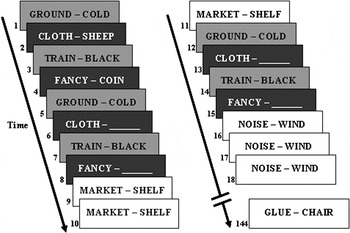
Stimuli consisted of 48 verbal paired associates (VPAs) chosen from a larger collection of weakly associated word pairs used in previous research (Balota, Duchek, Sergent-Marshall, & Roediger, Reference Balota, Duchek, Sergent-Marshall and Roediger2006; Tulving & Thompson, Reference Tulving and Thompson1973). VPAs were chosen for the current study if they (a) did not also appear on the California Verbal Learning Test-II (CVLT-II), (b) had forward association strengths ≤ .01 based on Nelson’s free association norms (Nelson, McEvoy, & Schreiber, Reference Nelson, McEvoy and Schreiber1998), and (c) had Dall-Chall readiability scores ≤ fourth grade. These same VPAs were used in a previous study on retrieval practice in multiple sclerosis (Sumowski et al., Reference Sumowski, Chiaravalloti and DeLuca2010), with sample VPAs provided in Figure 1. In this within-subjects design, the 48 VPAs were equally divided across three learning conditions: massed restudy, spaced restudy, retrieval practice. VPAs were counterbalanced across learning conditions, and were visually presented to participants on a computer screen. VPA presentation schedules for the three conditions are illustrated in Figure 1. During massed restudy, a VPA was presented for 6 s, followed immediately by two consecutive 6-s restudy trials. For spaced restudy, the initial VPA presentation (6 s) was followed by three filler trials (6 s each), a 6-s restudy trial, six filler trials (6 s each), and another 6-s restudy trial. Filler trials consisted of other VPAs (see Figure 1). Spaced restudy represents the aforementioned technique of distributed learning (Ebbinghaus, 1885/Reference Ebbinghaus, Ruger and Bussenius1913). For retrieval practice, VPAs were presented on the same basic schedule as spaced restudy; however, after the initial 6-s VPA presentation (e.g., Cloth – Sheep) and three filler trials (6 s each), the re-exposure trial consisted of a 5-s cued recall test (e.g., Cloth - _____) and 1-s feedback screen (e.g., Cloth – Sheep), followed by six filler trials (6 s each) and another 5-s cued recall test and 1-s feedback screen. Participants read VPAs aloud once during each exposure.
Sample verbal paired associate (VPA) presentation schedule. Slides represent learning trials and are shaded by condition: massed restudy = white, spaced restudy = light gray, retrieval practice = dark gray. As illustrated, the interstimulus spacing was 0-0 for VPAs in the massed restudy condition, and 3-6 for VPAs in the spaced restudy and retrieval practice conditions. Filler trials consisted of other to-be-learned VPAs. This basic presentation schedule was used for 48 VPAs across 144 trials.

The effect of learning strategy on memory was investigated with a delayed cued-recall task after 45 min of unrelated cognitive tasks. (These tasks, which were administered as part of a separate independent study, included the Paced Auditory Serial Addition Task, Symbol Digit Modalities Test, Tower Test of the Delis-Kaplan Executive Function System, and Digit Span, Letter-Number Sequencing, and Matrix Reasoning of the Wechsler Adult Intelligence Test, Third Edition; see descriptions in Strauss et al. (Reference Strauss, Spreen and Sherman2006). These tasks did not contain verbal material likely to retroactively interfere with VPAs used for the experimental protocol). The possible range of recall performance was 0 to 16 for each learning strategy, which was converted to percent correct. Delayed cued-recall was analyzed with a 3 (learning condition: massed restudy, spaced restudy, retrieval practice) × 2 (group: TBI, healthy) analysis of variance.
RESULTS
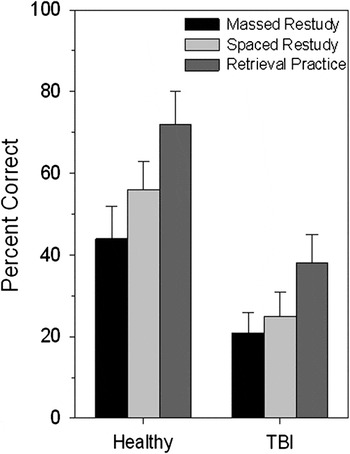
There was a large effect of learning condition on delayed cued-recall (F[1,26] = 76.76; p < .001,  ), with retrieval practice leading to the best recall, followed by spaced restudy, and then massed restudy. There was also a large effect of group (F[1,26] = 9.50; p = .005;
 ), with healthy persons performing better than persons with TBI. Importantly, there was an interaction between learning condition and group (F[1,26] = 4.25; p = .049;
 ). As illustrated in Figure 2, spaced restudy (distributed learning) provided a large mnemonic benefit over massed restudy for healthy controls (d = 1.6; p < .001), but not for persons with TBI (d = 0.3; p = .273). In contrast, both healthy controls and persons with TBI showed large benefits from retrieval practice over both massed restudy (healthy: d = 2.0; TBI: d = 1.5; ps < .001) and spaced restudy (healthy: d = 1.5; p < .001; TBI: d = 0.7; p = .023). Retrieval practice was the best (or tied for best) learning strategy for 93% of persons with TBI.
Effect of learning condition on verbal paired associate (VPA) delayed cued-recall for healthy controls and persons with memory impairment following a traumatic brain injury (TBI).

DISCUSSION
The retrieval practice strategy led to large memory improvements among persons with chronic memory impairment following a TBI. Of note, this was not the case for distributed learning, a strategy with established mnemonic value for healthy persons in the current and previous research (Ebbinghaus, 1885/Reference Ebbinghaus, Ruger and Bussenius1913; Roediger & Karpicke, Reference Roediger and Karpicke2006a; Sumowski et al., Reference Sumowski, Chiaravalloti and DeLuca2010). Taken together, retrieval practice is an effective memory strategy for persons with TBI, even when other well-established strategies are less effective.
The efficacy of retrieval practice may be explained by “transfer appropriate processing” (TAP; Morris, Bransford, & Franks, Reference Morris, Bransford and Franks1977), which posits that memory is enhanced when the cognitive processes engaged during learning match those required for subsequent retrieval. The mnemonic strategy of retrieval practice requires persons to perform the same cognitive process during the learning phase (retrieval) as during the delayed recall phase (retrieval). The TAP explanation of retrieval practice may also be supported neurologically. As discussed previously (see Sumowski et al., Reference Sumowski, Chiaravalloti and DeLuca2010), there is a double dissociation between brain regions required for memory encoding and retrieval (Prince, Daselaar, & Cabeza, Reference Prince, Daselaar and Cabeza2005). The use of retrieval during learning likely activates the same neural networks used for subsequent delayed recall (e.g., hippocampus). Although this hypothesis needs to be verified directly with functional neuroimaging, we do know that (a) memory retrieval processes are associated with hippocampal activation (Eldridge, Knowlton, Furmanski, Bookheimer, & Engel, Reference Eldridge, Knowlton, Furmanski, Bookheimer and Engel2000) and (b) the strength of hippocampal activation during learning is associated with the strength of subsequent memory retrieval (Shrager, Kirwan, & Squire, Reference Shrager, Kirwan and Squire2008). Taken together, recruitment of hippocampal regions during retrieval practice may increase the memory strength of studied information.
Spaced restudy did not significantly improve memory among persons with memory impairment following a TBI, which contrasts with research in healthy populations (for review, Cepeda et al., Reference Cepeda, Pashler, Vul, Wixted and Rohrer2006) and multiple sclerosis (Sumowski et al., Reference Sumowski, Chiaravalloti and DeLuca2010). As discussed above, the encoding variability hypothesis posits that information learned through spaced / distributed restudy is associated with more and varied contextual cues, which then support later memory retrieval. Given that TBI-related learning and memory problems are associated with poor attention (Mangels et al., Reference Mangels, Craik, Levine, Schwartz and Stuss2002), persons with TBI may not adequately process the contextual cues accompanying to-be-learned information. As such, attention problems may reduce the beneficial effect of spacing in persons with TBI. Indeed, research on divided attention suggests that persons with TBI show a reduction in cognitive resources available for simultaneous processing of additional information (Azouvi, Couillet, Leclercq, Maartin, Asloun, & Rousseau, Reference Azouvi, Couillet, Leclercq, Martin, Asloun and Rousseaux2004).
Regarding practical application, the retrieval practice strategy appears easy to use, as persons with memory impairment simply need to quiz themselves (or have others quiz them) on to-be-learned material. In addition to supporting daily living skills (e.g., errands, etc.), retrieval practice may help pediatric and young adult victims of TBI better cope with the large learning and memory requirements of formal education. Future research is needed to understand the neural substrates of retrieval practice, evaluate retrieval practice in naturalistic settings, and extend these findings to other populations with memory impairment (e.g., Alzheimer’s disease).
ACKNOWLEDGMENTS
This research was supported by grants from the National Institutes of Health (HD060765 to J.F.S.) and National Institute on Disability and Rehabilitation Research (Research Grant to N.C.). The authors have no conflicts of interest to report.