I. INTRODUCTION
Metal dichalcogenides are inorganic compounds with a layered two-dimensional (2D) structure, capable of forming closed-cage faceted fullerene-like nanoparticles or nanotubes.Reference Tenne1, Reference Feldman, Zak, Popovitz-Biro and Tenne2 The mechanical response of MX2 (M = W, Mo, Nb, Hf; X = S, Se) nanotubes to external loads was widely studied in the uniaxial tensionReference Kaplan-Ashiri and Tenne3, Reference Kaplan-Ashiri, Cohen, Gartsman, Rosentsveig, Seifert and Tenne4 and compression modes.Reference Kalfon-Cohen, Goldbart, Schreiber, Cohen, Barlam, Lorenz, Enyashin and Seifert5 Recently, the radial modulus of WS2 nanotubes was investigated using an atomic force microscope indentation technique and computational simulations.Reference Kalfon-Cohen, Goldbart, Schreiber, Cohen, Barlam, Lorenz, Enyashin and Seifert5, Reference Kalfon-Cohen, Goldbart, Schreiber, Cohen, Barlam, Lorenz, Joswig and Seifert6 The value obtained was very close to that of the interlayer shear modulusReference Nagapriya, Goldbart, Kaplan-Ashiri, Seifert, Tenne and Joselevich7 and points to the importance of the sliding between layers in moderating the radial modulus. Inorganic fullerenes and nanotubes are in high demand as novel solid lubricants.Reference Stefanov, Enyashin, Heine and Seifert8 The collective response to load of these novel nanostructures is critical in such applications.
The mechanism of failure in both inorganic nanotubes and the fullerene-like structures has also been investigated experimentally and theoretically.Reference Stefanov, Enyashin, Heine and Seifert8–Reference Lahouij, Dassenoy, de Knoop, Martin and Vacher14 The mode of failure suggested in the case of the nanotube (NT) initiates at the innermost layer of the hollow structure. 2D molecular dynamics simulations performed on MoS2 nanotubesReference Enyashin, Gemming, Bar-Sadan, Popovitz-Biro, YouHong, Prior, Tenne and Seifert15 supported a delamination mechanism proposed in Ref. Reference Stefanov, Enyashin, Heine and Seifert8 and suggested the fracture of the innermost layer as a precursor of total failure. The density-functional tight-binding (DFTB) model used also revealed the scaling relationship between the critical strain at breakage of the initial layer and the nanotube diameter.Reference Stefanov, Enyashin, Heine and Seifert8 For a sample of nanotubes with the same outer diameter but different inner diameters, fracture will first occur in the nanotube with the smallest inner diameter. This mechanism was extended to fullerene-like nano-onion structures. Previous theoretical studies also predicted delamination.Reference Schwarz, Komura and Safran11 Exceeding the theoretical critical pressure of 1.5 GPa leads to both buckling and delamination as dictated by the accompanying stress concentration in the hollow particle. However, the model is based on a nonfaceted particle, and theoretical studies have indicated that the nanoparticles become highly faceted when they contain more than about five WS2 layers.Reference Srolovitz, Safran, Homyonfer and Tenne12 The collective properties of WS2 nanoparticles were also investigated experimentally. WS2 nanoparticles were found to withstand hydrostatic pressures in the range of 500 MPa up to 20 GPa.Reference Joly-Pottuz, Martin, Dassenoy, Belin, Montagnac, Reynard and Fleischer9, Reference Leshchinsky, Popovitz-Biro, Gartsman, Rosentsveig, Rosenberg, Tenne and Rapoport10 In some cases, a partial delamination of the nanoparticle was observed at low pressure.
The mechanical response to uniaxial compression on individual closed-cage hollow WS2 particles was recently reported by Tevet et al.Reference Tevet, Goldbart, Cohen, Rosentsveig, Popovitz-Biro, Wagner and Tenne13 They described an original technique for measuring the compression of polyhedral nanoparticles using high-resolution scanning electron microscope. The compression failure strength and stiffness were evaluated for a number of particle sizes. For all cases, the failure of the particle initiates at the inner shell of the particle and at a lower force for faceted particles relative to the nonfaceted ones. This led to the hypothesis that the failure mode, associated with the collapse of the structure, correlates with the stress concentrated in the sharp corners.
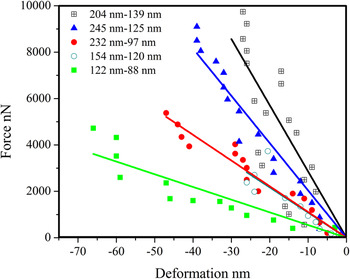
In this study, we report a finite element modeling of the compression in hollow, faceted WS2 fullerene-like nanoparticles. The mechanism of failure under compression is here investigated using a modification of a model previously published for WS2 nanotubes, which accounts for these closed polyhedral structures. The effect of the layered structure and the particle size in the ultimate compression stress is examined and compared to the reported experimental results,Reference Tevet, Goldbart, Cohen, Rosentsveig, Popovitz-Biro, Wagner and Tenne13 as summarized in Fig. 1.
Load-deformation traces generated from the compression of multilayered polyhedral nanoparticles using a nanomanipulator in a high-resolution scanning electron microscope. Dimensions listed are the long and short axis of each particle.Reference Tevet, Goldbart, Cohen, Rosentsveig, Popovitz-Biro, Wagner and Tenne13

II. EXPERIMENTAL
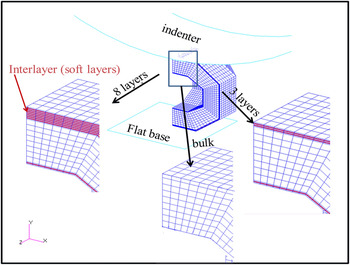
The three-dimensional (3D) finite element analysis (FEA) simulation of uniaxial compression on a hollow polyhedral particle is a nonlinear contact problem; the particle was modeled with PATRAN software, and the simulation was executed by the MSC.MARC FE solver allowing geometrical change of the element’s change with applied stress. Due to the double mirror symmetry, the simulation was done on a quarter of a 3D elastic polyhedron with 26 octahedral faces with appropriately sized long and short axes as discussed below and a hollow core of about half of the total particle thickness. The particle lies on a flat substrate and is compressed with an indenter tip with radius about twice the long axis of the nanoparticle as presented in Fig. 2. The FEA model comprises about 19,000 eight-node arbitrary hexahedral elements. The tip and the base are treated as infinitely rigid “slave” bodies indenting the “master” elements of the nanoparticle in the normal direction (no traction). This model is based on the nanotube model designed in Ref. Reference Kalfon-Cohen, Goldbart, Schreiber, Cohen, Barlam, Lorenz, Enyashin and Seifert5 with appropriate modifications as mentioned here. The layered structure is modeled by alternating stiff and soft interlayer composite, the latter representing the interlayer gap for only a few of the outer layers, and the innermost two layers, with the rest of the particle consisting of bulk material with thickness of the intermediate layers. Each layer is defined in the program as a 3D orthotropic material. The elastic moduli used in the simulation are based on those determined for WS2 nanotubesReference Kalfon-Cohen, Goldbart, Schreiber, Cohen, Barlam, Lorenz, Enyashin and Seifert5: in-plane modulus of 150 GPa, a radial modulus of 4 GPa, and the intralayer shear modulus of 80 GPa. The interlayer gap represents the interlayer forces existing between two concentric walls: the interlayer potential function based on the Lennard-Jones potential and interlayer shear C44 of 2 GPa. Solving the full FEA problem of a polyhedral body with 36 layers and 35 interlayer gaps is beyond our simulation capabilities; thus, the effect of the layered structure was examined via three particle models: nonlayered (with the homogeneous shell of equivalent thickness of 36 layers) and with both three and eight outer composite layers as shown in Fig. 2.
Finite element analysis model of a quarter of particle. The particle is glued on a base and loaded under a large radius tip.

The effect of the particle size was examined on a nonlayered particle for particles with dimensions of 88 × 122 nm2, 172 × 244 nm2, and 264 × 366 nm2, referenced henceforth by the long axis dimension.
III. RESULTS AND DISCUSSION
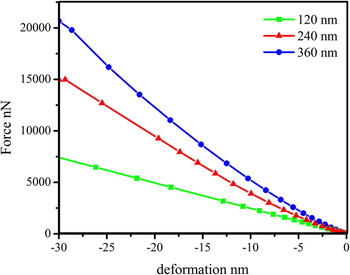
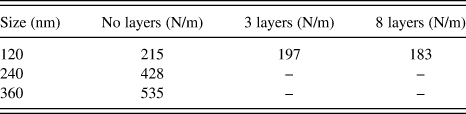
Comparison with the experimental results in Ref. Reference Tevet, Goldbart, Cohen, Rosentsveig, Popovitz-Biro, Wagner and Tenne13 was first done on three nonlayered models of differing particle sizes, namely 120, 240, and 360 nm, as a baseline to allow subsequent determination of the influence of the layers. The FEA simulations result in loading force versus deformation curves as displayed in Fig. 3. For the three models, the force applied increases almost linearly with the deformation. To achieve equivalent deformation of 30 nm, the simulation shows that the force applied in the 240-nm case is more than twice that required for the smallest 120-nm particle. These results fit the trend of increased stiffness with larger particle size observed in the experiments presented in Fig. 1. In the case of the homogeneous model (nonlayered particle), the stiffness found for the 120- and 240-nm particles are 215 and 428 N/m, respectively. We compare this with experimental values for 120- to 160-nm nanoparticles which range between 55 and 360 N/m and 230- to 270-nm particles which range between 110 and 480 N/m.Reference Tevet, Goldbart, Cohen, Rosentsveig, Popovitz-Biro, Wagner and Tenne13 The large range of experimental values, likely due to differences in shape, orientation during experiment, and other factors, allow only an order of magnitude comparison.
Particle size effect on the simulated compression force versus deformation curve.

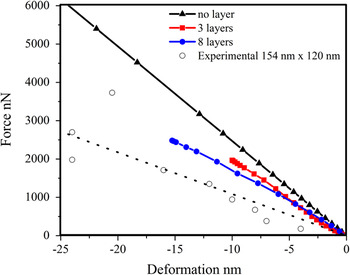
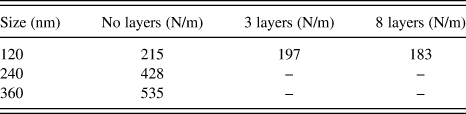
Calculations using the partially layered model allow investigation of the influence of the interlayer structure. The validity of the assumptions made in assigning the elastic properties of these curved layered structuresReference Kalfon-Cohen, Goldbart, Schreiber, Cohen, Barlam, Lorenz, Enyashin and Seifert5 has recently been verified for diameters larger than a few nanometers size by a combined DFTB and objective molecular dynamics study.Reference Zhang, Dumitrică and Seifert16, Reference Teich, Lorenz, Joswig, Seifert, Zhang and Dumitrica17 It is seen here that, addition of the layered structure leads to a better correlation between experimental and computational results. Results are summarized in Table I. The force versus deformation curves in the case of no layer, three, and eight external layers are presented in Fig. 4. For the comparison, a single experimental curve for a 154-nm-long axis particle is also shown. The stiffness declines with increasing number of layers, from 215 N/m for no layers down to 183 N/m for eight separated external layers. It seems that the reduction of the force necessary to achieve a given deformation when adding external layers to the structure is a direct consequence of the interlayer sliding. The same observation was made by Enyashin et al.Reference Enyashin, Gemming, Bar-Sadan, Popovitz-Biro, YouHong, Prior, Tenne and Seifert15 in the case of MoS2 fullerene-like particles. The effect of interlayer shear was already noted in the case of the radial compression of nanotubesReference Kalfon-Cohen, Goldbart, Schreiber, Cohen, Barlam, Lorenz, Enyashin and Seifert5, Reference Kalfon-Cohen, Goldbart, Schreiber, Cohen, Barlam, Lorenz, Joswig and Seifert6 where the radial compression modulus was found to be very close to the interlayer shear modulus. As the compression advances to deeper deformations, a part of the compression energy is released into interlayer shear so that the resistance to compression is reduced. This effect increased with the number of composite layers, so the more layers involved in the compression, the lower the stiffness should be. For the full 36-layer case, we would expect a convergence of the experimental and calculated values.
Effect of the extent of the layered structure on the simulated force versus deformation curves.

Modeling results of stiffness values of three sizes of WS2 nanoparticles and different extent of layering.
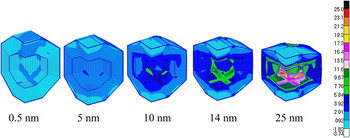
In addition to the estimation of stiffness, FEA calculations also simulate the internal stresses, identifying the location where they are concentrated and their evolution in the particle when it deforms under compression. The observation of the initiation and evolution of the stresses are useful in the understanding the mechanism of failure in closed-cage polyhedral particles. This stress is responsible for the failure of the WS2 structure as observed experimentally and theoretically.Reference Stefanov, Enyashin, Heine and Seifert8, Reference Tevet, Goldbart, Cohen, Rosentsveig, Popovitz-Biro, Wagner and Tenne13 The supposition is that the innermost layer yields first, leading to overall failure of the structure. The experimental results show that smaller particles fail at lower stress than larger structures. The cause of this feature is here examined by looking at the stress propagation during compression in the 120-nm WS2 particle designed with three external layers as displayed in Fig. 5. The map of the stress distribution in the structure shows a maximum at the innermost layer of the hollow particle, and the stress intensity is dissipated going from the inner core to the external layers. The maximum stress is concentrated in the internal corner of the deformed structure. The central role of the corners in the compressive failure reveals the effect of the faceted structure of the WS2 inorganic fullerene-like (IF) nanoparticle in the mode of failure. It was shown in a previous study that a MoS2 particle fails at higher loads than a WS2 particle with the same dimensions.Reference Tevet, Goldbart, Cohen, Rosentsveig, Popovitz-Biro, Wagner and Tenne13 The difference was related to the faceted structure of WS2, which involves more corners subjected to high stress concentration during loading, compared to the rounded geometry of the MoS2 particle. The simulation of the compression of WS2 strengthens this supposition.
Distribution and propagation of stress under compression in a three-layer 120-nm particle at increasing deformation. The stress scale units are nN/nm2.

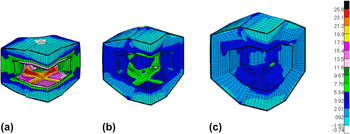
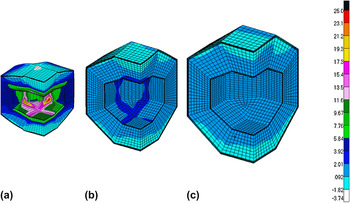
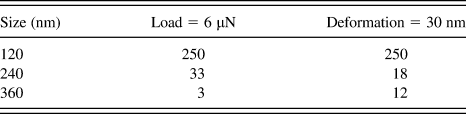
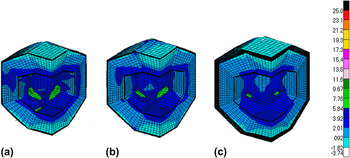
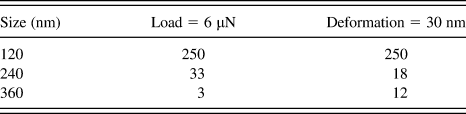
The effect of the particle size was established by looking at the stress distribution in different particles at a deformation of 30 nm. The results for 120-, 240-, and 360-nm nanoparticles are shown in Fig. 6 and clearly show that small particles developed higher stress than larger particles at the same deformation. To verify this observation, the deformation at a load of 6 μN was simulated in the three different models as shown in Fig. 7. Under identical compression load, the stress field developed in the inner shell of a small hollow particle is significantly higher than in the large particle. The stress concentrations at 6 μN and 30 nm are displayed in Table II. The values are calculated from the ratio of the stress at the inner corner (σmax) to the applied stress (σcontact). It is clear from Figs. 6 and 7 that the particle size governs the stress concentration. The largest deformation is observed in the 120-nm particle with a maximum stress field observed in the inner core. This large stress is responsible for the inner delamination observed in Refs. Reference Stefanov, Enyashin, Heine and Seifert8, Reference Schwarz, Komura and Safran11, and 13, which triggers the total failure of the particle. These results highlight the role of the faceted structure of WS2. Compared to MoS2, the maximum load supported by WS2 is lower due to the faceted structure containing polyhedral corners.
Stress map of (a) 120 nm, (b) 240 nm, and (c) 360 nm at 30-nm deformation. The respective loads applied to achieve 30-nm deformation were (a) 7.3 μN, (b) 15 μN, and (c) 20 μN. The stress scale units are nN/nm2.

Stress map of (a) 120 nm, (b) 240 nm, and (c) 360 nm models under applied load of 6 μN in the nonlayered case at deformation of 30, 14, and 10 nm, respectively. The stress units are nN/nm2.

The stress concentration ratio (stress at corner relative to that applied by indenter at center of contact zone) at 6-μN load and at 30-nm deformation for different-sized nanoparticles.
Finally, the simulation shows that increasing the number of layers leads to localization of the stress (stress concentration) in the inner layer, especially in the corners of the particle (Fig. 8). Thus, the low interlayer shearing (sliding modulus of 4 GPa) affects the stress concentration in the inner plane by adding another degree of freedom for stress relaxation. Consequently, the stress concentration decreases with increasing number of layers in the nanoparticle. This model predicts that for nanoparticles of the same outer dimensions, very different mechanical properties would be exhibited, depending on the inner structure.
Effect of the layered structure on the stress field in 120-nm particle at 10-nm deformation. The figure shows a 120-nm particle with (a) no layers at 2.5 μN, (b) three layers at 1.9 μN, and (c) eight layers at 1.6 μN. The scale units are nN/nm2.

IV. SUMMARY
The FEA simulation of the uniaxial compression on hollow polyhedral WS2 particles gives a good approximation to the experiment reported in Ref. Reference Tevet, Goldbart, Cohen, Rosentsveig, Popovitz-Biro, Wagner and Tenne13 The model was designed to emphasize the faceted and layered structure of the hollow particle. Two main points are drawn from the simulations. First, the relaxation effect of the layered structure on the energy release during compression loading was shown. This effect is also observed in the stress concentration observed at the inner layer of the particle. The second point identifies the mode of failure under compression. Under loading, a stress initiates in the inner layers of the particle and specifically in the inner corners of the hollow core and propagates to the external layers. For a given load, this stress was found to increase with reduced particle size. This stress concentration is responsible for the inner layer delamination and leads to the total failure of the particle.
These findings support the observation that more rounded MoS2 nanoparticles fail at higher loads than the faceted WS2 counterparts. Furthermore, the mode of failure, beginning with rupture and delamination of the innermost shell, as proposed in Ref. Reference Stefanov, Enyashin, Heine and Seifert8 is verified here. Also, it can be concluded from the FEA simulation that in agglomerates, which contain a range of hollow nanoparticle sizes, upon application of a compressive force the small nanoparticles will deform and eventually collapse first.
ACKNOWLEDGMENTS
We thank Reshef Tenne and H. Daniel Wagner for helpful discussions.