The “rising China” problem is not just about power, but purpose. China has consistently stressed that its development as a major power will be peaceful and non-obtrusive. Yet in the United States there is, as one U.S. Deputy Secretary of State put it, a “cauldron of anxiety” over China's future.1
Zoellick 2005.
See, for example the hearings held from the summer of 2006 up to now. http://www.uscc.gov/hearings/hearingarchive.php
Vice President's Remarks to the Australian-American Leadership Dialogue, Shangri-La Hotel Sydney, Australia, February 27, 2007. http://www.whitehouse.gov/news/releases/2007/02/20070223.html
It is rare when a pressing policy issue connects so directly to a critical gap in the scholarly literature. Such is the case with the impact of the rise of China on world politics. Will growing power lead Beijing to challenge international norms, rules, and institutions—possibly generating dangerous conflict among major powers in East Asia if not elsewhere? Or might China's integration in the international economy, its growing middle class, and increasing participation in international institutions and exchanges lead to enduring satisfaction in the existing international order? Today China appears to be a “status quo” power.4
Johnston 2003.
Existing answers to this question lack the very thing needed: a general explanation of contingent change in the intentions of China.5
Friedberg 2005 offers a typology and contingent analysis of future relations that lacks a general explanation to tell us whether events will move in one direction or another.
Copeland 2000a.
Indeed, that is what the two views dominating the debate on China argue, although they see different inevitable futures. The first focuses on China's power and claims that China's desire for revision will grow as China's relative capabilities increase despite what Beijing thinks today. In this view other countries must do all they can to contain a rising China because at some point China will wield its new-found power to challenge global order. The second view highlights China's growing interdependence and argues that such conflict can be avoided by continuing to engage China, which will build domestic interests in China that favor political liberalization and accommodation to the rules of the prevailing international system. Both answers tap into deep-seated forces shaping China, but both are flawed due to their linear projection of the future of Chinese policy towards international order—be it the conflictual revision expected by power theorists or the harmonious integration predicted by interdependence advocates.7
Friedberg 2005 documents that there is some variation in this dichotomy—some who focus on power do not see inevitable conflict and some liberals are more pessimistic.
China's diplomatic future, however, is likely to be more contingent than either the power or interdependence positions allow. To highlight contingency requires that something be said about what the future depends on—no small problem with a country like China that is authoritarian and non-transparent on many issues. What policymakers most need, scholars have found difficult to study.8
For a study that explores the link between uncertainty about intentions and cooperative or conflictual strategies, see Edelstein 2000.
The classic synthesis of power and interdependence (without ideas) is Keohane and Nye, 1977.
I argue that their influence depends on a third meshing gear—national ideas about how to achieve foreign policy goals. Such ideas perform three critical functions: they empower certain domestic interests groups over others, they generate expectations against which performance is assessed, and they either facilitate or impede the possibility for a new strategy to emerge. Specifically, when Chinese expectations about the benefits of integrating in the extant international order are defied by events with negative consequences, an opportunity exists for domestic critics to challenge that orthodoxy. Whether change actually occurs depends, however, on the distribution of replacement ideas that affects whether critics can coordinate on a feasible alternative world view.
This approach offers some twists on familiar thinking. Contrary to the power-centric view of China, the most dangerous scenario in the future is not the “rise” of China, but ruptures in China's economic growth. Opposed to the economic interdependence position, economic engagement need not lead to harmony. Countries that undertake rapid integration have generated considerable systemic conflict.10
China itself has displayed wide variation in its approach, be it cooperate with, challenge, or separate itself from international society over the past two centuries. The point is not that power or economic liberalization is unimportant, but rather that those factors interact with dominant ideas in particular ways to shape enduring patterns of national behavior.In terms of policy this means that neither a containment nor engagement policy is a reliable consistent choice. Indeed, the dominant view today among policymakers accepts this advice by advocating a “hedging” strategy that pursues both options simultaneously with the particular mix of strategy (conflictual vs. cooperative) dependent on Chinese behavior.11
The National Security Strategy of the United States of America (March 2006) “seeks to encourage China to make the right strategic choices for its people, while we hedge against other possibilities.” http://www.whitehouse.gov/nsc/nss/2006/. See also Carter and Perry 2007, 16–22; Council on Foreign Relations, U.S.-China Relations: An Affirmative Agenda, A Responsible Course, Independent Task Force Report 59 (April 2007).
The argument here offers a somewhat different and more proactive view: it suggests that managing a rising China will depend not on behavior per se but on the nature of the dominant ideas. When China espouses ideas and action that favor cooperative integration, it makes sense to do as much as possible to ensure that their internal supporters gain positive feedback and “I told you so” leverage vis-à-vis their domestic critics. Likewise, when China displays consistent revisionist tendencies, such ideas should be penalized—but only when influential opposition groups are promoting more attractive alternative ideas. Otherwise, no matter how loathsome any particular approach, if the alternative is even less desirable, dramatic pressure for rapid change is problematic. Therefore, it behooves the international community to be proactive (not just reactive to behavior) by nurturing groups and ideas in China that offer more benign replacements to the less desirable alternatives.
Naturally in all these areas, the potential for outside influence on a country of China's size and regime type has significant limits. Yet we know from the Soviet experience that even in authoritarian states, slow patient efforts to support reformers can have an impact.12
The future of China will not be decided by the actions of others, but the actions of outside parties have influenced China's orientation in the past (e.g., Nixon and the opening of China) and may do so again in the future.I approach the problem of the rise of China from the perspective of international relations theory, not as an area specialist. Thus I will emphasize how developments in China relate to a general pattern seen in other great powers in their attempts to revise, join, or separate from global order. The goal is to point out the problems in the current debate, offer an alternative view, and explore its contemporary relevance. A good starting point is to define what exactly “future intentions” means and to outline the nature of current Chinese intentions. The article then explores how power and interdependence arguments deal with intentions, offers an explanation for change and continuity, and explores the implications for the future of China's intentions.
China and Contemporary International Order
Intentions refers to what China plans to do. Here I focus specifically on plans for dealing with the international order. In general terms, states deal with international order in three ideal ways: integration, revision, and separation. The first, integration, refers to national strategies that accept the dominant principles, rules, and norms of what Hedley Bull called “international society.”13
See Bull 1995.
Intentions is a term that is often associated with aims or goals or interests. It is useful, however, to distinguish between interests and the ideas that states adopt to attain their interests. Broad interests show relatively little variation both within and among states. States have always sought security from external threats and especially in the twentieth century, economic prosperity has also emerged as a core responsibility of government.15
Rosecrance 1986.
Jiang Zemin's Report at the 15th National Congress of the Communist Party of China, September 12, 1997. http://www.fas.org/news/china/1997/970912-prc.htm; Hao and Wang 1978, 171.
Pillsbury 2000.
If such fundamental goals seem relatively constant over long periods of time, ideas about how to achieve those goals are not. They have ranged from the violent overthrow of international order to the desire to remain aloof from it, to an urge to integrate within it. As seen in figure 1, China's own history over the past two centuries shows variation among these positions.

China's outlook on international order
By this typology, China's current intentions are mostly integrationist. China is joining and working within the rules of the extant system. The wellspring of this status quo approach is found in Deng Xiaoping's ascent to leadership in 1978. Since that time, China has not sought separation from the system nor has it aspired to overturn it. Instead it has increasingly opted for involvement. This orientation has manifested itself in significant increases in international institutional membership as well as more informal cooperative behavior with the existing powers.18
This integrative orientation was cautious in the early Deng period, but in the past fifteen years has picked up considerable momentum. There is room to debate the depth of Chinese integration—whether it is shallow or enmeshed—but the trend is clear.19
China has left behind “world revolution” and “three worlds theory” rhetoric of revisionism and gives less emphasis to its self-proclaimed role as “leader of the Third World.”20Such themes are common in speeches from the 1970s. See for example, the keynote speeches at the 10th (1973) and 11th (1978) Party Congresses. In Jiang's address to the 16th National Congress of the Chinese Communist Party in November 2002, there was virtually no mention of this traditional role. Hu Jintao's leadership has placed somewhat more emphasis on it.
Ross 1997.
The five principles, which have been included in the Chinese constitution, are 1) respect for sovereignty 2) non-aggression 3) non-interference 4) equal and mutual benefit 5) peaceful co-existence.
Jiang Zemin's Report to the 16th National Congress of the Chinese Communist Party, November 8, 2002. http://www.china.org.cn/english/features/49007.htm. China's recent “reassurance diplomacy” in South East Asia suggests a mode of cooperative leadership not easily equated with domination or balancing behavior, but is nonetheless compatible with extant norms. See Medeiros and Fravel 2003; Shambaugh 2005.
To suggest that China accepts the basic principles of today's international order is not to say that it prefers no change in world politics. Certainly China is dissatisfied with some aspects. Three important ones are U.S. dominance, the status of Taiwan, and external pressure to democratize.
China favors “multipolarization” and “democratization” in international relations—i.e., that all states (or at least great powers) have a more equal say and the United States “hegemonism” (or any other predominant country) less influence—especially in terms of the U.S. ability to use force to achieve its goals or to intervene in the domestic politics of other countries.24
That sentiment, however, is hardly unusual and is shared by most major powers, including America's European allies. China has a special sensitivity in such matters due to the link between its colonial past, subsequent independence, and the legitimacy of the Communist regime (which bases its authority in part on successfully restoring China's autonomy).The second, and related, issue is Taiwan. China favors reunification and rejects any move that enhances Taiwanese independence. Since 1979 it has advocated peaceful reunification over “liberation” (but has also developed military capabilities suited to Taiwan as a target). China in this issue, as with Tibet or other disputed territories, portrays itself as defender of the extant rules. Unification with Taiwan in China's view is a “domestic issue” over which a sovereign state must make its own internal decisions. As Mao proclaimed to the United States in 1970, “You have occupied our Taiwan Island, but I have never occupied your Long Island.”25
As quoted in Westad et al. 1998, 135.
The combination of a desire for autonomy and reunification with Taiwan is fueling what is also anomalous for great powers (with the exception of the United States) in the contemporary system—a relatively rapid defense buildup. Although it is difficult to fathom exact numbers and levels of spending due to China's secrecy on these issues, it has bumped its military spending some 15 percent a year from 1990–2005 with a 17.8 percent increase announced for 2007. The overall level—with estimates ranging from $45–100 billion is still, however, a fraction of est. U.S. military spending of $440 billion (fy2007, excluding the $50 billion supplement for Iraq and Afghanistan).26
China has made significant progress in its capabilities (including in ballistic and cruise missiles, submarines, aircraft, and amphibious operations) that are mostly related to regional challenges, especially with regard to scenarios involving Taiwan. Assuming that the Chinese economy triples by 2025, Chinese military spending is expected to climb to somewhere between $185 billion to $400 billion (i.e., less than the current U.S. defense budget). The Chinese continue to face significant geopolitical challenges from neighbors such as India, Russia, Japan, and the United States, not to mention internal challenges and demands on public spending. Given this outlook, it is unlikely that the current scale of China's military modernization signals more than a desire to protect its version of autonomy, which problematically includes Taiwan and raises issues over other disputed areas in the East and South China Seas.27
Crane et al. 2005 and Annual Report to Congress: The Military Power of the Peoples Republic of China 2006.
Finally, China may have most of the attributes of a normal major power in the international system, but it is distinct from other contemporary great powers in one important way: it is the only non-democracy. This trait suggests tensions and disagreement with emergent norms of international society regarding human and political rights.28
In its international relations, China is quick to make hay out of relations with countries, that by a democracy standard, may be stigmatized or less desirable partners—as seen in the strong relationship China has been building with Iran, North Korea, the Sudan, Myanmar, and Russia.To the extent democracy becomes a defining feature of international society—and countries are forced to choose between democracies and non-democracies—China might indeed become a revisionist power. Indeed, some have argued (and China has not disagreed) that China offers a different model of development—“the Beijing consensus” that challenges the U.S.-dominated “Washington consensus.”29
Ramos 2004.
At the present time, China's notion of democracy is “the democracy of dictatorship” or one where people are the “master of the state”—Kafkaesque terms that refer to something that is not democracy as it is generally understood. Instead power resides in the hands of the Communist Party and all other political entities must follow its lead or pay a blood price. Indeed even today when China aspires to greater democratic reforms, the “most important and fundamental principle for developing socialist political democracy in China” is the leadership of the Communist Party.30
“Building of Political Democracy in China,” Information Office of the State Council of the People's Republic of China, October 2005, Beijing. http://news.xinhuanet.com/english/2005-10/19/content_3645750.htm. and Kahn 2007.
Foot 2000, 3.
Despite this standing, it is notable that China is not advocating that states adopt similar political systems to its own, or that human rights norms are illegitimate.32
China's respect for human rights saw a downturn in 2006 as China cracked down on dissent likely in anticipation of the 2008 Olympics. See Human Rights Watch, World Report 2007. http://hrw.org/englishwr2k7/docs/2007/01/11/china14867.htm. Small advances are also sometimes made. For example, the Human Rights Watch report in 2005 noted that China amending its constitution in March 2004 to include guarantees on private property and human rights “signals a growing acknowledgment of human rights.” Human Rights Watch, “Human Rights Overview: China,” in World Report 2005. http://hrw.org/english/docs/2005/01/13/china9809.htm.
The Limits of Power and Interdependence
The debate over China is not about what China wants today, but what it might want tomorrow. The rise of China could lead to a fundamental reorientation of Chinese thinking and perhaps a challenge to world order, as those who focus on power predict. Or China could increasingly enmesh itself in and support the existing rules of international society, even undergoing political democratization, as most who emphasize China's growing interdependence foresee. Both offer an important vision, but both are half blind in ignoring the contingent nature of China's future intentions.
Power
Power theories expect a clear shift in a revisionist direction. As Robert Gilpin once put it, “As its relative power increases, a rising state attempts to change the rules governing the system.”34
John Mearsheimer concludes that China's growing capabilities will mean it “would not be a status quo power, but an aggressive state determined to achieve regional hegemony.”35Mearsheimer 2001, 402.
Roy 1994, 149–168, 159–160.
This view of China has two variations, the “patient hegemon” and the “innocent giant.” In the first view, China is like Germany in the Weimar period, patiently biding its time until it is strong enough to reconfigure an oppressive international order. Hans Von Seeckt, the head of the outlawed (shadow) Germany army is reputed to have declared in the 1920s, “First we'll get strong, then we'll take back what we lost.”37
Geyer 1981, 107.
Hong Kong Jing bao, No. 172 (5 November 1991), 84–86, in FBIS-CHI, 6 November 1991, 28–30 as cited in Whiting 1995.
Quoted in Mosher 2001, ch. 1.
A second view of China is as an “innocent giant” that may not be revisionist right now, but is likely to shift in that direction as it gains power. China may genuinely believe its rise will be peaceful, but once it has gained enough resources, it is likely to want more and be willing to concede less and hence put up with less of the status quo. Sometimes such shifts will be provoked, not by China, but by the insecure actions of the declining hegemon, in this case the United States.40
See Copeland 2000b.
Not only is revisionism likely according to power theorists, but so too is conflict. Power transitions are viewed as a quintessential source of war in the international arena.41
E.g., see Organski and Kugler 1980; Gilpin 1981; Kim and Morrow 1992; Copeland 2000b. For different strategies of managing such a situation, see Schweller 1999.
Waldron 1995.
These power arguments correctly identify key elements shaping Chinese foreign policy and international relations. Chinese leaders pay close attention to power and geopolitics.43
For an argument that China has a long strategic tradition of realpolitik thought, see Johnston 1995.
Likewise power transition theorists rightly point to the higher probability of international tensions when power transitions occur. It is easy to imagine that a more powerful China might use its capabilities in ways that raise hackles of those (e.g., the United States) used to calling the shots in Asia without such constraints.
The problem with this argument however is that power is not destiny. There are analytic and empirical anomalies that confound such a spare view. We might, for example, assume that states are concerned first and foremost with power, but that tells us nothing about how they think they can best achieve power—by challenging the world, cooperating with it, or ignoring it. Because international relations are complex and road testing grand strategies is difficult, states show lagged responses at best to external conditions. The possibility of effective adjustment to international demands is further impeded by the fact that “the state” is not a single actor but an aggregation of leaders with different constituencies, each with varying perceptions and preferences.45
In the Chinese case see, Dittmer 1995, 1–39.
Gilbert 1987, 185–204
Empirically, states do not always expand their foreign policy as power increases (nor do they limit it as power declines). Historical anomalies are common.47
In the First World War, America emerged as the dominant power in international relations, but its involvement and goals did not expand, but contracted in the interwar period. China in the Qing era did not alter its isolationist ideas to deal with the encroaching and threatening European powers even though the security situation indicated mounting dangers. And in terms of power trajectories, Britain and the United States did not go to war with each other at the turn of the twentieth century, even as the United States surpassed Britain as the dominant international power.48Most power transitions occur without conflict. See De Soysa, Oneal, and Park 1997.
Nor have ideas followed the balance of power in lockstep. China has been consistently weaker than the dominant powers of world politics since at least the late nineteenth century, yet its ideas have varied between separation in Qing China to integration in Republican and contemporary China to revisionism during Mao (see figure 2).49
Relative power is given as a composite of the relative share of absolute total global data on six categories: energy consumption, iron & steel production, military expenditure, military personnel, total population, and urban population. See National Material Capabilities Study (v3.01) http://www.correlatesofwar.org and Singer et al. 1972, Singer 1987.

Relative power (CINC) of China, the United States, and Russia
And contrary to the “rising China” thesis—i.e., that foreign policy ambitions grow with relative power—China was most revisionist when it was at one of its weakest points in terms of relative power—i.e., after Mao came to power.
Scholars have attempted to modify the power view to take into consideration such anomalies. One notion is that states are shaped not just by raw power, but also by “intentions.”50
Power transition scholars have long noted that “national satisfaction with the status quo” is as important as transitions. In both instances these factors are viewed as distinct from, and not reducible to, power. They clearly imply that we cannot understand and predict what states will do without knowing how they think about appropriate action.51 Yet they do not address the key issue of when such thinking is likely to change—or not.Interdependence
A different response to Chinese power comes from those who believe that China's material improvement and social evolution through interdependence with the world give rise to domestic political forces that favor integration and support the existing system. This will occur through a number of mechanisms. First, government officials that take part in international diplomacy and negotiations over time come to define their interests in ways more consistent with the system.52
Johnston 2001.
Second, China's increasing participation in the world economy is expected to give rise to domestic economic and political interests that press for even greater liberalization.53
Frieden and Rogowski, 1996.
The index number of 100 for real disposable income in 1978 was equal to 343.4 RMB. See http://chinadataonline.org/member/yearbook/default.asp?StartYear=1984&EndYear=2006.

Disposable income of Chinese city dwellers
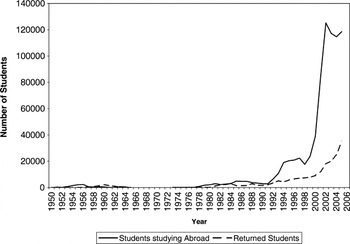
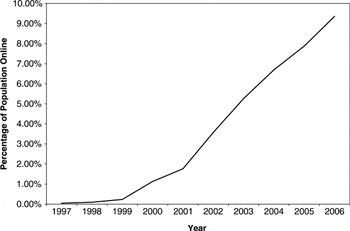
Finally as China opens, the increase in travel and education abroad (see figure 4),55
www.chinadataonline.org. For data prior to 1985, see China Statistical Yearbook, 633.
Statistical Reports on the Development of Chinese Internet, available at http://www.cnnic.net.cn/en/index/index.htm

Chinese students studying abroad

Chinese Internet users
Overall, the more that China is economically and socially entwined with other major powers (e.g., the United States) the more it gains from the overall system and the more it has to lose in changing the system or engaging in major conflict.57
We might also anticipate that as China participates in the system it will also change it, in consultation and agreement with other countries, more to its liking.These related arguments that support engagement certainly capture an important influence on Beijing's thinking today. China has become captivated by the economic growth that has accrued from its openness to the international economy. Such interaction has generated more significant domestic political interests that favor opening. While the growth of the Chinese middle class is still nascent, there is some evidence to suggest increasing wealth may affect foreign policy opinions.58
Johnston 2004b, 603–628.
Building on arguments offered by scholars, China's leaders such as General Secretary Hu Jintao and Premier Wen Jaibao have argued that China's modernization depends on peace and that China's “rise” would not lead to policies that pose threats or come at the expense of other countries. See Suettinger 2004. (http://www.chinaleadershipmonitor.org/20044/rs.pdf) and Zheng 2005.
The problem with these interdependence arguments is that they, like their power-centric debating opponents, are overly deterministic.61
For a synthesis of the two that overcomes some of these problems, see Copeland 2003.
Analytically, it has a difficult time accounting for how interests within societies “add up” to national policy choices.62
See Garrett and Lang 1996. It also applies to socialization arguments about China as well.
For an argument that China is unlikely to liberalize in any foreseeable time frame see Mann 2007.
Waldron 2004.
Democratization is a precarious process—democratizing states are often prone to conflict under the pressures of new-found nationalism stoked by exaggerated expectations unrestrained by fledgling institutions. Contemporary Chinese nationalism threatens to be the Mr. Hyde to the Dr. Jekyll of the “reform and opening” policy that Deng initiated.65
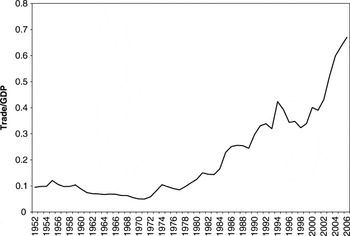
Economic interdependence may be a force that works against conflict, but it is not a failsafe—as seen in the interdependence of the early 1900s in Europe that ended in the Great War.Nor does globalization—the shrinking of the globe and increased density of contacts within international society due to technological advances—guarantee Chinese integration. The potential interdependence of China in the system—in terms of the declining costs of transportation and communication and the relative openness of the world trade order—has been occurring for decades. Whether China took advantage of the potential gains of interdependence was at least in part a Chinese policy choice that needs to be explained.66
The Western powers of course had a say on this outcome as well. U.S. policy after Mao came to power was largely aimed at isolating China.
Trade data is the total current value of imports and exports over the total current GDP. See http://chinadataonline.org/member/macroy/.

Chinese economic interdependence
The history of national economic modernization via engagement with the international arena is filled with stories of countries undertaking integration and then later moving in the opposite direction. Here we might think of Weimar Germany's shift under Hitler or Japan's shift from Taisho democracy to the Showa era or even the retreat of the United States in the interwar period. China itself reversed directions in moving from Qing China to Nationalist China and then reversed again in the transition to Communist China.
In sum, both power and economic interdependence may push strategy in particular directions but such moves have also been reversed even when power and interdependence conditions remain fairly constant. Similarly, sometimes states may stick to their plans even as conditions of power and interdependence alter significantly. Why?
The Meshing Gear: Collective Ideas
Neither power nor interdependence directly shaped Chinese grand strategy because such systemic factors are enacted through domestic politics and decision making. There are of course many types of domestic theories of politics. Here, however, I want to concentrate on the central (and misunderstood) role of enduring foreign policy ideas in domestic politics and subsequent national behavior.
There is a large and very insightful literature on how collective ideas (e.g., beliefs, norms, discourses, culture, etc.) “matter” in foreign policy.68
What is usually missing in these arguments is how ideas matter in their own transformation. The literature is very good on how collective ideas might keep intentions fixed, but less clear on how they affect change. To suggest that ideas play a role in their own transformation is not to argue that outcomes are wholly caused by ideas. It is useful to distinguish the impact of ideas from other factors (e.g., strategic circumstances or economic pressures) and to make sense of how they might conjointly cause outcomes—i.e., how power and interdependence interact with ideas through predictable mechanisms to cause outcomes. The central emphasis in what follows is on the role of ideas (simply because it is the least understood) but the importance of power and transnational pressures will also be clear.Foreign Policy Ideas and Intentions
States tend to formulate broad concepts—almost operational philosophies—that orient their international behavior. As large societies, nations require ideas that signify to their members what they stand for; as large organizations they require ideas to guide them in their interactions in the international arena. “Ideas,” as I use the term here, are not mental constructs of individuals, but instead the collective beliefs of societies and organizations about how to act. Examples of beliefs about “good policies” from the foreign policies of major powers include:
- “non-entanglement” in European politics (United States, 1776–1941)
- territorial expansion on the continent (Germany 1890–1945)
- isolation from extensive foreign interaction or presence (Japan 1640–1868)
- integration as a normal power (Soviet Union/Russia 1986–present)
They are embedded not only in some human brains, but most importantly in the collective memories, national symbols, government procedures, educations systems, and rhetoric of statecraft.69
Such views matter because they are a guide to national action and can shape what states want to achieve over time. Naturally state leaders strategically plan their actions but they often do so against a backdrop of certain dominant national ideas about what general behavior is appropriate. These ideas may be contested by some groups within societies but still serve as a guide for the collective “nation.” Promoted by those who benefit and nurtured by habit, they grow roots. As organization theorists point out, particularly when groups have intangible goals such as “security” or “wealth” states will focus their efforts around doctrines of action rather than actual goals. Put differently, ideas become intentions.70
E.g., the mission statement for the United States Department of State is “Create a more secure, democratic, and prosperous world for the benefit of the American people and the international community”—see http://www.state.gov/m/rm/rls/dosstrat/2004/23503.htm. On the general organizational dynamic see Selznick, 1949, 69–70, 250–259; Selznick 1957, 16; Wilson 1989.
May 1962.
National ideas about international order are difficult to change for a number of reasons. First, they have constituencies that benefit from them and thus are energized to promote and defend them. Second, such dominant ideas become ingrained in public rhetoric and bureaucratic procedures that make them resilient like all traditions that are institutionally entrenched. Third, because of this effect they become normalized not just as means to achieve ends, but also as a standard of what the nation should do, or even what it is (i.e., identity).
Tokugawa Japan came to be defined by its policy of excluding foreigners and its leaders appealed to that tradition to sustain their position. Similarly, the United States was distinguished by its refusal to “get entangled” with the suspect traditional powers of Europe in the first 150 years of its existence and presidents paid homage to that norm (e.g., Harding in the 1920s) in order to bolster their popularity.72
China in the nineteenth century in the face of foreign incursions attempted to hew to a traditional Qing Middle Kingdom mentality despite its waning authority.It is therefore not surprising that continuity is the norm in foreign policy ideas. Those who want to challenge tradition face significant hurdles. It is often hard for individuals to know if others desire change and if they do, how much they will risk acting on such preferences. Lacking such information, they cannot be sure if their own desire and efforts for change (should they exist) will have any effect. They must mount a case for why the old ideas were defunct, which can involve considerable effort, and because it threatens tradition, invites social and political criticism.
Likewise the formation and institutionalization of new ideas breeds strife and uncertainty because particular orientations offer differing costs and benefits to domestic groups that can stalemate over which, if any, new direction is more desirable. Continuity, therefore, is a potent force. Yet as May points out, entrenched foreign policy concepts are nonetheless vulnerable to transformation “as history grows” and countries “see the past in a new light.”73
May 1962, 667.
When Orthodoxy Disintegrates
Implicit in the above discussion is the fact that change is not a single phenomenon but involves two stages that must be explained: collapse of the old ideas and consolidation of the new. Both stages, I argue, are affected by pre-existing ideas.
In the collapse stage, pre-existing ideas affect how leaders justify policy and set a baseline of social expectations of what should result. Political opponents within countries then use those baselines to assess—and support or critique—existing policies, depending on events. When events contradict collective expectations and the consequences are starkly undesirable, change is more likely. Such situations facilitate change by giving ammunition to the opponents of the current orthodoxy, allowing them to rally support to their side while supporters of the current orthodoxy are put on the defensive. For example, the separatist approach of the Qing Empire was finally disrupted by the 1895 Japanese victory in the Sino-Japanese War. That event set off a race among outsiders to control China and encouraged forces within China to challenge tradition, including in foreign policy.74
In most other circumstances, continuity is likely. For example, continuity can be expected when deviations from existing ideas lead to undesired outcomes. When the United States intervened in World War I it violated its longstanding taboo against entanglement in Europe's politics. The results of World War I brought widespread disillusionment in the United States and the Americans embraced anew their tradition of “no-entanglement” in Europe. In such situations, defenders of the old ideas (as the American isolationists did) will be able to make political hay by claiming “told you so, we should never have strayed from our tried and true tradition.” Intervention in World War I, they argued, had been a disastrous mistake.
Likewise continuity is even likely when dominant ideas are ignored yet desirable results occur. It is hard to gather momentum to change collective ideas when outcomes are agreeable. Consider, for example, the dearth of investigations of large stock market increases that no one expected versus the special commissions that always seem to form to examine unexpected stock market crashes. When outcomes are desirable, it is difficult to generate momentum to reorient bureaucracies and alter traditions. The delegitimation of an extant orthodoxy requires events that both contradict its logic and have undesired consequences. In such circumstances, individuals will be more motivated and more likely to challenge those ideas, believe others are of a like mind, and hence the possibilities for change are more significant.
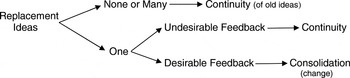
Figure 7 depicts the branching logic of collapse involving this interaction of ideas and consequences.

Collapse
Conditions of New Orthodoxy
Even when dominant ideas are delegitimated, however, change is not automatic. Consolidation, like collapse, faces hurdles that feed inertia. Individuals may agree that the old view has to go but may not be able to agree or coordinate on what new orthodoxy should be the guide. Such a dynamic has been charted in the study of revolution, but it also exists in foreign policy disputes and debates.75
On consolidation in the literature on revolutions, see e.g., Goldstone 1991.
As the future revolutionary Sun Yatsen wrote to an official in 1893, “the reason why we have not achieved much (relative to other countries that had opened up); public opinion and entrenched ideas simply will not allow it.” Mitter 2004, 32.
The sustainability of a new orthodoxy (when a prominent replacement does exist) over a longer period often hinges on some demonstration of its efficacy. Ideas that endure do so because they appear to generate desirable results. When those notions do not, revanchists often find fertile ground to argue for a return to the old ideas. This was the case in Weimar Germany when the results of Versailles undermined the liberal international policy of the fledgling Social Democratic government. Versailles also spawned the May Fourth Movement in China that helped discredit fledgling liberal democracy notions.77
See Hunt 1996, 77ff.
Figure 8 depicts the way that the distribution of replacement ideas and their demonstrated efficacy foster or inhibit change.

Consolidation
This argument features ideas as a meshing gear—one that interacts with other factors and in doing so has its own influence. National strategies therefore are a product of multi-causal influence. Prior ideas play a role but of course do not unilaterally determine all aspects of new orthodoxies. Consider, for example, the role of the relative power of actors, which often shapes negative and positive feedback to prevailing ideas. Dominant concepts that ignore relative power can lead to disappointing results that contribute to their delegitimation. Consider the decline of the Qing-era tribute system and sinocentrism under the weight of superior European and Japanese capabilities that exposed their fragility in the late nineteenth century. Likewise, the number and nature of replacement ideas so central to consolidation is shaped by the political activity and resources of interest groups and individuals that promote them. Economic interdependence and the promises of growth inherent in it can indeed strengthen those in favor of such ideas.78
Long-term efforts that encourage international exchange can facilitate the rise of replacement ideas in particular societies.79 Thus the success of ideas can also be shaped by the degree a country is involved in the international economy.Overall, then, the account of foreign policy change (and continuity) offered here is contingent. It depends on the interaction of the dominant foreign policy ideas of states with the results encountered, as well as the distribution of replacement ideas in a particular society and their initial success, if any. To stress contingency is not to forgo explanation.80
Friedberg 2005 rightly points out the difficulty of predicting the future when it depends on events that we cannot foresee. Nonetheless, it is possible to explicate the conditions and mechanisms through which events will produce different futures.
This general logic seems to have wide application in the history of great powers, and though there are differences, covers both democratic and authoritarian regimes.81
See Legro 2005.
The Contingent Path of China's Future Intentions
The argument above highlights particular signposts as important for understanding what China might do with its growing power in the future. Most centrally, the longevity of China's integrationist orthodoxy will depend on the expectations it generates in the domestic arena and the results that are experienced (collapse considerations), as well as on the nature of the ideas that might replace integration (consolidation factors). I address each in turn.
Justifications and Expectations
Contemporary Chinese leaders justify and promote the dominant integration idea—i.e., “reform and opening”—in two different ways.
The first, and most important, justification of current policy is that integration within the existing international order provides the best means for national economic development.82
Downs and Saunders 1998/99 argue that China has valued economic development ahead of nationalist goals.
It is essential for the Party to give top priority to development in governing and rejuvenating the country and open up new prospects for the modernization drive … the progressiveness of the Party is concrete and historical, and it must be judged by whether the Party promotes the development of the advanced productive forces.83
Jiang Zemin's Report to the 16th National Congress of the Chinese Communist Party; Fewsmith 2003, 3. See too recent speeches by Hu Jintao, successor to Jiang, that offer similar themes, e.g. “President Hu Outlines Work Agenda for 2005,” http://www.chinaembassy.org.il/eng/xwdt/t178046.htm.
The Fifth Plenary of the 16th Party Congress of the CPC in October 2005 called development “the overriding principle and the key to resolving all problems facing China.”84
Communique of the 15th CPC Central Committee Plenum, October 9–11, 2005. http://www.china.org.cn/english/features/45280.htm.
The second major justification for integration within the existing international order is that it enhances sovereignty—understood in terms of independence and territorial integrity. That is, integration should prevent the type of colonial subordination of the past and the infringement of China by outside powers. A defining point of history for the Communist Party (CPC) leadership is the “century of humiliation” China endured under the influence of imperialist powers (e.g., the West, Japan). One of the CPC's main claims to authority is that it liberated China from that outside influence.85
Lampton 2001, 251ff.; Zhao 2004. For an example of this view of history see China's October 2005 white paper “Building Political Democracy in China,” especially Section I, “A Choice Suited to China's Conditions.”
The most concrete marker of sovereignty for China today is Taiwan. China expects that its participation in the extant institutions and conventions of world politics will help to fulfill a desire (seemingly widespread across the political spectrum) to unite the mainland and Taiwan. Such participation allows China to stymie efforts by Taiwan to claim sovereign international standing and to build its own international support.
These two themes, economic modernization and sovereignty, may look closely linked to the realist focus on power and autonomy. The key difference, however, is that Chinese leaders justify them not based on increasing China's security, but on bettering the living standard of Chinese citizens. Likewise, China's obsession with Taiwan and other territories is hard to understand from strictly a power perspective. Without knowing China's history and the centrality of Taiwan to CPC legitimacy gains, it is impossible to understand the role this issue can play in Chinese politics and security decision-making.
Economic development and sovereignty can of course also be in tension with one another, a fact that does much to explain the complexity of contemporary Chinese policies.86
Wu 2001.
Anticipating Events that Favor Change
The durability of China's integrationist foreign policy, therefore, will depend on how results match social expectations related to economic growth and sovereignty. Events related to China's integration that represent significant setbacks to either of those issues would be occasions for China to rethink integration.
The first situation where the integrationist orthodoxy would be vulnerable involves troubles in China's economic modernization. From this viewpoint (and in contrast to the rise of China debate) the most likely scenario in which China will alter its integrationist mindset is not with the growth of Chinese power but, instead, major ruptures in that trajectory that could put the dominant “openness” view on a slippery defensive. A reasonable case can be made that a leveling of Chinese economic growth is as likely in the future as is China's rise to supremacy.88
Especially vis-à-vis current Chinese expectations, this would be a deeply disillusioning experience if China's government is somehow implicated. That is, in the absence of downturns that affect all countries or unforeseen crises, critics of the current orthodoxy will have incentive to use faltering Chinese economic prospects to rally political authority around a new approach to the international system. The motivating source in such a scenario will be the combination of surprising economic setbacks contrasted with optimistic expectations generated by leaders seeking legitimacy.The decline of economic growth would encourage previously silent groups that oppose integration. China's rapid development has led to daunting gaps between rich and poor.89
Social protests and disturbances appear to have risen steadily in recent years, increasing from 8,700 in 1993 to 87,000 in 2005.90Data based on figures released by China's Public Security Bureau. www.zonaeuropa.com/20061115_1.htm. See also Tanner 2004, 137–156.
Lin 2007.
Second, events supported by the international community that China sees as neo-colonial or which move Taiwan towards independence could help to undermine China's current integration orthodoxy. For example, the 1999 bombing of the Chinese embassy in Belgrade fueled nationalism and strengthened opponents of opening.92
Much, of course, will depend on the particular circumstances and whether they make Beijing government seem complicit. Taiwanese efforts to establish formal independence cause deep concern in China—indeed the type that can set the stage for China to take aggressive efforts on an issue seen as priority even by “reformist” governments. Taiwanese independence efforts in 2004–2005 were met by a strong (and self-defeating) reaction from Hu Jintao and National People's Congress passing anti-secession legislation which authorized China to use force against Taiwan if it continued to push for independence.93Cody 2005.
Replacements for “Reform and Opening”
If reform and opening does falter, what then? Presumably some sort of alternative path. Anticipating such a new approach, however, depends on a key factor that is especially elusive in the Chinese case: the nature and distribution of replacement ideas about international society within China.94
Seasoned China specialists note the difficulty assessing the nature and strength of competing coalitions, e.g., Christensen 2003, 4–6.
On different factions, see Swaine and Tellis 2000, 83–86; Johnston 2003; Yan 2001, 35; Deng and Gray 2001, 5–16. In general, see Dittmer 1995, 1–39; Nathan 1973, 33–66.
The first was identified by Jiang Zemin as a challenge to his own “reform and opening” emphasis in the years following the 1989 Tiananmen Square fiasco.96
Jiang Zemin's Report at the 14th National Congress of the Communist Party of China, 1992.
Jiang also identified a second group with alternative preferences for China's foreign policy. He called it “those with leftist tendencies” (distinct from the old Marxist variety) who critique reform—and international involvement—as contributing to social injustice and inequality. In the current context, this might include farmers, rural citizens, inland cities, and parts of the military or Communist party who have not shared equally in China's development and could rightly blame reform and opening or participation in the global order (think WTO) as the cause. In foreign policy such tendencies translate into social support for halting and reversing China's integration in the current order. If the communiqué from the Fifth Plenary Session of the 16th Party Congress in October 2005 is an indicator, the challenge from the Left—and the inequality of growth—is of particular concern to the leadership of Hu Jintao who has emphasized the more egalitarian goal of “harmonious society” in contrast to Jiang's mantra of “well-off society.”97
“Chinese Communist Party Fifth Plenary Session Communiqué—Text,” Xinhua News Agency Domestic Service, Beijing, October 11, 2005; Kahn 2005; Li 2005a, 2006.
A third position would come from those who are critical of globalization and western values, but are not necessarily isolationist or anti-capitalist. These people might advocate a nationalist realpolitik policy that favors a more confrontational strategy with the West, stability and central authority at home, while pursuing a soft line and integration in Asia. Think of this perhaps, as the platform for the resurgence of a modern day “Middle Kingdom” role where China would exercise increasing hegemony within Asia while perhaps distancing itself from overall international order.98
Absent better information, it would appear that those who would emphasize withdrawal—either the new Left or realpolitikers—would occupy the rhetorical high ground should future events defy the “opening” justifications of the Chinese government with clear disappointing results. Both offer a greater difference with current dominant integration ideas (Rightists want even more integration) and would likely be in a better position to draw off the language of nationalism to make their case.99
E.g., the appeal to in-group/out-group biases—see Gries 2004.
To the extent that a factional account of Chinese politics is overdrawn (e.g., because the decision making dynamic is one of consensus, not groups fighting over control) then any change in foreign policy thinking will demand especially negative results and could take considerable time, just as it did in Qing China.100
If there is a continued shared view that “isolation is the major factor explaining China's decline” and “opening fueled China's rise,” then shifting significantly away from reform and opening would not happen quickly.101Yan 2001, 35.
Influencing Intentions
Understanding future intentions is a significant and critical challenge for both scholars and policymakers. I have argued that one way (by no means the only way) to think about the evolution of intentions is as a product of change and continuity in dominant ideas about foreign policy. Situations involving the combination of unmet expectations and undesired consequences are likely to facilitate collapse while those where conceptual expectations are fulfilled or desired consequences occur favor the continuity of orthodoxy. Consolidation of a new foreign policy approach—and hence set of intentions—is enhanced by the existence of a prominent replacement idea that aligns with desirable results.
If this argument is right, it implies that understanding the future of a “rising China” means looking beyond, but not over, power and interdependence. The effects of power and interdependence are certainly important for understanding China's attitude towards international order. Relative power has shaped China's past thinking towards the dominant rules and norms of the international system. The penetrating geopolitical reach of Western power had much to do with why Qing China had the incentive to change its long enduring tributary system and sinocentrism. Likewise, the interdependence approach rightly highlights how the openness of China and growth of international trade and contacts has helped develop constituencies and liberal forces in China that otherwise might not exist. But these two constant structural forces cannot account for the variation over time in Chinese ideas about how to relate to international society. To do that we must also heed the contingent ways that foreign policy ideas relate to events, as well as the replacement ideas that form within China.
In terms of policy, this argument cautions against the choice that exists among the three main alternatives in the current U.S. policy debate: engaging, containing, or hedging against the rise of China. Any might be appropriate depending on what particular policy China is pursuing and how that relates to the Chinese government's rationale for its actions. To the extent Beijing leaders are attempting to build their authority and legitimate their rule based on actions that challenge international order, other states should object to or penalize such actions. For example, U.S. policies toward the Soviet Union—e.g., the Carter and Reagan defense buildup, the response to the Soviet deployment of new SS-20 Euromissiles, and the aid to the Muhjahadeen in the wake of the Soviet invasion of Afghanistan—helped to undercut the Brezhnev “correlation of forces” thinking that argued that the exercise of Soviet power served the USSR's interests. The dynamic was not just a balancing of power but an undermining of ideas. Likewise, should China pursue aggressive policies that undermine international order, other countries and organizations should sanction and delegitimize them.
The point here is not to pursue what has come to be the perceived wisdom in dealing with China's unknown future intentions—i.e., a hedging strategy. Such an approach counsels that the other countries prepare themselves for any eventuality and respond in kind. However, doing so suffers from two problems. It is overly passive in its dependence on simply reacting to what happens in China. And most important it is overly focused on China's behavior and not attentive enough to the ideas behind action and how they relate to the domestic politics of authority in China. A simple response to behavior may unnecessarily strengthen revisionist forces in Beijing.
If the goal is to incorporate China into the international system in a way that makes the system operate in a fashion acceptable to all, however, it is important to reinforce those Chinese leaders and movements that have staked their legitimacy on the positive aspects of integration. A modern-day repeat of the undermining of pro-liberalization advocates by Western action—as occurred when the Versailles Treaty produced the May Fourth Movement and a reactionary China—would be a disaster. This may mean making an extra effort to assure payoffs to China for particularly bold moves in terms of integration—or in terms of restraint vis-à-vis Taiwan. The point is not simply to impede hardliners and help softliners. Indeed, doing either might be desirable—depending on the ideas and expectations they are promoting.
There is of course a risk in supporting Chinese development through integration. It may lead—through unforeseen events, or miscalculation, or inadequate support—to a China that strengthens enough to be dangerous, but has not yet changed enough internally to be satisfied with the norms of the system.102
Christensen 2006, 81–126.
To deal with this scenario, it makes sense, then, to be proactive—to pay attention to the potential replacement ideas circulating in China and their backers—ones that may someday be conceptual kings. For example, it is important that long-term efforts be made to strengthen those Chinese groups and individuals who would support, in the event of significant setbacks to reform and opening, replacement ideas that are more desirable than an aggressive, separatist nationalist approach to foreign policy. There are historical precedents for such a transformative influence. Efforts taken over many years by a variety of groups in the United States (and in Britain) after World War I had much to do with why internationalism (a fusing of geopolitics and Wilsonianism) was a coherent replacement for isolationism in American strategy after World War II.103
Likewise during the Cold War, U.S. and European interaction with an even more authoritarian and closed Soviet Union helped “new thinking” (and not some other thinking) take shape as a viable replacement when the old Soviet foreign policy dogma disintegrated.104Of course, the limits of outside influence on a country of China's size and complexity, especially given the popular Chinese desire for autonomy and non-interference from foreigners, are significant. Moreover, China's authoritarian government and lack of transparency limit the ability to closely follow and shape internal developments. China's future in the world will be largely of its own making. Yet as seen in history, outside influence has sometimes played a role in the evolution of China's approach to international society—from the Opium Wars to the May Fourth Movement to the early Cold War period to the current integration. Central to this history—and China's future—are not just the perils of power or the promises of interdependence, but also how they relate to the way China thinks about the world.