Since the introduction of cardiac catheterisation to the diagnosis and intervention of congenital heart disease (CHD), several studies have evaluated the associated complications and risks. After years of cardiac catheterisation utilisation, procedures that are more complex have been developed, including catheter interventions using advanced equipment and devices. Recent studies have reported quite divergent findings with respect to complications – for example, a study including only interventional cases reported a complication rate of 4.1%,Reference Agnoletti, Bonnet and Boudjemline 1 whereas another contemporary study also including diagnostic procedures found a complication rate of 19%.Reference Bergersen, Gauvreau, Jenkins and Lock 2 Although some reports have described each complication separately without further grading,Reference Agnoletti, Bonnet and Boudjemline 1 , Reference Kobayashi, Sallaam and Aggarwal 3 others have distinguished between minor and major complicationsReference Mobley, Stroup and Kaine 4 – Reference Vitiello, McCrindle, Nykanen, Freedom and Benson 8 or used the more recent five-level system developed by Bergersen et al in Boston.Reference Bergersen, Gauvreau, Jenkins and Lock 2 The classification of types of complications has also differed.Reference Bergersen, Gauvreau, Jenkins and Lock 2 , Reference Mehta, Lee, Chaturvedi and Benson 6 , Reference Vitiello, McCrindle, Nykanen, Freedom and Benson 8 Seemingly, the manner in which occurrence, type, and severity of complications have been reported has varied, with different inclusion criteria and classification systems, leading to non-comparable results.Reference Bergersen, Giroud and Jacobs 9
Clinicians as well as patients and their families should be well informed about the results of and the risks associated with different procedures within the local context. Ideally, the same quality and risk-level classification systems should be used for all diagnostic and interventional procedures, regardless of geography and population size. Consensus on how to report and classify the type and severity of complications, however, remains lacking. On the basis of the study from the Boston group, the International Society for Nomenclature of Paediatric and Congenital Heart Disease (ISNPCHD) has proposed a new system of nomenclature for both procedures for and complications of cardiac catheterisation in children.Reference Bergersen, Giroud and Jacobs 9 , Reference Bergersen, Everett and Giroud 10 The system for complication severity level first published by Bergersen et al in 2008 and, to a certain extent, the risk categories also developed by the Boston group have been previously adopted by other groups.Reference Mobley, Stroup and Kaine 4 , Reference Mori, Takahashi and Nakanishi 11 , Reference Phillips, Cabalka, Hagler, Bailey and Cetta 12 To our knowledge, no previous clinical reports have been based on the nomenclature proposed by ISNPCHD, namely, the IPCCC classification system for complications.
The aim of this national, single-centre study was to evaluate the rate of complications related to cardiac catheterisation in children <18 years of age with heart disease with respect to type, attributability, and severity grade. This study also serves as an attempt to describe our results according to the IPCCC nomenclature for complications.
Materials and methods
The Pediatric Department of Oslo University Hospital (OUS) serves as a national centre for invasive cardiology in Norway, where the population currently approaches 5.3 million people. In the past 25 years, ~250 cardiac catheterisations have been performed in the paediatric population annually. Since 2008, all catheterisations have been electronically logged, and complications have been recorded. Consequently, this study includes all cardiac catheterisations performed on Norwegian children during the 5-year study period from January, 2010 to December, 2014. Electrophysiological investigations and interventions were excluded. This study was categorised as internal quality assurance and approved by the hospital authorities in accordance with ethical standards.
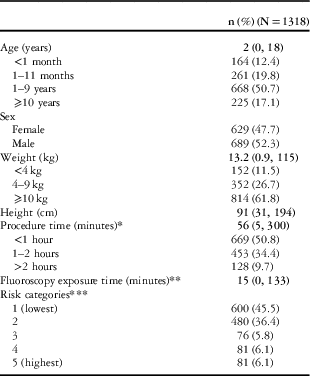
Almost all catheterisations were performed with patients under general anaesthesia and by one of three senior physicians who were assisted by junior physicians. The catheterisations were predominantly performed in the Children’s Department Angiography Laboratory; however, some catheterisations were performed at bedside in the ICUs or in the operating theatre. Both diagnostic and interventional procedures were recorded. Among cases in which several procedures were performed, the most complicated procedure defined the categorisation. The presented number of interventions per catheterisation represents a minimum due to the potential for multiple uses of balloons, stents, or devices. Myocardial biopsy was coded as a diagnostic procedure, as proposed by IPCCC. A five-level risk categorisation developed at OUS-RH was used. Details about the patients and catheterisations are listed in Table 1.
Characteristics of patients and catheterisations.

Numbers in bold are median and range (min, max)
* Data missing from 68 cases
** Data missing from 2 cases
*** See Supplementary Table S2 for description
Data were registered prospectively in the department’s catheterisation registry, which was established in 2008. The purpose of the registry was to standardise information about all procedures in the department, and it was not specifically dedicated to complications. Within this registry, an electronic report is filed by the performing physician after each catheterisation. This report includes general information about the patient and catheterisation, including the occurrence of complications. An additional report about the complication is filed when relevant and completed later in cases of delayed presentation or when follow-up is needed. Multicentre US studies, which have been validated for prediction of both high-severity complicationsReference Bergersen, Gauvreau and Foerster 13 , Reference Lin, Hegde and Marshall 14 and death attributed to catheterisation,Reference Backes, Bergersen and Rome 15 have used four risk levels.Reference Bergersen, Gauvreau and Marshall 16 In our clinical setting, five risk categories were well established and were used for all analyses (see Supplementary Table S2). Case ascertainment of the registry was validated by detailed review of hospital records for all children who underwent catheterisation during the month of November of each study year, representing ~10% of the total catheterisations.
All catheterisations with complications were identified. In case of more than one, the most severe complication was used in the analyses. Medical records were then reviewed in order to confirm type, severity, and course of the complications on the basis of consensus in the author group. Beginning in 2008, the complications were graded as incident/minor/major; however, in light of the recent literature, we wanted to apply the classification system proposed by IPCCC. Hence, the complications were re-classified into severity grades of 1–5 and sorted by type and attributability.Reference Bergersen, Giroud and Jacobs 9 For descriptions of severity-level definitions, see Supplementary Table S1. Preventability and timing were difficult to re-classify retrospectively using the IPCCC system and were not included in this study.
Statistical analyses were performed using SPSS® version 23. The unit of analysis was defined as catheterisations (n=1318), not persons (n=941), and were therefore not completely independent. Univariate and multivariate effects were estimated using logistic regression models and are reported as odds ratios with 95% confidence intervals and p-values based on the Wald test.
Results
Population and catheterisations
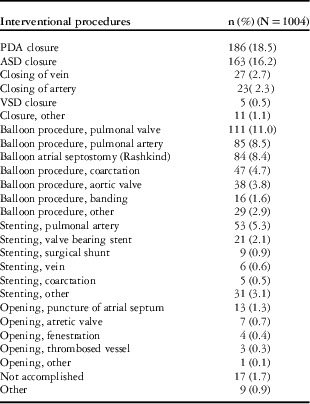
From January, 2010 to December, 2014, 1318 cardiac catheterisations were performed on 941 patients. Information regarding patients’ age, weight, height, sex, diagnosis, and procedure type was recorded at the time of catheterisation. General information about the patients and procedures used are presented in Table 1. Of the 1318 catheterisations, 902 (68.4%) were interventional, and the rest were diagnostic. Among the 902 interventional catheterisations, 1004 separate procedures were recorded (see Table 2). Closures of atrial septal defects and patent ductus arteriosus were the most common procedures. Catheterisations were assigned to one of five risk levels. These risk categories were developed at OUS based on the work of The Congenital Cardiac Catheterization Project on OutcomesReference Bergersen, Gauvreau and Marshall 16 (see Supplementary Table S2 for a detailed description).
Types and frequencies of interventional procedures.

PDA = patent ductus arteriosus; ASD = atrial septal defect; VSD = ventricular septal defect
Complications
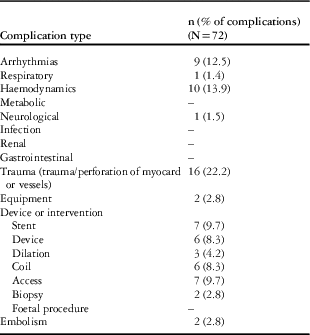
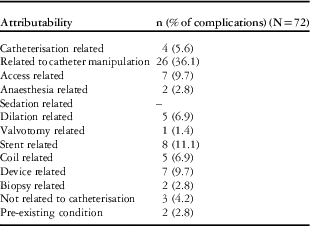
The occurrence, type, severity, and attributability of complications are summarised in Tables 3–5. Of the 1318 catheterisations, a total of 72 complications (5.5%) were registered. Only two additional complications were identified through validation of the registry data, indicating excellent completeness of the registry. All complications occurred in different individuals, except for two complications in two patients.
Complications grouped according to International Paediatric and Congenital Cardiac Codes for main categories.

Complications grouped according to International Paediatric and Congenital Cardiac codes for attributability.

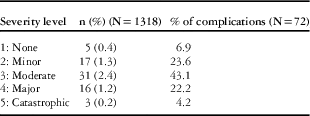
Complications grouped according to International Paediatric and Congenital Cardiac Codes for severity levels.

In accordance with the IPCCC system, a total of 31 (43.0%) complications were categorised as device or intervention adverse events; these were the most commonly identified complications (Table 3). Included within this category were stent complications, which included stent embolisation (n=3), stent thrombosis (n=3), and stent dislocation (n=1), and device complications, which included device embolisation (n=4) and device displacement (n=2). As a result of balloon dilation, three complications occurred; these complications included one event in which the introducer was stuck, another incident in which the balloon would not deflate, and one case with haemodynamic instability after balloon dilation. Coil complications (n=6) included coil embolisations (n=4), one incident in which the coil would not detach, and one event with haemolysis secondary to coil closure. Access complications included perforation of the vessels (n=4) and haematomas (n=3), and biopsy complications included two events with complete but temporary atrioventricular-block after several biopsies, which occurred in the same patient. The most common single type of complication was trauma to the vessels or the myocardium, including perforation of the myocardium (n=12), perforation of vessels (n=2), papillary muscle rupture (n=1), and worsening of subpulmonary atrioventricular valve regurgitation (n=1). A number of arrhythmias were also noted, including atrial flutter (n=4), atrioventricular block (n=4), and supraventricular tachycardia (n=1). Haemodynamic complications included a coronary spasm (n=1) and haemodynamic incidents such as bradycardia, desaturation, and hypotension (n=9). Of these complications, four ended in cardiac arrest, including two fatalities.
When categorising adverse events according to attributability (Table 4), complications related to catheter manipulation were the most common. Access-related, device-related, that is, stent, coil, or device, or dilation-related complications accounted for the majority of remaining complications.
Concerning severity levels (Table 5), 50 (3.8%) were considered at least moderate complications (⩾level 3), and 19 (1.4%) complications were graded as major (⩾level 4). The distinction between normally occurring events and complication of severity level 1 is not always clear, and minor complications without any consequences are most likely under-reported in our study. In particular, this applies to complications related to the anaesthesisa and haemodynamic instability, such as need for bolus doses of fluid and inotropic support. In our sample, three patients (0.23%) died following catheterisation, and all of them had severe and complex cardiac diseases: two of these complications were attributed to the catheterisation itself; pulmonary embolism following extensive pulmonary angioplasty was identified in a 7-year-old child; and atelectasis due to bronchial stenosis causing persistent desaturation was the explanation in a 4-month-old child during preoperative evaluation for Fontan surgery. Death occurred 15 minutes and 12 hours after the procedures in the 7-year-old and 4-month-old child, respectively. The third death was attributed to a pre-existing condition. This fatality occurred as a consequence of haemodynamic instability 20 hours after the opening of an atretic pulmonary valve in a newborn infant.
Risk predictors
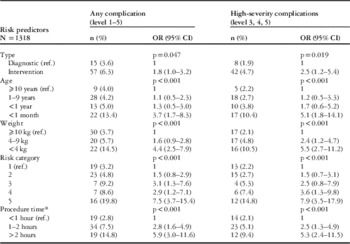
Table 6 shows the frequencies of complications in relation to the type of catheterisation, diagnostic or interventional, age, weight, risk category 1–5, and procedure time. Univariate associations between these variables and the occurrence of any complication and high-severity complications are shown as odds ratios. Age, weight, risk category, and procedure time were identified as the most important univariate predictors of complications.
Univariate predictors (odds ratio (OR) with 95% confidence intervals (CI)) of any complication and high-severity complications.

ref.=Referent values
* Data missing from 68 cases
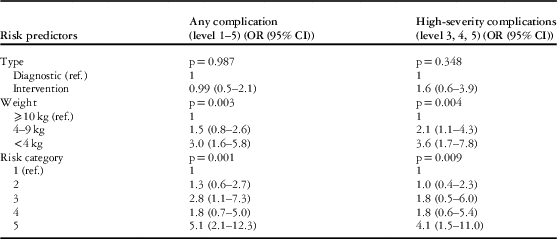
In Table 7, the same predictors except for age and procedure time are included in two multivariate models with the same response variables: any complication and high-severity complications. Owing to a high correlation between age and weight (Spearman’s ρ, 0.82), only weight was included in the multivariate analysis. As procedure time may well be a consequence of the actual complication, its predictive value may be limited, and therefore this variable was not included in the multivariate model. After controlling for type –diagnostic or interventional – weight and risk category 5 remained the strongest predictors of complications.
Multivariate predictors (odds ratio (OR) and 95% confidence intervals (CI)) of any complications and high-severity complications.

ref.=Referent values
Discussion
This study reports national data on the type, attributability, and severity grade of complications related to paediatric cardiac catheterisation in Norway during a 5-year period and is, to our knowledge, the first publication based on the IPCCC nomenclature.
Complications
We found a total complication rate of 5.5%, which is at the lower end of the range from 4 to 19% presented in several other studies.Reference Agnoletti, Bonnet and Boudjemline 1 , Reference Bergersen, Gauvreau, Jenkins and Lock 2 , Reference Yilmazer, Ustyol and Guven 5 – Reference Vitiello, McCrindle, Nykanen, Freedom and Benson 8 , Reference Mori, Takahashi and Nakanishi 11 , Reference Vincent, Moore and Beekman 17 – Reference Bergersen, Marshall and Gauvreau 20 An explanation for this relatively large variation could be the use of different definitions and inclusion criteria for complications. Further, the number of complications may be dependent on the type of patients and procedures. In general, the complexity associated with both patients and procedures has increased over the years; however, a few previous studies have presented detailed descriptions of risk stratification according to patients and/or procedures. Our study has the highest reported proportion of interventions, and we find no reason to believe that the low rate of complications could be explained by the simplicity of the cases; however, there has been less discrepancy in previously described incidences of both mortality and major events, with previously reported high-severity events ranging from 3.9 to 9%Reference Bergersen, Gauvreau, Jenkins and Lock 2 , Reference Mori, Takahashi and Nakanishi 11 – Reference Bergersen, Gauvreau and Foerster 13 , Reference Bergersen, Gauvreau and Marshall 16 , Reference Bergersen, Gauvreau, Lock and Jenkins 21 and major events ranging from 1.4 to 2.9%.Reference Bergersen, Gauvreau, Jenkins and Lock 2 , Reference Mehta, Lee, Chaturvedi and Benson 6 – Reference Vitiello, McCrindle, Nykanen, Freedom and Benson 8 , Reference Lin, Hegde and Marshall 14 , Reference Bergersen, Gauvreau and Marshall 16 , Reference Cassidy, Schmidt, Van Hare, Stanger and Teitel 18 , Reference Jayaram, Beekman and Benson 22 In our study, high-severity complications, defined as severity level ⩾3, occurred in 3.8% (n=50) of all cases, and major complications, defined as severity level ⩾4, occurred in 1.4% (n=19) of all cases. The mortality rate of 0.23% identified in our study is in accordance with previous studies in which the rate varied from 0.14 to 0.68%.Reference Agnoletti, Bonnet and Boudjemline 1 , Reference Bergersen, Gauvreau, Jenkins and Lock 2 , Reference Yilmazer, Ustyol and Guven 5 – Reference Vitiello, McCrindle, Nykanen, Freedom and Benson 8 , Reference Mori, Takahashi and Nakanishi 11 , Reference Lin, Hegde and Marshall 14 , Reference Cassidy, Schmidt, Van Hare, Stanger and Teitel 18 , Reference Bergersen, Marshall and Gauvreau 20
Trauma to the myocardium or vessels, haemodynamic complications, and arrhythmias were the most common complications among our patients. Although direct comparison is difficult, arrhythmias have been reported as one of the most frequent types of complication in several recently published studiesReference Bergersen, Gauvreau, Jenkins and Lock 2 , Reference Yilmazer, Ustyol and Guven 5 – Reference Stanger, Heymann, Tarnoff, Hoffman and Rudolph 7 , Reference Mori, Takahashi and Nakanishi 11 , Reference Lin, Hegde and Marshall 14 , Reference Cassidy, Schmidt, Van Hare, Stanger and Teitel 18 and in some of the first reports published on the subject.Reference Bergersen, Everett and Giroud 10 , Reference Mori, Takahashi and Nakanishi 11 It is, however, difficult to compare results from different centres, as the classification of complications may differ considerably between institutions.
Risk factors
In the multivariate model, we found low weight to be associated with both any complication and high-severity complications. This inverse relationship has been well documented in other studies.Reference Bergersen, Gauvreau, Jenkins and Lock 2 – Reference Yilmazer, Ustyol and Guven 5 , Reference Lin, Hegde and Marshall 14 , Reference Backes, Cua and Kreutzer 23 , Reference Rhodes, Asnes, Blaufox and Sommer 24 There was also a significant univariate effect of low age (<1 month) on complications, which is also in accordance with other studies.Reference Bergersen, Gauvreau, Jenkins and Lock 2 , Reference Yilmazer, Ustyol and Guven 5 , Reference Mehta, Lee, Chaturvedi and Benson 6 , Reference Vitiello, McCrindle, Nykanen, Freedom and Benson 8 , Reference Lin, Hegde and Marshall 14 As weight and age are highly correlated, we only included weight in our multivariate model, as we considered it the more clinically relevant variable.
Several studies have reported significant risk differences between interventional and diagnostic catheterisations, with interventional procedures carrying the highest risk.Reference Bergersen, Gauvreau, Jenkins and Lock 2 , Reference Yilmazer, Ustyol and Guven 5 , Reference Vitiello, McCrindle, Nykanen, Freedom and Benson 8 , Reference Vincent, Moore and Beekman 17 , Reference Bergersen, Marshall and Gauvreau 20 We also found higher complication rates for interventional than diagnostic catheterisations: 6.3 versus 3.6% for any complication (p=0.047) and 4.7 versus 1.9% for high-severity complications (p=0.019). Even though this variable – diagnostic versus intervention – was not significant in the multivariate model, we decided to include it in the final model as a control variable.
Risk categories
After all patients had been designated to a risk category (1–5; see Supplementary Table S2), we found a significant association between the three highest risk groups and any complication and the two highest risk groups and high-severity complications within the univariate analysis. In the multivariate analysis, the effect of risk category 5 remained highly significant for both any complication and high-severity complications.
Limitations
The physicians performing the catheterisations in this study prospectively collected data, and there may have been inaccuracies when filing each catheterisation report. As mentioned, minor complications are most likely under-reported in our study. The re-classification of complication type, attributability, and severity level in retrospect is also a possible source of error; however, all complications were reviewed in detail according to instructions that included clinical examples. Although some post-procedural complications had been registered, two late complications not in the registry were recognised by chart review. The effect of missing data is most likely limited. The use of catheterisations instead of individuals as cases in the study could be questioned with respect to independency; however, growth, surgical treatment, and haemodynamic conditions probably outweigh pure inter-individual differences. Besides, the low recurrence rate did not affect the results.
Conclusion
Norwegian national data used in the assessment of risks associated with cardiac catheterisation in children were comparable with similar international publications in spite of a high rate of interventions. On the basis of 1318 catheterisations in 941 patients, we found an overall complication rate of 5.5%. Weight and risk category were major determinants of complications. Diverse reporting systems remain an obstacle for more extensive comparisons across centres; however, we were able to classify most of our cases into meaningful categories using the IPCCC system. With the use of established international systems, the opportunity for more consistent reporting of complications from different centres increases.
Acknowledgements
None.
Financial Support
This research received no specific grant from any funding agency or from commercial or not-for-profit sectors.
Conflicts of Interest
None.
Supplementary materials
To view supplementary material for this article, please visit https://doi.org/10.1017/S1047951117000208