Logboats and plankboats
The logboat was probably the most widespread solution to water transport in Antiquity. Along with paddle oars, it constitutes the oldest tangible evidence of seafaring, and logboats are still used today in some parts of the world. Given this broad geographical and chronological use, it is understandable that the numerous variations of the logboat make it impossible to recognise a single, clearly defined vessel type. Even within limited regions, logboats sometimes differ considerably, with their commons features reduced to being made from a single tree and because they are confined by the natural shape of the log. In Europe during the Bronze Age and Early Iron Age however, the heterogeneity of these vessels seems to some extent to have ceased.
This paper considers the reasons that a considerable number of West European Bronze Age and Early Iron Age logboats show a remarkable homogeneity in comparison with both earlier and later periods in this part of the world (Figure 1). This homogeneity seemed to emerge around the beginning of the second millennium BC and coincided with the earliest known plank-built vessels in north-west Europe. These are predominantly found in Britain and Ireland, but re-evaluation of a number of old Scandinavian finds indicates that plank-built vessels in the same tradition also existed in this region. This synchronic appearance of homogeneous logboats and plank-built vessels is probably not a coincidence; instead, it points towards the existence of a complex bond between the plankboat and the logboat. Furthermore, the distribution of these logboats suggests that plank-built boats of Bronze Age Scandinavia were part of an interregional Western European tradition.
The Danish Varpelev Boat c. 1000 BC during excavation in 1973 (Archive of Museum Southeast Denmark).

Uniform elements in logboats
What, then, are the characteristics of these homogeneous Bronze Age logboats? Two morphological elements are the most important. First, the floor is frequently characterisedby transverse ridges hewn out of the trunk. This significant feature is seen on almost a third of the logboats from the period. Second, the cross section of the hull is rectangular and box-like, meaning that the outer surfaces of the tree trunk are shaped to provide the vessel with a flat bottom and more or less vertical sides; this feature is seen in the majority of logboats from the period.Another noteworthy characteristic of the Bronze Age logboats is their great size. Although smaller logboats obviously also existed in this period, there was a clear tendency towards building very long and spacious vessels. Many are over 10m long, and the longest reach 14–15m in length.
The logboats
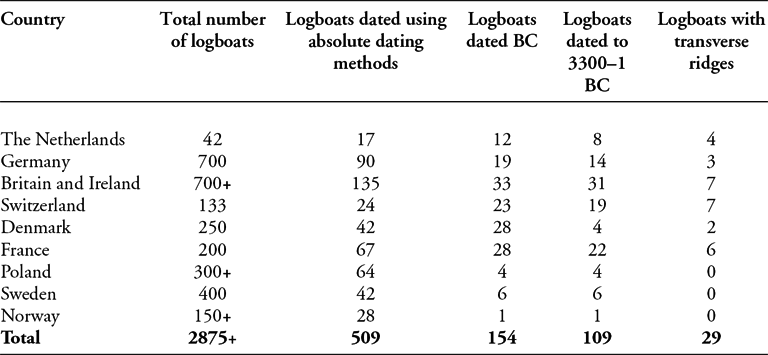
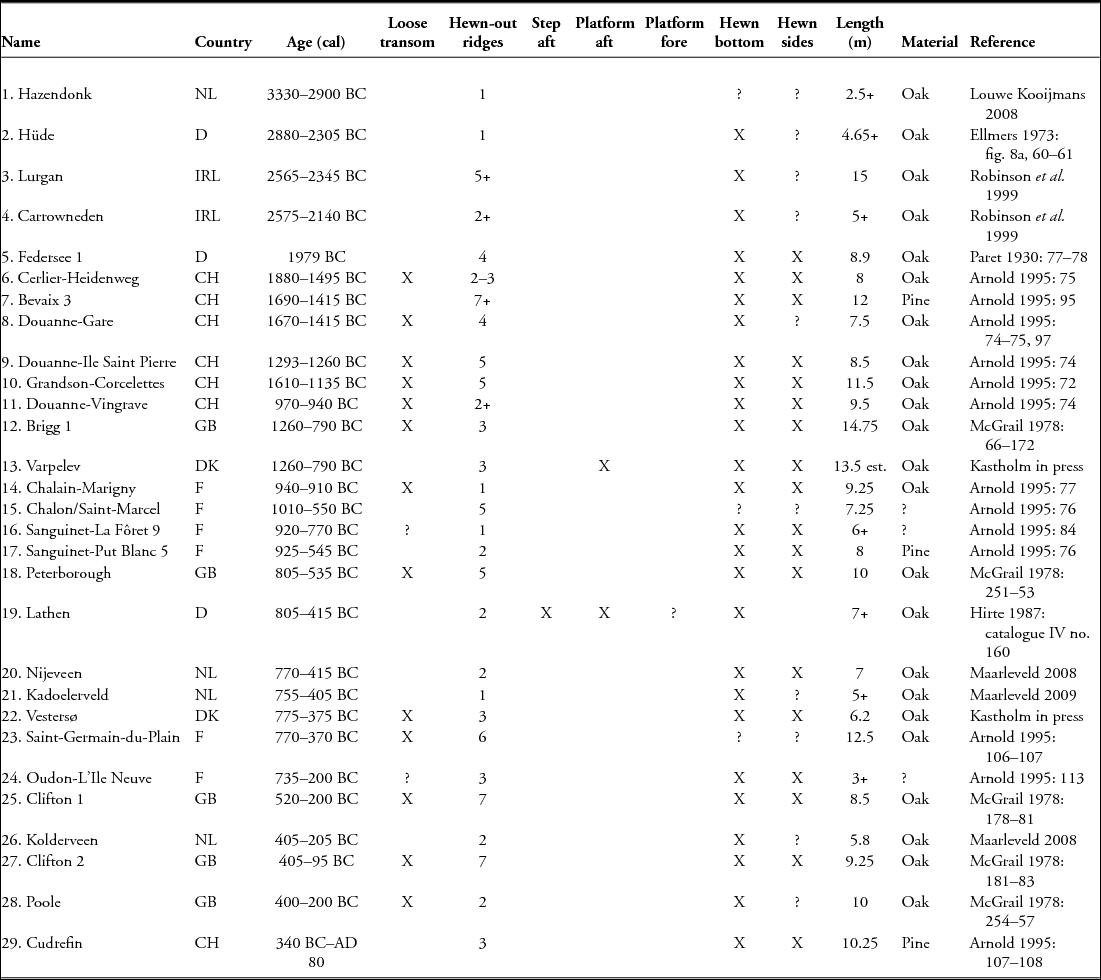
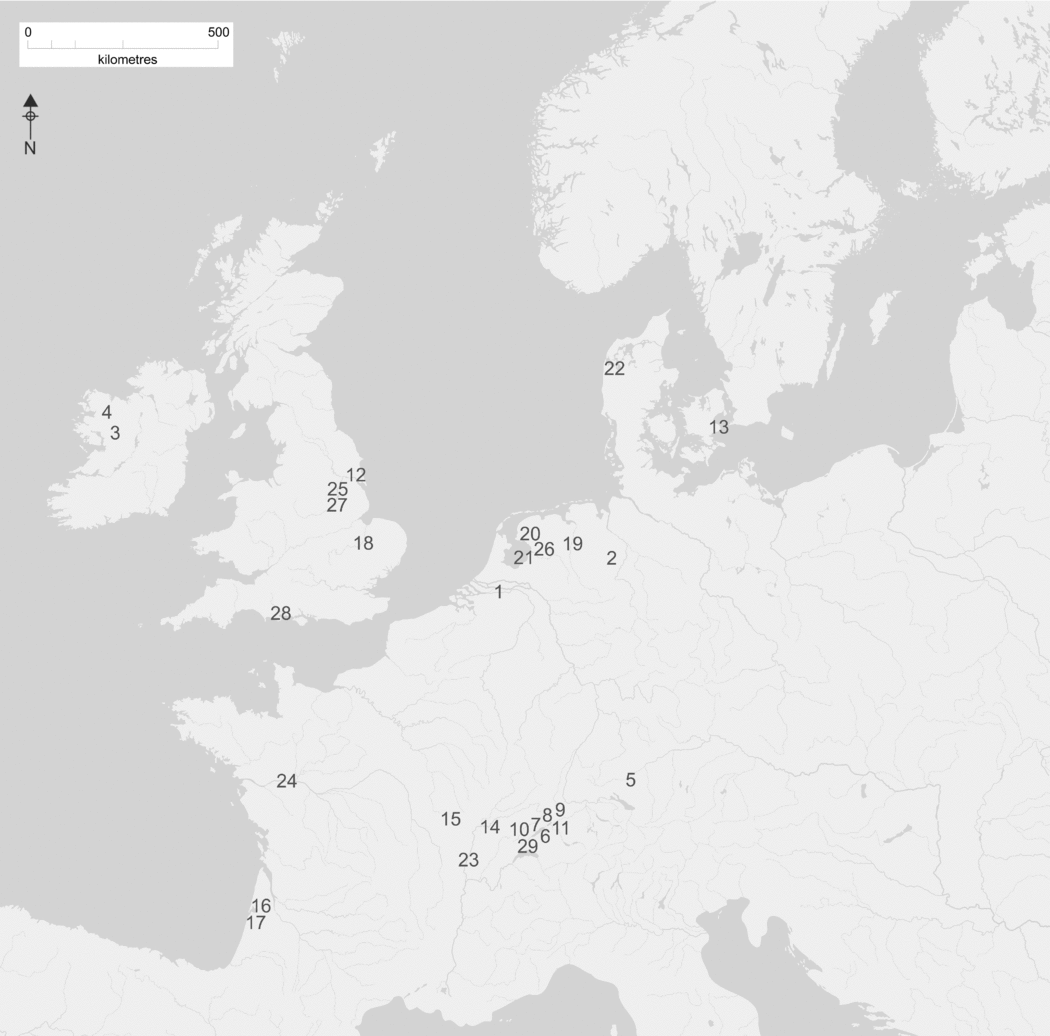
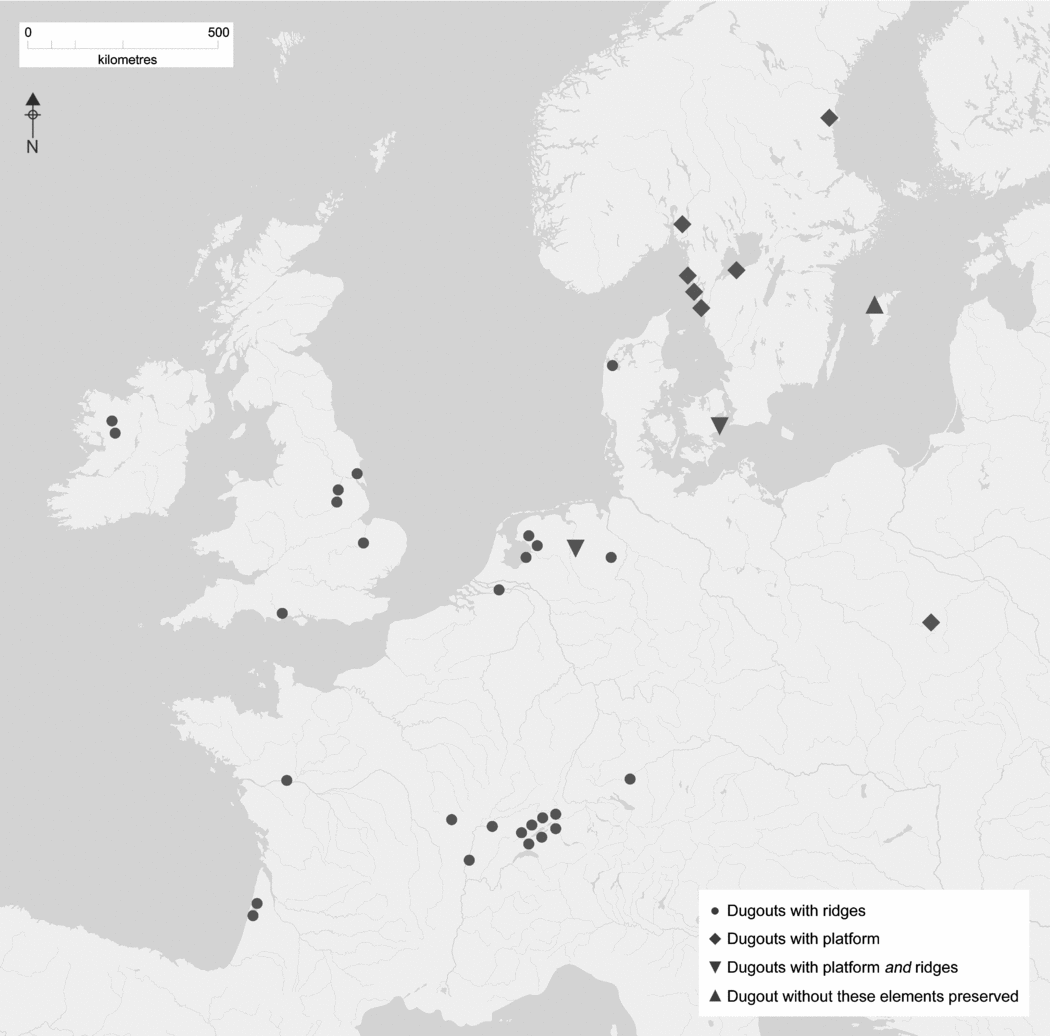
From the mainland of Western Europe, from Britain and Ireland, and from Scandinavia, about 110 logboats have been dated to the period from the Middle Neolithic to 1 BC by radiocarbon dating or dendrochronology (Table 1) (McGrail Reference McGrail1978; Hirte Reference Hirte1987; Arnold Reference Arnold1995, Reference Arnold1996; Mowat Reference Mowat1996; Ossowski Reference Ossowski1999; Fry Reference Fry2000). Lanting (Reference Lanting2000) provides the most recent European overview, supplemented by Maarleveld and Oosting (Reference Maarleveld, Oosting, Oosting and Van den Akker2008) who focus on the Netherlands. The majority of these finds are from Switzerland, France and Britain and Ireland; they occur in more limited numbers in the Netherlands, Germany, Poland and Scandinavia. The following overview focuses on logboats characterised by transverse internal ridges. The geographical distribution of the boats is seen in Figure 2 and their most important characteristics are shown in Table 2. The full dataset with references will be accessible in Kastholm (in press). The oldest of these boats dates to the end of the fourth millennium BC, thereby setting the starting point for this study (3300 cal BC). The 14C dates in this text are recalibrated at 2σ using OxCal 4.1 (Bronk Ramsey Reference Bronk Ramsey2009, with background data from Reimer et al. Reference Reimer, Bard, Bayliss, Beck, Blackwell, Bronk Ramsey, Buck, Cheng, Edwards, Friedrich, Grootes, Guilderson, Haflidason, Hajdas, Hatté, Heaton, Hoffmann, Hogg, Hughen, Kaiser, Kromer, Manning, Niu, Reimer, Richards, Scott, Southon, Staff, Turney and van der Plicht2013); the calibrated dates are rounded to the nearest 5.
A schematic view of the chronological distribution of logboats in North Alpine Europe; only countries and regions with finds dated BC are displayed; the numbers are approximate and based on Lanting Reference Lanting2000, Ossowski Reference Ossowski and Litwin2000, Maarleveld & Oosting Reference Maarleveld, Oosting, Oosting and Van den Akker2008 and Kastholm Reference Kastholm2014.

A schematic view of the logboats with transverse ridges; the boats are chronologically listed after uncalibrated dates; a publication of the full dataset and references for the boat finds can be found in Kastholm in press: Catalogue A.

Distribution map of logboats with transverse ridges (numbers correspond to Table 2).

Western Europe and Britain and Ireland
Around 42 logboats are known from the Netherlands; of these, 17 are dated using absolute dating methods, and 8 boats belong to the period 3300–1 BC (cf. Maarleveld & Oosting Reference Maarleveld, Oosting, Oosting and Van den Akker2008). Four boats share the uniform characteristics described above. The oldest of these, the Middle Neolithic Hazendonk fragment (Louwe Kooijmans Reference Louwe Kooijmans, Oosting and Van den Akker2008), dates to 3330–2900 BC and is thus considerably older than the homogeneous tradition in question. It has a single transverse ridge, but does not reveal any other significant information about the vessel. The other three finds are from the period 800–200 BC. A boat from Kadoelerveld has a single transverse ridge in the centre (Maarleveld & Oosting Reference Maarleveld, Oosting, Oosting and Van den Akker2008; Maarleveld Reference Maarleveld2009). Furthermore, two logboats were found at Nijeveen and Kolderveen. Both of these are constructed with two transverse ridges placed near either end (Maarleveld Reference Maarleveld, Oosting and Van den Akker2008: 12–17; Maarleveld & Oosting Reference Maarleveld, Oosting, Oosting and Van den Akker2008). The Dutch logboats seem to form a regional variant, even though they share characteristics with more uniform logboats from Switzerland and Britain and Ireland.
Around 700–750 logboats are known from Germany, of which around 90 are dated using absolute dating methods (Lanting Reference Lanting2000: 633). Fourteen of these boats are from the period 3300–1 BC (Lanting Reference Lanting2000: tab. 7). Three boats are of relevance here: the oldest is the Hüde boat (2880–2305 BC), characterised by a single transverse ridge (Ellmers Reference Ellmers1973: fig. 8a, 60–61); the second is the logboat from the river Ems at Lathen in Niedersachsen. This boat has a platform in the stern and two transverse ridges in the bottom; it is dated to c. 800–400 BC (Hirte Reference Hirte1987: catalogue IV, no. 160). The final boat is one of a number of logboats from the Federsee that share the relevant characteristics; only one of these boats is scientifically dated (Federsee 1, Paret Reference Paret1930: 77–78; Lanting Reference Lanting2000: tab. 7).
Over 700 logboats are known from Britain and Ireland, approximately 350 from Ireland and an estimated 350–400 from England, Wales and Scotland (cf. McGrail Reference McGrail1978; Mowat Reference Mowat1996; Fry Reference Fry2000; Lanting Reference Lanting2000: 627–31 with references). A total of 135 boats are dated using absolute dating methods, and 31 of these date to the period 3300–1 BC (cf. Lanting Reference Lanting2000: tabs 1 & 2). The recently discovered spectacular Bronze Age logboats from Must Farm, Cambridgeshire, are not considered here, as they have not yet been dated absolutely (cf. Murrell Reference Murrell2012). At least seven logboats display both of the uniform elements (Figure 3). The oldest of these is the Irish Lurgan boat dating to 2565–2345 BC (Robinson et al. Reference Robinson, Shimwell and Cribbin1999). The British finds occur mostly in the rivers of eastern England, not least the Humber and its tributaries. They are generally uniform long vessels with evenly spaced, often multiple, transverse ridges. In all cases, the stern is formed with a loose transom board (the flat surface that forms the stern of the vessel). The sides and bottom are shaped so the cross section becomes rectangular.
A selection of logboats with transverse ridges from Britain; from the top: Brigg 1, Peterborough, Clifton 1, Clifton 2 and Poole; not the same scale (after McGrail Reference McGrail1978).

From Switzerland around 133 logboats are known (Arnold Reference Arnold1995, Reference Arnold1996). Of these, 24 are dated using absolute dating methods, among which 19 vessels are from the period 3300–1 BC (cf. Lanting Reference Lanting2000: 638–39, tab. 11). At least seven of these boats display the above-mentioned uniform elements (Figure 4). The oldest is the Cerlier-Heidenweg boat dating to 1880–1495 BC (Arnold Reference Arnold1995: 75). The Swiss boats are all found within a relatively small area near the shores of Lake Neuchatel and Lake Biel. The two lakes are situated c. 430m above sea level in the valley between the Jura Mountains and the Alps. The transverse ridges in the seven Swiss boats are typically evenly distributed throughout the vessel, although a more unique pattern is seen in the Cerlier-Heidenweg boat. The ridges are a few centimetres high and hewn only out of the bottom; they do not continue up the sides. The Swiss boats, including the ones without ridges, are usually long vessels with hewn outer surfaces, giving them a rectangular cross section. They are largely made from oak and have a pointed stem and a loose transom in the stern, giving in general a rather uniform impression.
A selection of logboats with transverse ridges from Switzerland; from the top: Cerlier-Heidenweg, Bevaix 3, Douanne-Gare and Douanne-Ile Saint Pierre; not the same scale (after Arnold Reference Arnold1995).

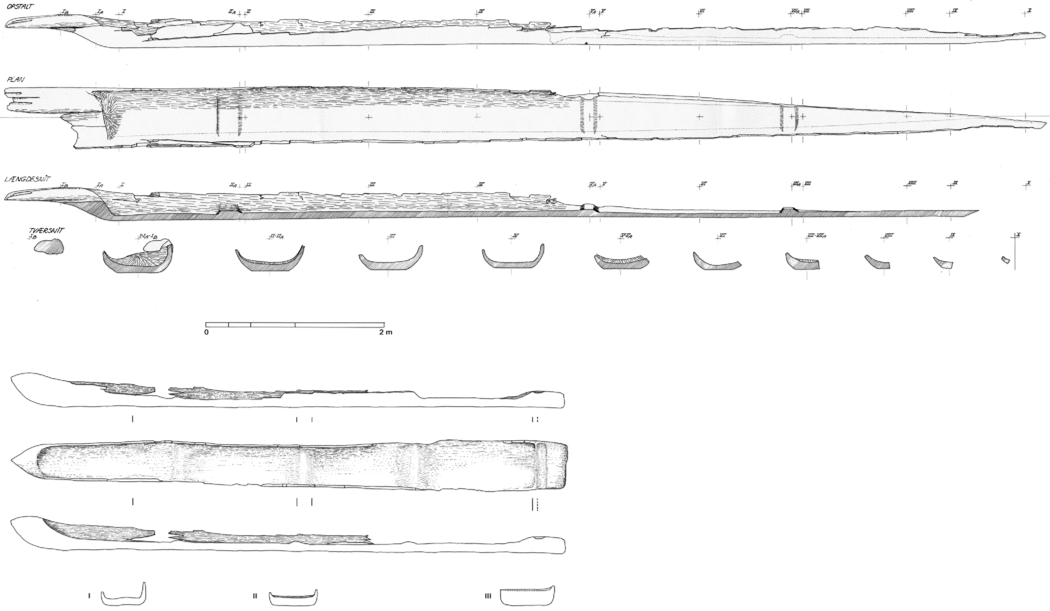
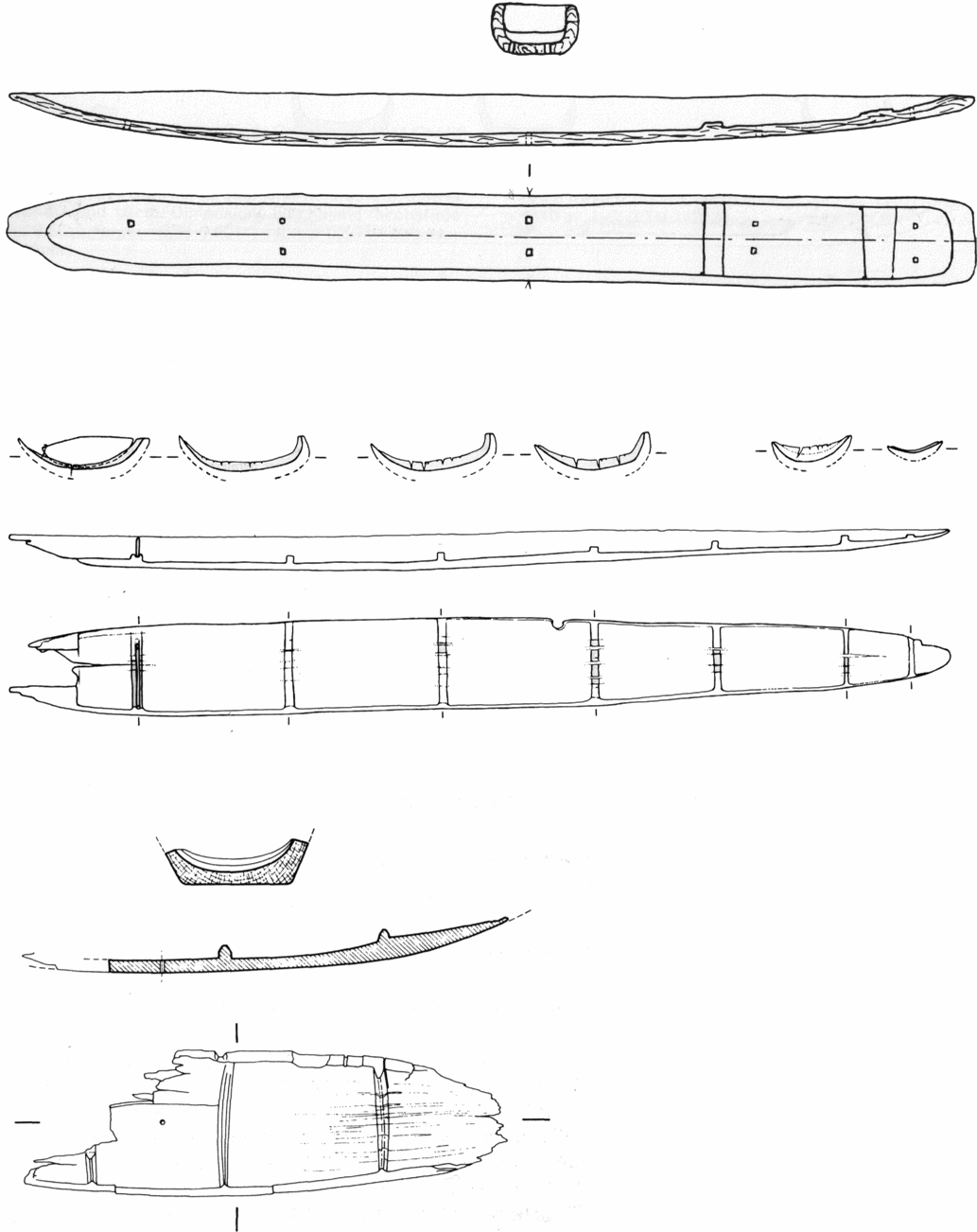
Around 250 logboats are known from Denmark, of which 42 are dated using absolute dating methods (Christensen Reference Christensen and Robinson1990; Lanting Reference Lanting2000: 632). Four logboats are from the period 3300–1 BC (cf. Lanting Reference Lanting2000: tab. 6) and two of these are relevant to this study: the Varpelev Boat from the easternmost part of the island of Zealand and the Vestersø Boat from north-western Jutland, respectively dated to 1260–790 BC and 775–375 BC (Hansen & Nielsen Reference Hansen and Nielsen1979: 99; Kastholm Reference Kastholm2012, Reference Kastholm2013, in press). Both these vessels are characterised by hewn-out ridges and hewn outer surfaces (Figure 5). It is constructed with a characteristic platform in the stern. Geographically, the Varpelev boat was located at a place, probably to be understood as a transit point (cf. Westerdahl Reference Westerdahl1992), in the Tryggevælde river valley, around 8km from open sea. The Vestersø boat was found, surrounded by stepping stones, near the shore of a shallow lake that, in the Bronze Age and Early Iron Age, was connected directly to the great fjord system ‘Limfjorden’, which cuts through the peninsula of Jutland. The Vestersø boat is constructed with a loose transom in the stern.
The two Danish logboats; the Varpelev Boat (on top) and the Vestersø Boat (drawings by Morten Gøthche and the author respectively).

The exact number of logboats from France is somewhat uncertain. Lanting estimates, however, that the number is probably around 200 (Lanting Reference Lanting2000: 636, with references). Of these, 67 are dated using absolute dating methods, 22 date from the period 3300–1 BC (cf. Lanting Reference Lanting2000: tab. 10). At least six of these have both uniform elements (Figure 6). The oldest find is the Chalain-Marigny boat from 940–910 BC (Arnold Reference Arnold1995: 77). Geographically, the French finds are spread out, although a minor concentration is seen west of the Jura Mountains and not very far from the Swiss finds, while others are situated nearer to the Atlantic, at Sanguinet in the Bay of Biscay and on the River Loire. The six vessels with transverse ridges are not as uniform as the Swiss ones, sometimes having only single ridges or ridges with an uneven distribution. Among the French boats, the pointed-oval hull shape combined with transverse ridges is seen in three cases: Chalon/Saint-Marcel, Saint-Germain-du-Plain and Oudon l’Ile Neuve (Arnold Reference Arnold1995: 76, 106–107, 113). The general impression of the French boats is that they are more diverse than the Swiss ones, but nevertheless they are often characterised by transverse ridges, a rectangular cross section and a considerable length.
A selection of logboats from France with transverse ridges; from the top: Sanguinet-Put Blanc 5, Saint-Germaindu-Plain and Oudon L'Ile Neuve; not the same scale (after Arnold Reference Arnold1995).

The Scandinavian Peninsula and Poland
Logboats dated to the study period in question are also known from Poland and the Scandinavian Peninsula. These boats seem to form a regional variation, with both differences and affinities when compared to their Western European counterparts. Among the four Polish logboats that are dated to this period, none have transverse ridges. One example, the Pinczow boat from the River Nida dated to c. 1220 BC, does have the characteristic rectangular cross section as well as an aft platform (Ossowski Reference Ossowski and Litwin2000: 60–61); this boat shares some characteristics with logboats from the Scandinavian Peninsula.
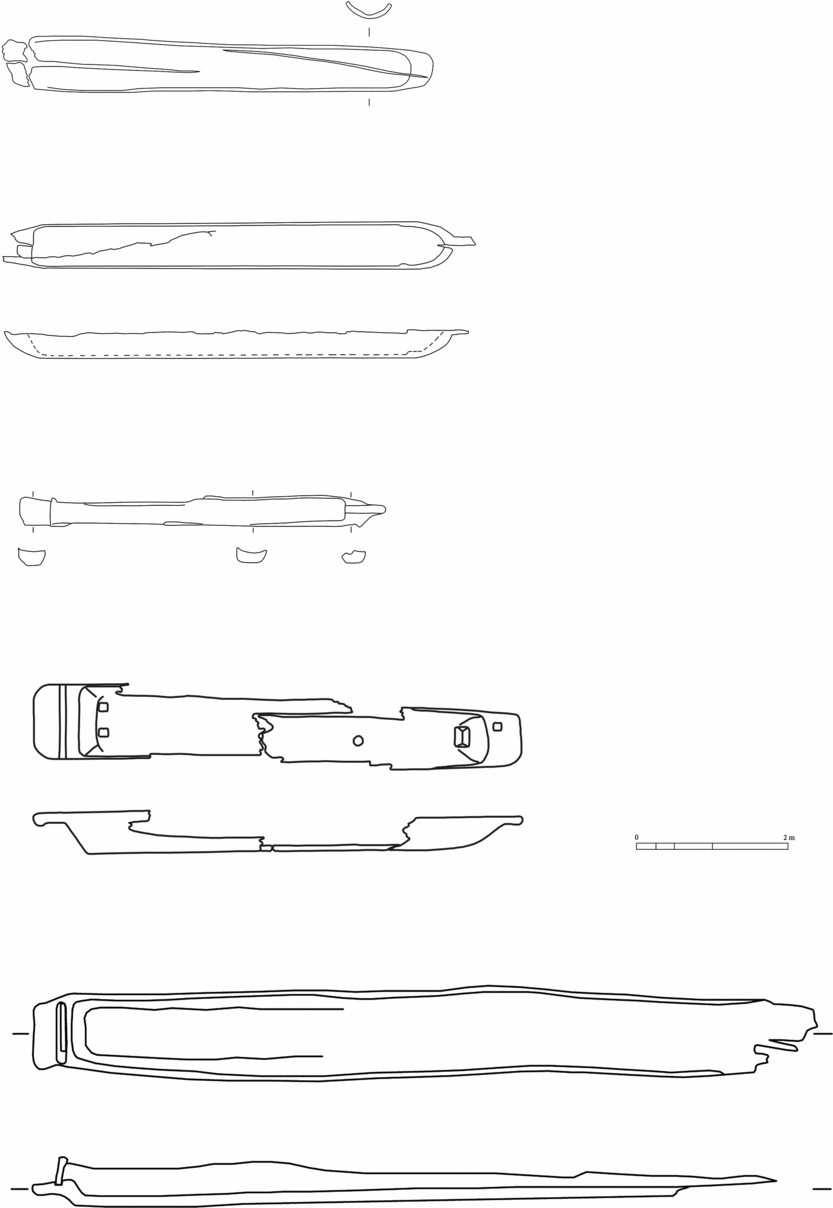
A total of seven logboats are known from the Scandinavian Peninsula, including the island of Gotland in the Baltic Sea dating before 1 BC (Figure 7). Logboats older than the Bronze Age have not yet been found in this region. For a detailed review of these finds see Kastholm (Reference Kastholm2014). The oldest example from Strö in Västergötland is dated to 1130–930 BC (Berglund Reference Berglund1998) and is therefore contemporary with the Danish Varpelev Boat. Other boats are more recent, including those from Skäggered in the Göteborg area (810–400 BC), Fiskeby in Gästrikland (770–400 BC) and Marteby Myr at Gotland (730–390 BC) (Olsson & Sjöberg Reference Olsson and Sjöberg1971; Ulfhielm Reference Ulfhielm2007; Wehlin Reference Wehlin2013: 136–37). The remaining finds are clustered in the Early Iron Age: Kvillehed and Låssby in the Göteborg area dated to 400–60 BC and 520 BC–AD 10 respectively (Olsson & Sjöberg Reference Olsson and Sjöberg1971; Sjöberg Reference Sjöberg1987). The oldest known logboat in Norway is from Sørum on the River Glomma and dates to 360 BC–AD 5 (Arisholm & Nymoen Reference Arisholm and Nymoen2005). Swedish and Norwegian boats are often found in fossil marine contexts such as fjords, bays and sounds. A feature that characterises the majority of the boats from the Scandinavian Peninsula is the aft platform, which, on two occasions, is also present at the stem. This feature is similarly seen on the Varpelev Boat, and seems to be a Scandinavian specialty with just a few exceptions as shown in Figure 8. A loose transom board in the aft, which is the common construction in Western Europe, is only seen in the Kvillehed Boat. The Scandinavian boats are mostly hewn on the outer surfaces, giving them a rectangular cross section; only the earliest find, the Strö Boat, keeps its log-shaped cross section. Among these boats no transverse ridges are seen, but some of them show other hewn-out features such as blocks in the inner bottom and steps in the aft.
A selection of logboats from the Scandinavian Peninsula; from the top: Strö (modified by the author after Berglund Reference Berglund1998), Fiskeby (modified by the author after drawing by B. Ulfhielm), Martebo Myr (modified by the author after Wehlin Reference Wehlin2013), Låssby (modified by the author after Olsson & Sjöberg Reference Olsson and Sjöberg1971) and Kvillehed (modified by author after Sjöberg Reference Sjöberg1987).

The distribution of the logboats mentioned with their respective characteristics.

The logboats from the Scandinavian Peninsula, as well as the sole Polish find, differ from the West European boats in having no transverse ridges. They still seem, however, more generally to relate to the West European tradition with their hewn outer surfaces. It might be that these boats should be regarded as a regional Baltic variation within the larger tradition (cf. Kastholm Reference Kastholm2014: 164 with references). A characteristic feature in this regional variation is the aft platform.
A characterisation of West European logboats from the second and first millennia BC
As shown in this brief overview, a minimum of 29 logboats from Western Europe share uniform elements (Figure 8). This represents about 32 per cent of the total finds from the region, scientifically dated to the study period. Although some regional variation is seen in France and the Netherlands, these vessels form a relatively well-defined group, with the transverse ridges and the hewn outer surfaces as characteristic features. It must be noted that even though the finds from Hazendonk and Hüde with their single transverse ridges appear as early as around 3000 BC, these seem to be the exceptions. The Lurgan boat from the middle of the third millennium BC does have many ridges, a hewn bottom and is very long; it therefore ought to be considered as part of this uniform tradition. An explicit uniformity first seems to emerge around 2000 BC, marked by the Federsee 1 find as well as the cluster of boats around the Swiss lakes.
A significant number of boats are characterised by their great length, up to 15m. The logboats sharing these characteristics seem not to be determined by specific maritime topographies, occurring on lakes and rivers, as well as near the sea—and they do not differ markedly between, for instance, Switzerland and Britain and Ireland.
Additional to this body of uniform logboats are a number of finds from the Scandinavian Peninsula and Poland, which should be considered as related. These boats lack transverse ridges and are characterised by massive sterns with platforms instead of the loose transoms common in Continental and Insular Europe. Most of them, however, have hewn outer surfaces and other hewn-out features.
Implications
The logboats of the second and first millennia BC thus reveal a homogeneous tradition covering Western Europe and southern Scandinavia. Variations are present on the Scandinavian Peninsula and in Poland. This consistent design reflects, unsurprisingly, the well-known interregional cultural community of Bronze Age Europe. The existence of such a homogeneous tradition underlines the importance of the boat and its role in networks of Bronze Age exchange e.g. amber and raw metals for bronze manufacturing (e.g. Ling et al. Reference Ling, Hjärthner-Holdar, Grandin, Billström and Persson2013; Rowlands & Ling Reference Rowlands, Ling, Bergerbrant and Sabatini2013). These networks probably developed in the Late Neolithic and provided the need for professional seafaring as well as seagoing vessels (Østmo Reference Østmo, Prescott and Glørstad2011; Van de Noort Reference Van de Noort, Fokkens and Nicolis2012). That the Bronze Age waterways were of great importance seems to be underlined by the many bronze objects found in central European rivers. Traditionally, these were perceived as objects lost by accident, but today they are viewed as votive offerings (Hansen Reference Hansen2000: 32, 54–58). The same is true of bronze finds on the seabed, such as the famous “shipload” from Langdon Bay in the Channel (cf. e.g. Van de Noort Reference Van de Noort2011: 60–61). Samson (Reference Samson2006) has challenged the traditional idea that such finds reflect accidentally lost objects and shipwreck sites, and has suggested that they are votive offerings, which actively involve the sea as a cultural landscape, and thus reflect the maritime practice of the Bronze Age. A more maritime approach to Bronze Age research has evolved in recent years in Scandinavia (see e.g. Ling Reference Ling2008; Wehlin Reference Wehlin2013).
Ridges and the hewn outer surface
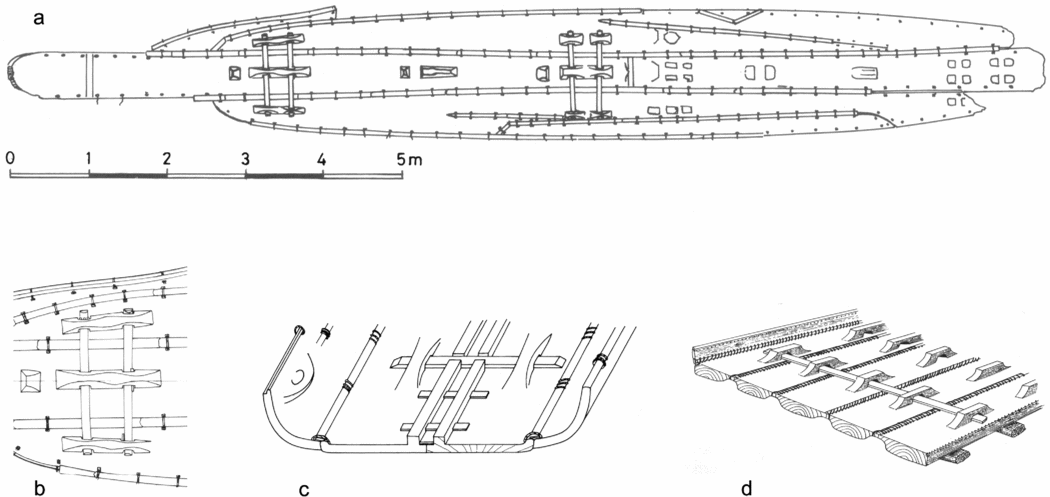
What are the meanings of these features that characterise logboats of the Bronze Age and Early Iron Age: the transverse ridges and the box-like cross section? The ridges vary in shape as well as in their distribution in the boats. Frequently, though, they are evenly distributed along the length of the boat. They are hewn out of the bottom and do not generally continue up the sides, if they do it is just for a few centimetres. Thus, they should not be confused with the essentially different frame-like structures and bulkheads that are seen in numerous logboats from later periods; such ridges hardly had any structural purpose with regard to the stiffening of the hull (Paret Reference Paret1930: 114). The question then is whether the ridges had a secondary practical purpose or not. A variety of practical purposes have been proposed, such as foot supports for paddlers, a base for floor timbers or to keep cargo secure (e.g. McGrail Reference McGrail1987: 76; Reference McGrail2001: 174–75; Berntsson Reference Berntsson2005: 58–60). Considering the vast distribution area of these logboats, and the variation in maritime topography, it seems more plausible to seek an explanation other than pure functionality. An explanation might be that the transverse ridges are skeuomorphs originating from the contemporary plank-built boats, predominantly known from Britain and Ireland. Thus, the ridges reflect a widespread cultural influence. The precise model for such skeuomorphs is probably the transverse timbers of these composite vessels, as seen on the North Ferriby Boats and the boats from Dover and Brigg (Figure 9). The idea that the ridges are skeuomorphs has already been postulated (e.g. Robinson et al. Reference Robinson, Shimwell and Cribbin1999; McGrail Reference McGrail2001: 174–75; Berntsson Reference Berntsson2005: 58–60), but without the implications being fully developed.
Bottom constructions in plank-built vessels from the second and early first millennia BC: a) plan of Ferriby Boat 1; b) detail in bottom of Ferriby Boat 1 (after Wright Reference Wright1990); c) schematic cross section of the Dover Boat; d) detailed reconstruction of Brigg 2 (after McGrail Reference McGrail2001).

Another feature that occurs on the logboats from around 2000 BC and onwards is the shaped outer surface. The bottom and the sides are hewn more or less flat in contrast to the Mesolithic and Neolithic logboats that generally follow the round shape of the log in their cross section (cf. Christensen Reference Christensen, Coles, Coles and Jørgensen1999: 49). It is indeed possible that this new hull shape gives a functional advantage, but the fact that the introduction of this element coincides with the oldest plank-built vessels again appeals to a cause other than functionality. Echoing the case of the transverse ridges, a skeuomorph from the plankboats seems a plausible explanation. This is most clearly seen in the Dover plank-built boat (Figure 9c), which, besides having the box-like cross section, gives a clear impression of being a monoxylous logboat split in two and widened across the bottom and at the sides with extra planks (cf. Crumlin-Pedersen Reference Crumlin-Pedersen2010: 60).
The image of the plank-built boat
The cross-beam timbers as well as the box-like cross section are fundamental characteristics of the plank-built boat. Plank technology made it possible to construct wider, sturdier vessels than logboats and the physical limitation of the log could now be ignored. This technology, well known from Britain, was a revolution in maritime technology. It occurs in the archaeological record from the beginning of the second millennium BC and continues throughout the Bronze Age, and probably already had forerunners by the end of the third millennium BC. Consequently, some of the most conspicuous features of this new technology were imitated in the contemporary logboats.
A matter of concern is therefore why the distribution of the Bronze Age plank-built vessels is apparently restricted to Britain. An explanation might be the exceptional conditions in the tidal zones of river estuaries, where sediments deposited by the rivers, as well as tidal waters, generate unique conditions for organic preservation. This is best seen in the Humber estuary, also an important maritime transit point, where parts of no less than six plank-built vessels are known (cf. McGrail Reference McGrail2001: 184; Van de Noort Reference Van de Noort and Clark2004) as well as a number of logboats. It seems fair to presume that the plank-built vessel was not necessarily an exclusively ‘British’ type.
Scandinavian plankboats in the second and first millennia BC
Logboats of uniform design featuring plankboat skeuomorphs might be seen as an indicator of an interregional plank-building tradition in Western Europe, including Scandinavia. This tradition is probably identifiable with the plankboat technology seen in Britain, although this does not necessarily imply that such vessels should be identical to British vessels; regional variations were probably present, just as they were among the logboats.
The possibility of a technological connection between British and Scandinavian boats was raised nearly 60 years ago by Swedish ethnologist Albert Eskeröd (Reference Eskeröd and Furumark1956: 77–78). From the evidence of the Ferriby boats, Eskeröd thought that the hewn-out cleats for the transverse bottom timbers of Ferriby 1 were fundamentally similar to the cleats on the board planks, used for lashing them to the frames, seen in several Scandinavian Iron Age Vessels, e.g. the Hjortspring boat (fourth century BC), the Nydam boat (fourth century AD) and the ships in the burial mounds of Oseberg and Gokstad (ninth century AD) (Figure 10a–c) (see also Kastholm Reference Kastholm2008). For a long time the famous Hjortspring boat of southern Denmark constituted the oldest and sole evidence of a plank-built vessel in Scandinavia before the first millennium AD (Crumlin-Pedersen & Trakadas Reference Crumlin-Pedersen and Trakadas2003). This key vessel is today complemented by other finds that, while fragmentary, are nonetheless of considerable importance. These are the Hampnäs thwart (third century BC), obviously of Hjortspring ‘type’, from northern Sweden, and boat planks with hewn-out cleats found at Haugvik (second–first century BC) in northern Norway that can also be paralleled with the Hjortspring boat (Ramquist Reference Ramquist2009; Sylvester Reference Sylvester and Bockius2009). These finds show that a more or less homogeneous boat technology was present across Scandinavia in the Early Iron Age. Finds that deserve a special mention are the oak coffin fragments from a Bronze Age burial at Alva Myr on the isle of Gotland (Floderus Reference Floderus1931; Bergerbrant et al. Reference Bergerbrant, Fredengren, Molnar, Löfqvist and Sabatini2013: 200–202), which Joakim Wehlin convincingly interpreted as boat fragments (Wehlin Reference Wehlin2013: 137–39). Among these fragments two have hewn-out cleats and another is hewn in shape with a rounded cross section (Figure 10). Contextually dated to 1400–1200 BC, the Alva Myr fragments represent the oldest known trace of plankboats in Scandinavia.
Hewn-out cleats in Scandinavian boats; left: boat fragments from Alva Myr at Gotland (after Floderus Reference Floderus1931); right: detail of cross sections from: a) the Hjortspring boat (after Crumlin-Pedersen & Trakadas Reference Crumlin-Pedersen and Trakadas2003); b) the Nydam boat (after Wright Reference Wright1990); c) the Gokstad ship (after Nicolaysen Reference Nicolaysen1882).

These cleats constitute a feature hitherto only found in Britain and Scandinavia. The boats might not be identical, but certainly seem to share the same fundamental technology. The nearest neighbouring technology, in the Mediterranean, is quite different, with planks directly attached to the frames of boats (e.g. McGrail Reference McGrail2001: 137, 149–50).
Concluding remarks
The skeuomorphic nature of these characteristic features—the ridges and the rectangular cross section—that are displayed on a considerable number of Bronze Age logboats indicate that they were a part of a larger maritime network, distributing not only goods but also ideas. The network was thus shaping the boats themselves. The factor that linked these logboats together was most probably the plank-built boat, suitable for crossing the open sea, and these plankboats must have been built in roughly the same way as the vessels whose preserved remains have hitherto been known only from Britain.
Through these uniform logboats we catch a glimpse of an extensive distribution system covering at least the northern part of Atlantic Europe in the Bronze Age. It was characterised by plankboats making journeys overseas, probably from one transit point to another, whether situated on the coast, in fjords or in river estuaries. Farther inland, distribution following the rivers and lakes was undertaken by logboats with widely shared characteristics that were of great length and therefore had considerable cargo capacity.