Introduction
In Finland there are many colourful and symbolic pre-historic rock paintings. These were created from within an emerging hunting and fishing civilisation in the central and southern areas of the country and have historical links with a much later Sámi culture from Lapland. Artists from the ancient hunting culture are responsible for decorating horizontal and vertical stone terraces and boulders close to rivers and waterways. The stylistic art which has been produced using substances such as iron ore and red ochre have both ritual and economical dimensions.
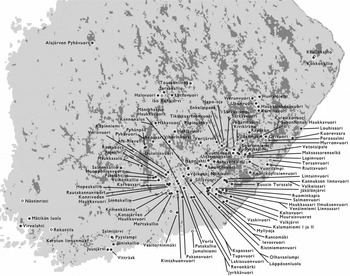
Recent ethnographical research in Finland reveals that there are ‘128 rock painting sites that are currently recorded [. . .] to the present day, 96 of which have figures that are identifiable’ (Luukkonen 2012: 1; Fig. 1). Data provided from within the field of archaeology in Finland informs us that the paintings have been dated ‘to ca. 5000–1500cal. BC’ (Lahelma Reference Lahelma2005: 29). According to Seitsonen (2005: 5) ‘Finnish rock-art has been interpreted using ethnographic (Kivikäs Reference Kivikäs1990: 21), functional (Simola) Reference Simola2001: 41) and shamanistic (Lahelma Reference Lahelma2001: 6–7) frames of reference’.
A map showing where the majority of the paintings are located around the Saimaa Lake region in eastern Finland. The sites also extend north towards the central part of the country. Luukkonen (Reference Luukkonen1994–2011).

Distinguishable symbols are portrayed mainly through abstract and schematic stick figures, and include, motifs of animals, humans, boats, handprints and spirits. There are solitary figures, as well in pairs, and sometimes groups of figures interacting with each other. The overall content of rock paintings helps emphasise the strong ties between human beings, animals magic and the natural world.
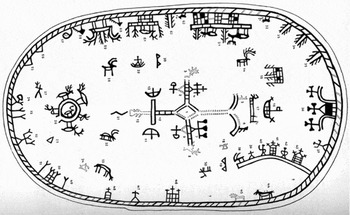
Many of the painted images found within rock paintings throughout Finland appear in a similar fashion on the heads of Sámi shaman divination drums from Sweden and Norway. The symbolic artwork in both cases is like a signature of the inheritance of past generations. Drums were comprehended as instruments through which when beaten with a reindeer bone hammer, various forms of communication could take place with beings in the spiritual worlds. According to Manker (Reference Manker1938) many of the instruments were passed from generation to generation along with the shamanistic skills. The drums came to the attention of Christian priests and missionary workers to whom were designated, during the 17th and 18th centuries, the task of converting the Sámi from their nature religion to that of the church, amidst accusations of witchcraft and sorcery throughout Lapland (see Joy Reference Joy2011). Drums in this sense have been used as an expression of culture and identity that dates back many millennia. A number of drums have been recorded by Manker as being over one hundred years old at the time they were confiscated by the church and collected by missionaries; providing evidence for the transmission of culture.
The Sámi shaman drum has three primary functions, the first relates to divination in matters related to fishing, hunting and problem solving. The second function is that of ecstatic entrancement in which the shaman with the assistance of helping spirits undertakes soul journeys into the world of the dead or realm of the gods-spirits for help and advice with community, family and individual affairs with life and death situations. The third function is concerned with fortune-telling and prophecy and healing.
The frame of the shaman's drum was typically made from pine or birch wood, which had reindeer skin stretched over it as a type of membrane that was then painted with symbolic metaphors representing a cognitive map of the shamans out of body encounters and experiences in the realms of the spiritual worlds. The three worlds consisted chiefly of three different dimensions, an upper or celestial heavenly realm where the ruling gods and goddesses resided; a middle world, of everyday affairs which was represented as a blueprint for the spiritual side of the physical everyday world; and a lower or nether world where the spirits of the dead live.
Previous research into rock paintings in Finland and Sámi shaman drum symbolism
There has been a tendency in early scientific research in Finland, since the majority of the rock paintings were discovered between 1960 and 2000, to link the artwork with Siberian culture and the roots of Finnish culture. According to Autio (Reference Autio1995: 13) ‘In principle, it is right to use Siberian material as a basis for interpretation but when making conclusions, we must first of all bear in mind the methodological guidelines which should be followed when dealing with local folk tradition’. Evidence of this trend by scholars is found through quotes taken from three scientific publications that have examined and assessed the content of rock paintings in Finland. For example Pekonen (Reference Pekonen1999: 5) who searches for comparatives to Finnish rock paintings in Egyptian mythology states: ‘Perhaps an ancient Egyptian [who] used [. . .] pictograms, would find it easier than ourselves to interpret the messages written by the Finns [. . .]’. In a similar way Kare (Reference Kare and Kare2000: 101) writes that: ‘The most powerful symbols of the Finnish nation are animals and landscape [. . .]. Rock art is governed by the same invariance's: the environment, the landscape situation and animals’. Also, Kivikäs who has written extensively on the topic of rock paintings in Finland states that ‘Tyypillinen Suomalainen kallionmaalaaus sijaltsee avian vedan äärellä’ [Typical Finnish rock paintings are located by the water's edge] (Kivikäs Reference Kivikäs1995: 16).
Reading between the lines, evidence suggests that the main reason for this way of thinking is not only because the rock paintings have been interpreted through Finnish eyes, but as the result of the way in which Sámi history has been recorded and interpreted by persons from outside Sámi culture. The first historical documentation was formulated by priests within what was known as ‘Lappology [which is] the name for the traditional study of Lapland and the Saami people’ (Pulkkinen Reference Pulkkinen, Seurujärvi-Kari and Kulonen2005: 189–191). More recently, however, research is directed towards gaining a wider understanding of Sámi culture and in particular pervious Sámi occupancy in the central and southern areas of Finland, which has helped to examine rock paintings and drum symbolism in a new light (see Lahelma Reference Lahelma2001, Reference Lahelma2005).
There are three invariable themes found within the symbolism of the rock paintings in Finland that are consistent with motifs painted on the Sámi shaman drums from Lapland: animals, human persons-shamans and spirits. Previous research which has discussed the links between the symbolisms from the hunting and nomadic cultures, has had a trend of associating horned and triangular headed figures in rock paintings with human persons or shaman's (see Kare Reference Kare and Kare2000; Siikala Reference Siikala1981). The grounds for this explanation arise from the practice in early research by Finnish scholars who compared rock paintings in Finland with those in Siberia. One basic problem with this orientation is the influence of the Siberian shaman's ritual dress which has consisted of, for example, reindeer horns and a robe made from animal fur and skin, which has been equated with particular designs in Finnish rock paintings, thus leading to a number of unreliable interpretations.
New findings in rock art research in Finland, reveal resemblances between groups of Sámi spirits
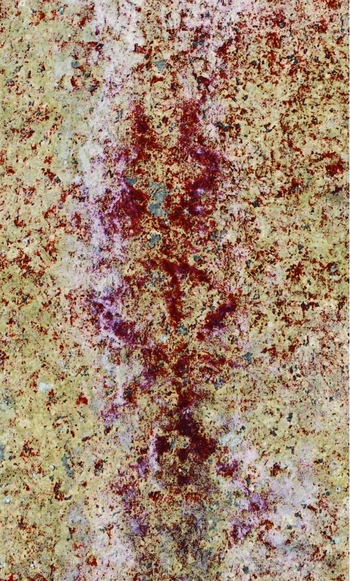
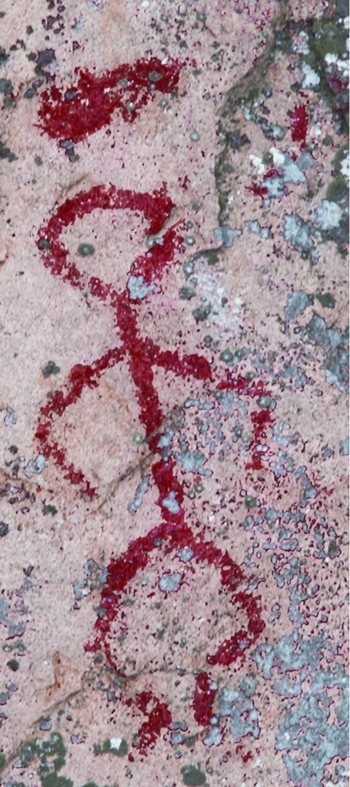
From a comparative study of rock paintings in Finland (for example Figs. 2, 3) by the author, it has been possible to identify and subsequently re-define a number of parallels between the horned and triangular headed figures found painted at the locations mentioned below. Comparisons are made between these two paintings through analysing the horned and triangular features on the heads, with those found on Sámi gods who are portrayed in their respective positions on the membranes of two shaman drums collected during the eighteenth century from ‘Lycksele and Åsle [which are two municipalities in] Swedish Lapland’ (Manker Reference Manker1938: 471, 620).
A horned figure with a triangular shaped head seen painted on the rock formation above the waterline at Keltavuori, Lappeenranta. Photo by Ismo Luukkonen.

A triangular headed figure painted on the rock formation above the water at Uittamonsalmi, Mikkeli. Luukkonen (Reference Luukkonen1994–2011). Photo by Ismo Luukkonen.

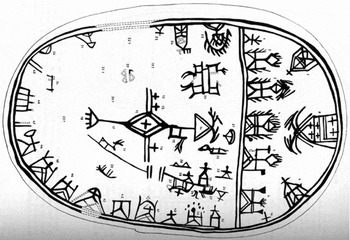
Figs. 4 and 5 are drawings of two 18th century Sámi shaman divination drums from the former Lappmark provinces in northern Sweden. The author has chosen these illustrations because the figures on the original photographs of each of the drums cannot be seen clearly. Fig. 4 originally from ‘Lycksele Lappmark, Sweden’ (Manker Reference Manker1938: 471) portrays in the top section of the drum, triangular and diamond headed shaped gods-spirit figures (images 1 to 6 which are numbered) whose legs are wide apart, and who have pointed features on the tops of their heads. The figures are known as the ‘Radien group’ (Manker Reference Manker1950: 234–235), who characterise the celestial heavenly realm of the Sámi cosmological picture, and are located on the border area between the earthly and heavenly realms. Image 5 is described as ‘Tiermes – Horagalles, [the thunder god] and Image 6 as Bieggolmai the wind’ (Manker Reference Manker1950: 235). Bieggolmai is holding what are similar to two shovels in his hands. ‘The gods high above include first Radien Atzhie who was the greatest and highest of all gods’ (Laestadius Reference Laestadius1838–1840: 73). Fig. 5 is a drum originally from ‘Åsle Lappmark, Sweden’ (Manker Reference Manker1938: 620). It also depicts gods who have triangular shaped heads. In the top northern section of the drum (figure 36 upside down) these are a group of three gods representing the ‘Radien group’ (Manker Reference Manker1950: 322). Below in the centre of the drum on the world pillar at the right side is a god figure which has a triangular shaped head that is holding what look like two shovels in his arms, the heads of which are also triangular shaped. The deity is called ‘Bieggolmai, the Windman’ (Manker Reference Manker1950: 320–322). At the centre of both drums there is a rhomb symbol which represents the Sun in Sámi cosmology. The rhomb symbol is characterised by 4 gateways, north, east, south and west. The northern and southern gateways on the vertical axis of the rhomb symbols have much significance in Sámi culture. This is because from these exit points, the Sámi shaman travels to meet with the celestial powers in the north, and the spirits of the departed in the south.
Sámi shaman drum from Lycksele Lappmark, northern Sweden (Manker Reference Manker1950).

Sámi shaman drum from Åsle Lappmark, northern Sweden (Manker Reference Manker1950).

From what has been written about the Radien group by Laestadius who was involved in the conversion of the Sámi from their native religion to Christianity, Laestadius says that from within the Radien group, one of the deities is called ‘Zhioaarve Radien [whose task it was] to send down the soul to the mother womb at the moment of conception. [. . .] Zhioaarve, according to Lindahl and Öhrling's [two clergymen] spelling, tjårwe, actually means horn, cornu; it is a metonym for might or the expression best of its kind’ (Laestadius Reference Laestadius1838–1840: 74). It is also helpful to take into account that notable variations would exist in the locations and numbers of gods on drums from different municipalities throughout Lapland, as is demonstrated above by the positioning of the deities on the two drum heads.
The importance of shedding light on the quote by Laestadius with regard to the presence of horns on Sámi spirits is essential, not only because the reference is one of the few found in literature about Sámi history, but it confirms that horned and triangular headed spirit figures have existed in Sámi society prior to the drums being collected. One can consider how the pictures presented above of the two figures from rock paintings in Finland have physical characteristics reminiscent of those presented above from the two drum heads from Sweden. The shapes of the heads on each of the rock painting figures possibly portray a more archaic and early portrait of spirit figures found within the early cosmology of the hunting and fishing civilization.
Concluding remarks
Scholarly discourse has in the past been reserved about drawing conclusions concerning the relationships between Finnish rock paintings and the figures on the heads of Sámi shaman drums from Sweden and Norway. However, as more and more of these parallels become evident, the many similarities which are now being clarified can no longer be ignored. As has been demonstrated above, apart from being able to place the notable and physical characteristics of the two rock painting figures in comparison with those of the Sámi Gods, this recognition helps to strengthen the evidence for Sámi involvement in the creation of rock paintings in Finland.