Motivation has been identified as a key factor in explaining learning and academic performance. Among the numerous models of motivation, self-determination theory has proved to be one of the most relevant (Deci & Ryan, Reference Deci and Ryan2000). A construct closely related to motivation is engagement (Skinner, Kinderman, & Furrer, Reference Skinner, Kinderman and Furrer2009). Both, motivation and engagement, determine to a large extent achievement across the academic life span (Martin, Reference Martin2009).
The authors of self-determination theory (SDT) distinguish different forms of motivation according to the degree of self-determination, self-regulation, and autonomy (Deci & Ryan, Reference Deci and Ryan2000; Moreno, González, & Chillón, Reference Moreno, González and Chillón2009; Reeve, Reference Reeve, Christenson, Reschly and Wylie2012; Ryan & Deci, Reference Ryan, Deci, Deci and Ryan2002, Reference Ryan, Deci, Wentzel and Wigfield2009). Amotivated students lack the drive to act thus their behavior is not-self-determined. Extrinsic motivation is defined as behavior driven by reasons external to the individual, and various types have been described: external regulation is defined as motivation driven by the need or desire to achieve an external goal, to avoid punishment, to obtain a reward or to fulfill the expectations of others; introjected regulation occurs when individuals have internalized the formerly external source of motivation but have not yet truly accepted the behavior (internal pressures); identified regulation is when one acknowledges and accepts the importance or utility of an act and performs it though it may be unpleasant; integrated regulation involves an individual assimilating a behavior within their set of goals and values. Intrinsic motivation refers to the personal desire to do activities that one feels are interesting, for their inherent satisfaction, and because they satisfy personal needs of autonomy, competence, and relation with others.
Academic performance has been positively related to intrinsic motivation and identified regulation, and was negatively related to amotivation and external regulation (Deci & Ryan, Reference Deci and Ryan2000; Ratelle, Guay, Vallerand, Larose, & Senécal, Reference Ratelle, Guay, Vallerand, Larose and Senécal2007; Reeve, Reference Reeve, Christenson, Reschly and Wylie2012; Ryan & Deci, Reference Ryan, Deci, Wentzel and Wigfield2009; Wormington, Corpus, & Anderson, Reference Wormington, Corpus and Anderson2012). However, the results for introjected regulation remain inconsistent i.e., the correlation between introjected regulation and academic performance was not significant in high school (Ratelle et al., Reference Ratelle, Guay, Vallerand, Larose and Senécal2007, Study 2) or at college (Ratelle et al., Reference Ratelle, Guay, Vallerand, Larose and Senécal2007, Study 3), but positive in high school (Wormington et al., Reference Wormington, Corpus and Anderson2012).
The analysis of student engagement has been approached from different perspectives. Traditionally, three components have been identified (Appleton, Christenson, & Furlong, Reference Appleton, Christenson and Furlong2008; Fredricks, Blumenfeld, & Paris, Reference Fredricks, Blumenfeld and Paris2004; Martin, Reference Martin2009; Skinner et al., Reference Skinner, Kinderman and Furrer2009): behavioral (e.g., effort), emotional (e.g., enthusiasm), and cognitive (e.g., learning strategies). According these authors, behavioral engagement is defined as interactions with the academic context that are active, constructive, and persistent. Some indicators of behavioral engagement in academic settings are effort, concentration, hard work, persistence, and task involvement. Usually, behavioral engagement was accompanied by emotions such as enthusiasm, interest, enjoyment, and satisfaction (Gutiérrez, Ruiz, & López, Reference Gutiérrez, Ruiz and López2010; Salanova, Schaufeli, Martínez, & Bresó, Reference Salanova, Schaufeli, Martínez and Bresó2010; Skinner et al., Reference Skinner, Kinderman and Furrer2009).
Conversely, at the opposite end of the scale to engagement we find burnout (Durán, Extremera, Rey, Fernández-Berrocal, & Montalbán, Reference Durán, Extremera, Rey, Fernández-Berrocal and Montalbán2006; Salanova et al., Reference Salanova, Schaufeli, Martínez and Bresó2010), disengagement (Green, Martin, & Marsh, Reference Green, Martin and Marsh2007; Martin, Anderson, Bobis, Way, & Vellar, Reference Martin, Anderson, Bobis, Way and Vellar2012; Stephan, Caudroit, Boiché, & Sarrazin, Reference Stephan, Caudroit, Boiché and Sarrazin2011) or disaffection (Skinner, Furrer, Marchand, & Kinderman, Reference Skinner, Furrer, Marchand and Kinderman2008; Skinner et al., Reference Skinner, Kinderman and Furrer2009). Behavioral disaffection has been typically operationalized in terms of lacking effort, distraction, passivity, lacking persistence, procrastination, and self-handicapping. This behavior was often associated to frustration, discouragement, resignation, and apathy.
Academic performance was positively associated to effort, persistence, and behavioral engagement (Fenollar, Román, & Cuestas, Reference Fenollar, Román and Cuestas2007; Martin & Liem, Reference Martin and Liem2010; Miñano, Castejón, & Gilar, Reference Miñano, Castejón and Gilar2012; Salanova et al., Reference Salanova, Schaufeli, Martínez and Bresó2010; Skinner et al., Reference Skinner, Furrer, Marchand and Kinderman2008, Reference Skinner, Kinderman and Furrer2009; Skinner, Chi, & the Learning-Gardens Educational Assessment Group, Reference Skinner and Chi2012). In contrast, burnout and behavioral disaffection were negatively correlated to academic achievement (Green et al., Reference Green, Martin and Marsh2007; Martin & Liem, Reference Martin and Liem2010; Salanova et al., Reference Salanova, Schaufeli, Martínez and Bresó2010; Skinner et al., Reference Skinner, Furrer, Marchand and Kinderman2008, Reference Skinner, Kinderman and Furrer2009; Stephan et al., Reference Stephan, Caudroit, Boiché and Sarrazin2011).
Relating self-determination and engagement
Intrinsic motivation and identified regulation positively correlated with effort, persistence, and behavioral engagement in elementary students (Assor, Vansteenkiste, & Kaplan, Reference Assor, Vansteenkiste and Kaplan2009; Skinner et al., Reference Skinner, Furrer, Marchand and Kinderman2008, Reference Skinner, Kinderman and Furrer2009, Reference Skinner and Chi2012), in secondary students (Gutiérrez et al., Reference Gutiérrez, Ruiz and López2010), and in undergraduates (Vansteenkiste, Simons, Lens, Sheldon, & Deci, Reference Vansteenkiste, Simons, Lens, Sheldon and Deci2004). The opposite was observed in external regulation.
As for introjected regulation, the findings were inconsistent i.e., introjected regulation was not significantly correlated with behavioral engagement in elementary education (Skinner et al., Reference Skinner, Kinderman and Furrer2009), and with academic persistence in college (Ratelle et al., Reference Ratelle, Guay, Vallerand, Larose and Senécal2007, Study 3). However, introjected regulation positively correlated with effort in elementary education (Ryan & Connell, Reference Ryan and Connell1989) as well as positively correlating with distraction in high school (Ratelle et al., Reference Ratelle, Guay, Vallerand, Larose and Senécal2007, Study 1). These inconsistent results may due to two factors: behavior that is considered to be indicative of behavioral engagement and disaffection, such as effort, persistence, and distraction; and the wide age range of students given that the relationship between indicators of engagement and introjected regulation can vary significantly at different stages of education i.e., primary, secondary, and university education.
Recent research has applied structural equation modeling to examine the role of indicators of engagement as mediators between motivation and performance at university (Fenollar et al., Reference Fenollar, Román and Cuestas2007; Salanova et al., Reference Salanova, Schaufeli, Martínez and Bresó2010) and compulsory secondary education (Miñano et al., Reference Miñano, Castejón and Gilar2012).
However, to our knowledge, no study has analyzed behavioral engagement and disaffection as mediators between different modalities of self-determination and academic performance, even though the relationships between these variables have been included in diverse theoretical proposals. Thus, Vallerand (Reference Vallerand and Zanna1997) outlines several consequences or outcomes of self-determination such as effort, persistence, and performance. Furthermore, Appleton et al. (Reference Appleton, Christenson and Furlong2008), Fredricks et al. (Reference Fredricks, Blumenfeld and Paris2004), Reeve (Reference Reeve, Christenson, Reschly and Wylie2012), and Skinner and Pitzer (Reference Skinner, Pitzer, Christenson, Reschly and Wylie2012) posit that diverse indicators of engagement (e.g., behavioral engagement and disaffection) act as mediators between facilitators of engagement (i.e., self-determined motivation) and learning outcomes (i.e., academic performance). The empirical findings previously summarized underpin this model.
Bearing in mind the theoretical assumptions and previous findings, the following hypotheses was formulated: (a) the greater the degree of self-regulation of a type of motivation, the greater will be the negative nexus with behavioral disaffection and the positive association with behavioral engagement and performance; (b) behavioral engagement and disaffection would significantly predict performance and mediate the relationships between self-determination and performance.
The rationale underlying this study took into account the low level of reading competence among Spanish students, though it plays a vital role in academic performance (Archambault, Eccles, & Vida, Reference Archambault, Eccles and Vida2010). According to the PISA 2009 Report (INEE, 2011), print reading competence significantly correlated with digital reading competence (r = .83), mathematics (r = .83), and sciences (r = .88). The mean score for reading competence for Spanish 15-year old students (mean = 481) was statistically similar to that of Italy or Greece and somewhat lower than those for Portugal, France, and the OECD average (OECD, 2010). Moreover, 20% of Spanish students were under level 2 in reading competence, a level considered to be the threshold required for lifelong learning at school, and for social and professional development (INEE, 2010). The development of reading competence, skills, and strategies is one of the main objectives of the subject of Spanish language outlined in the PISA Report.
Method
Participants
The sample consisted of 545 students (53.4% girls), aged 12 to 19 years (mean age = 15.15 years; SD = 1.8), studying compulsory (7th to 10th grade; n = 267) and post-compulsory secondary education (11th to 12th grade; n = 278) in different urban schools in the northwest of Spain. Students belonged to 22 classrooms with 17 Spanish language teachers.
Measures
Self-determination
The adapted Spanish version (Moreno et al., Reference Moreno, González and Chillón2009) of the Perceived Locus of Causality (PLOC) Scale (Goudas, Biddle, & Fox, Reference Goudas, Biddle and Fox1994) was administered. The stem for all items was “I take part in Spanish language class …” The questionnaire consisted of a total of 16 statements, four for each of the following forms of motivation: external regulation (e.g., “Because that’s what I am supposed to do”); introjected regulation (e.g., “Because I want the other students to think I’m skilful”); identified regulation (e.g., “Because it is important for me to do well in Spanish language”); and intrinsic motivation (e.g., “Because I enjoy learning new skills in Spanish language”). The students scored the degree to which they agreed (from 1 = totally disagree to 7 = totally agree) with each of the reasons.
Behavioral engagement vs. disaffection
To assess these constructs, the Engagement versus Disaffection with Learning: Teacher Report (Skinner et al., Reference Skinner, Furrer, Marchand and Kinderman2008) was administered. The Spanish language teachers assessed each student’s behavioral engagement and disaffection in the classroom. The Behavioral Engagement subscale consists of five items that evaluate the students’ attention, effort, and persistence (e.g., “In my class, this student works as hard as he/she can”). Analogously, the Behavioral Disaffection subscale consists of five items assessing distraction in class, absence of persistence, and lack of effort (e.g., “When we start something new in class, this student doesn’t pay attention”). In both subscales, teachers scored each student’s behavior on a scale ranging from 1 (not at all true for this student) to 5 (very true for this student).
Academic performance
Performance was assessed using the student´s final grade in Spanish language. Scores ranged from 1 (very deficient) to 10 (excellent). The pass mark was a score ≥ 5.
Procedure
Data were obtained over a nine-month period: students responded to the self-determination scale in October; teachers completed the engagement and disaffection scales in April and communicated the final grade in June. All students freely volunteered to participate in the study, and written authorization was obtained from the schools and parents. Students completed their questionnaires in their classrooms during school hours.
Outline of data analyses
Statistical analysis initially determined the reliability coefficients, the descriptive statistics, and the correlations using the SPSS.15 statistical package. Moreover, two indices for teacher-rated variables were calculated (engagement, disaffection, and performance): the design effect (DEFF) and the intraclass correlation coefficient (ICC).
Confirmatory factorial analysis (CFA) was then undertaken to confirm the fit of the measurement model using the AMOS.17 software (Arbuckle, Reference Arbuckle2008). Finally, a series of structural equation models (SEM) was performed to contrast the proposed mediational model. In both analyses (CFA and SEM) the model fit was evaluated by the following indices (Byrne, Reference Byrne2010): the χ2 statistic, the χ2 /df indicator, the adjusted goodness of fit index (AGFI), the comparative fit index (CFI), the root mean square error of approximation (RMSEA), and the standardized root mean square residual (SRMR).
Structural equation models were used to assess assumptions on the relationships between variables. These analyses offer several advantages over other correlational methods (Tomarken & Waller, Reference Tomarken and Waller2005) i.e., they allow for the analysis of statistically non-normal data; enable theoretical knowledge to be introduced into model specification; can test phenomena assessing multiple endogenous and exogenous variables; and they take into account the role of mediating variables.
According to Wu and Zumbo (Reference Wu and Zumbo2008), the most frequent procedure in mediation analysis consists of four stages. Step 1 is to determine if the independent variable predicts the dependent variable. Step 2 analyses if the independent variable is related to the mediator. Step 3 examines the effect of the mediator on the dependent variable to determine if it is predicted by both the independent variable and the mediator. Finally, step 4 compares stages 1 to 3; in particular, the direct effects of the exogenous variable on the endogenous variable are compared alone without the presence of mediators (step 1), and the direct effect when the model includes the mediators (step 3), which will reveal when there is a completely mediated relationship (the direct effect of the independent variable on the dependent variable disappears when mediators are included) or partially mediated (direct effect is not reduced to zero).
Results
Preliminary analysis
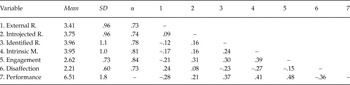
In terms of correlations two groups of variables can be distinguished: one includes identified regulation, intrinsic motivation, engagement, and performance; and the other, external regulation and disaffection (see Table 1).
Descriptive statistics, reliability coefficients, and correlations

Note: |rs| >.09 were statistically significant at p < .05; |rs| >.12 were statistically significant at p < .01.
The variables were positively correlated within each group, and negatively with the variables of the other group. Introjected regulation positively correlated with all variables. Crombach’s alpha values were all above the recommended minimum (α ≥ .73).
In this work students were grouped according to the class to which they belonged, and the teacher of the subject Spanish language. As engagement, disaffection, and performance are the core variables measured in the mediational model, the design effect (DEFF) and the intraclass correlation coefficient (ICC) were calculated to assess the extent to which these three variables reflect possible effects derived from “class” and “teacher”.
The design effect (DEFF) of an estimator is a measure of how much the sampling variability in a determined sample differs from the sampling variability in a simple random sample of the same size (see Kish, Reference Kish1995). In general, the value of a design effect is always positive and greater than 1, and has no fixed ceiling. Thus, when the DEFF for the mean of a variable is equal 1, the values of this variable are considered to be randomly distributed. In this study, the values of DEFF for the mean of engagement, disaffection, and performance ranged from 1.01 to 1.23 for data grouped by “class” and from 1.12 to 1.38 for data grouped by “teacher”.
Furthermore, an intraclass correlation coefficient (ICC) as proposed by Shrout and Fleiss (Reference Shrout and Fleiss1979) was calculated. This statistic estimates the proportion of variance in the data that is due to rated subjects (i.e., students) rather than due to groups (i.e., “class” or “teacher”) and residual. Their values may range from 0 to 1. A value of ICC = 1 indicates that all observed variance in a variable is explained by the differences between students. In the present work, the values of ICC for engagement, disaffection, and performance varied from .901 to .967 for data grouped by “class”, and from .896 to .957 for data grouped by “teacher”.
On the basis of the data obtained for both indices it would be reasonable to claim that engagement, disaffection, and performance can be considered as individual attributes given the minor involvement of the group variables (“teacher” and “class”) in generating total variability.
Measurement model
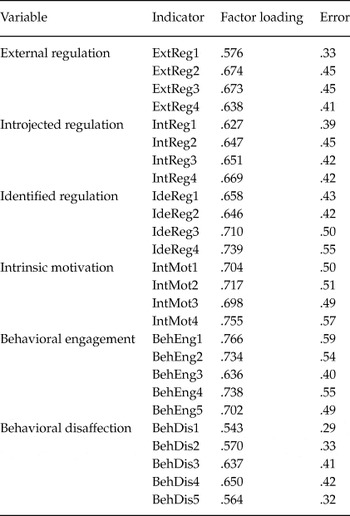
We estimated a measurement model to determine the extent to which the indicators represented the latent constructs properly. The latent variables were the different types of self-determination, behavioral engagement, and disaffection. The indicators were four items on each type of self-determination and five items on engagement and disaffection. The measurement model, with six latent variables represented by 26 indicators, provided an excellent fit to the data, χ2(284, N = 545) = 360.2, p < .001; χ2 /df = 1.27; AGFI = .94; CFI = .98; RMSEA = .022; SRMR = .038. The completely standardized factor loadings and errors associated with each item for each variable are presented in Table 2.
Standardized factor loadings and errors of the measurement model

Note: All factor loadings were statistically significant (p < .001).
As Shown in Table 2, the standardized factor loadings ranged from .543 (BehDis1) to .766 (BehEng1) (mean lambda = .65), and all were significant (p < .001). Correlations between latent constructs were similar to the Pearson correlations (see Table 1). All correlations between latent constructs were significant (p < .05) except for the relationship between introjected regulation and disaffection (.109; p < .065).
Structural mediational model
Thereafter, three structural equation analyses were performed to corroborate the initial hypotheses regarding the mediation between variables (Wu & Zumbo, Reference Wu and Zumbo2008). First (step 1), preliminary structural equation model analysis was undertaken in which modalities of self-determination were entered as predictors of academic performance. The analysis of these relationships revealed the model fitted the data fairly well, χ2(110, N = 545) = 176.5, p < .001; χ2 /df = 1.60; AGFI = .95; CFI = .97; RMSEA = .033; SRMR = .038. External regulation was negatively associated to performance (β = –.228, p < .01); and academic performance was positively predicted by introjected regulation (β = .144, p < .05), identified regulation (β = .246, p < .01), and intrinsic motivation (β = .281, p < .01).
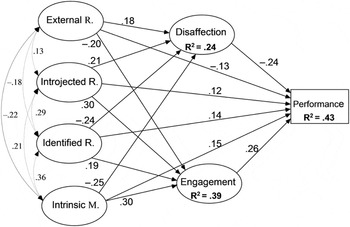
Second (step 2), the nexus between different types of self-determination as predictors, and behavioral engagement and disaffection as dependent variables were tested. The indices revealed the model once again fitted the data well, χ2(285, N = 545) = 360.23, p < .001; χ2/df = 1.26; AGFI = .94; CFI = .98; RMSEA = .022; SRMR = .037. Results showed that external regulation was positively related to disaffection (β = .18, p < .01) but negatively to engagement (β = –.20, p < .01); identified regulation and intrinsic motivation positively predicted engagement (β = .19, p < .01 and β = .30, p < .01, respectively), and negatively disaffection (β = –.24, p < .01 and β = –.25, p < .01); and introjected regulation positively predicted engagement (β = .30, p < .01), and disaffection (β = .21, p < .01).
The full mediational model (Step 3) showed a very good fit with the data, χ2(305, N = 545 = 408. 5 p < .001; χ2 /df = 1.33; AGFI = .94; CFI = .97; RMSEA = .025; SRMR = .038 (see Figure 1). Next, the entire mediational model was tested for educational level invariance (comparing compulsory vs. non-compulsory secondary education) by applying a chi-square difference test (Byrne, Reference Byrne2010); all structural paths were constrained to be equal between compulsory and non-compulsory secondary students. The results showed no significant educational level differences between models, indicating equivalence in the structural relations between educational levels. Figure 1 shows the direct effects for each modality of motivation on engagement, disaffection, and performance for the entire sample (both educational levels).
Structural model illustrating the relationships between variables. All standardized regression weights were significant (p < .05). For clarity of presentation, observed indicators were not drawn.

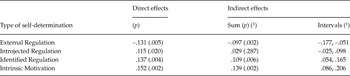
Finally (step 4), the data obtained from the direct effects in step 1 were compared to the direct effects in step 3. This revealed the degree to which the direct effect totals (step 1) were reduced by the inclusion of the mediators in the equation (step 3). Table 3 shows the effects of self-determination on performance.
Standardized effects of self-determination on academic performance

Note: (1) The probability associated to the sum of standardized indirect effects and their respective confidence intervals (CI) were estimated using the bias-corrected confidence interval bootstrap test of AMOS.17 (confidence level = 95%; samples = 500).
Direct effects from all modalities of self-determination to performance were significant (p < .05). Moreover, the AMOS bootstrap confidence intervals refer to the significance of the total indirect effects of the initial modality of motivation on final performance, mediated by both behavioral engagement and disaffection. As Table 3 highlights, bootstrap confidence intervals revealed that the sum of the indirect effects (mediated through engagement and disaffection) was significant for external regulation (–.097, p < .002), identified regulation (.109, p < .006), and intrinsic motivation (.139, p < .002); but the sum of indirect effects was not significant for introjected regulation (.029, p < .287). These results, in which the direct effects and many of the indirect effects were significant, suggest a partial mediation model. Jointly, the variables under evaluation explained 43% of the variance in academic performance.
Discussion
The present study aimed to assess the differential association between each modality of self-determination and behavioral engagement, disaffection, and academic performance, and to determine if the association between self-determination and performance was mediated by engagement and disaffection.
With reference to the first hypothesis, the results agree with the findings of previous research (Deci & Ryan, Reference Deci and Ryan2000; Ratelle et al., Reference Ratelle, Guay, Vallerand, Larose and Senécal2007; Reeve, Reference Reeve, Christenson, Reschly and Wylie2012; Ryan & Connell, Reference Ryan and Connell1989; Skinner et al., Reference Skinner, Kinderman and Furrer2009; Vansteenkiste et al., Reference Vansteenkiste, Simons, Lens, Sheldon and Deci2004). In terms of externally regulated reasons, adolescents participated in Spanish language mainly to avoid problems, because it was their obligation, and to get on well with the teacher. These reasons are associated to high levels of disaffection in class activities (pretending to work, making no effort, daydreaming in class) and less engagement (attention, participation, effort, persistence, and hard work). Not surprisingly external regulation has been associated to poor performance. The inverse relationship occurred with intrinsically motivated reasons such as the pleasure and satisfaction of learning and to discover new things; as expected, these reasons predicted good academic performance. Analogous relationships were found for identified reasons.
Introjected regulation shares some common characteristics with external regulation and intrinsic motivation. Similar to external regulation, introjected reasons positively predicted high levels of disaffection; however, similar to identified regulation and intrinsic motivation, introjected reasons also positively predicted engagement in academic tasks. This ambivalence may be explained if one considers the existence of two different types of introjected regulation i.e., approach and avoidance motivations (Assor et al., Reference Assor, Vansteenkiste and Kaplan2009): introjected approach motivation (where students try to attain and/or maintain high feelings of self-worth, pride or social approval) could explain the power of introjected regulation to predict engagement; and introjected avoidance motivation (where students try to avoid feelings of low self-worth, shame or guilt) could explain the positive nexus with disaffection.
The findings of the present study support the fundamental role assigned to behavioral engagement and disaffection and corroborated the proposed mediational model in which engagement and disaffection bridge students’ motivation to academic achievement (Appleton et al. (Reference Appleton, Christenson and Furlong2008), Fredricks et al. (Reference Fredricks, Blumenfeld and Paris2004), Reeve (Reference Reeve, Christenson, Reschly and Wylie2012), and Skinner and Pitzer (Reference Skinner, Pitzer, Christenson, Reschly and Wylie2012). The negative association between external regulation and performance can be partially explained as this regulation positively predicted disaffection and negatively engagement; and the presence of disaffection and the lack of engagement predicted poor academic performance. The inverse relationship was found for identified regulation and in particular for intrinsic motivation: both protected students from disaffection and fostered engagement; low levels of disaffection and high levels of engagement were positively associated to performance. Though the indirect effects on these three types of regulation were significant, the same was true for direct effects, indicating only partial mediation (Wu & Zumbo, Reference Wu and Zumbo2008). These findings coincide with the results of other studies that have found engagement mediated the relations between motivational constructs and performance (Fenollar et al., Reference Fenollar, Román and Cuestas2007; Miñano et al., Reference Miñano, Castejón and Gilar2012; Salanova et al., Reference Salanova, Schaufeli, Martínez and Bresó2010). Again, introjected regulation appears to lie halfway between external regulation and intrinsic motivation: the indirect effects on performance through disaffection were negative whereas other indirect effects through engagement were positive; accordingly, the total indirect effects were limited.
The present work makes several valuable contributions to the existing literature. The results corroborate the dichotomy “autonomous motivation vs. controlled motivation” proposed by Self Determination Theory (Ratelle et al., Reference Ratelle, Guay, Vallerand, Larose and Senécal2007; Vansteenkiste et al., Reference Vansteenkiste, Simons, Lens, Sheldon and Deci2004). The relationship between intrinsic motivation and engagement, disaffection, and performance were similar to the correlations between these variables and identified regulation: both modalities of motivation promoted academic achievement. In contrast, the forms of controlled motivation (in particular external regulation) were associated to poor academic performance.
To our knowledge, this is the first study to use a bipolar scale, as proposed by Skinner et al. (Reference Skinner, Furrer, Marchand and Kinderman2008), to assess separately behavioral engagement and disaffection in secondary students. In accordance with the recommendations of Skinner et al. (Reference Skinner, Kinderman and Furrer2009), the analysis of disaffection is of particular importance in contexts where adolescents cannot voluntarily exit, such as school during compulsory secondary education. Moreover, the PISA 2009 Report (OECD, 2010; INEE, 2010) has stressed the importance of developing, and assessing individual behavioral engagement in reading activities during this stage of education. The findings of the present study referring to Spanish language support the role assigned to behavioral engagement and disaffection by previously cited studies.
Furthermore, in this study the data was collected from multiple sources. A common practice is for students themselves to evaluate different types of self-regulation. However, behavioral engagement and disaffection were evaluated by teachers in order to obtain a more objective and comprehensive appraisal of the students´ behavior in class, as recommended by Benner (Reference Benner2013) and Hughes, Wu, and West (Reference Hughes, Wu and West2011).
Whilst previous studies have sought to evaluate these variables at specific times, this study has assessed these variables throughout the entire academic year employing a longitudinal design.
In contrast to most previous correlational studies, the relationship between variables was analyzed using SEM, which entails a series of advantages over other correlational methods (see Tomarken & Waller, Reference Tomarken and Waller2005), such as introducing theoretical knowledge into model specification, testing phenomena, assessing simultaneously multiple endogenous and exogenous variables, and to analyze mediation.
Moreover, the findings of the study are discussed in the light of clinical/educational intervention programs, and to generate explanatory hypotheses concerning the aetiology of academic disaffection and its impact on adolescents in order to minimize the activation and the adverse effects of this detrimental behavior.
Finally, though the hypothesized model of relationships satisfactorily explained the data, the limitations of this study raise a number of questions and issues that spur the need for further research. First, in terms of measures, the different modalities of introjected motivation (approach and avoidance) described by Assor et al. (Reference Assor, Vansteenkiste and Kaplan2009) were not evaluated, and further research is required to shed light on the seemingly inconsistent results related to this modality of self-determination. Moreover, other aspects of engagement and disaffection (e.g., cognitive and emotional) were not evaluated (Martin, Reference Martin2009; Skinner et al., Reference Skinner, Kinderman and Furrer2009); this information would be useful to contrast data obtained on the assessment of behavioral engagement and disaffection.
As previously mentioned, the students in this work were grouped by “class” and “teacher”. In spite of the inherent complexity of this type of analysis (see Preacher, Zhang, & Zypur, Reference Preacher, Zhang and Zyphur2011), an aim of further research could be to perform a multilevel SEM to test the extent to which assessed variables reflect possible “class” and “teacher” effects.
Furthermore, besides teachers, students will be given the opportunity to self-assess engagement and disaffection in order to avoid “teacher bias”.
In terms of design, our findings would be enriched by examining the reciprocal relationships between motivation, engagement, and performance throughout several academic years in line with Archambault et al. (Reference Archambault, Eccles and Vida2010).
This study has underscored the role of forms de autonomous motivation as predictors of behavioral engagement and performance, and as protectors against behavioral disaffection. These results and similar findings reported in other studies have led numerous authors (Ryan & Deci, Reference Ryan, Deci, Wentzel and Wigfield2009; Vansteenkiste et al., Reference Vansteenkiste, Simons, Lens, Sheldon and Deci2004) to propose several interventions (ranging from the school to the family) to promote student motivation and engagement in the classroom. Self-determination theory suggests teachers should enhance the process of internalization so students can advance through the continuum representing the different types of motivation (Ryan & Deci, Reference Ryan, Deci, Wentzel and Wigfield2009). Most of the recommendations have highlighted the importance of fostering teacher autonomy-supportive behavior (nurture inner motivational resources, rely on informational language, and acknowledge and accept students’ negative affect), and structure in the classroom (clear and explicit directions, guidance during the lesson, and constructive feedback) (Reeve, Reference Reeve, Christenson, Reschly and Wylie2012; Vansteenkiste et al., Reference Vansteenkiste, Simons, Lens, Sheldon and Deci2004).
Furthermore, this study has highlighted the role of engagement as predictor of performance which agrees with the observations of other studies (Reeve, Reference Reeve, Christenson, Reschly and Wylie2012). Hence, several researchers have stressed the need for classroom intervention to promote engagement and reduce disaffection during learning activities (Gutiérrez et al., Reference Gutiérrez, Ruiz and López2010; Jang, Reference Jang2008; Pianta, Hamre, & Allen, Reference Pianta, Hamre, Allen, Christenson, Reschly and Wylie2012; Reeve, Reference Reeve, Christenson, Reschly and Wylie2012). Some of the instructional strategies include providing a rationale (a verbal explanation as to why effort should be put) during those lessons that teachers expect students might be uninterested (Jang, Reference Jang2008); and giving students a developmentally calibrated sense of autonomy, control, competence, choice, and structure (Pianta et al., Reference Pianta, Hamre, Allen, Christenson, Reschly and Wylie2012; Reeve, Reference Reeve, Christenson, Reschly and Wylie2012).
Furthermore, as Bempechat and Shernoff (Reference Bempechat, Shernoff, Christenson, Reschly and Wylie2012) point out, parents are their children’s first and primary guides through their schooling experience, and research in education has consistently reported the fundamental role of the family in fostering motivation and involvement. Thus, Raftery, Grolnick, and Flamm (Reference Raftery, Grolnick, Flamm, Christenson, Reschly and Wylie2012) and Ryan and Deci (Reference Ryan, Deci, Wentzel and Wigfield2009) recommend parents enhance self-determination and engagement by encouraging their children’s autonomous problem-solving, taking their perspectives, and providing resources that facilitate children’s competence. Furthermore, parental involvement is a primary protective factor against student disaffection (Bempechat & Shernoff, Reference Bempechat, Shernoff, Christenson, Reschly and Wylie2012; Raftery et al., Reference Raftery, Grolnick, Flamm, Christenson, Reschly and Wylie2012).