1. INTRODUCTION
Compressed deuterium-tritium (DT) fuel is of interest in inertial confinement fusion schemes as thermonuclear (TN) ignition occurs at temperatures about 4 to 5 keV. There are two approaches to establish TN burn, viz., volume ignition and hot-spot ignition. In the former scheme, the entire fuel pellet is heated and ignition occurs over the whole mass. In the second scheme, a central hot-spot is heated to ignition conditions and a TN burn wave propagates to the outer fuel (Brueckner & Jorna, Reference Brueckner and Jorna1974; Kidder, Reference Kidder1976). This concept is more attractive as it leads to higher energy gains (Brueckner & Jorna, Reference Brueckner and Jorna1974; Fraley et al., Reference Fraley, Linnebur, Mason and Morse1974; Gus'kov et al., Reference Gus'kov, Krokhin and Rozanov1976; Kidder, Reference Kidder1976, Reference Kidder1979; Meyer-ter-vehn, Reference Meyer-ter vehn1982; Tahir & Long, Reference Tahir and Long1983) as only the hot-spot has to be ignited. However, it requires that energy released in the burn zone exceeds losses via heat conduction and radiation. Critical burn-up parameter or minimum areal density — defined as product of initial fuel density and minimum hot-spot radius — is generally used to characterize TN burn in various fuels.
The first estimates of TN burn parameters in DT target was obtained using self-similar solutions (Brueckner & Jorna, Reference Brueckner and Jorna1974; Gus'kov et al., Reference Gus'kov, Krokhin and Rozanov1976). More detailed calculations done later (Fraley et al., Reference Fraley, Linnebur, Mason and Morse1974; Kidder, Reference Kidder1976) to determine the hot-spot parameters, have established (Basko, Reference Basko1990) that ignition of pure DD fuel is much more difficult than DT fuel. Recently, Frolov et al. (Reference Frolov, Smith and Smith2002) calculated the critical burn-up parameter in isochoric DT, DD and deuterides of some light elements using a simple burn model (Avrorin et al., Reference Avrorin, Feoktistov and Shibarshov1980; Frolov, Reference Frolov1998; Frolov et al., Reference Frolov, Smith and Smith2002), which assumed same temperature (1-T) for ions, electrons and radiation.
Aim of the present paper is to extend Frolov's approach to include a three temperature (3-T) description (Atzeni, Reference Atzeni1986; Tahir et al., Reference Tahir, Long and Laing1986). In addition, accurate calculations of fusion reactivity, inclusion of Compton scattering and blackbody radiative losses are also accounted. While the 3-T scheme is less important in determining the critical burn-up parameter for DT, except for low temperatures, it plays a crucial role for DD fuel.
The paper is organized as follows. In Section 2, we recall the fusion reactions of DT and DD fuels. Section 3 describes 3-T burn model. A brief description of 1-T model is given in Section 4. Results of 3-T burn model are discussed in Section 5 and the paper is concluded in Section 6.
2. FUSION REACTIONS
Though there are a number of fusion reactions of interest, DD and DT reactions are the most important (Duderstadt & Moses, Reference Duderstadt and Moses1982). DD reaction takes places via two channels with equal probability:
 $$\eqalign{&_1{\rm D}^2+\,_1\!{\rm D}^2 \rightarrow _1\!\!T^3+\,_1\!p^1+\, 4.03 \; \hbox{MeV}\comma \; \cr \quad &_1{\rm D}^2+\,_1\!\!{\rm D}^2 \rightarrow _2\!\!{\rm He}^3+\;_0\!n^1+3.27 \; \hbox{MeV}.}$$
The tritium (1T 3) produced in p-channel or obtained by external sources, can react with D at a much faster rate in the following manner:
 $$_1\!{\rm D}^2+\,_1\!T^3 \rightarrow _2\!{\rm \!He}^4+\,_0\!n^1+17.6 \; \hbox{MeV}.$$
Due to the large cross-section at relatively lower temperature range, it is taken as the scheme of choice for all inertial confinement fusion (ICF) research. The rate of energy release (MJ/vol./s) for reactions of different species is
 $$q_0=n_1\; n_2\; \langle {\rm \sigma} v \rangle \; Q\comma \;$$
where Q is the energy released in a reaction. Here, 〈σv〉 is fusion reactivity defined as the probability of reaction per unit time per unit density of target nuclei (cm3/s). Among the three reactions, Q is largest (17.6 MeV) for DT.
3. THREE TEMPERATURE MODEL
For efficient burning, the net energy produced in the hot-spot should be positive, i.e., the energy produced within the hot-spot should exceed all possible energy losses. Energy loss inside the hot-spot is due to electron-ion collisons, Compton-scattering, bremsstrahlung radiation, and radiative loss. If net energy generation rate within the hot-spot is negative then the burn wave will die out. For DT fuel at solid density (0.23 g/cc), energy balance occurs around 4 keV. At higher densities requirement of ignition temperature comes down. For DD fuel, minimum ignition temperature is about 30–40 keV. Our aim is to determine the minimum hot-spot size for a specified initial temperature and density. We have evaluated the burn-up parameter for both DT and DD reactions in the temperature range 4–50 keV.
We consider the 3-T description of the plasma, i.e., with different ion, electron, and radiation temperatures. The initial spherical hot-spot has radius r 0 and volume V 0. Its other parameters are initial temperature T 0 and density ρ0. The total internal energy of ions in the hot-spot at time t is:
 $$E_i=\;{\rm \rho}_{ 0}V\, C_{Vi} T_i\comma \; $$
where C Vi is the ionic specific heat, T i is the ion temperature, and V is the volume at time t. Rate of change of E i can be expressed as
 $${dE_i\over dt}=V{\tilde q}_i \lpar r\comma \; T_i\comma \; T_e\rpar \comma \; $$
where  ${\tilde q}_i$ is the net energy production rate of ions in unit volume. It depends on hot-spot radius r at time t, ion temperature T i and electron temperature T e. The classical values of specific heats of ions and electrons are
 $$C_{Vi}={3\over 2} {k_B\over \bar m_i} \; \comma \; \; C_{Ve}={3\over 2} {\bar Z k_B \over \bar m_i}\comma \; $$
where k B is the Boltzmann's constant,  ${\bar m}_i$ is the average ion mass, and
 ${\bar Z}$ is the average atomic number. It is assumed that the plasma is fully ionized and electron degeneracy is unimpotant at temperatures of interest in ignition conditions. Expressions for
 ${\tilde q}_i$ will be discussed below. Using Eq. (2) and
 $V={4\over 3}{\rm \pi} r^3$, Eq. (3) reduces to
 $$C_{Vi}{dT_i\over dt}= -C_{Vi} {3\over r} {dr\over dt} T_i+{1\over {\rm \rho}_0} {\tilde q_i} \lpar r\comma \; T_i\comma \; T_e\rpar . $$
This equation specifies the evolution of ion temperature in the hot-spot. It is assumed that T i is spatially uniform in the hot-spot. In terms of the burn-up parameter x = ρ0r, Eq. (5) is expressed as
 $${dT_i\over dx}=-{3\over x}T_i+{q_i\lpar x\comma \; T_i\comma \; T_e\rpar \over C_{Vi}\; U_{max}}. $$
Here we have introduced the hot-spot expansion speed U max and  $q_i \lpar x\comma \; T_i\comma \; T_e\rpar \equiv {\tilde q}_i \lpar r\comma \; T_i\comma \; T_e\rpar /{\rm \rho}_0^2$. Expressions for U max are discussed below. Eq. (6) is a simple generalization of 1-T model (Avrorin et al., Reference Avrorin, Feoktistov and Shibarshov1980; Frolov et al., Reference Frolov, Smith and Smith2002) to include electron temperature, which could be different from ion temperature. In non-equilibrium burning conditions, the hot-spot has to be characterized using three temperatures, viz., T i, T e, and T r. The evolution equation for T e is given by
 $${dT_e\over dx}=-{3\over x}T_e+{q_e \lpar x\comma \; T_i\comma \; T_e\comma \; T_r\rpar \over C_{Ve} \, U_{max}}. $$
Here, q e (x,T i,T e,T r) denotes the net energy production rate for electrons and depends on temperatures of all three species. Assuming Stefan-Boltzmann law for specific radiation energy, E r = (1/ρ0)(4σB/c)T r4, where c is the speed of light and σB is the Stefan's constant, the evolution equation for T r is
 $${dT_r\over dx}=-{3\over 4x}T_r+{q_r \lpar x\comma \; T_e\comma \; T_r\rpar \over C_{Vr} \, U_{max}}. $$
The radiation specific heat is given by
 $$C_{Vr}={1\over {\rm \rho}_0} {16 {\rm \sigma}_B\over c} T_r^3. $$
Eqs. (6), (7), and (8) specify the variations of temperatures with respect to the parameter x, and hence the radius of the hot-spot r at time t. Initial values (initial conditions) of temperatures (T i0, T e0, T r0) at x 0 are used to integrate the ordinary differential equations (ODEs). For given values of ρ0 and T 0, the initial point x 0 can be determined such that T i, T e, and T r are positive for all x in the interval x 0 ≤ x ≤ x 1, where x 1 = ρ0r 1 corresponds to the outer radius of the pellet. The minimum value of x 0 needed is called the critical burn-up parameter x c. Thus for x 0 > x c, the entire fuel will burn while for x 0 < x c the burn will be extinguished leaving unburnt fuel. We have considered x 1 much larger than x 0 so that the results are independent of x 1. Solutions of the ODEs can also be obtained by choosing a specified value of x 0 but then treating the initial conditions T i0, T e0, and T r0 as variable parameters. The net energy production rates q i, q e, and q r are considered now.
3.1. Net Energy Release Rates
3.1.1. Ions
Net energy release rate for ions is given by
 $$q_i\lpar x\comma \; T_i\comma \; T_e\rpar =S_i-A_{ie} \lpar T_i-T_e\rpar \comma \; $$
where S i denotes the energy deposition rate to ions. For example, S i for DT reaction is
 $$S_{i-{\rm DT}}=n_{\rm D}\ n_T\ \langle {\rm \sigma} v \rangle_{\rm DT} \lpar f_{ion}+4g_n\rpar \ {Q_{{\rm \alpha}}\over {\rm \rho}_0^2}\comma \; $$
where n D and n T are the number of 1D2 and 1T 3 nuclei per cm3 and Q α = 3.5 MeV is the energy of the α-particle. 〈σv〉DT is the fusion reactivity discussed earlier. As the range of α-particle is much smaller than the hot-spot size, all its energy is assumed to be deposited within the hot-spot. However, a part (f ion) of its energy goes to ions and the remaining to electrons. An empirical fit to this fraction is f ion = (1 + 32/T e)−1, which shows that electrons and ions share energy equally at T e = 32 keV (Fraley et al., Reference Fraley, Linnebur, Mason and Morse1974). For very high density about ρ0 = 104 g/cc, equal sharing occurs at T e = 24 keV. Detailed calculations to determine leakage of α-particle energy from the hot-spot are also available (Atzeni, Reference Atzeni1995). g n is the fraction of neutron energy deposited in the hot-spot. Remaining fraction leaks out of the pellet. An empirical fit to g n is g n = x/(x + h n) with h n = 20 g/cm2 (Atzeni, Reference Atzeni1995). The factor 4 in Eq. (11) arises because 4Q α = 14 MeV is approximately the energy of neutron in DT reaction.
For DD reaction, S i is given by (Basko, Reference Basko1990; Frolov et al., Reference Frolov, Smith and Smith2002)
 $$S_{i-{\rm DD}}={n_{\rm D}^2\over 4}\ \langle {\rm \sigma} v \rangle_{\rm DD}\ {Q_{\rm DD}\over {\rm \rho}_0^2}.$$
Assuming that 1T 3 produced via the proton channel of DD reaction will certainly react with another 1D2 nuclei, Q DD can be computed as
 $$Q_{\rm DD}=\lsqb 2.45 g_{n2}+14.1 g_{n}+\lpar 3.02+1.01+3.5\rpar \ f_{ion}\rsqb +0.82.$$
Here g n2 = x/(x + 5.2) is the fraction of neutron energy deposited in the hot-spot from DD n channel. The factor 14.1 g n features total neutron energy from DT reaction. The remaining numbers (0.82, 3.02, 1.01, and 3.5) denote energy deposited by 2He3, proton, 1T 3 and α-particle, respectively. The heavier charged particle 2He3 delivers all its energy (0.82 MeV) to the ion component. This estimate of Q DD is adequate because the reactivity 〈σv〉DD is much smaller than 〈σv〉DT so that DT reaction can be assumed to follow a DD reaction. However, the possibility of D2 He3 reaction is neglected as its reaction rate is much smaller than that for DD fusion.
The second term in Eq. (10) accounts for energy loss from ions due to ion-electron collisions. A ie = C Ve × νeq where νeq is the collision frequency of ions with electrons. When T i = T e, net energy transfer by collisions is zero. The collision frequency is given by (Fraley et al., Reference Fraley, Linnebur, Mason and Morse1974; Spitzer, Reference Spitzer1962):
 $$\eqalign{{\rm \nu}_{eq}&={8 \sqrt{2{\rm \pi}}\over 3} \, \sqrt{m_e}\ e^4 N_A^2 \ {\bar Z^2\over \bar A^2}ln \lpar \Lambda_{ei}\rpar \ {{\rm \rho}_0\over \lpar k_BT_e\rpar ^{3/2}}\cr&\quad\times \left(1- {3\over 2} \ {T_i\over T_e}\ {m_e\over \bar m_i}\right)\comma \;}$$
where m e is the electron mass, e its charge, N A Avgadro's number and  $\bar Z$ and
 $\bar A$ are the average atomic number and mass number, respectively. The Coulomb logarithm
 $ln \lpar \Lambda_{ei}\rpar $ is obtained using (Spitzer, Reference Spitzer1962)
 $$\eqalign{ln \Lambda_{ei} & = max \left[1\comma \; \; {3 \over 2e^3} \, \left({\bar{A} k_B^3 \over \bar{Z} {\rm \pi} N_A {\rm \rho}_0} \right)^{1/2} \; T_e^{3/2} \right. \cr & \quad \times \left. \left[\bar{Z} + {1\over 2 {\rm \alpha}_F} \left({3k_B T_e \over m_ec^2} \right)^{1/2} \right]^{-1} \right]\comma \;}$$
where αF is the fine structure constant.
The number densities n D and n T in Eqs. (11) and (12) are determined using the rate equations (Martinez-Val et al., Reference Martinez-Val, Eliezer, Henis and Piera1998)
 $${dn_{\rm D}\over dt}= -n_D\ n_T \langle{\rm \sigma} v \rangle_{\rm DT} - {n_{\rm D}^2\over 2} \langle{\rm \sigma} v \rangle_{\rm DD}\comma \; $$
 $${dn_T\over dt}= -n_{\rm D}\ n_T \langle{\rm \sigma} v \rangle_{\rm DT} +{n_D^2\over 4} \langle{\rm \sigma} v \rangle_{\rm DD}\comma \; $$
and substituting ρ0U maxdt = dx. These rate equations take into account the removal of 1D2 and 1T 3 via DT and DD reactions as well as the production of 1T 3 in the proton channel of DD reaction.
As the present problem is concerned with propagating burn front, number densities in Eqs. (11) and (12) at the front are assumed to be n D0 and n T0.
3.1.2. Electrons
Apart from energy delivered to electrons directly by charged particles, electron-ion and electron-radiation exchanges also alter electron temperature. Therefore q e can be written as
 $$q_e \lpar x\comma \; T_i\comma \; T_e\comma \; T_r\rpar =S_e+A_{ie} \, \lpar T_i-T_e\rpar -\lpar A_{er}+A_c\rpar \, \lpar T_e-T_r\rpar .$$
Here S e, the direct contribution from charged particles, is given by
 $$S_{e-{\rm DT}}=n_{\rm D}\ n_T\ {Q_{{\rm \alpha}}\over {\rm \rho}_0^2}\ \langle{\rm \sigma} v \rangle_{\rm DT} \left(1-f_{ion} \right)\comma \; $$
 $$S_{e-{\rm DD}}= {n_{\rm D}^2 \over 4}\ {Q_C\over {\rm \rho}_0^2}\ \langle{\rm \sigma} v \rangle_{\rm DD} \left(1-f_{ion} \right)\comma \; $$
where Q C = (3.02 + 1.01 + 3.5) MeV. The factor A er, which determines energy exchange between electrons and radiation via bremsstrahlung, is (Duderstadt & Moses, Reference Duderstadt and Moses1982)
 $$A_{er}=2 \left[{2^5\over 3} {N_{ion}^2 {\bar Z}^3 e^6 {\rm \rho}_0\over h m_e c^3 } \right]\left({2 {\rm \pi} k_B\over m_e T_e} \right)^{1/2}\comma \; $$
where N ion is the total number of ions per cm3. Apart from bremsstralung radiation, electrons can transfer energy to radiation by inverse Compton-scattering. The factor A c in Eq. (18) is given by (Eliezer et al., Reference Eliezer, Henis, Martinez-Val and Vorobeichik2000):
 $$A_{c} = {128 \over 3} {{\rm \pi} \over m_e c^2} {\rm \sigma}_B N_e r_c^2 T_r^4\comma \; $$
where N e and r c stand for number of electrons per cm3 and classical radius of electron respectively. σB is the Stefan's constant. The unit of the factors A ie, A er, and A c is MJ/cm3 s keV.
3.1.3. Radiation
The net rate of energy gain by the radiation component is (Gsponer & Hurni, Reference Gsponer, Hurni and Eliezer1999)
 $$q_r\left(x\comma \; T_e\comma \; T_r \right)= \left(A_{er}+A_c\right)\left(T_e-T_r \right)- {{3 {\rm \sigma}_B T_r^4}\over{{\rm \rho}_0\ x}}.$$
The first two terms denote net photon energy gain via bremsstrahlung processes and Compton-scattering. The last term accounts for radiative loss from surface of the hot-spot, which may be modeled as a black-body (Gsponer & Hurni, Reference Gsponer, Hurni and Eliezer1999). Now we will discuss the speed of expansion of the hot-spot.
3.2. Expansion Speed U max
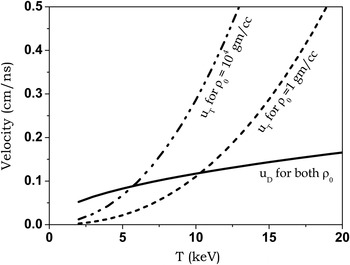
Specification of the burn model is completed by defining the expansion speed of the hot-spot. The time coordinate of the hot-spot front was converted to its radius or equivalently x, by introducing U max. Depending upon initial temperature, density and radius of hot-spot, the burn-front will propagate either as thermal wave or detonation wave. Thermonuclear burn wave can be compared to chemical detonation wave as the energy liberated in the reaction is used to sustain the propagating wave. However, electron thermal conduction and energy deposition by fusion products (e.g., α-particle) also sustain the wave. The wave speed is determined first by detonation and then by α-particles and electrons when temperature is increased at a specific density (Avrorin et al., Reference Avrorin, Feoktistov and Shibarshov1980). Following Frolov et al. (1998, Reference Frolov, Smith and Smith2002), it is assumed that U max = max (U D, U T) where U D is detonation wave speed and U T refers to the thermal wave speed. Assuming the hot-spot plasma to be ideal, U D can be expressed as (Zel'dovich Raizer, Reference Zel'dovich and Raizer1966)
 $$U_{\rm D}\lpar T_i\rpar = \left[{{\lpar {\rm \gamma}+1\rpar ^2 \lpar {\rm \gamma}-1\rpar }\over{\lpar 3 {\rm \gamma}-1\rpar }} C_{Vi} \right]^{1/2} \, \sqrt{T_i}\comma \; $$
where γ = 5/3 is the specific heat ratio of mono atomic ideal gas. For DT and DD reactions, this reduces to  ${U_{\rm D}^{\rm DT} = 3.7 \times 10^{-2} \sqrt{T_i}\ \hbox{cm/ns}}$ and
 $U_{\rm D}^{\rm DD}=4.1 \times 10^{-2} \sqrt{T_i}$ cm/ns, respectively.
Electrons carry energy from the hot-spot to its surrounding, thus giving rise to an expanding thermal wave. Speed of the thermal wave is given by (Avrorin et al., Reference Avrorin, Feoktistov and Shibarshov1980)
 $$U_T\lpar x\comma \; T_e\rpar = 2.39 \ {{k\lpar T_e\rpar }\over{C_{Ve}\ x}}\comma \; $$
where the thermal conductivity k(T e) of the plasma, modeled as a Lorentz gas, is given by
 $${k\lpar T_e\rpar ={{0.013}\over{\left(1+0.29\ \bar Z \right)}} {{T_e^{5/2}}\over{ ln\lpar \Lambda_{ei}\rpar }}}. \; $$
U D and U T are compared in Figure 1 for DT mixture at x = 0.1 g/cm2 for two initial densities ρ0 = 1 and ρ0 = 104 g/cc. It is clear that U T crosses over U D between 5 to 10 keV.
Detonation speed (U D) and thermal wave speed (U T) for DT (x = 0.1 g/cm2).

3.3. Determination of (x c)
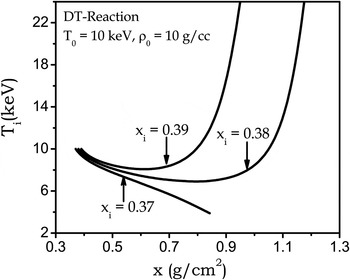
To understand the dependence of the hot-spot temperature profile, i.e., T iVs. x, the ODEs were integrated for DT fuel for the initial parameters: ρ0 = 10 g/cc and T 0 = 10 keV. Three initial values of x i = ρ0r 0, viz., 0.37, 0.38, and 0.39 g/cm2 give the profiles of T i Vs. x shown in Figure 2. It is clear that if x i ≤ 0.37 g/cm2, the burn will be terminated by the time it reaches about 0.9 g/cm2. However, T i(x) diverges around x = 0.8 g/cm2 for the initial value x i = 0.39 g/cm2. Thus, within the assumptions of the model, the critical value x c lies between 0.37 and 0.39 g/cm2.
Determining x c for DT fuel from T i(x) curves.

4. SINGLE TEMPERATURE MODEL
The main assumption here (Avrorin et al., Reference Avrorin, Feoktistov and Shibarshov1980; Frolov, Reference Frolov1998; Frolov et al., Reference Frolov, Smith and Smith2002) is that the hot-spot is characterized by a single temperature T. The effective specific heat of plasma is then given by
 $$C_V={3\over 2} {k_B\over {\bar m_i}} \lpar 1+\bar Z\rpar . $$
The evolution equation for T then becomes (Avrorin et al., Reference Avrorin, Feoktistov and Shibarshov1980; Frolov et al., Reference Frolov, Smith and Smith2002)
 $${dT \over dx}=-{3 \over x}T+{q\lpar x\comma \; T\rpar \over C_V\; U_{max}}.$$
The net energy production rate in the hot-spot, q(x, T), can be expressed as
 $$q\lpar x\comma \; T\rpar =S-q_L.$$
The production rate S is same as that in Eqs. (11) and (12) for DT and DD reactions. However, f ion = 1 as the model does not discriminate between energy deposition to ions and electrons. The energy loss rate q L is given by Avrorin (Avrorin et al., Reference Avrorin, Feoktistov and Shibarshov1980).
5. RESULTS
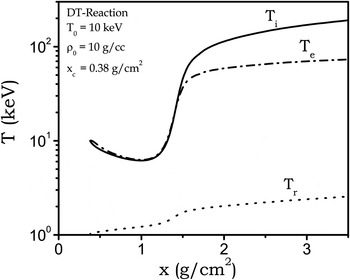
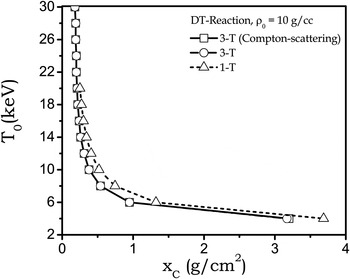
Extensive calculations were done by numerically integrating the temperature evolution equations using 3-T models for DT and DD fuels. It is well known that modeling the plasma as a three-component fluid (ions, electrons, and radiation) is necessary to describe non-equilibrium effects, if any. Evolution of T i, T e, and T r with the burn-up parameter, x, is shown in Figure 3 for DT fuel at T 0 = 10 keV and ρ0 = 10 g/cc. With these parameters, x c = 0.38 g/cm2. The initial value T r0, which is not a sensitive parameter, is taken as 1 keV. Temperature profiles of all three species alter due to various production and losses processes and finally attain almost steady values at the burn front. Variation of x c with starting temperature (T 0) of hot-spot is shown in Figure 4 for ρ0 = 10 g/cc. Results of the 1-T model are also shown for comparison. For temperatures up to 10 keV, x c values are higher for 1-T model. However, the resulst are almost same for both models at higer T 0. The main reason for this is the fast equlibration of temperatures of all species behind the front. This figure also compares the effect of including Compton-scattering. Differences in x c due to the inclusion of this effect are negligible as it becomes important only after about 60 keV for DT fuel (Gsponer & Hurni, Reference Gsponer, Hurni and Eliezer1999).
Ion, electron and radiation temperature profiles for DT fuel at x c = 0.38 g/cm2.

Comparison of x c values from 3-T and 1-T models (Frolov et al., Reference Frolov, Smith and Smith2002) for DT fuel.

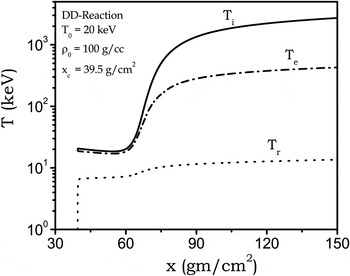
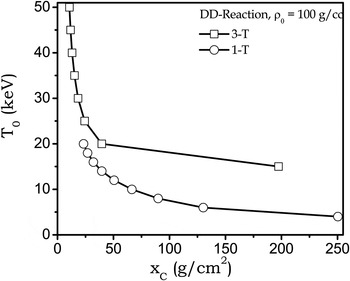
Evolution of temperatures vs. x are shown in Figure 5 for DD at ρ0 = 102 g/cc. Variation of x c with T 0 is given in Figure 6 at the same density. These results for DD fuel are without the inclusion of Compton-scattering. Addition of this mode of energy exchange, within the present model, does not lead to sustained burning. We find that the main reason for this is the lower rate of energy production in DD fusion. In fact, burn propagation does occur if fusion reactivity is just about doubled.
Ion, electron and radiation temperature profiles for DD fuel at x c = 39.5 g/cm2.

Comparison of x c values from 3-T and 1-T models (Frolov et al., Reference Frolov, Smith and Smith2002) for DD fuel.

CONCLUSION
In this paper we have developed a three temperature model (ions, electrons, and radiation) for describing propagation of thermonuclear burn in DT and DD fuels. Extensive numerical results were obtained and compared with results of 1-T model. Compton scattering was not found to be important in determining the critical burn-up parameter in DT fuel. However, the models we have employed here for various processes showed that propagating burn wave is not possible in DD fuel with Compton-scattering.
One of our main conclusions is that 3-T modeling has a role in determining the critical burn-up parameter for DT fuel at low temperatures. However, at higher temperatures, the 1-T description provides good estimates of this parameter. This finding does not imply that all the three components of the fluid are in equilibrium at the burn front. Burn propagation in DD fuel needs 3-T description because effects like Compton scattering can not be included otherwise.
Several aspects like inclusion of electron conduction, better modeling of Compton scattering and radiation loss are currently under study and new results will be reported separately.
ACKNOWLEDGMENTS
The authors thank the reviewers for their critical suggestions for improving the presentation and subject matter described in this paper.