Introduction
In the healthy adult brain, language dominance is typically within the left hemisphere, where gross language features are represented in two distinct perisylvian regions: language expression is supported by the inferior frontal lobe (Broca's area), and language comprehension is supported by the posterior superior temporal lobe (Wernicke's area). How the brain arrives at this pattern of language lateralization and localization through development is an area of debate. The nature of the normal development of this specialization is important for understanding the mechanisms underlying functional plasticity (Ballantyne, Spilkin, Hesselink, & Trauner, Reference Ballantyne, Spilkin, Hesselink and Trauner2008; Bates et al., Reference Bates, Reilly, Wulfeck, Dronkers, Opie, Fenson and Herbst2001; Reilly, Bates, & Marchman, Reference Reilly, Bates and Marchman1998; Vargha-Khadem, O'Gorman, & Watters, Reference Vargha-Khadem, O'Gorman and Watters1985) and atypical language representation following early brain dysfunction (Branch, Milner, & Rasmussen, Reference Branch, Milner and Rasmussen1964; Brazdil, Zakopcan, Kuba, Fanfrdlova, & Rektor, Reference Brazdil, Zakopcan, Kuba, Fanfrdlova and Rektor2003; Helmstaedter, Kurthen, Linke, & Elger, Reference Helmstaedter, Kurthen, Linke and Elger1997; Kadis et al., Reference Kadis, Iida, Kerr, Logan, McAndrews, Ochi and Smith2007, Reference Kadis, Kerr, Rutka, Snead, Weiss and Smith2009; Rasmussen & Milner, 1977; Saltzman-Benaiah, Scott, & Smith, Reference Saltzman-Benaiah, Scott and Smith2003; Satz, Strauss, Wada, & Orsini, Reference Satz, Strauss, Wada and Orsini1988).
Two competing theories have been proposed to explain how atypical language representation establishes following early injury: (1) “immature” language networks look much like adult networks; in cases where language representation is adult-atypical, function has reorganized and brain regions not typically involved have been recruited to support language; the pediatric brain has a relative propensity to recruit extra-canonical neural resources for language processing, possibly due to non-commitment of those regions (Gaillard et al., Reference Gaillard, Sachs, Whitnah, Ahmad, Balsamo, Petrella and Grandin2003; Wood et al., Reference Wood, Harvey, Wellard, Abbott, Anderson, Kean and Jackson2004); (2) “immature” language networks are extensive and bilateral; language establishes into non-canonical (adult-atypical) regions following early insult as diffuse networks precede focal networks in the normal developmental trajectory (Brown et al., Reference Brown, Lugar, Coalson, Miezin, Petersen and Schlaggar2005; Holland et al., Reference Holland, Plante, Weber Byars, Strawsburg, Schmithorst and Ball2001; Ressel, Wilke, Lidzba, Lutzenberger, & Krageloh-Mann, Reference Ressel, Wilke, Lidzba, Lutzenberger and Krageloh-Mann2008). Each theory has received support through functional neuroimaging of healthy children, adolescents, and adults.
Gaillard et al. (Reference Gaillard, Sachs, Whitnah, Ahmad, Balsamo, Petrella and Grandin2003) used functional magnetic resonance imaging (fMRI) to compare healthy children, aged 7 to 14 years, with adults engaging in a semantic fluency task. The researchers failed to observe differences in location or extent of activations between the child and adult groups (cp, Gaillard et al., Reference Gaillard, Hertz-Pannier, Mott, Barnett, LeBihan and Theodore2000). Similarly, Wood et al. (Reference Wood, Harvey, Wellard, Abbott, Anderson, Kean and Jackson2004) compared asymmetry and extent of activations in children and adults completing a verb generation and orthographic lexical retrieval (fluency) task in fMRI. Although children (aged 6 to 15 years) demonstrated a higher rate of atypical lateralization (15% of children, compared to only 6% of adults), the difference was not statistically significant, and the localization of activations was comparable. In these studies, the researchers documented similarities of language representation in children and adults. Their findings suggest that atypical representation in the context of early injury reflects shifts or reorganization from canonical to contralateral or perilesional regions; atypical representation is de novo, following early neurological insult.
In contrast, other studies have shown that the pattern of language representation changes with age across childhood. Holland et al. (Reference Holland, Plante, Weber Byars, Strawsburg, Schmithorst and Ball2001) used fMRI to assess healthy children aged 7–18 years participating in a verb generation paradigm and found that left hemisphere lateralization increased with age. Brown et al. (Reference Brown, Lugar, Coalson, Miezin, Petersen and Schlaggar2005) measured cortical activity using fMRI in healthy participants aged 7–32 years during three performance-matched overt word generation tasks and observed relatively widespread and bilateral representation in children, whereas adults demonstrated language representation focused in frontal and parietal regions of the left hemisphere. Ressel et al. (Reference Ressel, Wilke, Lidzba, Lutzenberger and Krageloh-Mann2008) used magnetoencephalography (MEG) to study hemispheric differences in 7- to 16-year-old children completing overt verb generation and vowel identification tasks, and found that left lateralization increased with age. These studies suggest that language representation in childhood is relatively extensive and bilateral and support the hypothesis that atypical representation following early neurological insult is facilitated by normal developmental changes; atypical representation reflects a break in the normal developmental trajectory.
The inconsistent findings across studies regarding changes in language lateralization across childhood may be explained, in part, by varied task selection and implementation. Language is not a unitary function; constituent processes are associated with different profiles of neural engagement. There is some evidence for distinct patterns of lateralization of expressive versus receptive language in healthy children and adults (Szaflarski, Holland, Schmithorst, & Byars, Reference Szaflarski, Holland, Schmithorst and Byars2006). The procedures adopted by Ressel et al. (Reference Ressel, Wilke, Lidzba, Lutzenberger and Krageloh-Mann2008) in their MEG study did not allow for a distinction to be made between expressive and receptive components of language. Compared to expressive language, receptive language functions are reported to be relatively plastic in childhood (Boatman et al., Reference Boatman, Freeman, Vining, Pulsifer, Miglioretti, Minahan and McKhann1999). Differences in the literature may reflect the variable engagement of expressive or receptive components of the language network. Ideally, studies addressing the developmental trajectory of language representation should focus on expressive and/or receptive language processes, in isolation. To minimize differences associated with effort, performance should be matched across study participants.
Differences in the literature may also reflect the choice of design and analytic approach adopted. In studies comparing child and adult language representation, subtle developmental changes may have been masked if they were not shared by all members of each group. The majority of studies that have shown developmental changes in language representation have retained subject age as a continuous variable in statistical analyses. This approach is preferred for studying the developmental trajectory, although it requires paradigms and analyses that are sensitive to individual subject language representation.
To test the two competing theories of the development of language representation, we designed an MEG expressive language paradigm (covert verb generation) for use with healthy subjects and children with neurological insults (Kadis, Smith, Mills, & Pang, Reference Kadis, Smith, Mills and Pang2008). Participants silently generate verbs to color photographs of everyday objects familiar to young children. The task does not require participants to read, and can be administered in any language. Covert responding minimizes movement and muscle artifact, thus maximizing signal-to-noise. We preferred MEG over other neuroimaging modalities (e.g., positron emission tomography, fMRI), as it is non-invasive, and in our experience, can be efficiently implemented for use with young children. The MEG scanner is completely silent, the MEG dewar encompasses the head only, and fast recording of transitory neuromagnetic signals permits use of brief paradigms, thus minimizing the demand for prolonged periods without motion during acquisition of functional data.
In our previous study of healthy adolescents and adults, generation of verbs to picture stimuli was characterized by low-beta event-related desynchrony (ERD) of neuromagnetic signal in the left inferior frontal lobe (Kadis et al., Reference Kadis, Smith, Mills and Pang2008; see also, Ressel et al., Reference Ressel, Wilke, Lidzba, Lutzenberger and Krageloh-Mann2008). Beta ERD is thought to characterize a variety of language processes, such as word generation and reading single words (e.g., Hirata et al., Reference Hirata, Kato, Taniguchi, Saitoh, Ninomiya, Ihara and Yoshimine2004).
In this study, we tested whether children's expressive language lateralization is the same or different from that of adults. The simplicity of the verb generation task facilitated use with children as young as 5 years of age, permitting characterization of representation around the generally accepted age-limit for interhemispheric plasticity (Rasmussen & Milner, Reference Rasmussen and Milner1977; Saltzman-Benaiah et al., Reference Saltzman-Benaiah, Scott and Smith2003). In verb generation to picture stimuli, we observe ERD over the primary visual cortex (Kadis et al., Reference Kadis, Smith, Mills and Pang2008); to isolate the expressive language source from the visual source, we confined our analyses to the neuromagnetic changes occurring within the frontal lobes.
Method
Participants
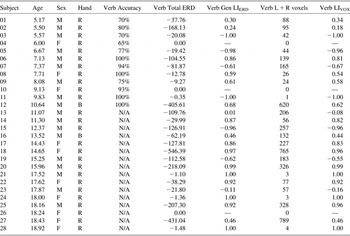
Twenty-eight children and adolescents (18 male, ranging in age from 5 to 18 years; mean age, 12.2 years) participated in this study. Subjects were recruited from the community, and were free of any history of neurological disorder, learning disability, or language disturbance. Twenty-seven subjects completed the Edinburgh Handedness Inventory (Oldfield, Reference Oldfield1971); scores indicated that 25 were right handed, 2 had mixed handedness. The one subject that did not complete the inventory reported right hand dominance. Demographic information is presented in Table 1. Subjects received a small gift for their participation. All MEG and MRI scanning and analyses were carried out at the Hospital for Sick Children (Toronto, Ontario, Canada). The study was approved by the Hospital's Research Ethics Board. Parents provided informed consent, and children and adolescents provided assent or consent, in accordance with the Research Ethics Board guidelines.
Participant demographic, performance, and neuromagnetic findings

Verb Generation Paradigm
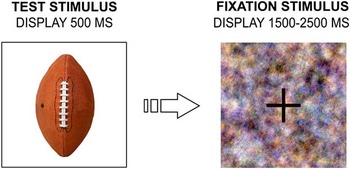
Based on several standardized language batteries (e.g., Peabody Picture Vocabulary Test, Dunn & Dunn, Reference Dunn and Dunn1997; Expressive Vocabulary Test, Williams, Reference Williams1997; MacArthur Communicative Development Inventory, Fenson et al., Reference Fenson, Dale, Reznick, Thal, Bates, Hartung and Reilly1993) and normative studies (e.g., Cycowicz, Friedman, Rothstein, & Snodgrass, Reference Cycowicz, Friedman, Rothstein and Snodgrass1997; Snodgrass & Vanderwart, Reference Snodgrass and Vanderward1980; see also, Bird, Franklin, & Howard, Reference Bird, Franklin and Howard2001), we established an 80-item set of objects whose names and usage are familiar to typically developing 5-year-old children. We obtained exemplary color digital photographs of each object for presentation on a plain white background. These images served as our test stimuli. Inter-trial fixation stimuli were phase-scrambled color images with a superimposed central black fixation cross. Examples of test and fixation stimuli are presented in Figure 1. To promote vigilance during the scanning period, we also included a picture of a hand clicking a computer mouse (vigilance trials); subjects were asked to quickly button-press upon presentation of this stimulus.
Depiction of test and fixation stimuli.

Stimuli were back-projected to a screen fixed in front of the opening of the MEG dewar, approximately 65 cm from the subject's eyes. The use of small, 12 cm square images, promoted foveal viewing; images were contained within 2–3° of the center of the visual field. Stimuli were delivered using Presentation software (Neurobehavioral Systems, Albany, CA); a photo-diode in the MEG room detected projected stimuli and directly triggered the MEG acquisition system for accurate trial epoching.
The children viewed alternating test and fixation stimuli. Test images were presented for 500 ms in random order, without repetition. For each test image, subjects were asked to covertly generate “action words” corresponding to test stimuli, as quickly as possible. Fixation stimuli were presented for 1500–2500 ms (duration randomly jittered). Subjects were instructed to simply focus on the central cross. Vigilance trials appeared in place of test stimuli at a 15% probability of occurrence, and remained on screen for 2000 ms or until the subject button-pressed.
Before MEG scanning, subjects were trained on overt versions of the task using a separate set of comparable stimuli. Once compliance was established by observation of consistently correct responding, subjects were instructed to begin responding covertly. Scanning was started only after it was determined that the child was familiar with and able to comply with the task requirements.
The task required less than 4 min of MEG scanning. Following the scans, response accuracy was assessed in children aged 10 years and younger by repeating the task with overt responding. Older children were not assessed for accuracy.
Data Acquisition
MEG data acquisition
Subjects were required to remove all metal before scanning. Fiducial markers were placed at the nasion and left and right pre-auricular points. All subjects were tested in the supine position in a magnetically shielded room which houses the MEG dewar. Neuromagnetic activity was recorded at 625 samples per second, at DC-100 Hz bandpass, using a CTF 151-channel whole-head MEG system. Subjects were asked to remain as still as possible for the duration of testing; in all cases, compliance was confirmed with recorded head motion of 5 mm or less over the scanning period.
Anatomical MRI acquisition and coregistration
MEG fiducials were replaced with MRI contrast-sensitive markers for coregistration of functional and structural data. Subjects underwent three-dimensional (3D) SPGR T1-weighted MR imaging (TE = 4.2 ms, TR = 9 ms, FA = 15; voxel dimensions = 0.938 × 0.938 × 1.50 mm) of the whole head at 1.5 Tesla (T) (Signa Advantage System) using an eight-channel head coil (GE Medical, Milwaukee, WI). The structural MRI scan was completed in approximately 6 min; subjects typically watched cartoons during acquisition. The 3D volume was automatically tissue segmented using BrainSuite2 (Dogdas, Shattuck, & Leahy, Reference Dogdas, Shattuck and Leahy2005; Sandor & Leahy, Reference Sandor and Leahy1997; Shattuck & Leahy, Reference Shattuck and Leahy2002; Shattuck, Sandor-Leahy, Schaper, Rottenberg, & Leahy, Reference Shattuck, Sandor-Leahy, Schaper, Rottenberg and Leahy2001) to establish inner skull morphology. A mask of each subject's inner skull was used to develop multiple sphere models for beamforming analyses.
Analyses
Differential beamformer analyses with bootstrap-derived thresholds
Neuromagnetic activity associated with verb generation was assessed using differential beamformer analyses (see Robinson & Vrba, Reference Robinson and Vrba1999; Sekihara, Nagarajan, Poeppel, Marantz, & Miyashita, Reference Sekihara, Nagarajan, Poeppel, Marantz and Miyashita2001; Van Veen, van Drongelen, Yuchtman, & Suzuki, Reference Van Veen, van Drongelen, Yuchtman and Suzuki1997; Vrba & Robinson, Reference Vrba and Robinson2001). Beamforming is a spatial filtering technique that permits characterization of oscillatory changes throughout the brain. The differential approach involves direct comparison of an active and a baseline period over a select frequency range. Previous investigations with covert verb generation in MEG revealed largely consistent ERD in the left inferior and middle frontal gyri between 13 and 23 Hz, corresponding to the low-beta band (Kadis et al., Reference Kadis, Smith, Mills and Pang2008; see also Ressel et al., Reference Ressel, Wilke, Lidzba, Lutzenberger and Krageloh-Mann2008). Group low-beta ERD occurred between 200 and 800 ms following stimulus presentation; however, individuals typically demonstrated brief (approximately 200–400 ms in duration) ERD at latencies that varied from subject-to-subject. We necessarily focused on brief periods in differential analyses, as contrasts with lengthy windows tend to include non-relevant neuromagnetic changes, potentially masking target signals. To optimize individual analyses in the current study, we computed differential beamformer analyses for 13–23 Hz activity during four overlapping active windows for each subject: 300–500 ms, 400–600 ms, 500–700 ms, and 600–800 ms following the onset of test stimulus presentation. Active windows were contrasted against a common baseline window consisting of the 200 ms period immediately preceding test stimulus presentation. The sliding window approach permitted unbiased individual tailoring of analyses while maintaining objectivity and power at a single subject level.
Thresholding of individual data must be sufficiently flexible to accommodate individual variability in signal strength and location, yet be objectively determined so as to remain meaningful in between-subject comparisons. The beamformer relies on multiple trials for establishment of a reliable covariance matrix, necessary for accurate source analyses. To objectively assess the reliability of observed ERD using all available trials for each verb generation run, we applied a bootstrap statistical procedure, whereby observed data were randomly sampled with replacement to establish possible alternate data sets (pseudo runs), collectively providing distributions of voxel-wise neuromagnetic changes. In the current implementation, we established 99 pseudo runs of 80 trials each (for each verb generation study). The observed ERD per voxel was then assessed across runs (actual and pseudo); surviving voxels included only those showing low-beta ERD on all runs (i.e., p < .01, uncorrected).
Extensive frontal lobe region of interest
In preliminary analyses, we observed expected frontal lobe ERD surviving the bootstrap procedure; we also observed a strong posterior signal, focused over the primary visual cortex, reflecting visual processing of the picture stimuli. To isolate the expressive language component from the strong visual source, we restricted analyses to a probabilistic volume of the human frontal lobes (developed by the International Consortium for Brain Mapping, made publicly available through the University of California's Laboratory of Neuro Imaging at http://www.loni.ucla.edu). Individual scans were automatically spatially normalized to an adult template using SPM2 routines (Friston, Reference Friston2003; the use of adult templates for comparison of pediatric and adult brain scans has been previously validated, Burgund et al., Reference Burgund, Kang, Kelly, Buckner, Snyder, Petersen and Schlaggar2002), then trimmed to exclude extra-frontal ERD.
Laterality index of ERD power
To determine the relative power of ERD within the left versus right frontal lobe, we computed laterality indices (LI) for all data surviving the bootstrapping statistical threshold across the four active-baseline contrast windows. Left (ERDL) versus right (ERDR) frontal event related desynchrony was compared at each differential window, as follows:

A single LIERD value, representing the power-weighted average of LIs computed at each differential contrast window, was computed. LIERD scores range in value from +1 (completely left) to −1 (completely right). Scores around 0 indicate bilateral contributions.
Total and hemispheric extent of ERD
To assess the spatial extent of ERD, we summed the number of voxels surviving the bootstrapping procedure across all four contrast windows.
We also computed LIs for total number of surviving voxels within the left (VOXL) and right (VOXR) frontal lobes at each differential window, as follows:

A single LIVOX value, representing the voxel count-weighted average of LIs computed at each differential contrast window, was computed. LIVOX scores range in value from +1 to −1, with scores around 0 representing an equal number of surviving voxels in the left and right frontal lobes. This particular laterality index does not take into account the power of ERD observed at each surviving voxel, but serves to compare the extent of left versus right frontal verb generation sources.
We assessed the correlation of LIERD and LIVOX to determine the uniqueness of each as a measure of lateralization.
Lateralization versus performance, demographic characteristics, and age
Using Pearson product-moment correlations, we assessed the relationship between post-scan verb generation performance and number of surviving voxels and the LIs in children aged 10 years and younger.
To assess a possible independent contribution of sex on expressive language lateralization, we conducted univariate analysis of variance on LIERD and LIVOX scores with age entered as a covariate.
To characterize changes in lateralization of expressive language across childhood, we calculated the Pearson product-moment correlations for LIERD and LIVOX versus participant age.
Results
All participants correctly responded to the vigilance trials. For three subjects, aged 6, 9, and 18 years, we failed to observe low-beta ERD surviving the bootstrap procedure. Post-scan verb generation accuracy ranged from 65% to 100% (M = 85.3%; SD = 13.2%) in children aged 10 years and younger. Performance was not significantly correlated with number of surviving voxels (r = 0.21; n = 12; p > .05), LIERD (r = 0.00; n = 12; p > .05), or LIVOX (r = −0.04; n = 12; p > .05). Among the two ambidextrous children, aged 10.6 and 13.5, LIERD and LIVOX values suggested leftward lateralization. Controlling for age, we observed comparable LIERD and LIVOX scores in males and females (F(1,22) = 2.5 for both indices, p > .05). Individual performance measures for the youngest participants and neuromagnetic findings for the whole group are presented in Table 1.
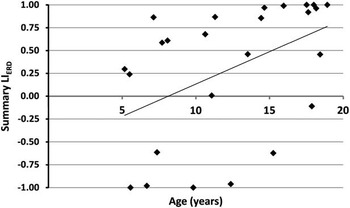
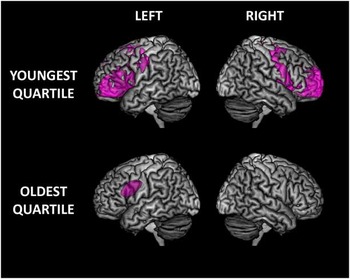
Within the 25 subjects with ERD surviving bootstrap thresholding, LIERD scores significantly increased with age, r = 0.46, n = 25, p < .05, one-tailed (see Figure 2). To appreciate changes in ERD localization across childhood, grand averages of surviving ERD for the youngest (< 7.65 years) and oldest (> 17.55 years) quartiles of the sample were plotted on a template brain, Figure 3.
Scatterplot with linear trendline for LIERD versus age at assessment (r = 0.46; n = 25; p < .05).

Grand averages of cortical ERD for the youngest (< 7.65 years) and oldest (> 17.55 years) quartiles of participants. The youngest participants show left inferior frontal ERD, as well as right hemisphere ERD in precentral and prefrontal regions; oldest participants show left ERD around canonical Broca's area.

The number of surviving voxels varied considerably across subjects (M = 166.3; SD = 221.4), but did not correlate with subject age, r = 0.25, n = 28, p > .05, one-tailed.
Among those with surviving ERD, LIVOX scores for verb generation significantly correlated with subject age, r = 0.47, n = 25, p < .05, one-tailed.
Comparison of LIERD and LIVOX
Laterality indices based on ERD power versus surviving voxel count were strongly correlated, r = 0.99, n = 25, p < 0.05, one-tailed.
Discussion
In the current study, we characterized changes in lateralization of verb generation from childhood through adolescence in typically developing individuals. In studying the normal developmental trajectory, we advanced our understanding of the context from which atypical language representation establishes following early injury. To our knowledge, this is the first study to assess expressive language lateralization in children as young as 5 years of age using age-appropriate stimuli and tailored objective individual analyses of neuromagnetic data.
We observed a significant increase in left lateralization with advancing age. This trajectory is consistent with recent neuroimaging studies showing relatively diffuse language representation in children compared to adults (Brown et al., Reference Brown, Lugar, Coalson, Miezin, Petersen and Schlaggar2005; Holland et al., Reference Holland, Plante, Weber Byars, Strawsburg, Schmithorst and Ball2001; Ressel et al., Reference Ressel, Wilke, Lidzba, Lutzenberger and Krageloh-Mann2008; see also, Szaflarski et al., Reference Szaflarski, Holland, Schmithorst and Byars2006). In our youngest children, we observed LIs suggesting left, right, and bilateral expressive language representation. Findings suggest that both hemispheres contribute to language early in life, and support the theory that adult-atypical language representation following early left hemisphere injury is facilitated by typical right hemisphere involvement in the immature language network. This explanation is supported by an extensive clinical literature indicating a decreasing potential for interhemispheric plasticity beginning around 5 or 6 years of age (Brazdil et al., Reference Brazdil, Zakopcan, Kuba, Fanfrdlova and Rektor2003; Duncan et al., Reference Duncan, Moss, Bandy, Manwaring, Kaplan, Reiman and Wodrich1997; Helmstaedter et al., Reference Helmstaedter, Kurthen, Linke and Elger1997; Kadis et al., Reference Kadis, Kerr, Rutka, Snead, Weiss and Smith2009; Muller et al., Reference Muller, Rothermel, Behen, Muzik, Mangner, Chakraborty and Chugani1998, Reference Muller, Rothermel, Behen, Muzik, Chakraborty and Chugani1999; Pataraia et al., Reference Pataraia, Simos, Castillo, Billingsley-Marshall, McGregor, Breier and Papanicolaou2004; Rasmussen & Milner, Reference Rasmussen and Milner1977; Saltzman-Benaiah et al., Reference Saltzman-Benaiah, Scott and Smith2003; Satz et al., Reference Satz, Strauss, Wada and Orsini1988; Springer et al., Reference Springer, Binder, Hammeke, Swanson, Frost, Bellgowan and Mueller1999), and a recent fMRI study by Everts et al. (Reference Everts, Lidzba, Wilke, Kiefer, Wingeier, Schroth and Steinlin2010), who found that children and adolescents recovering from stroke showed patterns of right hemisphere language representation that colocalized with that of healthy younger children.
Ressel et al. (Reference Ressel, Wilke, Lidzba, Lutzenberger and Krageloh-Mann2008) have previously shown an increase in left hemisphere lateralization with age using MEG. Our results extend their findings in several ways. Their use of speech stimuli and generation of overt responses necessarily engaged both receptive and expressive language regions, thus providing a broad picture of changes in language lateralization across childhood. Unfortunately, Ressel et al. did not conduct source analyses (i.e., the researchers drew their conclusions about changes in representation based on the distribution of power changes at the sensor level); from their study, it is unclear whether regional differences exist in the developmental trajectory.
A comparison of the youngest and oldest children in our sample revealed changes occurring in both hemispheres with normal development (see Figure 3). The youngest quartile showed cortical ERD distributed along the left inferior frontal region, the right precentral region, the right inferior frontal and right prefrontal region. The oldest quartile showed cortical ERD focused in the left posterior inferior frontal lobe, corresponding to canonical Broca's area. At a group level, differences in distribution of ERD suggest that expressive language representation becomes increasingly left lateralized and focal through childhood. Several factors may contribute to the observed difference, including brain signal and noise variability across childhood (e.g., McIntosh, Kovacevic, & Itier, Reference McIntosh, Kovacevic and Itier2008; Misic, Mills, Taylor, & McIntosh, Reference Misic, Mills, Taylor and McIntosh2010), relative variability of source localization in the youngest children (supported by variable LIs), and possible age-related differences in strategies required to complete the verb generation task. In the youngest quartile, right hemisphere prefrontal and precentral ERD suggests recruitment of brain regions not typically associated with language production. Furthermore, we know that the pediatric brain undergoes several structural changes throughout childhood, including robust protracted white matter development, which may contribute to changing networks and the corresponding neuromagnetic profile for expressive language.
Post-scan testing revealed imperfect performance in some of the youngest participants. Errors tended to result from omission of responses, rather than inappropriate generation of verbs. Informal testing revealed that all participants could correctly generate verbs when time limits for responding were eliminated, suggesting that a reduced rate of presentation may be appropriate in future implementations with young children or populations with developmental delays or cognitive deficits. We failed to observe any relationship between post-scan performance and expressive language lateralization in the limited subsample of children aged 10 years and younger. Our findings support the notion that increasing age, rather than expressive language performance level, drives the increasing left lateralization (Ressel et al., Reference Ressel, Wilke, Lidzba, Lutzenberger and Krageloh-Mann2008; Wood et al., Reference Wood, Harvey, Wellard, Abbott, Anderson, Kean and Jackson2004). However, others have documented a positive correlation between verbal intelligence and language lateralization, independent of age (e.g., Everts et al., Reference Everts, Lidzba, Wilke, Kiefer, Mirdasini, Schroth and Steinlin2009). In future studies of language lateralization in childhood, the inclusion of a comprehensive language battery may help to distinguish age from performance effects.
Of interest, we observed reliable ERD in a majority of the participants who demonstrated imperfect accuracy for verb generation, suggesting that ceiling performance may not be necessary for assessment of language representation in MEG. It is not known whether failed attempts at generating verbs is equivalent to successful verb generation in terms of neuromagnetic signal; increased effort associated with difficult items may be associated with a distinct neuromagnetic profile, which could accentuate, mask, or attenuate the target signal. In the future, researchers may circumvent questions of signal equivalence for successes and failures by screening participants prior to neuroimaging to establish a tailored stimulus set, or removing stimuli associated with errors prior to conducting any source analyses. The screening approach may be preferable, as alternate stimuli may be chosen to maintain set size and promote target signal in source analyses.
Since the verb generation task involves picture stimuli and simple one-word covert responding, the paradigm can be easily implemented for use with subjects speaking any language, without demand for literacy. The task was designed to be as easy as possible to complete, with a focus on engaging the expressive language cortex. We have successfully used this paradigm to assess expressive language representation in clinical populations (Kadis et al., Reference Kadis, Smith, Mills and Pang2008), and children as young as 5 years of age. However, children younger than 5 years of age may have difficulty completing the task, and may present additional challenges for successful MEG scanning. Children, more so than adults, tend to move during the scan, often in response to stimulus presentation, introducing task-related noise. Covert responding is helpful in maintaining stillness, although we have observed silent mouthing and subtle orofacial muscle movements while scanning young children, resulting in small head movements and muscle artifact. In general, signal-to-noise is lower in very young children—the MEG dewar is optimized for adult-sized heads, so source-to-sensor distance is increased with smaller head circumference. Biological noise is more prevalent in MEG scans of small children, due to the proximity of children's cardiovascular and respiratory organs to the MEG dewar. Newer MEG systems that can continuously record head location will permit subjects to make small movements during the scan period, and allow overt responding in expressive language paradigms. Recent improvements in localizing deep MEG sources (Quraan et al., Reference Quraan, Moses, Hung, Mills and Taylor2011) will also facilitate investigations that include very young children. These advances in MEG technology will permit future studies of language representation in children younger than 5 years of age, a period characterized by massive potential for plasticity of language representation.
To our knowledge, this is the first study to use objectively thresholded and tailored differential beamforming of MEG data to identify the neocortex in the frontal lobes supporting verb generation in individual subjects. The findings contribute to our understanding of the mechanisms potentially underlying plasticity of language representation early in life. Because the brief paradigm was well tolerated by all children tested and yielded localization and lateralization data on an individual basis, it is well suited for future research and clinical implementation.
Acknowledgments
This research was supported, in part, by a Studentship to D.S.K. through the Ontario Student Opportunity Trust Fund—Hospital for Sick Children Foundation Student Scholarship Program, and a Doctoral Research Award to D.S.K. through the Canadian Institutes of Health Research (CIHR) in partnership with Epilepsy Canada.
We have no conflicts of interest to disclose.