Introduction
Maize belongs to the top three main cereal staple foods (rice and wheat) in the world. Until recently, it has not been considered among the priority crops in Senegal, though it is consumed throughout the country (Ndiaye et al., Reference Ndiaye, Fofana, Ndiaye, Mbaye, Sene, Mbaye and Chanerau2005). Nevertheless, in the southern and eastern parts of the country, maize constitutes a basic food for a large part of the population. In poultry farming, maize is even a strategic feedstuff whose supply mostly originates from imports. Maize was among the crops promoted in a special food production programme to ensure food security in Senegal. As a result, its production has increased from 78,194 tons in 2002/2003 to 400,909 tons in 2003/2004 (FAO, 2009). Yet this production increase was soon accompanied by problems and challenges related to the conservation and storage of unprocessed and processed maize.
During post-harvest, on-farm stored maize is attacked by various insect pests. The maize weevil Sitophilus zeamais Motschulsky (Coleoptera: Curculionidae) is among the most important maize pests in tropical and subtropical regions (Markham et al., Reference Markham, Bosque-Pérez, Borgemeister and Meikle1994; Holst et al., Reference Holst, Meikle and Markham2000). Populations in stores can build up rapidly and losses by the weevil can reach 40% within 6 months of storage (Meikle et al., Reference Meikle, Holst and Markham1999; Tapondjou et al., Reference Tapondjou, Adler, Bouda and Fontem2002). Hence producers often apply synthetic pesticides despite their known adverse effects such as health hazards, selection of resistant insect pest strains and negative environmental impacts. Limited work has been done in Africa to manage the pest using host plant resistance. Gudrups et al. (Reference Gudrups, Floyd, Kling, Bosque-Perez and Orchard2001) found no complete resistance to S. zeamais in a screening trial with 52 maize varieties. However, a more systematic search among tropical maize populations might provide potential sources of resistance. Adda et al. (Reference Adda, Borgemeister, Biliwa and Meikle2002) suggested the use of maize varieties with thick husk cover to provide improved grain protection during storage. Today, the biopesticide Spinosad whose active ingredient derives from the naturally occurring soil dwelling micro-organism Saccharopolyspora spinosa, is increasingly used in maize storage (Athanassiou et al., Reference Athanassiou, Arthur, Kavallieratos and Throne2011). More environmentally friendly options using natural antagonists such as parasitoids and entomopathogens are still at an experimental stage in tropical Africa. Ekesi et al. (Reference Ekesi, Egwurube, Akpa and Onu2001) obtained encouraging results for the control of Caryedon serratus (Ol.) (Coleoptera: Bruchidae) with conidia of Metarhizium anisopliae and by Meikle et al. (Reference Meikle, Cherry, Holst, Hounna and Markham2001) for the management of Prostephanus truncatus (Horn) (Coleoptera: Bostrichidae) and S. zeamais with Beauveria bassiana.
Traditional know-how and the use of indigenous insecticidal plants have remained relatively neglected in the development of alternative methods to protect stored maize. Practices that minimize health risks and ecological problems should be encouraged especially if people use natural resources provided by their local biodiversity to solve storage problems. Preliminary field assessments made in Senegal in 2008 showed that farmers who did not winnow their maize stored in bags were not suffering from significant losses regardless of the maize variety (M. T. Gueye, personal observation). In the search for environmentally sound control methods, we therefore examined the observed effect using powdered shelled maize cobs against the maize weevil under laboratory conditions.
Materials and methods
Maize
For the study, we used ‘Jaune Denté de Bambey’ (JDB), a local dent maize variety with the following characteristics: protein = 8.2%; carbohydrates = 77.6%; specific density = 0.812 ± 0.001 g/cm3; thousand maize weight = 230 ± 0.46 g; and grain proportion of total cob weight = 64.8% (n = 300). Fresh-husked cobs were bought from a market in Dakar. They were subsequently sun dried for 3 weeks and then manually shelled. Thereafter, the maize grains were in turn dried for 1 week and packed in polyethylene bags before being frozen at − 4 °C for 14 days. Grains showing any kind of damage were discarded.
Maize cob preparation
Empty cobs gained from the dried and shelled maize were crushed with an Engelberg mill and reduced to powder. The latter was sieved to obtain particle sizes of 1.4 × 1.4 mm and 0.4 × 0.4 mm, representing the largest size difference of a standard laboratory sieving set. Both powdered fractions were kept in individual jars and placed on shelves in the laboratory at ambient temperature (22 ± 4 °C) and relative humidity (80 ± 5%). The temperature and relative humidity were monitored daily throughout the study.
Insect cultures
Sitophilus zeamais adults were collected on maize in the Kolda region of Senegal (12°52′00″N, 12°57′00″W) during the 2008 harvest period. The insects were maintained for four generations on maize grains in the laboratory at the above-mentioned conditions.
Insecticide
Actellic Super Dust, a binary insecticidal compound, composed of 16 g/kg of pirimiphos-methyl and 3 g/kg of permethrin served as a treated control. This insecticide, known to persist for more than 6 months, was applied at the recommended dose of 50 g/100 kg grains, which corresponds to 0.125 g for 250 g maize grains in the experiment.
Experimental procedures
Contact toxicity tests
One-litre glass jars were each filled with 250 g JDB maize grains with moisture content below 10%. For every dose level, a respective amount of powdered maize cobs was added to individual jars and thereafter carefully shaken till obtaining a homogeneous dispersion of the cob particles in the grain material. The maize grains were then infested with five pairs of S. zeamais that emerged less than 48 h before the start of the experiment. Insects were previously sexed by examination of their rostrum, those of females being distinctly longer and tapered (Halstead, Reference Halstead1963).
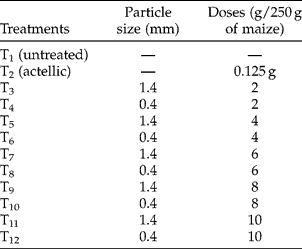
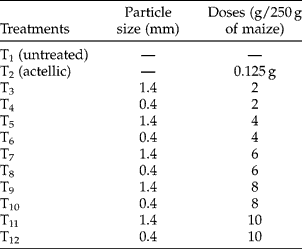
The experimental design consisted of a completely randomized block design with 12 treatments (glass jars) and four replicates. The treatments included two types of controls, i.e. one treated with actellic (treated control) and another untreated control (treated with neither powder nor actellic). The details of the treatment design are given in Table 1.
Treatment design
All jars were maintained in the laboratory at ambient temperature (22 ± 4 °C) and relative humidity (80 ± 5%). The experiment was monitored for 4 months at 2-day intervals. The data collected comprised mortality, survival of adults, progeny, grain damage and losses over 120 days.
Per cent grain damage was expressed as the proportion of damaged grain to the total sample. Grain weight losses were calculated according to the formula by Pantenius (Reference Pantenius1988):


where A is the total number of grains; B, the number of attacked grains; C, the number of healthy grains; D, the weight of attacked grains; and E, the weight of healthy grains.
Fumigation test
To verify possible fumigant properties of crushed maize cobs, the same dose levels used in the contact assay were again tested but in hermetically closed jars. Therefore, five pairs of S. zeamais were introduced into jars containing maize grains over which a finely punctured Petri dish filled with powdered cobs was laid to allow for eventual volatile organic compounds to spread without physical contact of the particles with the insects. As for the previous experiment, four repetitions were tested for every dose.
Statistical analysis
Values for maize damage and loss, weevil mortality and offspring production collected during or after 120 days were analysed using ANOVA. Percentage data were transformed into arcsine square root values before statistical analysis. Dunnett and Bonferroni's test was employed to compare means using the XLSTAT-Pro 6.1.9 program. The median lethal dose (LD50) was calculated by probit analysis (Finney, Reference Finney1971) using the StatPlus program. Abbott's formula (Reference Abbott1925) was used to correct natural mortality prior to the calculation. To avoid a generation overlap, only data recorded up to the appearance of the first weevil offspring, i.e. up to 28 days, were retained for the dose–response analysis of powdered maize cob.
Results
Damage and loss evaluation
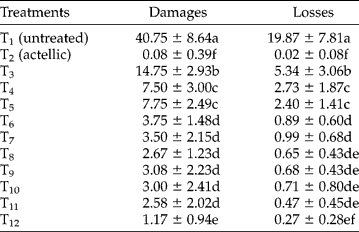
Table 2 indicates that damages by S. zeamais were significantly higher in the untreated control than in all the other treatments, peaking at 40%. They remained insignificant in the actellic treatment and were lower than 1% in T12 (P < 0.05). Damage decreased proportionally to the rising dose of powdered maize cobs. Thus the lowest dose T3 showed higher damages than the others. The results demonstrated the presence of two statistically homogeneous groups, namely T4 to T5 and T6 to T11. Data on losses were more homogeneous. They amounted to about 20% in the untreated control and almost zero in the presence of actellic. Treatments T8 to T11 showed similar levels and in treatments T6 to T12, losses did not reach 1%. Overall, a significant difference with the actellic treatment was found for all treatments except for T12. For the three highest dose rates, no significant differences were found between the two particle sizes.
Damage and losses caused by Sitophilus zeamais in the different treatments after 120 days
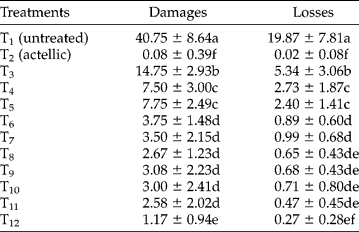
Means of four replicates. Means with different letters in a column are significantly different (P < 0.05).
Mortality and reproduction of S. zeamais
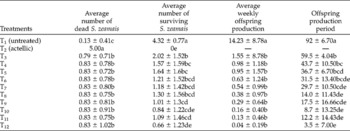
The actellic treatment killed all insects while in the untreated control, all insects survived after 4 months of experiment (Table 3), whereas in all powdered cob treatments a low but significant mortality was recorded. Overall, the powder applications had no significant influence between the weevil sexes (P < 0.05). Survival in the treated jars differed significantly between the treatments with 2 g and those with 8 and 10 g/250 g grain maize. Moreover, at equal dose, the cob particle size had no significant effect on weevil mortality. However, the LD50 in treatments with larger particles (2.70 ± 0.59 g) was about twice the one for smaller particles (1.28 ± 4.03 g), suggesting a contact effect of the powdered maize.
Effects of powdered maize cobs on the mortality and reproduction of Sitophilus zeamais according to the different treatments after 120 days

Means of four replicates. Means with different letters in a column are significantly different (P < 0.05).
Effects of the various doses of crushed maize cobs upon the progeny production of S. zeamais are shown in Table 3. Emergence was significantly highest in the control and no insects were recorded in the actellic treatment. There was no difference between the treatments with various doses of crushed maize cobs.
Monitoring of adult S. zeamais revealed a spreading and delay in offspring emergence due to the product (Table 3). Overall, the greater the dosage, the lower the fecundity and the shorter the time interval over which the offspring were produced. Compared with the control, fecundity was lowered between 89 and 99% and the offspring production period reduced between 35 and 96%.
Fumigation tests
No significant differences were observed between all tested treatments. Over 4 months, nearly all insects survived even when exposed to the highest dose of powdered maize cobs, and thus no fumigant effect could be detected.
Discussion
Many post-harvest studies with grain and legumes have tested various application levels of powders of leaves, fruits, barks, roots and essential oils (Meehan, Reference Meehan1980; Kimura et al., Reference Kimura, Mori, Susuki and Kobayashi1981; Gakuru and Foua-Bi, Reference Gakuru and Foua-Bi1996; Sanon et al., Reference Sanon, Garbab, Augerb and Huignard2002; Akob and Ewete, Reference Akob and Ewete2007). Therein, emphasis was put on their efficiency against S. zeamais for cereals and Callosobruchus maculatus Fabricius (Coleoptera: Chrysomelidae) for legumes. In maize storage, damage has been mainly attributed to S. zeamais and P. truncatus (Horn) (Coleoptera: Bostrichidae) (Philogène et al., Reference Philogène, Arnasson, Lambert and AUPELF-UREF1989). The utilization of resistant varieties was also evaluated, yet with mixed results. For instance, in a screening trial with 52 maize varieties, Gudrups et al. (Reference Gudrups, Floyd, Kling, Bosque-Perez and Orchard2001) were unable to determine a single variety showing sufficient resistance against S. zeamais, whereas, recently, Tefera et al. (Reference Tefera, Mugo, Likhayo and Beyene2011) found eight resistant hybrid maize varieties against S. zeamais and P. truncatus.
The complete control of all maize weevils in the actellic treatment confirms the high efficacy of this synthetic insecticide for stored maize protection. However, cases of pesticide resistance in S. zeamais have been reported from Togo following the application of a combination of organophosphorus and pyrethroid insecticides, a treatment similar to actellic (Richter et al., Reference Richter, Biliwa and Henning-Helbig1998). The decreasing survivorship of adult S. zeamais treated with increasing doses of powdered maize cobs and a lower LD50 value for small particle size suggest that cob particles do act by contact. Many plants used in traditional stores in Africa are chosen because of their contact insecticidal or fumigant properties. In Senegal, for instance, Boscia senegalensis (Pers.) Lam. ex Poiret (Capparaceae), Senna occidentalis (L.) Link (Fabaceae) and Calotropis procera (Aiton) W.T. Aiton (Asclepiadaceae) were effective in cowpea and groundnut conservation (Seck et al., Reference Seck, Lognay, Haubruge, Wathelet, Marlier, Gaspar and Severin1993; Thiaw et al., Reference Thiaw, Guèye, Guèye-Ndiaye, Samb and Sembène2007). Yet, the almost complete survival of all test insects in our fumigation test indicates a lack of an inhalatory action of volatiles emitted by cob particles.
Compared with the control treatment, increasing doses of crushed cobs strongly affected the progeny production of S. zeamais and significantly delayed offspring emergence. Whether the causal effect is attributed to the presence of some chemical or natural compounds remains to be verified. Based on a maize resistance screening involving hundreds of varieties, Philogène et al. (Reference Philogène, Arnasson, Lambert and AUPELF-UREF1989) showed that maize grains particularly rich in phenolic compounds, especially ferulic acid, were less attacked by S. zeamais and P. truncatus. Contrary to traditional belief, the application of a natural compound such as 4% (w/w) wood ash, a common practice in maize stores in tropical Africa, did not lead to a satisfactory protection against S. zeamais (Ntonifor and Monah, Reference Ntonifor and Monah2001).
A reduction to less than 1% losses at 2.4% (w/w) or even less at higher doses makes the benefit of using crushed maize cobs particularly attractive in grain storage if compared with 20% losses when S. zeamais is left uncontrolled over 4 months. A similar high efficiency against S. zeamais was observed when Basella alba L. (Basellaceae) seeds and Operculina turpethum (L.) Silva Manso (Convolvulaceae) leaves were used in stores (Haque et al., Reference Haque, Nakakita, Ikenaga and Sota2000). Compounds with a similar texture to powdered maize cobs have been tested before, in particular diatomaceous earth powders, sand and leaf ash. In Senegal, B. Legendre and K. Diarra (unpublished observations, 2007) found that the application over 4 weeks of pure diatomaceous earth taken from the Tamna Lake had an efficacy equal to synthetic pyrethroids, but at much less cost. The mode of action of diatomaceous earth is explained by its abrasive effect and absorption of cuticular lipids resulting in the death of insects by dehydration (Fields and Korunic, Reference Fields, Korunic and Pimentel2002). Akob and Ewete (Reference Akob and Ewete2007) tested the toxicity of leaf ash from Eucalyptus grandis W. Hill ex Maiden (Myrtaceae) against S. zeamais in Cameroon under laboratory conditions and found that it effectively protected maize grains during 6 months storage without affecting germination of the seeds and inhibited emergence of the weevil. Though the authors did not explain the mode of action, De Luca (Reference De Luca1979), Gwinner et al. (Reference Gwinner, Harnisch and Mük1996) and Saayman (Reference Saayman1997) suggested a deterrent action of the inert mineral powders resulting in a barrier that interferes with beetle movements, and/or changes in the environmental conditions such as reduced oxygen and relative humidity exchanges leading to the death of the pests. Considering that in our study adult weevils survived over several weeks but caused little damage and losses, it seems that powdered maize cobs have an inhibitory effect on adults, further corroborated by our observations that they most often gathered on the upper grain layers.
Conclusion
The present study shows that powdered maize cobs can be used as a viable and natural alternative to synthetic pesticides for protecting maize against S. zeamais, the major pest of this cereal in Senegal. Regardless of the particle size, a dose of 4% provided a protection equivalent to a treatment with actellic, a widely used synthetic post-harvest insecticide. Since shelling of maize cobs usually leaves enough material to protect grains at even higher doses than presently tested, farmers will only need little effort to ensure adequate grain protection. Future research should emphasize the mode of action on storage pests and investigate the presence of bioactive molecules. Lastly, longer-term efficiency needs to be evaluated in the field to better appraise the adequacy of this control technique for the prevailing storage conditions in West Africa.
Acknowledgements
The authors gratefully thank all farmers of the Tambacounda and Kolda regions for their collaboration and two anonymous reviewers for their helpful discussions and comments. This research was conducted at the ‘Institut de Technologie Alimentaire’, Hann-Dakar, Senegal and financially supported by the ‘Fonds National des Recherches Agricoles et Agroalimentaires – FNRAA’.