INTRODUCTION
Bivalves of the east coast of peninsular India have been well studied (Subba Rao & Dey, Reference Subba Rao and Dey1986; Subba Rao et al., Reference Subba Rao, Surya Rao and Maitra1991, Reference Subba Rao, Dey and Barua1992, Reference Subba Rao, Surya Rao and Manna1995a, b; Surya Rao & Maitra, Reference Surya Rao and Maitra1998; Durga Prasad et al., Reference Durga Prasad, Rama Sarma and Rao2001; Mohapatra, Reference Mohapatra2001; Dey & Ramakrishna, Reference Dey and Ramakrishna2007; Mahapatra, Reference Mahapatra2008). In particular, molluscs of the Visakhapatnam region were documented by Ganapati et al. (Reference Ganapati, Lakshmana Rao and Nagabhushanam1958), Balaji (Reference Balaji1988) and Padhy (Reference Padhy2004).
Among bivalves, mytilids (sea mussels) are sedentary molluscs that attach to rocks and other hard structures with the aid of a well developed byssus. While certain members of the family Mytilidae are recognized as major commercial species in aquaculture (Mason, Reference Mason and Bayne1976) some mussels colonizing anthropogenic materials are considered as foulers (Rzepecki & Waite, Reference Rzepecki and Waite1995). Such fouling species possess tremendous capacity to get translocated through driftwood/hull fouling in adult stages and ballast water during larval stages (Godwin et al., Reference Godwin, Eldredge and Gaut2004; Ashton et al., Reference Ashton, Boos, Shucksmith and Cook2006).
Until this study, the genus Modiolus was represented along the north-eastern coast of the Indian mainland by only five species viz. M. tulipa (Lamarck, 1836); M. philippinarum Hanley, 1843; M. metcalfei Hanley, 1844; M. striatulus Hanley, 1844; and M. undulatus (Dunker, 1856) (Preston, Reference Preston1914; Annandale & Kemp, Reference Annandale and Kemp1916; Ganapati et al., Reference Ganapati, Lakshmana Rao and Nagabhushanam1958; Sarma, Reference Sarma1977; Balaji, Reference Balaji1988; Subba Rao et al., Reference Subba Rao, Surya Rao and Maitra1991, 1992; Vijayakumar et al., Reference Vijayakumar, Ansari and Parulekar1991; Goswami, Reference Goswami1992; Subba Rao et al., Reference Subba Rao, Dey and Barua1995a, b; Surya Rao & Maitra, Reference Surya Rao and Maitra1998; Mohapatra, Reference Mohapatra2001; Khalua et al., Reference Khalua, Chakravarty and Chakraborty2003; Ramakrishna et al., Reference Ramakrishna and Talukdar2003, Reference Ramakrishna, Siddiqui and Sahu2006; Dey, Reference Dey2006; Dey & Ramakrishna, Reference Dey and Ramakrishna2007; Mahapatra, Reference Mahapatra2008; Pati et al., Reference Pati, Mahapatro, Singhsamant and Panigrahy2009). However, several animals of M. auriculatus were collected recently from reinforced cement concrete waterfront structures in Visakhapatnam harbour (Figure 1) during a survey under the Ballast Water Management Programme. These collections constitute a new record for the north-eastern coast of the Indian mainland.
Locations (marked as black squares) of collection of Modiolus auriculatus in Visakhapatnam harbour.

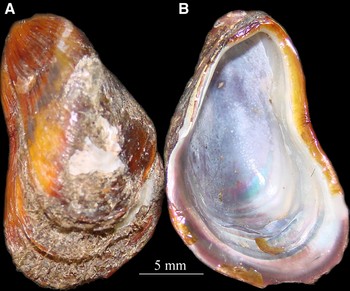
Dorsal (A) and ventral (B) views of left shell valve of Modiolus auriculatus recorded from Visakhapatnam harbour.

MATERIAL EXAMINED
Visakhapatnam harbour: Hindustan Shipyard Jetty, 2 specimens (8 January 2007); Dredger Berth, 2 specimens (10 January 2007); General Cargo Berth (north), 30 specimens (10 January 2007), 1 specimen (30 November 2007); Coal Berth, 19 specimens (11 January 2007), 1 specimen (1 December 2007); Oil Berth, 4 specimens (22 August 2008); Oil Refinery Berth, 1 specimen (23 August 2008).
MEASUREMENTS
Length: 7.5 to 22.2 mm; width: 4.2 to 13.7 mm.
DIAGNOSIS
Shell modioliform; anterior margin of valves very short, clearly not extending forward beyond umbones; posterodorsal margin raised into an ear-like hump, set off by a broad rounded keel radiating towards posteroventral end of valves; periostracal hairs present on posterodorsal side (Poutiers, Reference Poutiers, Carpenter and Niem1998).
DISTRIBUTION
Europe, South Africa, Mozambique, Tanzania, Gulf of Aden, Red Sea, Mediterranean Sea, Gulf of Oman, Gulf of Persia, Aldabra Islands, Madagascar, Réunion Islands, Mauritius, Seychelles, west coast of India, Chagos Islands, Chennai, China, Gulf of Thailand, Hong Kong, Japan, Philippines, New Guinea, Australia, Vanuatu, Polynesia, Tahiti and New Zealand (Sasaki, Reference Sasaki1996; Slack-Smith & Bryce, Reference Slack-Smith and Bryce2004; Galil, Reference Galil2007; GBIF, 2009; OBIS, 2009).
REMARKS
The current record of M. auriculatus from Visakhapatnam extends its distributional range by 750 km to the north of Chennai (previously reported from Madras by Gravely, Reference Gravely1941) in the Bay of Bengal. The species was collected from 0 m and 3 m depths in the littoral zone during high saline regimes. The outer shell was yellow to yellow-brown while its inner shell was nacreous and violet-blue. This species can be easily distinguished from M. philippinarum, M. metcalfei and M. undulatus by a very short anterior shell margin that does not extend beyond umbones and from M. tulipa and M. striatulus by a slightly concave ventral shell margin besides the presence of posterodorsal hump, rounded keel and relatively long periostracal hairs.
ACKNOWLEDGEMENTS
Thanks are due to the authorities of the Institute of Wood Science and Technology and the Indian Council for Forestry Research and Education for encouragement, researchers at the National Institute of Oceanography, Goa for collections and the Ministry of Shipping, Road Transport and Highways, Government of India for funding. The authors especially thank Dr (Mrs) Shirley Slack-Smith, Curator of Molluscs, Western Australian Museum and Dr Richard C. Willan, Senior Curator of Molluscs, Museum and Art Gallery Northern Territory, Australia for specimen identification and valuable suggestions.