On the afternoon of Friday April 20, 1883, attorney Kate Kane doused Judge James Mallory with a glass of water in a Milwaukee courtroom. Kane's frustrations were deep. That morning Mallory had reassigned one of her clients to another attorney, despite the fact that this client had specifically requested Kane. This time it was to Peter J. Somers, who had recently worked for Mallory's re-election. After the incident, Kane would announce, “Judge Mallory has been trying to drive me out of this court; he has continuously insulted and misused me, but I bore it.” “Today,” she explained, “I wanted to insult Judge Mallory just where he had insulted me—in open court.” She succeeded; Mallory was furious. Wiping the water from his brow, the irate judge shouted, “Arrest that woman,” and cited Kane for contempt of court. She was immediately apprehended and hauled off to the local jail, where she would stew for days. “I shall stay here for ten years before I pay that fine,” Kane vowed, defiantly.Footnote 1 The incident, which imperiled Kane's legal career in Milwaukee, also reveals critical tensions in women's claims on full citizenship that were reflected in battles over professional membership, legal and sexual equality, and political inclusion.
Although Kane lived and worked in the upper Midwest, her story resonates nationally in journalistic accounts that used her outburst in a Milwaukee courtroom to “mark” the status of all women as degraded.Footnote 2 The water incident was reported in newspapers across the nation, from California to North Carolina to New York, and from Texas to New England, where it sparked a debate about women's capacity to self-govern, to work, to vote, and to fulfill the basic obligations and duties of citizenship.Footnote 3 Journalists openly ridiculed Kane. The Idaho Avalanche demeaned all women's claims to political equality when it heckled, “After this who dare say woman is not qualified to exercise the right of suffrage?” The Milwaukee Sentinel took the incident as evidence that “women haven't the patience to succeed at the bar,” adding, “It is painfully evident that ladies cannot be lawyers,” despite the fact that Kane had already practiced law for several years.Footnote 4 The Chippewa-based Wyoming Herald argued—astonishingly—that Judge Mallory should “have taken her across his knee,” whereas Boston's more moderate Congregationalist reasoned that “the cause of the female lawyer will not be forwarded,” by Kane's act.Footnote 5 In New York, the drenching of James Mallory was front-page news. The Times branded Kane “demented,” and described her act as an “attack upon the dignity of the judicial branch,” and a “breach of judicial decorum.”Footnote 6 In Chicago, the Journal took the opportunity—like the Avalanche and the Herald—to denigrate all women when it editorialized that “a woman is not ordinarily a judicious minded person, nor is she noted for her logical acumen, nor for her powerful analysis.”Footnote 7 Amid journalists' effort to use Kane's outburst to justify all women's exclusion from politics and from professional membership, Kane's supporters bailed her out of jail. She spent most of 1883 exiled, by a standing contempt citation that threatened her disbarment, from the municipal court where she had made her living.Footnote 8 Pushed out of a job and blackballed in Milwaukee's legal community, at the end of 1883 Wisconsin's celebrated “lady lawyer” was forced to relocate to Chicago.Footnote 9 Kane's nemesis, James Mallory, would remain on the bench in Milwaukee until his retirement in 1889.Footnote 10
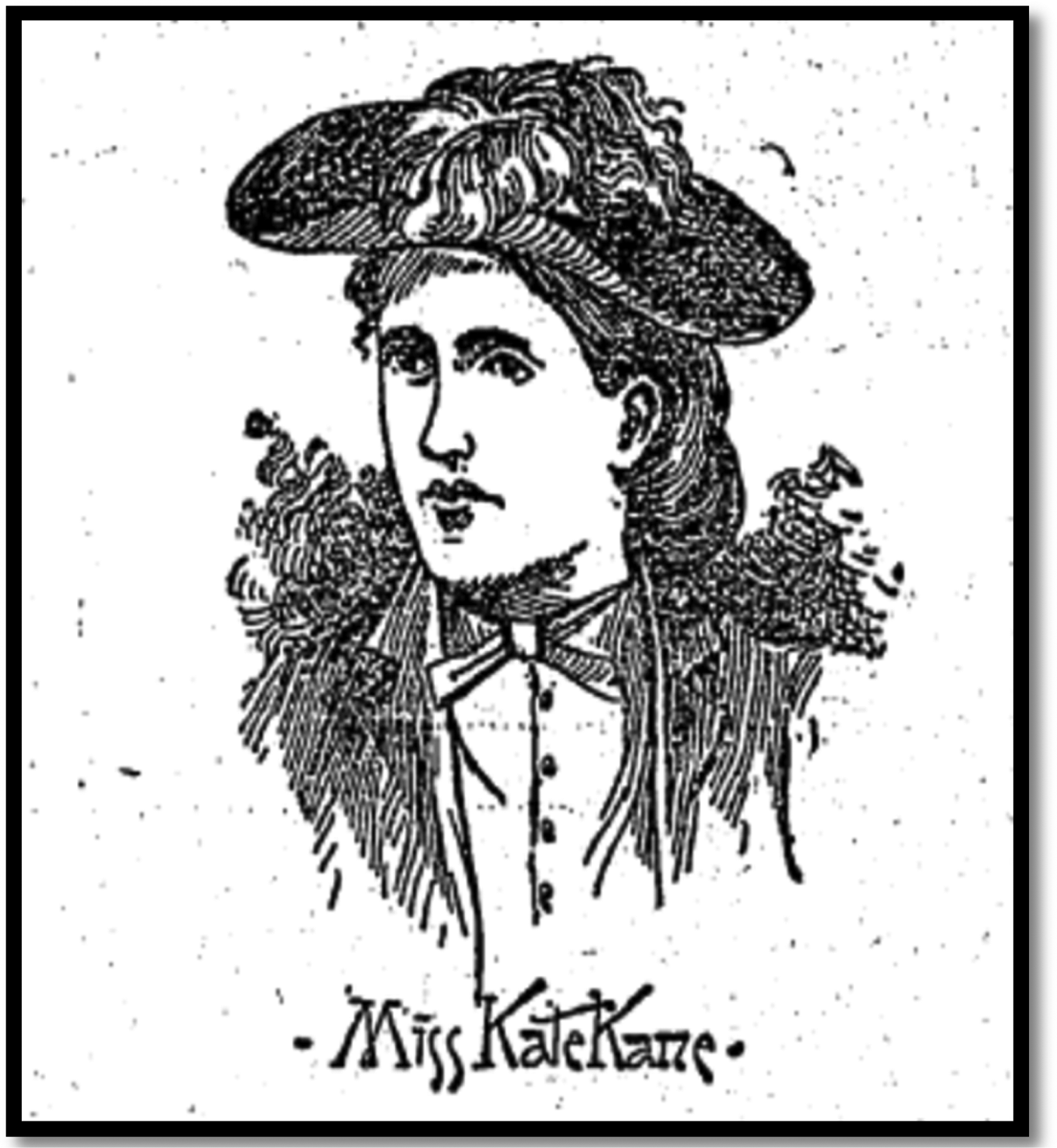
Portrait of Kate Kane. Source: “Ms. Kate Kane,” Milwaukee Journal, July 29, 1891, 5.

Kane's story intersects with histories of women's suffrage and women in the professions, and it connects events in Wisconsin and Illinois to national struggles for legal change and comprehensive citizenship. Kane clearly belongs among the first generation of trailblazing women attorneys whom historians have described as “rebels” and “sisters.”Footnote 11 Like other women who pioneered a foothold at the bar, in reform and advocacy, in legal publishing and writing, and in courts in Milwaukee and Chicago, Kane is distinguished by her extensive lower-court practice that required her to navigate hostile environments, to accommodate fluid circumstances, and to manage desperate clients.Footnote 12 As a “representative woman,” Kane shifted affiliation, moving “in-between” communities: societies of shared interest ranging from feminism, reform, and politics to advocacy, litigation, and business.Footnote 13 Kane's mobility—which translated into practicing law, running for office, and advocating legal and political reform—confounds a narrative of nineteenth century feminism that stresses gradual liberation. For professional women such as Kane, the gradual, measured removal of sexual barriers did not translate into full inclusion and comprehensive equality. Instead, it framed new struggles to put professional and political opportunities into practice.Footnote 14 Taken together, these fragments of Kane's story of self-fashioned belonging endorse a legal historiography of contested lawmaking and sexual and racial hierarchies.Footnote 15 They also imply a vision of citizenship that is formal, top down, and stratified.
This article builds on analyses of professional, reforming, and feminist women to tell a story about citizenship that centers on the ways that Kate Kane used everyday, street-level interactions and exchanges to stabilize membership in professional, political, and civic communities. Kane's professional, reform, and public activities corroborate a vision of citizenship that is not top down, but bottom up, fluid, and self-fashioned. This citizenship model resonates with a diverse and vigorous scholarship interpreting everyday life. It complements the insights of French theorist Michel de Certeau that everyday activities—such as walking, talking, and reading—both constitute and stabilize formal systems and structures of authority, such as constitutional citizenship.Footnote 16 It endorses claims that popular, everyday conceptions of law assembled by ordinary Americans could be more accurate and influential than official doctrine.Footnote 17 It ratifies the innovations of renowned sociologist T.H. (Thomas Humphrey) Marshall, who describes citizenship as a legal status invigorated by social interactions, by “the right to share in the full social heritage and to live the life of a civilized being.”Footnote 18 Kane's self-fashioned citizenship also replicates the insights of historian Thomas Holt that individuals are “marked” in their everyday interactions, and that those “markings” reinforce larger patterns of discrimination, racism, and sexism.Footnote 19 In contrast to Holt, however, the “markings” described in this article refer to processes of unmaking, but also making, belonging. These analyses of everyday interactions—which stress the agency of ordinary people—speak to the ways that Kate Kane self-fashioned her citizenship. Kate Kane was not the only woman to defy convention in the late-nineteenth century. But her story asks us to rethink the meaning of belonging in the era of formal, rigorous exclusion after the Civil War. Kane, who proved to be a master of publicly expressing her prominence, commitments, and beliefs through lawyering, uplifting, and petitioning, leaves historians a complicated and fragmented record with which to grapple.Footnote 20 Although her ambition never fully unmade the mistreatment and abuses that “marked” her status as inferior, the everyday interactions she corroborated—that are outlined in this record—reveal how Kate Kane self-fashioned her belonging by continuously shifting in between the multiple, diverse, and particularized communities that she encountered.
Citizenship Models
Kate Kane's drenching of James Mallory is the most extreme example of her iconoclasm. As a practicing attorney in the 1870s, she was statistically a phantom. Wisconsin census records from 1880 list zero female attorneys, despite the fact that in 1879 Kane practiced alongside Lavinia Goodell and Angie King in Janesville, a small town 40 miles (65 km) southeast of Madison, Wisconsin.Footnote 21 Like other women in the 1870s, Kane became an outlier of new constitutional claims on citizenship that developed from Fourteenth Amendment jurisprudence. Constitutional citizenship was formally established after the Civil War in the first section of the Fourteenth Amendment, ratified in 1868, which granted citizenship to “all persons born or naturalized in the United States.” The Amendment also enumerated three citizenship safeguards: Privileges and Immunities, Due Process, and, Equal Protections of the Laws.Footnote 22 After the Amendment was ratified, Americans scrambled to use the new constitutional standards to define their citizenship status and to expand their rights and liberties. The result was a sequence of landmark decisions in which the Supreme Court repeatedly denied comprehensive constitutional citizenship to members of disenfranchised and marginal groups, including women, African Americans, and wage workers.Footnote 23
Landmark legal opinions dealing with professional membership and voting track women's exclusion from the provisions of constitutional citizenship. Myra Bradwell, the accomplished wife of an Illinois state representative and judge, sued the state of Illinois when it refused to grant her a license to practice law, even after she passed the bar.Footnote 24 Justice Joseph Bradley's outrageous concurring opinion in Bradwell v. Illinois (1873), which appealed to the “noble and benign offices of wife and mother,” endorsed formal legal restrictions on women's labor and sanctioned their exclusion from professional practice.Footnote 25 A second—but not entirely unrelated—challenge was launched by Virginia Minor, the noted suffragist and wife of successful St. Louis attorney Francis Minor, who became the namesake of the legal campaign to use the citizenship provisions of the Fourteenth Amendment to disable Missouri's ban on women's suffrage.Footnote 26 In this decision, the Court explained that the state's enfranchisement of men did not violate the citizenship rights of women. Today, Minor and Bradwell anchor a traditional constitutional narrative of women's formal legal inequality that marked women's status as degraded into the twentieth century.Footnote 27
Kate Kane's lawyering, uplifting, and petitioning provide a bold alternative to this citizenship narrative by stressing acts of self-fashioned belonging. Born in Wheeling, West Virginia in 1854, Kane moved to Wisconsin as a child. After working briefly as a teacher in Lacrosse, Wisconsin, she attended the University of Michigan Law School for 1 year, in 1877. In 1878 she began reading law—a method of entering the legal profession by acquiring legal knowledge in a firm—in the offices of Pliny Norcross and A. A. Jackson in Janesville.Footnote 28 Despite the fact that Kane was only the second woman licensed to practice law in Wisconsin, she would be one of three female attorneys who practiced in Janesville in 1879.Footnote 29 That year, Wisconsin's Supreme Court reversed its ban and admitted Lavinia Goodell to the high court's separate bar.Footnote 30 Also in 1879, Kane relocated from Janesville to Milwaukee.Footnote 31 Despite Milwaukee's relative cosmopolitanism, the city's journalists immediately became obsessed with the novelty of a young female attorney, and described her repeatedly as a “pretty,” unmarried, “lady lawyer.” One journalist even imagined that her presence alone would end difficulties with finding jurors; instead, the court would “have to drive ‘em off with clubs.”Footnote 32 Kane's robust practice in Milwaukee would reveal that she was deeply invested in law, in legal conventions, and in an agenda, in which courts used rights to protect people, treat them fairly, and standardize their statuses.
Young, self-sufficient, professional women such as Kate Kane were a counterpoint to post-Civil War constructions of sexual and constitutional inferiority. Like Goodell, she created space for herself within the legal community, which she expanded at the end of 1881 when she was admitted to practice at the bar of the Wisconsin State Supreme Court, and again in the spring of 1890, when she became the eighth woman admitted to practice before the United States Supreme Court.Footnote 33 Unlike Goodell, whose promising legal career in Janesville was cut short by ovarian cancer in 1880, Kane's career in Milwaukee's and Chicago's lower courts put her at the center of legal (and sometimes physical) conflicts in courtrooms and jails, where she battled for the fate of clients who were sometimes disreputable, and often marginal. In fact, Kane's divergence from Goodell's habits and practices speaks to her larger deviation from the temper of late-nineteenth century feminist and reforming women. Although Goodell reportedly respected Kane's legal capabilities and even consulted her in preparing a defense for her client, Tom Ingalls—a young drunk convicted of theft—she also judged Kane to be coarse, and complained that she “lack[ed] principal, judgment, and refinement;” Kane reportedly even led Goodell to question the value of her own trailblazing, writing to her cousin Sarah Thomas, “is it for such as these that I went through the agony of breaking my way into a new profession for women.”Footnote 34 Kane's engrossment in the abrasive exchanges that punctuated life in the lower court, and which provide a basis for the alternative citizenship model described in this article, also set her apart from many of the leading professional and feminist women of her day.
Kane appeared to spend her life caught between striking commitments to sexual equality and instances of profound subordination. Kane fought for clients, battled judges, railed against sexual discrimination, and insisted on reforms to help workers and poor women. She also, at the age of 40 (in 1895), married Italian Vincenzo Rossi, and in the process, contracted her own formal subornation.Footnote 35 This ambivalence, coupled with Kane's multiple—and sometimes contentious—public personae and her outlier status, perhaps explain why she appears so intermittently in the historical literature, often in connection with accounts of poor defendants or of women in the professions.Footnote 36 Her writing and communications are not collected and archived. Instead, Kane survives today in fragments: in the snippets, editorials, speeches, and trials in which journalists portrayed her to readers more than a century ago. These fragments, which attest to her ability to use media, and to her ambition to shape policy and to initiate reform, reveal a character that could be deeply idealistic, and deeply pragmatic, but that was always fully engaged with her clients and her causes. In her day, Kane pushed back from the margins of the legal profession and of national citizenship to establish her membership in multiple campaigns organized around suffrage, reform, worker's rights, law, and prison reform. Through her lawyering, uplifting, and petitioning, she endorsed a model of everyday citizenship distinguished by three criteria: access to law and courts, social interactions and exchanges, and public engagement. Kate Kane revealed the “markings” of her denigrated status in everyday interactions that also corroborated her community memberships. By staking her membership and self-fashioning her belonging, she also held out the promise of unmaking the inscriptions and attributions that demeaned her, validating—in the process—her inclusion in the national community.
Lawyering: Cases and Clients
Kate Kane once boasted that she had defended “every crime known to modern times except treason and piracy.”Footnote 37 Milwaukee and Chicago journalists described how she litigated minor disputes, typically involving fringe figures charged with low-level crimes such as prostitution, disorderly conduct, vagrancy, or theft.Footnote 38 Kane's experience made her accustomed to the quick negotiations and agreements behind arraignments and trials that paced activity in the lower courts in Milwaukee and Chicago, and she was attentive to the ways that local law disadvantaged the marginal. For example, when domestic worker Agnes Bornhofen was accused by her employer and convicted of grand larceny in the theft of $140, Kane demanded that the verdict be overturned and additional evidence be introduced. It was not uncommon for mistresses to concoct charges that allowed them to dispose of unwanted housekeepers.Footnote 39 Unfortunately for Bornhofen, her ex-employer prevailed and she spent a year in jail after her conviction was upheld.Footnote 40 Although it was unsuccessful, Bornhofen's defense endorsed an ideal that Kane championed: that legal protections sanctioned equivalences, and that her defenses elevated the marginal and corroborated their membership in the larger, metropolitan community.
Late-nineteenth century journalists have detailed Kane's record in minor criminal cases. Milwaukee newspapers described Kane's defense of Fred Dilgus, who was charged with stealing livestock, of John Buckreis, who was accused of uttering threats, and of Frank Robinson and John Goodrich, who were charged with robbery.Footnote 41 Chicago papers described Kane's defense of Patrick and William Boyle, who were accused of breaking into a pawn shop on the city's South Side.Footnote 42 Milwaukee papers described her efforts to keep a family together that included 9-year-old Lilly Shaw and 7-year old Dora Shaw, the children of an ailing mother who was “charged with being destitute.”Footnote 43 Chicago's Inter Ocean described how Kane was able to secure a reduced, 1 year sentence for Frances Wilson, a sex worker who killed Henry Steinberg, “a stranger in the city,” in a dispute over $10. The Inter Ocean reported that Kane won this case despite an incriminating police report that “said Steinberg was shot by the woman as she was running down stairs and that the woman was in possession of the revolver.”Footnote 44 Kane's skillful defenses placed her at the center of criminal proceedings in lower level courts.
Journalists’ accounts also reveal that Kane was an inventive litigator. In her defense of an anonymous shoplifter, Kane “tried to convince the judge that it was not unusual for woman to wear pillow-cases for pockets inside their dress.”Footnote 45 In the case of Mary Henning, a Chicago begging woman charged with vagrancy, she deployed the sexist assumption of the jury and argued that a woman could not be a vagrant because “she was not made to work.” The defense worked. An all-male jury agreed and threw out the case.Footnote 46 During Chicago's Columbian Exposition, in 1893, Kane defended dozens of individuals' daily who were accused of sex work and other minor offenses by local police, who had been ordered to “clean up” the area around the fair.Footnote 47 Whereas Kane's insistence on full sexual equality reflected her idealism, her commitments to her clients' defense and to her professional duties revealed a deep pragmatism. Kane's recognition that the legal system was unfair to women and to poor men steered her toward arguments that sometimes defied her principals: that stealing was wrong, that working women were equal to working men, and that prostitution was degrading. By extending law to the urban margins and making legal protections available to men and women, who, like her, were not recognized as full members of their communities, Kane made local law into a mechanism of inclusion and belonging.
Kane was also involved in several high profile cases. She defended steamship cook Jack Johnson who was charged with murder after he fought and killed James Gordon, a waiter with whom he worked with aboard “the steamer, the city of Milwaukee.”Footnote 48 Both men were African American. According to the Milwaukee Sentinel, after a disagreement Jackson grabbed a “large bread knife” and cut Jordan “on the side, lacerating his flesh terribly and severing several arteries.” The Sentinel reported, “The wounded man died almost immediately from excessive bleeding.”Footnote 49 In Johnson's defense, Kane succeeded in getting the charges reduced to second-degree manslaughter, the equivalent of a conviction for self-defense. Her handling of the case inspired praise from journalists in nearby Indiana that she “conducted herself very credibly,” but Kane's defense of Johnson also puzzled the editor of the Indianapolis Sentinel, who admitted, “The spectacle of a disenfranchised white women conducting the legal defense of an enfranchised colored man, is a curious phase in the social status.”Footnote 50 Kane's skill as an attorney, which was widely publicized, would strain contradictions in her social, legal, and professional status; contradictions that she only intensified by strengthening her membership in communities from which she was formally excluded.
The Milwaukee Sentinel tracked Kane's exile from Milwaukee to Chicago, where she continued to attack the “markings” that plotted her exclusions. Admitting “more than a little interest” in “her maiden effort,” the paper reported that upon arrival she publicly admonished journalists who used the adjectives “lady” and “female” when describing her work as an attorney. Kane explained that she felt that these cloying modifiers were “vacillating” and “weak.” However, the crux of her complaint was that because they invoked questions about women's ability to practice law, they made her sex into an obstacle to her professional participation.Footnote 51 The issue, Kane announced, was solved “at the christening services when I was called Kate instead of John.”Footnote 52 This declaration, which reveals Kane's deft and direct use of media to endorse her membership in a male-dominated legal profession, denounced efforts to use her sex to configure her exclusion.
In Chicago, Kane continued to work successfully as an attorney. She became involved in two of the city's most illustrious criminal trials of the 1880s. In the first, Kane defended Giovanni Azari, a 31-year-old from Trabia, Italy, who had come to the United States to work. Azari was one of five Italian immigrants accused of killing Filippo Caruso, also an immigrant, stuffing his body in a trunk, and shipping it to Pittsburgh.Footnote 53 While news of the trial and Kane's involvement was broadcast widely in newspapers in Wisconsin, Colorado, and Texas, in Chicago, the accused—all unpopular Italian immigrants—were immediately institutionalized, rigorously interrogated, surreptitiously moved between precincts, and repeatedly denied access to Italian translations of arguments presented at their trials. Kane's representation of Azari was reportedly distinguished by her repeated appeals, by her effort to contact his family in Italy, and by her application for a pardon to Illinois Governor Richard J. Oglesby.Footnote 54 Despite these efforts, Azari was hanged for the Caruso murder; Kane was the only defense attorney to attend the execution.Footnote 55 The following year, Kane would play a smaller role in an even larger case when her services were retained by activist Lizzie Swank Holmes, whom police arrested along with the entire staff of Arbeiter Zeitung, the radical, working-class newspaper, in connection with the sweep of Chicago anarchists immediately following the bombing at Haymarket.Footnote 56 The arrests proved baseless, and Holmes, along with Lucy Parsons and the rest of the newspaper's staff, were released.Footnote 57 Her involvement in the “Trunk Murder” and Haymarket cases reveals that only a few years after her move, Kane was firmly entrenched in Chicago's legal profession.
Like feminist and professional women of her day, Kane was “marked” by the opinions of sexist Gilded Age religious, medical, and industrial figures; each rejected women's claims to membership in professional and political communities. Famed Episcopal clergyman Morgan Dix thought that women should never attend university or vote. He opposed women like Kane on principle. In his view, she had no legitimate role in the public sphere.Footnote 58 Similarly, gynecologist Ely van de Warker, who was committed professionally to women's physical health, argued in respectable, middle class “scientific” media that women could never function as professionals. According to Warker, evolution bred their “anatomical unfitness” for professional labor, while it bred their fitness for domestic labor, and he considered women like Kate Kane to be outliers, “battling with the established order of sexual relations.”Footnote 59 Industrialist Andrew Carnegie made a similar claim to Warker's, that sexual equality was “primitive,” whereas sexual hierarchy was evidence of “civilization” and progress.Footnote 60 In Wisconsin, State Supreme Court Justice Edward G. Ryan, who had opposed property rights for married women at the state's founding constitutional convention in 1848, described women who practiced law as a departure from “the natural order” and as “treason against it” in the 1875 legal opinion he authored that denied Lavinia Goodell access to the Wisconsin high court's separate bar.Footnote 61 These opinions—exercised by high-profile, public figures—ignored everyday corroborations of community membership, while they reinforced and reproduced the “markings” of subordination and professional exclusions that degraded women like Kate Kane.
These opinions would also help structure Kane's resistance. In Milwaukee, Kane encountered deep and systematic sexism in the figure of Judge James Mallory, her professional adversary and opponent, whom she drenched in open court. Tensions between Kane and Mallory had begun to build in summer 1882 when newspapers reported that Kane felt that she could not get a fair hearing in Mallory's courtroom. Conflict between the two simmered through summer 1882, and erupted when Mallory revoked Kane's defense of a client “after she obtained a change of venues to the circuit court” in September 1882.Footnote 62 Three weeks later, after Kane filed an affidavit in defense of “Jim” Keegan, a burglar and notorious escape artist, who had repeatedly eluded Milwaukee police (much to their embarrassment), Mallory blocked the order on a technicality—“because the proper notification had not been given”—and chastised her in open court. “I don't want to send a sheriff again to peep over your door,” Mallory lectured. “If you have business in this court you had better attend to it, or the next time you are wanted I will send an attachment for you,” Mallory added, declaring his intention to humiliate Kane.Footnote 63
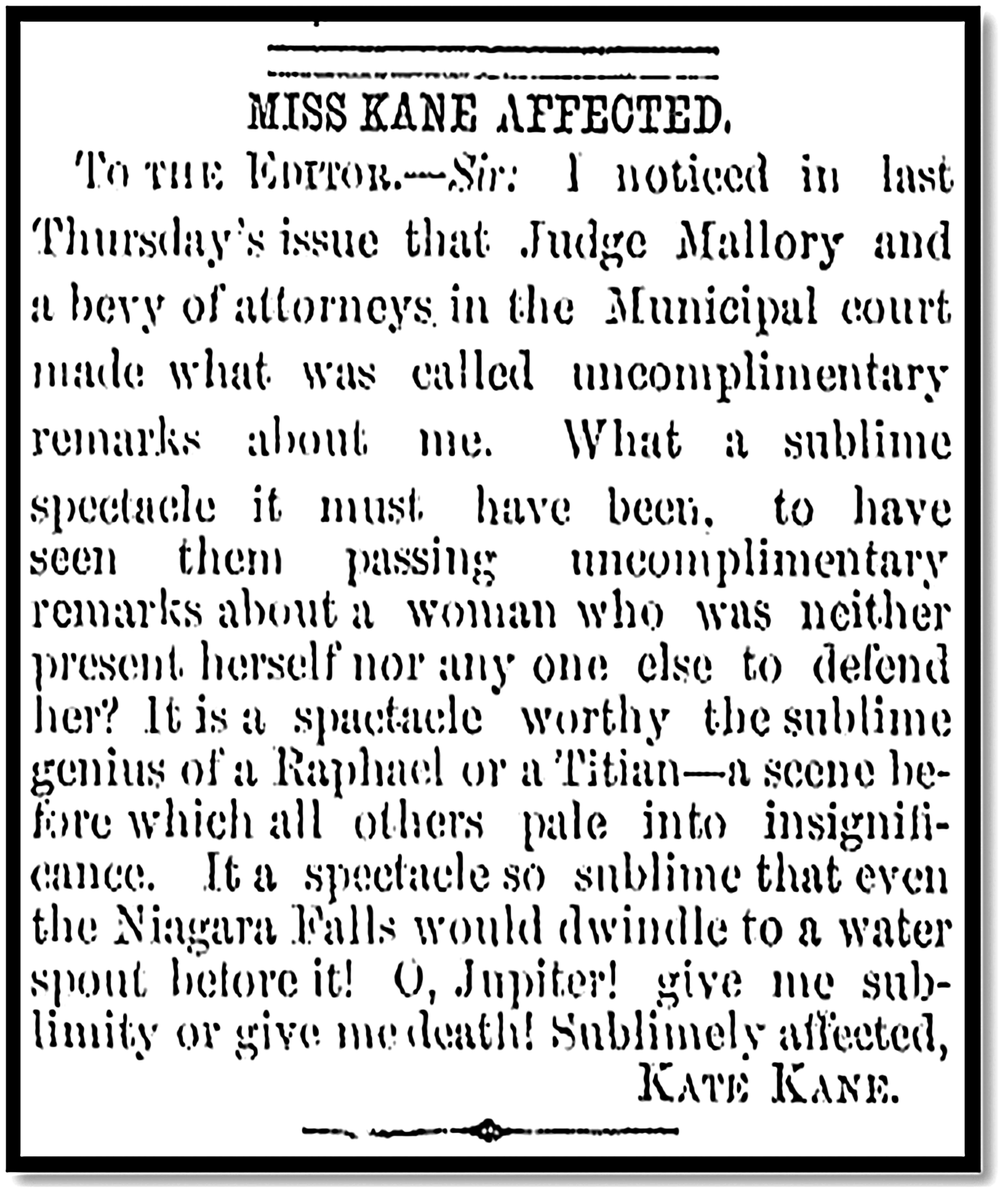
Conflict between Mallory and Kane escalated through the fall of 1882. After Mallory referred to two of Kane's clients as “sluts,” Kane snapped. “We always hear that the general politeness of well-bred men will protect women,” Kane explained, suggesting that Mallory was neither well bred, nor a man.Footnote 64 As tension between Kane and Mallory intensified, Kane made her complaints public when she published an editorial in the Milwaukee Journal, in which she restated her membership in the legal profession, complained that she was the frequent subject of ridicule in Mallory's courtroom, and then described her male colleagues as cowardly and sneaky. “What a sublime spectacle it must have been,” Kane wrote, “to have seen them passing uncomplimentary remarks about a woman who was neither present herself, nor [had] anyone else to defend her.”Footnote 65 The tensions between Mallory and Kane, which erupted in the water incident that effectively ended Kane's legal career in Milwaukee, resonated with the pervasive misogyny of the era. Like the marginal men and women she defended, Kane experienced “markings” that were intended to demean her in the spaces of a legal system that—rhetorically at least—was meant to uphold dignity and rights.
Kane made frequent and effective use of newspaper editorials. Source: “Miss Kane Affected,” Milwaukee Journal, January 8, 1883, np.
Kane would push back against mistreatment from other lower-level authorities in Milwaukee and Chicago, in particular, prison officials. She launched a suit against Sheriff Peter van Vechten that claimed he prevented her from seeing clients, including Anna Donnelly, a mother of three, who “insisted on employing her as counsel” in October 1879, and William and Patrick Boyle, who hired her in August 1880.Footnote 66 Although Kane chalked the interference up to “bribes received from a few sharks who hang upon the outskirts of the legal profession,” rather than to outright sexism, Chicago's daily Inter Ocean considered Kane's mistreatment an “interference in her practice” that was based on her sex.Footnote 67 Ultimately, van Vechten lost his political office at the end of 1882, although not necessarily because of his conflict with Kane.Footnote 68
While Kane reveled in van Vecten's political demise, she would encounter similar problems with jailers in Chicago, where clerk Ben Price refused to release her client, Annie Allen, who was facing charges of larceny and disorderly conduct; as their conflict escalated, Kane swore out a warrant for Price's arrest.Footnote 69 Two months later, in September 1890, after Kane was directed to the wrong prisoner and then locked “for some time” in a hallway in the dank and grisly Harrison Street Police Station, she filed charges with Chief of Police George Hubbard against jailer Frank Beaubien.Footnote 70 As with Ben Price, the charge against Beaubien was dismissed. Unlike in the Price case, however, Beaubien was given minor scolding for mistreating Kane.Footnote 71 Van Vechten's, Price's, and Beaubien's mistreatment of Kane reproduced structural commitments to exclusion based on sex.Footnote 72 Just as the “marking” of Kate Kane interfered with her ability to safeguard marginal men's and women's legal rights and protections, her self-fashioned membership in the lower court, corroborated by everyday routines, ordeals, and interactions, would broker her client's access to formal legal protection.
Uplifting: Temperance and Suffrage
In addition to litigation and legal battles, Kate Kane also established her public prominence through uplift and advocacy work. She frequently addressed meetings of the Ladies Board of Charities and Reforms, and gatherings of Milwaukee's Republican Party.Footnote 73 Kane was also involved in the two strongholds of late-nineteenth century women's activism: temperance and suffrage reform. Her speeches, which survive in journalist's accounts, provide evidence that she not only addressed mixed audiences in person, but that she also addressed them in print. In these speeches, Kane argued that “intemperance” was insidious, with wide-ranging consequences that “touched all conditions of man,” from the “master mechanic [who] finds it in his workshop, [to] the teacher among his scholars, [to] the physician among his patients.” According to Kane, “intemperance” attacked the dignity of men, who were often already demeaned by poverty and chronic joblessness, and represented what she called the “tyranny of society, which forced men to drink.” In a common uplift refrain, she appealed to her audience to do “so much in a moderate way.”Footnote 74 When Kane sought out these types of structural repairs to the social order, she identified the inequality and frequently challenged the “markings” that reproduced degraded status.
Although Kane self-fashioned her belonging through everyday interactions in communities of shared interests, she was also skilled at using newspapers and legislatures to broadcast her voice more broadly, publicly. In 1880, Kane would initiate an annual petition to the Wisconsin legislature for women's suffrage that survived even after her move to Chicago.Footnote 75 Excluding women from the political process, Kane would argue, reproduced instability in their status and in all parts of their lives—not just politics—while it made the rights and protections they experienced contingent, discretionary, and arbitrary. Because of this instability, Kane explained, women were perpetually at the discretion of judges and other officials; their rights were “created by one legislature and abolished by another, affirmed by one court and denied by another.”Footnote 76 Kane would argue that this arbitrariness, which pervaded formal law, “marked” women's subordination and generated “political distinction between men and women” that appeared to be biologically meaningful, but which were legally, economically, and socially baseless.Footnote 77 Kane was especially eloquent on this point, explaining in an editorial in the Milwaukee Sentinel that like men, women were subject to all forms of economic and social stress; they were allowed to “labor from twilight to twilight in unhealthy factories and mills at starvation wages;” and they were allowed to face pestilence, famine, and sacrifice. But, whereas they were permitted the full range of suffering, their ban from public life and lawmaking ensured that they were excluded from “the enactment or execution of the laws by which they [we]re governed,” and through which their suffering might be eased.Footnote 78
Kane often challenged—directly—the everyday disparagements that “marked” her. Kane's conduct in these instances, which reflected the intimacy of everyday interactions, would clash with the etiquettes of respectability and propriety to set her apart from leading nineteenth century feminists. In Chicago, 6 years after the Milwaukee water incident, Judge Hawes Williamson fined Kane $10 after she accused the judge of colluding with the states' attorney to “down her client.” Unlike the conflict with Judge Mallory, however, Williamson accepted Kane's apology, but lectured that “her language was unbecoming a lady or a lawyer.”Footnote 79 On another occasion, Kane reportedly chased her neighbor, Jane Roots, with a broom after Roots called her “jumbo;” Kane explained that she was trying to “teach her to mind her own business.” The charge against Kane was thrown out after Roots filed her complaint.Footnote 80 In another instance, when Assistant City Prosecutor Franklin Dennison, who was African American, refused to prosecute the John Morris Printing Press on a noise complain, Kane called him a “black vagabond” whose “place is somewhere down south with a rope around your neck.” When Dennison replied, “You ought to be nursing somebody's kids,” Kane broke her parasol over his head.Footnote 81 Elsewhere, Kane slapped another attorney in open court after he insulted her. She was arrested.Footnote 82 In 1908 she was forcibly escorted from the office of Chicago Mayor Fred Busse, “rambling about murders and atrocities committed in the city every day and covered up by the police,” and locked in the Harrison Police Station on a disorderly charge.Footnote 83 In 1912, she slapped a Chicago policeman in open court. In 1914 Domestic Relation Court Judge William Gemmill reprimanded her after an outburst.Footnote 84 In an environment in which lawyers and judges often misbehaved—where their rough conduct was used to rationalize women's exclusion—journalists noticed when women acted badly.Footnote 85 Scholars interpret Kane's rashness differently. Wisconsin educator Mary Bradford attributed Kane's outbursts to her iconoclasm, explaining that she was “untrammeled by ordinary conventions.”Footnote 86 Historian Virginia Drachman hazards that Kane's transgressions reveal a paradox: if she demurred and tolerated mistreatment from opponents “her courtroom career was doomed.” But if she resisted, she was criticized as irritable, petulant, and unladylike.Footnote 87 As Bradford and Drachman suggest, Kane's interactions in court were deeply personal exchanges that were animated, emphatic, and occasionally stunningly racist. These exchanges were expressed in a vernacular that was bawdy, rash, and sometimes vain, but rarely disconnected, and seldom aloof, from her convictions and her confines.
Kane recognized how the degraded status of intemperate men and politically excluded women disclosed structures of power and authority that were made and unmade through everyday interactions: “markings.” Her conflicts with guards, judges, and attorneys were a reminder that legal spaces were not only masculine spaces, but also combative spaces, and, that Kane was a part of that combativeness. However, unlike male colleagues, Kane was subject to censure that threatened to reproduce her exclusion. Journalists frequently used Kane's outbursts to justify her formal exclusion from political, legal, and reform communities. By folding Kane's bad acts into an argument for all women's inferiority, her opponents adhered to a model of formal, top-down constitutionalism that coordinated many of the inferiorities and inequalities—her “markings”—into a logic of exclusion. Amid this sequence, Kane's self-fashioned belonging proved durable. She argued that political and legal exclusions were invented and changeable; that they could be made, but also unmade. And, she interpreted law as a mechanism by which to unmake inferiority. In her activisms, Kane envisioned reforms that expanded community membership, incorporated new voices into legal spaces, and endeavored to make law reflect the agency marginal individuals exercised regularly, in their everyday ordeals and interactions.
Petitioning: Women Sheriffs and Working Men
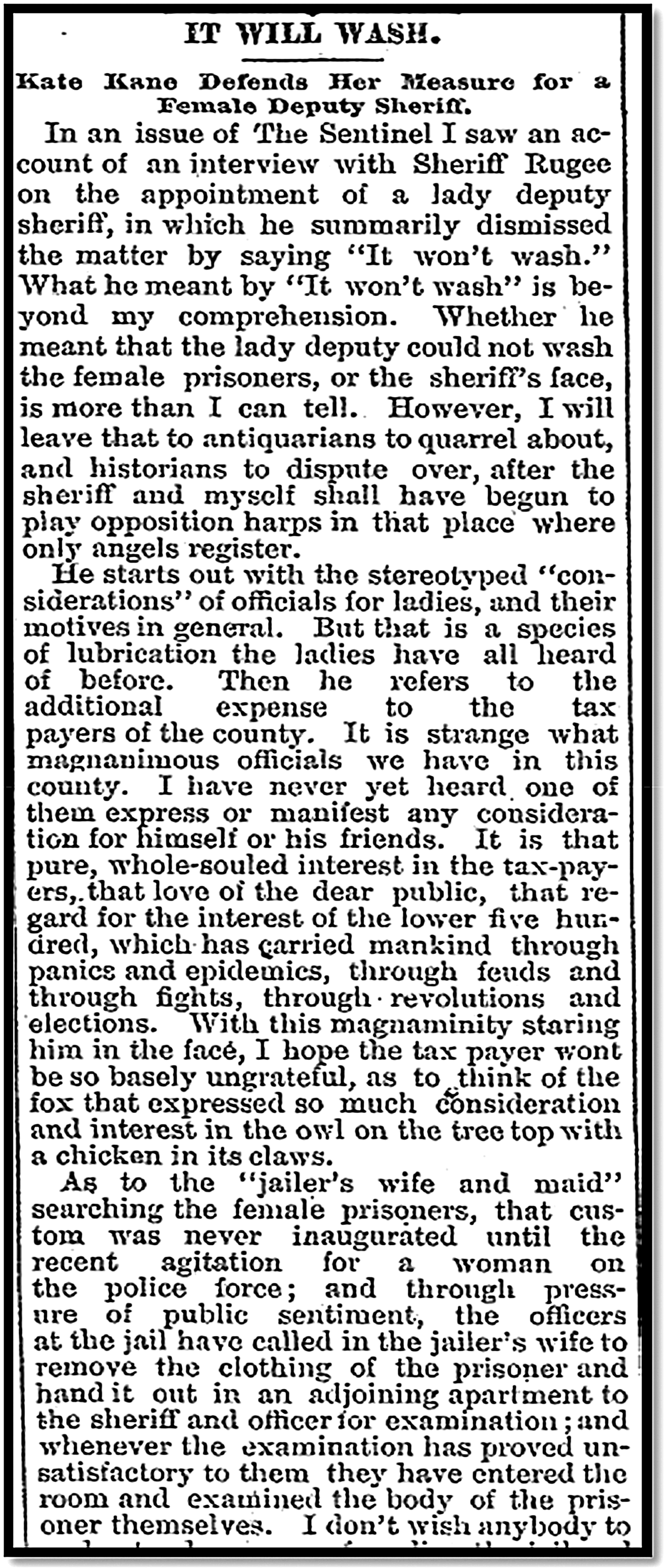
Kate Kane evolved a robust public identity outside local law and reform, in which she petitioned to improve the conditions of jailed women and working men. In the summer of 1880, Kane initiated a plan to have a woman appointed to the police force and put in “charge of all female prisoners in the several police stations;” by the following January her petition was presented to the Milwaukee council city.Footnote 88 The proposal was not entirely groundbreaking. In Chicago, only a few years earlier, five aldermen had forwarded a petition requesting “a lady physician” to administer to women detained in the police stations.Footnote 89 The police matrons Kane proposed would be stationed in the jails to safeguard women's bodies, “to draw attention to the treatment of women” in the jails, and to protect inmates from mistreatment and abuse.Footnote 90 Kane responded to opponents of a female sheriff, who argued, “it won't wash” resolutely, with an editorial entitled “It Will Wash.” She explained that the role of the female sheriff was to ensure the sexual equality of prisoners and prison employees. In effect, Kane wanted jailed women to be given the same treatment as jailed men, which meant they would be monitored and processed by a paid female officer, or “sheriff,” rather than “examined by the jailer's wife,” a figure she considered “already overburdened with domestic duties.”Footnote 91 In the early 1880s, Kane publicly demanded an institutional commitment to jailed women's equality. She would also insist on “legislation for the poor man,” and perhaps most audaciously, she would seek political office for herself. In each instance she aspired to “re-mark” individuals and self-fashion her belonging.
Editorial advocating installation of police matrons. Source: “It Will Wash,” Milwaukee Sentinel, February 14, 1881, 3.
In her campaign for a police matron, Kane was able to organize and communicate a new policy from a position of relative political powerlessness. After Milwaukee's Common Council rejected her police matron petition, Kane turned to Wisconsin's state legislature, where it received tepid support from members of the state's revenue-raising Ways and Means Committee; Chairman Nort Field even discussed the possibility of inviting Kane to make a public address.Footnote 92 However, while journalists from New Hampshire to California reported on Kane's proposal, her bill was “slaughtered in the assembly.”Footnote 93 Despite the setback, Kane and her supporters persisted. Eventually, “after three years of incessant labor and a great deal of newspaper controversy,” the Milwaukee Journal announced that a “matron of the jail and station house” was appointed. However, her $25 a month salary would not be paid by taxpayers, as Kane would have wanted, but by a private reform organization, the Ladies Local Aid Society.Footnote 94 The new position, which solidified hierarchical distinctions between male sheriffs, who were paid by the state, and female sheriffs, who were not, also denoted the implementation of a significant policy spearheaded by a citizen who was formally excluded from every part of the political process. This accomplishment must have animated Kane. Within a few months, she petitioned for childcare for women while they used the courts, and she criticized “authorities [who were] woefully ignorant or neglectful of the demands of decency,” for denying mothers charged with crimes the benefit of childcare.Footnote 95 As with the administration of female prisoners, Kane recognized how the absence of childcare constituted an everyday ordeal that “marked” accused women with a disadvantage that was at once systematic and deeply personal.
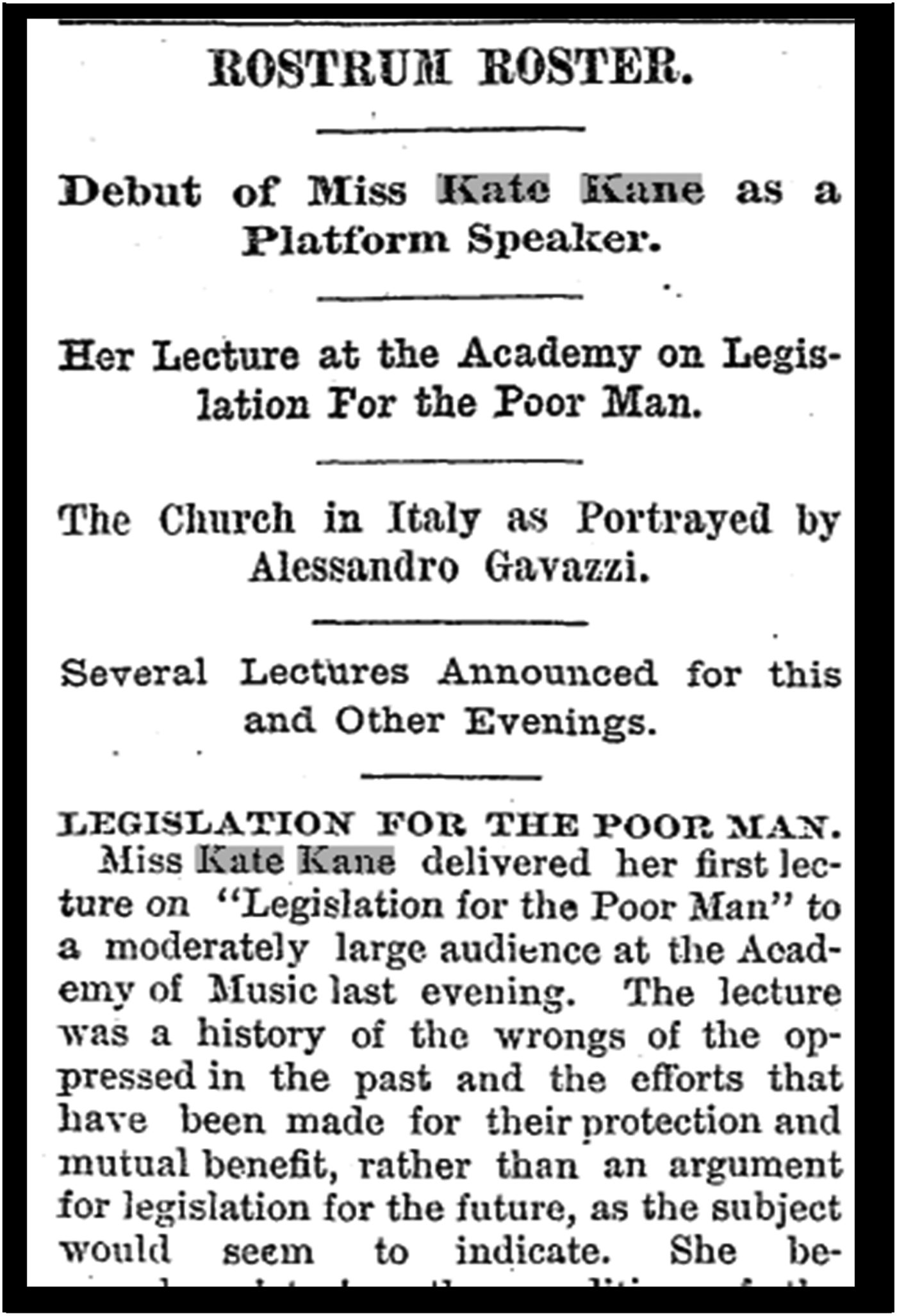
Kane also enhanced her public profile through paid speeches that she gave on the topic “legislation for the poor man.”Footnote 96 Newspapers reported Kane's speeches in Oshkosh, Waukesha, and Bay View at a bar named Puddler's Hall—all outside Milwaukee—and inside the city at the Academy of Music.Footnote 97 A Chicago Journal article that derided her public speeches—“A full fledged female lecturer is soon to make her debut in Milwaukee. What has the country done to Milwaukee?”—also ignored the content of Kane's “Legislation for the Poor Man” speech.Footnote 98 In it she made two significant points. The first point was that, historically, poor men have occupied a low status. According to journalists' descriptions, she argued that institutions such as feudalism, debtors' prisons, and the criminal justice system, which issued severe penalties, created and reproduced the degraded status of working men. Her second point was that democratic mechanisms—including law, courts, and legislative bodies— had the capacity to counter this low status, to elevate degraded men and women by broadening their liberties and “fundamental rights.” According to Kane, this opportunity was most available during moments of crisis; therefore, she encouraged workers to use law to seize crises to improve their status and unmake their inferiority.Footnote 99 Kane's point, that the “markings” that reproduced degraded status were changeable through everyday interactions, invited ordinary, marginal, and sometimes criminal men and women to expand their citizenship status through the courts, in law. Legal historians may find it surprising that Kane argued that law created, defined, and was defined by everyday social forces several decades before legal theorist Roscoe Pound was credited with inventing “sociological jurisprudence,” the legal theory that law should respond to social conditions.Footnote 100 Kane's invitation to workers to self-fashion their belonging through everyday routines and ordeals, and her conviction that legal status was changeable, were not necessarily out of step with law, but developmentally a few steps ahead of it.
Kane's “Legislation for the Poor Man” speech was advertised in Milwaukee newspapers. Source: “Rostrum Roster,” Milwaukee Sentinel, February 25, 1881, 3.
Also in the 1880s, Kane entered into symbolic battles for political office. Despite the fact that she was strictly barred from voting, Kane pursued public office dogmatically in a string of animated—but futile—late-nineteenth century campaigns. She ran for the office of associate judge on the Wisconsin Supreme Court in 1883, only 8 years after it prohibited women from practicing before it, and 4 years after it rescinded that prohibition.Footnote 101 She got three votes.Footnote 102 A decade later in Chicago, Kane ran for judge again; she collected more votes, but again lost badly. Because she was not officially nominated for office, Kane embarked on the arduous task of collecting signatures; she thought that wage workers, who also experienced the “markings” that sanctioned their exclusion, would be most “desirous of seeing a woman on the Superior Court bench.” She was mostly wrong. But, although Kane blustered that her opponents, who publicly described her campaign “as a huge joke,” would be “greatly surprised when the ballots were counted,” she may have been the one surprised when her efforts to enter public office engendered national opposition that publicized her campaign across the United States.Footnote 103 Once again, distant newspapers elevated the issues raised by Kane in her local, municipal campaigns to a national debate about women's status and their exclusion from politics. Journalists would be less uniform in their response to Kane's political ambition than they had been to the water incident. Some described Kane's candidacy on its merits. For example, Boston's Advisor and Kansas City's Atchison Globe reported that Kane was eager to run, and noted that she was opposed to divorce.Footnote 104 Portland's Morning Oregonian explained to readers that Kane had “distinguished herself” in “a few instances,” but revealing its familiarity with Kane's history, the Oregonian added that because she threw water at Judge Mallory, assaulted Franklin Dennison, and hit a jailer, she probably should not be elected as a judge.Footnote 105 In New Orleans, the Times-Picayune reported that Kane was physically robust and verbally caustic, but ultimately fair-minded, suggesting that she might even make a good judge.Footnote 106
Despite journalists' tacit approval, Kane encountered robust, formal opposition in the community she aspired to serve as judge. The Elections Board eliminated Kane from the 1893 race for judge in Chicago after it decided that her petition did not have the requisite 2% of registered voters in Cook County.Footnote 107 The following year, 1894, she would gather 3,100 signatures, and run for probate judge under the motto “Justice is the Inheritance of All,” a direct rejection of the “markings” of constitutional citizenship. This time, officials used “the sex of the nominee [to] disqualif[y] her.” An incredulous Kane called the decision “ridiculous,” but she was powerless to overturn it.Footnote 108 Although Kane's campaign appeared solitary, her ordeals against the “markings” that justified her exclusion placed her among the thousands of women who sought political office in the era before suffrage.Footnote 109
Despite repeated setbacks, Kane would continue to run for political office into the twentieth century, and even launched a bid to become chief of police in Chicago in 1911; she explained to Mayor Carter Harrison that she made a good candidate because she was “untrammeled by alliance and unburdened by pledges.”Footnote 110 Ultimately, Kane's fruitless (but highly symbolic) campaigns for public office, which restated that the political world was closed to her, were about more than individual tenacity. They reveal that neither the constitution nor the common law provided a functional basis of belonging for individuals with incomplete citizenship, and they demonstrated that everyday routines, ordeals, and interactions granted men and women living and working in the margins the authority to self-fashion their belonging. Although Kane never won an election, she used political campaigns, as she used courts and reform, to counter the “markings” of inferiority. Her political campaigns were also a harbinger of change in women's formal political and legal status.Footnote 111 In the spring of 1914, 150,000 women in Chicago cast ballots in local, municipal elections—for mayor, alderman, and the municipal court—that represented the first local enfranchisement of women voters east of the Mississippi River.Footnote 112 Kate Kane likely voted in 1914, and she most certainly voted after 1919. She died in Chicago in November 1928.
Conclusion
Kate Kane's story reveals limits to constitutional thinking about belonging, and tells a story about self-fashioned citizenship inaugurated by everyday interactions and ordeals. In his famous American Historical Association address two decades ago, Thomas Holt asked historians to think about the ways that everyday mistreatments and petty exclusions “marked” individuals and formed “minor links in a longer historical chain” of racial segregation and exclusion: an analysis not dissimilar to what Justice John Marshall Harland described as a “badge of slavery” in 1883-the same year Kane drenched Mallory.Footnote 113 In this account of self-fashioned citizenship, “markings” subordinate, but they also constitute sites of resistance, where exclusions are contested, inferiorities unmade, and belonging corroborated. Law, as Kane's story reveals, was crucial in efforts to unmake “markings.” “Women will never be emancipated until a sufficient number of them have mastered the law,” Kane wrote in the Albany Law Journal in the mid-1890s. Women lawyers, she explained, should “abolish their own servile environments” and “lead womankind out of degradation.”Footnote 114 At the same time, Kane recognized the limits of law; she understood how the prejudices of judges, lawmakers, and policy makers preserved sexual exclusions. In response to these obstacles and in order to accommodate her own ambition, Kane became a master at cultivating her prominence by lawyering, uplifting, and petitioning, activities that deepened her membership in multiple communities, from suffrage and temperance, from prisons to courts, and from labor to legislatures, where she shifted continuously between public and private, professional and political, and “men's” and “women's” communities. Kane would self-fashion her belonging through these diverse spaces and interests by constant corroboration, and by movement in between.
When Kate Kane doused Judge Mallory in open court in April 1883, she momentarily washed away the line between formal and everyday practices, and initiated the judge to a humiliation that constituted part of her “everydayness.” Kane's everyday—the interactions that unfolded in courtroom confrontation and trials, in newspaper editorials and public humiliations, and in private reform and political campaigning—captures the rich variety that Gilded Age poet Walt Whitman boasted of among Americans when he wrote, “I am large, I contain multitudes.”Footnote 115 Nearly a century and a half after she began practicing law in Janesville, Wisconsin, Kane's story points to the ways that we continue to distort our political principles and undercut ideals of a broadly shared national citizenship by parsing out features—such as sex, poverty, race, national origin, or ethnicity—and using them to “mark” individuals as different and unequal. Just as Kane challenged her detractors more than a century ago, she challenges our conception of citizenship today, most conspicuously in the hierarchies we use to define the formal, incomplete, citizenship status of classes of “illegal” aliens, immigrants, and “undocumented workers”: men and women who live and work at the margins in communities across the United States—often for years—without the benefits and protections of formal citizenship. By ignoring their socially corroborated memberships and their deep public commitments and contributions—and disregarding the ways that they are denied access to courts and to legal protections when out of frustration they make the intimacy of their exclusion palpable and “douse” an official—we continue to privilege a formal doctrine that curbs our “multitudes,” that excludes community members, and that upholds practices of “markings” outlying figures. By overlooking the everyday, Kane might argue that we continue to deploy a model of decreed constitutional citizenship, that we make artificial distinctions that degrade classes of Americans, and that in the process, we endorse practices that distort the democratic values of legal equality, political consent, and social inclusion that Kate Kane (and others) fought relentlessly to uphold.