Introduction
Questions pertaining to the ideological orientation of post-Byzantine art remain highly controversial for a number of reasons. First, because, in the past, such matters were deceptively upheld as self-evident truths in the service of political agendas which were set out in advance of research on post-Byzantine art-historical material.Footnote 2 Second, because, especially in pre-war Balkan scholarship, artistic problems and phenomena were separated from their historical context and were studied in light of national ideology in an attempt to construct the alleged ‘national’ character of post-Byzantine painting.Footnote 3 Such constructs are profoundly both methodologically problematic and research-distorting. However, despite the controversial nature of the ideological orientation of art, as I shall show below, one should not summarily discredit the matter, provided that such questions are investigated in art-historical terms within their contemporary contexts.
Byzantine and post-Byzantine art is the product of a civilization whose different expressions pre-existed the construction of national identity and, even after its appearance, remained largely independent. In the border areas of states or ecclesiastical territories founded on ethnic criteria, and after political intervention in artistic causes, it is still possible to trace some iconographic particularities, as in the art of the Byzantine tradition. Yet even these cannot be considered as ‘national’ characteristics, as the aesthetic principles of art are not dependent upon national reasoning. Orthodox art, quasi-marginal as it was in the Ottoman Empire, depended in different ways and places on private initiatives or the initiatives of the Church, itself subject to the central administration of the Ecumenical Patriarchate. Relationships of many kinds inevitably developed among the provinces under Ottoman domination. The alleged ‘national’ particularities, therefore, were but local traditions that were generated by the coupling of certain painters with particular aesthetic or artistic trends, or simply by the use of different models.Footnote 4
In this article I am building on previous workFootnote 5 on one of these local traditions generated by the influence of a patron with particular theological views and aesthetics over a group of artists who worked on the decorative programme of Ardenica Monastery, Kolonja, Lushnja, in the area of Myzeqe (Greek Μουζακιά) in central-southern Albania. More specifically, while in the previous article I demonstrated the necessity for the promotion of a militant spirit in the decorative programme of Ardenica Monastery on account of the region's conversion to Islam in the course of the eighteenth century and demonstrated how this programme addressed this need, in this article I am arguing that this militant spirit in the monastery's central church (frescoes, icons, ceramics and wood carvings) should be attributed to the influence of Nektarios Terpos (Albanian: Nektar Terpo), a fiery preacher from Moschopolis (Albanian: Voskopoja) during the first four decades of the eighteenth century, preaching suffering and martyrdom as means of salvation and glorification. To argue this, in the first part I shall outline the art-historical evidence provided by the given artworks viewed through an iconological method of enquiry. Finally, in the second part, I will link previous observations with the figure of the mastermind who, directly or indirectly (i.e. through his successors), was behind the artworks under consideration: the priest-monk Nektarios Terpos, by contextualizing his writings after analysing them by means of classical hermeneutics.
The circumstances
In the eighteenth century, conversion to Islam in the region increased and a large number of inhabitants of Labëri, Filiates, Pogon and Kurvelesh converted.Footnote 6 On 25 December 1724 the scholar-monk Nektarios Terpos, the abbot of Ardenica, travelled to the village of Dragot, Elbasan, to celebrate the Christmas liturgy. Upon entering the village church, he found the parish priest and around a hundred and twenty women, but only fifteen men. He learned that the other men had all converted to Islam.Footnote 7 In 1739, twenty-five villages in Thesprotia were forced to convert to Islam en masse.Footnote 8 It has also been noted that conversions intensified after the wars of Russia with the Porte (1710-11, 1768–74, 1787–92, 1806–12).Footnote 9 There is no thorough study of conversion to Islam in the region of Myzeqe based on demographic data; hence, although we anticipate that the region followed the overall trend of the conversion to Islam in Albania, what is known for the region is that by 1833 a significant portion of Myzeqe's territory was already Islamized, though the majority of the population were Orthodox Christian.Footnote 10
There are three main reasons for the spread of Islam throughout Albania and a part of Epiros. The first was social and political: since the Ottomans treated Christians with a certain distrust, conversions were favoured in order for Christians to acquire and retain official positions and privileges,Footnote 11 The second was economic: conversion to Islam was frequently accompanied by freedom from exploitation, arbitrary justice, overwhelming income tax and the payment of the poll tax. Conversion was also a means of amassing wealth.Footnote 12 Finally, it has been suggested that Albanians were well known for their indifference to religion. In the Middle Ages, for example, they converted effortlessly from Orthodoxy to Catholicism and vice versa, and during the Ottoman domination from either of these two confessions to Islam. Heresies such as Arianism and Bogomilism were also widespread in the country.Footnote 13 Furthermore, the illiteracy of the clergyFootnote 14 and the attendant poverty of the church must have played a role in conversion to Islam. Aravantinos has recorded the manner in which the Labs (the inhabitants of Labëri; in Greek: Λιάπηδες) were converted. Apparently, at a time of great famine, the bishop of Delvina and Himarra stubbornly refused to permit the semi-nomadic Labs to break the fast and consume milk. Their request to do so was countered by threats of interminable hell.Footnote 15 Fear of the possible consequences of the Ottoman occupation constituted another reason why disappointed and scared Christian populations living in regions formerly under Venetian rule and recently under Ottoman occupation felt impelled to convert. In his work on Venice and Albania, Arno states that ‘by 1690 Vlora had not only been placed under firm control by the Ottoman sultans, but also a strong and steady wave of conversion to Islam had already been observed’.Footnote 16
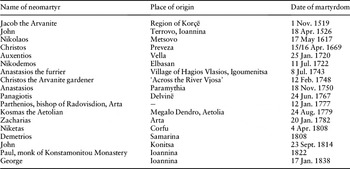
It was precisely at the peak of this conversion to Islam that a certain militant expression of resistance against it marked the appearance and veneration of neomartyrs during Ottoman domination. The neomartyrs were Christian converts who, having chosen to apostatize from Islam, faced the death penalty imposed by Islamic Law.Footnote 17 In Epiros and Albania there were at least eighteen neomartyrs (two in the sixteenth century, two in the seventeenth, nine in the eighteenth and five in the nineteenth), which indicates the pace of conversion to Islam (Table 1).Footnote 18
Neomartyrs of the Ottoman period in Epiros and Albania.

Emphasis must be given to the role of clergymen such as Terpos and Saint Kosmas the AetolianFootnote 19 in restricting the conversion to Islam. To a certain degree, these men, through the testimony of their sacrifice, helped to contain proselytism to Islam. Having outlined how one is to look at the ideological orientation of post-Byzantine art and the pace of conversion to Islam into the late nineteenth century, in the following section we shall move to our specific case-study. Ardenica Monastery must have been instrumental in containing conversion to Islam, not only because it provided a base for preachers such as Terpos and a refuge for Saint Kosmas’ disciples in times of turmoil after his death,Footnote 20 but also because its decorative programme, as manifested in its ceramic decoration, wall paintings, icons and wood carvings, aimed at preparing the faithful for redemption, glorification and resurrection through suffering, sacrifice and martyrdom.
The ‘militant spirit’ in Ardenica Monastery's artworks: the art-historical evidence
Situated on the highest hill among a group of knolls, lying in the middle of the large valley of Myzeqe (central Albania), Ardenica Monastery justifies its reputation as ‘the Castle of Myzeqe’. The Sacred Monastery of Ardenica is dedicated to the Nativity of the All-Holy Theotokos (8 September). The monastery has always been an important spiritual, cultural and historical centre for the region and beyond. This was due, among other reasons, to its proximity to the southern axis of the important road artery of the Via Egnatia, whose traces were still in use up to the beginning of the twentieth century.Footnote 21
Legend has it that the original nucleus of the monastery, the Church of the Holy Trinity, dates back to the tenth century. According to certain local traditions the monastery was founded in the thirteenth or fourteenth century. Other traditions, however, maintain that George Castriota Scanderbeg was crowned there in 26 April 1451 as ‘King of Epirots and Albanians,’Footnote 22 or that he was married there.Footnote 23 The katholikon (central church) of the Nativity of the Virgin was rebuilt between 1730 and 1743.Footnote 24 Yet, apart from unreliable oral traditions, there is some concrete historical and material evidence that the monastery existed before 1741.Footnote 25 First, a 1690 icon of the Archangel Michael from Ardenica Monastery bears an inscription commemorating the name of hieromonk Symeon, abbot of the very monastery.Footnote 26 Second, in 29 June 1718 the monastery of Ardenica received a donation of three hundred akçe, as shown in a note kept in the register of the Moschopolis tailors’ guild.Footnote 27 Thirdly, writing shortly before or after 1720, the Moschopolitan priest-monk and scholar Terpos introduces himself as the abbot of Ardenica Monastery.Footnote 28 Furthermore, two other inscriptions on monastic buildings or icons belonging to the monastery bear the dates 1730Footnote 29 and 1731,Footnote 30 while one of the extant oil-lamps of the monastery bears the date 1725 and states that it is the property of Ardenica Monastery.Footnote 31 In addition, other inscriptions on the monastery's bells bear the dates 1708 and 1738.Footnote 32 It is therefore beyond doubt that the monastery existed well before the eighteenth century, while legends placing its original nucleus in the late Byzantine period are reinforced by Reshat Gega's dating of Ardenica's Holy Trinity chapel to the thirteenth to fourteenth century on the grounds of anthropological analysis of the skeletons found outside the east wall of the chapel and of constructional data presenting similarities with the thirteenth- to fourteenth-century church of the Transfiguration at MborjëFootnote 33 and also by the so-called ‘Ardenica Codex’ dating from the twelfth to thirteenth century.Footnote 34
Considering that the excavations that took place during recent restorations of the monastery did not reveal any evidence that the current katholikon was built on the foundations of another church,Footnote 35 one has to assume that the original nucleus of the monastery is actually the chapel of the Holy Trinity, which is situated on the highest spot of Ardenica's knoll.Footnote 36 Various inscriptions and other sources suggest that the Monastery of the Nativity of the Theotokos, thanks to generous contributions from the merchants of VoskopojaFootnote 37 was built gradually from the 1730s to the 1770s.Footnote 38 The outcome was truly impressive: suffice it to say that Ardenica's katholikon stands out as the oldest and most lavish among a series of impressive eighteenth-century monuments to be built in the region of Myzeqe.Footnote 39
Around 10–19 November 1741, Sultan Mahmud I issued a firman permitting the repair of Ardenica Monastery.Footnote 40 Judging from the course of construction after 1741, this firman must have been used as a licence. If there were a prior firman granting a licence, the formulation of the 1741 letter would have been different and Ottoman bureaucracy would not have failed to mention it.
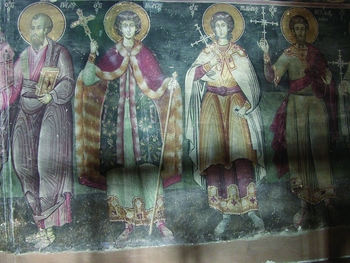
The katholikon of Ardenica Monastery is decorated with frescoes dating to 1744, i.e. a year after the construction of the katholikon was completed. They were painted by the brother painters Constantine and Athanasios from Korça, who were commissioned by merchants from Voskopoja. The katholikon bears four zones of frescoes, which generally follow the traditional structure of iconographic programmes. The lowest of these is taken up with full-length depictions of saints; the second register contains saints in medallions, the third depicts the Akathist Hymn and the fourth consists of scenes from the Christological cycle. Among the saints of the first zone, two observations are worth mentioning. First, the depiction of several military saints on the north wall (from East to West: St Demetrios, St Nestor, St Artemios and St James IntercisusFootnote 41 ) and on the south wall (from East to West: St George, St Prokopios, St Theodore Tyron, St Theodore Stratelates and St Menas) without their military attire (Fig. 1). The saints are instead portrayed as martyrs, bearing lay clothes and the characteristic cross of martyrdom. Such is also the choice of patrons at the Skete of St Anne on Mount Athos, also painted by Constantine and Athanasios from Korça, which follows late Palaeologan and early post-Byzantine models dating from no later than the seventeenth century.Footnote 42 Second, the scene of St TryphonFootnote 43 is not unlikely to be identified with a local martyr saint, St Tryphon of Sheqista, locally venerated in peasant-farmer settings, as is the well-known third-century saint of the same name who was martyred at Nicaea.Footnote 44
St George, St Prokopios, and St Theodore Tyron, fresco by Constantine and Athanasios of Korça, 1744, south wall of katholikon of Ardenica Monastery. All photos in this article are © K. Giakoumis.

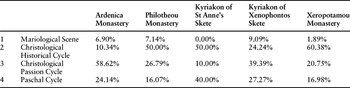
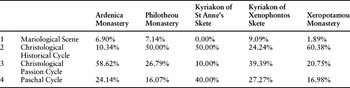
The programme of Christological scenes is characterized by a remarkable reduction of the historical cycle in order for the Passion and Resurrection cycles to occupy almost the entire pictorial surface. This choice, as demonstrated below (Table 2), is unique among the studied monuments painted by the same artists, even in such ascetic settings as Mount Athos.Footnote 45
Proportions of representation of different iconographic cycles in Ardenica Monastery's katholikon compared with those of other monuments painted by the same artists. The dominance of the Passion and, to a lesser extent, of the Resurrection cycle is evident.
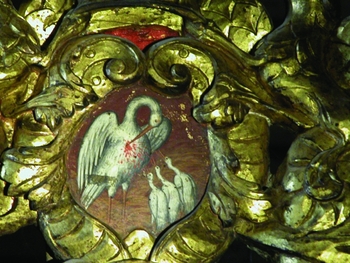
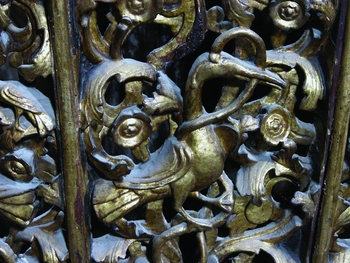
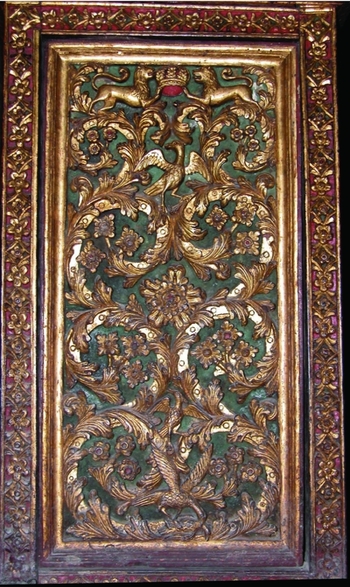
All the icons of the iconostasis were probably made in 1744, together with the iconostasis itself. The icons bear the signature of the painter, Deacon Constantine of Shpat.Footnote 46 Below the Cross of the Lypera a little almond-like tondo icon represents a pelican on the left of the painting, dominating the vertical axis of the pictorial space, piercing her right flank with her beak to feed her three chicks, who open their beaks to drink from the blood spilt from the wound (Fig. 2). Using iconological methods of interpretation, I have demonstrated that the association of the placing of the icon with relevant texts points to a powerful symbolism of sacrifice and resurrection.Footnote 47 The same variant of the pelican's story appears twice in wood carvings of the Ardenica Monastery. First, on the ambo, where a pelican is bitten by a serpent (Fig. 3). Second, on a panel of a proskynetarion, where narrative elements are observed: on the lower part of the panel an adult pelican with open wings appears to be tenderly caressing a dead chick lying on the ground. Above this, the now resurrected young chick is flying up to the skies with open wings. On the upper part of the panel, two lions in profile face each other holding a red, green and gilded crown with their front left foot. The crown's lower part is painted in red to demonstrate that it is lined with velvet. The two lions crown the young pelican chick which emerges underneath floral decorations (Fig. 4). The lion here symbolizes Christ, ‘the lion from the tribe of Judah’ (Rev. 5:5). According to Hall, in ‘medieval bestiaries the lion symbolizes the Resurrection because the cubs are born dead and only come to life on the third day when their father breathes on them.’Footnote 48
Constantine Hierodeacon from Shpat, Tondo-icon of the pelican on the iconostasis, 1744, tempera on wood and gold leaf.

Pelican bitten by a serpent on the ambo, c. 1744, painted wood and gold leaf.

The story of the pelican on front panel of Proskynetarion, c. 1744, painted wood and gold leaf.

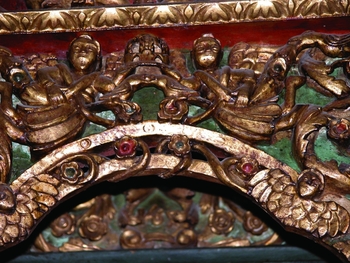
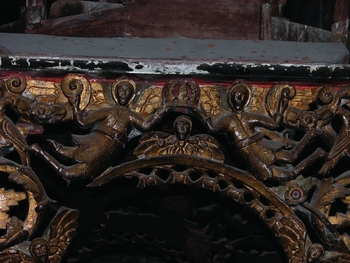
The dominance of the crown in the wood carvings, with its dual symbolism of passion and redemption or glorification, befits the overall messages conveyed through other artistic media. It can be found in the iconostasis, as well as in other wood carvings of the katholikon, like the bishop's throne (Fig. 5), the canopy of the altar (Fig. 6) and a proskynetarion.Footnote 49 In Christian iconography the crown is a symbol of sovereignty, power, victory and the attainment of honours. The Christian martyr's crown signifies both the passion, reminiscent of Christ's crown of thorns,Footnote 50 and victory over death,Footnote 51 also manifested in various ways and artistic media detailed above.
Crown held by two angels on lintel of bishop's throne, c. 1744, painted wood and gold leaf.

Crown held by two angels on south side of canopy frontal of the altar, c. 1744, painted wood and gold leaf.

The artist's persistence in rendering military saints as martyrs, without their military attire, though a trait of a period style in the Balkans, acquires a particular significance when combined with other elements. Such elements include, first and foremost, the extended Passion cycle, the image of the pelican piercing her flank below the crucified Christ of the Lypera and the similar image on the wood carvings of the ambo, and the dominance of the element of the crown in the wood carvings with its dual symbolism of martyrdom and triumph. To these elements one could also add the supreme symbol of the divine passion, the cross, formed with five glazed clay plates dating from the first decades of the eighteenth century (Fig. 7), which was formerly visible to pilgrims as they first glanced at the gable of the katholikon above the apse as soon as they entered the monastery (with one plate at the joint of the arms). Regrettably, these plates, which were still visible until 2010, have nowadays almost entirely perished, having fallen prey to children's slings. A complementary interpretation of the same artworks, however, points to an emphasis on salvation and glorification: martyred military saints are painted by the side of other saints united to God; besides the extended Passion cycle, there is another extended cycle of frescoes, the Resurrection and Paschal cycle; the resurrection of the pelican's chicks, the crown, a symbol of royalty and glory; and, last but not least, the very Precious and Life-Giving Cross as symbol of hope, salvation and glorification. I have no doubt that the mastermind behind the design of Ardenica Monastery's decorative programme must have been a theologian who placed much emphasis on eschatological theology.
Five plates in the shape of the Cross in gable above apse, early 18th century, glazed clay.

The mastermind
In the previous sections I outlined the history of the ideological orientation of ‘resistance’ in post-Byzantine painting,Footnote 52 the pace of conversion to Islam in Epiros and AlbaniaFootnote 53 up to the eighteenth century that set the historical backdrop of such a spirit, and the emphasis on salvation and glorification through suffering and martyrdom in the decorative programme of Ardenica Monastery. In this section I argue that, directly or indirectly, on the basis of his theological discourses and their ideological orientation, the mastermind behind the monastery's iconographic programme is most likely to have been Terpos, Ardenica's abbot during the first quarter of the eighteenth century.
The role of scholar monks in the drafting of a monument's iconographic programme in the period is known to us from various epigraphic and documentary sources, including contracts between the monks of Xeropotamou Monastery on Mount Athos and the two brother painters Constantine and Athanasios from Korça, who worked for this monastery in 1783, i.e. at the end of their career. Their contract with the monastery clearly stipulates that ‘the archons of this monastery gave us [i.e. the painters Constantine and Athanasios from Korça] a register of feasts drafted by kyr Kaisarios Dapontes and the feasts should be made according to this, at the place where the teachers [i.e. the painters] believe this is appropriate’.Footnote 54 Constantine Dapontes, renamed Kaisarios after his ordination as a priest-monk, was among the most learned men of the eighteenth-century Orthodox world of the Ottoman Empire, the dominant figure of eighteenth-century religious poetry and literature, whose seminal work is recognized as one of the most reliable geographical, ethnographical, sociological, anthropological and philological sources of the eighteenth-century Balkan world.Footnote 55 His role in drafting the iconographical programme of Xeropotamou Monastery, embedding in it the ‘militant’ spirit of neomartyrs, is well known.Footnote 56 It was therefore neither uncommon nor demeaning for the artists to receive a template of the programme they were to execute by their patrons or one of their appointees. Though the evidence in favour of the attribution of Ardenica Monastery's decorative programme to Terpos is not as strong as in the case of the role of Kaisarios Dapontes in the katholikon of Xeropotamou Monastery on Mount Athos, I am arguing that it is sufficient.
Terpos’ biography can arguably be classified as evidence of the sort of suffering that many Christian subjects of the Ottoman Empire had to endure. Notwithstanding the Ottoman Empire's pragmatism in matters pertaining to domestic inter-religious affairs,Footnote 57 non-Muslim subjects in the Ottoman world were clearly second-class subjects, with rare exceptions. Furthermore, local state authorities and those responsible for public order lacked the open-mindedness needed for a more pragmatic approach to sensitive issues, such as condoning the illegal construction of churches in return for strict loyalty to the Sultan, a characteristic which was only to be found in the capital or other major centres of the empire. In addition, provincial regions of the empire were also much more vulnerable to abuses at a local level, which the pragmatic open-mindedness of the central government had to control.Footnote 58
Terpos, an offspring of a well-known family,Footnote 59 was born in Voskopoja in the last decades of the seventeenth century. It was there that he completed his education, pursuing studies at the well-known Moschopolitan New Academy. After completing his studies, he pursued the path of monasticism. He travelled to the Skete of St Anne on Mount Athos, where he was ordained a monk, and later to the Monastery of St Naoum in Ohrid, before serving as abbot of Ardenica Monastery.Footnote 60 His affection for that monastery is evidenced by various references in his most important work,Footnote 61 dedicated to ‘the Holy Embrace of the Lady Theotokos, the so-called Ardenica’, whose icon, dated 1731, Terpos calls upon to help her servants. The quadrilingual prayer (in Greek, Albanian, Aromanian and Latin) accompanying this icon indicates Terpos’ Aromanian ethnic background, since Greek and Albanian would be the minimum languages spoken by intellectuals in these regions.Footnote 62 It is interesting to notice that his concern for the monastery remained undiminished even when he was temporarily deposed from the monastery's abbacy, having suffered much, as he claimed, at the hands of a certain Arsenios.Footnote 63 In the course of his abbacy, the monastery was renovated, attracted several monks andbecame an important educational centre of the region.Footnote 64 He must have died at the end of 1740 or at the beginning of 1741 at a hitherto unknown location.Footnote 65 Soon after his death, his portrait was painted in full monastic attire in the church of the Holy Apostles in Voskopoja.Footnote 66
The analysis of Terpos’ single most important work, Βιβλιάριον καλούμενον Πίστις (A Booklet Called Faith) – initially published in 1732 and henceforth republished as many as twelve times during and after his lifetimeFootnote 67 – reveals his almost obsessive persistence on suffering and martyrdom, his condemnation of those who refuse it, and his assurance of salvation and glorification for those who do not escape it. In his work, his assessment of the reasons which compel Orthodox Christian to convert to Islam relate to a ‘consumerist’ model in the service of social status.Footnote 68 He claims that the fashionable new cultural model is not in keeping with the meagre income of the non-Muslim subjects of these regions:
The inhabitants of these places of Illyricum, Albania and Morea (alas) deny the Lord of Glory, everyone's Jesus Christ and God, purely for the sake of certain material needs. They spend two ducats or more on their [cloth] dye, on their vest and other clothes and wide underwear and brilliant braids and silver-gilded knives and silver rifles; they spend their akçe on all these things. And for Christ's faith and Paradise, they do not want to give six kuruş or even less per year; and thus, the miserable, they only separate themselves from Christ. . .Footnote 69
Instead, Terpos insists that the faithful should bear suffering with fortitude, and in his description of what this suffering entails he provides a precious first-hand account of what it meant to be a Christian in the remote Ottoman provinces where Terpos lived and travelled, thereby providing another perspective on the reasons compelling Christians to Islamize. As ‘Christ teaches us to have no pity on our body, but to spill our blood, if required,’Footnote 70 he writes, so one should bear with joy and patience the foreigners and ‘infidel’, even ‘if someone enslaves you, if someone preys upon you, if someone takes anything from you, if someone boasts, [or] if someone slaps you in the face.’Footnote 71 The call to perseverance is grounded in the biblical passage ‘Because strait is the gate, and narrow is the way, which leadeth unto life, and few there be that find it’ (Matt. 7:14), a passage which the author contextualizes as follows:
So what is the strait way? [The strait way] is the suffering and passions that we, the Christians, have to suffer. What are these? These are when the Turks are torturing us for Christ's love, battering us and swearing at us; and [when] we give the haraç, they get us on the roads and bother us, impose forced labour on us and seize our horses, and they grab what they like, they come to our homes and they remove us from our hearths; they warm themselves, while we tremble with cold; they eat and drink from our own, while we are hungry and thirsty; they go towards food and drink on their own and they take as much as they want, to the extent that they do not leave anything and your children cry and lament in their hunger and thirst. They get all the rugs, woollen covers and bedspreads, they make their beds and cover themselves and use what they do not need to cover their horses, and your children are on the floor all night, they tremble and cry out. They ate all the straw and grains and your own (animals) come to a bad end. Every year and time you give donations and presents to the Turks, or rather we give, because I am also suffering with you.Footnote 72
Terpos makes a concerned and concerted effort to align himself in sympathy with the simple folk, as, in evidence of solidarity, he records many examples of personal suffering because of his faith. The most palpable example he uses is related to the event of his trip to the region of Elbasan, at the village of Dragot, which was outlined above, namely finding the local priest celebrating the liturgy with about a hundred and twenty women with only about fifteenth men in attendance, the rest having been ‘Turkicized’ (i.e. converted to Islam). At that village Terpos not only preached Christ to be true God and the Theotokos to be the Virgin Mother of God, but he further made offensive statements about Islam and Mohammed, as a consequence of which he was lucky to escape death with only a heavy beating, which ‘left my left arm injured and I can never rest on that side.’Footnote 73 Indeed, Terpos is a well-known polemicist against Islam and many of his passages reveal a hostile attitude towards Islam and Muslims,Footnote 74 for which reason Georgios ValetasFootnote 75 erroneously believed that his book was anathematized by the Ecumenical Patriarchate.Footnote 76 His generally conservative spirit must have also offended Jewish communities, as he records having been beaten five times by Jews.Footnote 77
Terpos’ unswerving longing for suffering and martyrdom, for him and others, does not condone those who, for the purpose of avoiding suffering, opt for crypto-Christianity.Footnote 78 The disposition of the Church towards crypto-Christianity in the earliest encounters with the Ottomans – as expressed in the letter of Patriarch John XIV to the Christians of Proussa (Boursa) which fell under Ottoman control in 1331 – was one of clemency in the spirit of economy to those who were not brave enough to voluntarily become martyrs in the conviction that this was a strategy that would help preserve Christianity in territories newly controlled by the Ottomans. Later, however, patriarchs abandoned such clemency, reasoning that, as the Ottoman were not temporary rulers, ‘tolerating crypto-Christianity meant assisting the spread of Islam’.Footnote 79 Terpos is very critical towards mixed marriages or mothers encouraging their children to crypto-Christianity to avoid the hardship of everyday lifeFootnote 80 – indeed conversion to Islam appeared to be quite appealing to the younger generation in the course of the eighteenth centuryFootnote 81 – or women finding mitigation for their husbands’ espousal of Islam in the fact that they secretly practised Christian rites at night.Footnote 82 Using a powerful metaphor, the fiery preacher likens crypto-Christians to a dead mouse he once found in a church, because of whose presence neither ‘the Holy Church suffered molestation, [nor] was the mouse sanctified; such is the fate of deniers, who are secretly being brought to God's Church’. Thus, in a powerful anti-syncretic statement, Terpos explains that crypto-Christians were destined to be damned together with the apostates to Islam, suffering and martyrdom being the sole means of repentance.Footnote 83
Indeed, elaborating upon several evangelical passages on the denial of the Trinitarian God, such as ‘whosoever denieth the Son, the same hath not the Father’ (1 John 2:23) and ‘whosoever shall deny me before men, him will I also deny before my Father which is in heaven’ (Matt. 10:33),Footnote 84 Nektarios describes at great length the damnation that awaited apostates in the afterlife.Footnote 85 In his writings he states that he, as a spiritual father, is prepared to exercise strict economy in condoning the non-application of any religious calendar fasts to avoid someone's conversion to Islam.Footnote 86 He further enjoins Christians, if they cannot bear suffering, to emigrate ‘beyond the wide seas and go to foreign territories, other kingdoms, rather than to become a Turk [i.e. a Muslim].’Footnote 87 Although he upholds messianic views on the divine approval of the Ottoman Empire's rule, i.e. that ‘God made the Turks and He gave them the kingdom and the rule’ on account of ‘certain mistakes we did and are doing’, he does not accept this as a valid reason for conversion to Islam and likens the Ottomans to beasts of the earth created by God ‘because of the first man's, Adam's, disobedience and transgression’.Footnote 88 Terpos also brings forth a model of life conducive to enduring hardship:
So, I will show you a way by which you can easily save money [to pay] for the haraç and avoid becoming a Turk, and an apostate of God, and foreigner to Christ's Holy Church. First, work more than you are used to; and second, restrain yourself from food and drink. And if you plan to buy an okka of fish or meat, or wine, or oil, get only half for the sake of your soul and body. And your hat should be shorter, your belts may be of cotton or leather, but not exclusively of leather. And you should wear a short hat or a cap, and you should not become a Turk.Footnote 89
The call for suffering is not without promise for salvation and glorification in the afterlife. ‘Whoever wants to be great and honoured in Paradise, I want him to be and become small in this world and the least of all’. So preaches Nektarios, updating Christ's words, ‘whosoever will be great among you, let him be your minister’ (Matthew 20:26).Footnote 90 Hence, he admonishes his contemporaries to believe in God as the Lord of everything, obey his commandments to go to Paradise in the spirit of ‘he that believeth in me, though he were dead, yet shall he live’ (John 11:25) and conduct an openly Christian life to be saintly and blessed.Footnote 91 The direct and stark contrast between earthly delights offered by the Turks and the delights that Christians would enjoy in Paradise in the company of the saints and angels amidst Christ, reads almost as a promise for the afterlife, filled, as it is, with various relevant evangelical passages.Footnote 92 In his book, these two worlds of the afterlife – hell and Paradise – and the paths leading to each of them are visualized in a woodcut, so that the message will appeal to those relying more on visual representations than on texts.Footnote 93
Conclusions
To conclude, Nektarios Terpos was well-known for his preaching against Islam and conversion to Islam, with polemical statements against Islam and Mohammed involving the dichotomy between Christ and Antichrist, thereby causing the reaction of Muslim individuals and authorities at a local level and forcing him several times to leave Ottoman territory and find refuge in Venice.Footnote 94 He lived and worked in a period characterized by cultural shifts and a new wave of conversion to Islam, especially by the youth in the westernmost regions of the Via Egnatia. In his teachings he emphasized the importance of bearing suffering with fortitude even if this had to come about through death by martyrdom, in the conviction that such suffering leads to salvation and glorification, while conversion to Islam, explicit or concealed in the form of crypto-Christianity, would lead to damnation. Considering Terpos’ association with Ardenica Monastery as the abbot and an avid patron, the unique emphasis of Ardenica Monastery's decorative programme on the two key concepts of salvation and glorification through suffering and passion cannot be coincidental, especially in the light of the uniqueness of the decorative programme and the rare specimens of Terpos’ teachings. By analysing the decorative programme of Ardenica Monastery by means of iconological methods of enquiry and the works of Nektarios Terpos through classical hermeneutics, I have demonstrated that a correlation exists between these two that would make me convinced that the mastermind behind the inception of the katholikon’s decorative programme must have been a personality of the intellectual calibre of Nektarios Terpos. Terpos must have acted as a source for the iconographic programme, either directly, by means of notes left with his disciples of the Ardenica monastic community, or indirectly, through his spiritual legacy formally set forth in his work Πίστις, which was certainly alive among his disciples at the time of the katholikon’s decoration. Through the design and execution of the decorative programme Terpos succeeded in manipulating visual imagery to prepare the faithful for suffering and martyrdom. In this regard, the monastery's contribution to the containment of conversion to Islam in Myzeqe should henceforth be appreciated more than it has been until now.