INTRODUCTION
With a fossil record extending back into the Lower Palaeozoic, Solemyidae are the oldest chemosymbiotic bivalves (Taviani, Reference Taviani, Reiner, Quéric and Arp2010). Solemyids live in ‘U’- or ‘Y’-shaped burrows; shells display an elongate, near cylindrical shape and are covered with glossy, thick, brown periostracum extended as a broad, pleated, flexible fringe (Reid, Reference Reid, Beesley, Ross and Wells1998; Taylor & Glover, Reference Taylor, Glover and Kiel2010).
Solemyids are geographically widespread at depths ranging from the intertidal to 5350 m (Fujiwara, Reference Fujiwara2003), and often associate with organically enriched habitats (reviewed in Taylor & Glover, Reference Taylor, Glover and Kiel2010). The family Solemyidae is well documented at cold seeps in the Pacific, where mainly empty shells have been observed in low numbers (Sibuet & Olu, Reference Sibuet and Olu1998; Sahling et al., Reference Sahling, Rickert, Lee, Linke and Suess2002; Neulinger et al., Reference Neulinger, Sahling, Suhling and Imhoff2006; Kamenev, Reference Kamenev2009). Only recently they have been found in cold seeps from the North Atlantic, (Oliver et al., submitted). To date, more than 30 species are known but continuous progress in deep sea investigation could rapidly increase this number (Neulinger et al., Reference Neulinger, Sahling, Suhling and Imhoff2006; Kamenev, Reference Kamenev2009).
In the Mediterranean Sea a single species (Solemya togata) has been reported from shallow coastal waters’ settings such as seagrass beds. On the other hand, large size solemyids (‘Acharax’ doderleini) are known from Neogene deposits of this basin interpreted as deep-sea reducing habitats (Taviani et al., Reference Taviani, Angeletti and Ceregato2008; Taviani, Reference Taviani, Reiner, Quéric and Arp2010).
This paper reports on the first solemyid recorded from bathyal depths in the Mediterranean Sea, based on a single living specimen found at 1697 m depth in the central province of the Nile Deep-sea Fan (eastern Mediterranean), where fluid seepage was reported in several locations (Dupré et al., Reference Dupré, Woodside, Foucher, Lange, Mascle, Boetius, Mastalerz, Stadnitskaia, Ondréas, Huguen, Harmégnies, Gontharet, Loncke, Deville, Niemann, Omoregie, Olu-Le Roy, Fiala-Medioni, Dahlmann, Caprais, Prinzhofer, Sibuet, Pierre, Sinninghe Damsté and Party2007; Bayon et al., Reference Bayon, Loncke, Dupré, Caprais, Ducassou, Duperron, Etoubleau, Foucher, Fouquet, Gontharet, Henderson, Huguen, Klauche, Mascle, Migeon, Olu-le Roy, Ondréas, Pierre, Sibuet, Stadnitskaia and Woodside2009).
MATERIALS AND METHODS
A single specimen of a solemyid bivalve was cored in soft sediment next to an active pockmark area of the Nile Deep-sea Fan (eastern Mediterranean Sea) (Station TVMUC1059; 32°32.05′N 30°21.13′E, 1697 m depth) using a TVMUC onboard the RV ‘Maria S Merian’ (Germany) (chief scientist: F. Wenzhöfer) during the MSM13/4 (HOMER) cruise (Figure 1). All metadata are stored in the PANGAEA database (http://www.pangaea.de).
Map of the study area (©Google Earth).

After collection the only available specimen (shell partly broken during sampling) was fixed in ethanol. Due to the single broken specimen available and its small size (7.5 mm shell length), detailed morphological identification was not possible and molecular tools were employed to help clarify its taxonomic position. DNA was extracted from gill tissue using the DNeasy Blood and Tissue Kit (QIAGEN, CA). Multiple marker genes (18S rRNA, 28S rRNA and cytochrome c oxidase subunit (COI)) were PCR amplified using primers and conditions described previously (Folmer et al., Reference Folmer, Black, Hoeh, Lutz and Vrijenhoek1994; Taylor et al., Reference Taylor, Williams and Glover2007) and sequenced (GATC Biotech, Germany). The presence of bacterial symbionts was also tested using PCR amplification of bacterial 16S rRNA genes (Duperron et al., Reference Duperron, Fiala-Medioni, Caprais, Olu and Sibuet2007).
Sequences were compared with the GenBank database using BLAST to identify sequences with highest similarities. Gene sequences were deposited in the EMBL database (http://www.ebi.ac.uk/embl) under Accession numbers FR715296 (18S), FR715297 (28S), and FR715326 (COI).
RESULTS AND DISCUSSION
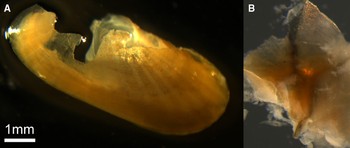
The solemyid shell presented the features reported for the genus Solemya. For instance, the shell was thin, flexible, poorly mineralized, elongate–oval, inflated to compressed, and its surface displayed widely spaced weak radial ribs. The ligament was opisthodetic, internal, and attached to chondrophore (Figure 2). A reduced digestive tract was also visible.
Solemyidae found in the central province of the Nile Deep-sea Fan: (A) broken shell; (B) ligament detail.

The 18S rRNA-encoding gene displayed 93% similarity with a sequence from Solemya velum 18S ribosomal RNA gene (AF120524) (Giribet et al., Reference Giribet, Distel, Polz, Sterrer and Wheeler2000); the 28S rRNA-encoding gene displayed 99% similarity with a sequence from S. velum 28S ribosomal RNA gene (AY45421) (Passmaneck et al., Reference Passmaneck, Schander and Halanych2004); the COI sequence yielded 83% sequence similarity with S. velum cytochrome c oxidase subunit I (U56852) (Hoeh et al., Reference Hoeh, Black, Gustafson, Bogan, Lutz and Vrijenhoek1998). Molecular results thus relate the present specimen with S. velum, a species from the north-west Atlantic that lives in sulphide-rich coastal sediments. Unfortunately, few 18S and 28S, and no COI sequences are available for the two genera of the family (Solemya and Acharax), so molecular data cannot yet be invoked as support for the generic affiliation with Solemya.
At this point, and in the absence of appropriate data on other species for comparison, it also seems impossible to determine the species or to postulate for a new species. Nevertheless several hypotheses may be suggested. First, the specimen here studied could be related to the shallow species Solemya togata (no available sequence) and could be the result of an evolutionary process from shallow to deep waters as already documented in other bivalve species (e.g. mytilids; Jones et al., Reference Jones, Won, Maas, Smith, Lutz and Vrijenhoek2006). An alternative hypothesis would be that the specimen is a living relative of the recorded fossil ‘Acharax’ doderleini.
The majority of Solemya species have been found in shallow depths, but Kamenev (Reference Kamenev2009) reported the occurrence of Solemya pervernicosa in Sagami Bay cold seeps at 1510 m; thus the occurrence of a Solemya species in the eastern Mediterranean at 1697 m would be not surprising.
Large size solemyids ascribed to the genus Acharax are known to have inhabited the Mediterranean in the past (Taviani, Reference Taviani, Reiner, Quéric and Arp2010). Solemyids were widely distributed in Miocene deep-sea reducing habitats and, after the Messinian salinity crisis (MSC), re-colonized suitable reducing environments up to the Middle Pliocene (Taviani et al., Reference Taviani, Angeletti and Ceregato2008). The putative absence of deep-sea solemyids in the present Mediterranean was puzzling and it was tentatively suggested to be possibly related to temperature (Taviani et al., Reference Taviani, Angeletti and Ceregato2008), although it was anticipated that this absence was only apparent (Taviani, Reference Taviani, Reiner, Quéric and Arp2010).
Until further molecular data becomes available on other species, these hypotheses cannot be tested.
Despite repeated attempts, no bacterial 16S rRNA gene sequence was amplified. In all previous studies Solemyidae are presented as ‘symbiont dependent’, with some species having small, reduced, or even absent alimentary tracts (reviewed in Taylor & Glover, Reference Taylor, Glover and Kiel2010). A weak suspension feeding capability is retained in S. velum (Krueger et al., Reference Krueger, Gallager and Cavanaugh1992). This capability could occur in other species and explain the absence of symbionts, but the most likely hypothesis remains that the protocols employed here actually failed to amplify symbiont DNA.
With the discovery of the first living solemyid at a depth of 1697 m in a cold seep in the eastern Mediterranean, this work extends the known distribution of this bivalve family. More research is needed to explore the deep richness of the Mediterranean Sea where a number of potentially suitable habitats for solemyids are present (Taviani, Reference Taviani, Reiner, Quéric and Arp2010). Nevertheless we expect to sample more specimens in the future to confidently assess the taxonomic position of Mediterranean deep-water solemyids and to unravel their evolutionary and biogeographical connections.
ACKNOWLEDGEMENTS
We thank Professor Antje Boetius and Dr Frank Wenzhöfer for inviting us on the MSM13/4 (HOMER) cruise. The captain and crew of the RV ‘Maria S. Merian’ and pilots of the ROV ‘Quest’ are acknowledged for their skilful work. We are indebted to Dr Ann Vanreusel for the precious collaboration offered during the mission. Finally, we would like to thank the three anonymous referees for their comments that helped improve the manuscript. This research was supported by the European Commission Seventh Framework Programme (FP7/2007-2013) under the HERMIONE project, Contract number 226354; MPG-CNRS-GDRE ‘Diversity, establishment and function of organisms associated with marine wood falls—DIWOOD’; ANR DEEP-OASES (ANRO6BDV005) and CHEMECO ESF EURODEEP. C.F.R. was also supported by a post-doctoral fellowship (SFRH/BPD/64154/2009) from the Fundação para a Ciência e a Tecnologia (Portugal).