Significant outcomes
• Inter-individual differences in positive affectivity, expressed as 50-kHz ultrasonic vocalizations (USVs), are persistent.
• Less chirping rats are more vulnerable to chronic variable stress (CVS).
• Less chirping rats have higher serotonin (5-HT) overflow in hippocampus after locally applied citalopram.
Limitations
• Absence of additional control groups in measurements of corticosterone levels.
Introduction
Animal models of anxiety and affective disorders, including approaches that are based on inter-individual differences, usually focus on states resembling fear, anxiety, neophobia, depressiveness and other expressions of negative affect (Reference Singewald1,Reference Harro2). In recent years, research on depression has increasingly paid attention to positive affect (Reference Clark and Watson3–Reference Geschwind, Nicolson, Peeters, Os, Barge-schaapveld and Wichers7). Positive affectivity is associated with playfulness, social joyfulness, and it helps to process emotional information more efficiently. It has been demonstrated that individuals persistently differ in emotional (positive and negative) reactivity and that these individual differences have implications for affect, social relationships and well-being (Reference Tellegen, Tuma and Maser8,Reference Gross and John9). While the independent role of positive affect in resilience to depression is well established in humans, detailed neurobiological studies have been hampered by the absence of suitable animal models.
Recently, positive affective states in rats have been measured by recording USVs at the frequency range of 50–55 kHz (Reference Panksepp10). Rats elicit USVs in many different social and emotional situations (Reference Sale and Pye11). These USVs vary in frequency and duration, but two typical variants can be distinguished in adults: longer-lasting low vocalizations (22-kHz USVs) and brief high vocalizations (50-kHz USVs) (Reference Miczek, Tornatzky, Vivian, Olivier, Mos and Slangen12). While the longer-lasting 22-kHz USVs in adult rats are associated with negative affective states and are elicited, e.g. during social defeat and in response to danger (Reference Blanchard, Blanchard, Agullana and Weiss13–Reference Tonoue, Ahida, Makino and Hata16), the shorter-lasting 50-kHz USVs (more colloquially, ‘chirps') reflect positive affective states such as in observed playfulness and social joyfulness (Reference Knutson, Burgdorf and Panksepp17,Reference Panksepp and Burgdorf18). The level of vocalizing at the 50-kHz (frequency) range has been found to reflect the pleasantness and reinforcing strength of the eliciting stimuli (Reference Burgdorf and Panksepp19). Very high rates of 50-kHz vocalization can be elicited in young isolated rats with a tickling-like stimulation delivered by an experimenter (Reference Burgdorf, Panksepp, Brudzynski, Kroes and Moskal20,Reference Panksepp, Knutson and Burgdorf21), probably because that mimics the stimulation exerted by natural rough-and-tumble play in rats (Reference Burgdorf and Panksepp19).
Stressful life events contribute to the onset of depression in humans (Reference Gilmer and Mckinney22). Therefore CVS paradigm has often been used as an animal model of depression (Reference Katz, Roth and Carroll23,Reference Katz24), as it consistently brings about behavioural and physiological signs of anhedonia and emotional reactions such as anxiety and fear (Reference Katz24–Reference Willner26). Many investigations suggest that anxiogenic stimuli elicit the release of 5-HT, but that distinct 5-HT-ergic pathways can make a different contribution (Reference Millan27,Reference Morilak and Frazer28). The hippocampal 5-HT-ergic system has been acknowledged to mediate the anxiogenic response (Reference File, Kenny and Cheeta29), while CVS profoundly affects hippocampal serotonergic neurotransmission in this region, especially in the dentate gyrus (DG) (Reference Joels, Karst and Alfarez30,Reference Mckittrick, Blanchard, Blanchard, McEwen and Sakai31).
We have found that stable inter-individual variations exist in the expression of 50-kHz UVS, accompanied by behavioural differences in tests used in anxiety and depression studies (Reference Mällo, Matrov and Herm32). These differences, however, were dependent upon environmental conditions such as housing individually versus in a group. Nevertheless, sensitivity to CVS in adulthood was clearly different in male high-chirping (HC) and low-chirping (LC) rats: stressed LC rats produced more 22-kHz distress calls, consumed less sucrose and had higher immobility in the Porsolt's test (Reference Mällo, Matrov, Kõiv and Harro33). In several brain areas, including the hippocampal areas, stressed male LC-rats had increased levels of oxidative metabolism. These results suggest that at least in male rats low positive emotionality predicts the vulnerability to stress.
The aim of this investigation was to examine whether extracellular 5-HT levels in hippocampus are differently affected by stress in LC- and HC-rats. We also measured corticosterone levels after the microdialysis procedure.
Materials and methods
Animals
Pairs of Wistar rats (Scanbur BK AB, Sollentuna, Sweden) were used to acquire pups. Male (n = 40) pups were weaned when 3 weeks old and single-housed in standard transparent polypropylene cages under controlled light cycle (lights on from 08:30 to 20:30 h) and temperature (19–21 °C), with free access to tap water and food pellets (diet R70; Lactamin, Kimstad, Sweden). Tickling sessions started the next day after single-housing and lasted for 14 days. After this, the animals were randomly group-housed by three or four and remained so until the surgery. Identification marks were checked twice per week and renewed when necessary. This procedure was random and did not cause apparent stress in these previously extensively handled animals. The experimental protocol was approved by the Animal Experimentation Committee at the Estonian Ministry of Agriculture.
General procedure
Rats were given daily sessions of tickling-like stimulation that mimics natural rough-and-tumble play in juvenile rats (Reference Burgdorf and Panksepp19) and elicits high levels of 50-kHz chirping (Reference Burgdorf, Panksepp, Brudzynski, Kroes and Moskal20). Tickling sessions lasted for 14 days as we have previously shown (Reference Mällo, Matrov, Kõiv and Harro33) that by this period the animals develop a stable level of USV response that enables the classification of animals into HC- and LC-rats, this differentiation persisting into adulthood. The procedure was carried out as previously described (Reference Mällo, Matrov and Herm32). In short, animals were individually removed from home cage into an empty and smaller cage and given 15 s for habituation, followed by 15 s of tickling by experimenter. Altogether, four 15-s sessions of stimulation were given over 2 min, after which animals were returned to home cage and test cage cleaned. A microphone was located about 20 cm from the floor of the tickling cage, recording high frequency audio files of the tickling sessions, which were later analysed with the Avisoft SASLab Pro (Avisoft Bioacoustics, Berlin, Germany) software, creating spectrograms from which USVs were manually counted. Fifty-kilohertz USVs were counted and animals classified as emitting high or low number of 50-kHz USVs by the median split of the average response on days 12–14 of tickling, providing the HC and LC groups. When the animals reached the age of 2 months, CVS procedure was started and applied for 4 weeks. Animals were weighed daily. After cessation of stress the animals were operated under chloral hydrate anaesthesia for the insertion of microdialysis probe (see below), followed by the microdialysis experiment approximately 24 h after the surgery. Immediately after the end of microdialysis sample collection, the animals were sacrificed by decapitation, whole blood samples collected for corticosterone measurement and whole brains immediately frozen on dry ice for microdialysis probe location verification. Only animals with valid data sets of microdialysis (n = 27) were included in data analysis of weight gain, 5-HT overflow and corticosterone levels.
Chronic variable stress
At the age of 2 months, the animals were submitted to CVS. The CVS regimen (Reference Harro, Tõnissaar, Eller, Kask and Oreland34) lasted for 4 weeks and comprised of seven different stressors each of which was intermittently used once every week: (a) imitation of peritoneal injection using special glove with syringe without needle being pressed to the animal's body for several seconds; (b) stroboscopic light (for 14 h, 10 Hz, 2 lx); (c) tail-pinch with a clothes-pin placed 1 cm distal from the base of tail (5 min); (d) cage tilt at 45 °C (for 24 h); (e) strong illumination (900 lx) during predicted dark phase (for 12 h); (f) cold (4 °C) water and wet bedding (400 ml of water was poured on the rats, and the sawdust bedding was kept wet for the following 22 h); (g) movement restriction in a small cage (11 × 16 × 7 cm) for 2 h. The stressors were administered during the light phase of the cycle (except for the stressors that lasted overnight). The individual application of the stress schedule was shifted for animals in such a way that the 4-week CVS could always be immediately followed by microdialysis that had a limited daily throughput.
Microdialysis
After 4 weeks of stress regimen, in vivo online microdialysis procedure was carried out as previously (Reference Mällo, Kõiv and Koppel35) in awake and freely moving animals divided into four groups: control LC (n = 7) and HC (n = 8) group and stressed LC (n = 7) and HC (n = 5) group. In short, the animals were anaesthetised with chloral hydrate (350 mg/kg intraperitoneally) and mounted in a Kopf stereotactic frame. A self-made concentric Y-shaped microdialysis probe with 4-mm shaft length and 1-mm active tip was implanted into DG with the following coordinates: AP: −4.3; ML: +2.2; DV: −3.8 (according to (Reference Paxinos and Watson36)). The dialysis membrane used was polyacrylonitrile/sodium methalyl sulphonate copolymer (Filtral 12; inner diameter: 0.22 mm; outer diameter: 0.31 mm; AN 69; Hospal, Bologna, Italy). Two stainless steel screws and dental cement were used to fix the probe to the scull. After the surgery, rats were placed in 21 × 36 × 18 cm individual cages in which they remained throughout the rest of the experiment and given about 24 h for recovery. After recovery, the animal was connected to the microdialysis system and the perfusate at flow rate 1.5 μl/min discarded during the first 60 min to allow stabilisation. Then six samples of microdialysate were collected, followed by local administration of the 5-HT reuptake inhibitor citalopram (1 μM) by reverse dialysis for 2.5 h (10 samples). The dose of citalopram was selected considering previous studies in our laboratory and others (Reference Mällo, Kõiv and Koppel35,Reference Thorre, Ebinger and Michotte37,Reference Bosker, Cremers, Jongsma, Westerink, Wikstrom and Boer38). Fourteen more samples were collected after the cessation of citalopram administration. The samples were collected in 15-min periods directly into a 50-μl loop of the electrically actuated injector (Cheminert C2V; Vici AG International, Schenkon, Switzerland) and injected automatically into the column in order to measure the quantity of 5-HT in the samples online by using high-performance liquid chromatography with electrochemical detection. The chromatography system consisted of a Shimadzu LC-10AD (Shimadzu Corporation, Kyoto, Japan) series solvent delivery pump, a Luna C18(2) 5 μm column (150*2 mm) kept at 30 °C and Decade II digital electrochemical amperometric detector (Antec Leyden BV, Zoeterwoude, The Netherlands) with electrochemical flow cell VT-03 (2 mm GC WE, ISAAC reference electrode, Antec Leyden BV). The mobile phase consisted of 0.05 M sodium citrate buffered to pH 5.3, 2 mM KCl, 0.02 mM ethylenediaminetetraacetic acid (EDTA), 4.9 mM sodium octanesulphonate and 18.5% acetonitrile. The mobile phase was filtered through a 0.22 μm pore size filter (type GV; Millipore, Billerica, MA, USA) and was pumped through the column at a rate of 0.2 ml/min. 5-HT eluted from the column (retention time 5 min) was measured with a glassy carbon working electrode maintained at a potential of +0.4 V versus Ag/AgCl reference electrode. Data were acquired using a Shimadzu LC Solution system. Concentrations of 5-HT were estimated by comparing peak heights from the microdialysates with those of external standards of known concentration of 5-HT (Sigma, Buchs, Switzerland). Baseline 5-HT levels were defined as average of samples three to six.
Corticosterone levels
Animals were decapitated immediately after the collection of the last microdialysis sample, and trunk blood was collected into pre-cooled tubes containing K3 EDTA. The blood samples were kept on ice and centrifuged after every four animals (4 000 × g for 10 min at 4 °C). Plasma was pipetted into eppendorf tubes and stored at −80 °C until the assay. Plasma samples were thawed on ice and lightly vortexed and diluted 15 times. Plasma corticosterone was measured by enzyme-linked immunosorbent assay (Correlate-EIA™; Assay Design Inc., Ann Arbor, MI, USA) according to manufacturer's directions. The sensitivity of this assay is 27 pg/ml. Upon completion of the assay, 96-well plates were read at 405 nm on a Labsystems Multiskan MCC/340 (Thermo Fischer Scientific Inc.,Waltham, MA, USA) microplate reader.
Data analysis
The data were analysed with a two-factor (Chirping × Stress) analysis of variance (ANOVA) with repeated measures for the weight gain and microdialysis data and with a two-factor (Chirping × Stress) ANOVA for the corticosterone data. When appropriate, post hoc comparisons were made with Fisher's PLSD test. Statistical significance was set at p < 0.05. Weight gain for a particular day n was calculated by subtracting the day 1 weight from the day n weight.
Results
Fifty-kilohertz USVs
We allocated animals into four groups (LC and HC, control and stress, n = 10) based on the number of 50-kHz USVs emitted in 2-min sessions. The average (mean ± SEM) number of 50-kHz UVSs was 31.5 ± 14.3 and 133.4 ± 29.8 in LC and HC control groups, respectively, and 45.4 ± 18.0 and 101.1 ± 20.8 in LC and HC stress groups, respectively. No significant different was present between the two LC and two HC groups, but the difference between LC- and HC-rats in emission of 50-kHz USVs was statistically highly significant (LC/HC effect in two-way ANOVA, [F(1, 35) = 13.0; p = 0.001]). Emission of 22-kHz USVs was present in only a few animals, even in these individuals at very low levels, and did not differ between the groups (data not shown).
Body weight gain during CVS
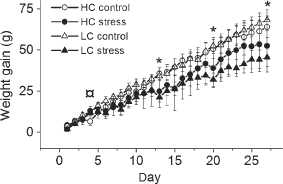
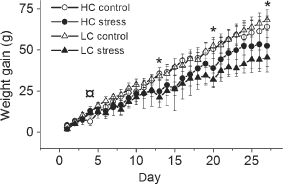
Stress had a significant effect on body weight gain (Stress × Day [(F(26,598) = 3.28; p < 0.001]. Stress effectively decreased weight gain in both HC- and LC-rats, nevertheless LC-rats gained weight more slowly than HC-rats (Fig. 1.)
Weight gain in control and stressed LC- and HC-rats (mean ± SEM). *p < 0.05 difference between LC control and LC stress groups;  p < 0.05 difference between HC control and HC stress groups. LC, low-chirping rats; HC, high-chirping rats.
Extracellular 5-HT levels
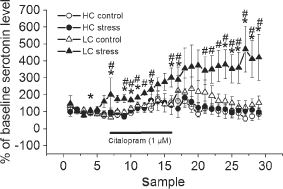
At baseline, the average (mean ± SEM of samples 3–6) extracellular levels of 5-HT in DG were 2.62 ± 0.68 fmol/22.5 μl and 2.77 ± 1.02 fmol/22.5 μl sample in LC and HC control groups, respectively, and 1.49 ± 0.46 fmol/22.5 μl sample and 3.16 ± 0.62 fmol/22.5 μl sample in the stressed LC and HC groups, respectively. No statistically significant difference was found between groups (Fig. 2).
Extracellular serotonin levels in the dentate gyrus of LC- and HC-rats after local infusion of 1 μM citalopram solution (mean ± SEM). Samples were collected every 15 min and are presented as percentage of baseline (mean of samples 3–6) levels. Infusion with citalopram was made during the collection of samples 7–16. *p < 0.05 difference between LC control and LC stress groups; #p < 0.05 difference between HC stress and LC stress groups. LC, low-chirping rats; HC, high-chirping rats.
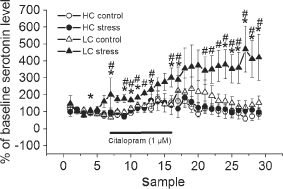
Nevertheless, there was a main effect of Chirping [F(1,23) = 8.82; p < 0.01] on baseline extracellular 5-HT levels, and a Chirping × Time interaction [F(28,644) = 3.25; p < 0.0001]; a significant Stress × Time interaction was also found [F(28,644) = 1.79; p < 0.01]. This was because after local inhibition of 5-HT uptake by citalopram, significant differences between the groups emerged. Thus, the increase in extracellular 5-HT levels after infusion with citalopram, as compared to baseline, was much higher in LC-rats that had been submitted to CVS.
Corticosterone levels after the experiment
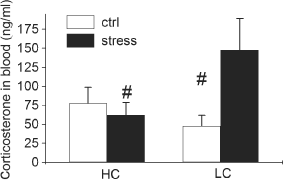
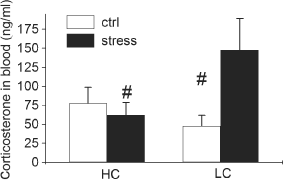
There was no main effect of Stress or Chirping on corticosterone levels, but an interaction effect of Stress and Chirping [F(1,22) = 4.52; p < 0.05] was found. Corticosterone levels measured from full blood after the end of microdialysis were significantly higher in the stressed LC animals as compared to both the unstressed group and the respective HC animals (Fig. 3).
Corticosterone levels in the plasma of LC- and HC-rats (mean ± SEM). #p < 0.05 as compared to LC stress group. LC, low-chirping rats; HC, high-chirping rats.
Discussion
CVS decreased body weight gain, to a larger extent in the LC-rats with lower positive affectivity. This confirms the effectiveness of the applied stress regimen (Reference Harro, Tõnissaar, Eller, Kask and Oreland34), and indicates a greater susceptibility to stress in LC-rats. A decrease in the body weight of stressed rats after CVS (or CMS) procedures, as compared to controls, has been observed in many studies (Reference Moreau, Jenck, Martin, Mortas and Haefely39–Reference Willner, Moreau, Nielsen, Papp and Sluzewska41), including our own (Reference Mällo, Matrov and Herm32,Reference Mällo, Matrov, Kõiv and Harro33,Reference Harro, Häidkind and Harro42). Our previous finding that body weight gain is affected by chronic stress more in LC- than the HC-rats (Reference Mällo, Matrov, Kõiv and Harro33) was thus reproduced.
We have previously found that citalopram infusion can reveal latent differences in 5-HT overflow in animal models of inter-individual differences in anxiety-related traits (Reference Mällo, Kõiv and Koppel35). In this study, after local perfusion with citalopram (1 μM) the increase in extracellular 5-HT levels in DG was higher only in the LC-rats. The effect of citalopram was also remarkably long-lasting in this group (Fig. 2). It might be that stressed LC group responded more to microdialysis procedure itself than other groups, additionally this might explain also the slightly higher 5-HT levels in stressed LC group immediately before treatment with citalopram. However, throughout the experiment, treatment with citalopram appeared to be increasing 5-HT overflow especially in the stressed LC-rats, as the baseline differences were minor and, when collapsed, not statistically significant.
The reuptake of 5-HT by the 5-HT transporter (5-HTT) is considered to be the critically important link in 5-HT neurotransmission (Reference Blakely, DE Felice and Hartzell43,Reference Lesch and Gutknecht44). Experiments with 5-HTT knockout mice have shown that they have increased anxiety-like behaviours, whereas transgenic overexpression of the 5-HTT reduces extracellular 5-HT levels and decreases these behaviours (Reference Jennings, Loder and Sheward45,Reference Wellman, Izquierdo and Garrett46). Differences in 5-HTT expression might explain why LC- and HC-rats had different 5-HT levels after 5-HTT blockade with citalopram. Another possible mechanism for increased 5-HT levels in LC-rats in DG after local infusion of citalopram may be through differential activity of 5-HT1B autoreceptors, which regulate the release of 5-HT by inhibitory feedback and have been hypothesised to be supersensitive in depression and anxiety (Reference Moret and Briley47).
Nevertheless, pharmacological studies have shown that elevating 5-HT overflow can both reduce and increase behaviours reflecting negative emotionality, probably dependent upon previous experiences, the particular task, and previous drug treatment (Reference Harro and Oreland48). Thus it is also conceivable that higher 5-HT levels during microdialysis in the stressed LC group reflect a coping response to negative affect. If this is the case, blockade to 5-HT receptors should lead to aggravation of negative emotionality in chronically stressed LC-rats, and this should by addressed in further experiments.
The fact that the stressed LC-rats are more sensitive to environmental challenges was evident also in corticosterone levels, which are considered to serve as a marker of stress response (Reference Curzon49,Reference Abelson, Adem, Royo, Carlsson and Hau50). While there was no difference between the control LC- and HC-rats, higher corticosterone in the LC-rats submitted to chronic stress, as measured after the microdialysis experiment, indicates that the stress axis is sensitised in rats with low positive affect by CVS.
In conclusion, CVS appears to modify regulation of hippocampal 5-HT-ergic neurotransmission differently in rats with low positive affectivity. This finding supports the notion of greater vulnerability to CVS in male rats with low positive affectivity.
Acknowledgements
This research has been supported by the Hope for Depression Research Foundation, Institute for the Study of Affective Neuroscience, the Estonian Ministry of Education and Science Project 0180027 and the EU Framework 6 Integrated Project NEWMOOD (LSHM-CT-2004-503474). The authors are grateful to Margus Kanarik for the help with the corticosterone assay.