Introduction
The placenta is essential for promoting and maintaining pregnancy and normal fetal development; however, it is normally disposed off after delivery without adequate examination.Reference Afodun, Ajao and Enaibe1 Pregnancy outcome depends on placental morphology and its efficiency to transfer nutrients, gases, waste products, heat, hormones, and other regulatory molecules. Placental morphology, blood flow, and nutrient transport functions primarily determine the growth trajectory of the fetus.Reference Balihallimath, Shirol, Gan, Tyagi and Bandankar2 Genes and lifestyle were long believed to be the predominant risk factors for the development of major noncommunicable diseases (NCD), such as type-2 diabetes and cardiovascular disease. However, a large body of epidemiological evidence has challenged this paradigm by demonstrating that adverse influences during early development, in particular in utero, increase the risk of developing these diseases in adult life.Reference Gluckman and Hanson3,Reference Gluckman, Hanson, Cooper and Thornburg4 Birth weight is associated with long-term effects on health and disease in adult life. Low birth weight (LBW) is a well-established risk factor for adverse long-term health, particularly cardiovascular disease and metabolic syndrome.Reference Barker5 Fetal growth is a result of multiple factors including genetic potential for growth, maternal nutrition, maternal metabolism, and endocrine factors. According to the Developmental Origins of Health & Disease (DOHaD) concept, maternal undernutrition has variable effects on placental growth. Placental size and the ratio of placental weight to birth weight have been found to be associated with type-2 diabetes and impaired glucose tolerance.Reference Barker6 In addition, the ability of the fetus to respond to nutrients and other growth regulatory factors may play a role.Reference Cetin, Alvino, Radaelli and Pardi7,Reference Haggarty8 The placenta can react to circulatory and nutritional environmental changes and challenges by adjusting nutrient transfer capacity, thus altering the relative proportions of different types of nutrients supplied to the fetus. These adaptive changes may affect the development of individual fetal tissues, and the pathophysiological consequences can be seen long after birth. Therefore, the placenta may represent a better marker of growth and disease risk in later life than other indices such as birth weight which have been predominantly used to indicate exposure to suboptimal conditions during intrauterine development.Reference Sibley, Turner and Cetin9–Reference Lauritzen and Carlson12
The adult population of the KOKAN region of the western Indian state of Maharashtra is poorly nourished and underweight [low body mass index (BMI)].Reference Patil, Kadam and Desai13 Malnourishment has also been observed among adolescent girls in the region.Reference Pevekar, Patil and Chavan14,Reference Patil, Wasnik and Wadke15 A small study in the same area has shown that adolescent girls have high prevalence of micronutrient deficiencies.Reference Patil, Joglekar and Desai16 The prevalence of LBW is also very high.Reference Patil17 Thus, KOKAN population is exposed to under nutrition across all stages of lifecycle. Also the NCD prevalence among adults in this region is very high.Reference Patil, Kadam and Desai13,18 Hence, we decided to focus on the intrauterine stage and study the placental morphology in addition to the size of the mother at the time of delivery. We tested the hypothesis that low placental weight will be associated with LBW.
Methods
Setting and study population
BKL Walawalkar Hospital is located at Dervan village in Ratnagiri District of KOKAN area situated about 250 km south of Mumbai in the Indian state of Maharashtra. The hospital was established in 1995. Since 2010 it has developed a community network for the entire Ratnagiri District with various community programs. Holistic education and nutrition counseling are provided to all newly married girls. The hospital also runs a community-based antenatal care program for pregnant women with educational sessions on safe motherhood. The importance of hospital-based delivery rather than home delivery is explained. Pregnant women are brought to the hospital for investigations during pregnancy and for delivery. Between April 2016 and September 2017, 985 pregnant women registered in the antenatal clinic of the hospital and subsequently delivered in the hospital. Data were retrospectively extracted from the hospital records.
Measures
The women in KOKAN are undernourished. Maternal undernutrition affects placental growth. We used maternal BMI at the time of delivery as a surrogate for undernutrition. The placenta supplies nutrients to the fetus ultimately affecting the development of fetal tissues. We measured birth weight and also carried out neonatal anthropometry.
Maternal data
Current obstetric history (gravida, parity) and history of previous pregnancies (abortions, terminations, still births, intrauterine deaths, live deliveries) were collected at the time of registration in the antenatal clinic of the hospital. We collected data on current age, birth order, age at menarche, age at marriage, and age at 1st pregnancy. Maternal height was measured to the nearest 0.1 cm using a stadiometer. Maternal weight was measured to the nearest 0.1 kg. BMI was calculated. Height and weight were measured immediately after the women reported to the hospital for delivery and their BMI calculated. Gestational age at delivery was estimated in weeks based on the last menstrual period (LMP) and the date of delivery.
Neonatal data
Anthropometric measurements (weight, length, head circumference, chest circumference) and mid upper arm circumference (MUAC) were recorded in babies immediately after birth using standardized protocol.
Those with gestational age at delivery < 37 weeks were classified as preterm.
Placental data
All the placental measurements were carried out immediately after delivery. The placenta was weighed using an electronic balance. The length (largest diameter) and breadth (smallest diameter) were measured. Placental thickness at maximum was measured. Placental volume was measured by the method described by Scherle.Reference Scherle19 Initially, a large empty plastic container was placed on a flat surface. At the center of this container, a steel container was placed which was filled with water up to the brim without spill over into the surrounding container. Placenta was placed in the steel container without dipping hands or fingers. The placenta displaced the water in the steel container into the empty plastic container surrounding it. After the placenta displaced no more water, the steel container containing the placenta was carefully removed. The displaced water in the plastic container was transferred into a graduated cylinder which is commonly used to measure the volume of a liquid. Thus, the volume of the displaced water was used to indicate the placental volume.
Ethics approval and consents
Written consent to use the data collected for the purpose of research was taken from individual pregnant women at the time of registration in the antenatal clinic. The hospital ethics committee approved use of relevant data from hospital records for the purpose of analysis and publication. Our institute ethics committee (BKL Walawalkar Rural Medical College and Hospital) is registered with the government of India with registration code as EC/755/INST/MH/2015/RR-18. The registration document is available at https://cdsco.gov.in/opencms/opencms/en/Clinical-Trial/Ethics-Committee/Ethics-Committee-Re-Registration/index.html.
Selection of sample for analysis
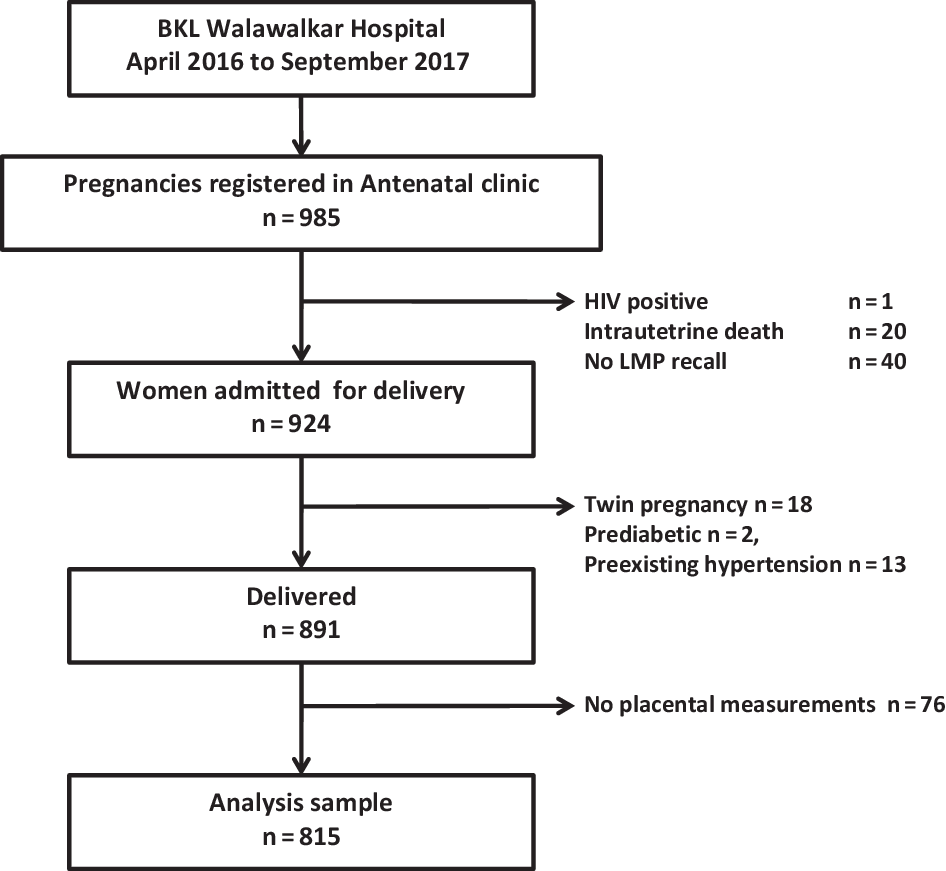
Totally, 985 pregnant women registered in hospital antenatal clinic for delivery. Sixty-one women were excluded (Figure 1). Of these one had tested positive for HIV, 20 had intrauterine fetal death, and 40 women could not recall the date of their LMP in order to have an accurate estimation of the gestational age at delivery. Remaining 924 delivered live-born babies. Of these 18 delivered twins, 13 had preexisting hypertension, and 2 were prediabetic. After exclusion of these, we were left with 891 mothers with single live-born babies. We further excluded 76 mothers who did not have placental data. Remaining 815 mothers formed our analysis sample.
Selection of sample.

Comparisons with international standards
LBW was defined as weight at birth <2500 g. We used World Health Organization (WHO) standards to compare the size at birth (weight, length, head circumference) using standard deviation (SD) scores.20 Stunting was defined as length SD score <−2 and small head as head circumference SD score <−2.
Statistical analysis
Data are presented as mean and SD for continuous variables. Normality of each continuous variable was checked using Shapiro–Wilks test. Those not normal were appropriately transformed. Data on categorical variables are shown as percentages. Comparison between the two groups was done using analysis of variance. Associations between neonatal anthropometry indices and maternal exposures including the placental data are shown by partial correlations adjusting for gestation at delivery, sex of the newborn, and maternal parity. Significant determinants of LBW, stunting, and small head circumference at birth were investigated by multiple logistic regression analysis using models with and without placental weight. Odds ratio (OR) and 95% confidence intervals (CIs) were calculated. Model fit was tested using McFadden R 2. The SPSS version 16.0 for windows (SPSS Inc, Chicago) was used for statistical analysis.
Results
Mothers
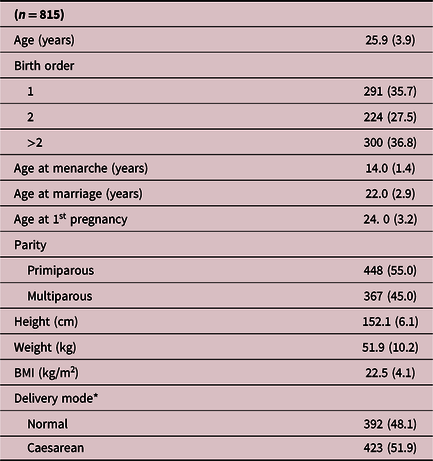
Table 1 shows maternal characteristics. Mean age of menarche was 14 years (± 1.4 years) and 55% were primiparous with a mean height of 152.1 cm (± 6.1 cm), while the weight at the time of delivery was 52 kg (± 10.2 kg). Slightly more than 50% of the mothers were delivered by caesarean section
Characteristics of the pregnant mothers admitted for delivery

* n(%) otherwise mean (SD).
Babies and placental measurements
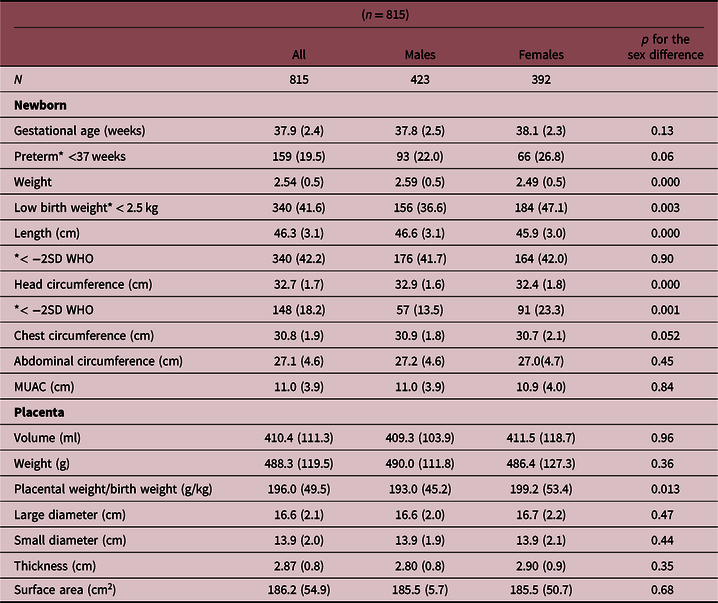
Table 2 shows the data on neonates (all combined and also according to sex). Proportion of those delivered preterm was 19.5%, and it was similar in both the sexes. Girls were lighter, shorter, and had a smaller head compared to boys. More than 40% neonates were born LBW though the proportion was significantly higher in girls. Using WHO standards for newborns, more than 40% had a length SD score of below −2 and 18% had a head circumference SD score below −2. Other anthropometric indices (chest circumference, abdominal circumference, and MUAC) were similar.
Characteristics of the newborns and placentas

* n(%) otherwise mean (SD).
p adjusted for gestation at delivery for anthropometric parameters.
Except placental weight (g)/birth weight (kg) ratio, which was higher in girls all, other placental measurements were similar in the two sexes (Table 2).
Mother–baby association
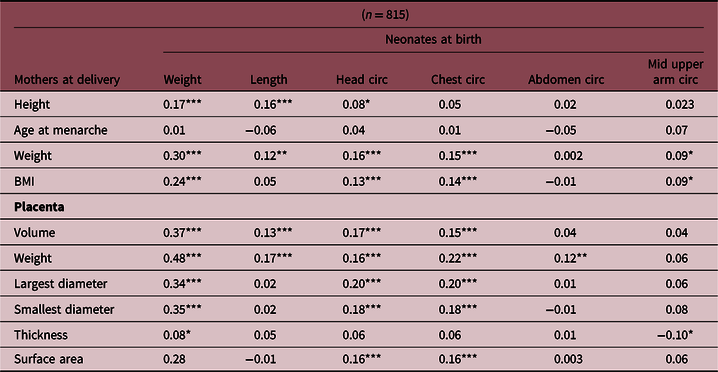
We used the maternal height as an indicator of the mothers own fetal and adolescence growth, age at menarche as a puberty indicator, and BMI at delivery as an indicator of nutrition in pregnancy. Maternal height was strongly associated with fetal weight and length and moderately (yet significantly) with head circumference. Mothers age at menarche was not associated with any of the babies anthropometric measures. Maternal weight and BMI were associated with baby’s weight, head circumference, chest circumference, and MUAC.
Placenta–baby associations
Placental volume and placental weight were related to most of the neonatal measurement except MUAC (Table 3). Diameters (largest as well as smallest) were related to neonatal weight, head circumference, and chest circumference. Placental thickness was directly associated with birth weight and inversely with MUAC.
Correlations between maternal, placental and neonatal measurements

Circ: circumference.
Figures are partial correlations adjusted for gestation at delivery, maternal parity, and sex of the baby, *p < 0.05, ** p < 0.01, *** p < 0.001.
Placenta–mother association
Maternal height, weight, and BMI were strongly correlated with placental volume and placental weight (p < 0.01 for all, data not shown). Other placental measurements (diameters, thickness, and the surface area) were not associated.
Multiple logistic regression of small size at birth
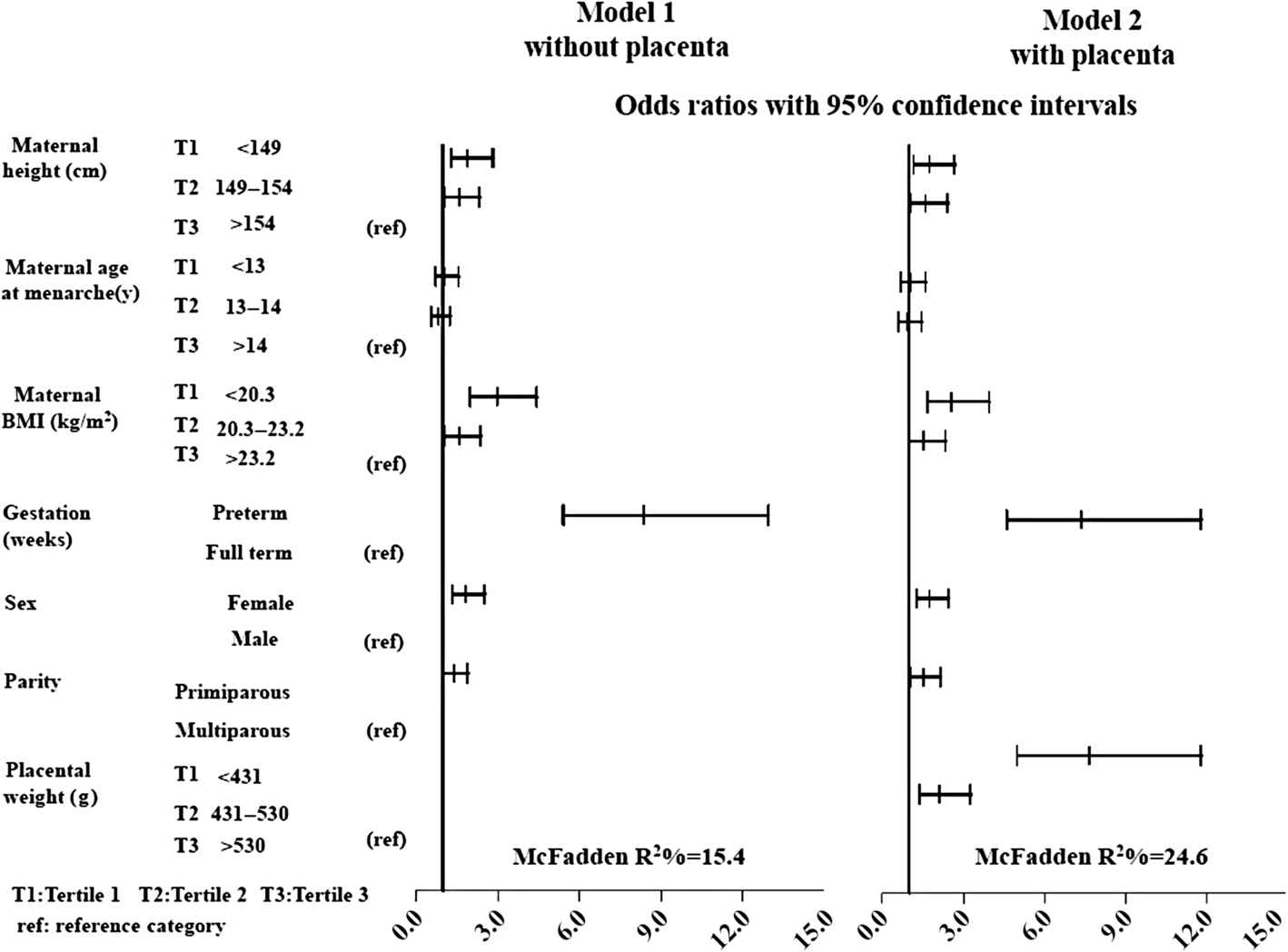
We divided maternal height, BMI, placental weight, and maternal age at menarche into tertiles. In a logistic regression (Fig. 2, Model 1), including maternal height, BMI, maternal age at menarche, gestation, sex, parity, LBW was independently associated with maternal height and maternal BMI. Shortest mothers, i.e., those in the lowest tertile for the height, were 1.93 times more likely to have LBW neonate compared to those in the highest (95% CI 1.31, 2.86). Those in the lowest tertile of the BMI had 3.01 times higher risk compared to those in the highest (95% CI 2.01, 4.45). With the addition of placental weight (Fig. 2, Model-2), those in the lowest tertile of placental weight had 7.69 times higher risk compared to those in the highest (95% CI 5.01, 11.8). Variance explained by each model using Mcfadden R2 was 15.4% for model 1 and 24.6% for the model 2. Similarly, we observed an independent effect of placental weight on stunting of the neonate. As shown in Supplementary Figure 1, mothers in the lowest tertile of height, BMI, and placental weight had significant risks of delivering the stunted neonate [OR 1.55, 95% CI (1.05, 2.30)], [OR 1.51, 95% CI (1.03, 2.23)], and [OR 1.99, 95% CI (1.35, 2.96)], respectively. The variances for both the models were 5.3% and 6.6%, respectively. Those in the lowest tertile of placental weight independently predicted smaller head circumference of the neonate [OR 2.4, 95% CI (1.43, 4.04)], and the variances were 12.9% an 14.8%, respectively (Supplementary Figure 2).
Determinants of low birth weight. (Multiple logistic regression.)

Discussion
We have measured maternal size, newborn size, and placental parameters at delivery in a large sample of rural pregnant Indian women. Mothers were short in stature, and their mean BMI at the time of delivery was only 22.5 kg/m2 (± 6.1 kg/m2). About 20% neonates were born preterm. Except weight, length, and head circumference, which were higher in males, all the other anthropometric parameters were similar in both sexes. Among various placental parameters measured, only placental weight/birth weight ratio was higher in female neonates. Other parameters were similar. Maternal size measures (weight and height) at delivery were associated with fetal size (weight, length, and head). Low placental weight independently predicted LBW, stunting, and small head. Many studies have reported data on placental weight, volume, and morphology and their associations with postnatal outcomes. A study on geographical variations in neonatal phenotype reports data on placental weight in many regions of the world including India.Reference Leary, Fall and Osmond21 Mean placental weight reported in the studies from India is much smaller than our mean of 488 g (± 120 g). Our results are very much similar to the Stork study from Norway which showed the mediatory role of placental weight in mother–baby associations.Reference Roland, Friis and Voldner22 Another report from Norway showed an association between placental weight/birth weight ratio and cardiovascular mortality in the adulthood,Reference Risnes, Romundstad and Nilsen23 but our study does not have any post-natal measurements except size at birth. A report from Jamaica found an association between placental volume (measured at three times in pregnancy) and placental growth rate with fetal size.Reference Thame, Osmond and Bennett24 A study from rural India reported association of mid pregnancy placental volume with birth weight.Reference Kinare, Natekar and Chinchwadkar25 Our placental volume measurement is only at delivery, and it was associated with fetal size. A study of babies born full term from Qatar has shown an association of placental weight with size at birth as well as childhood growth.Reference Soliman, Eldabbagh and Saleem26 We do not have any post-natal measures. A study from MalaysiaReference Sivarao, Vidyadaran and Jammal27 compared birth outcomes and placental parameters among three ethnicities (Malay, Chinese, and Indian) and found that size at birth and placental parameters (surface area, weight, and volume) were smallest in Indians. There are many studies from India describing associations of different maternal and placental measures with post-natal outcomes. A hospital-based cohort study from city of Mysore in the state of Karnataka in south India has reported association of maternal body composition, especially the fat mass and head circumference with the fetal growth.Reference Winder, Krishnaveni and Veena28 Our study has measured body composition only by measuring weight, height, and BMI at delivery which was associated with size at birth. The same study also found an association between placental breadth and blood pressure in the offspringReference Winder, Krishnaveni and Hill29 at 9 years of age. We do not have any post-natal measures except size at birth. A report from the same state but from a different city of Bangalore reported inverse association between eccentric placentas in small for gestational age (SGA) babies and birth weight.Reference Ravikumar, Crasta and Prabhu30 Another report from the same city measured cell marker antibody (CD15) and found immaturity in fetoplacental endothelium in IUGR placentas.Reference Ravikumar, Crasta and Prabhu31 Neither we have investigated eccentric placentas nor we have measured CD15. A report from another south Indian state of Kerala reported positive association of placental weight and birth weightReference Jaya, Kumar and Bai32 similar to our finding. In all the Indian studies, except the one measuring placental volume,Reference Kinare, Natekar and Chinchwadkar25 the populations were urban or semi urban. Our study population is rural. Placenta is the source of nutrients to the fetus. We observed significant sex differences in neonatal measurements of weight, length, and head, but not so in others (abdomen, MUAC, and chest). This might suggest the sex-specific role of nutrients on fetal growth. This could also be due to variation in maturation.Reference DiPietro and Voegtline33 A study in the United StatesReference Sood, Zehnder and Druzin34 on human placenta samples that were obtained after delivery found gender difference in the expression of some genes in placenta. It also identified some genes (e.g. FPR1, LILRB4, APOE) which were associated with lower birth weight as well as some (e.g. RHOBT1!, NCOA3) which were associated with higher birth weight.
To our knowledge, this is the first report on how the parameters of placental weight, volume, and morphological measurements are associated with birth outcomes from an impoverished and largely understudied KOKAN area of India. We have done comprehensive measurements of placenta. We believe that this is a major strength of our study. But there are many limitations of our study. We have not preserved the placenta samples. Our report is hospital based and hence representativeness of the sample could be questioned. But, due to the implementation of our holistic and antenatal care programs, women in this region have a distinct preference for delivery at our hospital. Another limitation is the lack of preconception size measures hence we cannot comment on weight gain in pregnancy. Nutrient transfer from mother to fetus takes place through placenta, but we do not have any measures of diet or blood nutrients in pregnancy. This is the major limitation of our study. A woman’s BMI at the time of delivery needs to be corrected as the weight of the fetus in utero contributes to the maternal weight. We subtracted the birth weight of the neonate from the maternal weight at delivery to get the true estimate of the mother’s weight at delivery. The estimated mean weight was 49.1 kg (±10.1 kg). Estimated mean BMI at delivery was only 21.4 kg/m2 (±4.1 kg/m2). These measurements, although were estimated, highlight the undernourished status of the mother at the time of delivery.
Our data showed a strong correlation between the maternal and placental parameters at delivery with fetal weight, length, and head circumference. Multivariate analysis shows a significant correlation between placental weight and outcomes such as LBW, stunting, and small head circumference. After inclusion of placental weight in the logistic regression analysis, there was a rise of 60% (15.4% to 24.6%) in the variance explained (Fig. 2) for LBW, 24% (5.3% to 6.6%) for stunting (Supplementary Figure 1), and 14.7% (12.9% to 14.8%) for small head circumference (Supplementary Figure 2). Head circumference is widely used as a surrogate for brain size. Our analysis has replicated many findings from previous research done in different parts of the world. But what makes our report unique is that unlike other reports, women in our region are poorly nourished and underweight.Reference Patil, Kadam and Desai13 Also, this area has a high incidence of NCDReference Patil, Kadam and Desai13 as well as a high incidence of under nutrition at the time of delivery as demonstrated in this report. A small study on adolescent girls in our region has demonstrated the inadequacy of major nutrients in their diet as well as blood.Reference Patil, Joglekar and Desai16 Therefore, KOKAN women begin their pregnancy with poor nourishment which affects their size and body composition at the time of conception. The role of placenta is crucial because it acts as the transporter of nutrients to the fetus. Our data indicate that maternal size (height, weight, and BMI) has a significant impact on placental weight and neonatal size. Maternal height is an indicator of the mother’s own fetal and adolescence growth. Maternal anthropometric factors are modifiable determinants of fetal growth. Recent papers have linked size of the newborn with the risk of developing coronary heart disease,Reference McCormick35–Reference Lawlor, Ronalds and Clark38 hypertension,Reference Barker39–Reference Law, Egger and Dada42 and diabetes mellitusReference Hales, Barker and Clark43–Reference Rich-Edwards, Colditz and Stampfer45 demonstrating the importance of optimal fetal growth on health in later life. Improving the fetal growth in antenatal period may reduce the morbidity and mortality of newborns and long-term risks of chronic diseases. There is an urgent need to focus on the health of an adolescent girl before she conceives to decrease the incidence of NCDs in the future generations.
Acknowledgments
The authors are grateful to the community, in particular the pregnant mothers in their antenatal clinic for taking part in this study. The authors would like to extend their special thanks to Dr Sanjiv Patankar, Educator and advisor to the Department of Surgery, BKL Walawalkar Hospital for the final editing of the manuscript.
Financial support
The study was conducted as a part of hospital funded holistic education program. It did not receive any specific grant from private or public sectors.
Conflicts of interest
None of the authors associated with this manuscript had any financial or personal conflicts of interest.
Author contributor statement
SP conceptualized the study and wrote the initial draft of the manuscript. VD, NP, KJ, and BV supervised the placental data collection. CJ analyzed the data and also wrote the results and interpretations of the data analysis. PB supervised placental morphology data collection.
Supplementary material
To view supplementary material for this article, please visit https://doi.org/10.1017/S2040174420000574