

1. Introduction
Wiwaxia is an enigmatic but widespread genus of marine metazoan, interpreted as a motile epibenthic animal (Conway Morris, Reference Conway Morris1985). It ranges from early Cambrian Series 2 to late Cambrian Series 3, and has been reported widely from platform to outer shelf environments (Conway Morris, Reference Conway Morris1982; Butterfield, Reference Butterfield1994; Zhao et al. Reference Zhao, Qian and Lee1994; Ivantsov et al. Reference Ivantsov, Zhuravlev and Leguta2005; Fatka et al. Reference Fatka, Kraft and Szabad2011) of North America (Conway Morris, Reference Conway Morris1985; Conway Morris & Robison, Reference Conway Morris and Robison1988; Butterfield, Reference Butterfield1994; Butterfield & Harvey, Reference Butterfield and Harvey2012), South China (Zhao et al. Reference Zhao, Qian and Lee1994, Reference Zhao, Yuan, Zhu, Guo, Zhou, Yang and Iten1999, Reference Zhao, Zhu, Babcock, Yuan, Parsley, Peng, Yang and Wang2005, Reference Zhao, Zhu and Babcock2011, pp. 182–183; Harvey et al. Reference Harvey, Ortega-Hernández, Lin, Zhao and Butterfield2012), Australia (Porter, Reference Porter2004), Siberia (Ivantsov et al. Reference Ivantsov, Zhuravlev and Leguta2005), and the Czech Republic (Fatka et al. Reference Fatka, Kraft and Szabad2011). Despite the wide palaeogeographic distribution and broad ecological partitioning, Wiwaxia is restricted to the tropical belt (Fatka et al. Reference Fatka, Kraft and Szabad2011). Wiwaxia was an elongate organism that was almost entirely covered with sclerites except on its ventral side. It possessed a feeding apparatus (a putative radula; Conway Morris, Reference Conway Morris1985; Butterfield, Reference Butterfield2006; Caron et al. Reference Caron, Scheltema, Schander and Rudkin2006) and two symmetrical rows of spines on the dorsal side. Wiwaxia was first described from the Ogygopsis trilobite beds of the Burgess Shale as a hyolith, assigned to Orthotheca corrugata (Matthew, Reference Matthew1899). Subsequently, complete individuals and numerous sclerites were discovered from this level and others in the Burgess Shale, and this genus was emended as Wiwaxia by Walcott (Reference Walcott1911). More than a half century later, renewed interest in the Burgess Shale fauna led to particular debate on the taxonomic affinities of Wiwaxia, which has clearly emerged as one of the Burgess Shale Fauna's signature problematic organisms (Conway Morris, Reference Conway Morris1982, Reference Conway Morris1985; Whittington, Reference Whittington1985, pp. 72–3; Briggs et al. Reference Briggs, Erwin and Collier1994, pp. 215–16).
The placement of Wiwaxia is still controversial and several competing views have emerged. These include close affinities with the annelids (Walcott, Reference Walcott1911; Conway Morris & Peel, Reference Conway Morris and Peel1995; Butterfield, Reference Butterfield1990, Reference Butterfield2003, Reference Butterfield2006; Zhang et al. Reference Zhang, Yao and Xiao2009) and molluscs (Scheltema et al. Reference Scheltema, Kerth and Kuzirian2003; Caron et al. Reference Caron, Scheltema, Schander and Rudkin2006), remote affiliation to the molluscs (Conway Morris, Reference Conway Morris1982, Reference Conway Morris1985; Bengtson & Conway Morris, Reference Bengtson and Conway Morris1984) and annelids (Eibye-Jacobsen, Reference Eibye-Jacobsen2004) and placement within the stem-group of the lophotrochozoa (Conway Morris & Caron, Reference Conway Morris and Caron2007). A new study on feeding apparatus of Wiwaixa by Smith (Reference Smith2012) supports a classification in Mollusca.
Recently, a new Burgess Shale-type lagerstätte was discovered in the Tsinghsutung Formation at Songshan Mountain, adjacent to the Wuliu–Zengjiayan Section, a candidate stratotype section for the Cambrian Series 2–3 boundary near Balang village, Jianhe County, Guizhou Province (Zhao et al. Reference Zhao, Yuan, Peng, Babcock, Peng, Lin and Guo2007). Abundant fossil sclerites of Wiwaxia constitute an important part of the new biota, providing a new stratigraphic window on the evolutionary history of the genus. A new study indicates that W. corrugata has a short geological history and evolutionary uniqueness and provides new data on taphonomy of this genus.
2. Geological setting
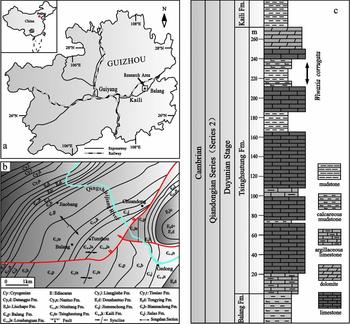
The Tsinghsutung Formation in the Songshan area of Jianhe County, Guizhou Province is well exposed in deposits of the transitional slope belt, lying between the Yangtze Platform and the Jiangnan Basin (Fig. 1a, b). The formation is 272 m thick and primarily consists of thin- to medium-bedded limestone, calcareous claystone, as well as fine-grained dolomite in the uppermost part (Fig. 1c). The Tsinghsutung Formation locally is distinct from the classic Tsinghsutung Formation of the Yangtze Platform in NE Guizhou (Yin et al. Reference Yin, Chen and Qin1945; Zhou et al. Reference Zhou, Yuan, Zhang, Wu and Yin1980) which is dominated by dolomite, and is also different from the coeval Wuxun Formation near the Jiangnan Basin of SE Guizhou which is dominated by mudstone (Zhang et al. Reference Zhang, Lu, Zhu, Qian, Lin, Zhou, Zhang and Yuan1980; Yin, Reference Yin1987, p. 61).
(a) Map of the research area. (b) Geological map of Gedong region (after Zhao et al. Reference Zhao, Yu, Yuan, Yang and Guo2001) and location of the Songshan Section. (c) Stratigraphic column of the Tsinghsutung Formation and fossil locations at Songshan Section.

A biostratigraphic framework for the Tsinghsutung Formation based on trilobites was proposed by Yin (Reference Yin1987, p. 87). In ascending order, the Tsinghsutung Formation includes the Redlichia (Pteroredlichia) murakamii – Hoffetella – Eoptychoparia Ass. Zone and the Redlichia (R.) guizhouensis-Redlichia (R.) nobilis Ass. Zone. According to the criteria for trilobite biozone correlation in South China, the Tsinghsutung Formation is middle–late Duyunian, Qiandongian (Cambrian Series 2, Stage 4) in age, and equivalent to the Longwangmiaoan in Eastern Yunnan. Numerous sclerites of Wiwaxia occur in association with abundant trilobites including Ovatoryctocara sp., Changaspis elongata, C. cf. elongata, Duyunaspis cf. D. duyunensis (Yang et al. Reference Yang, Zhao, Peng, Yang and Yang2010), coelenterates, sponges, ‘worms’, hyoliths and brachiopods as well as many other fossils that occur in the upper part of the uppermost trilobite zone.
In general, the Tsinghsutung Formation represents a deepening-upwards sequence towards its contact with the overlying Kaili Formation, a c. 200-m-thick mudstone-dominated unit characterized by calcareous claystone lithofacies passing into thin- to medium-bedded carbonate mudstone lithofacies near its top (Gaines et al. Reference Gaines, Mering, Zhao and Peng2011). The Tsinghsutung–Kaili depositional interval therefore represents two third-order eustatic depositional cycles (Zhang et al. Reference Zhang, Shen, Gong, Zhao, Mao and Yan1996; Zhu et al. Reference Zhu, Erdtmann and Zhao1999; Gaines et al. Reference Gaines, Mering, Zhao and Peng2011).
3. Systematic palaeontology
All specimens described here are deposited in the Palaeontological Museum of Guizhou University, Guiyang, China. Specimens with prefix Q were collected from the Tsinghsutung Formation at the Songshan Section near Balang village, Jianhe County, Guizhou Province, China.
Phylum, Class, Order uncertain
wiwaxiidae Walcott, Reference Walcott1911
Wiwaxia Walcott, Reference Walcott1911
Type species. Wiwaxia corrugata (Matthew, Reference Matthew1899), from the Ogygopsis Shale, Stephen Formation, Canada.
Wiwaxia corrugata (Matthew, Reference Matthew1899) (Figs 2–4)
-
1899 Orthotheca corrugata Matthew, p. 42, pl. 1, fig. 3.
-
1908 Orthotheca corrugata Matthew; Walcott, p. 246, pl. 1, fig. 11.
-
1911 Wiwaxia corrugata (Matthew); Walcott, p. 123, pl. 21, figs 1–4.
-
1982 Wiwaxia corrugata (Matthew); Conway Morris, pp. 94, 96, pl. 1, figs 1–9.
-
1984 Wiwaxia corrugata (Matthew); Bengtson & Conway Morris, pp. 320–2, figs 8, 10.
-
1985 Wiwaxia corrugata (Matthew); Conway Morris, pp. 507–82, pls 1–15, figs 5–161.
-
1988 Wiwaxia sp. cf. W. corrugata (Matthew); Conway Morris & Robison, p. 42, fig. 30.
-
1990 Wiwaxia corrugata (Matthew); Butterfield, pp. 288, 291, 293, figs 1–3, 4A.
-
1994 Wiwaxia corrugata (Matthew); Butterfield, p. 477, fig. 2a.
-
1994 Wiwaxia taijiangensis Zhao, Qian & Lee, p. 361, pl. I, figs 1–12.
-
1995 Wiwaxia corrugata (Matthew); Conway Morris & Peel, pp. 332, 334, fig. 47a–h.
-
1999 Wiwaxia taijiangensis Zhao, Qian & Lee; Zhao et al. p. 110, pl. II, fig. 4.
-
2004 Wiwaxia corrugata (Matthew); Eibye-Jacobsen, pp. 327, 329, fig. 4.
-
2004 Wiwaixa sp.; Porter, p. 588, figs 11.7, 11.9, 11.10.
-
2005 Wiwaxia taijiangensis Zhao, Qian & Lee; Zhao et al. p. 756, pl.Ⅱ, figs 1–2.
-
2011 Wiwaxia taijiangensis Zhao, Qian & Lee; Zhao et al. pp. 182–3, figs 229–232.
-
2011 Wiwaxia corrugata (Matthew); Fatka et al. pp. 871–2, fig. 2.
-
2012 Wiwaxia; Butterfield & Harvey, p. 71, fig. 1B–H, J.
-
2012 Wiwaxia; Harvey et al. pp. 428–29, fig. 3A–N.
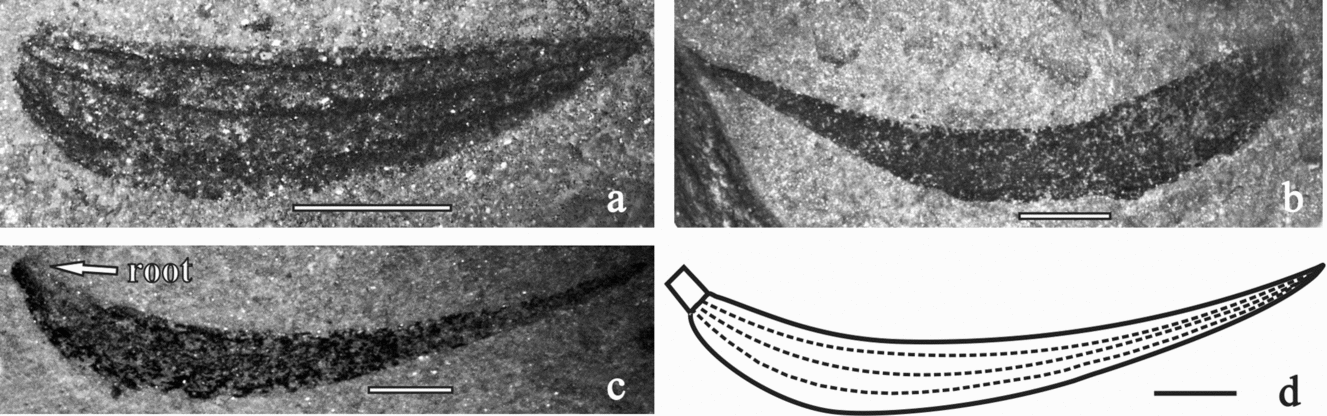
Ventro-lateral sclerites of Wiwaxia corrugata from the Tsinghsutung Formation. (a) Q52-1, morphological type A. (b, c) Q52-686, Q52-311, morphological type B. (d) Explanatory drawing of (c). Scale bars = 1 mm.

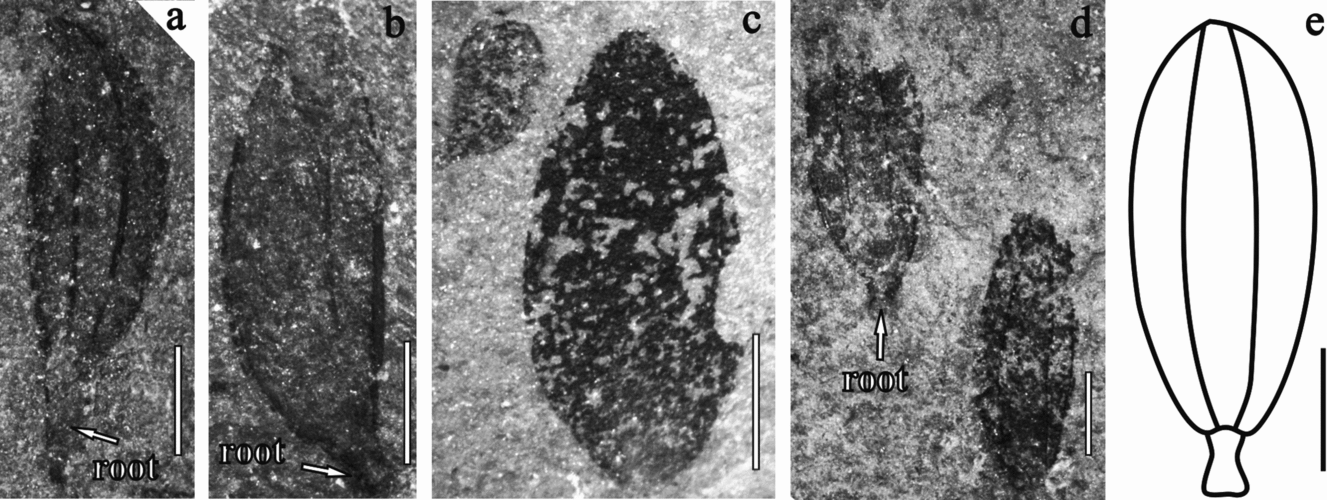
Lateral sclerites of Wiwaxia corrugata from the Tsinghsutung Formation. (a, b) Q34.6-279, Q34.6-179, slightly compressed specimens. (c, d) Q52-310a, Q35.6-102, sclerites preserved in association. (e) Explanatory drawing of lateral sclerites. Scale bars = 1 mm.

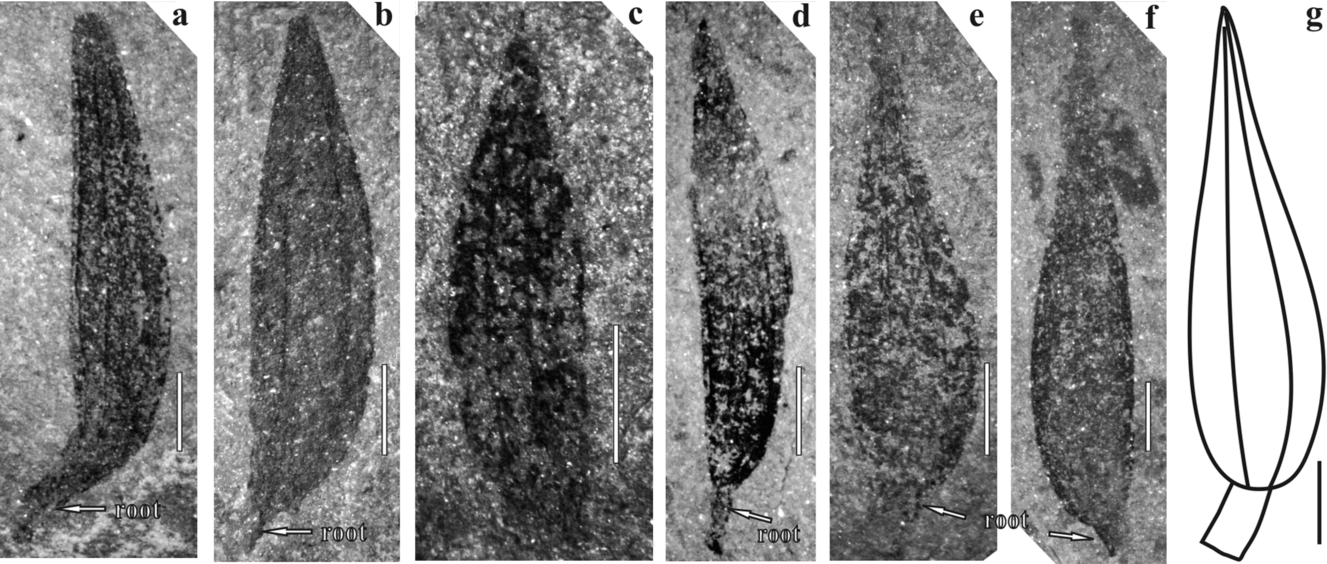
Dorsal sclerites of Wiwaxia corrugata from the Tsinghsutung Formation. (a–d) Q51-486b, Q35.6-98, Q35.6-91, Q56-1, morphological type A. (e, f) Q35.6-106, Q52-494, morphological type B. (g) Explanatory drawing of (e). Scale bars = 1 mm.

New materials. 22 specimens preserved as semi-isolated assemblages in calcareous claystone and 45 specimens preserved as isolated sclerites in the same lithofacies.
Description. Sclerites are preserved as thin carbonaceous compressions parallel or low-angle inclined to the bedding plane. Some of them show varying amounts of compaction (e.g. Figs 3a, b, 4c, d) after entombment, so that they exhibit abnormal morphology, including asymmetrical outline of lateral sclerites.
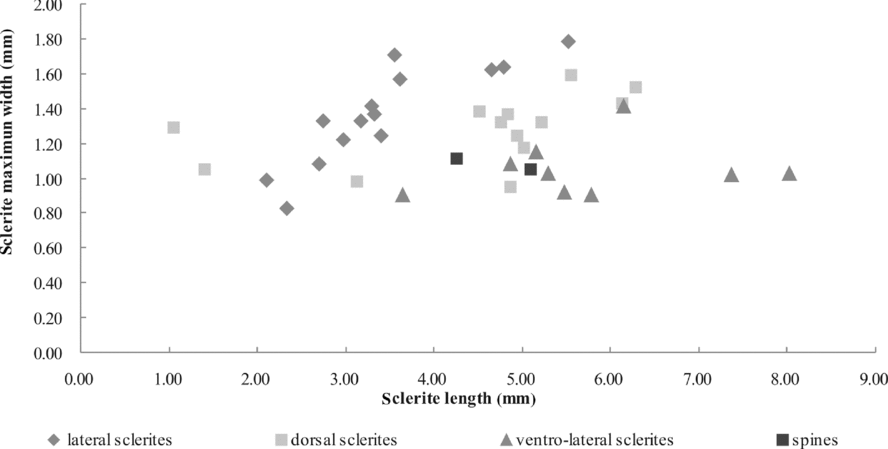
Ventro-lateral sclerites, characterized by a crescent shape, are preserved as two morphological types: (A) a less arcuate type with wider surfaces than typical crescent-shaped sclerites, gradually widening from the distal tip to the proximal base; traces of two–three robust longitudinal ribs ultimately taper and join towards the distal end (e.g. Fig. 2a); and (B) one side is strongly convex and the other is strongly concave and the sclerites narrow sharply from the proximal base to the distal tip, forming a distinctive crescent shape (e.g. Fig. 2b–d). Ribs on the surface are indistinct, and the root is short (0.45–0.49 mm) and columnar with approximately the same width as the sclerite base (e.g. Fig. 2c, d). (See Fig. 5 for morphological data.)
Statistical distribution of sclerite length and maximum width in Wiwaxia corrugata from the Tsinghsutung Formation.

Lateral sclerites are bilaterally symmetrical with an elliptical shape tapered towards the root at the distal end, with a pointed or broadly rounded anterior edge. Some individual sclerites are appear asymmetrical due to slight compaction of sclerites buried at an angle to bedding (Fig. 3a, b), their anterior areas are usually broad and the length (L) to maximum width (W) ratio of these sclerites is reduced compared to other asymmetric sclerites. The shape of the sclerite outline is also variable; some appear as globes, while others are relatively slender. There are two robust longitudinal ribs separating the surface into three more or less equal parts, while sometimes the central part is wider than the other two (Fig. 3). Roots are preserved in long columnar (Fig. 3a) and hourglass-shaped (Fig. 3b, d, e) outlines, ranging from 0.29 mm to 1.17 mm in length. (See Fig. 5 for morphological data.)
Dorsal sclerites are asymmetric and both lateral margins are convex to different degrees. They are preserved as two morphological types: (A) sclerites are narrow and long with a rounded or pointed anterior edge, one margin slightly convex while another side is distinctly convex, two robust longitudinal ribs divide the surface into three parts, and the axial section is wider than the two lateral parts (e.g. Fig. 4a–d); the root is short or long and columnar (e.g. Fig. 4a, b, d); and (B) sclerites with pointed and narrow anterior areas are sharply inflated proximally, and exhibit contraction at the distal end. Traces of two primary longitudinal ribs parallel to the sclerite margins converge in the distalmost area, and divide the sclerite surface into three approximately equal parts. The root is short and columnar, ranging from 0.46 mm to 1.29 mm in length (e.g. Fig. 4e–g). This morphological type is apparently unique, with no similar examples described to date. (See Fig. 5 for morphological data.)
Remarks. Wiwaxia taijiangensis was erected by Zhao, Qian & Lee in Reference Zhao, Qian and Lee1994 based on isolated sclerites from the Kaili Formation (Zhao et al. Reference Zhao, Qian and Lee1994). These macroscopic specimens were originally proposed to have significant differences from the type species W. corrugata in rib thickness (1–3 thicker ribs), lateral sclerites with longer roots and tapering more strongly proximally, and apparent crescent appearance of ventro-lateral sclerites (Zhao et al. Reference Zhao, Qian and Lee1994, p. 361, pl. I, figs 1–12). Articulated individuals have subsequently been discovered (Zhao et al. Reference Zhao, Zhu, Babcock, Yuan, Parsley, Peng, Yang and Wang2005, pl. II, fig. 2; Zhao et al. Reference Zhao, Zhu and Babcock2011, pp. 182–3, figs 229–231) in the same level.
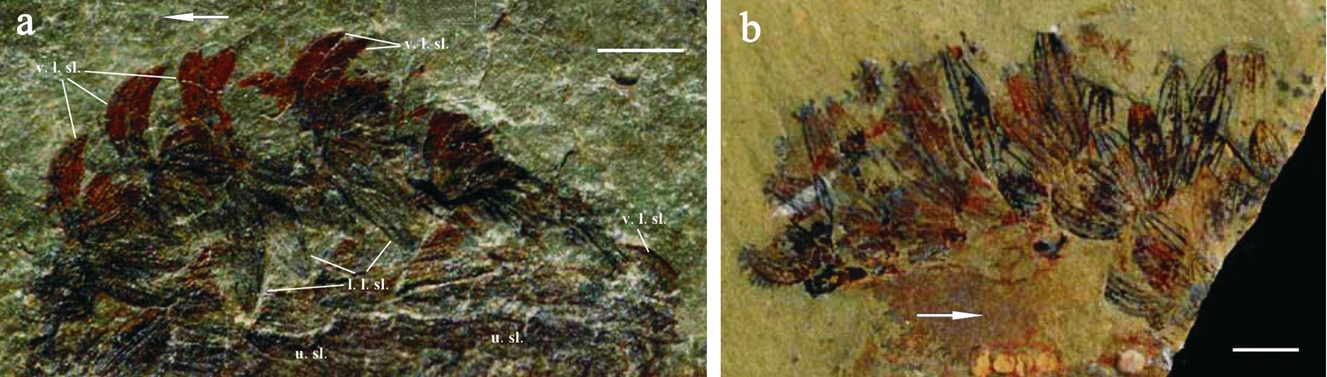
For example, GTBM-9-5-8888a (Fig. 6a) with a length c. 15 mm (interpreted as a juvenile; see Conway Morris, Reference Conway Morris1985, p. 530) is preserved in parallel-oblique compression and exhibits anterior and posterior terminations, as well as exposure of recognizable ventro-lateral and lower lateral sclerites in addition to some unidentified sclerites. The ventro-lateral sclerites are arranged in imbricate transverse rows extending from the anterior to posterior extremities. The lower lateral sclerites are oriented transversely and inserted over ventro-lateral sclerites. GTBM-9-5-1208 (Fig. 6b) exhibits five recognizable transverse imbricate rows of lower lateral sclerites. The space between rows is c. 1.8–2.9 mm. The rows are slightly curved but not parallel and radiate outwards from an arc, which may indicate a cabochon-like body shape or flexure of the specimen. The lower lateral sclerites with c. 3–4 robust ribs are bilaterally symmetrical in outline. Most of them are slender, while some are more rounded. The morphology of these sclerites is almost identical to that of specimens from the Tsinghsutung Formation (Fig. 3) and is also similar to sclerites of Wiwaxia corrugata (Conway Morris, Reference Conway Morris1985, pl. 2, fig. 21).
Incomplete articulated specimens of Wiwaxia from the Kaili Formation. (a) GTBM-9-5-8888a, parallel-oblique preservation, exposure of some ventro-lateral and lower lateral sclerites. (b) GTBM-9-5-1208, recognizable five transverse rows of lower lateral sclerites inclined to the bedding plane. Arrows indicate anterior directions. Abbreviations: v.l.sl. – ventro-lateral sclerite; l.l.sl. – lower lateral sclerite; u.sl. – unidentified sclerite. Scale bars = 2 mm.

Two articulated specimens from the Kaili Formation exhibit an arrangement of certain sclerites consistent with that observed in multiple complete individuals of Wiwaxia corrugata (Conway Morris, Reference Conway Morris1985, fig. 171a, b). There are important differences in the ribbing pattern of individual sclerites however, with Kaili specimens exhibiting fewer and more widely spaced ribs (Fig. 6) than Wiwaxia corrugata (Conway Morris, Reference Conway Morris1985). Although such differences are notable, they are not substantial since the ontogenetic growth of sclerites was accompanied by an increasing number of ribs, a decrease in rib spacing and slight shape modification (Conway Morris, Reference Conway Morris1985). Previous morphological variations suggested to distinguish these two species are therefore likely to be the result of taphonomic variation and/or different ontogenetic stages.
Newly acid-extracted sclerites from the Kaili Formation (Harvey et al. Reference Harvey, Ortega-Hernández, Lin, Zhao and Butterfield2012, fig. 3A–N) have the same ribbing pattern and morphology as the microfossils of W. corrugata from the Burgess Shale (Butterfield, Reference Butterfield1990, figs 1–3) and Mount Cap Fauna (Butterfield, Reference Butterfield1994, fig. 2a), which provides further evidence to indicate that Wiwaxia taijiangensis should be a junior synonym of W. corrugata. The Wiwaxia materials from the Tsinghsutung Formation are approximately the same as the sclerites from the Kaili Formation.
Occurrence. Grey-greenish calcareous claystones of the upper part of the Tsinghsutung Formation; Cambrian Series 2, Duyunian Stage, Songshan Section, near Balang village, Jianhe County, Guizhou Province, China.
4. Discussion
4.a. Stratigraphic distribution and evolutionary uniqueness of Wiwaxia
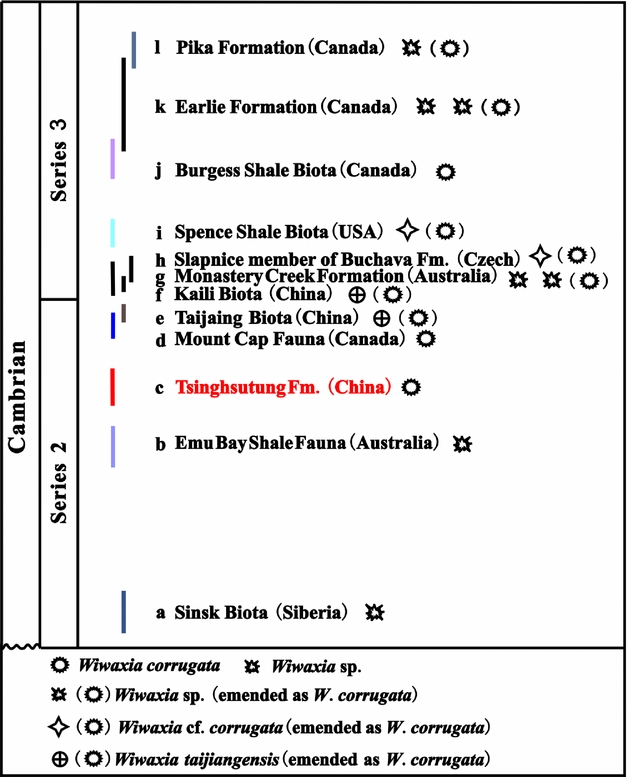
To date, Wiwaxia is known from 12 Burgess Shale-type deposits spanning Cambrian Series 2–3 (Fig. 7). Recently discovered examples from south China and elsewhere (Fatka et al. Reference Fatka, Kraft and Szabad2011; Butterfield & Harvey, Reference Butterfield and Harvey2012) suggest that Wiwaxia was an important member of metazoan communities during Cambrian Series 2 (Tsinghsutung Formation) to middle Series 3 (Burgess Shale Biota). Its absence from the early Ordovician Fezouata biota (Van Roy et al. Reference Van Roy, Orr, Botting, Muir, Vinther, Lefebvre, Hariri and Briggs2010) is potentially noteworthy. Considering the relatively high preservation potential of Wiwaxia sclerites in Burgess Shale-type biotas (Butterfield & Harvey, Reference Butterfield and Harvey2012), it is possible that this enigmatic organism did not survive the Cambrian Period. Wiwaxia from different strata constitute an evolutionary chain; sclerites of this group from the Tsinghsutung Formation provide an important link between middle Cambrian Series 2 to late Cambrian Series 3 (Fig. 7c).
Global stratigraphic distribution of Wiwaxia. a – Sinsk Biota (Bergeroniellus gurarii Zone), Siberian Platform (Ivantsov et al. Reference Ivantsov, Zhuravlev and Leguta2005); b – Emu Bay Shale Fauna, South Australia (Porter, Reference Porter2004); c – Tsinghsutung Formation (Redlichia (R.) guizhouensis – Redlichia (R.) nobilis Ass. Zone), Guizhou, China; d – Mount Cap Fauna (Bonnia–Olenellus Zone), NW Canada (Butterfield, Reference Butterfield1994); e – Taijiang Biota (Bathynotus holopygus – Ovatoryctocara cf. granulata Ass. Zone), SE China (Zhao et al. Reference Zhao, Yuan, Zhu, Guo, Zhou, Yang and Iten1999, Reference Zhao, Zhu and Babcock2011); f – Kaili Biota (Oryctocephalus indicus Zone), Guizhou, China (Zhao et al. Reference Zhao, Qian and Lee1994, Reference Zhao, Zhu and Babcock2011, pp. 182–3; Harvey et al. Reference Harvey, Ortega-Hernández, Lin, Zhao and Butterfield2012); g – Monastery Creek Formation (Ptychagnostus gibbus Zone), North Australia (Porter, Reference Porter2004); h – Slapnice Member of Buchava Formation (Pompeckium kuthani Zone), Czech Republic (Fatka et al. Reference Fatka, Kraft and Szabad2011); i – Spence Shale Biota (upper Glossopleura Zone), Utah, USA (Conway Morris & Robison, Reference Conway Morris and Robison1988; j – Burgess Shale Biota (Bathyuriscus–Elrathina Zone), British Columbia, Canada (Matthew, Reference Matthew1899; Walcott, Reference Walcott1911; Conway Morris, Reference Conway Morris1982, Reference Conway Morris1985; Whittington, Reference Whittington1985, pp. 72–3; Briggs et al. Reference Briggs, Erwin and Collier1994, pp. 215–16); k – Earlie Formation, Saskatchewan, Canada (Spencer & Demicco, Reference Spencer and Demicco2002; Dixon, Reference Dixon2008; Butterfield & Harvey, Reference Butterfield and Harvey2012); l – Pika Formation, Alberta, Canada (Spencer & Demicco, Reference Spencer and Demicco2002; Butterfield & Harvey, Reference Butterfield and Harvey2012).

New Wiwaxia material from the Tsinghsutung Formation and new observations of articulated individuals from the Kaili Formation indicate that Wiwaxia taijiangensis should be a junior synonym of W. corrugata. Only a single species of this taxon is therefore valid, indicating that Wiwaxia exhibited limited diversity during its short evolutionary history. Articulated individuals are known only from the Burgess Shale and Kaili Biotas (Fig. 7f, j; Conway Morris, Reference Conway Morris1982, Reference Conway Morris1985; Zhao et al. Reference Zhao, Zhu and Babcock2011, pp. 182–3). W. corrugata is known from isolated to semi-isolated sclerites over a broader stratigraphic range spanning Cambrian Series 2 and 3 (Fig. 7c–e, g–i, k, l; Conway Morris & Robison, Reference Conway Morris and Robison1988; Butterfield, Reference Butterfield1994; Zhao et al. Reference Zhao, Qian and Lee1994, Reference Zhao, Yuan, Zhu, Guo, Zhou, Yang and Iten1999; Porter, Reference Porter2004; Fatka et al. Reference Fatka, Kraft and Szabad2011; Butterfield & Harvey, Reference Butterfield and Harvey2012). These sclerites from different ages and ecological environments show nearly the same sclerite structure and limited morphological variation. The precise evolutionary position of W. corrugata is presently unavailable due to the scarcity of intact individuals from different stratigraphic horizons. Moreover, whether the overall body morphology or structure of this widespread group was modified or remained unchanged across its range is still unknown.
In addition to W. corrugata, there also exists a possible distinct species (Butterfield, Reference Butterfield1994) – the microscopic isolated sclerites from the Cambrian Series 3 Mount Cap Biota (Butterfield, Reference Butterfield1994, p. 478, fig. 2b), the Kaili Formation (Harvey et al. Reference Harvey, Ortega-Hernández, Lin, Zhao and Butterfield2012, pp. 428–9, fig. 3O, P), the Earlie Formation (Butterfield & Harvey, Reference Butterfield and Harvey2012, p. 71, fig. 1I) and the Monastery Creek Formation (Porter, Reference Porter2004, p. 588, figs 11.8, 11.11) – which display unique transverse tuberculate ornamentation on the sclerites. This suggests the potential for evolutionary differentiation at the species level, although this idea requires more evidence.
4.b. Taphonomy of Wiwaxia from the Tsinghsutung Formation
Although Wiwaxia has been documented from several localities worldwide, articulated individuals are only known from the Burgess Shale and the Kaili Formation (Fig. 6; Conway Morris, Reference Conway Morris1982, Reference Conway Morris1985; Zhao et al. Reference Zhao, Zhu and Babcock2011, pp. 182–3). Exceptional preservation resulted partly from biostratinomic factors, but was promoted in the early burial environment by the inhibition of microbial activity in anoxic sediments after burial by early bed-capping carbonate cements that created a permeability barrier, preventing oxidants that sustain microbial degradation of organic matter into the sediments where fossils were entombed (Gaines et al. Reference Gaines, Hammarlund, Hou, Qi, Gabbott, Zhao, Peng and Canfield2012).
Abundant isolated and semi-isolated sclerites of Wiwaxia discovered in the Tsinghsutung Formation in specific associations provide critical insight into preservational conditions. The associated community includes: partially articulated trilobites and intact individuals; disarticulated brachiopods with complete single valves, which mostly occur in convex-up orientations; pyritized monoplacophorans, some preserved in life orientations (perpendicular to the bed); Sphenothallus with suckers; and many other fossils including algae, thecal plates of eocrinoids, fragments of ‘worms’ and large bivalved arthropods, among others. Some fossils may represent examples of in situ burial, which is supported by intact individuals preserved in non-size-sorted associations with chaotic orientations and even preserved in life orientations, while some others preserved as fragments were likely transported by storm currents from nearby environments. These taphonomic characteristics indicate rapid burial and low background environmental energy (see Brett & Baird, Reference Brett and Baird1986, p. 219, table 3). Moreover, early diagenetic pyritization of fossils proceeded in anoxic sediments beneath the lower-aerobic to dysaerobic bottom water (see Brett & Baird, Reference Brett and Baird1986, p. 221, table 4).
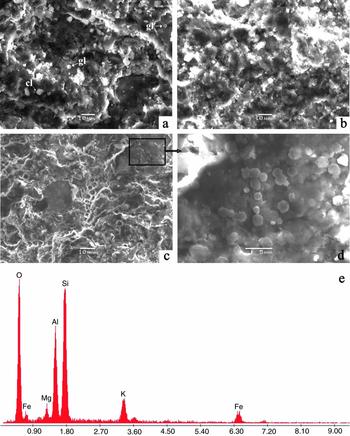
The Tsinghsutung fossil assemblage occurs in fine-grained calcareous mudstones, which exhibit random orientations of clay minerals and an absence of coarser particles (authigenic calcite and glauconite crystals, grain size 1–6 μm; Fig. 8a, b), which indicates a rapid deposition from event-driven density currents (O'Brien et al. Reference O'Brien, Nakazawa and Tokuhashi1980). The presence of authigenic glauconite as ultrafine-grained (1–3 μm) spheres in mudstones (Fig. 8c, d) as determined by elemental mapping (Fig. 8e) suggests low-energy and lower-aerobic to dysaerobic bottom water (Liu & Zeng, Reference Liu and Zeng1985, p. 30). Overall, the Wiwaxia sclerites associated with abundant fossils in the Tsinghsutung Formation were clearly rapidly entombed by event-driven currents and preserved in low-energy and oxygen-deficient bottom-water environments.
Scanning electron micrographs of fine-grained calcareous mudstone and mudstone fabrics, showing random orientations of clay mineral grains and the absence of coarser grains. (a, b) Calcareous mudstone from 236 m, containing very-fine-grain-sized (1–6 μm) authigenic calcite (cl) and glauconite (gl) crystals; (c) mudstone from 220 m; (d) cluster of very-fine-grained authigenic glauconite crystals (1–3 μm); (e) SEM-EDAX elemental analysis of glauconite grains. Samples were collected in the field from the Tsinghsutung Formation of Songshan Section, and were analysed using SEM, conducted in the Institute of Geochemistry, Chinese Academy of Sciences.

It has been proposed that Wiwaxia may have lived among algae or sponges (Conway Morris, Reference Conway Morris1985) or grazed upon bacterial scum on algal thali (Ivantsov et al. Reference Ivantsov, Zhuravlev and Leguta2005). Although sclerites of Wiwaxia in the Tsinghsutung Formation are usually preserved in close association with fragments of the algae Marpolia and Morania, this association does not provide unequivocal evidence for this lifestyle. The exceptional record of incomplete margins preserved on some sclerites (e.g. Fig. 3c) is noteworthy. Disruption of the sclerite margins by fracturing or decay seems unlikely, because ribs thicken and support the sclerite wall. Fracturing or decomposition should have resulted in breakage of weaker areas or along ribs, forming irregular or jagged margins rather than relatively smooth notches. The sclerite illustrated (Fig. 3c) may have been damaged and possibly detached as a result of predation. The rarity of articulated specimens in general might also reflect a tendency towards rapid disarticulation during decay on the seafloor prior to burial. Even weak bottom-flowing currents accompanying depositional events would have been sufficient to dissociate and transport the small, lightweight sclerites over short distances. The absence of articulated individuals of Wiwaxia in the Tsinghsutung Formation therefore appears to be due to biostratinomic factors that led to disarticulation prior to burial and exceptional preservation.
Acknowledgements
We are very grateful to Dr R. R. Gaines (Pomona College, USA) for his useful suggestions and correction of English and Dr T. H. P. Harvey (Cambridge University, UK) for his helpful comments and provision of photos of acid-extracted Wiwaxia sclerites from the Kaili Formation. This manuscript benefited from constructive reviews from Dr N. J. Butterfield and another anonymous reviewer. We acknowledge Dr Tang Yang for assisting with photographing the SEM samples. This research was supported partly by grants from the Major State Basic Research Development Program of China (973 Program) (No. 2013CB835002), the National Sciences Foundation of China (No.41172005), the Key Project of International Cooperation of Guizhou Science and Technology Department (Gui. Co. 2010–7001), the Science, Technology and Education Talents from Governor of Guizhou Province (Gui. Sp. 2011–37), Graduate Student Innovation Fund of Guizhou University (Technology 2012056), the State Key Laboratory of Palaeobiology and Stratigraphy (Nanjing Institute of Geology and Palaeontology, CAS, No. 113111), Attracted Talent of Guizhou University (No. 2010021) and the Palaeontology Museum of the Shenzhen Xianhu Botanical Garden.